Once I was a clever boy learning the arts of Oxford... is a quotation from the verses written by Bishop Richard Fleming (c.1385-1431) for his tomb in Lincoln Cathedral. Fleming, the founder of Lincoln College in Oxford, is the subject of my research for a D. Phil., and, like me, a son of the West Riding. I have remarked in the past that I have a deeply meaningful on-going relationship with a dead fifteenth century bishop... it was Fleming who, in effect, enabled me to come to Oxford and to learn its arts, and for that I am immensely grateful.


Showing posts with label Michael Pacher. Show all posts

Sunday, 10 January 2016

The Baptism of the Lord


Today is the Feast of the Baptism of the Lord.

Traditionally one of the Three Wonders that mark Epiphany on January 6th - the visit of the Magi, the Baptism and the Miracle at Cana - it has only been a separate feast since 1955, being originally on January 13th, the old octave day of Epiphany, and since 1970 on the Sunday following that feast.

To mark the feast here are two panels from the St Wolfgang Altarpiece by the astonishingly versatile Austrian painter and sculptor Michael Pacher (c.1435-98). They are part of the great altarpiece in the church of St Wolfgang im Salzkammergut in Austria. There is a biography and a list of his surviving works at Michael Pacher. this includes a description of the altarpiece and its sections - the wings can be opened and closed in three different positions. There is more about the altarpiece, which dates from 1479-81, at  Pacher, St. Wolfgang Altarpiece - Khan Academy and at St Wolfgang Altarpiece - Web Gallery of Art. There is a link to a 1983 University of Pennsylvania dissertation on the composition at The St. Wolfgang Altarpiece.

Pacher combined Renaissance perspective and ideas close to those of Mantegna with German late medieval forms to create a rich and evocative style.

Unfortunately both these photographs are dark - I am not sure whether this is just caused by the difficulties of photographing the paintings in situ or because the piece needs cleaning. I hve seen others which suggest that much brighter images are possible.


undefined

Michael Pacher St Wolfgang Altarpiece 1479-81

Image:Wikimedia


Michael Pacher St Wolfgang Altarpiece 1479-81

Image:Wikimedia


http://www3.artflakes.com/artwork/products/238641/poster/238641.jpg 

The St Wolfgang Altarpiece
The panels above are on the back of the wings at the side

Image:artflakes.com 


Friday, 1 January 2016

The Circumcision of Our Lord and the Solemnity of Mary Mother of God


In addition to being the opportunity to wish readers a happy New Year - and that seems more than a seasonal platitude but an ever more ardent wish in the troubled state of the world - today is traditionally the feast of the Circumcision of Our Lord, and now retitled in the novus ordo the Solemnity of Mary Mother of God. Both titles - and I do not see why the older could not have been retained alongside the newer emphasis on Our Lady - point to the rootedness of the Incarnation in the traditions of Israel, its law and obligations ( e.g. circumcision) and its people ( Mary as the ultimate representation of the Chosen People )

John Dillon has posted a selection of images of the Circumcision of Our Lord on the Medieval religion discussion group as well as an introduction to the history of today's feast(s) as follows:

In the General Roman Calendar 1 January is the feast of Mary, the Mother of God. Greek Orthodox churches celebrate the Synaxis of the Holy Theotokos on 26. December. Neither date works as an anniversary of the adoption of Mary's designation as Theotokos ("Mother of God") by the Council of Ephesus (held in June and July 431); both bespeak rather a desire for a specifically Marian commemoration within the octave of the Nativity. 

Whereas this feast is attested from sixth-century Rome, for most of the western Middle Ages 1. January was principally the dayof the Feast of the Circumcision, a fourth-century feast in the east
that seems to have been adopted in Rome in the seventh or eighthcentury and that lasted on the general Roman Calendar from the latter's late sixteenth-century inception until its revision of 1969. The Circumcision of Jesus, mentioned only circumstantially in the revised Roman Martyrology's laterculus for today's Solemnity of Mary the Mother of God, remains a focus for the feast of the Circumcision celebrated on this day in Byzantine-rite churches and, as that of the Naming and Circumcision of Jesus, in churches of the Anglican Communion. According to Luke 2:21, a traditional reading on this feast, Jesus' circumcision on the octave of his birth was the occasion of His naming. Re-titled and re-imagined as that of the Holy Name of Jesus, the feast so construed is celebrated on 1 January in yet other churches and on 3 January in the Roman Catholic Church.


Herewith some links to period-pertinent images of the Circumcision of Jesus:

a) as depicted in the late tenth- or very early eleventh-century
so-called Menologion of Basil II (Città del Vaticano, BAV, cod. Vat.
gr. 1613, p. 287):

 File:Menologion of Basil 047.jpg


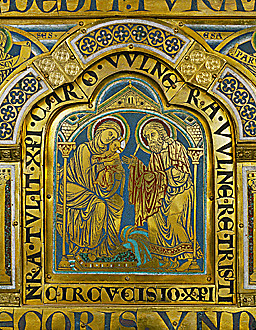
b) as depicted by Nicholas of Verdun on an enameled plaque of his late twelfth-century altarpiece (c. 1181) for the abbey of Klosterneuburg near Vienna:

 https://c1.staticflickr.com/7/6208/6073659927_c5f5514ecb.jpg


c) as depicted in a number of mid-thirteenth- to late fifteenth-century illuminations in manuscripts now in French collections (images expandable):
http://tinyurl.com/7n6lweh

d) as depicted in a panel of the late thirteenth-century Life of Mary and Infancy of Jesus window (w. 6, panel 18) in the église Saint-Sulpice in Saint-Sulpice-de-Favières (Essonne):
http://therosewindow.com/pilot/st%20sulpice%20le%20faviere/EwSa-18.htm

e) as depicted in a late thirteenth-century copy of French origin of the Legenda aurea (San Marino, CA, Huntington Library, ms. HM 3027, fol. 16r):
http://digitalassets.lib.berkeley.edu/ds/huntington/images//000856A.jpg

f) as depicted in the late thirteenth-century Livre d'images de Madame Marie (c. 1285-1290; Paris, BnF, ms. Nouvelle acquisition française16251, fol. 23r):
http://tinyurl.com/p29l922

g) as depicted in an initial on a detached leaf, from an early fourteenth-century antiphoner from Regensburg, in the Walters Art Gallery and Museum, Baltimore (Walters ms. W 754AV):
https://c1.staticflickr.com/9/8185/8371415982_50189af2cd_b.jpg

h) as depicted by the Master of the Tree of Life in a detail of his mid-fourteenth-century Tree of Life fresco (c. 1347) in the basilica di Santa Maria Maggiore in Bergamo:

 http://www.toscanaoggi.it/var/ezdemo_site/storage/images/cultura-societa/le-feste-di-capodanno-e-della-circoncisione/1657570-2-ita-IT/Le-feste-di-Capodanno-e-della-Circoncisione_articleimage.jpg

The painting in its entirety:
http://tinyurl.com/onzznz9

i) as depicted in the later fourteenth-century Breviary of Charles V (c. 1364-1370; Paris, BnF, ms. Latin Latin 1052, fol. 36v):
http://gallica.bnf.fr/ark:/12148/btv1b84525491/f82.item.zoom

j) as depicted in a later fourteenth-century copy (c. 1370-1380) of part of Vincent of Beauvais' Speculum historiale in its French-language version by Jean de Vignay (Paris, BnF, ms. Nouvelle
acquisition française 15940, fol. 26v):
http://gallica.bnf.fr/ark:/12148/btv1b8449693p/f60.item.zoom

k) as depicted by Giovanni di Benedetto and workshop in a late fourteenth-century Franciscan missal of Milanese origin (c. 1385-1390;  Paris, BnF, ms. Latin 757, fol. 291v):
http://gallica.bnf.fr/ark:/12148/btv1b8470209d/f586.item.zoom

l) as depicted in the very late fourteenth- or earlier fifteenth-century Breviary of Martin of Aragon (Paris, BnF, ms.Rothschild 2529, fol. 141v):
http://gallica.bnf.fr/ark:/12148/btv1b52000996s/f284.item.zoom

m) as depicted in an earlier fifteenth-century copy of Guillaume de Deguileville's (or Degulleville's) Pèlerinage de vie humaine and other writings (betw. 1426 and 1450; Paris, BnF, ms. Français 376, fol.176r):
http://gallica.bnf.fr/ark:/12148/btv1b84702013/f355.item.zoom

n) as depicted (lowest register) in the earlier fifteenth-century Hours of Jean de Montauban (c. 1430; Rennes, Bibliothèque de Rennes Metropole, ms. 1834, fol. 47r):
http://tinyurl.com/l7defp7

o) as depicted by the Masters of the Delft Grisailles in an inserted earlier fifteenth-century grisaille in a later fifteenth-century Hours of the BVM from Naples (c. 1440; Den Haag, KB, ms. 135 E 23, fol. 53v):
http://manuscripts.kb.nl/zoom/BYVANCKB%3Amimi_135e23%3A053v_min

p) as depicted by Beato Angelico in a mid-fifteenth-century panel painting (c. 1451; from his Armadio degli Argenti) in the Museo nazionale di San Marco in Florence:

 http://www.wga.hu/art/a/angelico/11/armadio8.jpg

http://www.wga.hu/art/a/angelico/11/armadio8.jpg

q) as depicted in a later fifteenth-century glass window panel (c.
1460-1470) from Köln in The Cloisters Collection of the Metropolitan
Museum of Art, new York:

http://www.ipernity.com/doc/laurieannie/35821507

r) as depicted in a later fifteenth-century glass window (c.1467-1469; w. 2) in the cathédrale Notre-Dame in Évreux:
http://therosewindow.com/pilot/Evreux/w2-B2-whole.htm

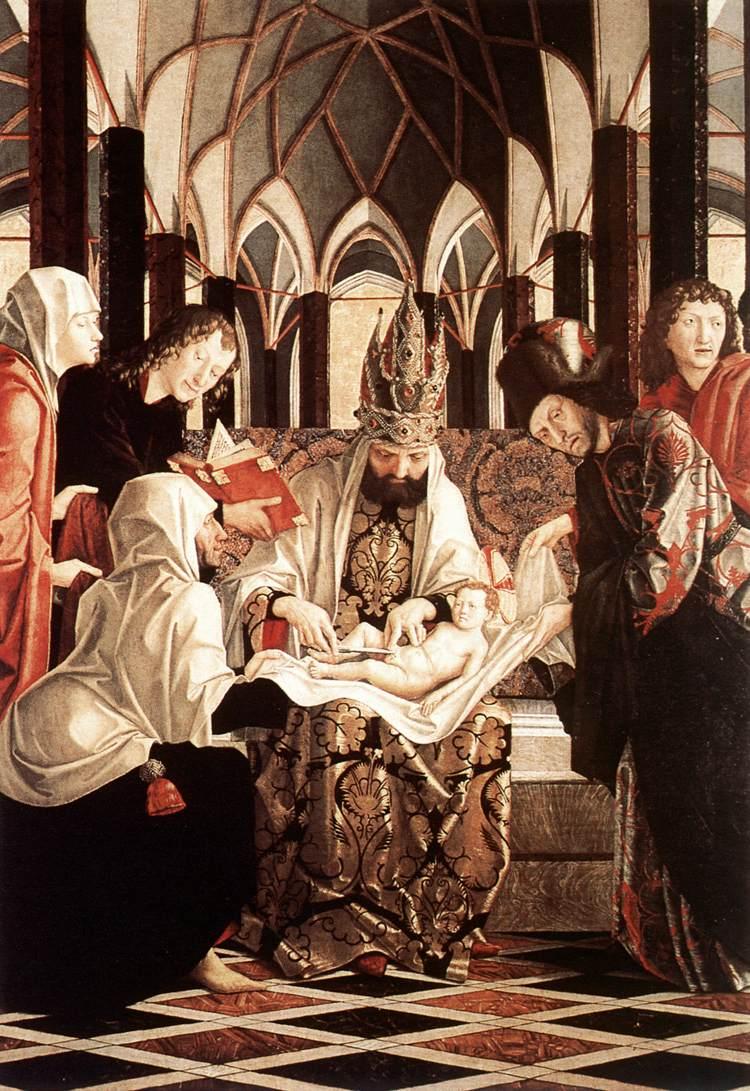
s) as depicted by Michael Pacher in a panel painting on a wing of his later fifteenth-century St. Wolfgang Altarpiece (centre completed,1479; wings completed, 1481) in the Wallfahrtskirche St. Wolfgang in Wolfgangsee (Land Salzburg):

 https://upload.wikimedia.org/wikipedia/commons/3/33/Michael_Pacher_-_St_Wolfgang_Altarpiece_-_Circumcision_-_WGA16822.jpg


t) as portrayed in polychromed wooden figures from a later fifteenth-century altarpiece from Brabant (c. 1480) in the Bode-Museum, Berlin:

 https://upload.wikimedia.org/wikipedia/commons/0/0e/Fl%C3%BCgelretabel_aus_Brabant_Berlin_Beschneidung.jpg


u) as depicted by the Elmelunde workshop in the late fifteenth-century paintings (c. 1481) in Fanefjord Kirke, Fanefjord, Vordingborg Kommune, Sjælland:

 http://ica.princeton.edu/images/mills/08-027.jpg


v) as depicted by a follower of Willem Vrelant in an illuminated initial in a late fifteenth-century Hours of the BVM (c. 1490; Den Haag, Museum Meermanno, ms. 10 F 1, fol. 98v):
http://manuscripts.kb.nl/zoom/BYVANCKB%3Amimi_mmw_10f1%3A098v_init

w) as depicted by Hugues Le Coq (possibly from cartoons by Pierre Spicre) in a late fifteenth-century tapestry of the Life of the BVM (in five separate segments, of which the last is dated 1500) in the
collégiale Notre-Dame in Beaune:
https://www.flickr.com/photos/morio60/23293556706

x) as portrayed by Jörg Ratgeb in an earlier sixteenth-century fresco (c. 1514-1521; restored, 2009) in the cloister of the former Carmelite monastery in Frankfurt am Main:
https://www.flickr.com/photos/hen-magonza/6987921695/

y) as portrayed by Jean Soulas in an earlier sixteenth-century set of stone sculptures (1521-1535) on the choir screen of the basilique cathédrale Notre-Dame in Chartres:

 https://enthusiastical.files.wordpress.com/2013/05/dsc02098.jpg


z) as portrayed in polychromed wooden figures on an earlier sixteenth-century altarpiece from Antwerp (c. 1535) showing scenes from the Life of the Virgin and the Infancy of Christ, now in the Museo Civico d'Arte Antica (Palazzo Madama) in Turin:

 https://upload.wikimedia.org/wikipedia/commons/2/2d/Bottega_di_anversa,_ancona_con_storie_della_vergine_e_dell%27infanzia_di_cristo,_1535_ca._circoncisione_di_cristo.JPG


To this Gordon Plumb added another image of the Circumcision in a stained glass roundel of c.1500 now in St Oswald Malpas in Cheshire:

Malpas, St Oswald, Cheshire, nV, 1c, Cologne area, c.1500:
https://www.flickr.com/photos/22274117@N08/5490049810
and detail:
https://www.flickr.com/photos/22274117@N08/5489456189

Monday, 7 December 2015

St Ambrose


John Dillon posted on the Medieval Religion discussion group the following for today. I have added a few comment in [ ]:

In the Roman Calendar and in Ambrosian Calendar December 7th is the feast day of Ambrose of Milan (d. 397). Not to be confused with the Blessed Ambrose of Milan (Franciscan; d. 1525), this Ambrose is a Saint and a Doctor of the Church. A member of the imperial aristocracy, he was governor of Milan when he was elected bishop of that city in 374. Ambrose became an extraordinarily influential preacher, theologian, and ecclesiastical administrator. Along with St. Augustine of Hippo (whom he baptized) and St. Jerome he is one of the great western Christian churchmen of the fourth century.

Ambrose's dies natalis is 4. April (his feast day in the ninth-century martyrologies of St. Ado of Vienne and Usuard of Saint-Germain) but today, the anniversary of his consecration as bishop, was his feast day in some places since at least the ninth century, though what it represented was not always perfectly understood (the earlier ninth-century Marble Calendar of Naples describes it as the day of Ambrose's laying to rest). In the medieval Greek church today was Ambrose's feast day in both the later tenth-century Metaphrastic Menologion and the initially tenth- and eleventh-century Synaxary of Constantinople, as it also is now in some but not all Byzantine-Rite churches. Today was also Ambrose's principal feast day in the late medieval breviary of the Roman curia and from there the commemoration was continued in the later sixteenth-century Tridentine Calendar (as well of course as in the late sixteenth-century Roman Martyrology that was built around it).

An English-language translation of Ambrose's Vita by his former secretary Paulinus of Milan, written in Roman Africa at the behest of St. Augustine of Hippo, is here:
http://www29.homepage.villanova.edu/christopher.haas/Life%20of%20Ambrose.html

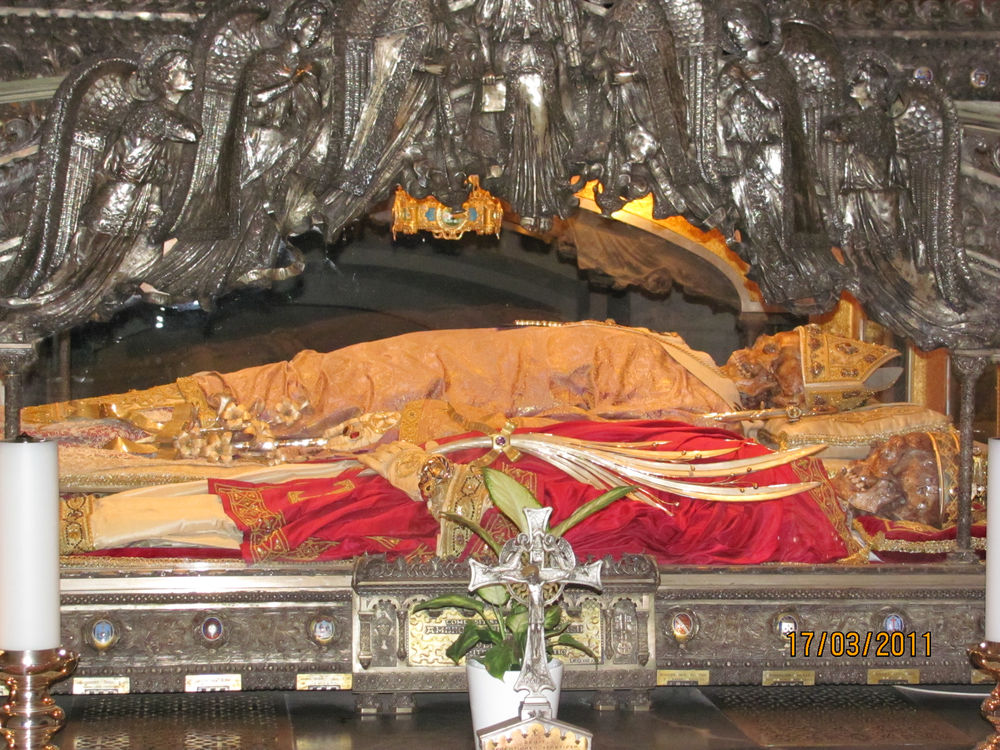
Skeletal remains believed to be those of St. Ambrose repose between those of Sts. Gervasius and Protasius in the cripta di Sant'Ambrogio in Milan's basilica di Sant'Ambrogio (the martyrs in red, Ambrose in white):


Supplementing Gordon Plumb's post from earlier today:

Wells Cathedral, SIII, 2b-3b, 2nd. qr. 14thC.:
https://www.flickr.com/photos/22274117@N08/14786023498

Bourges, Cathédrale Saint-Étienne, Bay 35, figure on right, c.1462:
https://www.flickr.com/photos/22274117@N08/4257386374

herewith are some links to other period-pertinent images of St. Ambrose of Milan:

a) as depicted in a restored fifth-century mosaic portrait in the basilica di Sant'Ambrogio's sacello di San Vittore:
http://www.atlantedellarteitaliana.it/immagine/00007/3858OP6466.jpg
http://tinyurl.com/2875f6x

b) as portrayed in relief in three panels on the rear side of the earlier to mid-ninth-century Golden Altar ("Pala d'Oro"; between 824 and 859, restored in 1966) in Milan's basilica di Sant'Ambrogio:
1) the miracle of the bees:


2) journeying on horseback from Liguria to Emilia:


http://img.over-blog-kiwi.com/0/54/79/43/20140626/ob_13819b_image5.jpg
3) blessing the altar's maker, Magister Wolvinus (or Vuolvinus):


c) as depicted lower register) in an eleventh-century copy of his De bono mortis from Fécamp (Paris: BnF, ms. Latin 2639, fol. 31v):
http://tinyurl.com/y9rm62v

d) as depicted in an eleventh-century manuscript of writings of Church Fathers (Avranches, Bibliothèque d'Avranches, ms. 72, f. 182v):
http://www.enluminures.culture.fr/Wave/savimage/enlumine/irht4/IRHT_074884-p.jpg

e) as depicted in a twelfth-century copy of his Hexaemeron (Charleville-Mézières, Médiathèque Voyelles, ms. 212, t. III, fols. 1-88v, fol. 1r):
http://www.enluminures.culture.fr/Wave/savimage/enlumine/irht6/IRHT_096061-p.jpg

f) as portrayed (at left) in a twelfth-century relief on Milan's Porta Romana:


g) as portrayed in a relief on the earlier twelfth-century west front of Milan's basilica di Sant'Ambrogio:

San Ambrogio


h) as depicted in the mid- or slightly later twelfth-century mosaics of the Cappella Palatina in Palermo:


http://tinyurl.com/3s9uolg

i) as depicted in one of four panels of a full-page illumination in the late twelfth-century so-called Bible of Saint Bertin (c. 1190-1200; Den Haag, KB, ms. 76 F 5, fol. fol. 38v, sc. 1A):
http://manuscripts.kb.nl/zoom/BYVANCKB%3Amimi_76f5%3A038v_min_a1

j) as depicted in two late twelfth-century panels (c. 1180) in a mostly early thirteenth-century composite window in the cathedral of St.-Étienne in Le Mans (photographs by Gordon Plumb):
1) St. Paul in a vision tells the sleeping Ambrose where to find the bodies of Sts. Gervasius and Protasius:
http://www.flickr.com/photos/22274117@N08/2209088732/
2) Ambrose (nimbed) and a brother bishop unearth the bodies of Sts. Gervasius and Protasius:
http://www.flickr.com/photos/22274117@N08/4714852210/

k) as depicted as depicted in a panel of a mid-thirteenth-century glass window (c. 1245-1250; w. 207) in Strasbourg's cathédrale Notre-Dame:


l) as portrayed in relief on a later thirteenth- or early fourteenth-century grosso of eight denari issued by the first Ambrosian Republic (i.e. communal Milan; 1250-1310):
https://www.numisbids.com/n.php?p=lot&sid=323&lot=197

m) as depicted (at right, barring the emperor Theodosius from the cathedral of Milan) in a late thirteenth-century copy of French origin of the Legenda aurea (San Marino, CA, Huntington Library, ms. HM 3027, fol. 47r):
http://digitalassets.lib.berkeley.edu/ds/huntington/images//000866A.jpg

n) as portrayed (flanked by Sts. Gervasius and Protasius) in a fourteenth-century statue on Milan's Pusterla di Sant'Ambrogio:


o) as depicted in the earlier fourteenth-century frescoes (c. 1312-1321) in one of the little domes of the monastery church of the Theotokos at Gračanica in, depending on one's view of the matter, either Serbia's province of Kosovo and Metohija or the Republic of Kosovo:
http://tinyurl.com/ydtx5b7

p) as depicted (upper roundel) in the earlier fourteenth-century frescoes (1330s) of the church of the Hodegetria in the Patriarchate of Peć at Peć in, depending on one's view of the matter, either the Republic of Kosovo or Serbia's province of Kosovo and Metohija:
http://tinyurl.com/ygxkvuw

q) as depicted (at left; at right, St. Patapius) in a December calendar composition in the earlier fourteenth-century frescoes (between 1335 and 1350) in the narthex of the church of the Holy Ascension at the Visoki Dečani monastery near Peć in, depending on one's view of the matter, either the Republic of Kosovo or Serbia's province of Kosovo and Metohija:
http://tinyurl.com/yaswkw7

r) as depicted in a mid-fourteenth-century glass window panel (c. 1340-1350) from Kärnten, now in The Cloisters collection of the Metropolitan Museum of Art in New York:

Saint Ambrose


s) as depicted (the miracle of the bees) in a mid-fourteenth-century copy, from the workshop of Richard and Jeanne de Montbaston, of the Legenda aurea in its French-language version by Jean de Vignay (1348; Paris, BnF, ms. Français 241, fol. 98r):
http://tinyurl.com/ygb8up7

t) as depicted by Vitale da Bologna in a mid-fourteenth-century panel painting (between 1350 and 1353) in the Pinacoteca of the Musei Civici in Pesaro:


v) as portrayed in a statuette and in two panels on St. Augustine's later fourteenth-century tomb in Pavia's basilica di San Pietro in Ciel d'Oro:
1) statuette (second from left; photograph by Genevra Kornbluth):
http://www.kornbluthphoto.com/images/Pavia_249.jpg
Detail (bust):
http://tinyurl.com/24nqhle
2) panel (upper register at right, preaching; Augustine among the listeners):
http://tinyurl.com/2cft8mj
3) panel (at left, officiating at at Augustine's vesting):
http://tinyurl.com/37xxotc
Views of these objects in stronger light will be found at Genevra Kornbluth's Archive page on the Arca di Sant'Agostino:
http://www.kornbluthphoto.com/Arca.html

w) as depicted (at right, barring the Emperor Theodosius from the cathedral of Milan) in a later fourteenth-century copy (c. 1370-1380) of Vincent of Beauvais' Speculum historiale in its French-language version by Jean de Vignay (Paris, BnF, ms. Nouvelle acquisition française 15943, fol. 58r):
http://gallica.bnf.fr/ark:/12148/btv1b8449689s/f123.highres

x) as depicted (at far left) by Niccolò di Pietro Gerini in one of four late fourteenth-century panel paintings of the Doctors of the Church (c. 1380) used for the altarpiece in the cappella maggiore of Florence's basilica della Santa Croce:


y) as portrayed (in the lower right-hand corner) by Pietro di Puccio in his late fourteenth-century mosaic (1388; heavily restored) on the facade of Orvieto's basilica cattedrale di Santa Maria Assunta:


z) as depicted (reading) in a late fourteenth- or early fifteenth-century copy of the _Legenda aurea_ in its French-language version by Jean de Vignay (Rennes, Bibliothèque de Rennes Métropole, ms. 266, fol. 105r):
http://tinyurl.com/q3pz84h

aa) as portrayed in high relief (in his study) by Lorenzo Ghiberti in a panel of his early fifteenth-century north doors for the baptistery in Florence:
http://tinyurl.com/yz6jvxn

bb) as depicted (at right; at left, St. Augustine of Hippo) as depicted by Filippo Lippi in an earlier fifteenth-century panel painting (c. 1440) in the Accademia Albertina di Belle Arti, Turin:


cc) as portrayed in relief on a mid-fifteenth-century grosso agontano issued by the second Ambrosian Republic (1447-1450):


dd) as depicted (at right, baptizing St. Augustine) in a mid-fifteenth-century copy of Giovanni Colonna's Mare historiarum (between 1447 and 1455; Paris, BnF, ms. Latin 4915, fol. 277v):
http://gallica.bnf.fr/ark:/12148/btv1b6000905v/f624.item.zoom

ee) as depicted by Giovanni di Paolo in a later fifteenth-century panel painting (c. 1465-1470) in the Metropolitan Museum of Art, New York:

Saint Ambrose


[ Note the use of pearls to decorate the mitre. The emblematic whip - coming from the pen#aence he imposed on Theodosius - is an earlier form of the cat o'nine tails]

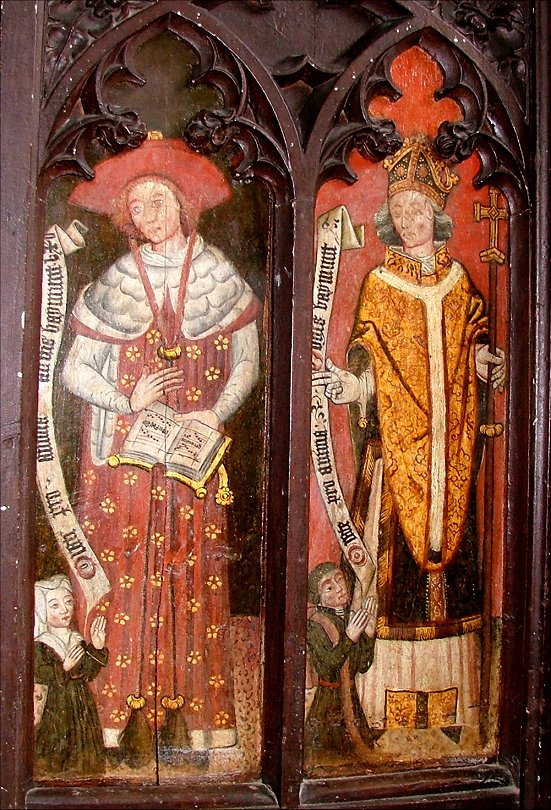
ff) as depicted (at right; at left, St. Jerome) on the late fifteenth-century rood screen in the church of St Thomas, Foxley (Norfolk):


gg) as depicted (at far right) by Michael Pacher on his late fifteenth-century Fathers of the Church altarpiece (c. 1483) in the Alte Pinakothek, Munich:


http://www.wga.hu/art/p/pacher/various/2father1.jpg

hh) as depicted (at left; at right, St. Augustine) by Giovanni Masone in a late fifteenth-century panel painting (Genoa, 1491) in the Musée Jacquemart-André, Paris:


ii) as depicted (left margin at top) in a hand-coloured woodcut in the Beloit College copy of Hartmann Schedel's late fifteenth-century Weltchronik (Nuremberg Chronicle; 1493) at fol. CXXXIIIIv:
http://www.beloit.edu/nuremberg/book/6th_age/left_page/38%20%28Folio%20CXXXIIIIv%29.pdf

jj) as depicted (second from left) by Carlo Bracceso in a late fifteenth-century panel painting (ca. 1495) in the Galleria Franchetti, Ca' d'Oro, Venice:
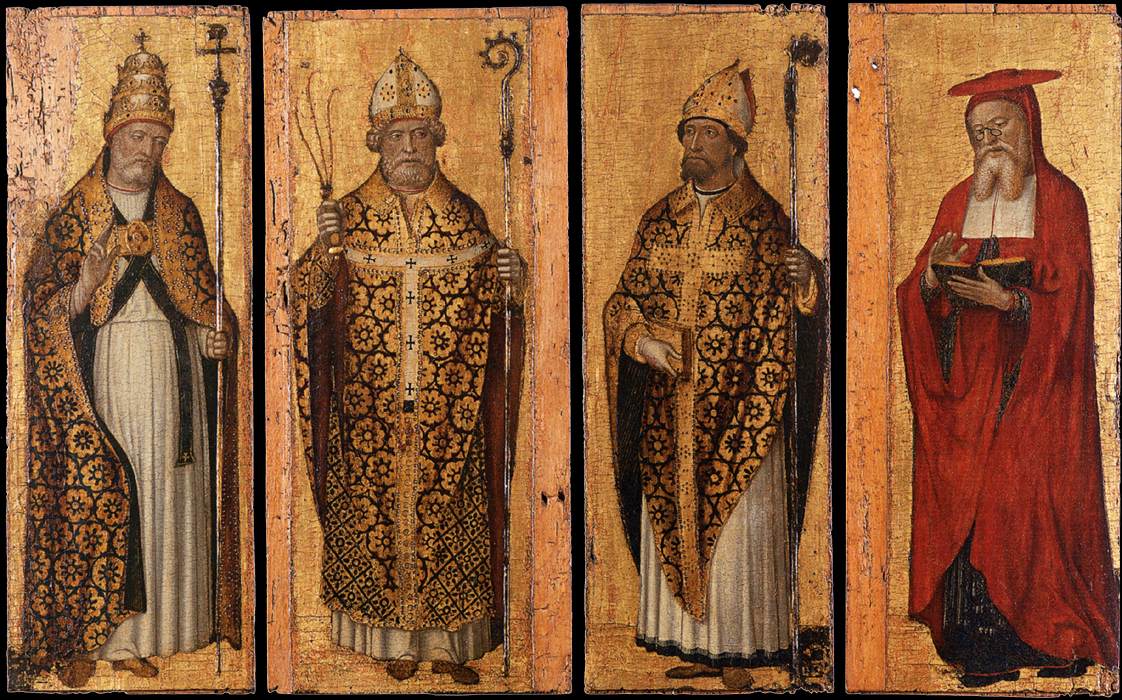


[I like the idea of unity of doctrine expressed in the same textile being worn in their vestments by SS Gregory, Ambrose and Augustine. I also  like St Jerome's pince nez ]

kk) as portrayed (in his study) in a late fifteenth- or early sixteenth-century wooden statue with traces of paint (c. 1500) from Palencia in The Cloisters collection of the Metropolitan Museum of Art in New York:

Saint Ambrose in His Study


Saturday, 22 August 2015

Coronation of the Virgin Mary


Today is the Feast of the Queenship of Mary, being the Octave Day of the Assumption.


Image: Michael Pacher - M.Pacher / Coronation of the Virgin Mary 

The Coronation of the Virgin
Michael Pacher  c.1435-1498

Image:art-prints-on-demand.com


This wonderful image is one I first came across many years ago, but until recently was unable to locate, not being sure of the name of the artist, and which I have tracked down thanks to the Internet. 


Thursday, 1 January 2015

The Feast of the Circumcision of Our Lord


Nowadays re-named the Solemnity of Mary, Mother of God, today is traditionally celebrated as the feast of the Circumcision of Our Lord. Both titles refer to the same concept, that is, that Jesus was born to a Jewish mother, the representative of the people of the Old Covenant, and that her son was full heir to the promises and obligations of that tradition. Only from that beginning could He inaugurate the New Covenant with all of mankind.   


The Circumcision of Christ
Michael Pacher, 1430 - 1498
The St Wolfgang Altarpiece, 1479-81

Image:squishyjesus.blogspot.com


Friday, 26 December 2014

St Stephen's Day


St Stephen, whose feast falls today is, of course, venerated as the first martyr of the Church - apart that is from the claims to that dignity of the Holy Innocents and St John the Baptist. To mark his feast I am republishing a post from this day three years ago with a few emendations and additions.
http://cache2.artprintimages.com/p/LRG/13/1348/GUCS000Z/art-print/michael-pacher-the-stoning-of-st-stephen-from-the-altarpiece-of-st-stephen-circa-1470.jpg
The Stoning of St Stephen
From the St Stephen Altarpiece by Michael Pacher c.1470

Image: art.com

There are a series of readings and traditional devotions to him, as well as various depictions here.


St Stephen.
He is quite often shown in a standing pose but being bombarded with stones.
A rather effete depiction of a saint who was anything but that, being noticeably robust according to the Acts of the Apostles in Chapter 6 and Chapter 7.

The remainder of this post is adapted from a post from this day in 2005 on A Catholic Life.

"If you know what witness means, you understand why God brings St. Stephen, St. John, and the Holy Innocents to the crib in the cave as soon as Christ is born liturgically. To be a witness is to be a martyr. Holy Mother Church wishes us to realize that we were born in baptism to become Christ — He who was the world's outstanding Martyr" (Love Does Such Things by Rev. M. Raymond, O.C.S.O.)

We have only just celebrated the birth of our Lord and already the liturgy presents us with the feast of the first person to give his life for this Baby who has been born. Yesterday we wrapped Christ in swaddling clothes; today, he clothes Stephen with the garment of immortality. Yesterday, a narrow manger cradled the baby Christ; today, the infinite heaven has received Stephen in triumph (St. Fulgentius, Sermon 3)


This painting is a detail from The Ordination of St Stephen by Blessed Fra Angelico
(circa 1395-1455) in the Niccoline chapel in the Vatican.
Saint Peter is ordaining Stephen to the diaconate while Saint John the Beloved (whose feast is tomorrow), holding his Gospel, looks on.

The composition is remarkable: the three heads of Peter, John and Stephen form a triangle, a symbol of communion in the Three Divine Persons. Peter is handing over the chalice and paten which are very large. Fra Angelico makes the Most Holy Eucharist central; he paints what Saint Thomas Aquinas taught, i.e. that the unity of the Church is constituted and held together by participation in the adorable Body and Blood of Christ.

Source for the above excerpt: Vultus Christi

The Martyrdom of St Stephen.
A rather florid Baroque view.

Saint Stephen, martyr of Christ, ora pro nobis. Amen

Grant us, we beseech Thee, O Lord, so to imitate what we revere, that we may learn to love even our enemies: for we celebrate the heavenly Birthday of him who knew how to pray for his very persecutors to our Lord Jesus Christ, Thy Son: Who liveth and reigneth with Thee.

1962 Daily Missal

Images: A Catholic Life blog

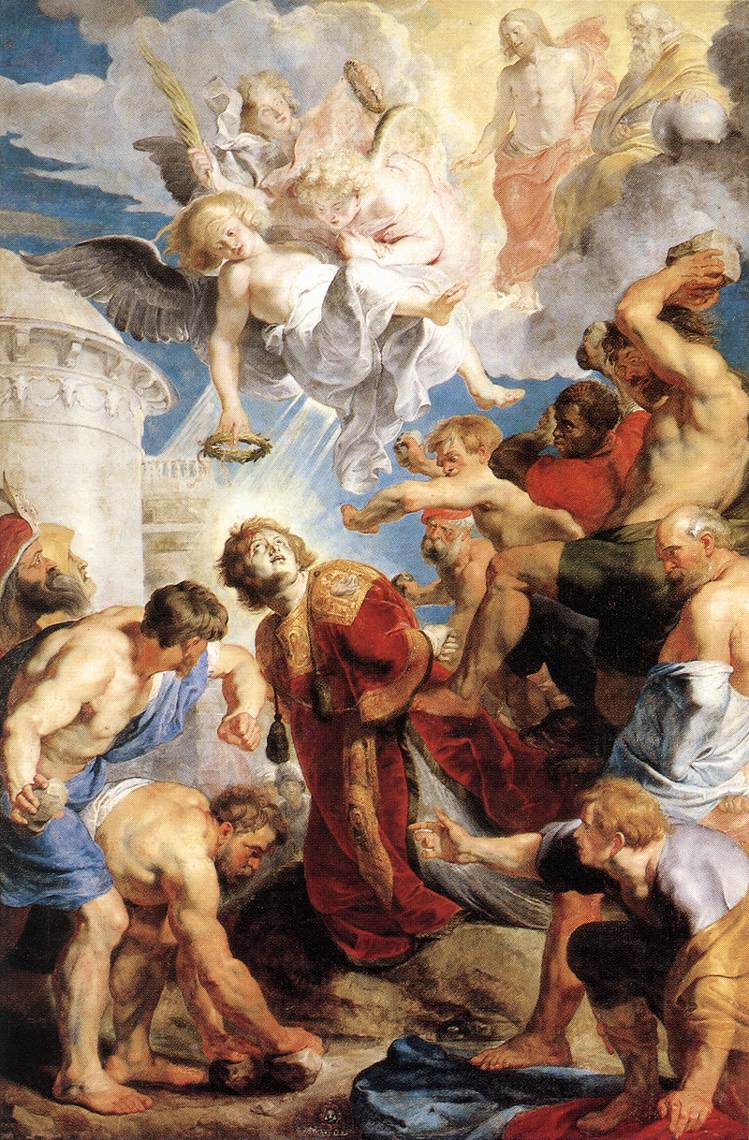
The following year I posted another depiction of his death - again very much in the most dramatic Baroque style:

Fichier:Peter Paul Rubens - The Martyrdom of St Stephen - WGA20224.jpg

The Martyrdom of St Stephen

Sir Peter Paul Rubens
1616/17
Musee des Beaux Arts, Valenciennes

Image: fr.Wikipedia

That year I also posted St Stephen at Bourges about one of the greatest churches under his patronage.