Once I was a clever boy learning the arts of Oxford... is a quotation from the verses written by Bishop Richard Fleming (c.1385-1431) for his tomb in Lincoln Cathedral. Fleming, the founder of Lincoln College in Oxford, is the subject of my research for a D. Phil., and, like me, a son of the West Riding. I have remarked in the past that I have a deeply meaningful on-going relationship with a dead fifteenth century bishop... it was Fleming who, in effect, enabled me to come to Oxford and to learn its arts, and for that I am immensely grateful.


Showing posts with label Virgin Mary. Show all posts

Sunday, 15 September 2024

The Feasts of the Seven Sorrows of the Virgin Mary


The New Liturgical Movement has an interesting article today about the two Feasts of the Seven Sorrows which appear, with different rankings over time, in the pre-1970 Calendar. The coincidence of today, September 15th, where the celebration was fixed by St Pius X, being a Sunday, and the third of the month, when it would have been observed from Pope Pius VII’s inclusion of it in the universal Calendar in 1814, obviously helped inspire the article.

The two feasts, one in Passiontide on the Friday of Passion Week, and one in September, arise from popular devotion In the first case this originated in the later medieval Rhineland, and spread across much of the continent. The second is a somewhat later fruit of the work of the Servite Order. Both represent the organic development of private devotion over time and place to become a part of the life of the whole Church. Often called the Compassion of Our Lady it is part of the religious culture that made carvings and paintings of the Pieta so much a part of late medieval spirituality and devotion.

The article gives a detailed account of the evolution of the two celebrations and of the Office for the two days. It can be seen at Liturgical Notes on the Feasts of the Seven Sorrows


Friday, 1 January 2016

The Circumcision of Our Lord and the Solemnity of Mary Mother of God


In addition to being the opportunity to wish readers a happy New Year - and that seems more than a seasonal platitude but an ever more ardent wish in the troubled state of the world - today is traditionally the feast of the Circumcision of Our Lord, and now retitled in the novus ordo the Solemnity of Mary Mother of God. Both titles - and I do not see why the older could not have been retained alongside the newer emphasis on Our Lady - point to the rootedness of the Incarnation in the traditions of Israel, its law and obligations ( e.g. circumcision) and its people ( Mary as the ultimate representation of the Chosen People )

John Dillon has posted a selection of images of the Circumcision of Our Lord on the Medieval religion discussion group as well as an introduction to the history of today's feast(s) as follows:

In the General Roman Calendar 1 January is the feast of Mary, the Mother of God. Greek Orthodox churches celebrate the Synaxis of the Holy Theotokos on 26. December. Neither date works as an anniversary of the adoption of Mary's designation as Theotokos ("Mother of God") by the Council of Ephesus (held in June and July 431); both bespeak rather a desire for a specifically Marian commemoration within the octave of the Nativity. 

Whereas this feast is attested from sixth-century Rome, for most of the western Middle Ages 1. January was principally the dayof the Feast of the Circumcision, a fourth-century feast in the east
that seems to have been adopted in Rome in the seventh or eighthcentury and that lasted on the general Roman Calendar from the latter's late sixteenth-century inception until its revision of 1969. The Circumcision of Jesus, mentioned only circumstantially in the revised Roman Martyrology's laterculus for today's Solemnity of Mary the Mother of God, remains a focus for the feast of the Circumcision celebrated on this day in Byzantine-rite churches and, as that of the Naming and Circumcision of Jesus, in churches of the Anglican Communion. According to Luke 2:21, a traditional reading on this feast, Jesus' circumcision on the octave of his birth was the occasion of His naming. Re-titled and re-imagined as that of the Holy Name of Jesus, the feast so construed is celebrated on 1 January in yet other churches and on 3 January in the Roman Catholic Church.


Herewith some links to period-pertinent images of the Circumcision of Jesus:

a) as depicted in the late tenth- or very early eleventh-century
so-called Menologion of Basil II (Città del Vaticano, BAV, cod. Vat.
gr. 1613, p. 287):

 File:Menologion of Basil 047.jpg


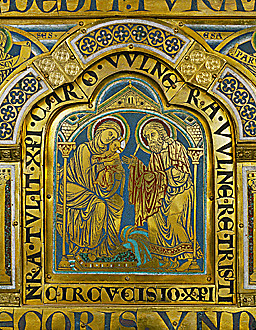
b) as depicted by Nicholas of Verdun on an enameled plaque of his late twelfth-century altarpiece (c. 1181) for the abbey of Klosterneuburg near Vienna:

 https://c1.staticflickr.com/7/6208/6073659927_c5f5514ecb.jpg


c) as depicted in a number of mid-thirteenth- to late fifteenth-century illuminations in manuscripts now in French collections (images expandable):
http://tinyurl.com/7n6lweh

d) as depicted in a panel of the late thirteenth-century Life of Mary and Infancy of Jesus window (w. 6, panel 18) in the église Saint-Sulpice in Saint-Sulpice-de-Favières (Essonne):
http://therosewindow.com/pilot/st%20sulpice%20le%20faviere/EwSa-18.htm

e) as depicted in a late thirteenth-century copy of French origin of the Legenda aurea (San Marino, CA, Huntington Library, ms. HM 3027, fol. 16r):
http://digitalassets.lib.berkeley.edu/ds/huntington/images//000856A.jpg

f) as depicted in the late thirteenth-century Livre d'images de Madame Marie (c. 1285-1290; Paris, BnF, ms. Nouvelle acquisition française16251, fol. 23r):
http://tinyurl.com/p29l922

g) as depicted in an initial on a detached leaf, from an early fourteenth-century antiphoner from Regensburg, in the Walters Art Gallery and Museum, Baltimore (Walters ms. W 754AV):
https://c1.staticflickr.com/9/8185/8371415982_50189af2cd_b.jpg

h) as depicted by the Master of the Tree of Life in a detail of his mid-fourteenth-century Tree of Life fresco (c. 1347) in the basilica di Santa Maria Maggiore in Bergamo:

 http://www.toscanaoggi.it/var/ezdemo_site/storage/images/cultura-societa/le-feste-di-capodanno-e-della-circoncisione/1657570-2-ita-IT/Le-feste-di-Capodanno-e-della-Circoncisione_articleimage.jpg

The painting in its entirety:
http://tinyurl.com/onzznz9

i) as depicted in the later fourteenth-century Breviary of Charles V (c. 1364-1370; Paris, BnF, ms. Latin Latin 1052, fol. 36v):
http://gallica.bnf.fr/ark:/12148/btv1b84525491/f82.item.zoom

j) as depicted in a later fourteenth-century copy (c. 1370-1380) of part of Vincent of Beauvais' Speculum historiale in its French-language version by Jean de Vignay (Paris, BnF, ms. Nouvelle
acquisition française 15940, fol. 26v):
http://gallica.bnf.fr/ark:/12148/btv1b8449693p/f60.item.zoom

k) as depicted by Giovanni di Benedetto and workshop in a late fourteenth-century Franciscan missal of Milanese origin (c. 1385-1390;  Paris, BnF, ms. Latin 757, fol. 291v):
http://gallica.bnf.fr/ark:/12148/btv1b8470209d/f586.item.zoom

l) as depicted in the very late fourteenth- or earlier fifteenth-century Breviary of Martin of Aragon (Paris, BnF, ms.Rothschild 2529, fol. 141v):
http://gallica.bnf.fr/ark:/12148/btv1b52000996s/f284.item.zoom

m) as depicted in an earlier fifteenth-century copy of Guillaume de Deguileville's (or Degulleville's) Pèlerinage de vie humaine and other writings (betw. 1426 and 1450; Paris, BnF, ms. Français 376, fol.176r):
http://gallica.bnf.fr/ark:/12148/btv1b84702013/f355.item.zoom

n) as depicted (lowest register) in the earlier fifteenth-century Hours of Jean de Montauban (c. 1430; Rennes, Bibliothèque de Rennes Metropole, ms. 1834, fol. 47r):
http://tinyurl.com/l7defp7

o) as depicted by the Masters of the Delft Grisailles in an inserted earlier fifteenth-century grisaille in a later fifteenth-century Hours of the BVM from Naples (c. 1440; Den Haag, KB, ms. 135 E 23, fol. 53v):
http://manuscripts.kb.nl/zoom/BYVANCKB%3Amimi_135e23%3A053v_min

p) as depicted by Beato Angelico in a mid-fifteenth-century panel painting (c. 1451; from his Armadio degli Argenti) in the Museo nazionale di San Marco in Florence:

 http://www.wga.hu/art/a/angelico/11/armadio8.jpg

http://www.wga.hu/art/a/angelico/11/armadio8.jpg

q) as depicted in a later fifteenth-century glass window panel (c.
1460-1470) from Köln in The Cloisters Collection of the Metropolitan
Museum of Art, new York:

http://www.ipernity.com/doc/laurieannie/35821507

r) as depicted in a later fifteenth-century glass window (c.1467-1469; w. 2) in the cathédrale Notre-Dame in Évreux:
http://therosewindow.com/pilot/Evreux/w2-B2-whole.htm

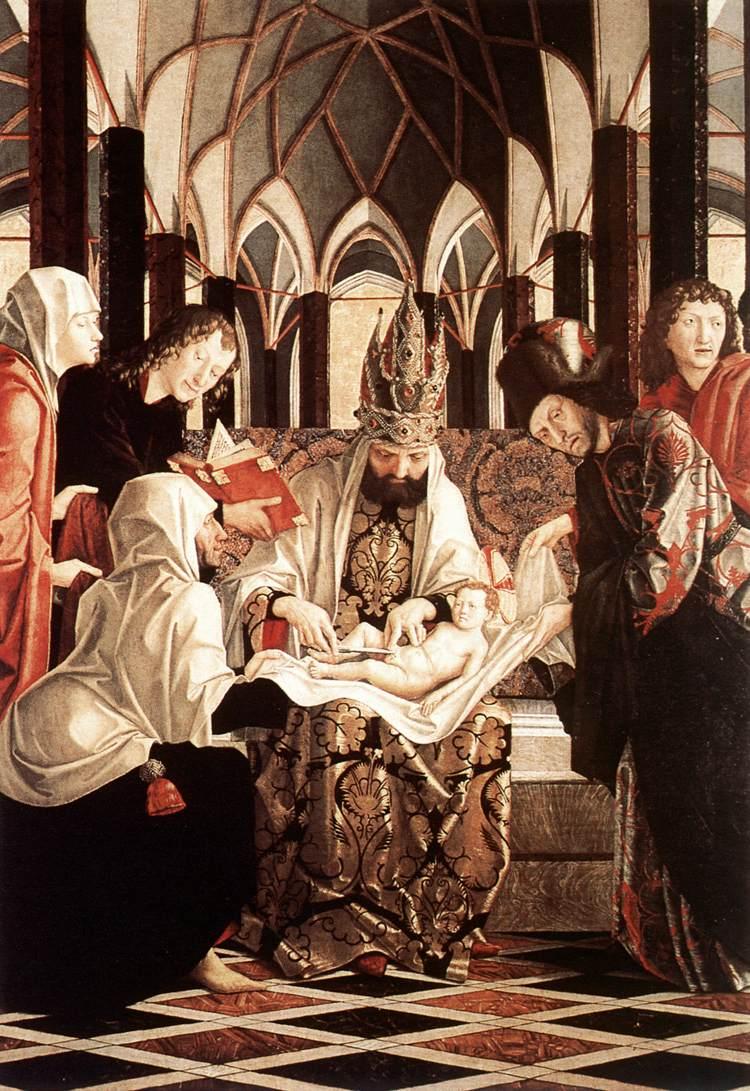
s) as depicted by Michael Pacher in a panel painting on a wing of his later fifteenth-century St. Wolfgang Altarpiece (centre completed,1479; wings completed, 1481) in the Wallfahrtskirche St. Wolfgang in Wolfgangsee (Land Salzburg):

 https://upload.wikimedia.org/wikipedia/commons/3/33/Michael_Pacher_-_St_Wolfgang_Altarpiece_-_Circumcision_-_WGA16822.jpg


t) as portrayed in polychromed wooden figures from a later fifteenth-century altarpiece from Brabant (c. 1480) in the Bode-Museum, Berlin:

 https://upload.wikimedia.org/wikipedia/commons/0/0e/Fl%C3%BCgelretabel_aus_Brabant_Berlin_Beschneidung.jpg


u) as depicted by the Elmelunde workshop in the late fifteenth-century paintings (c. 1481) in Fanefjord Kirke, Fanefjord, Vordingborg Kommune, Sjælland:

 http://ica.princeton.edu/images/mills/08-027.jpg


v) as depicted by a follower of Willem Vrelant in an illuminated initial in a late fifteenth-century Hours of the BVM (c. 1490; Den Haag, Museum Meermanno, ms. 10 F 1, fol. 98v):
http://manuscripts.kb.nl/zoom/BYVANCKB%3Amimi_mmw_10f1%3A098v_init

w) as depicted by Hugues Le Coq (possibly from cartoons by Pierre Spicre) in a late fifteenth-century tapestry of the Life of the BVM (in five separate segments, of which the last is dated 1500) in the
collégiale Notre-Dame in Beaune:
https://www.flickr.com/photos/morio60/23293556706

x) as portrayed by Jörg Ratgeb in an earlier sixteenth-century fresco (c. 1514-1521; restored, 2009) in the cloister of the former Carmelite monastery in Frankfurt am Main:
https://www.flickr.com/photos/hen-magonza/6987921695/

y) as portrayed by Jean Soulas in an earlier sixteenth-century set of stone sculptures (1521-1535) on the choir screen of the basilique cathédrale Notre-Dame in Chartres:

 https://enthusiastical.files.wordpress.com/2013/05/dsc02098.jpg


z) as portrayed in polychromed wooden figures on an earlier sixteenth-century altarpiece from Antwerp (c. 1535) showing scenes from the Life of the Virgin and the Infancy of Christ, now in the Museo Civico d'Arte Antica (Palazzo Madama) in Turin:

 https://upload.wikimedia.org/wikipedia/commons/2/2d/Bottega_di_anversa,_ancona_con_storie_della_vergine_e_dell%27infanzia_di_cristo,_1535_ca._circoncisione_di_cristo.JPG


To this Gordon Plumb added another image of the Circumcision in a stained glass roundel of c.1500 now in St Oswald Malpas in Cheshire:

Malpas, St Oswald, Cheshire, nV, 1c, Cologne area, c.1500:
https://www.flickr.com/photos/22274117@N08/5490049810
and detail:
https://www.flickr.com/photos/22274117@N08/5489456189

Tuesday, 20 October 2015

St Luke painting a portrait of the Virgin


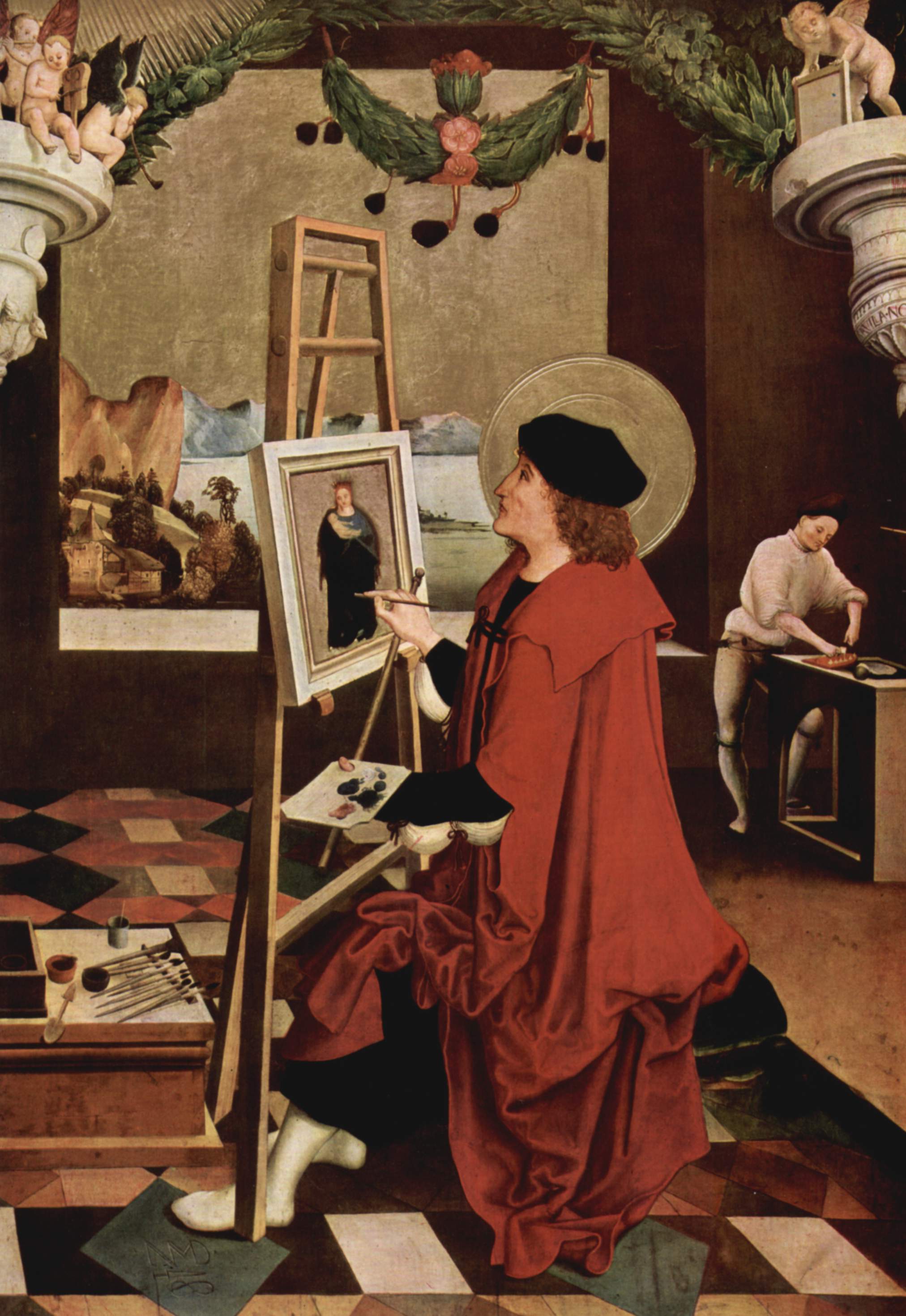
John Dillon has followed up his selection of images of St Luke on the Medieval Religion discussion group with another series of depictions of the Evangelist painting Our Lady. They all appear as a late- medieval theme,and may reflect a changing or developing awareness of the place of the painter in society. Not only are they pleasing in themselves but they are also an insight into how artists worked - or saw themselves as working - in the period.

a) as depicted in an early fifteenth-century Russian icon in the Ikonen-Museum Recklinghausen:


b) as depicted in the early fifteenth-century Châteauroux Breviary (c. 1414; Châteauroux, Bibliothèque municipale, ms. 2, fol. 373v):


c) as depicted by Michelino Molinari da Besozzo in an earlier fifteenth-century prayer book from Milan (c. 1420; New York, The Pierpont Morgan Library and Museum; Morgan MS M.944, fol. 75v):
http://www.themorgan.org/collection/medieval-and-renaissance/manuscript/145545

d) as depicted in one of the earlier fifteenth-century paintings added to the Malet-Lannoy Hours probably at the time of an early owner's wedding (1430s; Baltimore, The Walters Art Gallery and Museum, Ms. W.281, fol. 17r):
http://tinyurl.com/oyxxxd3

e) as depicted by Rogier van der Weyden in an earlier fifteenth-century panel painting (c. 1435-1470) in the Museum of Fine Arts, Boston:


Other versions of this painting exist. Three are shown here:
http://tinyurl.com/6czabs

f) as depicted in the mid-fifteenth-century by the  Master of the Duke of Bedford Hours (c. 1440-1450; Los Angeles, J. Paul Getty Museum, MS. LUDWIG IX 6, fol. 209r):

Saint Luke Painting the Virgin / Bedford Master


g) as depicted by Dieric Bouts the Elder in a mid- or later fifteenth-century panel painting (c. 1440-1475; transferred to canvas) in Penrhyn Castle, Bangor, North Wales:

Penrhyn Castle © National Trust


h) as depicted in grisaille by Jean le Tavernier in the mid-fifteenth-century Hours of Philip of Burgundy (ca. 1451-1460; Use of Paris; Den Haag, KB, ms. 76 F 2, fol. 255r):
http://manuscripts.kb.nl/zoom/BYVANCKB%3Amimi_76f2%3A255r_min

i) as depicted by Simon Marmion in a cutting, from a later fifteenth-century book of hours (c. 1465-1470), in the British Library, London:
https://www.pubhist.com/w5513

j) as depicted in a later fifteenth-century glass window in the cathédrale Notre-Dame in Évreux (c. 1467-1469; w. 4);
http://tinyurl.com/nvadcjt
Detail view:

Image agrandie numéro 10


k) as depicted in a later fifteenth-century Gospels for the Use of the Parlement de Bourgogne (c. 1470; Besançon, Bibliothèques municipales, ms. 93, fol. 018):
http://www.enluminures.culture.fr/Wave/savimage/enlumine/irht5/IRHT_083574-p.jpg

l) in a later fifteenth-century book of hours according to the Use of Saintes (c. 1470-1480; Besançon, Bibliothèques municipales, ms. 150, fol. 57v):
http://www.enluminures.culture.fr/Wave/savimage/enlumine/irht5/IRHT_084380-p.jpg

m) as depicted by Gabriel Mälesskircher in a later fifteenth-century panel painting (1478) in the Museo Thyssen-Bornemisza, Madrid:
http://www.museothyssen.org/en/thyssen/ficha_obra/330

n) as depicted by Derick Baegert in a late fifteenth-century painting (c. 1485) in the LWL-Landesmuseum für Kunst und Kulturgeschichte, Münster (Westfalen):


o) as depicted (left margin at top) in a hand-coloured woodcut in the Beloit College copy of Hartmann Schedel's late fifteenth-century Weltchronik (Nuremberg Chronicle; 1493) at fol. CVIIIr):
http://www.beloit.edu/nuremberg/book/6th_age/right_page/12%20%28Folio%20CVIIIr%29.pdf

p) as portrayed in two places on the late fifteenth-century Lukasaltar in the Evangelisch-lutherische Hauptkirche St. Jakobi in Hamburg (1499):
1) in a carving in high relief in the central panel of the opened altar (lower register at right; at left, Anna Selbdritt):


Detail view:


2) in a panel painting on an outer wing:


q) as portrayed in high relief by Jacob Beinhart in an early sixteenth-century wood sculpture (1506) in the National Museum in Warsaw:


r) as depicted by Niklaus Manuel in an early sixteenth-century panel painting (1515; from a dismembered altar of St. Anne) in the Kustmuseum Bern:


s) as depicted by a follower of Quentin Matsys (Massys, Metsys) in an earlier sixteenth-century panel painting (c. 1520) in the Fogg Art Museum, Harvard University:


t) as depicted in the earlier sixteenth-century Hours of Françoise Brinnon (1524; Den Haag, Museum Meermanno, cod. 10 F 33, fol. 15v):
http://manuscripts.kb.nl/zoom/BYVANCKB%3Amimi_mmw_10f33%3A015v_min


And a few period-pertinent images of St. Luke displaying a painted portrait of the BVM:

aa) as depicted in a late fifteenth-century book of hours according to the Use of Tours (Tours, Bibliothèque municipale, ms. 2042, fol. 8r):


bb) as depicted by Jean Bourdichon in the early sixteenth-century Grandes Heures d'Anne de Bretagne (c. 1503-1508; Paris, BnF, ms. Latin 9474, fol. 19v):

Grandes Heures d'Anne de Bretagne.


cc) as depicted by Vincenzo Foppa in an early sixteenth-century vault fresco (1510s) in Milan's chiesa di San Maurizio al Monastero Maggiore:


Thursday, 11 December 2014

The Memorare Prayer


As part of their coverage of the feast of the Immaculate Conception this week the Zenit newsagency had a post about the Memorare prayer. This widely used prayer is often attributed to St Bernard of Clairvaux (1090-1153). However the online article at Memorare argues that in fact it originates as part of a longer fifteenth century prayer, and that the attribution to St Bernard comes from confusion with its seventeenth century populariser Fr Claude Bernard. Nonetheless the article contains stories suggesting the efficacy of the prayer.

The Catholic Church grants a partial indulgence, initiated by Pope Pius IX in 1846, for those who devoutly recite the emorare. It is said that in order to receive a grace, the prayer should be recited at least nine times consecutively.

Mother Teresa of Calcutta was particularly devoted to the recitation of this prayer. It has been said that along with her fellow sisters, this prayer was recited almost 25,000 times to obtain the healing of a nun who was gravely ill.


Remember, O most gracious Virgin Mary,
that never was it known
that anyone who fled to thy protection,
implored thy help,
or sought thy intercession
was left unaided.
Inspired with this confidence,
I fly to thee, O Virgin of virgins, my Mother;
to thee do I come; before thee I stand, sinful and sorrowful.
O Mother of the Word Incarnate,
despise not my petitions,
but in thy mercy hear and answer me.
Amen.


Monday, 8 September 2014

The Birthday of Our Lady


Today is the Feast of the Birthday of Our Lady. 

To celebrate this joyful day I am posting an image of a painting by Jan van Eyck (c.1380/90-1441), and dated to 1438-40, which is now in the Gemäldegalerie in Berlin.

http://upload.wikimedia.org/wikipedia/commons/thumb/b/bb/Jan_van_Eyck_-_The_Madonna_in_the_Church_-_Google_Art_Project.jpg/369px-Jan_van_Eyck_-_The_Madonna_in_the_Church_-_Google_Art_Project.jpg

 Image:Wikipedia

There is an online account of the painting here.

At only 12.2 inches high and 5.5 inches wide it is essentially a miniature.

Apart from its beauty and indeed charm it is of interest as a depiction of the interior of a church in the Low Countries in the early fifteenth century - and church interiors remained popular as a theme with artists there both before and after the reformation. There is a delight in conveying the spatial qualities of the building as well as the play of light through the north porch and windows. Given that this must represent afternoon light is there a hint that time is moving on, and that ?late in time the Redeemer has come to save? Is there something then of later medieval mysticism and expectations of the call to Judgement? That is an idea that has been popular - as in Jan Huizinga's The Waning of the Middle Ages - and it is certainly present in the culture of the times with books of Ars moriendi, cadaver tomnbs and the danse macabre. Against that one should bear in mind the artistic vitality - of which this is but one example - and the general confidence of the fifteenth century in its beliefs and its ability to achieve great things.

Theologically I like the association here of the Child-bearing Virgin with the Church as represented by an ecclesiastical building. Here indeed is Mary as Mother of the Church, Mother of the Church which is the Body of Christ, that Body which she holds. The Virgin Mary is also a type of the Church, and that too is eloquently conveyed in this delicate composition. 

Blessed Mary, Ever Virgin, pray for us 


Tuesday, 5 August 2014

The Virgin Mary as Mother of God and of the Church


Today is the feast of the dedication of the Basilica of St Mary Major on the Esquiline Hill in Rome, the oldest church in the West dedicated to the Virgin Mary. It was built soon after the Council of Ephesus which proclaimed the status of the Virgin at Theotokos in 431

Here is the text of the second reading appointed for today from the Office of Readings in the Divine Office. It is from a homily delivered at the Council of Ephesus by Saint Cyril of Alexandria. I particularly like the way he links and combines, and explores, the image of Our Lady as a model, as a type, of the Church and of the church building itself.

In praise of Mary, Mother of God
I see here a joyful company of Christian men met together in ready response to the call of Mary, the holy and ever-virgin Mother of God. The great grief that weighed upon me is changed into joy by your presence, venerable Fathers. Now the beautiful saying of David the psalmist: How good and pleasant it is for brothers to live together in unity has come true for us.
  Therefore, holy and incomprehensible Trinity, we salute you at whose summons we have come together to this church of Mary, the Mother of God.
  Mary, Mother of God, we salute you. Precious vessel, worthy of the whole world’s reverence, you are an ever-shining light, the crown of virginity, the symbol of orthodoxy, an indestructible temple, the place that held him whom no place can contain, mother and virgin. Because of you the holy gospels could say: Blessed is he who comes in the name of the Lord.
  We salute you, for in your holy womb was confined him who is beyond all limitation. Because of you the holy Trinity is glorified and adored; the cross is called precious and is venerated throughout the world; the heavens exult; the angels and archangels make merry; demons are put to flight; the devil, that tempter, is thrust down from heaven; the fallen race of man is taken up on high; all creatures possessed by the madness of idolatry have attained knowledge of the truth; believers receive holy baptism; the oil of gladness is poured out; the Church is established throughout the world; pagans are brought to repentance.
  What more is there to say? Because of you the light of the only-begotten Son of God has shone upon those who sat in darkness and in the shadow of death; prophets pronounced the word of God; the apostles preached salvation to the Gentiles; the dead are raised to life, and kings rule by the power of the holy Trinity.
  Who can put Mary’s high honour into words? She is both mother and virgin. I am overwhelmed by the wonder of this miracle. Of course no one could be prevented from living in the house he had built for himself, yet who would invite mockery by asking his own servant to become his mother?
  Behold then the joy of the whole universe. Let the union of God and man in the Son of the Virgin Mary fill us with awe and adoration. Let us fear and worship the undivided Trinity as we sing the praise of the ever-virgin Mary, the holy temple of God, and of God himself, her Son and spotless Bridegroom. To him be glory for ever and ever. Amen.

Text version from Universalis


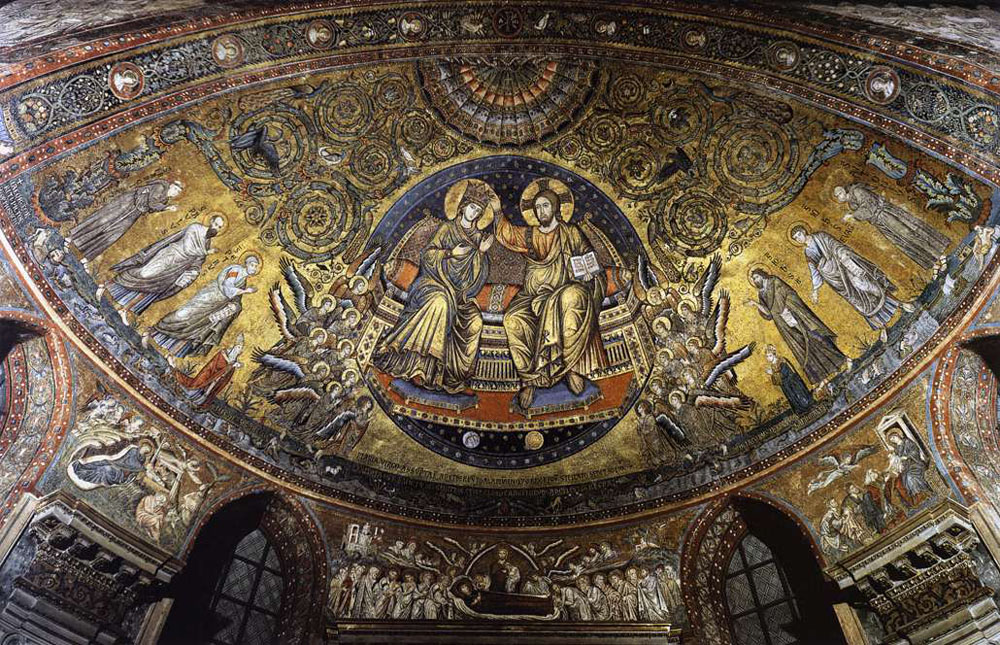
The Coronation of the Virgin
Mosaic in the apse of Sta Maria Maggiore, by Jacopo Torriti, completed in 1296

Image:Wikipedia


Wednesday, 29 May 2013

Listening to the Akathistos Hymn


Yesterday evening I went to Pusey House to listen to the singing of the Akathistos Hymn about which I posted in The Akathistos Hymn at Pusey House on May 28th and where there is a link to the text of the piece.

We began with an introductory talk by Bishop Kallistos of Diokleia, who is always a stimulating and interesting preacher and speaker. He outlined the historty ofg the hymn, which is dated to the first half of the sixth century, and pre-dates the fixing of the feast of the Annunciation under Justinian. It may be the work of the greatest Byzantine hymnographer St Romanus. Given its date it may have originally been intended for the feast of the  Synaxis of Our Lady on December 26th.
The current Greek use is to sing sequential parts of it on the Fridays of Lent, but the more ancient or traditional practice is preserved in the Russian use, where it is sung in its entirity on the fifth Friday5 of Lent.

In the Orthodox tradition, unlike the western one, the feast of the Annunciation is never transferred - thus if it falls on Good Friday its celebration has to follow that of the passion. This cannot happen with the modern calendar, but with the Julian calendar such a coincidence with Good Friday can sometimes occur

Bishop Kallistos drew attention to three themes in the hymn. The first was that of Joy  - the repeated call upon the Virgin, and the believer, to rejoice in all that she embodied and represented.

The second point was the Christological thought of the hymn - Mary, however exalted, is always subordinate to her Son.

The third point was the mystery and paradox described by the hymn in its account of the Incarnation and how they are integral to the life and story of the Virgin Mother of God.

The hymn is now prefaced and followed by the singing of a kontakion in which the City - that is Constantinople - gives thanks for deliverance from its assailants. this appears to originate with the 626 Persian siege, and the kontakion being the work of Patriarch Sergius after its lifting. The hymn also gives thanks for the delivery of the city from the 718 siege by the Arabs, and that of  846 by the still pagan Russians.

The hymn was sung in its entirety in English in a liturgical translation published by the Ecumenical Society of the Blessed Virgin Mary together with another by Roger Green which draws out the richness of the original Greek. Green himself describes the expereince of the hymn as being "caught up in a brilliant firework display." Copies of this translation were available for purchase.

To someone used to the western tradition the most obvious parallel is with litanies such as that of Loretto, but in the case of the Akathistos Hymn the officiant and schola divide the piece between them as a series of collects and invocations, whilst the icon of Our Lady is censed throughout the rite.

Listening to the hymn and looking at the text I was reminded of Fr Hunwicke's  point that for the most advanced expressions and forms of Marian devotion one should look to the Orthodox tradition


Icon of the Mother of God "of the Akathist"
Image:idlespeculations-terryprest.blog


The Vatican Directory on Popular Piety and the Liturgy (December 2001) lists many approved "popular pieties" and devotions outside the Liturgy, and includes the Akathistos Hymn. This seems to have been a particular favourite of the late Pope John Paul II.

Wednesday, 21 November 2012

Presentation of the Blessed Virgin Mary


Today is the feast of the Presentation of the Blessed Virgin Mary in the Temple.


The Presentation of the Virgin Mary in the Temple

Image: Catholic Church Conservation blogspot

The feast itself originates in the east, where it is recorded in the sixth century and is specifically referred to by the Emperor Michael VIII Comnenus in 1166,  rather than in the west, where it arrived in the 1370s, as is explained in an illustrated article which can be read here, together with an explanation of its meaning as a festival.   


The emphasis in the liturgy of the day is not only on the Blessed Virgin's consecraton to God, but also on the place of the Temple, both physical and spiritual, in the life of the people of God. As a feast it became universal with the 1570 Missal and a decree of Pope Sixtus V in 1585.

The source of the feast is however much more ancient, arising from the account given in the second century text of the Protoevangelium of St James, or, as it is sometimes known, the Gospel of St James. There is an account of this text which can be read here.

Although it has never been accounted canonical by the Church the Protoevangelium is nonetheless very early as a text, and cannot therefore be dismissed as a later medieval doctrinal excressence. it is the earliest Marian text outsid ethe Gospels, and narrates the stry of her birth and later upbringing in the Temple community and her betrothal to St Joseph. Some scholars have certainly opined that its origins  do indeed lie in the teaching of St James the Less as Bishop of Jerusalem in the first century. The text of the Protoevangelium can be read in translation here.


Thursday, 5 August 2010

Dedication of St Maria Maggiore

Today is the feast of the Dedication of St Maria Maggiore in Rome, built following the Marian definitions at the Council of Ephesus in 431, and the first church built in honour of Our Lady in the west.*
There is a history together with more pictures of the basilica here.


I was particularly struck by the second lection from today's Office of Readings. It is from a homily delivered at the Council of Ephesus by Saint Cyril of Alexandria, and with its praise of the Virgin proof of the antiquity of such devotion - and proof that such devotion is not a medieval or baroque excrescence - and worthy of being used to describe Our Lady as Mediatrix of all Graces and Co-Redemptrix. I have therefore copied it, courtesy of Universalis, and publish it below:

In praise of Mary, Mother of God
I see here a joyful company of Christian men met together in ready response to the call of Mary, the holy and ever-virgin Mother of God. The great grief that weighed upon me is changed into joy by your presence, venerable Fathers. Now the beautiful saying of David the psalmist: How good and pleasant it is for brothers to live together in unity has come true for us.

Therefore, holy and incomprehensible Trinity, we salute you at whose summons we have come together to this church of Mary, the Mother of God.

Mary, Mother of God, we salute you. Precious vessel, worthy of the whole world’s reverence, you are an ever-shining light, the crown of virginity, the symbol of orthodoxy, an indestructible temple, the place that held him whom no place can contain, mother and virgin. Because of you the holy gospels could say: Blessed is he who comes in the name of the Lord.

We salute you, for in your holy womb was confined him who is beyond all limitation. Because of you the holy Trinity is glorified and adored; the cross is called precious and is venerated throughout the world; the heavens exult; the angels and archangels make merry; demons are put to flight; the devil, that tempter, is thrust down from heaven; the fallen race of man is taken up on high; all creatures possessed by the madness of idolatry have attained knowledge of the truth; believers receive holy baptism; the oil of gladness is poured out; the Church is established throughout the world; pagans are brought to repentance.

What more is there to say? Because of you the light of the only-begotten Son of God has shone upon those who sat in darkness and in the shadow of death; prophets pronounced the word of God; the apostles preached salvation to the Gentiles; the dead are raised to life, and kings rule by the power of the holy Trinity.

Who can put Mary’s high honour into words? She is both mother and virgin. I am overwhelmed by the wonder of this miracle. Of course no one could be prevented from living in the house he had built for himself, yet who would invite mockery by asking his own servant to become his mother?

Behold then the joy of the whole universe. Let the union of God and man in the Son of the Virgin Mary fill us with awe and adoration. Let us fear and worship the undivided Trinity as we sing the praise of the ever-virgin Mary, the holy temple of God, and of God himself, her Son and spotless Bridegroom. To him be glory for ever and ever. Amen.


I propose to mark the day by going to the Extraordinary Form Mass at SS Gregory and Augustine here in Oxford, and which I advertised last week.

* Which is not to deny the claims of the Old Church of Glastonbury, but it does not have the historical certainty of St Maria Maggiore.