Once I was a clever boy learning the arts of Oxford... is a quotation from the verses written by Bishop Richard Fleming (c.1385-1431) for his tomb in Lincoln Cathedral. Fleming, the founder of Lincoln College in Oxford, is the subject of my research for a D. Phil., and, like me, a son of the West Riding. I have remarked in the past that I have a deeply meaningful on-going relationship with a dead fifteenth century bishop... it was Fleming who, in effect, enabled me to come to Oxford and to learn its arts, and for that I am immensely grateful.


Showing posts with label Pusey House. Show all posts

Friday, 30 August 2024

Steven Doody R.I.P.


This morning there took place in his home town of Newport in Shropshire the funeral of my Oxonian friend Steven Doody. 

Steven was one of a group of valued male and female friends I made in Oxford in my more active years there. A generation or so younger than me we bonded through a similar world view, often through shared church going, and certainly through shared meals in pubs and especially one favoured Italian restaurant. I recall many happy hours spent with him, and especially his unstinting help to me as Churchwarden in organising, during a vacancy, the celebration of Easter at St Thomas’ Oxford in 2004.

Steven died at the beginning of this month aged only 46. As a memorial, and with the speaker’s permission, I am reproducing here the eloquent eulogy given at the funeral by Steven’s school friend and fellow Oxonian, Dr Roland Enmarch, who now lectures in Egyptology at Liverpool University.

Steven Doody
16.iii.1978 – 5.viii.2024
Eulogy

I would like to begin by offering thanks to Tranters funeral directors, and to Rev. Ward and the staff of St. Nicholas’ Church, for organising this opportunity today for us to come together to remember Steven Doody, and to celebrate his life. 

And thank you all for coming here today, to show your love for our departed friend.

And may I say that all our hearts today are with Steven’s father, Dave, and his aunt, Mo, whose grief is great for the loss of a son (and nephew) of such extraordinary gifts ¬– of confidence, exuberance, great intelligence, and great love.  

I hope I can do him justice in these few words.

So, where to begin?  Well, Steven was a lover of tradition above all things, so let me be traditional and start at the beginning: I first met Steven Doody in 1989, when we both started at Adams Grammar School aged 11. Even then I think he may already have developed his trademark quizzical raised eyebrow and his uniquely mischievous way of arguing: – one of the earliest recollections I have of him was a heated argument we had over the correct way to spell the word ‘Britain’.  I am fairly sure that, in purely orthographic terms, I was in the right – but I certainly wasn’t the one who won the argument!

Fortunately, our friendship survived this first trial. And with his gift of a prodigious memory, -combined with dedicated study, Steven would soon be winning many more arguments, more fairly. And his memory really was prodigious: after the 1992 general election he spent hours in the Big School library poring over Whitaker’s Almanack –– there no was no Internet Wikipedia in those days –– and he memorised not just all the MPs of the new UK parliament, but he was also actually able to quote from memory all their majorities as well. I know this – because Steven insisted that I test him, repeatedly! 

Before long, he was achieving the same mental mastery of much of 19th and early 20th century British history, a period which frankly fascinated him, and for which he developed over the course of his life such a profound empathy: he could discourse learnedly for hours on any number of historical topics from this time, whether it be the Primrose League, the Second Irish Home Rule bill, Hedgers and Ditchers, or the question of tariff reform. He became a sure-footed master of the facts and the arguments, as well as the nuances. In later years, he wore his erudition rather lightly, but it remained a key part of who he was. 

Perhaps inevitably, in 1996 Steven became the first pupil of Adams’ in many years to go to Oxford to study History. He had already proven himself a gifted public speaker, with his forthright contributions at school to the William Adams’ Arts and Debating Society - these were already the stuff of legend. However, it was at Oxford where Steven’s rhetorical talents took wing, and where he really honed the charisma and humour that would be the hallmarks of his whole life.

I remember being rather in awe of Steven at Oxford – he successfully adopted a larger-than-life personality,  and seemed to make his whole existence into one giant artistic performance. 
He became a favourite of the student gossip columns, where he was known as ‘Thirties Throwback’ - a reference to his sense of style, and his love of old-fashioned clothes. His wardrobe was of the very finest and most elegant tweeds and cords, while accounts of his going to Ascot in full morning dress placed Steven (to me, at any rate) in an impossibly glamorous world – a star in the Oxford firmament. The press loved his look too – who can forget his popularisation of wearing rubber ducks as a fashion accessory, or the wonderful headline ‘Let’s party like it’s 1899’? 

As an undergraduate, Steven immersed himself in the world of student politics, serving in various elected capacities in the Oxford Union, and the Oxford University Student Union – but perhaps most notably he also managed to get himself elected as the leader of Oxford University’s  Conservative Association – and strikingly he went on to swiftly lead that organisation to quite unprecedented levels of national celebrity, as some of you may well remember.

That was one side of his Oxford life – and Steven’s exoteric antics are perhaps the ones most people know best.   But on a more profound level, Steven also had a very active inner life, to which perhaps fewer of us were privy. Here too, his Oxford years were crucial: in 1997, he first attended Sunday High Mass at Pusey House, and was instantly drawn to High Church Ritualism ¬– and its deep spiritual understanding – which went on to become cornerstones of his whole life.

As a terrible heathen, I may not be best placed to recollect Steven’s Pusey days. Fortunately, I have been helped here by another long-time friend and former congregant of Pusey House, John Whitehead - who sadly is unwell and cannot be here with us today. John tells me that he remembers Steven fondly as a generous and loyal friend, though he notes that Steven was a bit of a menace when swinging his incense-thurible during the mass…. 

It is only fair to add that Steven brought his love of fine clothes to his High Anglicanism: He was an authority on such things as the correct liturgical colours for Laetare Sunday, and he knew his biretta from his mozzetta from his zuchetto. In 2002, the highlight of his holiday in Rome was visiting Gamarelli the papal tailors, where he purchased episcopal purple socks (for himself), and a miniature biretta (for Tiny Bear, his teddy).

But more seriously, Steven drew a real and profound comfort from his High Anglican faith, in which he remained steadfast to the end of his life. Steven was a great believer in the power of prayer, and so at this point I should note that Fr. Barry Orford, of Pusey House, will be saying a requiem today on behalf of Steven - and Steven will also be remembered today at mass, by Fr. Alaric Lewis, in the church Steven attended for many years in Norwich, St. George’s Tombland. And I should also mention that many, many of Steven’s ecclesiastical friends have contacted me to say that they too have said masses, requiems and angeluses for Steven. 

After completing his studies, Steven stayed on in Oxford  – which he dearly loved – for some years, serving rather unexpectedly as the postmaster at St. Giles, a job he conducted with considerable flair before returning (as I think we all knew or hoped he would) to his true vocation in education. He became a teacher of History, first training in Liverpool where he is remembered with great fondness, and then working for many years at City College, Norwich, teaching sixth formers. Steven turned out to be a truly inspirational teacher – indeed his students successfully nominated him for an award for innovative teaching methods . . . which was wonderfully ironic, for such a determined traditionalist as Steven.  Unfortunately, failing eyesight began to pose increasing problems for Steven, and so eventually he had to give up this role in which he had been so successful, and which he had accomplished with such enjoyment.

Of course Steven remained fascinated by history and its infinite complexities, and in his later years even talked about embarking on a doctorate, to undertake a comprehensive study of the Liberal Unionist party from 1886-1912. Sadly, his fragile health prevented him from achieving this aim.

As I draw to a close, I want to stress just what a special person Steven was, to so many of us here and further afield, who knew and loved him.  He was a kind and generous soul, with a real gift for friendship: he had an easy way with people, effortlessly setting them at ease, and making them feel valued. His innate sense of life’s absurdities made him a natural comic, and he was adept at spreading mirth to everyone he encountered. He had a mischievous, transgressive sense of humour, always delivered with a raised eyebrow and a knowing smile.

Steven Doody was a lover of life, and he lived his life to the fullest. He followed his star, which shone brightly, if alas all too briefly, in this world. Let us hope for a better world to come.

Steven, you will not be forgotten. Rest in peace, my friend.


Friday, 21 March 2014

Metropolitan Kallistos on the Catholic - Orthodox dialogue


Last Tuesday evening I attended another of the public meetings organised by the Fellowship of St Alban and St Sergius and held at Pusey House to hear Metropolitan Kallistos of Diokleia deliver the Nicholas Zhernov Memorial Lecture about the continuing Catholic - Orthodox dialogue under the title "Orthodox and Catholic Relations: Then and Now." There is a biography of the Metropolitan here, and a bibliography of his numerous writings here.


Metropolitan Kallistos

Image: penandpalette.blogspot

I have heard the Metropolitan speak previously and he is always exceptionally good value as a speaker. He is has been a member of the joint commission since 2007 and is also Co-Chairman of the Anglican-Orthodox commission.

Just over fifty years ago, on January 5th 1964, Pope Paul VI and Ecumenical Patriarch Athenagoras met in Jerusalem, the first such meeting since the Council of Florence in 1438-9.


The meeting of Patriarch Athenagoras I and Pope Paul VI in 1964

Image:scnu.edu.cn
At that time there was great optimism as to the possibilities for ecumenism. On December 7th 1965 there was by Pope and Patriarch a mutual revocation of the anathemas issued by their predecessors in  1054  - a striking symbolic gesture.

This year  from  May 24th-26th Pope Francis and Patriarch Bartholomew will mark the anniversary by meeting in Jerusalem. What will follow in term sof the official dialogue which has been pursued since 1980 is not yet clear

At the Council of Florence in 1438-9 ten months was spent on the discussion of the Procession of the Holy Spirit and the  Filioque, and four months on Purgatory and the cult of saints, but only ten days on the issue of Papal Primacy at the very end before the issue of the decree of Union Laetentur caeli.There is an introduction the the Council of Florence here.


The Council of Florence
Emperor John VIII and the Ecumenical Patriarch Joseph II face Pope Eugenius IV, with delegates of East and West sitting between them

Image:syropoulos.co.uk
In the 21st century there are different perspectives, and the crucial point of discussion is the Papal position in the Church - as Patriarch Bartholomew has said the two communions have a different ecclesiology

The dialogue since 1980 did not look at the Papal role first - it would not have been fruitful to do so. Instead there were three conferences producing papers on Christ, the Eucharist and Ministry. There has also been discussion of the place of the Eastern rite Catholic Churches.

Only since after 2007 and the Ravenna agreement have discussions moved to look at the position of the Pope. The largest Orthodox Church, that of Russa was not present at Ravenna, and that has had significant consequences. The Ravenna statement recognises three levels of primacy:
1. The local level - that of the diocesan bishop
2. Regional patriachates, metropolitans etc
3. Universal primacy of the Pope

In the Catholic tradition it is possible to view the Pope as bishop of his diocese, as a patriarchal, and as having a Universal primacy that is a mark of unity

For the Orthodox there is no problem in him being Bishop of Rome, or in possessing a regional primacy as head of the Church in the West. There are however difficulties at a Universal level.

However the fact of Primacy was accepted by both East and West, but there was not discussion of  what that actually involves, of what is the power vested in the Pope. In the past the Orthodox denied any Papal primacy, whilst accepting him as bishop and patriarch only, and indeed that the Pope is the most senior patriarch.

The Ravenna accord moved the discussion forward, and saw recognition of the fact that the Pope was different, but the absence of the Russian Church meant this was a lessthan complete acceptance.

The next question to be answered was: What was the position within the Church of the Pope in first millenium?

In  Ut Unum sint Pope John Paul II recognised that the Papacy could claim no more than what had been established as apapal power  before 1054, but also that it could claim no less.

There have been two meetings on what was the view in the first millenium at Paphos in 2009 and in Vienna in 2010. Much of the discussion was tortuous and it was not clear what could be established. The leading Orthodox theologian, Metropolitan John, expressed the view that the appeal to history would not resolve the problem - a point which worried Metropolitan Kallistos.

The discussion had moved forward on Synodality and Primacy, which is to be discussed further in September this year.

By this time a division had appeared in the Orthodox ranks, with the Moscow Patriarchate ranged  against the rest.

For the leading Orthodox theologian Metropolitan John - Primacy was of the essence of the Church, but for Metropolitan Hilarion of Russia Primacy is not of Divine origin, but is something which emerged in the practice of the churches.

Attention had been paid to Apostolic Canon 34, traditionally ascribed as agroup to the Apostles, but now dated to the late 4th century prescribes that bishop must recognise the Bishop who is first, and he, in turn, must consult with the others - there is mutuality in the relationship. Apostolic Canon 34 refers to regional primacy. The Ravenna agreement applies this to the Universal Primacy and the model stemming from Vatican II and the concept of collegiality. In contrast the Moscow Patriarchate says this only applies at the regional level. Similarly Moscow regects an analogy advanced by some of the Church to the relationships within the HolyTrinity.

Under the ideas being drafted the Pope would convoke an Ecumenical Council. This, hoewever, was not the case in the undivided early Church. All seven Councils recognised by both communions were called by the Emperor - unfortunately, as Metropolitan Kallistos said, there is currently no Emperor. No Popes attended any of these seven Councils. Today the Pope summons and presides as at Vatican I and II. Moscow says there is no precedent for this, but suggets no alternative. Most Orthodox are willing to give the Pope a specific role, but this is denied by the Russians. Mutual communion would be the measure of unity.

Why is this the Russian attituide.  Metropolitan Kallistos opined that there is a hidden agenda - the Russians  recognise the Ecumenical patriarchate in Constantinople, but are reluctant to give its occupant Primacy. When he describes himself as "First among equals " it is to use a term not liked by the Russians. As a consequence they are reluctant to concede to Rome  that which they deny Constantinople when it takes it to itself. This is not stated policy but Metropolitan Kallistos thinks it is the cause.

If the question is posed as to what do Orthodox seek in this quest for union Metropolitan Kallistos quoted a piece written in 1947 by Fr Lev. This envisaged a Primacy of " humility, service and love" not just one of honour, a unique pastoral mission. Metropolitan Kallistos would happily accept that.

What the Orthodox term freedom in the Holy Spirit for the Paraclete to speak to the individual conscience is comparable to the "Sensus fidelium" in the West. The Catholic and Apostolic tradition of seven accepted Ecumenical Councils links both traditions. The Chair of Peter conveys the unique position of Rome. However many Orthodox see all bishops as successors of Peter - as St.Cyprian said in the 3rd century. Most Orthodox would, he believed, accept the unique role of the Pope. The concept of "the care of all the churches" articulated by Popes Siriacus and Innocent I, that is not a newly invented jurisdiction but concern for the total Church and it would be for the Pope to take the initiative if unity was in danger. Another phrase of importance was the Papal title of "Servus servorum Dei" first used by Pope Gregory I.

This left the question as to whether such would this do for Catholics?

Patriarch Athenagoras in 1968 spoke of unity as a necessity, as our destiny, and also that unity will be a miracle, but a miracle in history. Unity will be a gift from God, and so we should ask for it. This was the Metropolitan's conclusion.

In answer to a short series of questions he said that PopeBenedict XVI's dropping of the use of the title  Patriarch of the West, which was said to be in consequence of ambiguity as to its meaning led him to ask why it was not better to clarify rather than discard it ; the Orthodox had no problem with it, and see the Western Patriarch as historically possessing more poewer than the Eastern ones. He would like to see the title taken back into use.

During Vatican II Pope Paul VI had developed the concept of collegiality, but with Humane Vitae in 1968 appeared to go against that principle. Under both Pope John Paul II and PopeBenedict XVI there seemed little of collegiality in the Roman structures. The question is what will Pope Francis do?

The role of Roman Curia, which has taken on a life of its own would need to be examined,  and also the appointment of bishops in the 19th century most were appointed by monarchs under concordat sor other than by the Popes; only in the 1917 Code of canon law was this reserved to the Holy See.

This was fascinating and insightful lecture, which, as with the one last week on Anglican- Oriental Orthodox dialogue, spoke in centuries and millenia rather than merely decades. One was aware one was watching a stage in great historical process. What its outcome will be is far from clear. I think people will be watching for many many years to come...


Tuesday, 11 March 2014

Anglican - Oriental Orthodox relations


Last night I went to an open meeting arranged by the Fellowship of St Alban and St Sergius at Pusey House to hear an interesting lecture on the ecumenical discussions between the Anglican Communion and the Oriental Orthodox churches. The speaker was the Rt. Rev. Dr Geoffrey Rowell D.D., sometime Chaplan of Keble College and until recently the Anglican Bishop of Gibralter in Europe. 

Bishop Rowell began by recounting his langstanding interest in the Oriental Churches, which began whilst he was astudent in Cambridge, and led to him eventually becomg co-Chairman of the Amglican- Oriental Othodox Commission.


http://www.anglicancommunion.org/ministry/ecumenical/intimages/full/2001orientalorthodox.jpg 

A meeting of Anglican and Oriental Orthodox representitives in 2001
Bishop Rowell is seated in the centre

Image: Anglicancommunion.org

The Oriental Orthodox churches are those which do not accept the formula worked out at Chalcedon in 451 about Christology and the two natures of Christ. Though often referred to as monophysite this is a term they dislike and describe themselves as miaphysite. There is an explanation of this at the online article Miaphysite churches. There is an online account of the churches and their history here.

The chuches which beliong to this group are the Egyptian Copts, the Ethiopian Copts, now with the addition of the Eritrean Orthodox, the Syrian Orthodox, the Armenians, with two Catholicos at Etchmaidzin and for Cilicia in the Lebanon and the Indian Malankara church. The Armenians in 2001 celebrated the 1700th anniversary of their becoming the first Christian nation. Most of these communities have lived under Islamic rule for most of the last fourteen centuries, and as far as the Westrn and Byzantine Orthodox are officially concerned have been deemed to been heretics since 451, although in 1989 the Byzantine and Oriental Orthodox lifted whatever anathemas separated them.

The churches use their own liturgical language, and are not Greek speaking liturgically - thus in Syria Syriac is sued, the Armenians use their own langauge - created by one of the early churchmen and the Ethiopians use a distinct liturgical language analagous to Old Church Slavonic; the Indian Malakara Syrians use Malayala.

The Chalcedonian division can in part be explained by the politicala nd military events of the times - as the late Patriarch Karekin I of the Armenians argued in recent years the ancestors of his people were too busy fighting the Persians to attend the Council. The Chalcedonian formula struck the more ardent supporters of the views of St Cyril of Alexandria as conceding too much to the ideas of St Cyril's opponant Nestorius, and the Orientals place great emphasis on the one nature of the Incarnate Word, not as monophysite but that two separate identities are united in the misphysite Person. That Unity reaches outwards from the centre.

In consequence they have little fellow feeling for the Nestorian Church of the East or, as it is sometimes known today, the Assyrian Church, of which there is a history here. Oriental Orthodox can be heard blaming Nestorian monastics in pre-Islamic Arabia for giving Mohammed a false idea of Christian teaching. This group now has a very scattered diaspora, but early Anglican contact from the time of Archbishop Benson and the supportive resolutions of earlier Lambeth Conferences had been in consequence of some concern to the Orientals

Until recently there were few members of any of these Oriental Orthodox in this country, although there was some contact from the nineteenth century made by travellers, and Queen Victoria presented a printing press to the then patriarch peter of Syria to assist his Church. In recent years, and following on from a suggestion by Bishop Rowell to the British embassy the Prince of Wales has visited some monasteries in south-east Turkey. Interest in Syriac and other liturgies had led scholars to look at the service books of the Orientals - Bishop Westcott of Durham was intrigued by the rite for consecrating clergy wives.

Like the Anglican Communion the Oriental Orthodox form a communion, but with no common canon law, and no clear idea as to who can all a Council - the Emperor Haile Selassie did so on one occasion relying on his Imperial authority - but they do not possess a primus inter pares like the Archbishop of Canterbury and the power to invite to a Lambeth Conference.

Following on from the building up of contact over a number of years Anglican-Oriental OrthodoxDiscussions in Holy Etchmiadzin did result in an important document in November 2002 an Agreed Statement on Christology which drew upon the traditions of both communions and rejected both Nestorian and Eutychean formulae. Bishop Rowell had telephoned Henry Chadwick - the nearest thing to an Anglican fount of intellectual theoloical authority  - as to signing to be reassured that if the Byzantine Otthodox were happy with the Orientals the Anglicans could be.


http://www.anglicancommunion.org/ministry/ecumenical/intimages/full/2002orientalorthodox.jpg

The Commission which drew up the Joint Statement at Holy Etchmiadzin in 2002

Image:anglicancommunion.org

Organising reception of this by bothfamilies of churches has proved slower than might have been hoped. In 2004 the controversy over the impending US consecration of the divorced homosexual Gene Robinson as Bishop of New Hampshire led several of the Oriental Orthodox to say they could not attend a plenary joint meeting at Walsingham - for them such aconsecration would be exploited by Muslim journalists in their own countries as to whom they were associating with.  As aresult the meeting was cancelled.

In 2013  there was a successful full meeting to discuss th role of the Holy Spirit and the Filioque clause, and, all being well, another meeting is scheduled for this year in Cairo. Current political circumstances always posed problems, not least that the Orientals might not want to be seen as tools of the West.

Visits by successive Archbishops of Canterbury to these churches had helped develop good realtins, as had the presence of orientals at such Papal events as the inaugurations of both Pope Benedict and Pope Francis.

This was a very interesting evening, the topic presented with lucidity and insight as well as good humour and Anglican episcopal elan of the best sort. This was ecumenism with a sense of history, and a sense that something worthwhile was being achieved, even if the timescale was very much in centuries.


Friday, 21 February 2014

Peter Hitchens on the Book of Common Prayer


On Wednesday evening I went to an open public meeting at Pusey House of the Oxford branch of the Prayer Book Society to hear the thoughts and ideas of the Mail on Sunday columnist Peter Hitchens on the BCP. He entitled his talk "The Constitution of the Private Life."


peter hitchens

Peter Hitchens

Image;nigelfarndale.com 


He began his talk with the point that apart from the State Prayers there was little that was overtly or directly political in the Book of Common Prayer, and that the services of commemoration on such lines added in the seventeenth century had been removed in 1858, but went on to argue for its wider significance for national life.

This argument was that there was a social ethic outlined in the Prayer Book that did have far reaching implications for the country in that it gave a framework within which the individual could learn to exercise authority over themselves and their lives in such a way that it gave them autonomy from the undue involvement of the State.

He recalled reading the Catechism as a schoolboy, with the expectation that one might indeed be expected to know it by heart and to understand what it stated. He continued by wondereing how long it was since Anglican bishops actually examined children at their confirmation on its contents. He saw this as being a valuable tool in the formation of young people for adult and responsible life. Here was a clear exposition of the individuals spiritual and social obligations. Instead he saw modern life as ever more determined by unrestrained individualism and the fulfilling of consumer gratification.
He cited the marriage service as contributing to a proper understating of this as a building block of society. He contrasted what he saw as the fuss last year over same sex marriage - a concern for a tiny minority - with the virtual silence from Church leaders about the marriage crisis. He was sharply critical of the most recent divorce legislation which he saw as putting the State on the side of the partner who seeks dissolution of a marriage rather than being neutral. He thought the pamphlet produced by the Anglican bishops about this entitled Putting Asunder as a selling of the pass and an admission of failure or abandonment in this key area of social life.

He spoke less about the burial  service, but pointed to it as a reminder to everyone of their mortality.

One of his overiding concerns was that Britain has irrecoverably damaged itself as a society, and he was pessimistic as to its - our - chances of survival.

His dislike of the State involving itself in the lives of individuals and usurping the proper roles of parents and families is clear, and he sees the ideas adumbrated or inherent in the BCP as a safeguard against that if they are inculcated and developed in people.
 
The questions from the sizeable audience were mainly about marriage. I was somewhat surprised at such a gathering to sense so liberal an interpretation of ideas about this. Peter Hitchens was perhaps not. He stressed the indissolubility of Christian marriage as contrasted with other traditions - a point some clearly did not share. He also stressed the importance of finding a basis for authority in the life of a family that was natural and integral rather than the constraint of the modern State system or law.

Asked about the impact of feminism on family life  - had it led women to implicitly denigrate their sons for example - he took a more liberal line than I might have expected from someone speaking to the Prayer Book Society - he has, for example, never had objections to the ordination or consecration of women in the Church of England.

He also stressed that the language and concepts underlying it in the BCP draw the hearer and reader out of themselves towards that which is greater and the sense of wider truths. For Hitchens the Prayer Book puts the hearer in mind of eternity, and he clearly felt that dimension needed to be contrasted to the overly materialist world of so many people.

An interesting talk, and thought provoking, as one would expect. Peter Hitchens has a good dose of Burkean Tory pessimism about him -  I  share in that myself - and he is not afraid to express his ideas about the decline of the moral foundation and grounding of national life.  The ideas he sees contained in the BCP are part of a wider inheritance than just that of the Church of England, and his arguments can be appreciated by others of different traditions. 

This then was not just a lament for the absence of BCP services - though he would doubtless like to see it used more - but for the loss of moral grounding in national life. Whether one should be as pessimistic as he appeared to be at one point I do not know, but I do see that he makes a good case for striving to re-establish it through sensible and secure channels.


Saturday, 26 October 2013

Roger Scruton on Language and Liturgy


Last night I went to a meeting of the Prayer Book Society at Pusey House to hear Prof. Roger Scruton speak on the topic of Liturgy and Language.

The Ursell Room was packed out to hear what Prof Scruton had to say and his talk was followed by questions and discussion.

In effect describing himself as someone who had come to find in the settled phrases and rhythms of the Bookof Common Prayer a spiritual path the Professor, not surprisingly given his well known and robust defence of traditional values and ideas, as well as his audience, stressed the importance of that high register language deliberately chosen by Cranmer, consolidated by its reissue in 1662 and hallowed by constant use which characterises the BCP. Such language aquires an aura, and conveys meaning by more than literalism. That depth of meaning was in one sense beyond the power of words and acquired alife and being of its own. It is noble language used in a noble aim, the worship of Almighty God.To that end he quoted Philip Larkin writing of religion as a "serious thing on serious ground." Such language can and should convey meaning beyond the conscious to the depths of the soul.

The retention of such serious, charged language was important to convey fundamental and unchanging truths to present and subsequent generations, that the words carried meaning beyond their linguistic and academic ones, opening up the mind and spirit to the Infinite. Prof. Scruton clearly implied that  his view could be broadened to include the concept that the same principle could be applied to the Roman Missal of 1570 and its successive reissues down to 1962.

Amongst the many questions and commends I was particularly struck by one from an academic who was raised as a Catholic and who, when he had worked in Japan had found modern Catholic worship offered by western chaplains dull and uninspiring. Together with those same chaplains he had visited Buddhist shrines, with their elaborate and beautiful worship amidst clouds on incense, at which they had all been entranced. Nonetheless on return to the chaplaincy the to him uninspired liturgy of modern Catholicism had resumed Sunday by Sunday. The importance and need for the beautiful in the externals of holiness failed to make an impact. The result - the academic who told us this had, in consequence, given up on Catholicism and become a High Anglican, because they did the liturgy better.

This was talk which was about a much debated issue, but still a valuable set of thoughts from an intellectual, on a topic of concern to Anglicans and Catholics in respect of their liturgical books, and what they are saying.


Wednesday, 29 May 2013

Listening to the Akathistos Hymn


Yesterday evening I went to Pusey House to listen to the singing of the Akathistos Hymn about which I posted in The Akathistos Hymn at Pusey House on May 28th and where there is a link to the text of the piece.

We began with an introductory talk by Bishop Kallistos of Diokleia, who is always a stimulating and interesting preacher and speaker. He outlined the historty ofg the hymn, which is dated to the first half of the sixth century, and pre-dates the fixing of the feast of the Annunciation under Justinian. It may be the work of the greatest Byzantine hymnographer St Romanus. Given its date it may have originally been intended for the feast of the  Synaxis of Our Lady on December 26th.
The current Greek use is to sing sequential parts of it on the Fridays of Lent, but the more ancient or traditional practice is preserved in the Russian use, where it is sung in its entirity on the fifth Friday5 of Lent.

In the Orthodox tradition, unlike the western one, the feast of the Annunciation is never transferred - thus if it falls on Good Friday its celebration has to follow that of the passion. This cannot happen with the modern calendar, but with the Julian calendar such a coincidence with Good Friday can sometimes occur

Bishop Kallistos drew attention to three themes in the hymn. The first was that of Joy  - the repeated call upon the Virgin, and the believer, to rejoice in all that she embodied and represented.

The second point was the Christological thought of the hymn - Mary, however exalted, is always subordinate to her Son.

The third point was the mystery and paradox described by the hymn in its account of the Incarnation and how they are integral to the life and story of the Virgin Mother of God.

The hymn is now prefaced and followed by the singing of a kontakion in which the City - that is Constantinople - gives thanks for deliverance from its assailants. this appears to originate with the 626 Persian siege, and the kontakion being the work of Patriarch Sergius after its lifting. The hymn also gives thanks for the delivery of the city from the 718 siege by the Arabs, and that of  846 by the still pagan Russians.

The hymn was sung in its entirety in English in a liturgical translation published by the Ecumenical Society of the Blessed Virgin Mary together with another by Roger Green which draws out the richness of the original Greek. Green himself describes the expereince of the hymn as being "caught up in a brilliant firework display." Copies of this translation were available for purchase.

To someone used to the western tradition the most obvious parallel is with litanies such as that of Loretto, but in the case of the Akathistos Hymn the officiant and schola divide the piece between them as a series of collects and invocations, whilst the icon of Our Lady is censed throughout the rite.

Listening to the hymn and looking at the text I was reminded of Fr Hunwicke's  point that for the most advanced expressions and forms of Marian devotion one should look to the Orthodox tradition


Icon of the Mother of God "of the Akathist"
Image:idlespeculations-terryprest.blog


The Vatican Directory on Popular Piety and the Liturgy (December 2001) lists many approved "popular pieties" and devotions outside the Liturgy, and includes the Akathistos Hymn. This seems to have been a particular favourite of the late Pope John Paul II.

Tuesday, 21 May 2013

The Akathistos Hymn at Pusey House on May 28th


On Tuesday next week, May 28th,  Pusey House is hosting at 5 pm a joint event by the Ecumenical Society of the Blessed Virgin Mary and the Fellowship of St Alban and St Sergius when Bishop Kallistos Ware, Bishop of Diokelia  will give an introductory talk and lead the singing of the Akathistos hymn to the Most Holy Mother of God.

The text of this great sixth century hymn to Our Lady can be read in translation here.

Literally akathist means standing - this is a devotion during which one remains on one's feet because of its solemnity.


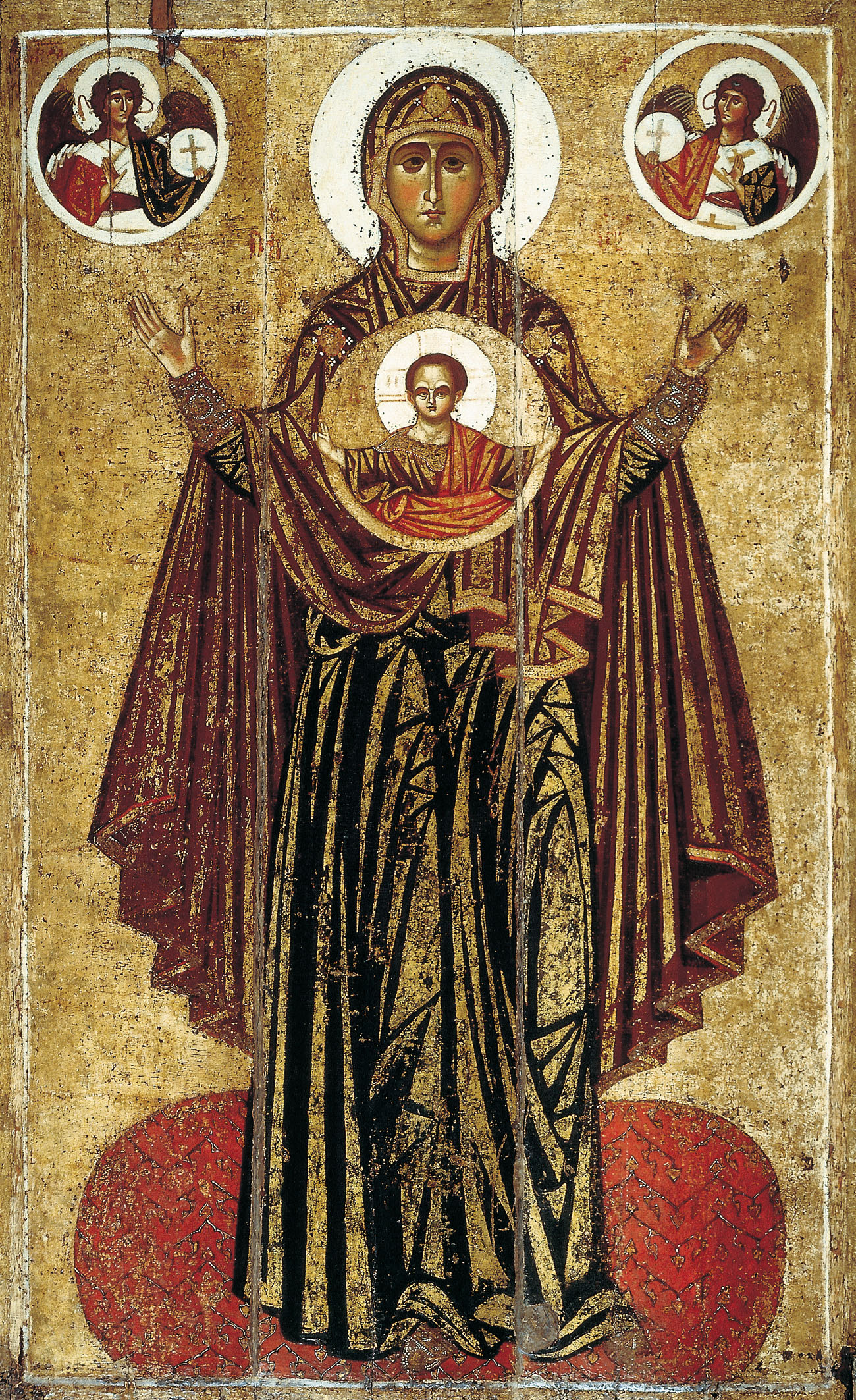
File:Oranta.jpg
 
 
The Theotokos orans
A thirteenth century icon from the Spassky cathedral at Yaroslavl

Image: Wikipedia
 
When the word akathist is used alone, it most commonly refers to this, the original hymn known by this name. This, the sixth century Akathist to the Theotokos , is attributed to St. Romanos the Melodist. The tradition is that the Theotokos appeared to him, gave him a scroll and commanded him to eat it. The result was a miracle: Romanus received a beautiful, melodic voice and, simultaneously, the gift of poesy.

This hymn is often split into four parts and sung at the "Salutations to the Theotokos" service on the first four Friday evenings in Great Lent; the entire Akathist is then sung on the fifth Friday evening. Traditionally it is included in the Orthros (Matins) of the Fifth Saturday of Great Lent, which for this reason is known as the "Saturday of the Akathist". In monasteries of Athonite tradition, the whole Akathist is usually inserted nightly at Compline.

The four sections into which the Akathist is divided correspond to the themes of the Annunciation, Nativity, Christ and to the Theotokos  herself.

The hymn itself forms an alphabetical acrostic—that is, each oikos begins with a letter of the Greek alphabet, in order—and it consists of twelve long and twelve short oikoi. Each of the long oikoi include a seven-line stanza followed by six couplets employing rhyme, assonance and alliteration, beginning with the greeting Chaíre and ending with the refrain, "Rejoice, Bride without bridegroom!" (also translated as "Rejoice, thou Bride unwedded!") In the short oikoi, the seven-line stanza is followed by the refrain, Alleluia.

The Salutations to the Theotokos service, often known by its Greek name, the Χαιρετισμοί/Chairetismoí  (from the Χαίρε/Chaíre! so often used in the hymn), consists of Compline with the Akathist hymn inserted. It is known in Arabic as the Madayeh.

As next Tuesday is the eve of 560th anniversary of the fall of Constantinople in 1453 this seems a not inappropriate day on which to celebrtae the glories of Byzantine liturgy and culture.


Sunday, 16 September 2012

Remembering Dr Pusey


Today is the 130th anniversary of the death of  Edward Bouverie Pusey at the house of nuns he founded, the Society of the Most Holy Trinity, at Ascot Priory. He is buried in Christ Church cathedral in Oxford, and Pusey House was founded as a memorial to preserve both his library and his life work for future generations. 

E.B. Pusey

Dr Pusey by Vanity Fair

Image: Nova Scotia Scott

As someone who owes a great deal to the Oxford Movement of which Pusey was a founder, and to Pusey House where I worshipped regularly from 1996 until 2004, and made many valued and enduring friendships there as well as using the library I feel I owe a great deal to Dr Pusey, and am happy to commemorate him and to pray for the repose of his soul.

Unlike Newman, who shared in the Victorian love of the camera Pusey refused to be photographed or to sit for his portrait. This I think stemmed from his self-abnegatory regime which he adopted following the death of his beloved wife Maria. Apart from his death-mask all the portraits we have are sketches made during sermons or done as pictures from memory. The one I reproduce below suggests something of the charm and cheerfulness in his faith which clearly marked  him as a spiritual director and sustained him in his long and often lonely years of leadership of the Puseyites after Newman's reception as a Catholic in 1845.

E.+B.+Pusey - 56020 Rev Pusey Lg
Dr Pusey

Image:explow.com

Tuesday, 10 January 2012

Archbishop William Laud


http://mercuriuspoliticus.files.wordpress.com/2009/02/william_laud.jpg?w=377&h=500

Archbishop Laud by Sir Anthony van Dyke

Image from Mercurius Politicus blog

Archbishop William Laud was judicially murderd by the Long Parliament on January 10th 1645. It is in no way unreasonble to see him as a martyr, although officially the Church of England has never recognised him as such - I do n't think he made it to the rather curious calendar contained in Common Worship in 2000.

He has, of course, always been esteemed by High Anglicans. Whether he can really be classed as an Anglo-Catholic is open to debate. I think he is more what one would term a High Anglican or a Catholic Anglican, and believed in the branch theory. His Arminian (if that is what it was) base does not, I think, quite follow on from the Elizabethan Church Papists, although I am not sufficiently versed in the subject to make a definite assertion as to the influences that formed him. He did of, of course, belong to St John's College, here in Oxford, which had strong Papistical inclinations stemming from its founder Sir Thomas White.

To call him an Anglo-Catholic or Romaniser is, perhaps, to fall for the arguments of his opponants - including those of my odious fellow Orielensis William Prynne - and not to see what he sought to do. His vision was an Anglican one of a reformed, purified Catholicism for the realms of his King. In obedience to the pursuit of that vision that he was a good and great man - arguably the greatest Archbishop of Canterbury since 1558.

The post 1660-62 Church of England was not operating in quite the way he had, but the vision he and others had encouraged, even if it became a minority interest, survived to provide a key element in the thought of the founders of successive Oxford Movements. Without Laud, Andrewes, Wren, Cosin and others there would have been neither Wesley and 'Methodism' in the 1730s, still less Keble, Pusey, Foude and Newman in the 1830s. Anglo-Catholicism, in the outward forms as we used to know it, might have been very different from Laud's version, but Laud gave it an historical pedigree which helped legitimate it.

There is something fitting (dignum et justum est) that it was in the church over whose south porch stands the statue of Our Lady and the Christ Child whose very existence was used as one of the ridiculous charges to destroy Laud in 1644 that the Oxford Revival of 1833 was launched.

If you are visiting Oxford do not fail to go and see Canterbury Quad at St John's College, built in the 1630s by Laud, and one of the greatest buildings in the city, redolent of those tranquil, halcyon, visionary years of Court High Anglicanism in the middle of the reign of King Charles I - a truly moving place to be when one reflects on the storm of destruction that was to follow.

photo

Canterbury Quad at St John's

Photo by fr Laurence Lew OP on Flickr


St John's still possesses vestments he gave to the college, and the purple scull cap he wore to the scaffold, and these and other treasures are displayed, and can be seen at advertised times.

In 1660 Laud's body was reinterred in the chapel of his beloved St John's. When I was a regular worshipper at Pusey House, which is almost opposite the college on St Giles, I developed the conceit that poor Laud must be not only turning, but positively spinning in his grave over the current state of the Church of England. I came to envisage the Pusey faithful assembled in the choir stalls one day at 1662 Mattins or Evensong when one of the paving stones would be lifted from underneath, pushed aside and a pair of lawn clad sleeves would lift out the Archbishop's head, and then he would lift himself out and join us in reciting the Office - his sepulchral rotations had finally brought him under the road to a safe haven with us.

A revised version of a post from this day last year.

Saturday, 21 May 2011

A quiet Saturday in Oxford


Following my perusal of the Gough Map in the Bodleian I went off to meet my good friend The Last Knight ( The Noise of the Crusade) for a leisurely two stage Italian lunch with plenty of Frascati and Chianti, and a thoroughly enjoyable discussion putting all manner of things in the world to rights. 

We then went on to the Novena at the Oxford Oratory  preparing for the feast of St Philip Neri next Thursday, before going to the Ordinariate Mass at Pusey House (an old haunt of ours), and then with other acquaintances to the Eagle and Child (aka the Bird and Baby) for a drink before he had to depart.  A very civilised way to spend a May Saturday in Oxford. 

Saturday, 30 April 2011

Making liturgical history with the Ordinariate


Earlier this evening I attended the first Mass offered by the Oxford group of the Ordinariate at Pusey House. Following the reception of members in Holy Week this was the first independent liturgical celebration, and along with a number of other supporters I went along to support the group and to participate in the Mass.

The celebrant was Mgr Andrew Burnham, and this was the first opportunity to really enable one to see what the liturgical character of the Ordinariate may be. Whilst faithfully adhering to the Missal the Mass, rather as at the reception Mass the previous week at the Oratory, had more congregational hymns and also sung propers that drew upon the older traditions of the Church. If "patrimony" was what one was seeking to identify then yes, it was present - present as a particular, reverential, style that used good music to ornament the liturgical action.

In this Mgr Burnham, who used to teach liturgical studies, and his team of servers and musicians are to be congratulated in producing a fine liturgy that reflected the Anglican inheritance that the Ordinariate can bring to the established Catholic books.

It was slightly curious for several of us, old Pusey hands that we are, to be back in the church and able to communicate as part of the Universal as well as the local Church. As was said the stones of the building were doubtless happy to see us back. The congregation was welcomed by the Principal of Pusey House, who sat in choir for the Mass.

The Ordinariate group's Mass will be celebrated at Pusey House at 6.30 (doors open at 6.15) on Saturdays this term with the exception of Pentecost eve and in Eighth Week, when another venue will be used.

Monday, 10 January 2011

Archbishop William Laud


http://mercuriuspoliticus.files.wordpress.com/2009/02/william_laud.jpg?w=377&h=500

Archbishop Laud by Sir Anthony van Dyke

Image from Mercurius Politicus blog

Archbishop William Laud was judicially murderd by the Long Parliament on January 10th 1645. It is in no way unreasonble to see him as a martyr, although officially the Church of England has never recognised him as such - I do n't think he made it to the rather curious calendar in Common Worship in 2000.

He has, of course, always been esteemed by High Anglicans. Whether he can really be classed as an Anglo-Catholic is open to debate. I think he is more what one would term aHigh Anglican or a Catholic Anglican, and believed in the branch theory. His Arminian (if that is what it was) base does not, I think, quite follow on from the Elizabethan Church Papists, although I am not sufficiently versed in the subject to make a definite assertion as to the influences that formed him. He did of, of course, belong to St John's College, here in Oxford, which had strong Papistical inclinations stemming from its founder Sir Thomas White.

To call him an Anglo-Catholic or Romaniser is, perhaps, to fall for the arguments of his opponants - including that my odious fellow Orielensis William Prynne - and not to see what he sought to do. His vision was an Anglican one of a reformed, purified Catholicism for the realms of his King. In that he was a good and great man - arguably the greatest Archbishop of Canterbury since 1558.

The post 1660-62 Church of England was not operating in quite the way he had, but the vision he and others had encouraged, even if it became a minority interest, survived to provide a key element in the thought of the founders of successive Oxford Movements. Without Laud, Andrewes, Wren, Cosin and others there would have been neither Wesley and 'Methodism' in the 1730s, still less Keble, Pusey, Foude and Newman in the 1830s. Anglo-Catholicism as we used to know it might have been very different from Laud's vision, but Laud gave it an historical pedigree which helped legitimate it.

There is something fitting (dignum et justum est) that it was in the church over whose south porch stands the statue of Our Lady and the Christ Child whose very existence was used as one of the ridiculous charges to destroy Laud that the Oxford Revival was launched.

If you are visiting Oxford do not fail to go and see Canterbury Quad at St John's College, built in the 1630s by Laud, and one of the greatest buildings in the city, redolent of those tranquil, visionary years of the middle of the reign of King Charles I - a truly moving place to be when one reflects on the storm of destruction that was to follow.

photo

Canterbury Quad at St John's

Photo by fr Laurence Lew OP on Flickr


St John's still possesses vestments he gave to the college, and the purple scull cap he wore to the scaffold, and these and other treasures are displayed, and can be seen at advertised times.

In 1660 Laud's body was reinterred in the chapel of his beloved St John's. When I was a regular worshipper at Pusey House, which is almost opposite the college on St Giles, I developed the conceit that poor Laud must be not only turning, but positively spinning in his grave over the current state of the Church of England. I came to envisage the Pusey faithful assembled in the choir stalls one day at 1662 Mattins or Evensong when one of the paving stones would be lifted from underneath, pushed aside and a pair of lawn clad sleeves would lift out the Archbishop's head, and then he would lift himself out and join us in reciting the Office - his sepulchral rotations had finally brought him under the road to a safe haven with us.


Monday, 26 April 2010

Pusey House Conference


On Saturday morning and afternoon I attended the conference on Anglicanorum Coetibus organised by Pusey House.

The main theme was that of seeking to define the Anglican Patrimony that is both the heritage of Anglo-Catholicism and that which it might bring to the proposed Ordinariates.

There were four speakers - Prof Eamon Duffy, Canon Robin Ward, Fr Philip North and Fr David Ackerman- and the overlap of ideas and concepts opened up many of the issues involved. That there is more to be considered was made clear at the beginning and may well be addressed in another conference. In the nicest possible way one could say that many of the usual suspects were there in the audience. The mood was relaxed, serious, and, I think, positive.

There is an excellent summary by Bishop Edwin Barnes on his Ancient Richborough blog, and you can listen to the presentations and discussions - isn't the internet wonderful - and see pictures of the day on The Anglo Catholic blog.

In particular I would recommend listening to Professor Duffy. His presentation was a classic example of his scholarship, expressed with knowledge, precision and charity. Anyone interested in the history of the Church in England in the sixteenth and seventeenth centuries would find it insightful and intellectually stimulating. His point about the internalisation of revisionist insights into the history of the period as exemplified by the famous convert who attributed his conversion to reading The Stripping of the Altars - you will have to listen to find out who - is something of which I can give a similar example. In my own case it was not so much Prof. Duffy's work - I already had assimilated his points about the sack of our churches - but rather Glyn Redworth's In Defence of the Chuch Catholic which played a significant factor in my own move into full peace and communion. That, however, is something I shall perhaps write more about on another occasion.

The conference was organised with that stylish efficiency that is a hallmark of Pusey House, and we were offered the possibility of another one later in the year. If there is, and you are interested and have the chance to attend, I would strongly recommend it.