Once I was a clever boy learning the arts of Oxford... is a quotation from the verses written by Bishop Richard Fleming (c.1385-1431) for his tomb in Lincoln Cathedral. Fleming, the founder of Lincoln College in Oxford, is the subject of my research for a D. Phil., and, like me, a son of the West Riding. I have remarked in the past that I have a deeply meaningful on-going relationship with a dead fifteenth century bishop... it was Fleming who, in effect, enabled me to come to Oxford and to learn its arts, and for that I am immensely grateful.


Showing posts with label St Bernard. Show all posts

Thursday, 28 January 2016

St Thomas Aquinas


Today is the novus ordo feast of St Thomas Aquinas, and John Dillon has again provided a selection of depictions of St Thomas for the Medieval Religion discussion group, which I am reproducing here.


Thomas Aquinas (d. 1274) was a nephew of one of the kingdom of Sicily's great nobles, Tommaso d'Aquino, count of Acerra and grand justiciar of the realm.  His father, Landolfo d'Aquino (the count's younger brother), was the lord of Roccasecca, the castle where Thomas was born.  Educated first at Montecassino and then at the University of Naples, Thomas shocked his family by becoming a Dominican novice rather than pursuing a traditional career in the landed church.  Unhappy at this turn of events, his father had him kidnapped and then held at another castle until he should come to his senses.  After almost two years Thomas managed to escape with the aid of his sister Theodora and then entered upon the life's work that would make him famous.  For that, one may read Ralph McInerny's account of Thomas in the Stanford Encyclopedia of Philosophy:
http://plato.stanford.edu/entries/aquinas/
Thomas was canonized in 1323.

A few views of what's left of the castle at Roccasecca (FR) in southern Lazio:
http://tinyurl.com/28dpo8
http://tinyurl.com/jen93b6 [click on the images for much higher resolution]
http://flytodiscover.com/wp-content/uploads/2015/04/DAquinoCastle1.jpg
http://tinyurl.com/jphgexq


Some period-pertinent images of St. Thomas Aquinas:

a) as depicted (author portrait; at left, Pope Urban IV) in a late thirteenth- or early fourteenth-century copy of his Catena aurea (Dijon, Bibliothèque municipale, ms. 72, fol. 2r):

http://www.enluminures.culture.fr/Wave/savimage/enlumine/irht6/IRHT_093909-p.jpg


b) as depicted (predella; sixth figure from right) by Simone Martini in his early fourteenth-century polyptych of Santa Caterina in the Museo nazionale di San Matteo, Pisa (1319):

 https://upload.wikimedia.org/wikipedia/commons/8/81/Pisa_Simone_Martini_01.JPG


c) as depicted (at upper right, above Sts. Dominic of Caleruega and Francis of Assisi) in an earlier fourteenth-century copy of Dante's Commedia (London, BL, Egerton MS 943, fol. 146r):
http://www.bl.uk/catalogues/illuminatedmanuscripts/ILLUMINBig.ASP?size=big&IllID=10474

d) as depicted (at centre, between St. Peter and St. Paul) by the Master of the Piani d'Invrea Cross in an earlier fourteenth-century triptych (1330s) in Albi's cathédrale Sainte-Cécile:

 http://si.wsj.net/public/resources/images/BN-KS540_nyscen_J_20151012154441.jpg


e) as depicted (at left) by Bernardo Daddi in an earlier fourteenth-century panel painting (1338; "The Temptation of St. Thomas Aquinas") in the Gemäldegalerie, Berlin:

 http://theredlist.com/media/database/fine_arts/arthistory/painting/international%20gothic/bernardo-daddi/012_bernardo-daddi_theredlist.png


f) as depicted by Lippo Memmi in an an earlier fourteenth-century panel painting (c. 1340; "The Triumph of St. Thomas Aquinas"; formerly attributed to Francesco Traini) in Pisa's chiesa di Santa Caterina d'Alessandria:
http://www.turismo.pisa.it/export/sites/default/.content/images/031_Trionfo_S_Tommaso.jpg

 http://www.wga.hu/art/t/traini/aquinas.jpg


g) as depicted in a mid-fourteenth-century copy of southeastern English origin of an anonymous abridgement of his Vita by William of Tocco (c. 1350; London, BL, Harley MS 916, fol. 1r):
http://www.bl.uk/catalogues/illuminatedmanuscripts/ILLUMINBig.ASP?size=big&IllID=15759

h) as depicted in the lower panel of the mid-fourteenth-century window (1350s; from designs by Nardo di Cione) in the cappella Strozzi di Mantova in Florence's basilica di Santa Maria Novella:
http://tinyurl.com/hd5eueo
Detail view (better colour, too):
http://tinyurl.com/grmqztb

i) as depicted (teaching) in the later fourteenth-century Breviary of Charles V (c. 1364-1370; Paris, BnF, ms. Latin 1052, fol. 348v):
http://gallica.bnf.fr/ark:/12148/btv1b84525491/f706.item.zoom

j) as depicted by Andrea Bonaiuti (Andrea da Firenze) in a later fourteenth-century fresco (ca. 1365-1368; "The Triumph of St. Thomas Aquinas") in the former chapter room, now the cappella Spagnuola, of Florence's basilica di Santa Maria Novella:

 http://www.wga.hu/art/a/andrea/firenze/spanish/3west.jpg

Detail view (Thomas Aquinas):

 http://www.wga.hu/art/a/andrea/firenze/spanish/3west1.jpg


k) as depicted twice in a later fourteenth-century book of prayers of southern French origin (c. 1378-1383; Avignon, Bibliothèque-Médiathèque Municipale Ceccano, ms. 6733):
1) preaching [ or teaching -Clever Boy ] (fol. 6r):

 http://www.enluminures.culture.fr/Wave/savimage/enlumine/irht3/IRHT_057708-p.jpg
2) praying (fol. 6v):

 http://www.enluminures.culture.fr/Wave/savimage/enlumine/irht3/IRHT_057710-p.jpg

l) as depicted (his vision of the two angels who protected his chastity) in an early fifteenth-century copy of the Legenda aurea in its French-language version by Jean de Vignay (Paris, BnF, ms. Français 242, fol. 323r):
http://gallica.bnf.fr/ark:/12148/btv1b8426005j/f663.item.zoom

m) as depicted (inspired while at prayer) by Sassetta (Stefano di Giovanni) in an earlier fifteenth-century panel painting (1423) in the Museum of Fine Arts, Budapest (photographs courtesy of Genevra Kornbluth):

 http://www.kornbluthphoto.com/images/MFAB_5.jpg
 

Detail view (Thomas and the dove of the Holy Spirit):

 http://www.kornbluthphoto.com/images/MFAB_7.jpg


n) as depicted in the earlier fifteenth-century Hours of Catherine of Cleves (c. 1440; New York, The Morgan Library and Museum, Morgan MS M.917, p. 367):
http://www.themorgan.org/collection/hours-of-catherine-of-cleves/112

o) as depicted (at far right, upper register of saints) by Beato Angelico in a mid-fifteenth-century fresco (c. 1441-1442) in the chapter room of the convento (now Museo nazionale) di San Marco in Florence:

 https://upload.wikimedia.org/wikipedia/commons/4/40/Fra_Angelico_Kreuzigung_mit_Heiligen_Fresco_1441-1442_San_Marco_Florenz-1.jpg
Detail view:

 https://upload.wikimedia.org/wikipedia/commons/b/bc/Angelico_Crucifixi%C3%B3n_y_santos_05.JPG


p) as depicted (at right, flanking the BVM and Christ Child; at left, St. Dominic of Caleruega) by Beato Angelico in a mid-fifteenth-century fresco (c. 1445) transferred to canvas in the State Hermitage Museum, St. Petersburg:

 http://www.wga.hu/art/a/angelico/14/0fresco.jpg


q) as depicted (upper register at centre, accompanied by a mitred St. Albertus Magnus; at left, Beatrice and Dante) by Giovanni di Paolo in a mid-fifteenth-century copy of Dante's Commedia (c. 1450; London, BL, Yates Thompson MS 36, fol. 147r):
http://tinyurl.com/ol3yphu

r) as depicted in grisaille by Jean le Tavernier in the mid-fifteenth-century Hours of Philip of Burgundy (c. 1451-1460; Den Haag, KB, ms. 76 F 2, fol. 269v):
http://manuscripts.kb.nl/zoom/BYVANCKB%3Amimi_76f2%3A269v_min

s) as depicted (praying before engaging in a disputation) in a later fifteenth-century Flemish miniature in a French-language version of the Legenda aurea (c. 1470; Mâcon, Médiathèque municipale, ms. 3, fol. 215v):
http://www.enluminures.culture.fr/Wave/savimage/enlumine/irht6/IRHT_095386-p.jpg

t) as depicted by Benozzo Gozzoli in a later fifteenth-century panel painting (1471; "The Triumph of St. Thomas Aquinas") in the Musée du Louvre, Paris:

 http://www.wga.hu/art/g/gozzoli/5various/8aquinas.jpg

Detail view (Thomas between Aristotle and Plato):
http://tinyurl.com/h83n3bk

u) as depicted (second from left; at far left, St. Bernard of Clairvaux) by Francesco di Giorgio Martini in a later fifteenth-century panel painting of the Nativity (1475) in the Pinacoteca nazionale di Siena:
http://tinyurl.com/jht8mxm
Detail view (Bernard and Thomas):

 https://upload.wikimedia.org/wikipedia/commons/1/1a/Francesco_di_Giorgio,_Nativity_siena_02.jpg


v) as depicted by Carlo Crivelli in a panel of his later fifteenth-century Demidoff Altarpiece (1476) in the National Gallery, London:


Image: Wikipedia 
 
http://www.nationalgallery.org.uk/paintings/carlo-crivelli-saint-thomas-aquinas


w) as depicted by Sandro Botticelli (attrib.) in a late fifteenth-century panel painting (c. 1481-1482) in the Abegg-Stiftung, Riggisberg (canton Bern):

 http://www.nicolaseverino.it/Roccasecca%20in%20Arte/Iconografia%20tomistica%20Images/tommaso%2060%20attribuito%20a%20Botticelli%201481.jpg

x) as depicted by Matteo Felice in a late fifteenth-century copy of Neapolitan origin of his Expositio litteralis in Isaiam (between 1489 and 1492; Paris, BnF, ms. Latin 495, fol. 1r):
http://gallica.bnf.fr/ark:/12148/btv1b84467918/f9.item.zoom

y) as depicted by Alessandro Agolanti in a panel of the late fifteenth-century glass window (1492; from designs by Domenico Ghirlandaio) in the cappella Tornabuoni in Florence's basilica di Santa Maria Novella:
https://www.flickr.com/photos/orestesmazieiro/8322106712

z) as depicted (left margin at top) in a hand-coloured woodcut in the Beloit College copy of Hartmann Schedel's late fifteenth-century Weltchronik (Nuremberg Chronicle; 1493) at fol. CCXVr:
https://www.beloit.edu/nuremberg/book/6th_age/right_page/118%20%28Folio%20CCXVr%29.pdf
 

Monday, 24 August 2015

St Bernard in medieval art


Last Thursday, August 20th, was the feast day or day of commemoration of St. Bernard of Clairvaux.

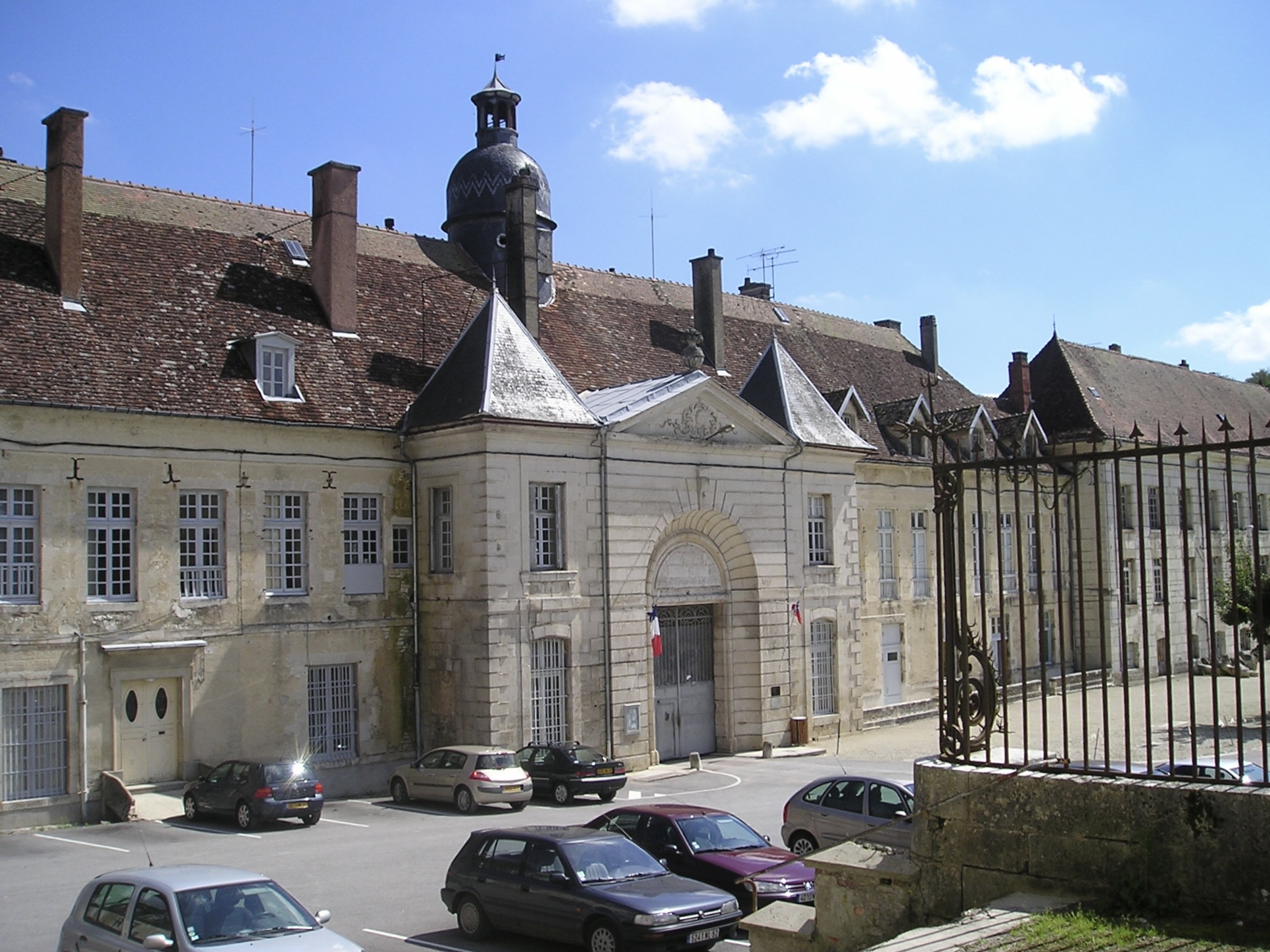
I posted two years ago about my visit to what remains of Clairvaux. This was rather depressing as although there is a visitor centre in the forecourt the remaining portions of the abbey are still used as a prison, to which limited access is possible at certain times - we were not able so to do. It seems extraordinary to me that a site of such historic and spiritual interest shoulds still, after more than two centuries, be used as a prison by the French authorities. The atmosphere is, as I said above, rather depressing and slightly sinister, as well as frustrating to the pilgrim

John Dillon has posted what he describes as some period-pertinent images of St Bernard on the medeval religion discussion group as follows:

a) as depicted (at left, in prayer with bishop St. Malachy of Armagh) in a late thirteenth-century copy (ca. 1280-1300) of French origin of the Legenda aurea (San Marino, CA, Huntington Library, ms. HM 3027, fol. 106r; image greatly expandable):
http://tinyurl.com/28tzdt3

b) as depicted (standing central figure plus scenes from the life) in a late thirteenth-century altarpiece of Catalan origin (ca. 1285-1290; either Barcelona or Mallorca) in the Museu de Mallorca:
http://tinyurl.com/qa56v5u [click on "Ampliar Imagen"]

 http://images.ara.cat/cultura/Retaule-Sant-Bernat-ISAAC-BUJ_ARAIMA20150518_0209_5.jpg

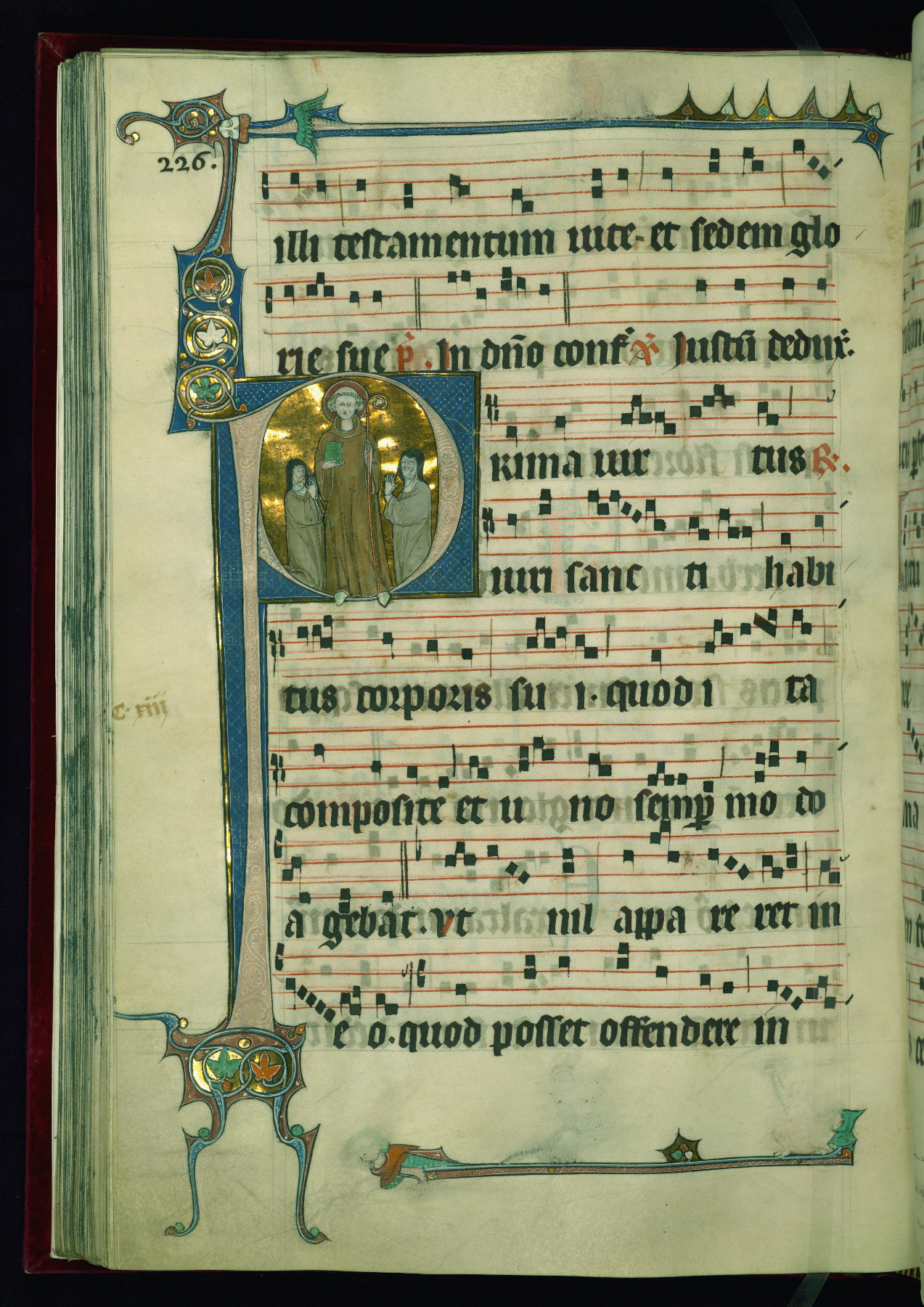
c) as depicted (flanked by two nuns) in the late thirteenth-century Beaupré Antiphoner (ca. 1290) from a house of Cistercian nuns in the diocese of Cambrai (Baltimore, Walters Art Museum, ms. W 760, fol. 113v):
http://www.thedigitalwalters.org/Data/WaltersManuscripts/W760/data/W.760/sap/W760_000234_sap.jpg
http://cistercians.shef.ac.uk/image_gallery/pages/0273.php

d) as depicted (at right; at left, the Emperor Conrad III) in an earlier fourteenth-century copy (ca. 1301-1325) of Vincent of Beauvais' Speculum historiale (Paris, BnF, ms. Latin 4900, fol. 184r):
http://tinyurl.com/2wzhge3

e) as depicted in an earlier fourteenth-century copy (ca. 1330) of his Epistulae (Laon, Bibliothèque municipale, ms. 168, fol. 1r):
http://www.enluminures.culture.fr/Wave/savimage/enlumine/irht6/IRHT_099811-p.jpg

f) as depicted (at left; at right, the BVM appearing to him) by Giovanni da Milano in a predella panel of his mid-fourteenth-century Prato polyptych (ca. 1343-1363) in that city's Pinacoteca comunale:
http://tinyurl.com/nascwmz

g) as depicted (at left, second from top [just beneath St. Eulalia]) as depicted either by Ferrer Bassa and Arnau Bassa or by Arnau Bassa alone in their or his mid-fourteenth-century altarpiece of the Annunciation and the Epiphany (betw. 1347 and 1360) in the Museu Nacional d'Art de Catalunya, Barcelona:
http://www.museunacional.cat/sites/default/files/015855-000.JPG

h) as depicted in a mid- to later fourteenth-century breviary for the Use of Paris ("Breviary of Charles V"; betw. 1347 and 1380; Paris, BnF, ms. Latin 1052, fol. 478r):
http://gallica.bnf.fr/ark:/12148/btv1b84525491/f965.image

i) as depicted (at center) in an earlier fourteenth-century copy (1348), from the workshop of Richard and Jeanne de Montbaston, of the Legenda aurea in its French-language version by Jean de Vignay (Paris, BnF, ms. Français 241, fol. 214r):
http://tinyurl.com/283o38m

j) as depicted (at right; at left, the BVM appearing to him) by Matteo di Pacino (a.k.a. the Master of the Cappella Rinuccini) in the central panel of his later fourteenth-century triptych of the Apparition of the Virgin to St. Bernard (1360s), now in the Galleria dell'Accademia in Florence:

 http://www.wga.hu/art/m/matteo_p/appariti.jpg

https://acrh.revues.org/docannexe/image/2768/img-1.jpg
Detail view:
https://acrh.revues.org/docannexe/image/2768/img-2.jpg

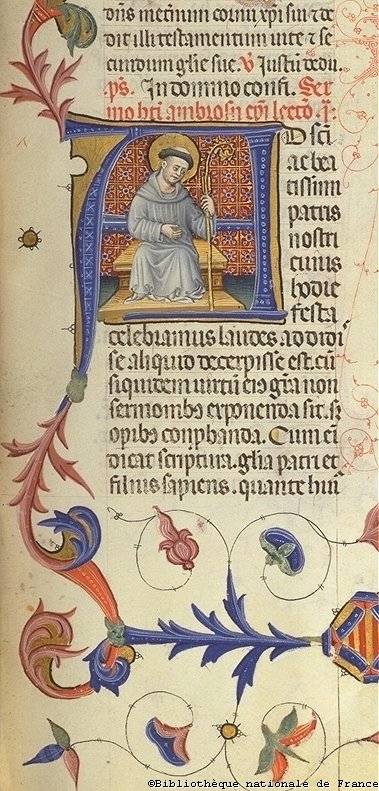
k) as depicted in a late fourteenth- or early fifteenth-century Cistercian breviary of Catalan origin ("Breviary of Martin of Aragon"; Paris, BnF, ms. Rothschild 2529, fol. 374r):
http://www.aquiweb.com/templiers/images/bernard2.jpg

l) as depicted in one of the numerous pen-and-ink illustrations in the margins of an early fifteenth-century copy (ca. 1400-1415) of the Chronicon a mundi creatione ad annum 1220, an abbreviation and continuation of the Pantheon of Godfrey of Viterbo (Paris, BnF, ms. Latin 4935, fol. 17r):
http://gallica.bnf.fr/ark:/12148/btv1b8455934w/f43.image

m) as depicted in an early fifteenth-century breviary (ca. 1414) for the Use of Paris (Châteauroux, Bibliothèque municipale, ms. 2, fol. 304r):
http://www.enluminures.culture.fr/Wave/savimage/enlumine/irht2/IRHT_054146-p.jpg

n) as depicted in an earlier fifteenth-century Franciscan breviary (ca. 1430; Chambéry, Bibliothèque municipale, ms. 4, fol. 594r):
http://www.enluminures.culture.fr/Wave/savimage/enlumine/irht1/IRHT_035713-p.jpg

o) as depicted (at left; at right, the BVM appearing to him) by Filippo Lippi (with workshop assistance?) in a mid-fifteenth-century panel painting (1447) in the National Gallery, London:
http://tinyurl.com/qxobnch

 https://upload.wikimedia.org/wikipedia/commons/e/e0/Fra_Filippo_Lippi_-_The_Virgin_Appears_to_St_Bernard_-_WGA13229.jpg


p) as depicted (left of centre, at the building of the abbey of Clairvaux) in a mid-fifteenth-century copy (betw. 1447 and 1455) of Giovanni Colonna's Mare historiarum (Paris, BnF, ms. Latin 4915, fol. 361r):
http://gallica.bnf.fr/ark:/12148/btv1b6000905v/f791.item
NB: At fol. 369v ; the BnF's image database Mandragore identifies the two standing figures as "s. hildegarde et s. bernard". Yet the manuscript's own chapter heading immediately preceding this illumination describes what follows as De Ildegarde prophetissa theutonie et Ricardo de sancto Victore et eius libris.._. One might think, then, that the standing figure in Cistercian habit and holding a book is not St. Bernard but rather his fellow Cistercian Richard of St. Victor.

q) as depicted (holding a devil on a slender chain) by the workshop of Filippo Lippi in a mid- or slightly later fifteenth-century panel painting (ca. 1447-1469) in the Metropolitan Museum of Art, New York:
https://www.metmuseum.org/toah/works-of-art/1975.1.70b


r) as depicted in a panel from a mid-fifteenth-century stained glass window (ca. 1450) of upper Rhine origin in the Musée national du Moyen Âge (Musée de Cluny) in Paris:
http://tinyurl.com/p8prbtk

s) as depicted (standing over a devil falling to the floor or arising from it) in a later fifteenth-century copy (ca. 1451-1500) from Bruges of Jean Mansel's Fleur des histoires (Paris, BnF, ms. Français 298, fol. 76r):
http://tinyurl.com/pxzp3oz

t) as depicted (upper register at center; with others of his family) in a later fifteenth-century copy (ca. 1480-1490) of the _Legenda aurea_ in its French-language version by Jean de Vignay (Paris, BnF, ms. Français 245, fol. 44r):
http://tinyurl.com/pkjav53

u) as depicted (at center; at left, the Virgin appearing to him) as depicted by Filippino Lippi in a late fifteenth-century panel painting (ca. 1482-1486) in Florence's chiesa della Badia Fiorentina:


https://upload.wikimedia.org/wikipedia/commons/7/7e/Bernardo_claraval_filippino_lippi.jpg 

Detail view (Bernard):
http://tinyurl.com/otgly5h

v) as depicted (leading a devil chained to him) in a late fifteenth-century Roman breviary (betw. 1482 and 1500; Clermont-Ferrand, Bibliothèque du patrimoine, ms. 69, fol. 1v):
http://www.enluminures.culture.fr/Wave/savimage/enlumine/irht4/IRHT_081510-p.jpg

w) as depicted by the Master of the Modena Book of Hours in a late fifteenth-century Dominican missal from Lombardy (ca. 1490-1500; The Hague, Museum Meermanno, Ms. 10 A 16, fol. 211v):
http://manuscripts.kb.nl/zoom/BYVANCKB%3Amimi_mmw_10a16%3A211v_init

x) as depicted (at right, his lactation by the BVM) in a late fifteenth-century miscellany of canon law (ca. 1490-1500; Troyes, Médiathèques de l'Agglomération Troyenne, ms. 41, fol. 1r):
hxtp://www.enluminures.culture.fr/Wave/savimage/enlumine/irht7/IRHT_108351-p.jpg

y) as depicted (lower register at right) in the very late fifteenth-century Prodigal Son window of the cathédrale Saint-Pierre-et-Saint-Paul in Troyes (baie 232; after July 1499):


z) as depicted (his lactation by the BVM) in an early sixteenth-century collection of private prayers and devotions in Latin and in French (ca. 1501-1520; Oxford, Bodleian Library, MS Douce 264, fol. 38v):
http://tinyurl.com/qdzrl7y

aa) as depicted in an earlier sixteenth-century window panel (baie 6; window is from ca. 1501-1525 with extensive late C19 additions) in the église paroissiale Sainte-Savine in Sainte-Savine (Aube):
http://therosewindow.com/pilot/Troyes-St-Savine/w16-c2.htm

bb) as depicted (with his parents, Aleidis and Tesclin; here considered saints) in earlier sixteenth-century window panels (ca. 1505-1508) thought to have come from the Cistercian abbey of Mariawald in today's Heimbach (Lkr. Düren) in the Eifel southwest of Köln and now in the Metropolitan Museum of Art, New York:
https://www.flickr.com/photos/wallyg/2190512206


cc) as depicted (being tempted by a devil) in an early sixteenth-century book of hours for the Use of Rome (ca. 1510; Tours, Bibliothèque municipale, ms. 2104, fol. 149r):
http://www.enluminures.culture.fr/Wave/savimage/enlumine/irht2/IRHT_051185-p.jpg


dd) as depicted in thirteen panels of varying size from a suite of earlier sixteenth-century windows (after 1535) on the life of Bernard from the Cistercian abbey of Altenberg in today's Odenthal (Lkr. Rheinisch-Bergisches Kreis) just east of Köln and now in Köln in the Museum Schnütgen:
http://tinyurl.com/nfhvggr

Gordon Plumb added  a link to his album on Flickr of the St Bernard panels from Altenberg now in St Mary's Shrewsbury:
https://www.flickr.com/photos/22274117@N08/albums/72157611911914112


Thursday, 11 December 2014

The Memorare Prayer


As part of their coverage of the feast of the Immaculate Conception this week the Zenit newsagency had a post about the Memorare prayer. This widely used prayer is often attributed to St Bernard of Clairvaux (1090-1153). However the online article at Memorare argues that in fact it originates as part of a longer fifteenth century prayer, and that the attribution to St Bernard comes from confusion with its seventeenth century populariser Fr Claude Bernard. Nonetheless the article contains stories suggesting the efficacy of the prayer.

The Catholic Church grants a partial indulgence, initiated by Pope Pius IX in 1846, for those who devoutly recite the emorare. It is said that in order to receive a grace, the prayer should be recited at least nine times consecutively.

Mother Teresa of Calcutta was particularly devoted to the recitation of this prayer. It has been said that along with her fellow sisters, this prayer was recited almost 25,000 times to obtain the healing of a nun who was gravely ill.


Remember, O most gracious Virgin Mary,
that never was it known
that anyone who fled to thy protection,
implored thy help,
or sought thy intercession
was left unaided.
Inspired with this confidence,
I fly to thee, O Virgin of virgins, my Mother;
to thee do I come; before thee I stand, sinful and sorrowful.
O Mother of the Word Incarnate,
despise not my petitions,
but in thy mercy hear and answer me.
Amen.


Friday, 19 July 2013

Clairvaux


On our ourney northwards across Burgundy we entered the heartland of the Cistercian Order, and passed the sign for Citeaux itself. Further on, and near to the Gaullist shrine of Colombey les Deux Eglises we came to the sign for Clairvaux and decided to break our journey for lunch there.  

The village is quite pretty, and the monastic enclosure quite clearly defined by its perimeter wall, but the home of St Bernard is today a rather sad place for the pilgrim or historian.


 St Bernard of Clairvaux 


Image: fatherhollywood.blogspot.co.uk


Founded in 1115 on a site immediately to the west of the present enclosure the house expanded and produced agreat number of daughter foundations under the example and influence of its great abbot. In 1134/5 it moved to the present site, two decades before St Bernard died in 1153. The conventual buildings were nearly all replaced by the present complex in 1708 - as at Paray and cluny evidence once again of vitality amongst the monastics of the Ancien Regime, but following the revolution the abbey became a prison, which it remains to this day, and in 1808 the medieval  church was destroyed.


 Clairvaux before the eighteenth century rebuilding and post-revolution destruction

Image:gardenvisit.com


Although it is still a prison, there is a visitors centre in the Hostellerie des Dames, which dates from about 1500, and where we had lunch in a common room, with good information displays about the abbey on the walls. We did not have time, but one can pay and enter part of the prison - no cameras, mobile phones etc - and see the surviving cloisters.