Once I was a clever boy learning the arts of Oxford... is a quotation from the verses written by Bishop Richard Fleming (c.1385-1431) for his tomb in Lincoln Cathedral. Fleming, the founder of Lincoln College in Oxford, is the subject of my research for a D. Phil., and, like me, a son of the West Riding. I have remarked in the past that I have a deeply meaningful on-going relationship with a dead fifteenth century bishop... it was Fleming who, in effect, enabled me to come to Oxford and to learn its arts, and for that I am immensely grateful.


Showing posts with label Issoire. Show all posts

Monday, 24 August 2015

Something missing at St Bartholomew the Great Smithfield?


Before leaving today and the feast of St Bartholomew it gives me an opportunity to reprise a point I made in my talk the other week to the Second Spring Summer School on A Shattered Culture, about what we have lost in this country due to active iconoclasm in the sixteenth and seventeenth centuries and through subsequent neglect, and, in this case, from later misunderstanding.

The priory church of St Bartholomew the Great in Smithfield is one of the very few medieval churches to survive in central London, although it is not as well known as it should be. A substantial part of the priory church - presbytery and transepts - survives, and is a fine example of early twelfth century work - the priory was founded by Rahere, jester to King Henry I:


Image: bellatrovata.com


Image: beenthere-donethat.org.uk


When we visit it can be very grateful that it has survived and feel we are seeing something of medieval London. 

However what we are not seeing is the colour that would have enriched the church. This changes the atmosphere  and experience. A medieval church was 'other' than that day to day living because it was, in the modern phrase, 'sacred space.'  Entering a medieval church was to enter a foretaste of Heaven. Yet this point seems still to be lost on so many people. I have even known distinguished academics in medieval history who have dismissed medieval colour schemes as garish and somehow imply we are better off without them.

To visualise the interior of St Bartholomew's as it would once have been is difficult - we have fragments and pieces but little in the way of complete schemes, or if they are they are faded  and pale. At Issoire in central France one such scheme has been recreated in 1857-59 - albeit controversially in the eyes of some, but maybe they also do not like the fact of  colouration. Like St Bartholomew Issoire has stilted arches around the apse making the comparison all the easier:


Image;phototeque-arnaudfiche.com


Image; revue.shakti.pagesperso-orange.fr


Image:auvergnecentrefrance


Image:auvergnecentrefrance


Even if you might quibble about shades and detail as Issoire I still imagine - not having been and only knowing it from photographs - that here one does get and idea of what a great twelfth century church looked like. Just because we have lost that tradition in England does not make it wrong. Scrubbed grey stone is not what twelfth century patrons, architects and artists set out to create. Personally I like the impression I have formed of the interior of Issoire. It's just a case of waking up and smelling the incense...


Image:phototeque-arnaudfrichphoto.com


Image:flickr.com


Image:rando-planetepuydedome.com


Thursday, 28 November 2013

Colouring in the medieval church


A post on the Medieval Religion discussion group pointed me to an article in last weekend's Observer about the use in this country at Norton priory in Cheshire of laser projections to supply the colour to medieval sculpture that time and neglect have destroyed. The article can be read here.

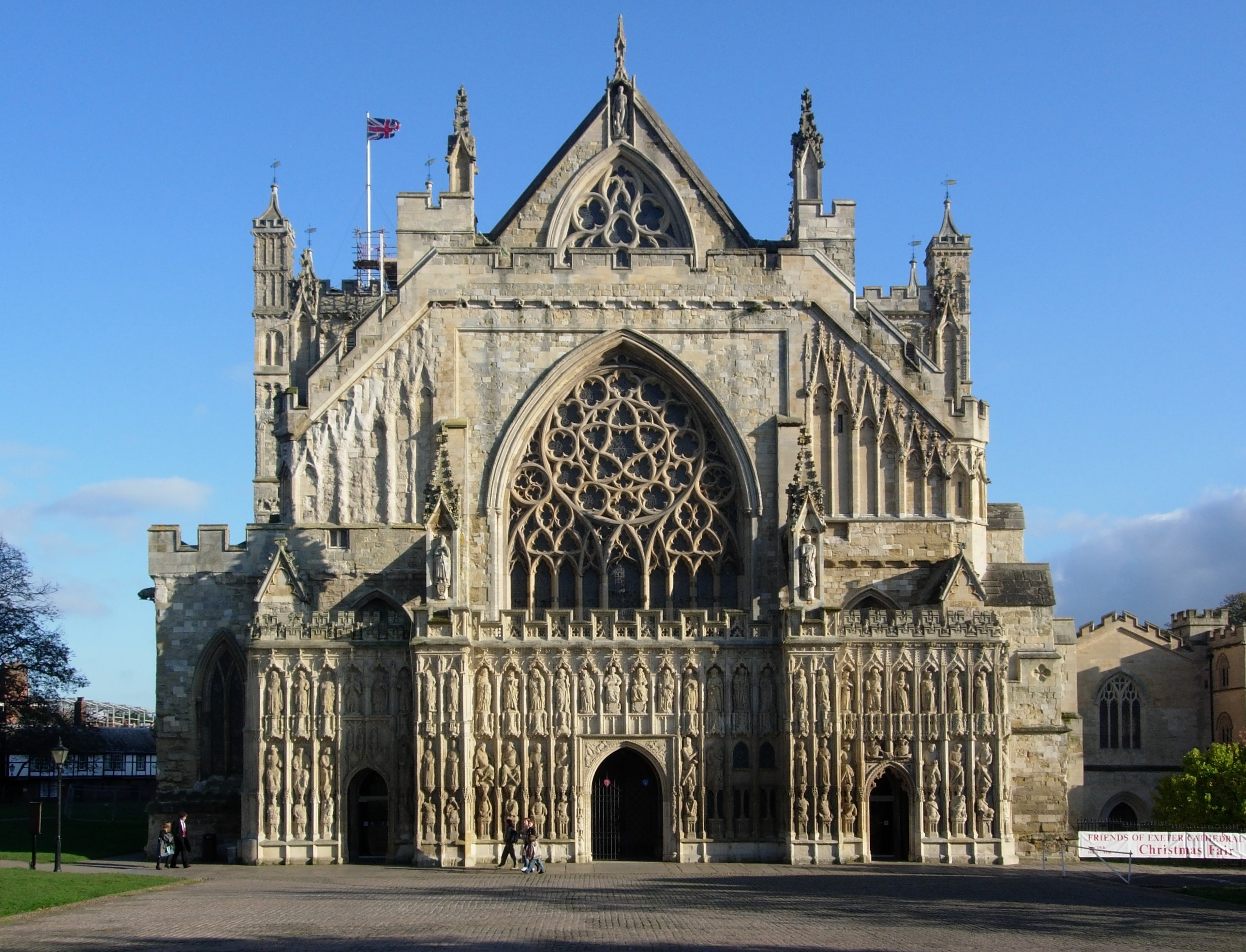
The technology to do these recreations of medieval splendour was developed for the cathedral in Amiens, and I have posted about this before. However I have no scruples about making the point again, that medieval cathedrals were splendidly painted on the outside as well as the inside. At Exeter cathedral you can buy a guide leaflet which indicates with what splendour and sophistication the statues late-fourteenth century screen of the west front were painted. This is the result of careful study of the surviving fragments of pigment.


File:Cathedral of Exeter edit.jpg

The west front of Exeter cathedral

Image:Wikipedia
As the Observer article suggest this is not an expensive technique maybe we can hope to see such spectacular effects as are achieved at Amiens this side of the Channel.

The loss of the polychrome decoration of the walls and statues of medieval churches whether romanesque or gothic both in the interior and on the exterior is an impoverishment of the original concept and of our appreciation of what the patrons and builders intended.

These magnificent buildings retain their physical grandeur, but their walls, now usually plain stone, would appear incomplete or "bare ruined choirs" to a medieval worshipper or visitor. Too often even those knowlegeable about the middle ages do not give thought to what is missing, or, if they do, they dismiss it as having been crude and gaudy. There really is no case for that view when you look at surviving examples - such as the restored scheme at Issoire in central France - or at medieval manuscripts or glass, or indeed at serious reconstructions, as by Pugin and others. At the basilica in Maastricht there is an external doorway still painted as it would have been originally:


Image: churchmousewebsite.co

Once you realise the colour should be there you become ever more concious of its absence.


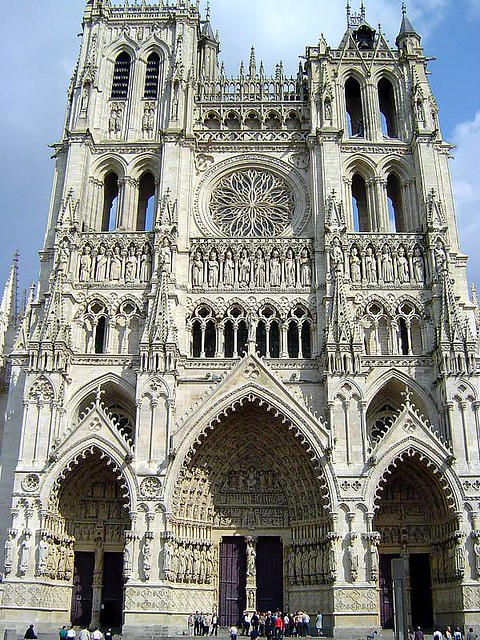
The west front of Amiens cathedral by day

Image: Daniel Mitsui

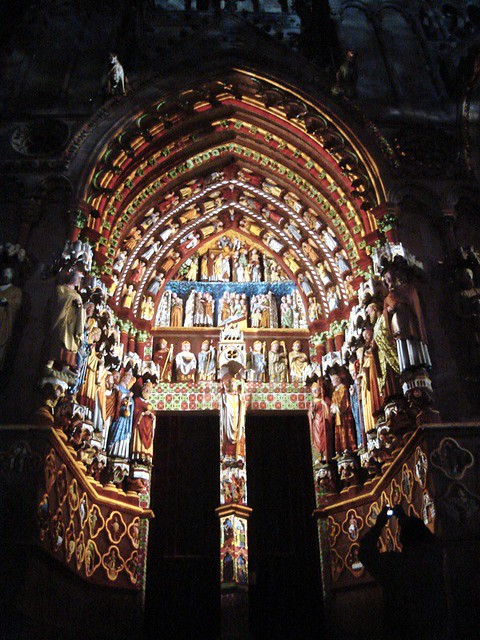
None of the great thirteenth century French Cathedrals have had their exterior repainted, but Amiens cathedral can offer visitors an idea of its original scheme. On summer nights and special occasions, spotlights and lasers are projected at the façade, bathing the ornaments and statuary in bright colours and creating the illusion of what was once for all to see. 


photo

Amiens cathedral by night - medieval splendour recreated through modern technology

Image:amyinberlin on Flickr


One of the western portals of Amiens at night with the colour projected on to the sculpture

Image:amyinberlin on Flickr


Monday, 23 April 2012

St George at Fordington


Possibly the earliest carving to indicate English devotion to St George can be seen at the church dedicated to him at Fordington, which is now part of Dorchester in Dorset. His cult, as being that of an essentially eastern saint in England appears to have developed after the Crusades

The church as it now stands is mainly a handsome later medioeval structure, but over the south door is this carving:


http://farm4.staticflickr.com/3530/3881686872_10c94a36c4_z.jpg?zz=1


Image: Pryderi on Flickr
It is thought to depict St George coming to assistance of Crusaders when they were  hard pressed by the Saracens at the battle of Dorylatum 1097. The Christain soldiers kneel in prayer or thanksgiving  on the left as St George sees off their opponants on the right. There are some small differences in the armour of the two groups.

I suppose one must imagine the carving originally to have been painted like the carvings at Issoire about which I posted at Easter.


The sculpture can be seen, as I saw it one evening,from outside the church as it is in the open porch - it is well worth walking out to from the centre of Dorchester if you are visting that very interesting town.


Sunday, 8 April 2012

He is not here -The Three Marys at the Tomb at Issoire


Here are the images from Issoire of the discovery of the Empty Tomb by the Three Marys on Easter Day:

R-33-63500-0008-19409 2668px x 4059px - 22.23 cm x 33.82 cm @ 300 ppp RGB


Images :romanes.com/Issoire

Friday, 6 April 2012

Good Friday at Issoire


In this capital at Issoire the scourging at the pillar is depicted:


and here Christ carries the Cross to Calvary:


Images :romanes.com/Issoire

Thursday, 5 April 2012

The Last Supper at Issoire


Last November in I wrote in Colour in the medieval church - St Austremoine de Issoire about the spectacular and elaborate restored colour scheme of that Romanesque church at Issoire in the Auvergne. Although the tones of the pigments might be disputed it is possible by looking at the decoration of the basilica to imagine what other great churches looked like in the twelfth century and later.

I thought I would publish over the Triduum some of the capitals depicting the story of Easter. Here is the capital depicting the Last Supper.


R-33-63500-0000-19401 2678px x 4070px - 22.31 cm x 33.91 cm @ 300 ppp RGB

Images :romanes.com/Issoire

Thursday, 3 November 2011

Colour in the medieval church - St Austremoine de Issoire


In addition to being All Saints Day November 1st is the feast day of a number of individual saints, including St Austremonius, traditionally held to be the first Bishop of Clermont Ferrand, and whose shrine church is the basilica of St Austremoine at Issoire in the Auvergne.

I have not had the good fortune so far to visit it, but judging by photographs the present church is a fine example of twelfth century architecture from the region, as can be seen in the links. I am particularly interested in it because of its internal decoration.

sg5_029__892x1200_The nineteenth-century restoration restored or renewed the colour scheme of the building as first completed. This is not to everyone's taste, but it does appear in essence that it is what was intended and executed.

Personally I accept that it is what the patrons and builders intended, so who are we to fault them? If the colours are not as they would have been it is regretable, but still better than bare stone or plaster - which was not intended

A whole series of expandable images of the basilica and its decoration can be viewed here and here and from the Art Roman site here.

A series of posts the other year on the Medieval Religion discussion group drew out comments such as:

When I visited Saint-Austremoine d'Issoire, the neighboring curates sniffed at two things: the plaster capitals and the truly, to our eyes, garish painting of the walls. When I objected rather blandly that medieval churches were painted after all, the horrified response was "But not like that!" After all this discussion.... I'm wondering now if Issoire is an example of exactly how churches were painted.

and

Although one can never be sure about the colour quality of pictures on the web, the colour red on the pillars seems to me to be too modern and bright. That colour was not known in the Middle Ages as a pigment. It was used in dyes for broadcloth, although this was usually a bit more orangy. On the other hand the figures on the capitals are too light. The colours are mixed with too much white and so appear to be 'pastel' hues.

and

While there are some churches of substantial size which have extensive painted programmes (e.g., Issoire -assuming that the restoration reflects the original reality- St. Savin-sur-Gartemp ,more telling might be the quite large number (~100?) of very, very modest minor churches which, from what we can see of what remains, were also given extensive mural programs...and what are we to do with Chauvigny - assume that the painted ashlar reflects the original decor, given the extensive sculpture and the painting of the columns?

There is a page of links to some photos of modest churches, in just one small region of France, which appear to have had extensive murals here ; note that all save St-Benny (which has no surviving paint, though it surely originally had it) are modest churches.

Lavardin is a "normal" sized "parish" (priory, actually) church, while Montoire (also a priory of Marmoutier) is just plain tiny, as is the spectacular Berzé-la-Ville. Berzé is exceptional, not because of its size and the quality of its painting, but because of its origins - it was the chapel of a vacation residence of the Abbot of nearby Cluny (and we may reasonably assume that its paintings reflect, in their style and iconography, what was to be seen in the Mother Church). Although only the paintings of the apse survive, there is no reason to believe that the whole of this modest building was covered with murals as well.

The point is, if the most modest of churches were given extensive, high quality decoration, it is simply absurd to think that the larger churches (which "owned" the smaller ones, after all) were not given the same treatment - and, methodologically, that we cannot use them to reconstruct what some of those mother churches looked like themselves, most of them having been subsequently rebuilt. [Adapted from the original post]


It is clear that fashions changed in decoration then as now - a lighter style came in with the early Gothic, followed by lavish colour schemes in the fourteenth century - the style A.W. Pugin revived and adopted for many of his churches - and a more restrained style appeared again in the fifteenth century - when larger windows reduced the wall space available to be painted.

What we are presnted with is a whole scheme, not a few fragments, and one that integrates sculpture and the architecture with the painted surfaces. Thus ground colour and stencilling provides the frame and context for figurative work. This is not putting a coat of paint on the walls- it is theology and liturgy expounded and integrated in a piece of Heaven on earth. To enter the building is to enter the presence of God and meet him in His sacraments

Issoire may be gaudy, but so, in many ways was the age that produced it. So, come to think of it, and in its own way is the Sistine Chapel, and no-one, other than a fully paid up Iconoclast, wishes it other than it is.


The High Altar and apse

Image: romanes.com


A view from the ambulatory


Image: romanes.com


Capitals and a chevet chapel ceiling

Image: romanes.com


Capital depicting the Women at the Tomb

Image: romanes.com

Issoire enables us to see something of the visual culture that surrounded the people of the twelfth century and against which their political dramas, intellectual achievements and spiritual insights were worked out and played out.

I think it would be wonderful if the great churches, and indeed the parish churches, that survive from this period still looked like this - as they were intended to be, and there for the greater glory of God.