Once I was a clever boy learning the arts of Oxford... is a quotation from the verses written by Bishop Richard Fleming (c.1385-1431) for his tomb in Lincoln Cathedral. Fleming, the founder of Lincoln College in Oxford, is the subject of my research for a D. Phil., and, like me, a son of the West Riding. I have remarked in the past that I have a deeply meaningful on-going relationship with a dead fifteenth century bishop... it was Fleming who, in effect, enabled me to come to Oxford and to learn its arts, and for that I am immensely grateful.


Showing posts with label Amiens cathedral. Show all posts

Friday, 29 August 2025

The reputed head of St John the Baptist at Amiens


Today is the feast of the Decollation of St John the Baptist. 

My previous posts for this feast can be seen at A German Reliquary of St John the Baptist from 2020, and which looks at a tooth relic of St John in a medieval reliquary from the Guelph Treasure. The Beheading of St John the Baptist from 2023 looks at the possible site of his martyrdom and some late medieval images of his death.  The Decollation of St John the Baptist from last year, which looks at two earlier seventeenth century paintings of the beheading by Matthias Stom from Malta.

A while ago I came upon a video which sets out the story, and the historical context, of how the reputed head of the saint travelled from the sack of Constantinople in 1204 and came to Amiens, and how this led the Bishop to rebuild the cathedral.

The video, which includes some fine images of the actual relic but also of the cathedral, can be seen at Does Amiens Cathedral REALLY have the Head of John the Baptist?


May St John the Baptist pray for us

Wednesday, 24 February 2016

St John the Baptist


John Dillon posted on the Medieval Religion discussion group about the Orthodox feast of the First and Second Finding of the Head of St John the Baptist, which falls today. I posted about it previously in The First and Second Findings of the Head of St John the Baptist last year, but this year there is an interesting further post from Paul Chandler O, Carm. about a recent discovery that is pertinent to the feast:


Guibert de Nogent (1053-1121) already noted in his Treatise on Relics the existence of several "heads of John the Baptist", one in Constantinople and another in Angers. At the time of composition he did not know of another nearby head of the Baptist which was given to the bishop of Amiens in 1206 and was the occasion for the construction of the cathedral <http://www.atlasobscura.com/places/the-head-of-st-john-the-baptist-at-amiens-cathedral>. There is another in San Silvestro in Capite in Rome, and another in the Umayyad Mosque in Damascus, and various others. 

Interestingly, recent archaeological work at the ancient church site of Sveti Ivan (Saint John) near Sozopol in Bulgaria turned up bone fragments in a 5/6th-century marble casket from Constantinople. Surprisingly, carbon-dating assigned a 1st-century date to the bones, and DNA testing a Middle Eastern origin. That does not prove a connection to John the Baptist, of course, but is intriguing. Some non-credulous reports:

    Science Daily:

    Reuters:

    Oxford News&Events:

    Archaeology In Bulgaria (illustrations):

Saturday, 29 August 2015

The Beheading of St John the Baptist


Today is the feast of the Decollation or Beheading of St John the Baptist.

Here is a late medieval depiction of the event in a carving from the north choir ambulatory of Amiens cathedral. The cathedral still possesses one of the skulls which is claimed, and has been claimed for centuries, to be the head of the Baptist. I have posted about this great relic previously.


Image:ww1westernfront.gov.au


It was a much later French artist, Pierre Puvis de Chavannes (1824-98), who produced what is, to my mind one of the most compelling - and perhaps disturbing - images of the Decollation. Painted in 1869 and exhibited at the Paris Salon of 1870 this is now in the Barber Institute in Birmingham, with another, and later, version, possibly unfinished, and less compelling, in the National Gallery in London:


The National Gallery version

Image: Wikimedia

Writing of this painting the Web Gallery of Art says that it exemplifies Puvis' ideals and methods. whilst almost certainly unfinished its lean pain surface is characteristic of the artist. During his travels he had fallen in love with  ' Italian primitive ' frescoes and it was their flat matt surfaces that he tried to imitate. Deriving the composition from church frescoes Puvis distorts bodies - such as the executioner's muscular back - to appear parallel to the picture surface, or at right angles to it in strict profile. Perspective is suppressed and space behind the fig tree is patterned by its branches into two-dimensional shapes.

These features can be seen again in the Birmingham painting, but here more clearly dominated by the calm, full face figure of St John, his nimbus drawing attention to his as the central figure in the frozen moment of time.


Image: oldpainting.tumblr.com

The contrast between the victim's stillness, prayerfulness, trustfulness and the sweeping movement of the executioner is striking. This is one of the reasons why the image is haunting.

What also makes the painting so striking is the youthfulness and vulnerability of the saint. He appears less fierce, more human, than he often does in paintings - not just the last of the prophets but also the son of Zechariah and Elizabeth.

The full face depiction of the pale face and body are reminiscent of the facing alabaster panels from the late middle ages which were popular products of the English alabasterers.


Image:culture24.org.uk


St John the Baptist pray for us


Tuesday, 24 February 2015

The First and Second Findings of the Head of St John the Baptist


Traditionally today is the feast of St Matthias the Apostle, which was transferred in the 1970 novus ordo to May 14th. However as John Dillon pointed out on the Medieval Religion discussion group it is also a feast of St John the Baptist:

In Orthodox and some other Eastern-rite churches of the Chalcedonian persuasion February 24th is the feast of the First and Second Finding(s) of the Head of St. John the Forerunner. Roman-rite martyrologies from at least the ninth century through to the modern Roman Martyrology prior to its revision of 2001 entered under that day a commemoration of the Finding (later, the First Finding) of the Head of St. John the Baptist. The Coptic Orthodox Church celebrates these Findings in a feast of the Appearance of the Head of St. John the Baptist on 30. Amshir (9. March; 24. February, old style).

In Greek tradition the First Finding took place in the time of Constantine the Great (306-337) and was effected by two monks informed by John in a dream. The recovered head was brought in secret to another place where in time it came into the possession of an Arian who used its miracle-working presence to bring about cures for which he took the credit and who, having been exiled, buried the head against an intended return that never happened. Later, after a monastery had been built over the place where the head was hidden, John appeared to the monastery's hegumen Marcellus, apprised him of what lay beneath, and so put in motion the Second Finding. Coptic Orthodox tradition is very similar but identifies the churchman who effects the Second Finding as Martianus, bishop of Emesa. In the Latin tradition represented by the later ninth-century martyrology of Usuard of Saint-Germain the Finding took place in the time of the Emperor Marcian (450-457); this accords with the customary dates for the Second Finding (either 452 or 453).

According to its originally eleventh-century Hypotyposis (handbook of arrangements), at the Theotokos Evergetis monastery in Constantinople on only this feast and that of the Forty Martyrs of Sebaste would the monks break their fast during Great Lent.

Some medieval images of the First and Second Findings of the Head of St. John the Forerunner:

a) The First Finding as depicted (with Constantine and others present) in the later tenth- or very early eleventh-century so-called Menologion of Basil II (Città del Vaticano, BAV, cod. Vat. gr. 1613, p. 420; reduced grayscale view):

b) The First Finding (at bottom left) as depicted in an eleventh- or twelfth-century menologion of undetermined origin (Paris, BnF, ms. Grec 1528, fol. 216r):

c) The First Finding as depicted (panel at lower right) in an earlier fourteenth-century set of miniatures from Thessaloniki (betw. 1322 and 1340) for the Great Feasts (Oxford, Bodleian Library, MS Gr. th. f. 1, fol. 28r):

d) The Second Finding (note the presence of the monastery church) as depicted in the St. John the Forerunner cycle in the earlier fourteenth-century frescoes (1330s) in the diakonikon of the church of the Hodegetria in the Patriarchate of Peć at Peć in, depending upon one's view of the matter, either Serbia's province of Kosovo and Metohija or the Republic of Kosovo:

e) The First Finding (upper register; lower register: the Entombment of St. John the Forerunner) as depicted in the earlier sixteenth-century frescoes (1545 and 1546) by Theofanis Strelitzas-Bathas (a.k.a. Theophanes the Cretan) in the chapel of St. Nicholas in the katholikon of the Stavronikita monastery on Mt. Athos:

f) The First and Second Findings (bottom register, last two panels at right) as depicted in an earlier sixteenth-century icon, from Nyonoks in the Arkhangelskaya region, of St. John the Forerunner with scenes from his life, now in the Arkhangelsk Fine Arts Museum:
The Second Finding is represented by John's appearance to the hegumen Marcellus.

g) The First and Second Findings (bottom register, last two panels at right) as depicted in an earlier or mid-sixteenth-century Yaroslavl School icon of St. John the Forerunner with scenes from his life, now in the Art Museum in Yaroslavl:

h) The First and Second Findings (bottom register, last four panels at right) as depicted in two pairs of scenes (John's appearances; actual findings) in a mid-sixteenth-century Yaroslavl School icon of St. John the Forerunner with scenes from his life, now in the Museum of History and Architecture, Yaroslavl:

I will add that several places have claimed to possess the head. the best known in the west is Amiens cathedral, and there are articles about this relic at The Head of St. John the Baptist at Amiens Cathedral,at Priest Maxim Massalitin. The Untold Story of the Head of St. John and at The head of the Precious Forerunner in Amiens, France


The Head of St John the Baptist at Amiens

Image:ivarfjeld.com


The Shrine in the cathedral

Image:ww1westernfront.gov.au

Thursday, 28 November 2013

Colouring in the medieval church


A post on the Medieval Religion discussion group pointed me to an article in last weekend's Observer about the use in this country at Norton priory in Cheshire of laser projections to supply the colour to medieval sculpture that time and neglect have destroyed. The article can be read here.

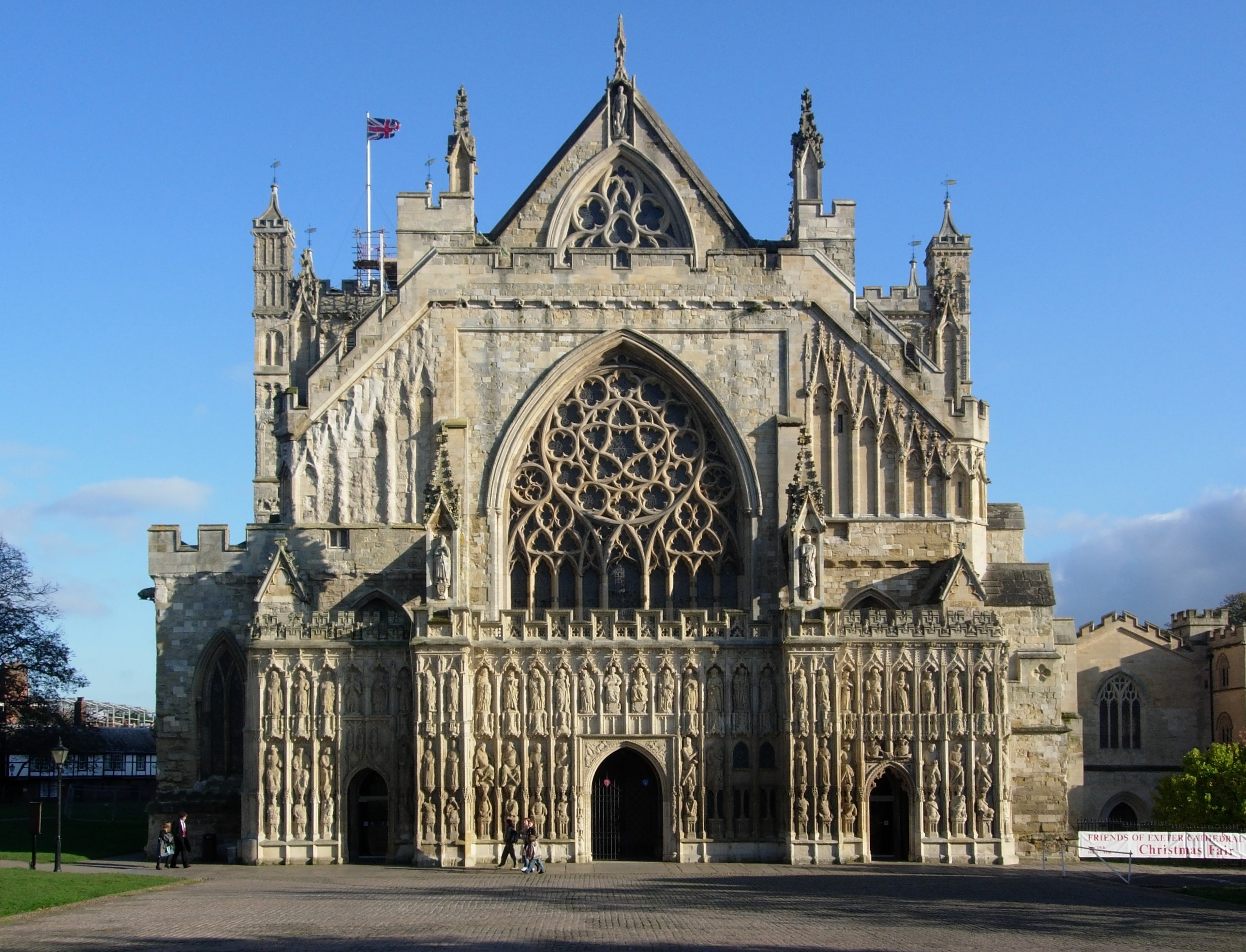
The technology to do these recreations of medieval splendour was developed for the cathedral in Amiens, and I have posted about this before. However I have no scruples about making the point again, that medieval cathedrals were splendidly painted on the outside as well as the inside. At Exeter cathedral you can buy a guide leaflet which indicates with what splendour and sophistication the statues late-fourteenth century screen of the west front were painted. This is the result of careful study of the surviving fragments of pigment.


File:Cathedral of Exeter edit.jpg

The west front of Exeter cathedral

Image:Wikipedia
As the Observer article suggest this is not an expensive technique maybe we can hope to see such spectacular effects as are achieved at Amiens this side of the Channel.

The loss of the polychrome decoration of the walls and statues of medieval churches whether romanesque or gothic both in the interior and on the exterior is an impoverishment of the original concept and of our appreciation of what the patrons and builders intended.

These magnificent buildings retain their physical grandeur, but their walls, now usually plain stone, would appear incomplete or "bare ruined choirs" to a medieval worshipper or visitor. Too often even those knowlegeable about the middle ages do not give thought to what is missing, or, if they do, they dismiss it as having been crude and gaudy. There really is no case for that view when you look at surviving examples - such as the restored scheme at Issoire in central France - or at medieval manuscripts or glass, or indeed at serious reconstructions, as by Pugin and others. At the basilica in Maastricht there is an external doorway still painted as it would have been originally:


Image: churchmousewebsite.co

Once you realise the colour should be there you become ever more concious of its absence.


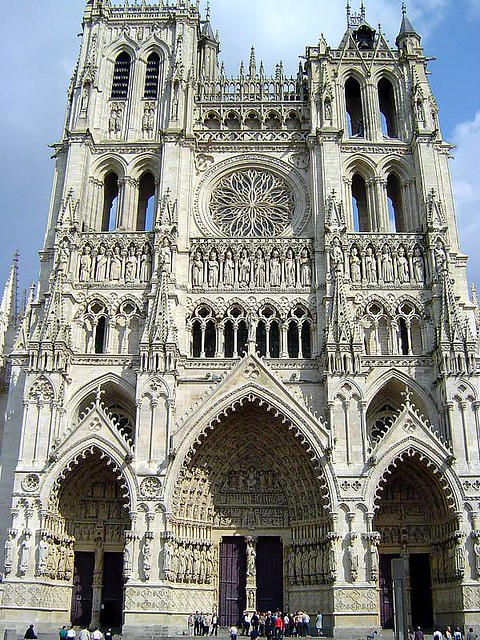
The west front of Amiens cathedral by day

Image: Daniel Mitsui

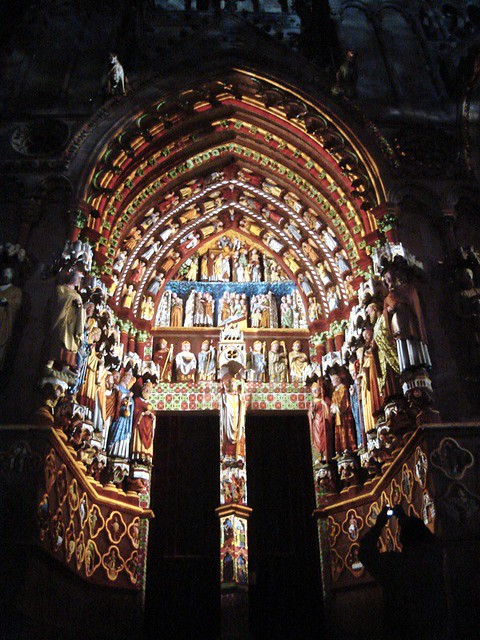
None of the great thirteenth century French Cathedrals have had their exterior repainted, but Amiens cathedral can offer visitors an idea of its original scheme. On summer nights and special occasions, spotlights and lasers are projected at the façade, bathing the ornaments and statuary in bright colours and creating the illusion of what was once for all to see. 


photo

Amiens cathedral by night - medieval splendour recreated through modern technology

Image:amyinberlin on Flickr


One of the western portals of Amiens at night with the colour projected on to the sculpture

Image:amyinberlin on Flickr


Friday, 28 December 2012

Holy Innocents


Today is the feast of the Holy Innocents' and I am again using a selection of images posted by John Dillon on the Medieval Religion discussion group site to mark the day.

The story was frequently depicted in medieval churches, and the form often predictable, but the works are also of considerable interest for contemporary details, especially of military dress.


http://upload.wikimedia.org/wikipedia/commons/e/eb/RomaSantaMariaMaggioreArcoTrionfaleSxRegistro3.jpg


Mosaic of the fifth-century on the triumphal arch, Basilica of Santa Maria Maggiore, Rome

Image: Wikipedia


http://www.wga.hu/art/zgothic/mural/12c2/03catala.jpg

Fresco of circa 1180, Panteón de los Reyes, Colegiata de San Isidoro, Léon

Image: World Gallery of Art


The earlier thirteenth-century apse mosaic of circa 1220 of Rome's Basilica of San Paolo fuori le Mura has a depiction unusual for the medievalperiod showing the Innocents as nimbed martyrs rather than as children being slaughtered:

[3+-+Detail+2.jpg]

Image: 4.bp.blogspot.com
 
In addition to being unusual this particular part of the mosaic is also seldom seen. Since the basilica's rebuilding in the nineteenth century this section of the mosaic has been hidden from ordinary view by a neo-classical entablature as can be seen in the photographs here  and here

St Paul's is the stational church for today as it held relics of the Holy Innocents, and hence their depiction in the mosaic.  


Relief circa 1220 - 1236, south portal, west facade, Amiens cathedral


Image:medievalart.org.uk


http://www.bluffton.edu/~sullivanm/strasbourg/westntympdet.jpg

Tympanum relief between 1280 and circa 1285, north portal, west facade, Strasbourg cathedral

Image:bluffton.edu.

photo

Glass panel circa 1385 by Jakob Acker the Elder, Ulm Minster

Image:gerfaut.d on Flickr

http://www.burgenseite.com/faschen/terlan_ritter_5.jpg

  
Detail from a wall painting of 1407, 
chiesa parrocchiale di Santa Maria Assunta / Pfarrkirche St. Mariä Himmelfahrt at  Terlano / Terlan (BZ) in the South Tyrol 

Image:burgenseite.com


Hugo van der Goes, c1440-1482, Massacre of the Innocents

Hugo van der Goes circa 1440-1482

Part of a larger work at the Hermitage Museum, St Petersburg.

Image: fixcas.com

Finally here are two rather lurid versions of the story by Matteo di Giovanni, showing how he re-worked the painting for another comission:

http://www.wga.hu/art/m/matteo/innocent.jpg


Panel painting of 1482  by Matteo di Giovanni, Chiesa di Sant'Agostino, Siena, where he had produced similar images for the mosaics of the cathedral floor. This is considered to be his masterpiece

Image: World  Gallery of Art


File:Matteo di Giovanni 002.jpg 


Panel painting of 1488 by Matteo di Giovanni, Museo nazionale di Capodimonte, Naples

Image: Wikipedia


Thursday, 27 December 2012

St John the Evangelist in Christian Art


Last year on this day I posted in St John the Evangelist  about images of him, and this year, thanks to a post by John Dillon on the Medieval Religion discussion group which gives fifty ancient and medieval images of the saint, I am sharing some of those from the western tradition which struck me as being particularly interesting or noteworthy.


http://www.foxnews.com/static/managed/img/Scitech/Spotlight%20on%20John_slideshow_604x500.jpg 

This figure is thought to be St John
It is late fourth century and in the catacomb of St Tecla in Rome

Image: John Dillon 

Plaque carved in elephant ivory at Aarchen in the early ninth century, now in The Cloisters Collection in New York.

Until 1977, when it appeared at a London auction, this ivory from the Carolingian Renaissance was unknown. Carved in high relief, the frontally enthroned Evangelist displays his Gospel with the opening phrase IN PRINCI / PIO ERAT / VERBVM ("In the beginning was the Word" [John 1:1]). The arch, with its rich acanthus decoration, is supported by elaborate columns and encloses John's symbol, the eagle, which is directly above him. The entire composition is framed by a simple inscribed border. The text of this inscription is based on a line from the "Carmen Paschale," a poem by the fifth-century Christian writer Sedulius. Among the remarkable features of this ivory are John's loose, classical pallium and mantle, whose calligraphic treatment and plasticity verge on pure fantasy. This tendency toward a sumptuous ornamental effect, in which the abundant drapery patterns and textures take on a life of their own, becomes a characteristic of several ivories of the Court School of Charlemagne (r. 768–814). Artistically, these ivories are very close to the manuscripts produced in Aachen for the court of Charlemagne; this resemblance suggests that they probably were carved there. Some scholars have maintained that some of these ivories may date into the reign of his successor, Louis the Pious (814–840).


Image and notes : Metropolitan Museum New York


[Iluminura.+São+João+Evangelista,+do+Evangelho+do+Abade+Wedricus.+1147..jpg]

St John as depicted on the surviving leaf of the mid-twelfth-century (ca. 1147) Wedricus Gospels
Societé Archéologique et Historique, Avesnes-sur-Helpe (Nord) France

Image: John Dillon

At Chartres cathedral in the souith aisle of the nave there is an early thirteenth century window illustrating stories about him from the Golden LegendThe Sacred Destinations page about it, with expandable images, can be viewed here. St John is also featured in the sculptured figures of the Apostles at Chartres:

photo

Chartres Cathedral Earlier thirteenth century central portal of the south transept

From left to right: SS Paul, John, James the Great, James the Less and Bartholomew

Image: Gordon Plumb on Flickr

Slightly later in date, and showing significant stylistic development are the statues of Apostles and Prophets at Amiens cathedral on the Last Judgment portal of 1220 - 1236.  These include this figure of St John, carrying his emblem of a chalice with a serpent:

Amiens Cathedral: Last Judgment Portal: St. John the Evangelist

Image: © 2008 Holly Hayes/Art History Images. All rights reserved.


There are pictures of all these portal statues here and here.


http://upload.wikimedia.org/wikipedia/commons/5/5b/Saint_John_on_Patmos.jpg

St John on Patmos as depicted in the  Très Riches Heures of the Duc de Berry of 1412 and 1416
(Chantilly, Musée Condé, ms. 65)

I like the way the Evangelist's eagle obediently holds his pen case and ink well.

Image: Wikipedia

By this early fifteenth century date one of the conventions was well established whereby St John was depicted with long, often ringletted, hair, as by Jan van Eyck in this grisaille figure on the outer side of the St Bavon Altarpiece of 1432 in Ghent:


http://www.wga.hu/art/e/eyck_van/jan/09ghent/2closed2/l3johne.jpg

Image: World Gallery of Art

This type of depiction was very common during the Renaissance, both in Italy and in northern Europe. Here is one example from Bavaria:

http://upload.wikimedia.org/wikipedia/commons/5/50/Riemenschneider_Evangelisten_Johannes.jpg


Limewood statue of 1490-1492 by Tilman Riemenschneider
From the predella of the high altar of the St. Magdalenenkirche in Münnerstadt (Lkr. Unterfranken) in Bavaria, now in the Bode-Museum in Berlin

Image: Wikipedia


There is more about the wonderful work of the sculptor here.

In Italy there was also a continuing tradition of depicting him as an older man, and indeed as a very old man, as in this marble sculpture by Donatello from 1410-11:

http://www.wga.hu/art/d/donatell/1_early/duomo/3john_1.jpg


Statue in Museo dell'Opera del duomo, Florence

Image: World Gallery of Art
These are, of course, only a sample of depictions of a figure who has attracted a lot of attention and inspired varied images from artists in many mediums over the centuries


Tuesday, 25 September 2012

Amiens at night


Writing about Amiens cathedral earlier reminded me that I had on file these pictures of the west front as it can be seen at night, when an idea of the original colour scheme of its painted statuary can be re-created by modern technology.


None of the great thirteenth century French Cathedrals has been repainted, but Amiens Cathedral offers its visitors a hint of its original beauty. On summer nights and special occasions, spotlights and lasers are projected at the façade, bathing the ornaments and statuary in bright colours.


Images amyinberlin
I also found on YouTube two short film sequences that give an idea of the spectacle Amiens affords on these occasions, and a reminder of just what medieval worshippers and pilgrims saw as they approached and entered the cathedral of Notre Dame:


St Firmin and his relics at Amiens - a late medieval view


Today is the feast of St Fermin (also spelt Firmin). There is an informative account of his life and cult here with expandable illustrations of the polychrome panels about his life, death and miracles in Amiens cathedral which are featured below.

According to legend St. Fermin, a native of Pamplona and a disciple of St. Saturninus of Toulouse, founded the first church in Amiens in the third century and was martyred there on September 25th 303. Not much is known about him and his biography considered to be mostly an invention of the eighth century.

The legend as it developed from the eighth century onwards the life of St. Fermin is told in these late Gothic polychromatic reliefs made between 1490 and 1530 and which ornament the tomb of Adrien de Henencourt, formerly Dean of the cathedral, in the south ambulatory.  They depict his story in terms of contemporary late medieval life, and with wonderful vigour and detail. The following series of photographs are, I think, considerably better than those attached to the online account I have linked to above.


Fermin being desperate to achieve martyrdom travelled from the south of France to the pagan areas of Gaul (northern France). He was arrested by the Roman authorities in Lisieux but for some reason the governor died and he was released. He then travelled to Amiens.

Saint Firmin PreachingSaint Firmin Preaching


Detail Saint Firmin Preaching

Detail of the scene above

Baptising the People of AmiensBaptising the People of Amiens

where he established a large church, and where he converted and baptised many of the inhabitants.


Arrest and BeheadingArrest and Beheading

The pagan priests are then supposed to have reported Fermin to visiting Roman officials, who had him arrested and beheaded.

File:St Firmin decapitated.jpg
The martyrdom of St Fermin
Image: Wikipedia

Exhumation of the RemainsExhumation of the Remains

At the begining of the seventh century the then bishop of Amiens, St Salve, got the people and clergy to pray for a sign as to where Fermin's body was buried. On the third day God sent a ray of the sun, which pierced the wall of the monastery where the body lay. When the faithful dig there they find the body of St Fermin. A sweet odour arose from the grave

Bringing the Relics To AmiensBringing the Relics To Amiens

As the body was carried through the streets of Amiens a number of miracles happen: the sweet odour from the relics causes ice ans snow to melt, trees and meadows flowered and came into leaf, trees inclined reverently towards the saint, the sick were healed, and the rich released their servants and serfs from servitude.


Unless otherwise indicated the images are from professor-moriarty.com, and I am very grateful  to Christopher Crockett of the Medieval Religion Discussion group for the link.