Once I was a clever boy learning the arts of Oxford... is a quotation from the verses written by Bishop Richard Fleming (c.1385-1431) for his tomb in Lincoln Cathedral. Fleming, the founder of Lincoln College in Oxford, is the subject of my research for a D. Phil., and, like me, a son of the West Riding. I have remarked in the past that I have a deeply meaningful on-going relationship with a dead fifteenth century bishop... it was Fleming who, in effect, enabled me to come to Oxford and to learn its arts, and for that I am immensely grateful.


Showing posts with label Beheading of St John the Baptist. Show all posts

Wednesday, 24 February 2016

St John the Baptist


John Dillon posted on the Medieval Religion discussion group about the Orthodox feast of the First and Second Finding of the Head of St John the Baptist, which falls today. I posted about it previously in The First and Second Findings of the Head of St John the Baptist last year, but this year there is an interesting further post from Paul Chandler O, Carm. about a recent discovery that is pertinent to the feast:


Guibert de Nogent (1053-1121) already noted in his Treatise on Relics the existence of several "heads of John the Baptist", one in Constantinople and another in Angers. At the time of composition he did not know of another nearby head of the Baptist which was given to the bishop of Amiens in 1206 and was the occasion for the construction of the cathedral <http://www.atlasobscura.com/places/the-head-of-st-john-the-baptist-at-amiens-cathedral>. There is another in San Silvestro in Capite in Rome, and another in the Umayyad Mosque in Damascus, and various others. 

Interestingly, recent archaeological work at the ancient church site of Sveti Ivan (Saint John) near Sozopol in Bulgaria turned up bone fragments in a 5/6th-century marble casket from Constantinople. Surprisingly, carbon-dating assigned a 1st-century date to the bones, and DNA testing a Middle Eastern origin. That does not prove a connection to John the Baptist, of course, but is intriguing. Some non-credulous reports:

    Science Daily:

    Reuters:

    Oxford News&Events:

    Archaeology In Bulgaria (illustrations):

Saturday, 29 August 2015

The Beheading of St John the Baptist in popular medieval art


There are many images of the death of St John the Baptist - some of which I have posted in previous years. From his photo-archive Gordon Plumb has posted on the Medieval Religion discussion group some images in stained glass and one mural painting of the beheading of St John the Baptist:

Rouen Cathedral, Bay 53, early 13thC.:
https://www.flickr.com/photos/22274117@N08/15081555403

Bourges, Cathédrale St Étienne, Bay 20, c.1210-15:
https://www.flickr.com/photos/22274117@N08/4279131415

Wickhambreux, St Andrew, Kent, south aisle, east window, very late 14thC.:
https://www.flickr.com/photos/22274117@N08/3894491654
and detail:
https://www.flickr.com/photos/22274117@N08/3894495614

York Minster, nXXII, (glass originally in St John the Evangelist Micklegate):
https://www.flickr.com/photos/22274117@N08/3217764487

Gresford, All Saints, Trevor Chapel, East window, 3a, c.1498:
https://www.flickr.com/photos/22274117@N08/15236211207

and amongst surviving wall paintings there is

Pickering, St Peter and St Paul, south nave arcade, wall painting, 15thC.:
https://www.flickr.com/photos/22274117@N08/9578703780


The Beheading of St John the Baptist


Today is the feast of the Decollation or Beheading of St John the Baptist.

Here is a late medieval depiction of the event in a carving from the north choir ambulatory of Amiens cathedral. The cathedral still possesses one of the skulls which is claimed, and has been claimed for centuries, to be the head of the Baptist. I have posted about this great relic previously.


Image:ww1westernfront.gov.au


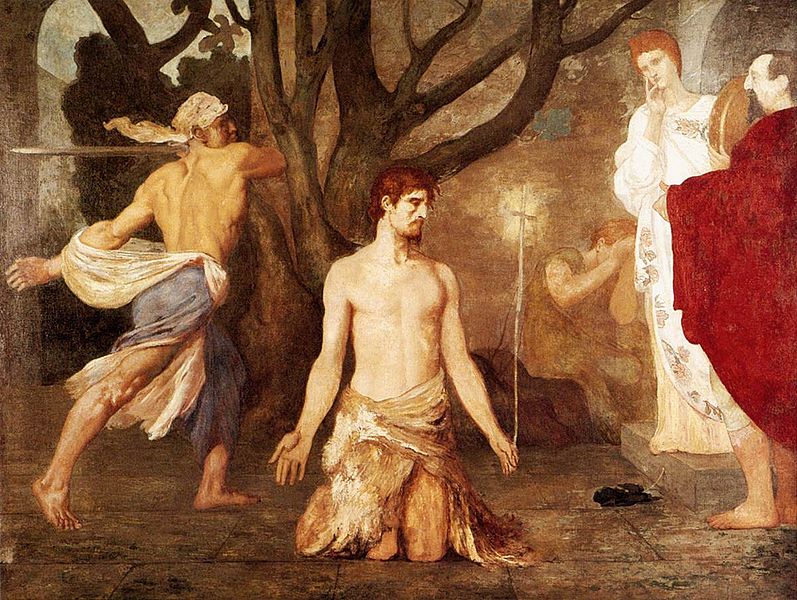
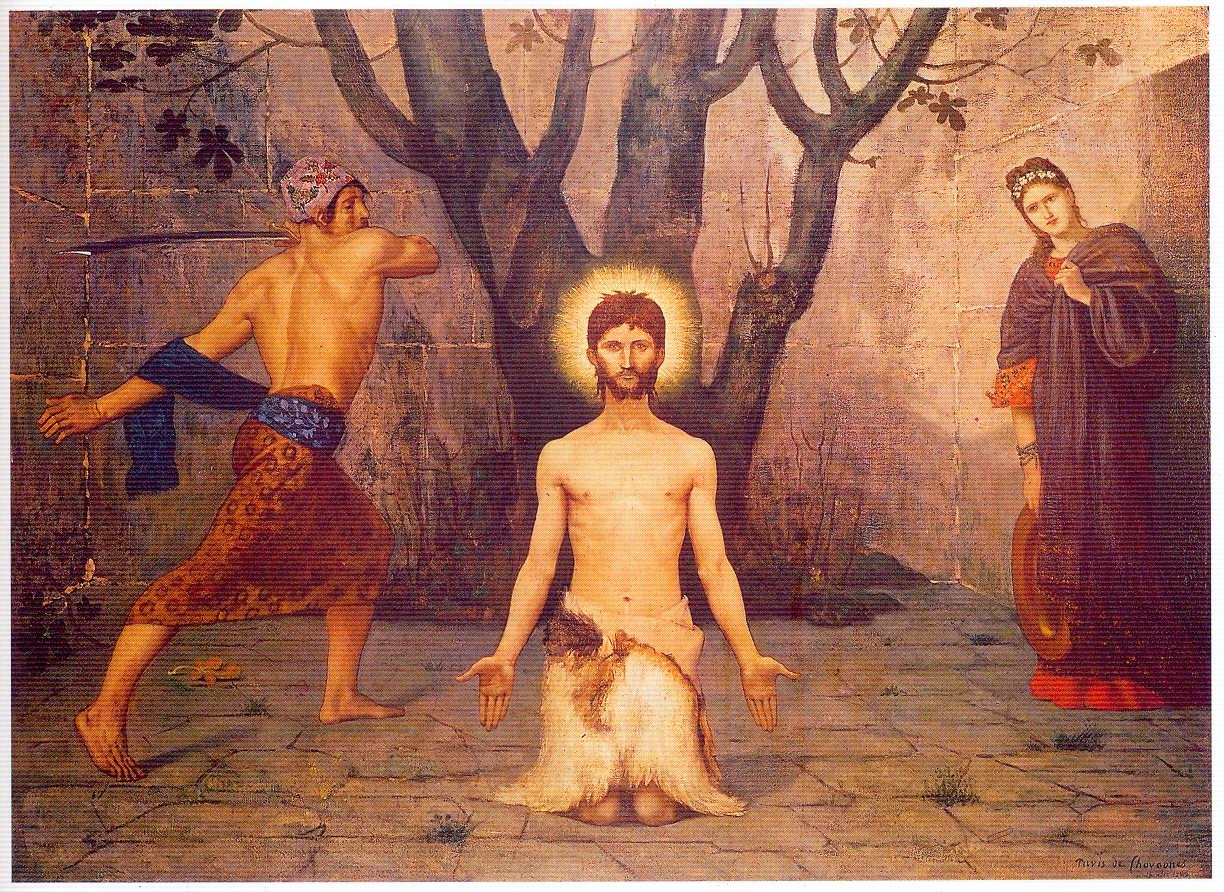
It was a much later French artist, Pierre Puvis de Chavannes (1824-98), who produced what is, to my mind one of the most compelling - and perhaps disturbing - images of the Decollation. Painted in 1869 and exhibited at the Paris Salon of 1870 this is now in the Barber Institute in Birmingham, with another, and later, version, possibly unfinished, and less compelling, in the National Gallery in London:


The National Gallery version

Image: Wikimedia

Writing of this painting the Web Gallery of Art says that it exemplifies Puvis' ideals and methods. whilst almost certainly unfinished its lean pain surface is characteristic of the artist. During his travels he had fallen in love with  ' Italian primitive ' frescoes and it was their flat matt surfaces that he tried to imitate. Deriving the composition from church frescoes Puvis distorts bodies - such as the executioner's muscular back - to appear parallel to the picture surface, or at right angles to it in strict profile. Perspective is suppressed and space behind the fig tree is patterned by its branches into two-dimensional shapes.

These features can be seen again in the Birmingham painting, but here more clearly dominated by the calm, full face figure of St John, his nimbus drawing attention to his as the central figure in the frozen moment of time.


Image: oldpainting.tumblr.com

The contrast between the victim's stillness, prayerfulness, trustfulness and the sweeping movement of the executioner is striking. This is one of the reasons why the image is haunting.

What also makes the painting so striking is the youthfulness and vulnerability of the saint. He appears less fierce, more human, than he often does in paintings - not just the last of the prophets but also the son of Zechariah and Elizabeth.

The full face depiction of the pale face and body are reminiscent of the facing alabaster panels from the late middle ages which were popular products of the English alabasterers.


Image:culture24.org.uk


St John the Baptist pray for us


Wednesday, 25 February 2015

An English Alabaster of the Head of St John the Baptist


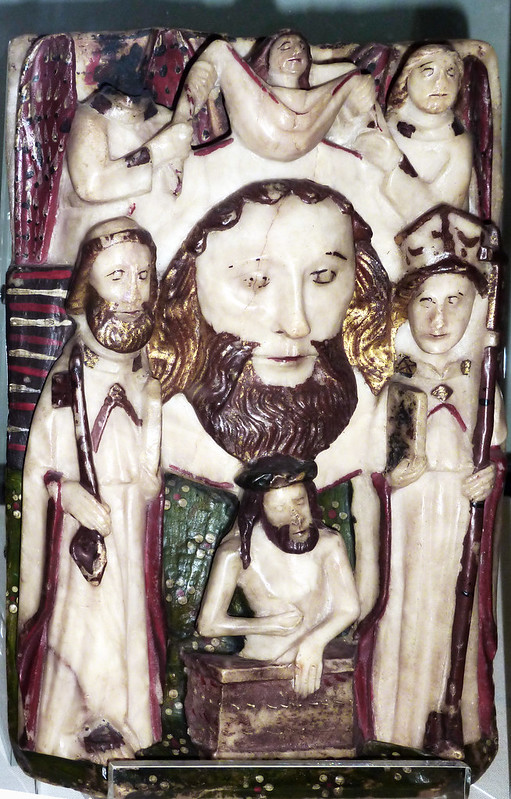
Following on from John Dillon's post which I republished in my post The First and Second Findings of the Head of St John the Baptist yesterday Gordon Plumb posted on the Medieval Religion discussion group this photograph of an English medieval alabaster from the Nottingham workshops:

photo

This panel, now in Nottingham Castle museum was purchased at Sotheby's in 1937. The head of John on a platter is central, flanked by St Peter and a bishop who is almost certainly St Thomas Becket. A Bury St Edmunds will of 1552 goes a long way to confirming this identification, for it speaks of "Seynt John hede of alabast wt Seynt Peter and Seynt Thomas and the figure of Christ". Prior to the date of this panel (c.1450-1500) we find the Agnus Dei beneath the head, but it later becomes replaced by the Christ of Pity. Above two angels hold the head in a napkin, symbolising the saint's soul being taken up to heaven. This subject is common in Nottingham alabasters, there being 20 Agnus Dei one and 45 showing the Christ of Pity. That is out of a total of 97 John the Baptist heads. The panels were designed for private devotion rather than fitting into an altar piece.

Notes and image: Gordon Plumb on Flickr

A similar piece from the Ashnolean can be seen in the Museum of the History of Science in Oxford.

Another example of this very popular medieval devotional image in a different design, and now in the Victoria and Albert Museum can be seen in my post The Decollation of St John the Baptist from last year.

John Dillon posted a further note about this and similar images of St John the Baptist, which I have slightly adapted:

Plastic images of John's head on a charger exist in media other than alabaster. Barbara Baert, "The Head of St. John the Baptist on a Platter: The Gaze of Death", Ikon (Croatia) 4 (2011), 1-12, is a useful discussion, nicely illustrated, of such images in late medieval thought and practice. It's available on the free Web at academia.edu:
TinyURL for that:

A partial answer to the question about provenances occurs in the second paragraph of this discussion (also from 2011) of the late medieval English alabasters:

Specimens of this craft were exported commercially in large numbers. Most of those that remained in England or went to Scotland will have been destroyed during the Reformation (or discarded then and destroyed later); most of those that one sees today in the Vand A (and, presumably, in the Burrell Collection as well) returned to the UK with modern travellers who had acquired them abroad.

Tuesday, 24 February 2015

The First and Second Findings of the Head of St John the Baptist


Traditionally today is the feast of St Matthias the Apostle, which was transferred in the 1970 novus ordo to May 14th. However as John Dillon pointed out on the Medieval Religion discussion group it is also a feast of St John the Baptist:

In Orthodox and some other Eastern-rite churches of the Chalcedonian persuasion February 24th is the feast of the First and Second Finding(s) of the Head of St. John the Forerunner. Roman-rite martyrologies from at least the ninth century through to the modern Roman Martyrology prior to its revision of 2001 entered under that day a commemoration of the Finding (later, the First Finding) of the Head of St. John the Baptist. The Coptic Orthodox Church celebrates these Findings in a feast of the Appearance of the Head of St. John the Baptist on 30. Amshir (9. March; 24. February, old style).

In Greek tradition the First Finding took place in the time of Constantine the Great (306-337) and was effected by two monks informed by John in a dream. The recovered head was brought in secret to another place where in time it came into the possession of an Arian who used its miracle-working presence to bring about cures for which he took the credit and who, having been exiled, buried the head against an intended return that never happened. Later, after a monastery had been built over the place where the head was hidden, John appeared to the monastery's hegumen Marcellus, apprised him of what lay beneath, and so put in motion the Second Finding. Coptic Orthodox tradition is very similar but identifies the churchman who effects the Second Finding as Martianus, bishop of Emesa. In the Latin tradition represented by the later ninth-century martyrology of Usuard of Saint-Germain the Finding took place in the time of the Emperor Marcian (450-457); this accords with the customary dates for the Second Finding (either 452 or 453).

According to its originally eleventh-century Hypotyposis (handbook of arrangements), at the Theotokos Evergetis monastery in Constantinople on only this feast and that of the Forty Martyrs of Sebaste would the monks break their fast during Great Lent.

Some medieval images of the First and Second Findings of the Head of St. John the Forerunner:

a) The First Finding as depicted (with Constantine and others present) in the later tenth- or very early eleventh-century so-called Menologion of Basil II (Città del Vaticano, BAV, cod. Vat. gr. 1613, p. 420; reduced grayscale view):

b) The First Finding (at bottom left) as depicted in an eleventh- or twelfth-century menologion of undetermined origin (Paris, BnF, ms. Grec 1528, fol. 216r):

c) The First Finding as depicted (panel at lower right) in an earlier fourteenth-century set of miniatures from Thessaloniki (betw. 1322 and 1340) for the Great Feasts (Oxford, Bodleian Library, MS Gr. th. f. 1, fol. 28r):

d) The Second Finding (note the presence of the monastery church) as depicted in the St. John the Forerunner cycle in the earlier fourteenth-century frescoes (1330s) in the diakonikon of the church of the Hodegetria in the Patriarchate of Peć at Peć in, depending upon one's view of the matter, either Serbia's province of Kosovo and Metohija or the Republic of Kosovo:

e) The First Finding (upper register; lower register: the Entombment of St. John the Forerunner) as depicted in the earlier sixteenth-century frescoes (1545 and 1546) by Theofanis Strelitzas-Bathas (a.k.a. Theophanes the Cretan) in the chapel of St. Nicholas in the katholikon of the Stavronikita monastery on Mt. Athos:

f) The First and Second Findings (bottom register, last two panels at right) as depicted in an earlier sixteenth-century icon, from Nyonoks in the Arkhangelskaya region, of St. John the Forerunner with scenes from his life, now in the Arkhangelsk Fine Arts Museum:
The Second Finding is represented by John's appearance to the hegumen Marcellus.

g) The First and Second Findings (bottom register, last two panels at right) as depicted in an earlier or mid-sixteenth-century Yaroslavl School icon of St. John the Forerunner with scenes from his life, now in the Art Museum in Yaroslavl:

h) The First and Second Findings (bottom register, last four panels at right) as depicted in two pairs of scenes (John's appearances; actual findings) in a mid-sixteenth-century Yaroslavl School icon of St. John the Forerunner with scenes from his life, now in the Museum of History and Architecture, Yaroslavl:

I will add that several places have claimed to possess the head. the best known in the west is Amiens cathedral, and there are articles about this relic at The Head of St. John the Baptist at Amiens Cathedral,at Priest Maxim Massalitin. The Untold Story of the Head of St. John and at The head of the Precious Forerunner in Amiens, France


The Head of St John the Baptist at Amiens

Image:ivarfjeld.com


The Shrine in the cathedral

Image:ww1westernfront.gov.au

Friday, 29 August 2014

The Decollation of St John the Baptist


Today is the feast of the Decollation or Beheading of St John the Baptist. There is an online history of the feast here. In the later middle ages at least devotion to St John was very considerable,and in addition to statues and paintings there was a sizeable market in alabaster plaques, often showing his severed head on the platter. These were the work of the alabasterers of Nottinghamshire and Derbyshire in particular. Here is an example in a different style: 


St John the Baptist 1470-90 alabaster V&A

Alabaster head of St. John the Baptist, 1470-90

 Victoria and Albert Museum

Image:Shafe.co.uk 

Such images travelled widely. I am told that one was found on the ship of the Turkish commander at Lepanto in 1571. I assume it must have been captured from an English Knight of Rhodes or of Malta. Sent to Rome to be prsented to the Pope it was shown to St Philip Neri, who insisted on keeping it. It can, I understand, still be seen in his room at the Chiesa Nuova 


Thursday, 29 August 2013

The Beheading of St John the Baptist


Today is the feast of the Beheading or Decollation of St John the Baptist. 

This has attracted artists over the centuries and I post the other year about a late medieval depiction of his death in  The Decollation of St John the Baptist.

The nineteenth century French artist Pierre-Cécile Puvis de Chavannes (1824-98) produced two striking images of the death of the Great Forerunner, both of which are now in this country in the collections of the National Gallery - although it is not on display - and at the Barber Institute in Birmingham.There is another online piece about Puvis de Chavannes, who was working in the style termed Symbolism, here.

The paintings both date from 1869 and are curiously memorable, with a somewhat hypnotic quality to them, evoking a rather horrible fascination with the event. In both the stasis, the serenity, of the Saint is in striking contrast to the sweeping action of the executioner.

Puvis de Chavannes, Beheading of St John the Baptist (1869)National Gallery London

Image:christchurchwindsor.ca

Salome's features are here thought to be based on those of the Princess Cantacuzène, who married Puvis de Chavannes in 1897. The figure of Herod standing on the right may be based on the novelist Anatole France.

The cross which Saint John the Baptist holds as the executioner prepares to strike is the focus of the composition. The static character of the design is mitigated by the figure of the executioner, recalling comparable figures in Delacroix and Chassériau.

Probably unfinished, this painting remained with the painter until the time of his death.
Adapted from the National Gallery website


A related composition is now in the Barber Institute in Birmingham, and is, I think more effective and haunting - a piece I read about it in the Daily Telegraph some years ago, which first introduced me to the painting, when it was on show in London argued that this was the more considered, indeed sophisticated, and striking of the two paintings. 

Puvis de Chavannes, Execution of St. John the Baptist, 1800s on Flickr.

Click image for 1224 x 892 size.
Scanned from “Os Santos”, Elizabeth Hallam.Pierre-Cécile Puvis de Chavannes, The Beheading of St John the Baptist, c. 1869.

Pierre-Cécile Puvis de Chavannes, The Beheading of St John the Baptist, c. 1869.
Oil on canvas, Barber Institute, Birmingham.

Image:oldpainting.tumblr.com


Friday, 24 February 2012

Finding the Head of St John the Baptist


Today, February 24th, is the feast day, in Orthodox and other Eastern-rite churches, of the First and Second Finding of the Head of St. John the Forerunner i.e. the Baptist. Roman-rite martyrologies from at least the ninth century through to the modern Roman Martyrology prior to its revision of 2001 entered under today a commemoration of the Finding (later, the First Finding) of the Head of John the Baptist. Until 1970 today was the feast day of St Matthias the Apostle, as it still is in the Usus antiquior calendar.

In Greek tradition the First Finding took place in the time of the Emperor Constantine the Great (306-337). In the Latin tradition represented by the later ninth-century martyrology of Usuard of Saint-Germain the Finding took place in the time of the Emperor Marcian (450-457); this corresponds with the customary dates for the Second Finding (either 452 or 453).

As Lady Bracknell might well have observed, to lose it once might be considered unfortunate, but to lose it twice betokens carelessness.

My posts from last August for the feast of the Decollation of St John the Baptist can be seen at The Decollation of St John the Baptist and Relics of St John the Baptist. The head itself has become such a prized item that there are have been several claimants over the centuries to be the actual relic.


With acknowledgements to John Dillon's post on the Medieval Religion discussion group for today.