Once I was a clever boy learning the arts of Oxford... is a quotation from the verses written by Bishop Richard Fleming (c.1385-1431) for his tomb in Lincoln Cathedral. Fleming, the founder of Lincoln College in Oxford, is the subject of my research for a D. Phil., and, like me, a son of the West Riding. I have remarked in the past that I have a deeply meaningful on-going relationship with a dead fifteenth century bishop... it was Fleming who, in effect, enabled me to come to Oxford and to learn its arts, and for that I am immensely grateful.


Showing posts with label King Henry VI. Show all posts

Tuesday, 5 November 2024

The Coronation of King Henry VI in 1429


595 years ago today, King Henry VI was  crowned at Westminster. Two years later he was to be crowned as King of France in Notre Dame in Paris, the only Plantagenet or later monarch to receive the crowns of both realms. The young king was a month short of his eighth birthday and the move to crown him followed from the events of the spring when his uncle King Charles VIi had been crowned King of France at Reims. The view of the government was that King Henry should be crowned as soon as possible in France and that meant that his English coronation had to take place first.

In the early fifteenth century the English coronation rite had assumed probably its most elaborate form following from the compilation of the Liber Regalis in the reign of King Richard II. Thus the boy King was at the centre of a ritual that had been celebrated in 1399 for his grandfather and in 1413 for his father.At its heart was the use of the eagle ampulla believed to have been delivered by the Virgin Mary to St Thomas of Canterbury for anointing English kings, but not used before 1399.

The King Henry VI website, which unfortunately appears to be dormant,has a quite detailed description of the ceremony in Westminster Abbey and in the Palace afterwards, which can be seen at The English Coronation – KING HENRY VI

It is not a criticism of the blog author to say that this does not include everything that must have happened, such as the homage of the peers, and that there appears to be some confusion presumably on the part of the contemporary chroniclers as to some precise part of the liturgy, the account of which seems curiously repetitious or confused as to the number of the King’s prostrations and what he wore at certain  points, and not in line with the norms of an English coronation at that time or subsequently. That said a lot of what we witnessed last year in Westminster Abbey at the present King’s Coronation would have been recognisable to those attending in 1429. Whether Archbishop Chichele had as many very obvious problems getting St Edward’s Crown straight on the monarch’s head as his successor did last year is not recorded.

Effigy of Archbishop Henry Chichele in Canterbury Cathedral 

Image: Wikipedia 

There is more about the Coronation Banquet in Westminster Hall after the ceremonies in the Abbey in a feature from last year on the British Library Medieval manuscripts blog which can be seen at The Coronation Banquet of Henry VI

Some slight idea of what might have been seen that day can be gleaned from the illumination of the charter granted by the King in 1445-6 to his new fo foundation of King’s College in Cambridge.

Although the king was by now in his twenties, he is still depicted as a small boy in his robes of state supported by the Lords Spiritual ( including Cardinals Beaufort and Kempe ) and Temporal ( in the earliest serving coloured depiction of their robes with the differing bars of ermine indicating their rank ) and by the faithful Commons in Parliament assembled offering the new foundation to the Virgin Mary and to Saint Nicholas.

Detail of the Charter upon Act of Parliament, 16 March 1445-6
King Henry VI and his Lords and Commons
Image: kcctreasures.com

Detail of Henry VI from the Charter upon Act of Parliament, 16 March 1445-6 (KC/18) ©DIAMM
King Henry VI
Image:kcctreasures.com

The fact of his anointing and coronation and the oaths made to him were doubtless a very potent factor with many in rhe political elite, and hence the reluctance of a large part of the aristocracy to set the King aside in 1460 in favour of the Yorkist line. Furthermore it helps explain the continuing Lancastrian loyalism, expended in blood, until his own violent death in 1471, and even thereafter in his cult as a saint invoked by ordinary people as well as by King Henry VII.

Preparing this article, I came upon another blog Friends of Henry VI which was active iin 2019, but not seemingly since. It can be viewed at Friends of Henry VI


Friday, 17 January 2014

Ockwells Manor


Earlier today I had the good fortune to visit Ockwells Manor near Bray in Berkshire with the Oxford University Heraldry Society and the Maidenhead Civic Society. This mid-fiteenth century house is in private ownership and not usually open for visitors, so this was a rare opportunity to visit this important building.


Ockwell's Manor

Ockwells Manor
Image: Maidenhead Civic Society

There is a short online account of the house here, and a somewhat longer one from David Nash Ford's Royal Berkshire History website here. There are some fine black and white photographs of the house from the English Heritage NMR site here. There is a detailed account of the house and its related buildings from Anthony Emery's 2006 book which can be viewed at Greater Medieval Houses of England and Wales, 1300-1500 - Google Books


Ockwells Manor, Bray, Berkshire


The east front of Ockwells in 1928
The oriel windows are additions of 1889-93, when the dorrway was widened to the full width of the porch. The archway on the far left led to the chapel.

Image:© English Heritage.NMR  Ref.no. CC000307


Ockwells Manor is a manor house begun in the years 1446 - 1450 by John Norreys , Keeper of the Great Wardrobe of King Henry VI, and Treasurer of the Chamber and Keeper of the Queen's Jewels to Queen Margaret of Anjou. He remained in office under King Edward IV after 1461, and was indeed made a Knight of the Bath by the Yorkist king. There is a life of him here. The house does not appear to have been completed until about the time of Sir John's  death in 1466. Norreys imself is linked to the origin of civic life in Maidenhead; in 1451 Norreys and his brothers helped to found a guild based at a chapel in the middle of the High Street.

The house was described by Sir Nikolaus Pevsner as “the most refined and the most sophisticated timber-framed mansion in England” (The Buildings of England: Berkshire, 1966). Although it has lost its flanking wings, which contained a chapel - still being built in 1465 - and presumably lodgings for retainers, and of which only fragments survive, in the eighteenth and early nineteenth centurie, the main house has survived, as have a gateway and the barns and dovecote which face the manor across the courtyard. From about 1625 until the 1880s Ockwells was leased out, and declinedinto being a farmhouse - neglect which in many ways was benign, although there were significant losses, but by 1880 there was a serious risk that the dilapidated house would collapse or be demolished.Ockwells was one of the cases that inspired William Morris to found the Society for the Protection of Ancient Buildings. It was rescued by succesive tenants and is now, following further restoration in the 1980s, in beautiful condition.

The especial glory of Ockwells is the armorial stained glass installed by Norreys depicting the arms of his patrons and friends in the Lancastrian establishment and which is still in its original position in the windows of the Great Hall. There are views of some of these panels on the Corpus Vitrearum Medii Aevi website which can be seen here.


 http://www.countrylifeimages.co.uk/ResizedImages/VeryLarge/525974.jpg

The Great Hall
The long table, shown here on the left, is original to the building

Image: countrylifeimages.co.uk 


Armorial Stain Glass


The arms of Queen Margaret of Anjou, the Duke of Suffolk and King Henry VI in the Great Hall

Image: Maidenhead Civic Society


http://www.fromoldbooks.org/OldEngland/pages/HallAtOckwells-Berkshire/HallAtOckwells-Berkshire-500x378.jpg


The Hall at Ockwells
From Charles Knight Old England: A Pictorial Museum 1845

Image: fromoldbooks.org

The windows were removed for safety for part of the nineteenth century, and some losses have occurred to the original heraldry, and the name sof the bearers have also been lost.

The two windows in the body of the Hall show on the right the arms of John Norreys and his first wife, and his Berkshire connections, and on the left his arms impaling those of his second wife and his Worcestershire connections.Behind the glass has Norreys' motto "Faithfully Serve" and his badge of three distaffs. Along with the arms of the King and Queen only Norreys' own arms have supporters, who literally do so, hol;ding the shields up above their heads.

The bay window has at the side the mitred arms of the Abbot of Abingdon and of Bishop Richard Beauchamp of Salisbury, appointed in 1450, and there was once another ecclesiastical shield, possibly that of the Abbot of Reading. In the main section are the arms of the Duke of Warwick ( d.1446), of the Duke of Somerset (killed in 1455 at the first battle of St Albans), Queen Margaret, who married the King in 1445, the Duke of Suffolk (exiled and murdered in 1450), King Henry VI and the Earl of Wiltshire and Ormond (executed by the Yorkists in 1461). Our guide, Anne Darracott, who has done extensive research on the glass thinks the window commemorates the negotiations leading to the royal wedding, and the wedding itself, in which many of those whose arms appear were major participants.

The crowns and mitres are "jewelled" with the glass indicating the stones set into that of the insignia, and similar to glass in the Beauchamp chapel at Warwick, built after 1439.

I knew the glass from photographs, but to actually see it was privilege I very much appreciated.  A visit to Ockwells, despite all the changes of five and half centuries, does admit one to the world of the rising courtier John Norreys, his fine house and service buildings, his friends and connections and the great ones he met with in his life at Court around 1450.


Tuesday, 9 April 2013

The Coronation of King Henry V


Rather like many modern journalists on such occasions the chroniclers who recorded the coronation of King Henry V on April 9th 1413, six centuries ago, tended to remark on the less important if more obvious features. There were two in 1413 - the weather and the food. A snow storm swept across the country. A century and a half later John Foxe the Protestant martyrologist wrote of "the ninth day of April,  called then Passion Sunday, which was an exceeding stormy day, and so tempestuous, that many did wonder at the portent thereof." The contemporary chronicler Adam of Usk wrote that the day was  "...marked by unprecedented storms, with driving snow which covered the country's mountains, burying men and animals and houses and, astonishingly, even inundating the valleys and fenlands, creating great danger and much loss of life."

According to Thomas Walsingham, the monk-chronicler of St Albans, abbey people were undecided as to whether it was a good or bad omen. Some took it to be a sign of impending austerity, but others, in his view more sensibly, saw it as a positive sign, the cold and snowwould bring an end to difficult times and usher in a new era of hope and prosperity, and citing the Song of Songs, with the concept of winter now being past and the rain over and gone. To them this was the beginning of a spring.

The Coronation was held on Passion Sunday, and as a result the banquet afterwards in Westminster Hall was one with Lenten fare, so all the dishes were of fish rather than meat.

In fact we know rather less about this  coronation than about some others of the period, but the saliant features are clear.

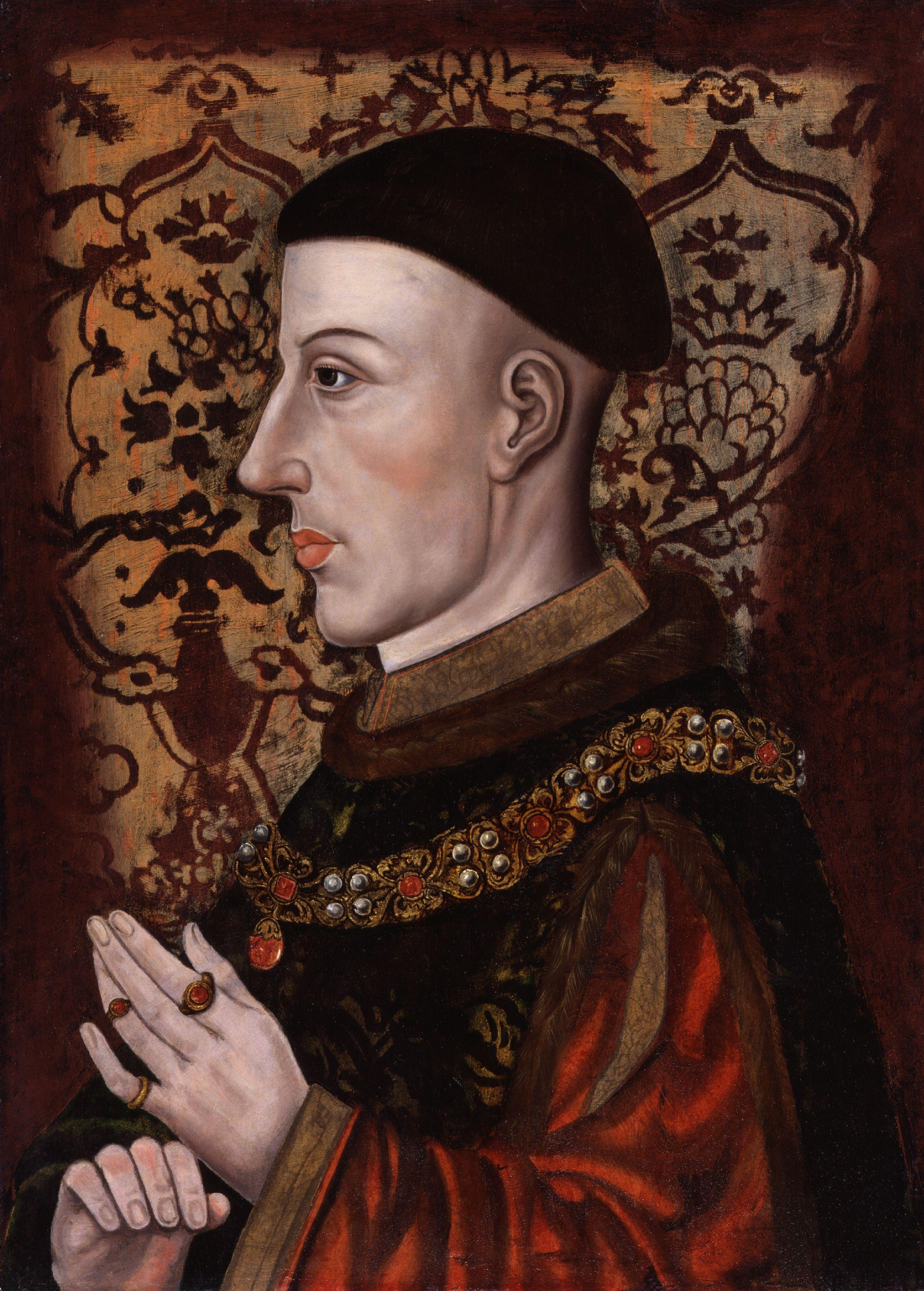
File:King Henry V from NPG.jpg

King Henry V

Image:Wikmedia

The King had arrived in London two days earlier, on April 7th, was met by many lords and knights as well as clergy and citizens in procession and took up residence at the Tower. There he was met by fifty or so candidates for knighthood who waited upon him at table at a feast that evening. The following day, having attended Mass, they rode in splendid array to the royal lodgings where they waited upon the King who dubbed them and as Knights of the Bath, escorted him through the city that day to Westminster ready for the coronation. There he was received in procession and escorted to his palace to prepare in prayer for his anointing.

The officiant at the coronation was the Archbishop of Canterbury, Thomas Arundel, who had crowned the king's father in 1399.

  Thomas Arundel (1353–1414) illuminated initial

Archbishop Thomas Arundel

Image: oxforddnb.com

 
It is possible, indeed probable, that the oil used to anoint the King was the same as usedfor his father and his son, that supply believed to have been delivered by the Virgin Mary to St Thomas Becket, left by him in France, rediscovered and brought back in its ampulla by Edward Prince of Wales, and treasured by his son King Richard II.

Early fifteenth centuries ceremonies did not always go with the smoothness one would expect of such an occasion today - Adam of Usk recorded that during the Mass the King dropped one of his obligatory noble son the floor, and both he himself and those who were present had to search carefully to find it before it could be offered up.

Within weeks Henry was to return to the abbey when he attended divine service in the church on Ascension Day and Whitsunday of 1413, and resumed funding of the rebuilding of the nave of the church that summer.

The closest contemporary depictions of the coronation are from the King's chantry which was built from 1438 onwards and completed about 1450. Its sculpture is an important record of contemporary ceremonial dress for the peers who are also represented. The scheme includes two Coronation groups, perhaps representing the acclamation and the homage:


CORONATION OF HENRY V.

The Coronation of King Henry V from his chantry chapel at Westminster

Image: Project Gutenburg text of E.H. Pearce William de Colchester Abbot of Westmisnter SPCK 1915


 In each of which the Abbot of Westminster, William Colchester, is represented as standing, in cope and mitre, on the King's left hand, Thomas Arundel, the Archbishop of Canterbury, being on the King's right hand. The other carving has the King holding the orb and flanked by the Archbishop and Abbot:


Coronation of Henry V 

The other carving of the Coronation
Above the canopy can be seen the King's badges of the antelope and the swan

Image:Corbis images

In the carving of the coronation the King is shown wearing an arched crown. This is significant. When in 1399 his father had been crowned with St Edward's crown Froissart noted that it was arched - something he clearly saw as noteworthy. The sttae crown worn by the effigy of King Henry IV at Canterbury looks to be identical, allowing that is for artistic licence between a sculptor and a painter, to that worn by King Richard II circa 1390 ;

http://www.anglophile.ru/uploads/posts/2012-06/1340705763_queens-50.jpg

King Henry IV

The head of the effigy on his tomb in Canterbury Cathedral

Image: anglophile.ru


King Richard II

The Westminster portrait of circa 1390

 Image: Wikuipedia

This appears very similar to the crown dated to 1370-80 and which was part of the dowry of King Henry IV's daughter Blanche when she married the future Elector Palatine Louis III, son of King Rupert I,  in 1402, and which can now be seen in the Munich schatzkammer. It was on display in London in 1987-8 at the Age of Chivalry exhibition.


File:Schatzkammer Residenz Muenchen crown of an english queen 1370.jpg


The crown of Blanche of Lancaster

Image: Wikipedia


However from the reign of King Henry V it appears to have become usual to depict  him and his successors wearing a crown with arches, and indeed that the actual crown did have arches long before Tudor assertions that England was an Empire, and hence the current designation of the Imperial State Crown.


  photo

King Henry V

St Cuthbert Window York Minster circa 1440

Image: Gordon Plumb on Flickr


http://www.luminarium.org/encyclopedia/henry5initial.jpg

King Henry V - an illumination of 1451-80

Image: Luminarium

The crown destroyed in 1649 and known as the King's Imperial Crown or the ' Harry Crown' has recently been reconstructed by the Historic Royal Palaces Agency and is on display at Hampton Court. Like Sir Roy Strong in his  piece about the crown in his book Lost Treasures of Britain, the HRPA attribute the crown to the reign of King Henry VII, but with no certain date. I have long thought it possible, if not probable, that the 'Harry Crown' was made for King Henry V, if not actually for his coronation, but at least during his reign. In style it has some resemblance to the Crown of St Wenceslaus in Bohemia, which dates from the mid to later fourteenth century and the reign of the Emperor Charles IV (1346-1378). That does not, of course, preclude the possibility that it may have been modified under subsequent monarchs

There is an online article from the HRPA about the making of the reproduction here, and there is more about it in this post, Henry VIII's Crown.


The reconstructed Harry Crown
Image:Lord Belmont in Northern Ireland blog 

The crown as depicted on the important but sadly damaged statue of King Henry VI from All Souls in Oxford, and probably of 1437-43, appears remarkably similar, as may be seen from this, the only image I can find on the internet:


King Henry VI - statue at All Souls Oxford 


Image; Amazon

The portrait of  King Edward IV in the Royal window at Canterbury cathedral - for which see the following post - also looks to show a very similar crown.