Once I was a clever boy learning the arts of Oxford... is a quotation from the verses written by Bishop Richard Fleming (c.1385-1431) for his tomb in Lincoln Cathedral. Fleming, the founder of Lincoln College in Oxford, is the subject of my research for a D. Phil., and, like me, a son of the West Riding. I have remarked in the past that I have a deeply meaningful on-going relationship with a dead fifteenth century bishop... it was Fleming who, in effect, enabled me to come to Oxford and to learn its arts, and for that I am immensely grateful.


Showing posts with label King Henry V. Show all posts

Thursday, 7 November 2024

A Bridgettine volume at the British Library


The British Library Medieval manuscripts blog has a feature about Harleian MS 612 from the great Bridgettine house of Syon Abbey founded by King Henry V, and which is on display as part of the Medieval Women exhibition at the Library.

It is a massive mid-fifteenth century compendium of the life of the fourteenth century monastic foundress and mystic Saint Bridget ( Birgitta ), of her writings and of writings about her. It is the work of Thomas Colyngbourne, one of the brothers of the community and written for the use of the other brothers as part of their devotional formation.

They blog article particularly concentrate on the delightful and delicate marginalia which are included to indicate important sections of the text or to pass comment upon it. 

The illustrated description can be seen on the website at Birgitta's marvellous marginalia

The remarkable history of Syon Abbey and its endurance from its foundation in 1415 down to the tragic decision to close in 2011 is set out by Wikipedia at Syon Abbey

That article is regrettably too concise in its account of the travels and travails of these English nuns living in exile until their final return to England in 1861.

In 2004 with a relative who lived nearby I paid fleeting visit to the community house at South Brent in Devon and did see one of the Sisters in her very distinctive Bridgettine habit taking her morning walk in the grounds. A rare privilege and now, alas, unavailable to others.


Friday, 25 October 2024

The road to Agincourt


Today is the anniversary of the battle of Agincourt in 1415. Probably no other comparable battle, no other comparable victory, has fixed itself, and did so even before Shakespeare, in the collective n English national self-consciousness. One result of that is a continuing range of publications about the battle and about King Henry V.

This autumn has seen the much publicised appearance of Dan Jones! new biography of the King. I have not so far looked at it, but in an online conversation Jones made a point about the injury suffered by the future King when Prince of Wales at Shrewsbury in 1403. He argues John Bradmore may have been an even more skilled surgeon than modern commentators give him credit for. This is a point I have made for several years. We also agree that surviving such an injury gave, or reinforced, a personal sense of destiny, of Divine favour, with the future King.

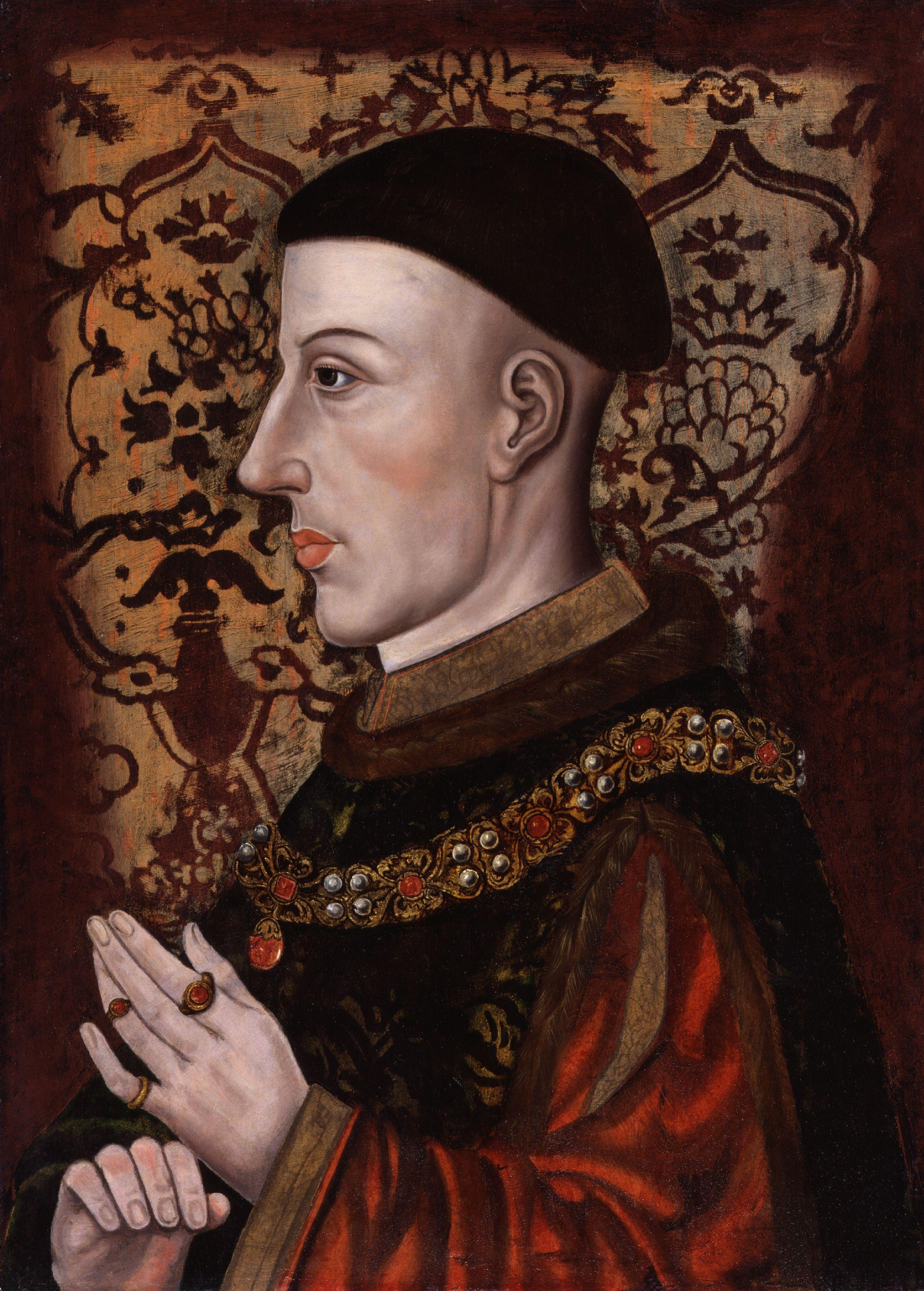
Portrait of Henry V by Unknown: Buy fine art print
King Henry V

Image:MeisterDrucke

YouTube offers a range of features in Agincourt and on the life of its victor. Two of the best are an excellent pair of podcasts by the now well-established duo of Tom Holland and Dominic Sandbrook about the events leading up to the battle fought 609 years ago at Agincourt.


Wednesday, 12 April 2017

King Henry V - boys will be boys


The BBC History Magazine online site reproduces an article from 2013 by Prof. Anne Curry about the Royal apprenticeship of King Henry V during his father's reign and the stories about his dissolute behaviour before he became King. I have copied and pasted it, and added a few comments as an afterword:

Behaving badly: Henry V's misspent youth

He’s widely feted as one of England’s greatest medieval kings but, for much of his early life, Henry looked more like a dithering also-ran than a statesman in the making. Anne Curry explores the growing pains of the hero of Agincourt.
This article was first published in the March 2013 issue of BBC History Magazine


On Friday 25 October 1415, in a muddy field in Picardy, the reputation of Henry V as a great warrior king was sealed. His victory over the French at Agincourt had a major effect on his position both at home and abroad. Even before he returned to England, a grateful parliament had granted him all revenue from customs duties – a sizeable income – for life. As for the French, they never again dared to face him in battle.

So Henry was able to conquer the whole of Normandy and advance on Paris, exploiting the divisions in France – between the Burgundian and Armagnac factions – that the defeat at Agincourt had exacerbated. The treaty of Troyes, signed in May 1420, sealed Henry’s acceptance as regent to Charles VI (‘The Mad’) and – through marriage to Charles’s daughter Katherine – heir to the throne of France. It seemed only a matter of time before he would rule over both England and France.
At the parliament held at Westminster in December 1420, the chancellor explained why the English had “special cause to honour and thank God” for the deeds and victories of the king. He had recovered the ancient rights of the English crown in France. He had destroyed heresy in the realm – a reference to his actions against Sir John Oldcastle and the Lollards (critics of the established church) in 1414. And, in his youth, he had put down rebellion in Wales.

In short, though Henry’s untimely death in 1422 curtailed the fulfilment of his plans, his career was, on the face of it, a complete success. As Thomas Walsingham, author of The St Albans Chronicle, expressed in a panegyric for the dead king: “He was a warrior, famous and blessed with good fortune who, in every war he undertook, always came away with victory.”

But had Henry always been so successful? Let us reflect on Henry’s life before he became king.
This 15th-century illustration depicts Henry, then Prince of Wales, paying homage to the French king Charles VI. The Treaty of Troyes, signed in 1420, saw Henry named Charles’s regent; by marrying the latter’s daughter, Katherine, Henry secured his position as heir to the French throne. (Credit: Bridgeman Images)
There are ample reasons to believe that Henry the prince was a far cry from Henry the king. In Henry IV, Parts 1 and 2, Shakespeare portrays him as a medieval ‘hooray Henry’. In those plays, the prince chooses bad company; though wealthy, he prefers the low life and petty criminality; and it is only at his father’s deathbed and his own subsequent coronation that he reforms himself – becoming as excessively ‘correct’ as he was once so ‘incorrect’ for his social and political position. But was this fact as well as Shakespearean fiction?

The first ‘published’ comments on Henry’s bad behaviour so far unearthed appear in the Latin lives written about him in the late 1430s. In the anonymous Vita et Gesta Henrici Quinti (often called the Pseudo-Elmham), Henry is described as being in his youth “an assiduous cultivator of lasciviousness…passing the bounds of modesty he was the fervent soldier of Venus as well as Mars; youthlike he was fired by her torches and in the midst of worthy works of war found leisure for excesses common to ungoverned age”. The work devotes much space to his last-minute repentance to his father for his bad behaviour.

We could dismiss all of this as simply a good story – except that it was dealt with at great length, and in a work known to have drawn information from one of Henry’s courtiers: Walter, Lord Hungerford.
In another work, the Vita Henrici Quinti by Tito Livio Frulovisi (now believed to have been derived from the Vita et Gesta), stories of a misspent youth and late change of heart are shorter, but remain. Given this work’s links with Henry’s last surviving brother, Humphrey, Duke of Gloucester, and the status of both works as eulogies for Henry V, we have to assume that the accounts of his youth are basically true – as are those of the well-publicised change of character at his accession.
There are many intriguing facets to Prince Henry. For one thing, he had not been born to be king. Until just after his 13th birthday, in September 1399, he was merely the eldest son of the eldest son of a collateral line of King Richard II . He stood to inherit, in time, the duchy of Lancaster created for his grandfather John of Gaunt (d.1399), the third son of Edward III. He was also to be bequeathed the earldom of Derby held by his father, Henry Bolingbroke (d.1413), and the titles brought to the family by his co-heiress mother, Mary (d1394), daughter of Humphrey de Bohun, Earl of Northampton, Essex and Hereford (d.1373).

So the career that lay ahead for the “young lord Henry” or “Lord Henry, son of the Earl of Derby”, as he is described in the financial records of his father and grandfather, was that of a peer – but at the time it seemed that he might have to wait many years for his inheritance.
Tom Mison plays Prince Hal, with David Yelland as the old king, in a performance of Shakespeare’s Henry IV, Part I. The play portrays Hal as a medieval ‘hooray Henry’. (Credit: Rex)
As it was, his life was completely transformed – first, in October 1398, by the exile of his father by Richard II; and then, the following September, by Bolingbroke’s return to England and usurpation of the throne as Henry IV.

On 15 October 1399, two days after his father’s coronation, Henry was created Prince of Wales, Duke of Cornwall and Earl of Chester, and was acknowledged as heir to the throne. Later in October, the title Duke of Aquitaine was added and, on 10 November, that of Duke of Lancaster.

Given the fragile political position of the new dynasty, Prince Henry was a vital cog in its establishment and, as such, shared in its problems – indeed, he experienced them even before the usurpation. In May 1399 the young Henry was taken to Ireland by Richard II , seemingly in an attempt to ensure his father’s good behaviour. It failed: in the king’s absence, Bolingbroke invaded England.

Education in arms

Henry was then 12 years old, an age at which it was customary for noble boys to begin gaining experience of military service, though they were not expected to actually participate in the fighting. So in the summer of 1400 he was assigned a company of troops within the huge army – over 13,000 strong – that his father took to Scotland.

Then, as the army returned to England, the Welsh revolt began. The historian Adam Chapman has observed that it was no coincidence that Owain Glyndŵr declared himself Prince of Wales on 16 September 1400 – the 14th birthday of the formal holder of the title, Prince Henry. Only six months later, the latter found himself involved in his first siege, at Conwy.


It is not surprising that the teenage prince learned under the tutelage of advisors appointed by his father. The young Henry held a number of nominal commands but was always guided by others, including Henry Hotspur, son of the Earl of Northumberland, and Hotspur’s uncle, Thomas Percy, Earl of Worcester, who was appointed Prince Henry’s governor at the end of 1401.

Yet these were the very men who, in 1403, rebelled against Henry IV and his son. So the battle of Shrewsbury on 21 July, when he faced his erstwhile mentors, must have been a chastening experience for the prince – not least because he was wounded by an arrow that pierced his left cheek. The surgeon John Bradmore removed the arrowhead, but the wound put the prince out of action for a year or so.

Even as Henry entered his late teens, his father was reluctant to give him complete authority in the Welsh wars. The young prince was neither wholly committed nor effective, and constantly complained of being kept short of funds. Alongside praise for the prince’s good heart and courage, the speaker of the parliament of March 1406 also urged that he should maintain continual residence in Wales for the sake of the wars – an indication that he had not been attentive to his duties.
All did not go well with the prince’s campaigns. In 1407, at the siege of Aberystwyth, Henry theatrically negotiated its peaceful surrender, withdrawing his troops; Glyndwˆ r, though, simply occupied the castle. Aberystwyth remained in rebel hands until September 1408 and was recovered, as was Harlech in 1409, not by the prince in person but by those to whom he delegated.
This late 15th century illustration shows prisoners being taken at Agincourt. Some of Henry’s earlier military endeavours had not met with such success. (Credit: Alamy)

Sickly and sexed up

As the late Welsh historian Rees Davies observed, the prince’s personal role in Wales was limited. Chroniclers of the wars scarcely mention him at all. He seems to have preferred to stay in the relative safety of the English border towns and, increasingly, to spend his time in and around London.
In 1409 he was appointed constable of Dover Castle and warden of the Cinque Ports but so far no evidence has been found to show that he went to Dover or Calais, the captaincy of which he gained in March 1410. Yet in 1412, the prince was investigated for misappropriating the garrison’s wages.
The overall impression formed from the sources is that King Henry IV was slow to let his son have his head, but that, as the prince grew up, his father could not hold him back. It is notable how, once he turned 21, Prince Henry began to build up his own support. Fifty-one new grants of annuities were made in the year following Michaelmas 1407, a big increase on the average for the previous six years of less than ten.

Many of Henry’s circle were nonentities, which fans the notion that he associated with unsuitable people. It also seems that he promoted favourites such as Thomas, Earl of Arundel, and Richard Courtenay, whom Henry had appointed as bishop of Norwich after his accession. Comments made by Courtenay in 1415 tell us that Henry suffered from being overweight and in bad health, and that he was of the opinion that there were no decent doctors in England.

There’s more evidence for a sickly Prince Henry in his household accounts listing purchases of medicines. These records also suggest that he may have lived beyond his means, partly because of the large payments he made to retainers. Thomas Walsingham speaks of his retinue in 1412 being “larger than any seen before these days”. Intriguingly, too, in 1415 Courtenay observed that Henry had not had sexual relations with any woman since he came to the throne – the implication being that, as the Vita et Gesta suggests, he had been notably promiscuous before his accession.

As prince and heir, we would expect Henry to have had a place on the royal council. This was the case from at least the end of 1406, when he was 20. As the medievalist Christopher Allmand observes, Prince Henry attended a good proportion of meetings but was increasingly advancing the interests of key friends and relations – including his father’s half-brother, Henry Beaufort – and challenging the power of the chancellor, Thomas Arundel, archbishop of Canterbury. Indeed, Henry’s growing influence may have contributed to Arundel’s decision to resign from the chancellorship in December 1409.
Henry married Katherine of Valois, daughter of Charles VI of France, on 2 June 1420. This painting of 1487 is from the Chroniques de France ou de Saint Denis. (Credit: AKG images)
Yet, in November 1411, it seems that the prince’s influence over the council abruptly ended. There is no doubt that Henry’s relations with his father, and with his brother, Thomas, were bad: there were major differences of opinion on foreign policy, and a study of diplomatic relations with Burgundy suggests that the prince was making offers he was simply not entitled to issue. He was  also outraged not to be chosen to lead an expedition to Aquitaine in the summer of 1412.

The seriousness of the situation is reflected in a letter sent by Prince Henry from Coventry on 17 June 1412, a missive that was clearly intended to reach a wide audience. It addressed rumours accusing him of plotting to rebel against his father and seize the throne.

Father and son became reconciled but, according to the chronicler Thomas Walsingham, Henry IV refused to punish immediately those who had spread the rumours; instead, he ordered that sanctions should wait until the next parliament, when they could be tried by their peers. This could only mean that the prince’s detractors were noblemen. Interestingly, the Latin lives made much of Henry’s last-minute reform and confession to his father – does this suggest that, despite his protestations, he might have had a guilty conscience?

Henry the prince emerges as a complex character: not always living up to expectations, making enemies and choosing unsuitable friends. He was brave but flawed, and always prioritised his own desires. Six centuries after he assumed the throne, it’s worth remembering that the road to his achievement as all-conquering hero of Agincourt was often a rocky one.

Professor Anne Curry is the dean of the Faculty of Humanities at the University of Southampton.

Related articles 

The Clever Boy thinks both those pieces are interesting, but not without error in the first case and being somewhat tendentious in the second - a point picked up in the comments section - and makes little allowance for stories of a dissolute youth.

He would also point out the error in the illustration in the main text of Henry as Prince of Wales paying homage to King Charles VI - the only possible such event would be when as King Henry V under the Treaty of Troyes in 1420 he was recognised as Duke of Normandy and Heir to King Charles for the French realm. This is a serious error in ascription.

Otherwise this is a very interesting article by a distinguished historian of the period, and the pity is that it is not longer. Were it so then it could have included the story of the Prince being committed to prison by Chief Justice Gascoigne for contempt of court when the Prince turned up and demanded the release of one of his retainers. These and similar stories may have been preserved by the family of the Earl of Ormonde who himself was part of Henry's circle. A discussion of the emotional reconcilation with his father at Westminster late in 1412 would also have been interesting - it certainly suggests the Prince exploiting the situation for all it was worth in offering his dagger to his father to kill him there and then if he considered him disloyal.The facial injury in 1403 at the battle of Shrewsbury was more serious than this article might suggest. It was life-threatening, and maybe life-changing for the teenage Prince. I shall post about that later on in the year.

If this article's assessment of the future King is correct then it makes his achievement as monarch all the more notable and reveals something of his character after 1413 as well as before. Shakespeare's portrayal may be closer than historians have thought, and what one sees is a King determined to fulfil his responsibilities despite or in reaction to his inclinations as a young man. These two aspects make him more completely human both in his limitations and in his successes.


Tuesday, 1 December 2015

December


Image: Wikipedia

The December calendar page from the Très Riches Heures is attributed to Paul Limbourg. In the foreground is a hunting scene. Judging from the way the dogs are crowding around the quarry it is difficult to know if much will be left for the seasonal feasting for which it may be intended for in the chateau - but perhaps that is just artistic licence.

In the background is the great French royal palace-fortress of Vincennes. This had originated as a  hunting lodge for King Louis VII about 1150, but had become a major royal residence during the thirteenth century. The donjon in the centre of the view was built by King Philip VI in 1337, and is the tallest building of its type in Europe. It was in the donjon that King Henry V of England and Regent of France was to die in 1422, only a few years after the minature was painted.The towers on the surrounding curtain wall were reduced to the height of the walls with one exception in the early 1800s.

There is more about the history and architercture of the fortress to be read at the link Château de Vincennes.


Saturday, 31 October 2015

Barker on Agincourt


I marked the anniversary last weekend of the battle of Agincourt by reading right through Juliet Barker's Agincourt


Image: Amazon

In my post some months ago on Prof. Anne Curry's book on the battle I described Juliet Barker's book as being more popular. That it perhaps is, but not in any slighting sense. It does perhaps set the battle and the society that existed at the time in a way that is perhaps a little more approachable to the non-specialist reader.

Although I would have some quibbles about points Juliet Barker makes, especially on church matters, her book is splendid - very readable and full of details, one that self-consciously looks at individuals and how they prepared for the campaign, such as the Earl Marshal equipping himself with armour, but not always from the same supplier, and it is a gripping read, which touches on those emotions Agincourt still evokes in the English, a point to which I referred in a recent post.

For anyone wanting to know about the battle or the wider campaign, or the military society of the time this is, perhaps, the book to read. When first published it was the fourth best selling history book of the year ( which also tells you something about the continuing fascination with the battle) and richly deserved its success.

It is quite a page turner, gives one plenty to think about - such as firing off ten arrows inside a minute to be able to qualify as an archer - and catches the sheer emotion of the success against the odds of King Henry V and his men in 1415.


Sunday, 25 October 2015

Agincourt 600


Today is the 600th anniversary of the battle of Agincourt.


Map of Henry's Route to Agincourt
 The English route to Agincourt
Each arrow represents a days travel

Image:aginc.net 

Jane Stemp Wickendon posted on the Medieval Religion discussion group King Henry V's pre-battle speech as re-written for him by William Shakeapeare almost two centuries later - still powerful and emotional stuff:


This day is called the feast of Crispian:
He that outlives this day, and comes safe home,
Will stand a tip-toe when the day is named,
And rouse him at the name of Crispian.
He that shall live this day, and see old age,
Will yearly on the vigil feast his neighbours,
And say 'To-morrow is Saint Crispian:'
Then will he strip his sleeve and show his scars.
And say 'These wounds I had on Crispin's day.'
Old men forget: yet all shall be forgot,
But he'll remember with advantages
What feats he did that day: then shall our names.
Familiar in his mouth as household words
Harry the king, Bedford and Exeter,
Warwick and Talbot, Salisbury and Gloucester,
Be in their flowing cups freshly remember'd.
This story shall the good man teach his son;
And Crispin Crispian shall ne'er go by,
From this day to the ending of the world,
But we in it shall be remember'd;
We few, we happy few, we band of brothers;
For he to-day that sheds his blood with me
Shall be my brother; be he ne'er so vile,
This day shall gentle his condition:
And gentlemen in England now a-bed
Shall think themselves accursed they were not here,
And hold their manhoods cheap whiles any speaks
That fought with us upon Saint Crispin's day.

John Dillon added as a more contemporary version Thomas Elmham's verse account of the battle (Liber metricus de Henrico V, vv. 485-580). As he said not exactly Shakespeare, of course. Herewith some selections:

CAPITULUM XXXVII. -De bello de Agincourt, in die Sanctorum Crispini et Crispiniani

Octobris mensis vicenus quintus habetur,
Anglos dans memores fervidus ille dies.
In feria sexta, Crispinus Crispiniano
Christi pila nuens nomine ferre potest.
Hostes in campo plures statuere cohortes,
Trusa quod his saevis arcubus ala foret.
Anterior fuerat Francorum turma pedestris,
In triplo superans Anglica rura viris.
Hinc equitum turmis acies sunt posteriores;
Sexaginta simul millia rure viri.
Ex Regis parte septem tunc millia vix sunt;
His unum bellum regia cura parat.

Henry arranges his troops and assigns the Duke of York to his station, then turns to the others about him:
Rex dixit reliquis, "Consortes, arma parate;
"Anglica jura quidem sunt referenda Deo;
"Edwardi Regis, Edwardi principis isto
"Jure notant memores praelia plura data.
"Cum paucis Anglis victoria multa notatur;
"Hoc nunquam potuit viribus esse suis.
"Anglia non planget me captum sive redemptum;
"Praesto paratus ero juris agone mori.
"Sancte Georgi! Sancte Georgi, miles! adesto;
"Anglis in jure, Sancta Maria, fave!
"Hac hora plures pro nobis corde precantur
"Anglorum justi : fraus tua, France!, ruet."

Near the end of Elmham's account we are told that some saw St. George on the field during the battle:

CAPITULUM XL. - Quod a quibusdam cernitur Sanctus Georgius in campo, armatus pro parte Anglorum.

Cernitur in campo sacer ille Georgius armis,
Anglorum parte, bella parare suis.
Protegit his Anglos victrix manus Altitonantis:
Non nobis, sed ei, gloria tota datur.

https://upload.wikimedia.org/wikipedia/commons/7/7f/Henry5.JPG

 King Henry V

Image: Wikimedia

Westminster Abbey is holding several events to commemorate the battle - including a special service on October 29th, the anniversary of the news of the King' s victory reached London, and day upon which he reached Calais - about which there are details at http://www.westminster-abbey.org/events/agincourt

I  have some more posts in mind about this anniversary, but for today I will add this comment that at Agincourt King Henry V and his band of brothers not only won a major and remarkable military victory but also, in that strange process which defines nations and communities, managed on that wet October day amidst the mud and blood, the pain and suffering, to touch the very soul of England. So we may well say " Cry God for Harry, England and St George"


Thursday, 1 October 2015

October


Image: Wikipedia

This calendar page in the Très Riches Heures of John Duke of Berry is attributed to Paul Limbourg, with possible additions by Jean Colombe in the 1480s

The scene in the foreground is winter sowing and harrowing, with crows and magpies eating some of the seeds. The harrow is shown as horse drawn rather than by oxen. Beyond there is an archer in the middle ground with pollarded willows on the river bank. Meanwhile in the background people walk by the Seine, across which small boats ply. Once again this is a tranquil, reassuring scene of agricultural harmony. This is an idealised view as the building which dominates the scene is the palace of the Louvre, then at the western end of Paris, but the foreground would have been built up as it would be part of the Ile de la Cite or the left bank of the Seine.

The Louvre was originally built by King Philip II (1180-1223)  - the impressive foundations of his fortress are once again visible in the basement of the museum complex - but the Louvre as depicted was the result of its  remodelling as a residence by Duke John's elder brother, King Charles V, after his accession to the throne in 1364. As at Saumur in last month's illustration the palace fortress is decorated with elaborate finials and the chimneys point to domestic comfort inside the royal residence.

October 1415 was to see the English army make its doubtless in many ways weary way north-eastwards on the route towards Calais, with King Henry V seeking, it would appear, to avoid engagement with the French. That was not to be and the road to Calais was the road to the battle of Agincourt.... 


Tuesday, 1 September 2015

September


The painting is attributed to Paul Limbourg and, in part, to the later painter who worked on the manuscript in the 1480s, Jean Colombe.

September is the time of the grape harvest. Five people gather the grapes whilst another man, who looks to be sampling the vine crop, and a woman, apparently pregnant and perhaps stretching after bending to gather the grapes, watch them. The bunches of grapes are put first into baskets and than transferred to paniers which are borne by mules. The paniers are then loaded into larger whicker containers on carts drawn by oxen, presumably to the winepress linked to the château of Saumur in Anjou which forms the backdrop to the scene.The towers are decorated with gilt fleurs de lys, similar to the details shown on English castles in sixteenth century survey drawings for the Duchy of Lancaster.

Once again in the Limbourg's scenes there is the sense of peace and tranquility, of plenty and a confident enjoyment of the good things of life.

Anjou is still a wine producing region and, unlike some others of  the Duc be Berry's residences, the castle is still excellently preserved as can be seen at the link Château de Saumur. The survival of the château and of parts of other ducal residences confirm the accuracy of the depictions by  the Limbourgs. Even if allowance is made for elements of idealisation in the warm sunlight of the artists' creation, and recalling that France in these years of 1412-16 was a very troubled realm, this is nonetheless confirmation of the medieval castle as primarily an aristocratic residence rising out of its agricultural base. Saumur may well be a fortification of considerable strength, but the message conveyed by the artist, and that expected by the patron, is peaceful.

In September 1415 the English army led by King Henry V was at Harfleur. They began the investment of the port on August 18th, but it did not surrender until September 22nd. this delay was accompanie dby the outbreak of diseae which claimed a considerable number of lives, including the Earl of Suffolk and the King's close friend the Bishop of Norwich. As aresult with men invalided home or left to defend the newly conquered town by the end of the month it was a reduced army that the King led northwards on the road towards Calais, the road that brought him to Agincourt. There is an online introduction to the siege at Siege of Harfleur

Thursday, 23 July 2015

A new history of Syon Abbey


Given that today is the feast of St Bridget of Sweden I am not sure how providential or fortuitous it was that as I finished my voluntary shift this morning in the bookshop at the Oxford Oratory that I noticed on the shelves a copy of this new book by Professor Edward Jones about the great English Bridgettine monastery of Syon, and which is published by Gracewing at £9.99.


Image: Amazon

For those who do not know the story of Syon it can be summarised briefly as follows. In 1415 King Henry V - who was quite busy that year invading France - founded the only Bridgettine monastery in England. This was close to his palace at Sheen ( now Richmond) in Surrey and prospered until the reign of King Henry VIII. It was one of the mainsprings or wellsprings of late medieval English spirituality and devotion, influencing many members of the elite and beyond. The chaplain, St Richard Reynolds was one of the first martyrs of May 1535, and the house was dissolved four years later. Nothing daunted the Sisters went off to their family homes in groups and continued their common life. Returning to Syon in 1557 they were again dispersed in 1559, and left England with the retiring Spanish ambassador for Flanders. Forced by the Netherlandish revolt to seek refuge elsewhere they settled in Rouen until the victory of King Henri IV led this pro-Spanish community to seek refuge in Lisbon. There, always an English community in exile,they survived the Portuguese uprising against Spanish rule in 1640, the Earthquake of 1755, the Peninsular War, and desire some sisters leaving for England soon after the core community remained there until 1861 when they returned to England after more than three centuries. They settled first in Dorset and then Devon, latterly at South Brent. Tragically in recent decades the community has declined in numbers and they gave up their house in 2011 and now the two remaining sisters live the Bridgettine life within a home run by other religious in Plymouth.

Their archives are now at Exeter University where Prof Jones is based, and Exeter has made an important contribution to modern scholarship on this remarkable community.

From his book I discovered that one of the great treasures of Syon is now at the Catholic church at Heavitree near Exeter. This is one of the pinnacles from the original gatehouse at Syon, and presumably the one on which St Richard Reynolds head was impaled in 1535. This substantial relic has accompanied the sisters on their wanderings from Syon to Flanders, France, Portugal and back to England. They also, in token of ownership, retained the door key of the abbey buildings at Syon - the site now being occupied by Syon House, now the property of the Duke of Northumberland.

The book is handsomely illustrated and reflects academic research and the latest scholarship on the Order and the unique place of Syon on English Catholic history.

A book I am looking forward to reading at lenth and one which I would warmly recommend, and on a topic well worthy of study and reflection which I would also commend to anyone at all interested in the later medieval English Church, the reformation and in recusant history.

The one regret I have is that the book ends with the closure of the abbey, rather than its continuance and continuing prayer and witness.

May we join St Bridget in prayer for the sisters of Syon and all they represent.


Monday, 1 December 2014

December


Image: Wikipedia

The December calendar page from the Très Riches Heures is attributed to Paul Limbourg. In the foreground is a hunting scene. Judging from the way the dogs are crowding around the quarry it is difficult to know if much will be left for the seasonal feasting for which it may be intended for in the chateau - but perhaps that is just artistic licence.

In the background is the great French royal palace-fortress of Vincennes. This had originated as a  hunting lodge for King Louis VII about 1150, but had become a major royal residence during the thirteenth century. The donjon in the centre of the view was built by King Philip VI in 1337, and is the tallest building of its type in Europe. It was in the donjon that King Henry V of England and Regent of France was to die in 1422, only a few years after the minature was painted.The towers on the surrounding curtain wall were reduced to the height of the walls with one exception in the early 1800s.

There is more about the history and architercture of the fortress to be read at the link Château de Vincennes.

Saturday, 25 October 2014

Agincourt


Today is the 599th anniversary of the battle of Agincourt, King Henry V's spectacular defeat of the French army in 1415.

I recently read Professor Anne Curry's excellent and authoritative book Agincourt: A New History - available in paperback from Tempus - and I would heartily recommend it to anyone interested in the campaign and the battle.


Image: Amazon

Anne Curry brings out a whole range of details which have, I think, rather escaped earlier historians of the battle, and she writes with these in mind as well as considering the larger picture - not least the route taken by the English from Harfleur to the fateful confrontation at Agincourt.

The only criticism I would make is not of the author but of the publishers who provide many interesting  illustrations, but not of the best quality. This really is disappointing, given, for example, the care to show in photographs the landscape through which the army moved, yet for the images to be of low resolution, or relating to other themes, other stock images lacking the quality of other photo-agencies.

I shall no doubt have more to write about the battele and its context in the light of own interest in the period as we approach the 600th anniversary next year, but in the meantime Prof. Curry's book is a detailed and well researched read ideal for historians and armchair warriors alike.


Thursday, 12 December 2013

The Order of the Dragon and its curious legacy


Today is the 605th anniversary of the foundation by King Sigismund of Hungary and his Queen Barbara of Cilli of the Order of the Dragon, a chivalric order designed to unite the King's supporters both to his cause and to the defence of Christendom against the Ottoman advance in south-eastern Europe.

Pisanello 024b.jpg 

King Sigismund, about 1418
 A portrait traditionally attributed to Pisanello

Image:Wikipedia

There is a good illustrated and referenced online account of the Order here, and there is a short article about it here. There are also online biographies of King Sigismund and Queen Barbara.

When King Sigismund, King of the Romans and Emperor-Elect as well as King of Hungary, came on a state visit to King Henry V in 1416 he was admitted as a Knight of the Garter, and in return made King Henry a Knight of the Dragon - as well as giving a major relic of St George to the chapel at Windsor. This exchange of diplomatic courtesies is still recalled in the Sword of State of the City of York, which is the one which hung over King Sigismund's stall in St George's chapel Windsor, and is ornamented with the emblem of the Order of the Dragon; I posted about this and its history, with illustrations, this time last year in Emperor Sigismund.


Emblem of the Order

Image:rodoslovlje.com

Unlike the Garter, the Annunziata and the Golden Fleece, the Order of the dragon was not to have a continuous history, and seems to have declined in significance after the Emperor-King's death in 1437, and whilst surviving as Hungarian mark of distinction for the rest of the century until perhaps the disatrous battle of Mohacs in 1526, whenit became merely a memory. No attempt to revive it, as happened with some other monarchical Orders of Chivalry, such as the Order of the Elephant in denmark occurred until apparently, a refoundation at the time of the coronation of King Charle sIV in 1916.

There is, however, one curious legacy of the Order. One of the early recipients was Prince Vlad of Wallachia, whose adoption of the device led to his people referring to him in Romanaian as Dracul  (The Dragon), and yes, his son, also called Vlad, acquired the diminutive form of ... Dracula.

I found in the online article on the Order I mentioned above links to two articles about the Order and the origins of the Dracula story from the Journal of Dracula Studies - a publication to get one's teeth into - and they can be viewed and read by clicking of the highlighted numbers in the following references:


  • Rezachevici, Constantin. "From the Order of the Dragon to Dracula." Journal of Dracula Studies 1 (1999): pp 3–7. Transcriptions available online: [2] (RTF-document), [3] (Barcelona-Esoterismo-Esoterisme-Magia).
  • McNally, Raymond T. "In Search of the Lesbian Vampire: Barbara von Cilli, Le Fanu’s “Carmilla” and the Dragon Order." Journal of Dracula Studies 3 (2001). [4]

Friday, 25 October 2013

"Warrior King" - Keith Dockray's view of King Henry V


Today being the anniversary of the battle of Agincourt it seems an appropriate one on which to comment on a fairly recent biography of the victor, King Henry V. Recently I have been looking again at "Warrior King" by Keith Dockray, which is published by Tempus.


Image:Amazon

It is useful, indeed valuable, contribution to studies of the reign, and well worth looking at, although it is pity the publshers did not use better quality illustrations to accompany the text. 

The author sets out at the beginning specifically to be conciously more critical of the King's achievements than have been historians such as say K.B.Macfarlane or Christopher Allmand. There is nothing necessarily wrong in that, although it would not necessarily be my opinion. He certainly raises the question - ultimately unaswerable  - as to whether the King could ever have succeeded in his French plans.  They may well have been unattainable, but King Henry V did show a remarkable ability to make things happen and to happen as he wanted them to. 

Occasionally however this approach does seem to lead Dockray to what becomes a rather selective use of language. Thus, writing about the King's non-appearance at his Queen's coronation at Westminster in 1421 the author suggests that Henry was not interested in such "junketings". That, to my mind, misses the point about Kings usually being absent from such a seperate coronation of their consorts, so as to leave the Queen centre stage - as with Margaret of Anjou in 1445, Elizabeth Woodville in 1464, Elizabeth of York in 1487 and Anne Boleyn in 1533. The King might well be there, but hidden away in a royal pew,so as not to divert attention from her.Furthermore as King his sense of the importance of ceremony appears clear. Queen catherine's coronation indeed appears to have been an impressive occasion, and demonstration of the unuin of the dynasties and crowns.

The book is divided into three parts - the historiography, life, and the author's assessment of his subject. I was struck by the way in which the historiography is surprisingly consistent whether contemporary English or French writers or later historians using those same sources - a consistent portrait emerges. The difference lies more in the attitude of the different writers to the King they are describing, and thus reveals more about them rather than modify the image of King. Individual historians may or may not like or admire King Henry V, but he himself emerges true to the record - a disciplined, austere, intelligent man, gifted in the art of governance, well able to assert his authority and command men, a man able to lead. Whether what he sought to do was practicable, possible or desirable may be open to discussion, but that he stamped his presence on his contemporaries and the enduring national conciousness (not least thanks to Shakespeare) is unquestionable.


Monday, 15 July 2013

Laon and Troyes and on to Ars


We left the motel in good time and drove up the hill into the old city, past the funicular, to Laon cathedral, and were looking around the interior of this great church dedicated to Notre Dame before 9. The atmosphere was of a building that was both cared for and prayerful. As were were early it was quiet, but I suspect it always has something of that quality - it is a bit off the main tourist routes.


http://farm4.static.flickr.com/3086/2479159322_da86a3e04e.jpg

Laon cathedral from the south west

Image; Stan Parry - farm4.static.flickr.

The setting is spectacular somehat reminiscent of Lincoln back in England. Laon cathedral with its five towers has a distinctive profile, crowning the hill on which the old city is situated. Built and rebuilt in the period from 1180 to 1230 it is very much of the era of King Philip II (1180-1223). There is more about if here.

Following Sir Richard Southern's interpretion earlier than that it was Anselm of Laon who at the beginning of the twelfth century was seen as an outstanding teacher who attracted pupils to study under him. From the rather cramped site in Laon they migrated to Paris, thus bringing into being the University there. In the cathedral the medieval glass of the north transept rose depicts the liberal arts.

http://farm3.static.flickr.com/2781/4300796225_ff81291bc3.jpg

 The choir of Laon cathedral.
Unusually for a French cathedral it does not end in an apse but, like most English cathedrals, with a square termination.

Image: Aidan McRae Thompson - farm3.stati.flickr

The cathedral is rich in early glass, incised slabs - of great interest to Fr Jerome - some interesting examples of surviving colour on stonework and elegant screens of sixteenth century date leading to the chantries built between the buttresses of the aisles. Many of these side chapels were still funished and it felt as if it is indeed used as a church - which is not always the impression I have had on previous visits to France. 

Laon was an important bishopric, the Bishop being one of the six ecclesiastical Peers of France, with the privilege of carrying the Sante Ampoule at the coronation in Rheims, but the bishopric was not revived as an independent one after the unfortunate events in France at the end of the eighteenth century. 

http://www.proprofs.com/flashcards/upload/q6115427.jpg

The west front of Laon cathedral
The south west tower at least still had a spire in the late eighteenth century

Image;proprofs.com

The cathedral is spacious and uncluttered, a building I liked, and very well worth visiting. Laon offers more than just the cathedral. It is a traditional French city, not too touristic or modernised. One can imagine the pre-1789 world of the canons. After a coffee in a cafe facing the great west front with its cavernous portals, and the famous carvings of the oxen on the towers we embarked, drove out through the line of the city walls and took the road south east. 

Although we were somewhat delayed by a traffic diversion this took us through the ripening corn fields, reminding me of another point made by Sir Richard Southern - the wealth generated by the rich cornlands of northern France which financed the rise of the Capetian monarchy and the great buildings of the twelfth and thirteenth century. 

Along our route I noticed several wayside shrines - crucifixes or statues - of the type my memory assocaites with images of rural France seen as a boy - it is good to see they stuill survive.

We caught aglimpse of Rheims cathedral from the distance as we went on the by-pass - we plan to stop there on our return. Then it was across the flat lands of Champagne towards Troyes, the old capital of the county. 

The outskirts of the city appeared rather run down, but the old centre has a wealth of timber framed buildings and several striking large late medieval churches - although we did not get into them - as well as the impressive cathedral of St Pierre and St Paul. Not one of the best known amongst the great medieval cathedrals of France it follows the standard plan, and like so many was never completed - it only has a north west tower, and the west fron was clearly never completed with all its envisaged sculpture and decoration.


http://files2.structurae.de/files/photos/64/troyes01.jpg 

The incomplete but splendid west front of Troyes cathedral

Image; files2.structurae.de

Nonetheless it is a fine building and possesses a great array of medieval and sixteenth century stained glass in its splendid windows - the walls are reduced to a minimum and the galzing expanded to the maximum with the use of sinuous and flowing bar tracery - a delight to the eye. There is more about the cathedral here.


http://www.steveallenphotography.com/assets/galleries/51/troyes_cathedral_22792.jpg

The view from the west end of the interior of Troyes cathedral

Image: steveallenphotography.com


Whoever is in charge of it has a fondness for altars of rough stone with glass tops, and the tabernacle in the Blessed Sacrament chapel off the south transept was again a confection of glass - in this instance large coloured beads. The side altars in the chapels were still in place and useable, and there was again a sense of spacious dignity to the cathedral, and, like Laon, it had a prayerful quality that was clearly maintained. 

http://farm4.static.flickr.com/3406/3522549111_f865247709.jpg


The crossing of Troyes cathedral

Image;Stan Parry - farm4.static.flickr

 I was particularly interested to be in Troyes because it was there that the Treaty of 1420 was negotiated and signed whereby King Henry V became Regent and Heir of France, with a view to the union of the crowns of England and France in him and his successors. The Treaty is said to have been signe din the cathedral, and it was there or in the church of St Jean that King Henry married Catherine, daughter of KIng Charles VI. Oddly enough there was no mention of this Treaty in the city, merely a plaque on the cathedral recording the fifth centenary of the visit by Joan of Arc and King Charles VII in 1429 - funny that....

Troyes also has a fine former charitable hospital from the later paert of the reign of King Louis XIVwith fine ironwork gates resplendent with the French royal arms in blue and gold. I do not think anything is now visible of the chateau of the Counts of Champagne, where Chretien of Troyes entertained Marie de France and others with his verse in the twelfth century, though we were close to the site.

Troyes is once again a cathedral and city I liked - you could imagine living there in its slightly decrepit but picturesque surroundings.

We resumed our journey across Champagne and Burgundy, around Dijon and down to the Saone and on to Ars. Delays on the journey meant we were too late to eat at La Providence, the pilgrim's hostel at which we were staying, but it meant that as we were fasting we were able to have Mass, celebrated by Fr Jerome in the small crypt under the old church where St Jean Marie's body had been enshrined before its translation to the basilica above at the time of his canonisation. The church is much as he left it, and must now be a rare survival of what a French village church was like in the first half of the nineteenth century - so many rural churches appear to be bland late nineteenth century rebuildings of an unexceptional blandness . 

After that we went off to ahotel and found a good meal, eaten outside on a warm night, before walking back to our comfortable rooms at La Providence.

Friday, 19 April 2013

King Henry V and Lady Thatcher


I am currently re-reading Keith Dockray's The Warrior King: the Life of Henry V. This  is a useful contribution to Henrician studies, with an emphasis on the historiography of the King and the nature of the contemporary and near- contemporary sources. The author is perhaps not as much an enthusiastic partisan for the King as some other biographers have been, and it is very much a political biography. He has a strong sense that we see Henry through the prism of his own propaganda as received by both friend and foe, and perhaps he does not give enough weight to the points that both the King and his contemporaries were mentally constrained by the times in which they lived, thinking and acting as men of their times faced by situations as they understood them.

Thinking on these lines began to lead me to think about the similarities with Lady Thatcher who has dominated the news media in the days since her death, and the numerous articles assessing her and her legacy. Here too the debate is formulated by her advocacy of her political position over the years.

Cartoonists not infrequently depicted her as Boadicea, Joan of Arc or Queen Elizabeth I, and these were not inapposite choices for a woman political leader, but I began to see that she had not a little in common with the perception of the victor of Agincourt.

That notion was reinforced particularly by the images of her coffin lying in the chapel of St Mary Undercroft at Westminster, which is one of the surviving parts of the Palace of Westminster which the King would have known.

One cannot push the similarities too far of course, but iron as an adjective was used for King Henry V by several contemporary writers, and the Soviet nickname of the Iron Lady became a badge of honour for Margaret Thatcher.

Both were conviction politicians, but ones who, on the whole, combined taht with prudence and preparedness. Both had luck - be it at Agincourt, internal French faction and Montereau, or Michael Foot, Neil Kinnock, Labour infighting and the SDP, not to mention Arthur Scargill. Both knew how to use that luck and to seize the opportunity to achieve what they wanted. Both could, and did, catch the  mood of the country. The technical skill of the Falklands campaign would have, no doubt, have attracted the approval of the Lancastrian King, who would have had the same fixity of purpose in asserting the claim to sovereignty. Both won the respect of many of their opponents as formidable and committed champions of their cause. Both were perhaps unique in their times by reason of their personality, abilities and achievements.

Tuesday, 9 April 2013

The Coronation of King Henry V


Rather like many modern journalists on such occasions the chroniclers who recorded the coronation of King Henry V on April 9th 1413, six centuries ago, tended to remark on the less important if more obvious features. There were two in 1413 - the weather and the food. A snow storm swept across the country. A century and a half later John Foxe the Protestant martyrologist wrote of "the ninth day of April,  called then Passion Sunday, which was an exceeding stormy day, and so tempestuous, that many did wonder at the portent thereof." The contemporary chronicler Adam of Usk wrote that the day was  "...marked by unprecedented storms, with driving snow which covered the country's mountains, burying men and animals and houses and, astonishingly, even inundating the valleys and fenlands, creating great danger and much loss of life."

According to Thomas Walsingham, the monk-chronicler of St Albans, abbey people were undecided as to whether it was a good or bad omen. Some took it to be a sign of impending austerity, but others, in his view more sensibly, saw it as a positive sign, the cold and snowwould bring an end to difficult times and usher in a new era of hope and prosperity, and citing the Song of Songs, with the concept of winter now being past and the rain over and gone. To them this was the beginning of a spring.

The Coronation was held on Passion Sunday, and as a result the banquet afterwards in Westminster Hall was one with Lenten fare, so all the dishes were of fish rather than meat.

In fact we know rather less about this  coronation than about some others of the period, but the saliant features are clear.

File:King Henry V from NPG.jpg

King Henry V

Image:Wikmedia

The King had arrived in London two days earlier, on April 7th, was met by many lords and knights as well as clergy and citizens in procession and took up residence at the Tower. There he was met by fifty or so candidates for knighthood who waited upon him at table at a feast that evening. The following day, having attended Mass, they rode in splendid array to the royal lodgings where they waited upon the King who dubbed them and as Knights of the Bath, escorted him through the city that day to Westminster ready for the coronation. There he was received in procession and escorted to his palace to prepare in prayer for his anointing.

The officiant at the coronation was the Archbishop of Canterbury, Thomas Arundel, who had crowned the king's father in 1399.

  Thomas Arundel (1353–1414) illuminated initial

Archbishop Thomas Arundel

Image: oxforddnb.com

 
It is possible, indeed probable, that the oil used to anoint the King was the same as usedfor his father and his son, that supply believed to have been delivered by the Virgin Mary to St Thomas Becket, left by him in France, rediscovered and brought back in its ampulla by Edward Prince of Wales, and treasured by his son King Richard II.

Early fifteenth centuries ceremonies did not always go with the smoothness one would expect of such an occasion today - Adam of Usk recorded that during the Mass the King dropped one of his obligatory noble son the floor, and both he himself and those who were present had to search carefully to find it before it could be offered up.

Within weeks Henry was to return to the abbey when he attended divine service in the church on Ascension Day and Whitsunday of 1413, and resumed funding of the rebuilding of the nave of the church that summer.

The closest contemporary depictions of the coronation are from the King's chantry which was built from 1438 onwards and completed about 1450. Its sculpture is an important record of contemporary ceremonial dress for the peers who are also represented. The scheme includes two Coronation groups, perhaps representing the acclamation and the homage:


CORONATION OF HENRY V.

The Coronation of King Henry V from his chantry chapel at Westminster

Image: Project Gutenburg text of E.H. Pearce William de Colchester Abbot of Westmisnter SPCK 1915


 In each of which the Abbot of Westminster, William Colchester, is represented as standing, in cope and mitre, on the King's left hand, Thomas Arundel, the Archbishop of Canterbury, being on the King's right hand. The other carving has the King holding the orb and flanked by the Archbishop and Abbot:


Coronation of Henry V 

The other carving of the Coronation
Above the canopy can be seen the King's badges of the antelope and the swan

Image:Corbis images

In the carving of the coronation the King is shown wearing an arched crown. This is significant. When in 1399 his father had been crowned with St Edward's crown Froissart noted that it was arched - something he clearly saw as noteworthy. The sttae crown worn by the effigy of King Henry IV at Canterbury looks to be identical, allowing that is for artistic licence between a sculptor and a painter, to that worn by King Richard II circa 1390 ;

http://www.anglophile.ru/uploads/posts/2012-06/1340705763_queens-50.jpg

King Henry IV

The head of the effigy on his tomb in Canterbury Cathedral

Image: anglophile.ru


King Richard II

The Westminster portrait of circa 1390

 Image: Wikuipedia

This appears very similar to the crown dated to 1370-80 and which was part of the dowry of King Henry IV's daughter Blanche when she married the future Elector Palatine Louis III, son of King Rupert I,  in 1402, and which can now be seen in the Munich schatzkammer. It was on display in London in 1987-8 at the Age of Chivalry exhibition.


File:Schatzkammer Residenz Muenchen crown of an english queen 1370.jpg


The crown of Blanche of Lancaster

Image: Wikipedia


However from the reign of King Henry V it appears to have become usual to depict  him and his successors wearing a crown with arches, and indeed that the actual crown did have arches long before Tudor assertions that England was an Empire, and hence the current designation of the Imperial State Crown.


  photo

King Henry V

St Cuthbert Window York Minster circa 1440

Image: Gordon Plumb on Flickr


http://www.luminarium.org/encyclopedia/henry5initial.jpg

King Henry V - an illumination of 1451-80

Image: Luminarium

The crown destroyed in 1649 and known as the King's Imperial Crown or the ' Harry Crown' has recently been reconstructed by the Historic Royal Palaces Agency and is on display at Hampton Court. Like Sir Roy Strong in his  piece about the crown in his book Lost Treasures of Britain, the HRPA attribute the crown to the reign of King Henry VII, but with no certain date. I have long thought it possible, if not probable, that the 'Harry Crown' was made for King Henry V, if not actually for his coronation, but at least during his reign. In style it has some resemblance to the Crown of St Wenceslaus in Bohemia, which dates from the mid to later fourteenth century and the reign of the Emperor Charles IV (1346-1378). That does not, of course, preclude the possibility that it may have been modified under subsequent monarchs

There is an online article from the HRPA about the making of the reproduction here, and there is more about it in this post, Henry VIII's Crown.


The reconstructed Harry Crown
Image:Lord Belmont in Northern Ireland blog 

The crown as depicted on the important but sadly damaged statue of King Henry VI from All Souls in Oxford, and probably of 1437-43, appears remarkably similar, as may be seen from this, the only image I can find on the internet:


King Henry VI - statue at All Souls Oxford 


Image; Amazon

The portrait of  King Edward IV in the Royal window at Canterbury cathedral - for which see the following post - also looks to show a very similar crown.