Once I was a clever boy learning the arts of Oxford... is a quotation from the verses written by Bishop Richard Fleming (c.1385-1431) for his tomb in Lincoln Cathedral. Fleming, the founder of Lincoln College in Oxford, is the subject of my research for a D. Phil., and, like me, a son of the West Riding. I have remarked in the past that I have a deeply meaningful on-going relationship with a dead fifteenth century bishop... it was Fleming who, in effect, enabled me to come to Oxford and to learn its arts, and for that I am immensely grateful.


Showing posts with label Order of the Dragon. Show all posts

Thursday, 12 December 2013

The Order of the Dragon and its curious legacy


Today is the 605th anniversary of the foundation by King Sigismund of Hungary and his Queen Barbara of Cilli of the Order of the Dragon, a chivalric order designed to unite the King's supporters both to his cause and to the defence of Christendom against the Ottoman advance in south-eastern Europe.

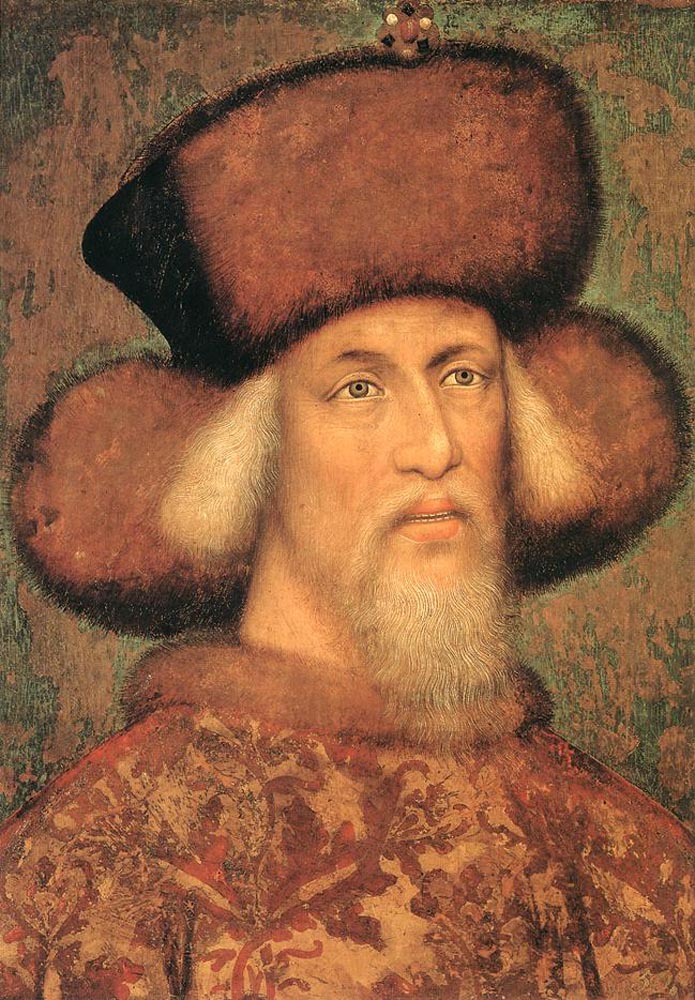
Pisanello 024b.jpg 

King Sigismund, about 1418
 A portrait traditionally attributed to Pisanello

Image:Wikipedia

There is a good illustrated and referenced online account of the Order here, and there is a short article about it here. There are also online biographies of King Sigismund and Queen Barbara.

When King Sigismund, King of the Romans and Emperor-Elect as well as King of Hungary, came on a state visit to King Henry V in 1416 he was admitted as a Knight of the Garter, and in return made King Henry a Knight of the Dragon - as well as giving a major relic of St George to the chapel at Windsor. This exchange of diplomatic courtesies is still recalled in the Sword of State of the City of York, which is the one which hung over King Sigismund's stall in St George's chapel Windsor, and is ornamented with the emblem of the Order of the Dragon; I posted about this and its history, with illustrations, this time last year in Emperor Sigismund.


Emblem of the Order

Image:rodoslovlje.com

Unlike the Garter, the Annunziata and the Golden Fleece, the Order of the dragon was not to have a continuous history, and seems to have declined in significance after the Emperor-King's death in 1437, and whilst surviving as Hungarian mark of distinction for the rest of the century until perhaps the disatrous battle of Mohacs in 1526, whenit became merely a memory. No attempt to revive it, as happened with some other monarchical Orders of Chivalry, such as the Order of the Elephant in denmark occurred until apparently, a refoundation at the time of the coronation of King Charle sIV in 1916.

There is, however, one curious legacy of the Order. One of the early recipients was Prince Vlad of Wallachia, whose adoption of the device led to his people referring to him in Romanaian as Dracul  (The Dragon), and yes, his son, also called Vlad, acquired the diminutive form of ... Dracula.

I found in the online article on the Order I mentioned above links to two articles about the Order and the origins of the Dracula story from the Journal of Dracula Studies - a publication to get one's teeth into - and they can be viewed and read by clicking of the highlighted numbers in the following references:


  • Rezachevici, Constantin. "From the Order of the Dragon to Dracula." Journal of Dracula Studies 1 (1999): pp 3–7. Transcriptions available online: [2] (RTF-document), [3] (Barcelona-Esoterismo-Esoterisme-Magia).
  • McNally, Raymond T. "In Search of the Lesbian Vampire: Barbara von Cilli, Le Fanu’s “Carmilla” and the Dragon Order." Journal of Dracula Studies 3 (2001). [4]

Sunday, 9 December 2012

Emperor Sigismund


Today is the 575th anniversary of the death of the Holy Roman Emperor Sigismund in 1437. Born in 1368 a younger son of the Emperor Charles IV he became King of Hungary by marriage, King of the Romans and, ultimately, Holy Roman Emperor by election and King of Bohemia by inheritance.


Emperor Sigismund

The painting is attributed to Pisanello and shows Sigismund at about the age of 50, that is about 1418.
He appears to have reqularly worn a hat of this type as he is always depicted wearing one.
Kunsthistorisches Museum Vienna

Image: Wikipedia


There is an illustrtaed online life of him here.  He played amajor part in convening and supporting the Council of Constance in 1414-18, and travelled to Spain, France and Englandin 1416 to secure the adhesion of the Iberian kingdoms to the Council and to negotiate with the government of King Charles VI of France and with King Henry V. Initially this was mediation in the wake of King Henry's success at Agincourt the previous year, but when he came  to England he entered by the Trearty of Canterbury into alliance with King Henry.He was feted in England, and the monarch's exchanged gifts and honours, including Sigismund being made a Knight of the Garter. He gave, inter alia relics of St George to the chapel of the Order at Windsor

One aim of the allaince was to pursue Church reform ahead of the electuion of a new, unquestioned, Pope. However in the autumn of the following year the English King deceided to fall in with other realms and support the elction of anew pope following on from what had been achieved in the way of reform. So it fell to Richard Fleming, by then a leading figure in the English delegation at Constance to tell Sigismund of the change in English policy. In the weeks that followed Cardinal Colonna became Pope Martin V and Richard Fleming entered the Apostolic Household.

In the summer of 1422 Fleming, bu now Bishop of Lincoln, was sent on a diplomatic mission by King henry to woo poloiticala nd miliatry support from the Elector Palatine and the three Archbishop Electors and to attend the Imperial Diet Sigismund had summoned to Nuremburg. It was whilst this was meeting that King Henry V died and Fleming returned home.

A link with Sigismund's visit in 1416 survives in York in the city's Sword of State. Granted the privilege by King Richard II of the sword and a cap of mainatence to indicate its rank as a city and county of the city, the civic authorities were given the sword by Henry Hanslap, a native of York, and canon of Windsor in 1439. Two years earlier when the Emperor Sigismund died his Garter stall at St Georges was dismanted and the sword and helm removed from the chapel, passing to the
Dean and Canons of Windsor. The Dean later gave it to one of his canons,  Hanslap, who then  presented it to his native city in 1439. The sword was redecorated in 1586, as is recorded on the blade, and has been frequently repaired.


http://mek.oszk.hu/02000/02096/html/saxon03.jpg
The Sigismund Sword 
The Dragons refer to the Order of the Dragon, founded by Sigismund as King of Hungary

Image:mek.oszk.hu

http://www.thediamondjubilee.org/sites/www.thediamondjubilee.org/files/styles/lightbox/public/LN-TQ-Apr12-Micklegate.jpg

The Sigismund Sword is presented to The Queen on her visit to York for the Royal Maundy service this year.
The Swordbearer is wearing the other distinctive piece of insignia of the City, the Cap of Maintenance

Image:thediamondjubilee.org

photo

The Sword of State, Cap of Maintenance and Mace

Image: City of York Council photostream on Flickr 


Thursday, 16 August 2012

The Order of St Stephen of Hungary


Other than in Hungary itself, where it is observed on August 20th, the day of the translation of his relics - today is the feast of St Stephen of Hungary, the first Christian King of that country, who died in 1038. There is an online life of him here.
   
My posts about him from previous years can be read at St Stephen of Hungary and  The Holy Crown of Hungary from 2010 and St Stephen of Hungary from 2011.

Saint Stephen I of Hungary Statue

St Stephen of Hungary
Nineteenth century statue at the Fisherman's Bastion in Budapest

Image:judgedredd on Flickriver
As principal patron of the kingdom after the Virgin Mary, to whom he entrusted it on his deathbed, it is not surprising that the chivalric order of the Habsburg Kings of Hungary was under his patronage. Ther had been at least two earlier orders of chivalry founded by Kings of Hungary. In 1326 King Charles Robert (Charles I or Carobert )  instituted the Order of George, which as a chivalric confraternity has manage dto survive to the present day through arather curious descent. The website of its British branch, which includes a history and the text of the foundation document can be seen here.       
In 1408 King Sigismund founded the Order of the Dragon, of which there is a history here. Its foreign knights included King Henry V, but it disappeared after 1526, although, as you will read on the link, it has left a familiar reference in modern popular culture. In 1916 there was, I understand, a brief refoundation by King Charles IV at the time of his coronation.
In 1764 the Empress Maria Theresa - technically and literally King Maria Theresa in Hungary - founded the Order of St Stephen of Hungary as a national Order for the Apostolic Kingdom. There is a handsomely illustrated account, which includes a list of recipients here. 
It must have been one of the first such orders to have three classes Knights Grand Cross, Knights Commander and Knights, rather than simply being a confraternity of Knights around the Sovereign. As Hungary had a sizeable Protestant population membership was not, like the Golden Fleece, restricted to Catholics. As a result it was the most senior Habsburg Order that could be conferred on rulers such as King Edward VII and King George V or Kaiser Wilhelm II.