Once I was a clever boy learning the arts of Oxford... is a quotation from the verses written by Bishop Richard Fleming (c.1385-1431) for his tomb in Lincoln Cathedral. Fleming, the founder of Lincoln College in Oxford, is the subject of my research for a D. Phil., and, like me, a son of the West Riding. I have remarked in the past that I have a deeply meaningful on-going relationship with a dead fifteenth century bishop... it was Fleming who, in effect, enabled me to come to Oxford and to learn its arts, and for that I am immensely grateful.
Visiting Oxford?
Allow me to be your guide... and discover the history of Oxford with an Oxford historian.
I offer a wide range of guided walks around the city and university. These can be a general introduction to the history and architecture or looking at specific themes and subjects.
I am a Catholic and a historian based in Oxford, where I am a member of Oriel College. My research, for a long delayed D.Phil., is a study of Richard Fleming, Bishop of Lincoln in the second decade of the fifteenth century. I also work as a freelance tutor in History and as an independent tour guide.
I was received into the Church in 2005 and am a Brother of the External Oratory of St Philip Neri at the Oxford Oratory.
Music for Vespers of St Michael
-
When Pope Urban VIII had the hymns of the Roman Breviary revised in a more
classicizing style, few were altered as completely as the hymn for Vespers
of St...
A Fifteenth Century Green Chasuble from Sweden
-
The Nordic countries of Europe are not countries Catholics tend to jump to
of when contemplating historical Catholic vestments. In point of fact,
however, ...
Obituary of a very failed Pontificate
-
"Nun khre methusthen kai tina per bian ponen, epei de katthane
Mursilos."Such would have been the reaction of the unchristianised Greeks.
But for us, for t...
Saint Gabriel
-
The angels call for our veneration and awe as part of God’s creation. Part
of the destructive modernism of the 1970s included advice to Catholic
school t...
Prayer and Reality
-
[image: Image result for kneeling "low Mass"]
"It is not the healthy who need a physician but the sick"
Jesus is supposed to be our Saviour but most of us...
The Guardian has a review of Viking North, the new exhibition in York about the Viking era in northern England about which I wrote in my previous post. The article gives a much more detailed resumé of the items on display and the themes explored by the exhibition than does the original BBC article I linked to.
The BBC News website has an article about the opening of a major exhibition at the Yorkshire Museum in the grounds of St Mary’s Abbey in York. The exhibition, entitled Viking North will run for the next two years, and there is no additional charge to visit it.
The display brings together items from the collection in York and from other museums. It includes items recently discovered and not previously on public display. The aim appears to be to show the whole range of life in the region between the beginning of major Viking settlement in 866-868 with the invasion of those years and the Norman Conquest two centuries later.
There have been two reports online recently about the discovery of foundations of part of the buildings of the medieval Saint Leonard‘s Hospital in York.
This late Anglo-Saxon foundation survived until the dissolution of the monasteries and related institutions in the sixteenth century. Unlike the great mediaeval hospitals of London this York foundation was suppressed and largely destroyed. Although parts of the site have been investigated since the early nineteenth century the only remains above ground out of part of the gate house and the adjoining chapel, dated to about 1240, adjacent to the City Library. The remainder lies under.Duncombe Place, the Theatre Royal and adjoinhg buildings, and adjacent to the York Oratory.
The VCH for York has an article describing the various religious precinct of the mediaeval city, including that of St Leonard’s, together with a map. This can be accessed here
By 1300 the Hospital had up to 225 inmates, ministered to by thirteen chaplains and eight sisters. However in 1350 the buildings were said to be in great disrepair.
I recall reading in the VCH volume on the City of York - which I cannot find online - that a few days before the battle of Towton in 1461 King Henry VI and Queen Margaret together with the Dukes of Somerset and Exeter, and, I assume, others of the Lancastrian court, attended Vespers in the chapel of St Leonard’s.
In 1515 the chapel and other buildings were described as dilapidated. The foundation was surrendered to the Crown in 1540, and after sale and repurchase a branch of the Royal Mint was established on part of the site in 1546.
In January 1556 the City Council petitioned Cardinal Pole for the re-establishment of the Hospital, but without success before the end of the Marian Restoration.
In March the British Library Medieval manuscripts blog had an interesting article about a Cottonian manuscript which depicts the layout for King Henry VIII’s mobile military court when he was on campaign. It can be seen at Henry VIII’s pastry tent
It is not clear if this illustrates the King’s French invasion of 1513 or his later one in 1544. In many ways it probably resembles the layout on his grandfather King Edward IV’s anticlimactic expedition of 1475. The tents as depicted resemble in many cases others shown in manuscripts of the same period which depict tents with richly decorated colourful exteriors and of a similar structure. It was not just for military campaigns that Kings and their couriers occupied tented accommodation. From the contemporary account of Niclas von Popplau it is clear that King Richard III was in staying an impressive tent when visiting York, staying in the Minster Close, in the early autumn of 1483. That may well have been taken over from the late King Edward. In 1541 King Henry VIII and Queen Catherine and their entourage occupied tents set up in the grounds of the recently suppressed abbey of St Mary in the city. Tents were clearly an important element in the accommodation for the Field of Cloth of Gold in 1520, although on that occasion King Henry and his Queen occupied a temporary residence constructed from timber and canvas designed to look like a permanent structure.
To what extent a tented court was set up at each stop on such journeys is not clear as various royal or duchy castles such Nottingham and Pontefract were utilised as stopping places. Maybe the tented accommodation was set up for a major halt on such journeys, although, as with a military campaign, the total numbers involved would have been considerable with the retinues attendant on the monarch, his secretariat, his nobles and gentry, and their servants. Billeting the court on a small town would have been a major logistical issue, when the population might literally overnight. Tents would obviate that if the necessary arrangements could be made to send them on ahead whilst the monarch and courtiers perhaps had an opportunity for hunting and the use of proffered or commandeered lodgings before the next principal halt.
Operating a military campaign, especially on enemy territory, might well mean there was less concern about causing offence when occupying accommodation in towns. Nevertheless whatever the circumstances the time involved in setting up and then dismantling and moving forward must have been a considerable concern when doing forward planning, let alone when it had to be actually done, resources packed, carts loaded, animals harnessed, people marshalled, and routes scouted. A royal progress in peacetime might have less urgency but would in its own way be equally stressful.
The Cottonian MS also shows specifically military preparations in progress in relation at a distance from the royal accommodation with not only swords but artillery as a feature, food preparation to feed the army and the tents for the services and officers who supported the troops. When the King went forth to war, or on a peaceful domestic or diplomatic progress, a sizeable part of his kingdom went with him.
I saw this article on Tumblr and thought it was worth copying and sharing with readers - the links from it are also worth looking at, especially the last two about a Roman militart burial from Leicester and the remains of York gladiators:
Wealthy Roman Settlement Discovered Beneath Britain's Longest Road
By Rossella Lorenzi, Live Science Contributor |
A rare silver ring shaped like
a snake that wraps around the finger hints at the great wealth of the
people who lived at Cataractonium.
Credit: Northern Archaeological Associates
Construction work to upgrade Britain's longest road into a major
highway has revealed a treasure trove of rare artifacts from one of the
earliest and wealthiest Roman settlements in the country.
The findings include ancient shoes, cups, a rare silver ring, keys, a
high-relief glass bowl and an elaborately carved amber figurine,
archaeologists with the public group Historic England announced
yesterday (April 6).
Archaeologists uncovered the artifacts in North Yorkshire along the A1,
which stretches 410 miles (660 kilometers) from London to Edinburgh,
Scotland, during a major project to improve the existing roadway. [See Photos of the Excavation and Roman Artifacts]
"It is fascinating to discover that nearly 2,000 years ago, the Romans
were using the A1 route as a major road of strategic importance and
using the very latest technological innovations from that period to
construct the original road," Tom Howard, project manager at the
government agency Highways England, said in a statement.
Beneath Britain's longest road lay a treasure trove of rare Roman artifacts.
Credit: Historic England
Indeed, the newly found artifacts include a plumb bob used to build
straight roads, which was likely utilized in the construction of Dere
Street, a Roman road following the course of the A1, the researchers
said.
Wealthy settlement
The excavations have also led to the discovery of a major Roman settlement at Scotch Corner, one of the best-known junctions in the country.
Taking its name from an old Roman road called Scots Dyke, Scotch Corner
links Scotland with England and the east coast with the west coast.
Right there, the archaeologists with the professional consultant group
Northern Archaeological Associates unearthed the remains of a large
settlement dating back to A.D. 60, thus predating settlements in York
and Carlisle by 10 years.
The settlement at Scotch Corner was unusually large compared to others
in northern England, and stretched over 4,600 feet (1,400 meters) from
north to south — roughly the length of 13 football fields positioned end
to end, according to Historic England.
Artifacts unearthed there suggest that the people who lived at Scotch
Corner were rather wealthy. High-status imported items include the
figure of a toga-clad actor carved from a block of amber, which is
believed to have been made in Italy during the first century A.D.
"A similar example was found at Pompeii. Nothing like this has ever before been found in the U.K.," representatives with Historic England said.
The archaeologists unearthed more than 1,400 clay fragments of molds
used for making gold, silver and copper coins, thus making the site the
largest known and most northerly example of coin production ever found
in Europe, the researchers said. Those findings suggest that the
settlement might have served as a sophisticated industrial and
administrative center, the archaeologists said.
"It shows that the Romans were carrying out significant industrial
activity in this part of England and potentially producing coins of high
value," Historic England representatives said in the statement.
Rise of Cataractonium
But it was a short-lived glory. The settlement was occupied for just
two to three decades. Its demise seems to coincide with the rise of
Catterick, a town south of Scotch Corner known by the Romans as
Cataractonium.
Finds at Catterick abounded. The archaeologists unearthed several
well-preserved leather shoes, along with large sheets of leather,
perhaps used for producing clothes. The artifacts suggest that
Cataractonium was an important leatherworking center that likely
supported the Roman military, the archaeologists said. [See Photos of Decapitated Gladiator Skeletons]
A rare silver ring shaped like a snake, which wraps around the finger,
and a number of keys of various sizes suggest that the people who lived
in Cataractonium were wealthy and that they locked up their valuable
possessions, the archaeologists suggested.
Moreover, the many styli (Roman pens) and a pewter inkpot found at the
site indicate that most of these ancient people were able to read and
write, the researchers said.
"The sheer amount of exceptional objects found on this road scheme has
been extraordinary," Neil Redfern, principal inspector of ancient
monuments at Historic England, said in the statement. "This project has
given us a unique opportunity to understand how the Romans conducted
their military expansion into northern England and how civil life
changed under their control."
I came across the following post “Mooke, fylthe and other vyle things” – Tudor dirt and dung on the History Extra site. Using material from the city records in York Pamela
Hartshorne describes householders’ daily battles with rotting
vegetation, dung heaps and overflowing cesspits in Tudor England. It shows that valiant attempts were made to keep the city streets clean.
The Shambles in York
The quintessential medieval side street of York, and the butchers quarter - often a particular cause of nuisance to street cleanliness in the period
Image: York 360
The
article was first published in the August 2014 issue of BBC History
Magazine. Read the full story
The Daily Telegraph had a report the other day entitled "Scientists say prized ambling gait 'originated in York' as gene responsible for horses' funny walk traced."
Described as a comical waddling horse step known as the ambling gait it originated in or around ninth-century York, and, being prized by the Vikings, was encouraged by them in horse breeding a study of DNA has found. The characteristic has over subsequent centuries travelled worldwide.
Stephanie A. Mann at Supremacy and Survival: The English Reformation has an interesting post today about two York recusant martyrs, Bl. Peter Snow and Bl. Ralph Grimston and the reconstruction of their appearance from their skulls which survive. Her post can be seen at June 15, 1598 in York
The BBC News website has a report on the most recent
research into the DNA of human remains from late Roman and Anglo-Saxon
Britain. This indicates that a third of the DNA of the English comes
from the Anglo-Saxons. It also gives insight into matters such as
intermarriage and the survival of the Romano-British population.
Today is the 605th anniversary of the foundation by King Sigismund of Hungary and his Queen Barbara of Cilli of the Order of the Dragon, a chivalric order designed to unite the King's supporters both to his cause and to the defence of Christendom against the Ottoman advance in south-eastern Europe.
King Sigismund, about 1418
A portrait traditionally attributed to Pisanello
Image:Wikipedia
There is a good illustrated and referenced online account of the Order here, and there is a short article about it here. There are also online biographies of King Sigismund and Queen Barbara.
When King Sigismund, King of the Romans and Emperor-Elect as well as King of Hungary, came on a state visit to King Henry V in 1416 he was admitted as a Knight of the Garter, and in return made King Henry a Knight of the Dragon - as well as giving a major relic of St George to the chapel at Windsor. This exchange of diplomatic courtesies is still recalled in the Sword of State of the City of York, which is the one which hung over King Sigismund's stall in St George's chapel Windsor, and is ornamented with the emblem of the Order of the Dragon; I posted about this and its history, with illustrations, this time last year in Emperor Sigismund.
Emblem of the Order
Image:rodoslovlje.com
Unlike the Garter, the Annunziata and the Golden Fleece, the Order of the dragon was not to have a continuous history, and seems to have declined in significance after the Emperor-King's death in 1437, and whilst surviving as Hungarian mark of distinction for the rest of the century until perhaps the disatrous battle of Mohacs in 1526, whenit became merely a memory. No attempt to revive it, as happened with some other monarchical Orders of Chivalry, such as the Order of the Elephant in denmark occurred until apparently, a refoundation at the time of the coronation of King Charle sIV in 1916.
There is, however, one curious legacy of the Order. One of the early recipients was Prince Vlad of Wallachia, whose adoption of the device led to his people referring to him in Romanaian as Dracul (The Dragon), and yes, his son, also called Vlad, acquired the diminutive form of ... Dracula.
I found in the online article on the Order I mentioned above links to two articles about the Order and the origins of the Dracula story from the Journal of Dracula Studies - a publication to get one's teeth into - and they can be viewed and read by clicking of the highlighted numbers in the following references:
Rezachevici, Constantin. "From the Order of the Dragon to Dracula." Journal of Dracula Studies 1 (1999): pp 3–7. Transcriptions available online: [2] (RTF-document), [3] (Barcelona-Esoterismo-Esoterisme-Magia).
McNally, Raymond T. "In Search of the Lesbian Vampire: Barbara von Cilli, Le Fanu’s “Carmilla” and the Dragon Order." Journal of Dracula Studies 3 (2001). [4]
The announcement this weekend by the Bishop of Middlesborough that he has invited the Oxford Oratory to take charge of the church of St Wilfrid in York, and the consequent hopes that this will lead to the eventual establishment of a York Oratory represents a very positive challenge for both the Oratorians and the parishioners in York. The parish includes the shrine of St Margaret Clitherow in The Shambles. It is a project that will need our prayers to support it, but it holds great possibilities.
The Oratory website has a piece about the proposal, and a copy of Bishop Drainey's letter to the parish which can be seen in the article St Wilfrid's, York.
There is an online account of the church here. Although I have often passed the church when in York, which is close to my home town, I do not think I have ever been inside it to look around. It has a very distinctive French or continental appearance. It stands in strong contrast to the Minster, which is only yards away. Here are some pictures of the church:
The church from Duncombe Place
St Wilfrid's Church and its near neighbour YorkMinster
The highly ornate doorway.
St Wilfrid's Church was designed by George
Goldie and was built in 1862-1864. For some years it served as the pro-cathedral of the diocese of Beverley until that was divided in 1878.
The view down the nave to
the polygonal apse and altar. It is built in late 13th century style and the pillars of the aisle arcade arches are quite
massive and assertive with a pronounced shaft ring and elaborate
Early-French Gothic capitals.
Images: docbrown.info
Another door opens for the Oratorians
Image: Patrick Costello on Flickr
May Our Lady, St Philip Neri and St Wilfrid pray for this proposal
Amongst the books I am currently reading is Saint Margaret Clitherow by Katharine Longley, which was published in 1986, and is a readable and well researched account of the life of the York housewife who was martyred in 1586. It brings out her remarkable qualities as a devout woman, and also gives an insight into just what was possible for an urban wife to do and how she lived in the period. I wrote about St Margaret in April in my post Recusant women. Coming as I do from quite close to York I have always known the story of St Margaret, and the more I know about her the more interesting she proves to be.
A modern statue of St Margaret Clitherow
Image: Our Lady's catechists
Today I saw on Stephanie Mann's Supremacy and Survival blog a review of a new book by Peter Lake and Michael Questier on St Margaret which sets her in the context of the issues facing recusants in the later sixteenth century. Her post can be read at Book Review: The Trials of Margaret Clitherow. From the post this would appear to be an intersting contribution to our understanding of the world of Elizabethan recusancy.
Following on from my previous post with its reference to the recusant heritage of York and the recent Latin mass Society Pilgrimage there, which I commented on last month in Mass in York Minster there are two illustrated accounts of the Pilgrimage on the LMS Chairman's blog and they can be seen here and here. The pictures include not only the Mass itself but also the visit to the shrine of St Margaret Clitherow in The Shambles.
Friends who were there commented on the beauty of the celebration in the Minster and how enjoyable the whole weekend had been.
In my series of tutorials last term on women in sixteenth century England we moved from the Protestant women of the 1540s to their antitypes, the Catholic recusant women of the 1570s and 1580s and later.
Some of them were aristocrats, such as Madeleine, Lady Dacre, whose religious opinions earned the respect of Queen Elizabeth I, and about whom Alice Hogge has written in God's Secret Agents, Lady Vaux and the other well-born ladies who appear in Fr. John Gerard's Autobiography, and Anne, Countess of Arundel, the wife of St Philip Howard.
Anne Countess of Arundel in later life.
Image: Wikipedia
As women of birth and rank they were able to exercise their authority in their local communities and in some cases protect their co-religionists.
Rather different was the story of the York housewife St Margaret Clitherow. As a regular visitor to York I have known her story virtually all my life.
St Margaret Clitherow
Image: Sacred Destinations
Here is an account of her life which I have adapted from that given by Terri Morgan on the Medieval Religion discussion group on March 25th this year - St Margaret's feast day.
Margaret was a native of York, the daughter of a prosperous candle maker. She married the butcher John Clitherow in 1571. A few years after the marriage, Margaret converted to Catholicism. She became notorious for her recusancy. Her husband was repeatedly fined because Margaret would not attend the services of the Church of England. She was even imprisoned for two years - and on her release set up a Catholic school. She even sent her oldest son to Douai to study, for which she was put under house arrest for over a year.
Margaret was also a prominent hider of fugitive priests. In 1586 her house was searched, and a missal and Mass vessels were discovered. She was arrested and put on trial, but she refused to plead so as to protect those she had helped. She refused to enter a plea, so was sentenced to the peine fort et dure (laid on the ground with a door over her, with a sharp stone under her neck, and then weights added to the door until she should finally answer the courts with a plea) which was carried out in the crypt of the despoiled chantry chapel of St William on Ouse Bridge and so died, refusing to speak.
By not entering a plea meant there was no trial at all. She thereby saved her children, her stepchildren and her neighbour’s children from being hauled into the witness box and being bullied into giving the evidence to condemn her. (There was no minimum age for giving evidence and no protection for minors). This evidence would have pointed to other Catholics in York. By keeping silent she sabotaged the entire anti-Catholic clampdown and gained the moral high ground in popular opinion - even among the extreme Protestants in the neighbourhood. This was of course not only at the price of her own life but the life of her unborn - and unbaptised - child. Has she pleaded (guilty or not guilty would have made no difference) and been found guilty then her execution would have been deferred until after the child's birth. It was an even harder choice that it looked at first.
Visitors to York can see the house in the Little Shambles where she lived for some time, and the dormer window at the Black Swan, which she hired as a Mass-house. You can also see her hand at the Bar Convent Museum in York.
St Margaret Clitherow's hand, venerated at the Church of the English Martyrs in York on the recent Latin Mass Society Pilgrimage.
Image: LMS Chairman blog
To this I would add links to other websites about her, beginning here, and which has the interesting point that St Margaret's martyrdom appears to have arisen from an excess of zeal on the part of the local authorities, who were subsequently reprimanded by Elizabeth I in a letter - another woman faced with the same penalty was kept in prison on the Queen's orders, but the penalty not exacted, as described in Alice Hogge's book.
There are two other sites of interest about St Margaret here and here.
What emerges is Margaret Clitherow's remarkable dedication to the Catholic cause, and the fact that a woman from the middle ranks of life in York could achieve so much. She does not appear to have been dominated by her husband or social convention.
One of the priests she helped was Bl. William Hart, arrested on Christmas night 1582, apparently in her house. When he was executed in March 1583 the crowd apparently would not let the executioner draw and quarter him as he hanged - that is they ensured he was dead before he was hacked to pieces, which suggests sympathy either for him or his cause, which was not uncommon at public executions in the period. There is an account of his life here.
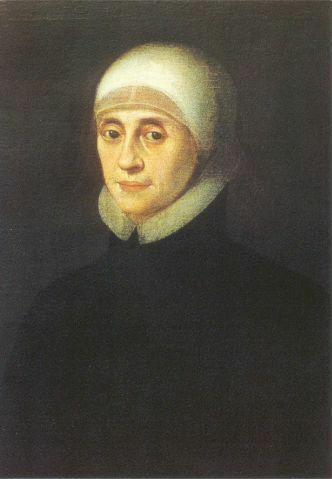
Another remarkable Yorkshire-born recusant woman was Mary Ward (1585-1645). She came from an old Yorkshire family, grew up in this time of persecution and was connected to some of those involved in the Gunpowder Plot. Her active life was largely lived in exile on the continent and in her attempts to establish a new type of religious order for women, the institute of the Blessed Virgin Mary, inspired by the Jesuit model. In 1630 she was imprisoned for three months by the Inquisition and her communities dispersed, and only after death did her ideas begin to find official favour in the Church. She is probably better known in the area she worked in on the continent - Germany and Belgium - than in her own country. She died in York, and the Bar Convent there belongs to her order, and includes a museum of recusant history.