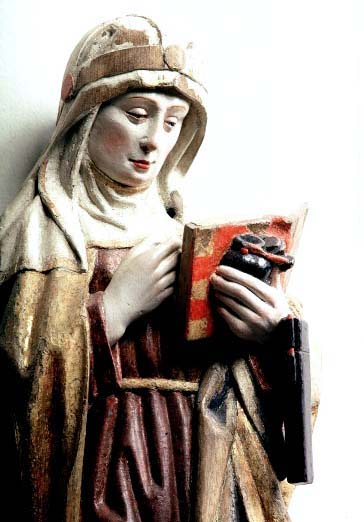
Once I was a clever boy learning the arts of Oxford... is a quotation from the verses written by Bishop Richard Fleming (c.1385-1431) for his tomb in Lincoln Cathedral. Fleming, the founder of Lincoln College in Oxford, is the subject of my research for a D. Phil., and, like me, a son of the West Riding. I have remarked in the past that I have a deeply meaningful on-going relationship with a dead fifteenth century bishop... it was Fleming who, in effect, enabled me to come to Oxford and to learn its arts, and for that I am immensely grateful.


Showing posts with label Bridgettines. Show all posts

Wednesday, 18 June 2025

Five Medieval Manuscripts bought by the British Library


The British Library Medieval manuscript blog recently reported the acquisition as a result of significant financial donations, of five important medieval manuscripts from the collection at Longleat House by the Library.

The blog describes, and has fine illustrations from, each of the five volumes. Each one offers a range of insights into the religious and intellectual history of the high and later medieval centuries.

I will leave readers to peruse the blog post, and find out what the books contain. The piece, which promises future articles on each book, can be seen at Five outstanding manuscripts acquired for the nation


Monday, 3 August 2015

Images of St Bridget of Sweden


Having posted myself on her feast day last week A new history of Syon Abbey, I now see that John Dillon has posted on the Medieval Religion discussion group a splendid series of medieval images of St Bridget (Birgitta) of Sweden. These indicate the popularity of this saint in the late fourteenth and fifteenth centuries across much of north-west Europe. They also onvey the quality of later medieval Scandinavian ecclesiastical art. I have been able to open and paste some, but others - and all are worth seeing - readers will need to click on themselves:

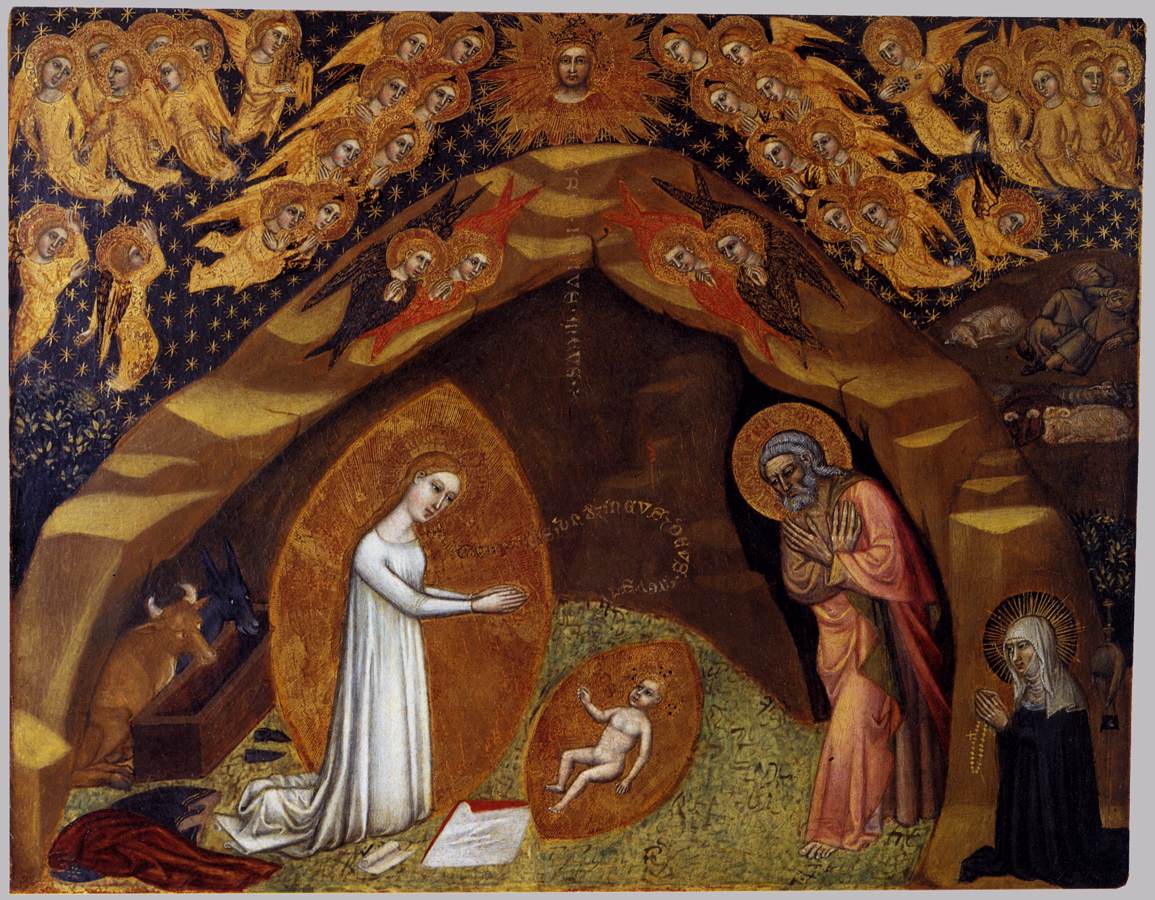
a) as depicted (at lower right, experiencing her vision of the Nativity) by Niccolò di Tommaso in a later fourteenth-century panel painting (between 1373 and circa 1380) in the Pinacoteca Vaticana:

http://www.wga.hu/art/n/niccolo/tommaso/bridget.jpg


b) as depicted (at lower left, experiencing her vision of the Nativity) by Turino Vanni in a late fourteenth- or earlier fifteenth-century panel painting (between 1395 and 1433) in the Museo Nazionale di San Matteo, Pisa:

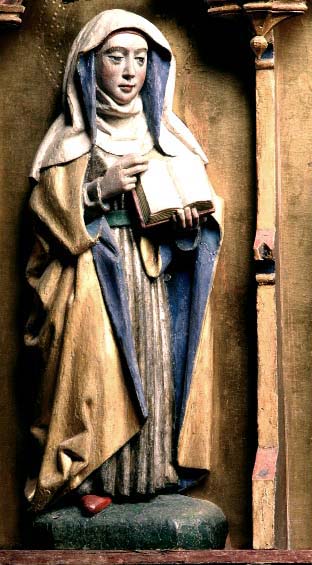
c) as portrayed in a late fourteenth- or early fifteenth-century wooden statue in the monastery church of the BVM and St. Birgitta in Vadstena (Östergötlands län):

d) as depicted in two illuminations in the earlier fifteenth-century Burnet Psalter (Aberdeen University Library, AUL MS 25, fols. 28v, 61r):

e) as depicted (tempted by a devil whilst writing) in the earlier fifteenth-century frescoes of Nørre Tranders kirke, Nørre Tranders (Nordjylland):

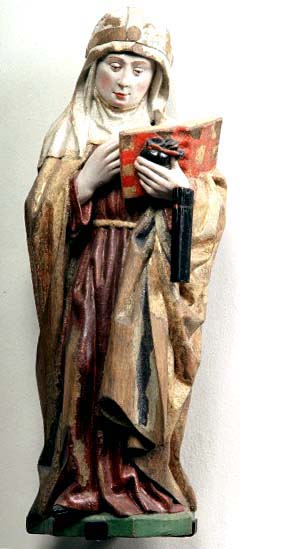
f) as portrayed in an earlier fifteenth-century wooden statue (ca. 1425-1435) in the monastery church of the BVM and St. Birgitta in Vadstena (Östergötlands län):

https://upload.wikimedia.org/wikipedia/commons/e/e0/Vadstena_kloster%2C_den_24_juni_2008%2C_bild_12.jpg


g) as depicted by Johannes Rosenrod in two of his earlier fifteenth-century frescoes (1437) in Tensta kyrka, Uppsala kommun (Uppsala län):
1) Receiving a revelation:
2) with Urban VI:

h) as portrayed (at right; at left, St. Gertrude) in a statue belonging to the recently restored earlier fifteenth-century Kumla Altar (1439-1440; made in Lübeck) from Kumla kyrka, Kumla kommun (Örebro län), now in the Historiska Museet in Stockholm:

http://41.media.tumblr.com/1592b1ecd3f4ba28928479e55cdde409/tumblr_inline_noqyf54SCy1tnxzib_1280.jpg


i) as depicted (at left) in a mid-fifteenth-century triptych (betw. 1440 and 1455) by the Master of Pratovecchio, formerly in the Getty and sold at auction by Sotheby's, New York on 27. January 2011:
 http://tinyurl.com/pzb2m4f

j) as portrayed in a mid-fifteenth-century wooden statue, perhaps of German origin, from Padasjoen kirkko / Padasjoki kyrka (Pirkanmaan maakunta / landskapet Birkaland) in the Suomen Kansallismuseo, Helsinki:
Detail view:

k) as portrayed (at center) in the great mid-fifteenth-century altarpiece (betw. 1455 and 1459; made in Lübeck) of the monastery church of the BVM and St. Birgitta in Vadstena (Östergötlands län):
http://tinyurl.com/o8habz9
Detail view (Birgitta):
 http://tinyurl.com/pb7nzfu
A digitally restored view of the altarpiece can be seen here:

l) as portrayed in a later fifteenth-century statue (betw. 1450 and 1500) in an altarpiece from Törnevalla kyrka in Törnevalla, Linköpings kommun (Östergötlands län), now in the Historiska Museet in Stockholm:
St Bridget is at the centre of the altarpiece:http://tinyurl.com/q95p98f

Detail view:

http://catview.historiska.se/catview/media/lowres/24688


m) as portrayed in a later fifteenth-century wooden statue (betw. 1450 and 1500) in Viksta kyrka, Uppsala kommun (Uppsala län):
During the restoration of the church in 1932-33?:
After the rebuilding of 2006:

n) as portrayed by the Master of Soeterbeeck in a later fifteenth-century wooden statue, originally painted, (ca. 1470) of Brabantine origin in the Metropolitan Museum of Art, New York:


Saint Bridget of Sweden

o) as depicted (as a pilgrim) in a later fifteenth-century hand-coloured woodcut (1470s or 1480s) of Bohemian origin pasted inside the front cover of a late fourteenth-century manuscript of her Revelaciones (Praha, Archiv Prazského Hradu, Knihovna Metropolitní Kapituly, C. LXXXVII (519)):

scanned image


p) as portrayed in a later fifteenth-century wooden statue (ca. 1475) from an altarpiece from Sollentuna kyrka in Sollentuna (Stockholms län), now in the Historiska Museet in Stockholm:
 http://medeltidbild.historiska.se/medeltidbild/mbbilder/bilder/94/9416427.jpg

q) as portrayed (at right, after Anna själv tredje [Anna selbdritt / Anne trinitaire] and a crowned female saint]) on a wing of the later fifteenth-century altarpiece (between 1475 and 1500) from Hammarby kyrka (Stockholms län), now in the Historiska Museet in Stockholm:

r) as portrayed in a later fifteenth-century wooden statue (between 1475 and 1500) in Borgs kyrka in Norrköpings kommun (Östergötlands län):

http://medeltidbild.historiska.se/medeltidbild/mbbilder/bilder/95/9523630.jpg


Detail view:

http://medeltidbild.historiska.se/medeltidbild/mbbilder/bilder/95/9523636.jpg


s) as depicted (at far right) in a painting on a wing of a later fifteenth-century altarpiece (betw. 1475 and 1500) from Salems kyrka in Salem (Stockholms län), now in the Historiska Museet in Stockholm:
Detail view:

t) as depicted (at lower right, experiencing her Eucharistic Vision) in a later fifteenth-century manuscript (betw. 1475 and 1500), of Neapolitan origin, of her Revelaciones and other texts (New York, Pierpont Morgan Library, MS M.498, fol. 4v):

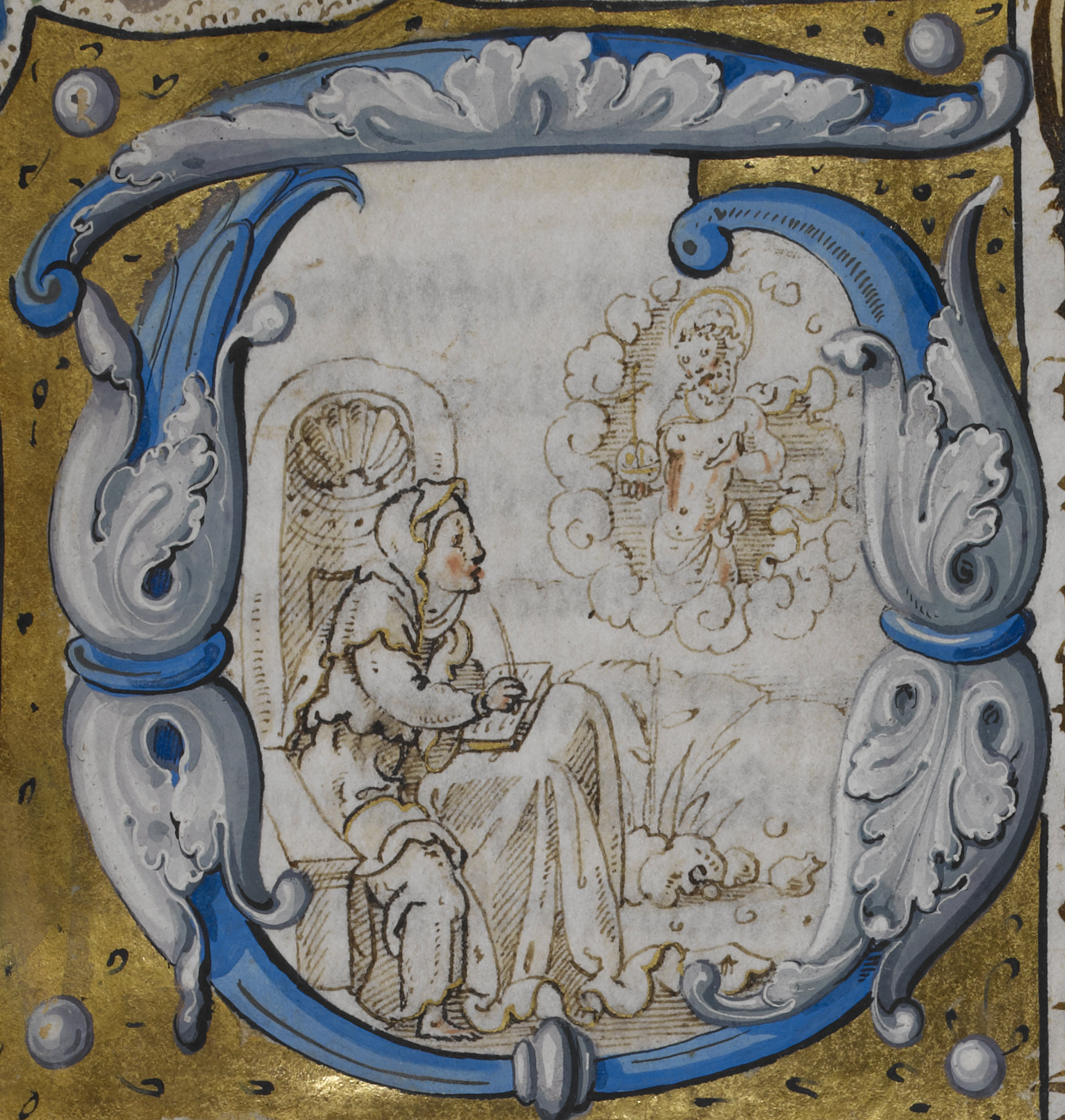
u) as depicted (receiving a revelation whilst writing) in a later fifteenth-century Birgittine / Bridgettine breviary (1476) in the New York Public Library (Spencer Collection Ms. 63):

v) as depicted in the later fifteenth-century frescoes (ca. 1480) of Gislinge kirke in Gislinge, Holbæk Kommune (Nordvestsjælland):

w) as depicted (praying before a crucifix) in a late fifteenth-century prayer book (betw. 1480 and 1500) of southern Netherlandish origin (London, BL, Yates Thompson MS 18, fols. 202-244, at fol. 234r):

x) as depicted (giving her order its Rule) in a late fifteenth-century hand-colored woodcut print (between 1480 and 1500) of south German origin (Augsburg?) in the British Museum, London:

y) as depicted in two hand-colored, late fifteenth-century woodcuts in a copy in the Bayerische Staatsbibliothek, München, of the first complete printing of her Revelaciones (Lübeck: Bartholomaeus Ghotan for the Vadstena monastery, 1492):
1) Dictating to a scribe (p. 29):
2) Imparting a revelation (p. 36):

z) as depicted (receiving a revelation whilst writing) in a late fifteenth-century woodcut in a copy in the Kongelige Bibliothek, København, of the Sunte Birgitten Openbaringe, a Low German reworking of her Revelaciones (Lübeck: Hans van Ghetelen [the Poppy printer], 1496):

aa) as depicted (at left; at right, St. Katarina / Catherine of Sweden) in an altar painting of ca. 1500 said to be in Högsby kyrka in Högsby (Kalmar län):

bb) as depicted (at far right) in an altar frontal of ca. 1500 from Urjalan kirkko / Urdiala kyrka in Pirkanmaan maakunta / landskapet Birkaland, now in the Hämeen museo in Tampere / Tammerfors:
http://urjala.ekirkko.fi/kuvat/isot/urjala-00010426-2.jpg
Detail view (at left, St. Hemming):

cc) as depicted in the early sixteenth-century frescoes (ca. 1510) of Nibe kirke in Nibe, Aalborg Kommune (Nordjylland):

dd) as depicted (receiving a vision whilst writing) on the earlier sixteenth-century screen (1528) in the church of St Mary and St Andrew, Horsham St Faith (Norfolk):

ee) as depicted (receiving a revelation whilst writing) in an earlier sixteenth-century indenture (1530) conveying lands to Syon Abbey, Islesworth (London, BL, Harley MS 4640, fol. 15r):

https://upload.wikimedia.org/wikipedia/en/d/d3/StBridgetSyonIndenture.jpg


Thursday, 23 July 2015

A new history of Syon Abbey


Given that today is the feast of St Bridget of Sweden I am not sure how providential or fortuitous it was that as I finished my voluntary shift this morning in the bookshop at the Oxford Oratory that I noticed on the shelves a copy of this new book by Professor Edward Jones about the great English Bridgettine monastery of Syon, and which is published by Gracewing at £9.99.


Image: Amazon

For those who do not know the story of Syon it can be summarised briefly as follows. In 1415 King Henry V - who was quite busy that year invading France - founded the only Bridgettine monastery in England. This was close to his palace at Sheen ( now Richmond) in Surrey and prospered until the reign of King Henry VIII. It was one of the mainsprings or wellsprings of late medieval English spirituality and devotion, influencing many members of the elite and beyond. The chaplain, St Richard Reynolds was one of the first martyrs of May 1535, and the house was dissolved four years later. Nothing daunted the Sisters went off to their family homes in groups and continued their common life. Returning to Syon in 1557 they were again dispersed in 1559, and left England with the retiring Spanish ambassador for Flanders. Forced by the Netherlandish revolt to seek refuge elsewhere they settled in Rouen until the victory of King Henri IV led this pro-Spanish community to seek refuge in Lisbon. There, always an English community in exile,they survived the Portuguese uprising against Spanish rule in 1640, the Earthquake of 1755, the Peninsular War, and desire some sisters leaving for England soon after the core community remained there until 1861 when they returned to England after more than three centuries. They settled first in Dorset and then Devon, latterly at South Brent. Tragically in recent decades the community has declined in numbers and they gave up their house in 2011 and now the two remaining sisters live the Bridgettine life within a home run by other religious in Plymouth.

Their archives are now at Exeter University where Prof Jones is based, and Exeter has made an important contribution to modern scholarship on this remarkable community.

From his book I discovered that one of the great treasures of Syon is now at the Catholic church at Heavitree near Exeter. This is one of the pinnacles from the original gatehouse at Syon, and presumably the one on which St Richard Reynolds head was impaled in 1535. This substantial relic has accompanied the sisters on their wanderings from Syon to Flanders, France, Portugal and back to England. They also, in token of ownership, retained the door key of the abbey buildings at Syon - the site now being occupied by Syon House, now the property of the Duke of Northumberland.

The book is handsomely illustrated and reflects academic research and the latest scholarship on the Order and the unique place of Syon on English Catholic history.

A book I am looking forward to reading at lenth and one which I would warmly recommend, and on a topic well worthy of study and reflection which I would also commend to anyone at all interested in the later medieval English Church, the reformation and in recusant history.

The one regret I have is that the book ends with the closure of the abbey, rather than its continuance and continuing prayer and witness.

May we join St Bridget in prayer for the sisters of Syon and all they represent.


Monday, 23 July 2012

Feast of St Bridget of Sweden


Today is the feast of St Bridget of Sweden, the fourteenth century mystic and foundress of the Bridgettine Order, who has also been co-patroness of Europe since 1999.
An introduction to the life of this remarkable woman can be found in the short account, with illustrations and links, here and the Catholic Encyclopedia biography is here 
In recent years there has been an upsurge in interest in her and her Order, both from historians of the later middle ages and the reformation, and from the promotion of devotion to her through the work of the new Bridgettine Order established or re-established by Bl. Elisabeth Hesselblad in the twentieth century.
My previous posts from past years can be read at St Bridget of Sweden  and  St Bridget of Sweden and Syon Abbey
St. Bridget of Sweden


St. Bridget of Sweden
A late medieval statue at her shrine church at Vadstena


Image: sim1.se

St Bridget.
As in the previous picture she is correctly shown as a vowess and not in the habit of the Order she founded, but which she would never have worn, not being herself a member of it.

Image:calvinohsey.blogspot

My interest in her, indeed devotion to her, as my previous posts indicate, arises from the fact that she is one of the great figures of the alte medieval church - my particular period of academic interest - and from the fact that relics of her wwere once in osney abbey close to where I live, and that I once briefly, visited Syon Abbey, the Bridgettine house founded by King Henry V in 1415-20 at the community's home in Devon - the last surviving pre-reformation community in the English Church.

May St Bridget continue to pray for us 

Saturday, 23 July 2011

St Bridget of Sweden and Syon Abbey


Today is the feast of St Bridget of Sweden (1303-1373), interest in whom has revived in recent decades as a result of the designation in 1999 by Pope John Paul II of her as a co-patron of Europe, from the work of the modern Swedish restored Bridgettine Order, founded in 1911 by Bl.Elizabeth Hesselblad, and also from the work of historians looking at her influence on late medieval spirituality. In that last sense she is reminder of how much later medieval Scandinavia was part of Catholic Christendom. Devotion to her, and use of her spiritual techniques was widespread and appealed both to political elites and to the general populace. Here in Oxford relics of her were presented in the fifteenth century to Osney Abbey, which stood close to where I live.

St. Bridget of Sweden


A statue of St Bridget at Vadstena,
the original mother house of the Bridgettine
Order
Image: american-pictures.com/genealogy/descent/photos/Holy.Birgitta-x.jpg


However in England her most enduring legacy is Syon Abbey. This was initially founded by King Henry V in 1415, and definitely established in 1420 at Isleworth in Middlesex. it rapidly became a centre for disseminating devotion and enjoyed a great reputation for its spirituality. One of thefirst victims of King Henry VIII was the confessor of the house, St Richard Reynolds (1492-1535).


The Angel of Syon

A modern representation of St Richard Reynolds

The monastery was suppressed by King Henry VIII, but the nuns remined together in the households of some of their families, returned to Syon under Queen Mary I, were again disperesed under Queen Elizabeth I, and travelled with the Spanish ambassador to take refuge in the Spanish territories in the Low Countries. Their original home is now partially covered by Syon House, where excavations have revealed the extent of the great church.

Taken under the protection of King Philip II they were forced to flee from the Netherlandish revolt and took refuge in Rouen, until they felt compelled to flee again following the French Wars of Religion in the 1590s, taking refuge unstill under King Philip's protection in Lisbon. There they stayed, an English community in exile surviving the Portuguese war of independence of the 1640s, the Lisbon earthquake of 1755, Pombal's Enlightenment reforms, the Peninsula War, a split in the community when some of the nuns returned to England in the early nineteenth century but eventually dispersed, and a final return in the summer of 1861. Settling in Dorset they then moved to Chudleigh and finally to South Brent in Devon early in the twentieth century. They are the sole surviving monastic community from the English middle ages.


The Nuns of Syon Abbey in 1984

This is all recorded in Canon J.R. Fletcher's fascinating history. A website about the abbey and with pictures of the life of the nuns, still following the Rule of St Bridget, can be seen at Syon Abbey. It is one of four surviving houses of the original congregation.

A few years ago I had the privilege of visiting the grounds of the abbey in Devon and did indeed glimpse an elderly nun talking her morning stroll through the grounds.

However I now hear that the community is so small and elderly that they are leaving South Brent and, I think, going to live under the care of other nuns, although I have not seen reports in print or online, so I am not sure. In recent years some of their treasures, including a pinnacle from the original gateway of the abbey, which they have carried with them in all their travels, have been deposited in other hands for safekeeping.

The pinnacle from the fifteenth century gateway of Syon Abbey

I understand that this St Bridget's day was being observed for the last time at South Brent. If I can find out more I will post about it.

To me it is tragic, heart-rending, that a community which had survived so much, and approaching its sixth centenary, is on the brink of extinction. The failure, for whatever reason, to recruit new generations to such a foundation is desperately sad. Syon has been a precious link which now hangs by the slightest thread.

Friday, 23 July 2010

St Bridget of Sweden

Today is the feast of St Bridget of Sweden (d. 1373).

She interests me for a number of reasons. She is very much a product of the late medieval church, very much of "my period". Eamon Duffy's The Stripping of the Altars gives an idea of her popularity in fifteenth and early sixteenth century England. Some relics of her were presented by a fifteenth century Yorkshireman resident in Oriel, Thomas Gascoigne, to Osney Abbey - a proverbial stone's throw from where I live. I have visited the grounds of Syon Abbey in Devon, that remarkable and profoundly moving survivor of medieval piety - the one English community to survive the reformation, having been founded by King Henry V in 1415-20. A website about the abbey is here.

She is probably better known today than for several centuries. Most of her original Order's foundations werecasualties of the reformation era, and it has been in the twentieth century that the new Order, established by Bl. Elizabeth Hasselblad has prospered and made a great contribution to the work of the Church. It is to this community that Sr Mary Richard Beauchamp Hamborough, an English woman, whose cause is being promoted by the Order, belonged. There are some details here.

Alongside that are still those houses with a continuous history, such as Syon, from the age of St Bridget, and also, I undertand an American group who have revived the order for men, as well as women, as was the original scheme of the foundress.

I am reproducing John Dillon's post for today in his 'Saints of the Day' series from the Medieval Religion discussion group, slightly edited. I think life is too short to convert all the addresses to links!

"Bridget (Birgitta) was the daughter of an important Swedish family. She was married when she was about the age of fourteen. One of her eight children was St. Catherine of Sweden (or of Vadstena; 24. March). After her husband's death in 1344 Bridget lived as a penitent near the Cistercian monastery at Alvastra and in 1346 she entered the newly founded double monastery at Vadstena (endowed for her by King Magnus II, whose Queen she had once served at court as a lady in waiting). There Bridget established her Order of the Most Holy Saviour (a.k.a. the Brigittine Sisters), whose rule was confirmed in 1370. In 1349 she moved to Rome, where she continued to record the visions and revelations that she had been receiving since childhood and where she worked tirelessly for the improvement of the Church and for the return of the papacy from Avignon.

Bridget's daughter St. Catherine brought her body back to Vadstena in 1374. Bridget was canonized in 1391. She is the patron saint of Sweden and now, since John Paul II's pontificate a patron saint of Europe. Herewith two views of her putative relics, preserved together at Vadstena with those of Catherine:
http://www.sanctabirgitta.com/media/331.jpg and http://tinyurl.com/3xphp57
Bridget's supposed cranium there is apparently not hers:
http://tinyurl.com/2734gpp and http://tinyurl.com/38mlezs

Bridget in an altar painting of ca. 1485 said to be in Salems kyrka (Stockholms län):
http://tinyurl.com/luwj5e
I haven't seen that painting in recent photos of the altar area and wonder if it is not now in a museum.
Bridget at left (Catherine at right) in an altar painting of ca. 1500 said to be in Högsby kyrka (Kalmar län): http://tinyurl.com/2beecf
Bridget at right (St. Hemming at left) in an altar frontal of ca. 1500 said to be at Urjala (Swedish: Urdiala) in southern Finland: http://tinyurl.com/lkc72r

A late medieval cult statue of Bridget (ca. 1475) from an altarpiece formerly in Sollentuna kyrka (Stockholms län), now in the Historiska Museet in Stockholm: http://tinyurl.com/my3emr
This page of expandable views of fifteenth-century statues in Borgs kyrka in Norrköpings kommun (Östergötlands län) includes several views of one of Bridget: http://tinyurl.com/n7fxox
The first image on this illustrated, Swedish-language page on Bridget is a view of a fifteenth-century statue of Bridget formerly in Törnevalla kyrka in Törnevalla (Östergötlands län) and now in the Historiska Museet in Stockholm:
http://historiska-personer.nu/manadensperson.htm A detail view of the upper part of that statue: http://tinyurl.com/l3v2n9

Another statue of Bridget, no longer holding the pen and the book that are her recurring attributes, formerly in the same church and now also in the Historiska Museet in Stockholm:
http://mis.historiska.se/mis/sok/fid.asp?fid=94092
If you go again to: http://mis.historiska.se/mis/sok/fid.asp?fid=94092
and click on the tag "Heliga Birgitta" (at upper right) you should get a page of thumbnail links to many other such statues and to views of some pilgrim badges from Vadstena.
A better view of a Vadstena pilgrim's badge: http://www.sanctabirgitta.com/media/120.jpg

A view of Vadstena abbey church, consecrated in 1430, in today's Vadstena kommun (Östergötlands län): http://tinyurl.com/2e8mlc
A couple of views of the originally mid-thirteenth-century King's Palace at Vadstena, given to the monastery in 1346, remodeled for the nuns' use, used for other purposes after the monastery's abandonment at the end of the sixteenth century, and restored in the 1950s (the site is now a museum): http://tinyurl.com/yvyer5 and http://tinyurl.com/2ba4xk
An illustrated, Swedish-language page on the history of the abbey:
http://wadbring.com/historia/sidor/vadstklost.htm
An embroidered fifteenth-century reliquary from the abbey church, now in the Historiska Museet in Stockholm: http://tinyurl.com/nga6gz

After her canonization Bridget's childhood church at Skederid in Norrtälje kommun (Stockholms län) became a pilgrimage site. It was expanded in the fifteenth century and has since been greatly modified. Here's an expandable view showing its fifteenth-century portal:
http://tinyurl.com/2acwcpl

The monastery at Alvastra in today's Ödeshögs kommun (Östergötlands län) in whose vicinity B. lived just prior to her going to Vadstena was founded in 1143. It is now a ruin. Herewith illustrated, English-language and Swedish-language pages on the site and some other views:
http://tinyurl.com/2uur68b
http://wadbring.com/historia/undersidor/iklostret.htm
http://tinyurl.com/2a6ykxb
http://www.benedictine.org.au/Alvastra_1.jpg
http://www.benedictine.org.au/Alvastra_2.jpg
http://tinyurl.com/3ajdy7t
http://tinyurl.com/2uehm6n
More of the church was still standing in ca. 1700 (the engraving is from Erik Dahlberg's _Svecia Antiqua et Hodierna_): http://tinyurl.com/34bg5kn "


Other relics, such as her cup and mantle are preserved in Rome.