Once I was a clever boy learning the arts of Oxford... is a quotation from the verses written by Bishop Richard Fleming (c.1385-1431) for his tomb in Lincoln Cathedral. Fleming, the founder of Lincoln College in Oxford, is the subject of my research for a D. Phil., and, like me, a son of the West Riding. I have remarked in the past that I have a deeply meaningful on-going relationship with a dead fifteenth century bishop... it was Fleming who, in effect, enabled me to come to Oxford and to learn its arts, and for that I am immensely grateful.


Showing posts with label St Martin le Grand York. Show all posts

Wednesday, 11 November 2015

St Martin


Today is the feast of St Martin of Tours, the first non-martyr to have a recognised cult, and a very popular saint in the middle ages - as is indicated by the wide distribution of the images below.

On the Medieval Religion discussion group Gordon Plumb posted the following stained-glass depictions of St Martin:

Beverley Minster, east window, panels of c.1235:
1e, Martin dividing cloak with beggar:
https://www.flickr.com/photos/22274117@N08/3370751437
2a: St Martin among robbers:
https://www.flickr.com/photos/22274117@N08/3370748595
2h: Dream of St Martin:
3h: St Martin chosen as bishop:
https://www.flickr.com/photos/22274117@N08/3370766983
https://www.flickr.com/photos/22274117@N08/3371577724
3b: Miraculous mass of St Martin:
https://www.flickr.com/photos/22274117@N08/3371584594
4h: Death of St Martin:
https://www.flickr.com/photos/22274117@N08/3371590234

Tours Cathedral, bay4, St Martin window, c.1300:
https://www.flickr.com/photos/22274117@N08/14915306224
and detail:
register 4, Martin and the miracle of the pine; Martin baptizes:
https://www.flickr.com/photos/22274117@N08/15536918582

Exeter Cathedral, Choir Clerestory, east window, c.1301-1304:
https://www.flickr.com/photos/22274117@N08/2886163886

York St Martin cum Gregory, sII, 2b-3b, Martin dividing cloak with beggar, c.1340.:
https://www.flickr.com/photos/22274117@N08/4093266976
and detail:
https://www.flickr.com/photos/22274117@N08/4093261040

York St Martin--le-Grand, Coney Street, nII, Life of St Martin, a set on images of the window, c.1440:
https://www.flickr.com/photos/22274117@N08/albums/72157603903400734

Dewsbury Minster, north transept window, 2c, arms of St Martin:
https://www.flickr.com/photos/22274117@N08/4009638434

Shrewsbury, St Mary, south aisle, south-west window, glass from Musterbilzen in Belgium:
https://www.flickr.com/photos/22274117@N08/3180236634

St Nicholas-de-Port, bay 20, St Martin and the beggar, 1514-20 by the workshop of Valentin Bousch:
https://www.flickr.com/photos/22274117@N08/15603129316

John Dillon supplemted Gordon Plumb's posting by adding additional period-pertinent images of St. Martin of Tours:

a) as depicted (at far left) in the heavily restored later sixth-century mosaics (c. 560) in the nave of Ravenna's basilica di Sant' Apollinare Nuovo:

 https://blogger.googleusercontent.com/img/b/R29vZ2xl/AVvXsEiUlfvXORG2JtV4s-b02823lFTyBQre0XH2hc8E6oRAQlfxjxgfM0vRMLUxICpsxXhfQ8WDsCqvCjKXMSpVHhtFSRTIryKFf7Gku-vFIhVt18S5EAImM51sUaZ9VoA7E1ruPDGPRZwSGy5u/s1600/IMG_3936med.jpg

b) as portrayed on one of the very late eleventh-century capitals in the cloister (consecrated, 1100) of the abbaye de Saint-Pierre at Moissac:
http://p2.storage.canalblog.com/28/53/610887/78802475_o.jpg

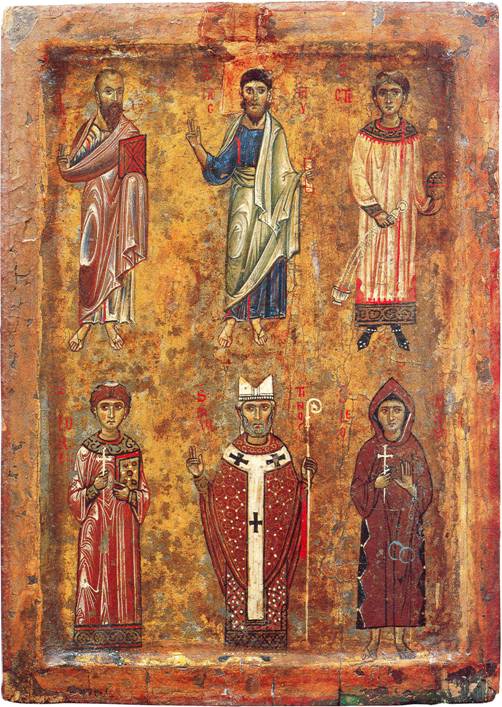
c) as depicted (at centre in lower register, between Sts. Lawrence of Rome and Leonard of Noblac) in a twelfth-century icon of Byzantine origin or inspiration in the Holy Monastery of the God-trodden Mount Sinai in St. Catherine (South Sinai governorate):

 http://www.forum-orthodoxe.com/images/stmartindetours.jpg


d) as depicted in a somewhat restored seemingly earlier twelfth-century mosaic in the diaconicon of the basilica (ex-cattedrale) di Santa Maria Assunta on Torcello:
http://tinyurl.com/26vvdrv
http://tinyurl.com/25a2z44

e) as depicted in an earlier twelfth-century legendary from the abbey of Cîteaux (between 1101 and 1133; Dijon, Bibliothèque municipale, ms. 641, fol. 113r):

http://www.culture.gouv.fr/Wave/savimage/enlumine/irht6/IRHT_094818-p.jpg


f) as depicted (at far left) in the late twelfth-century mosaics (c. 1182) in the sanctuary of the basilica cattedrale di Santa Maria Nuova in Monreale:
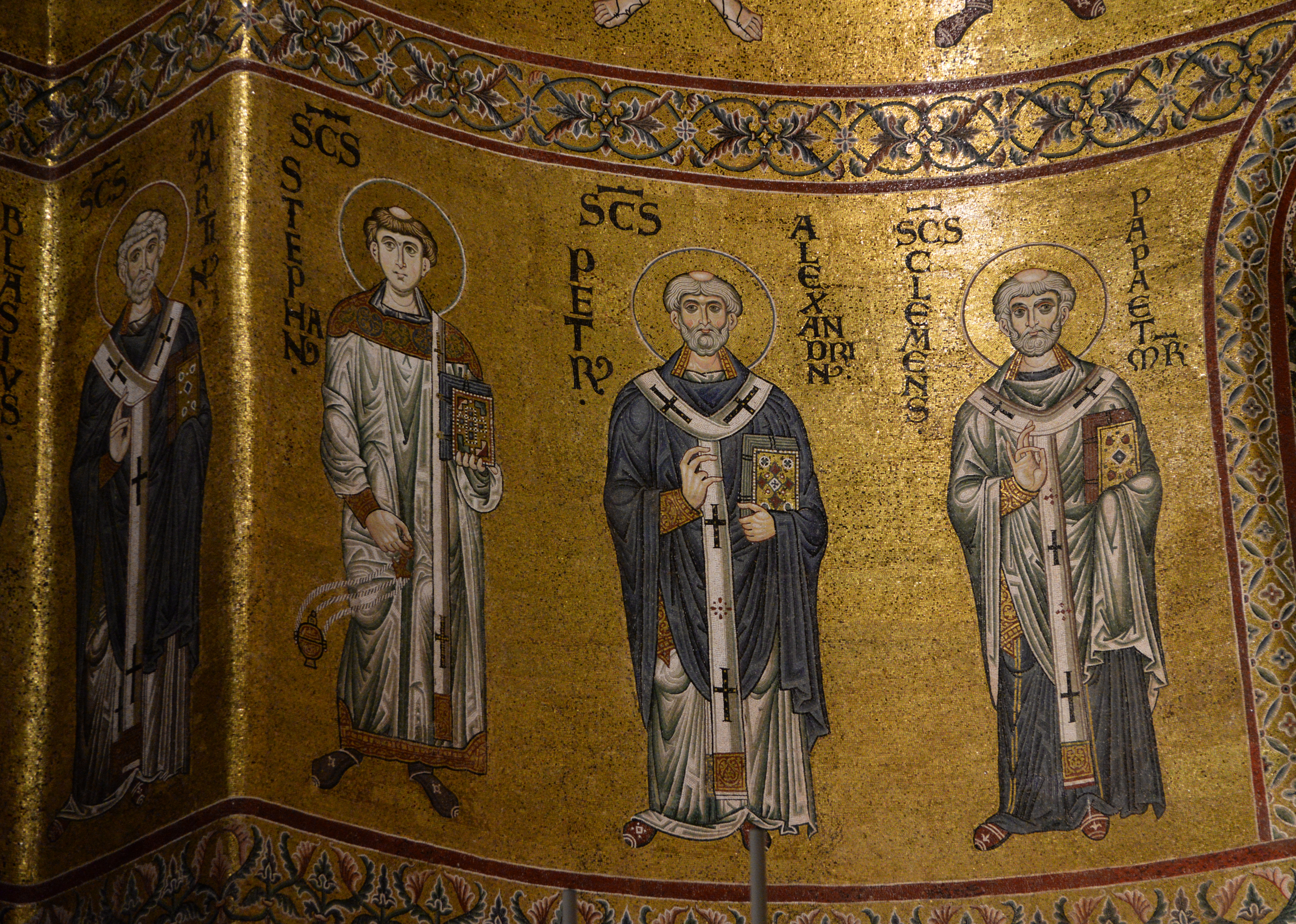


g) as portrayed in high relief in two locations on the right portal of the late twelfth or earlier thirteenth-century south porch of the basilique cathédrale Notre-Dame in Chartres:
1) On the right jambs (at left; at right, St. Jerome):
http://tinyurl.com/ostx422
Detail view:


2) On the tympanum (cutting his cloak):
http://tinyurl.com/ou6mnb5
Detail view:
http://tinyurl.com/nqfmnwc

h) as portrayed (scenes from his Vita) in four earlier thirteenth-century reliefs on the facade of the cattedrale di San Martino in Lucca:
http://tinyurl.com/27df48s
http://tinyurl.com/26rpoeb
http://tinyurl.com/2agms7o
http://tinyurl.com/29zfghw
There are detail views on this page:
http://tinyurl.com/32c6gkz

i) as depicted in the early thirteenth-century Life of St. Martin window (bay 7; c. 1215) in the cathédrale Saint-Étienne in Bourges:
http://www.medievalart.org.uk/bourges/07_pages/Bourges_Bay_07_key.htm
Detail view (cutting his cloak):
http://www.medievalart.org.uk/bourges/07_pages/Bourges_Bay_07_panel_01.htm

j) as depicted in the earlier thirteenth-century Life of St. Martin window (bay 102; c.1215-1225; restored, 1922 and 1995-1996) in the basilique cathédrale Notre-Dame in Chartres:
http://tinyurl.com/na6elhu
Detail view (cutting his cloak):

 https://s-media-cache-ak0.pinimg.com/736x/b2/4b/31/b24b312d70efcdb809034dc8c36a9aaf.jpg


k) as depicted (cutting his cloak) in an earlier thirteenth-century copy (c.1236-1250) of part of the Magnum legendarium Austriacum (Zwettl, Stiftsbibliothek, cod. 14, fol. 149r):
http://tarvos.imareal.oeaw.ac.at/server/images/7002565.JPG

l) as depicted in the earlier thirteenth-century Life of St. Martin window (bay 102b; c. 1240) in the cathédrale Saint-Maurice in Angers:
http://www.medievalart.org.uk/Angers/Bay_102b/Angers_Bay102b_Key.htm

m) as depicted (enthroned) in a mid-thirteenth-century pontifical from Mainz (between 1241 and 1251; Paris, BnF, Ms. Latin 946, fol. Av):


n) as depicted (cutting his cloak) in a late thirteenth-century copy of French origin of the Legenda aurea (San Marino, CA, Huntington Library, ms. HM 3027, fol. 156r):
http://digitalassets.lib.berkeley.edu/ds/huntington/images//000913A.jpg

o) as depicted (cutting his cloak) in the late thirteenth-century Livre d'images de Madame Marie (c. 1285-1290; Paris, BnF, ms. Nouvelle acquisition française 16251, fol. 89r):


p) as depicted (cutting his cloak) in an early fourteenth-century fresco in the cathédrale Saint-Gatien in Tours:
https://www.flickr.com/photos/biron-philippe/7585653434/

q) as depicted (scenes from his Vita) by Simone Martini in a series of early fourteenth-century frescoes (between 1312 and c. 1318) in the cappella di San Martino in the lower church of the basilica di San Francesco in Assisi:

 http://www.wga.hu/art/s/simone/3assisi/00view3.jpg


http://www.wga.hu/art/s/simone/3assisi/00view2.jpg
Detail views with captions:
http://www.wga.hu/frames-e.html?/html/s/simone/3assisi/index.html

r) as depicted (at top right in the major panels) by Giovanni di Bonino, perhaps working from a design by Simone Martini, in one of the three earlier fourteenth-century windows (after 1312) in the cappella di San Martino in the lower church of the basilica di San Francesco in Assisi:
http://www.wga.hu/art/s/simone/3assisi/scenes/99window.jpg
Detail view:

 http://www.akg-images.fr/Docs/AKG/Media/TR3_WATERMARKED/2/6/e/1/AKG286952.jpg


s) as portrayed in an earlier fourteenth-century elephant ivory statuette of German origin (c. 1320; Köln or Mainz) in the Victoria and Albert Museum, London:
http://tinyurl.com/nsnqkgh

 http://sargasso.nl/wp-content/uploads/2014/11/martinus_tours_1320_cologne_vam.jpg


t) as depicted (cutting his cloak) in an earlier fourteenth-century French-language legendary of Parisian origin with illuminations attributed to the Fauvel Master (c. 1327; Paris, BnF, ms. Français 183, fol. 165v):
http://tinyurl.com/nnuec2h

u) as depicted (at left; at right, St. Theodore the Stoudite) in the earlier fourteenth-century frescoes (between 1335 and 1350) in the narthex of the church of the Holy Ascension at the Visoki Dečani monastery near Peć in, depending on one's view of the matter, either the Republic of Kosovo or Serbia's province of Kosovo and Metohija:


v) as portrayed in high relief (consecration as bishop; cutting his cloak) on a mid-fourteenth-century polychromed ivory diptych (c. 1340-1350) of northern French or Flemish origin in the Cleveland Museum of Art:


w) as depicted (at lower right; cutting his cloak) in the mid-fourteenth-century San Martino altarpiece (seemingly later 1340s) from Oristano in the Antiquarium Arborense - Museo archeologico Giuseppe Pau, Oristano:

 http://www.antiquariumarborense.it/it/Museo/Sale/Immagini/retabloSanMartino1.jpg


x) as depicted (cutting his cloak) in a mid-fourteenth-century copy, from the workshop of Richard and Jeanne de Montbaston, of the Legenda aurea in its French-language version by Jean de Vignay (1348; Paris, BnF, ms. Français 241, fol. 300r):
http://tinyurl.com/pua5rvp

y) as depicted (cutting his cloak) in a mid-fourteenth-century vault painting (c. 1350) in Skibby Kirke at Skibby, Lejre Kommune, Sjælland:

 https://upload.wikimedia.org/wikipedia/commons/4/4c/Martin_af_Tours_(Skibby_Kirke).jpg


z) as portrayed in a late fourteenth-century reliquary bust (from Avignon?; restored in the twentieth century) in the Musée du Louvre in Paris:
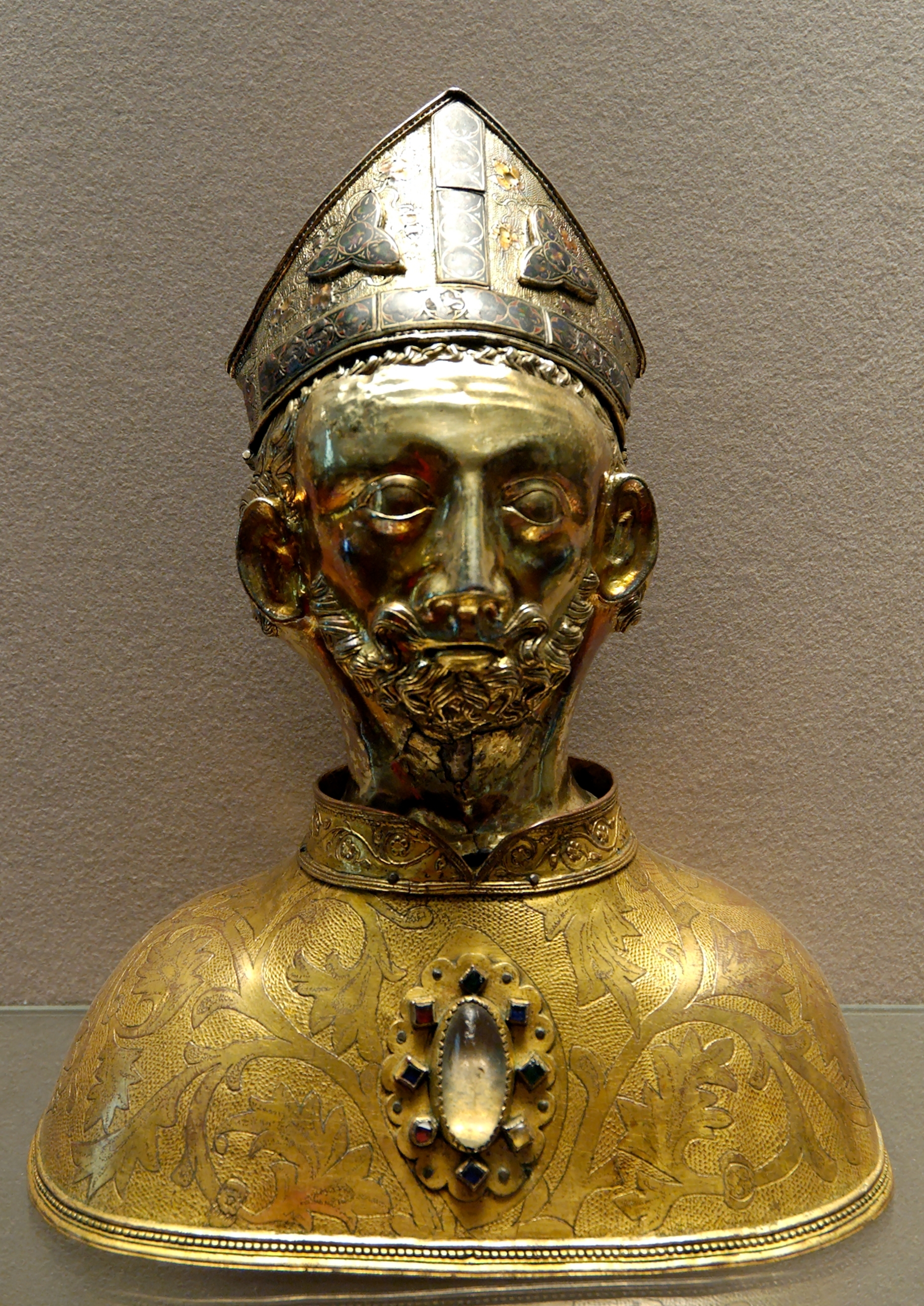
 
 https://upload.wikimedia.org/wikipedia/commons/7/74/Head_reliquary_Martin_Louvre_OA6459.jpg


aa) as depicted (at top in the right margin; demanding a steep price of Clovis for the return of a horse) in the numerous pen-and-ink illustrations in the margins of an early fifteenth-century copy of the Chronicon a mundi creatione ad annum 1220, an abbreviation and continuation of the Pantheon of Godfrey of Viterbo (c. 1400-1415; Paris, BnF, ms. Latin 4935, fol. 8v):
http://gallica.bnf.fr/ark:/12148/btv1b8455934w/f26.image

bb) as depicted (at left; at right, brigands) in an earlier fifteenth-century embroidery of southern Netherlandic origin (c. 1430) in The Cloisters Collection of the Metropolitan Museum of Art, New York:

Saint Martin and the Brigands


cc) as depicted in grisaille (cutting his cloak) by Jean le Tavernier in the mid-fifteenth-century Hours of Philip of Burgundy (c. 1451-1460; Den Haag, KB, ms. 76 F 2, fol. 264v):
http://manuscripts.kb.nl/zoom/BYVANCKB%3Amimi_76f2%3A264v_min

dd) as depicted (upper right; cutting his cloak) by Girolamo di Giovanni of Camerino in a later fifteenth-century triptych (c. 1473) in the chiesa di San Martino Vescovo in Monte San Martino (MC) in the Marche:
http://tinyurl.com/q74m33o

Detail view:

 http://www.liricigreci.it/blog/wp-content/uploads/2013/06/polittico_girolamo_giovanni_monte_san_martino04.jpg


ee) as depicted (cutting his cloak) in a later fifteenth-century vault painting (c. 1474) in Jetsmark Kirke at Pandrup, Jammerbugt Kommune, Nordjylland:
http://tinyurl.com/pu5sh97

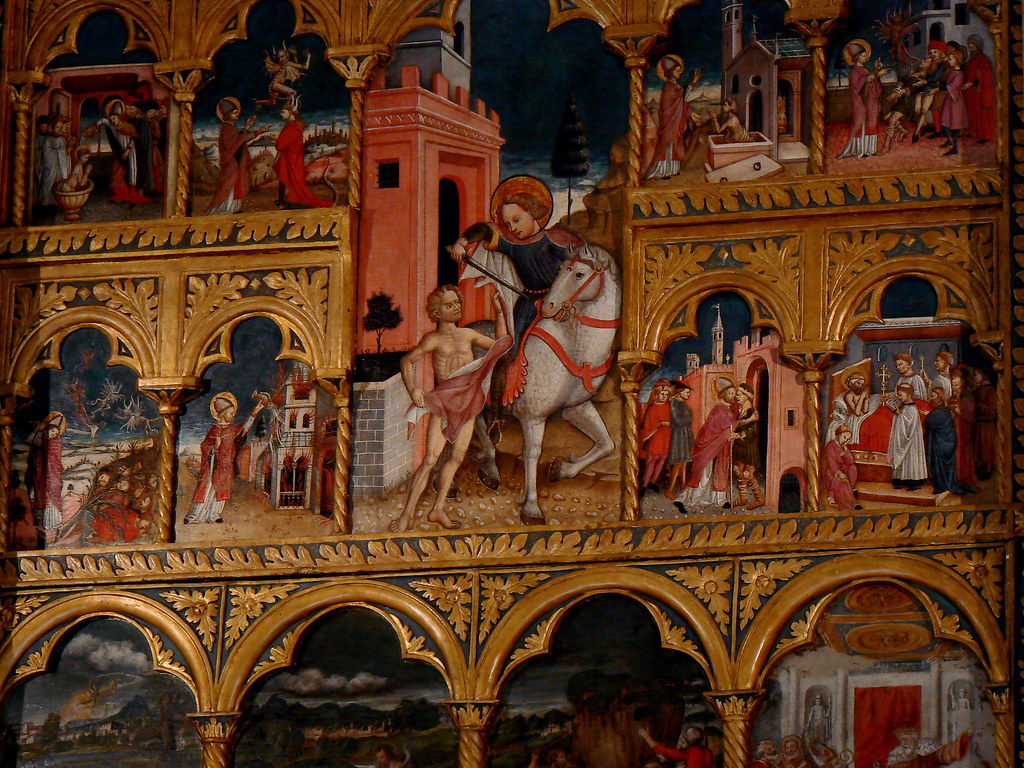
ff) as depicted (cutting his cloak and other scenes from his Vita) by the Master of the Galletti Chapel in a later fifteenth-century painted altarpiece (c. 1475-1480) in the crypt of the basilica cattedrale di San Martino in Belluno:
https://c1.staticflickr.com/3/2397/2177982293_8c1e640b3d_b.jpg

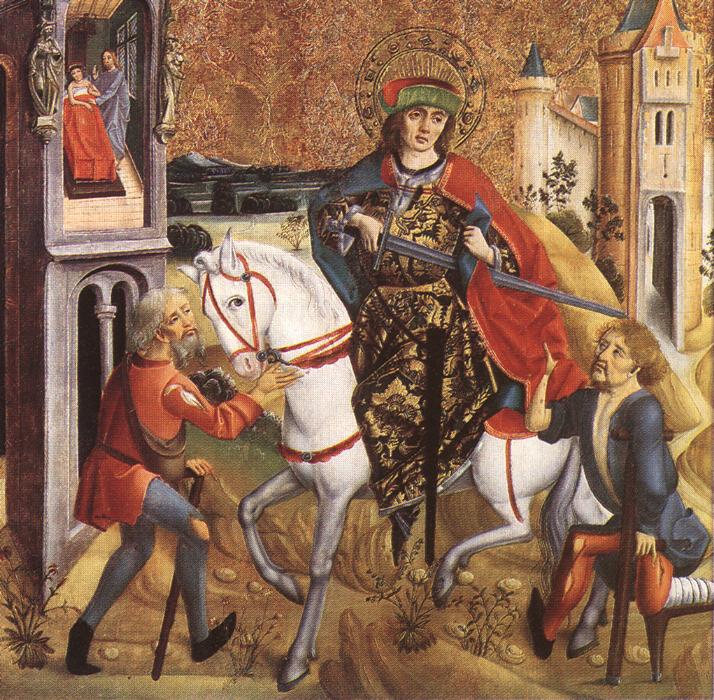
gg) as portrayed (with the beggar) in a later fifteenth-century statue (c. 1475-1480) of German origin in the Seattle Art Museum, Seattle (WA):

 http://www.wga.hu/art/m/master/zunk_ge/zunk_ge8/5martin.jpg


hh) as depicted in two late fifteenth-century panel paintings (c. 1490) on either side of a wing from a dismembered altarpiece in the Magyar Nemzeti Galéria, Budapest:
1) Cutting his cloak:

 http://www.wga.hu/art/m/master/zunk_hu/zunk_hu1/06martin.jpg


2) Celebrating Mass in shabby dress:


 http://www.wga.hu/art/m/master/zunk_hu/zunk_hu1/04martin.jpg


ii) as depicted (center panel; cutting his cloak) by Bartolomeo Vivarini in his late fifteenth-century Triptych of St. Martin (1491) in the Accademia Carrara, Bergamo:

 http://passaggioadovest.ilserio.it/immagini/Trittico.JPG


jj) as portrayed (cutting his cloak) in high relief in a late fifteenth- or early sixteenth-century sculpture (c. 1500), from Bjæverskov Kirke in Sjælland, in the Nationalmuseet, Copenhagen:


 https://wuhstry.files.wordpress.com/2015/10/imag0667_burst0021.jpg


kk) as depicted (cutting his cloak) in an embroidered early sixteenth-century cope shield (between 1500 and 1509) in the Museum Catharijneconvent in Utrecht:

 https://upload.wikimedia.org/wikipedia/commons/thumb/2/29/MCC-31218_Koorkapschild_met_St._Maarten_te_paard_en_bedelaar%2C_ingelijst_%281%29.tif/lossy-page1-1024px-MCC-31218_Koorkapschild_met_St._Maarten_te_paard_en_bedelaar%2C_ingelijst_%281%29.tif.jpg?1447199959777


Tuesday, 13 January 2015

St Hilary and St Martin


Today is the feast of St Hilary of Poitiers, the fourth century Gaulish champion of orthodoxy in respect of the Divinity of Christ.

He also was the bishop who ordained St Martin of Tours as an acolyte. In this panel from the St Martin window in the church of St Martin in York St Martin is depicted as acolyte at a Mass celebrated by St Hilary. The window dates from circa 1442, and was the gift of the vicar Robert Semer. Originally the west window of the church it was removed in 1940 and so survived the bombing of the church in 1942. In the peculiar, and to my mind, highly dubious scheme of restoration of part of the church - once a fine moid-fifteenth century building - it is now situated in the new north wall.

photo

Image: Gordon Plumb on Flickr

Tuesday, 23 August 2011

Almuces


Almost a year ago I posted Men in mink about almuces. Since then I have been meaning to publish some further thoughts about the topic. Well, let's face it, it is the sort of thing that is never that far from my mind.

The almuces we were considering were those of secular canons - those of cathedrals and collegiate churches - rather than regular canons, such as the Premonstratenians, who as Br. Rupert O.Praem pointed out, have retained the use of white almuces.

Some medieval foundations specify in their foundation deeds or statutes the type of almuces to be worn by the canons. Some were of cloth rather than fur, as for example at the College of the Holy Trinity in my home town of Pontefract, which was founded in 1385. At Beverley Minster different groups within the community had different types of fur for their almuces so as to differentiate them.
The brass rubbings and incised slabs we were considering were from both England and the continent. English medieval almuces appear to have been more on the lines of a mozzetta, but unlike continental examples had two pendant lappets at the front - shown on many English brasses. The examples from the Empire and Poland appear to be longer, and did not have the lappets. Here is a photograpgh from Fribourg in Switzerland from c.1900:

In appearance it is virtually identical to one shown on a brass from Posznan of c.1390.

In France and Scotland the almuce appears to have been worn drawn up over the head of the wearer - wearing it like that in choir on a cold morning must have been rather like wrapping oneself in a duvet to keep warm.

English, German and Polish examples on monuments and in illuminations show it being worn as a close fitting shoulder cape. Here is a mid-fifteenth century English depiction of the almuce worn by an Augustinian canon under a cope:

photo

St John of Bridlington
Mid-fifteenth century glass in the Beauchamp chantry Warwick

Photo: Gordon Plumb's photostream on Flickr

Here is another image of a secular priest from the same period who is also depiced in an almuce:

photo

Robert Semer, Vicar of St Martin-le-Grand York, c.1442.
The cappa nigra is shown as blue rather than black for the sake of allowing light through. Also noteworthy is his "Old English surplice" with its scallopped edges.

From the St Martin window, given by Semer, and still in the church

Photo:Gordon Plumb's photostream in Flickr

By the later fifteenth century the almuce is sometimes shown being carried over the left forearm, as it still is by the Premonstratensians. Thus the figure of Provost Edward Bonkil on the Trinity panels from his collegiate church in Edinburgh from the years 1473-1482, and dated more closely to 1478-9, shows him carrying his almuce over his arm.

The Trinity Altarpiece

Photograph from the National Gallery of Scotland.
Provost Bonkil is in the second panel ftom the left

I found I had copied a posting from the New Liturgical Movement by Gregor Killmorgan from January 14th 2010 about almuces, and I am adding that to this post:


Yesterday I mentioned that the books of the great Joseph Braun SJ are available online. To give those of you unfamiliar with his work an idea, and since I recently came by some very good - and rare - pictures of the almuce being worn on my friend Leo's The Far Sight 2.0, which I use to illustrate this piece, I have translated the respective section from Braun's Handbuch der Paramentik [Manual of Paramentics], p. 204 f. The photographs of tomb slabs of the 16th century were taken by me in Halberstadt Cathedral.


The almuce (almucia, armutia) is not very commonly used today anymore. A part of choir dress, it identifies the wearer as a canon or prebendary. It is made of fur and is in principle a shoulder cape, but is only sporadically used as such any longer. Mostly it is today merely an insignia which either rests on the left arm or is placed on the desk of the choir stall.

The first news of the almuce we receive from the 12th Century. It was originally a headdress: it either had the shape of a cap reaching somewhat beyond the ears , or that of a hood extending below far down the back. Both types are mentioned and described in the statutes of Bayeux (ca. 1270). The hoodlike almuce was here a privilege of the canons of the upper row of choir stalls. It was made, whether cap or hood, sometimes of woolen stuff or silk, sometimes, and this was most common, of fur or lambskin; but in the latter case it was lined with stuff. Also, if made of fur or skin, it was popular to trim it with tassels at the hem, which were made from the tails of weasels and similar animals. The sculptures show plenty of evidence for this, especially in the later period.

Towards the end of the Middle Ages the almuce underwent, in terms of shape and character, a very significant change. The pictorial representations, but especially the numerous tomb figures of canonici from this period are very instructive in this regard [NLM note: see photographs of tomb slabs at Halberstadt Cathedral to the left]. The Almucia now takes the form of a collar, of a real shoulder cloak, which is either slit at the front, or completely closed in the manner of a bell-shaped [NLM note: the term used in German for conical chasubles] chasuble, and it often not merely covered the upper body, but even reached down beyond the waist. A hood was indeed still attached to it, but more as a decoration and as a reminder of the erstwhile purpose and character of the garment than for the sake of use as head covering. In this new form the almuce appears uncommonly becoming.

If the collar remained open in the front of, it ended in some places from the chest on in two long, wide, stole-like strips, which extended almost to the knees. The transformation of the almuce was no doubt occasioned by the circumstance that during choral Office, more and more the more convenient biretta came into use as head covering, and consequently, the almuce lost its practical significance.

The almuce was not originally an insignia of collegiate and cathedral canons. It was even worn by laypeople, and not merely by men, but also by women. In the late Middle Ages it must, however, have already possessed the character of an insignia, as can be inferred from the circumstance that it now regularly recurs in the tomb figures of canons, if the deceased is not shown in Mass vestments. With express words it is called by the Provincial Synod of Milan of the year 1579 an insigne Canonicorum. The odd-sounding name almuce has as yet not found a completely satisfactory explanation.


An almuce of the closed variety is also worn by the canons of the Collegiate Chapter of Saints John Baptist and John Evangelist at Regenburg, Germany, of which Mgr. Georg Ratzinger, the brother of Pope Benedict XVI, is a member:


Thursday, 11 November 2010

St Martin


Today is the feast of St Martin of Tours (316-397). He was the first confessor saint to be afforded liturgical honours and is the patron of numerous churches and cathedral across Europe. The Wikipedia article about him and his cult, with appropriate links, is here. The key text of the life of St Martin by Sulpicius Severus can be read here.

In a biography of St Martin I read some years ago there is the argument that in Britain missionary communities inspired by St Martin's life and example often placed their churches under his patronage. This seems to be borne out by churches such as St Martin in Canterbury - usually thought to pre-date St Augustine's mission of 597 - St Martin in the Fields in London, where recent excavations found late Roman burials underneath the present church, rebuilt in the early eighteenth century in its present form, and the cathedral of St Martin at Whithorn, established by St Ninian. It occurs to me that he is not infrequently found as a patron of histotic churches in cities with Roman origins. I do not know how far the theory has been tested, but it is an attractive one, and one I think plausible. It does, of course, depend on an accurate transmission of the dedication - something which has been questioned in south-west England. In the areas I know well I am not sure, but in most cases dedications seem well established, or changes are recorded.

In my home area there is the fine medieval church of St Martin at Womersley.

<span class=Womersley, The Church of St Martin" src="http://s0.geograph.org.uk/photos/26/06/260618_86ef3667.jpg">
Womersley, The Church of St Martin
© Copyright Gordon Kneale Brooke


<span class=Womersley, Church of St Martin, Interior" src="http://s0.geograph.org.uk/photos/26/06/260643_8c5322f6.jpg">

Womersley, Church of St Martin, the nave and Rood screen

Situated on the magnesian limestone ridge it is built of excellent local stone and has some Anglo-Catholic fine furnishings by G.F.Bodley, who carried out a sympathetic and striking renovation in the 1890s. Unfortunately the stencilled decoration he included has largely disappeared. Nonetheless with some beautiful glass and vestments it was, when I knew it, a prayerful building.

Womersley includes the site of a Roman villa or farmstead, and there have been other Roman finds within the parish, as there has of a pagan Anglo-Saxon burial with grave goods. Given that this part of what is now Yorkshire remained under Christian rule, in the kingdom of Elmet until the beginning of the seventh century, and only a generation or so before St Paulinus' mission in 625 to convert the north - where he found churches which had been deserted by their British clergy - the evidence of late Roman occupation, a pagan Anglo-Saxon presence and a church dedicated to a St Martin whose cult appears to have spread soon after his death in 397, all gathered together in a classically English village setting suggests that Womersley, on well drained land above the marshes to the east and the more wooded clay soils to the west , and not far from Roman roads and routes that have remained in use, may, and I only write may, be an argument for continuity of settlement from the Roman period onwards. It is a complex question, but this looks a tempting example.

Also in my home area, in the city of York is the church of St Martin le Grand in Coney Street. This was a fine mid-fifteenth century church , but tragically was bombed in 1942, and "restored" in the 1960s, which in my opinion, and as we would say up north, made a right mess of it. (Yes, I know the Luftwaffe messed it up to start with but that is no reason not to restore it properly. It is, in my opinion one of G.G. Pace's awful designs, though one website says it is "considered to be one of the best designs by architect George Pace". The whole thing smacks of the diocese of York ridding itself of unwanted and unloved churches).

It is the church where St Margaret Clitherow was baptized and married, so she would have seen the St Martin window.

Mercifully this, the great west window of circa 1442, and the gift of the vicar Robert Semer, had been removed at the beginning of the war and survived, and is still to be seen on site.

photo

The figure of St Martin,
from the window in St Martin le Grand York,
given by the vicar, Robert Semer, circa 1442

Photo by Gordon Plumb


There are details of the window here, in photographs again by Gordon Plumb and also here, which highlights the episodes from St Martin's life as depicted in the window, and shows that Sulpicius Severus' life of the saint remained known.

And finally, simply because I like the paintings of El Greco, here is his depiction of the saint dividing his cloak. Although completely anachronistic in its dress and setting, it does convey the idea of Martin the idealistic young officer impelled to an act of Christian charity.

http://www.salemcatholic.org/wp-content/uploads/2009/11/St-Martin-of-Tours-El-Greco.jpg

El Greco St Martin and the Beggar c.1597-99
National Gallery of Art,
Washington D.C.