Once I was a clever boy learning the arts of Oxford... is a quotation from the verses written by Bishop Richard Fleming (c.1385-1431) for his tomb in Lincoln Cathedral. Fleming, the founder of Lincoln College in Oxford, is the subject of my research for a D. Phil., and, like me, a son of the West Riding. I have remarked in the past that I have a deeply meaningful on-going relationship with a dead fifteenth century bishop... it was Fleming who, in effect, enabled me to come to Oxford and to learn its arts, and for that I am immensely grateful.


Showing posts with label St Elizabeth of Hungary. Show all posts

Tuesday, 17 November 2015

St Elizabeth of Hungary


John Dillon posted about St Elizabeth of Hungary, whose feast falls today in the General calendar, on the Medieval Religion discussion group as follows:

A daughter of King Andrew II of Hungary, Elizabeth was married in 1221 to Ludwig IV, landgrave of Thüringen (whence she is also known as Elizabeth of Thüringen). They had three children of whom the third, a daughter, was born after her crusading father's death at Otranto in 1227 and died in infancy. Only twenty when she was widowed, Elizabeth left the Thuringian court soon afterward -- there was a nasty struggle over her dowry -- and took up residence in Marburg (in today's Hessen), where she lived ascetically, devoted herself to works of charity, and died in 1231 at the age of twenty-four. Miracles were reported at her tomb and a cult arose. Two canonization trials ensued, followed by a canonization in 1235. Having dedicated to St. Francis of Assisi a hospital she had built in Marburg, she was subsequently promoted by Franciscans as a model of lay spirituality and charity. But she was educated at a Dominican convent in Hungary and the Dominicans claim her as well.

Elizabeth has a very extensive hagiographic dossier, including rather different miracle collections emanating from the Order of Friars Minor and from the Order of Preachers. In one legend, the young Elizabeth was forbidden by her father to distribute food to the poor. She of course did so anyway and was stopped for inspection, whereupon the food was changed miraculously to flowers (or was miraculously covered by them).

Some period-pertinent images of St. Elizabeth of Hungary / of Thüringen:

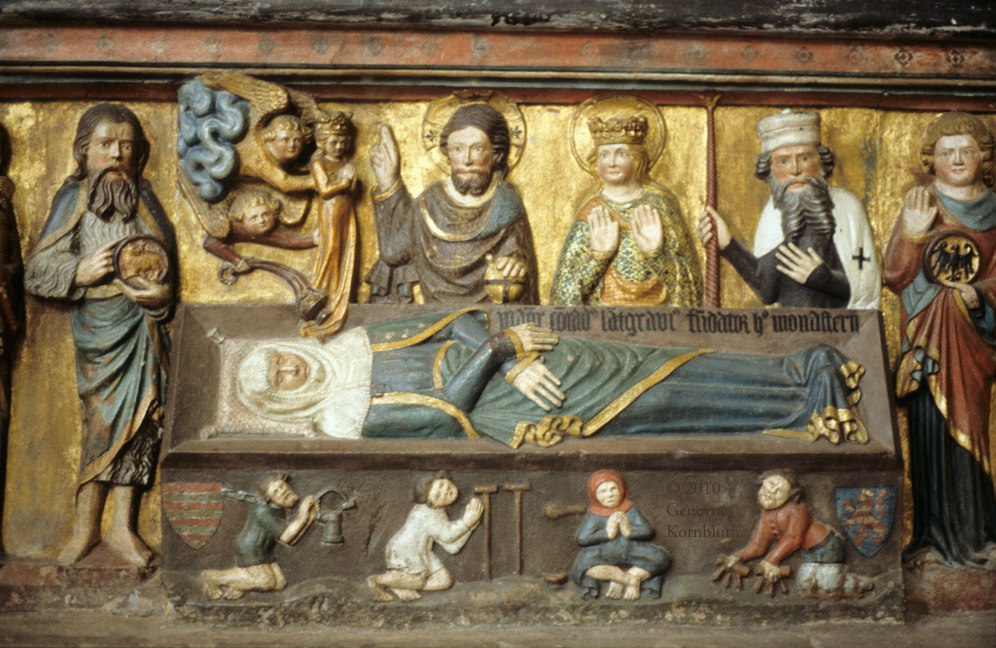
a) as portrayed at the base of her tomb (c. 1235-1250) in the originally thirteenth- and earlier fourteenth-century St. Elisabethkirche in Marburg an der Lahn, begun in the year of her canonization:

 http://www.kornbluthphoto.com/images/ElizShrine2.jpg

http://www.kornbluthphoto.com/images/ElizShrine2.jpg [photo courtesy of Genevra Kornbluth]
The tomb as a whole:

 http://www.elisabethkirche.de/fileadmin/_processed_/csm_04_EC_Mausoleum_01_e7d7fb54ad.jpg


http://www.kornbluthphoto.com/images/ElizShrine1.jpg [photo courtesy of Genevra Kornbluth]

b) as portrayed on her copper-gilt shrine (between 1235 and 1250) in the same church:
1) standing, on one of the shrine's short ends:

 http://www.elisabethkirche.org/typo3temp/pics/aeb08e1fc2.jpg


 http://www.elisabethkirche.org/typo3temp/pics/1ad12d9afb.jpg


2) Scenes of Elizabeth as portrayed on the roof of the shrine:

 http://www.rmv.de/linkableblob/de/38882-26173/original/MR_Elisabethkirche_Schrein.jpg

 http://www.kirchenzeitung.de/sites/bz5.bistumspresse-zentralredaktion.de/files/imagecache/node-gallery-display-full/images/fotostrecken/Elisabeth_5.jpg


 https://www.uni-marburg.de/aktuelles/news/2007/0515w/image_preview


 http://www.heilige-elisabeth-damp.de/bilder/00561_01.jpg


c) Elizabeth as portrayed in an earlier thirteenth-century statue, thought to be from very shortly after her canonization in 1235, in the Kirche (ex-cathedral) St. Peter und Paul in Naumburg:
http://tinyurl.com/2c92wjh

 https://rezitante.files.wordpress.com/2009/08/alten-naumburg-181.jpg?w=450&h=600

d) as depicted (scenes) in several panels of the earlier thirteenth-century glass window (before 1250) devoted to her in the choir of the St. Elisabethkirche in Marburg an der Lahn:
1) http://tinyurl.com/pn23wco
larger view:

 https://s-media-cache-ak0.pinimg.com/736x/6d/e8/32/6de83286d593fb41391968a23b499669.jpg

2) http://tinyurl.com/p4a2k7l

3) http://tinyurl.com/okvgktd
The window as a whole (click on the panels for smallish individual views):
http://alt.elisabethkirche.de/rundgang/ixu_fur_l6.htm

e) as depicted (at right; at left, St. Francis of Assisi) in a late thirteenth-century copy of French origin of the Legenda aurea (San Marino, CA, Huntington Library, ms. HM 3027, fol. 157r):
http://digitalassets.lib.berkeley.edu/ds/huntington/images//000914A.jpg

f) as depicted (tending the sick) in the late thirteenth-century Livre d'images de Madame Marie (c. 1285-1290; Paris, BnF, ms. Nouvelle acquisition française 16251, fol. 82v):
http://tinyurl.com/268a74o

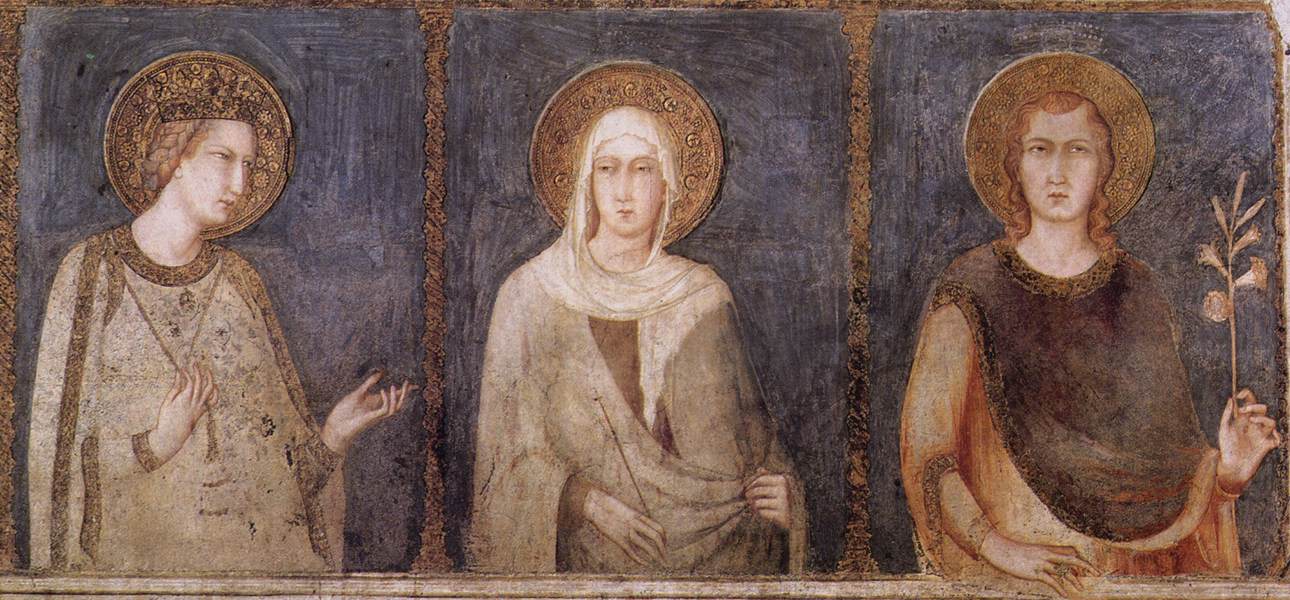
g) as depicted (at left; with Sts. Margaret of Hungary and Henry of Hungary) by Simone Martini in his early fourteenth-century frescoes of Franciscan saints (c. 1318) in the south transept of the lower church of the basilica di San Francesco at Assisi:

 http://www.wga.hu/art/s/simone/3assisi/transept/5saints2.jpg


h) as depicted (at right; at left, St. Clare of Assisi) by Simone Martini in an earlier fourteenth-century fresco (c. 1318-1320) at the entrance to the cappella di San Martino in the lower church of the basilica di San Francesco at Assisi:

 http://www.wga.hu/art/s/simone/3assisi/1saints/saints40.jpg

Detail view (Elizabeth):

 http://www.wga.hu/art/s/simone/3assisi/1saints/saints41.jpg


i) as depicted (giving a cloak to a beggar) in a panel of the earlier fourteenth-century Altenberg Altarpiece (c. 1330) in the Städelsches Kunstinstitut, Frankfurt m Main:
https://www.flickr.com/photos/hen-magonza/5888827150/

j) as depicted (at right; miracle of the flowers) in an earlier fourteenth-century fresco (c. 1337) formerly in the chiesa di Sant'Elisabetta d'Ungheria in Perugia and now in the Galleria Nazionale dell'Umbria in that city:

 http://www.heiligenlexikon.de/Fotos/Nikolaus_von_Tolentino3.jpg


k) as depicted (experiencing a vision) in an earlier fourteenth-century copy of the Legenda aurea in its French-language version by Jean de Vignay (c. 1326-1350; Paris, BnF, ms. Français 185, fol. 223r):
http://tinyurl.com/27kq28s

l) as depicted (experiencing a vision) as depicted in an earlier fourteenth-century copy, from the workshop of Richard and Jeanne de Montbaston, of the Legenda aurea in its French-language version by Jean de Vignay (1348; Paris, BnF, ms. Français 241, fol. 305r):


m) as depicted on the upper portion of a wing of a later fourteenth-century altarpiece (c. 1370-1373) from Schloss Tirol in the Tiroler Landesmuseum Ferdinandeum, Innsbruck:

http://tarvos.imareal.oeaw.ac.at/server/images/7003466.JPG

The altarpiece as a whole:

 http://sammellust.ferdinandeum.at/wo_files/images/objekte/1826b.jpg


n) as depicted (holding flowers) in a late fourteenth- or very early fifteenth-century panel painting attributed to Gherardo Starnina (formerly known as the Maestro del Bambino Vispo) sold at auction at Sotheby's in 1962:

 https://upload.wikimedia.org/wikipedia/it/6/6b/Gherardo_Starnina_-_Sant%27Elisabetta_d%27Ungheria.jpg

Expandable grayscale views of the painting as photographed prior to that sale are here:
http://tinyurl.com/3x2fuzp
Where is the painting now?

o) as depicted (experiencing a vision) in the earlier fifteenth-century Châteauroux breviary (ca. 1414; Châteauroux, Bibliothèque municipale, ms. 2, fol. 415v):

 http://www.enluminures.culture.fr/Wave/savimage/enlumine/irht2/IRHT_054274-p.jpg


p) as depicted (washing a leper) in an early fifteenth-century copy of the Elsässische Legenda aurea (1419; Heidelberg, Universitätsbibliothek, Cod. Pal. germ. 144, fol. 242v):
http://digi.ub.uni-heidelberg.de/diglit/cpg144/0500
http://heidicon.ub.uni-heidelberg.de/heidicon/58/59/8795.html

q) as depicted (experiencing a vision) in an earlier-to-mid-fifteenth century Franciscan breviary of Milanese origin (Paris, BnF, ms. Latin 760, fol. 573r):
http://tinyurl.com/2a7psrq

r) as depicted (scenes) on the earlier fifteenth-century choir screen (c. 1420-1430) of the Heiligen-Geist-Hospital in Lübeck:


The panels in situ:

 https://upload.wikimedia.org/wikipedia/commons/d/d6/L%C3%BCbeck_Heiligen-Geist-Hospital_070311.jpg


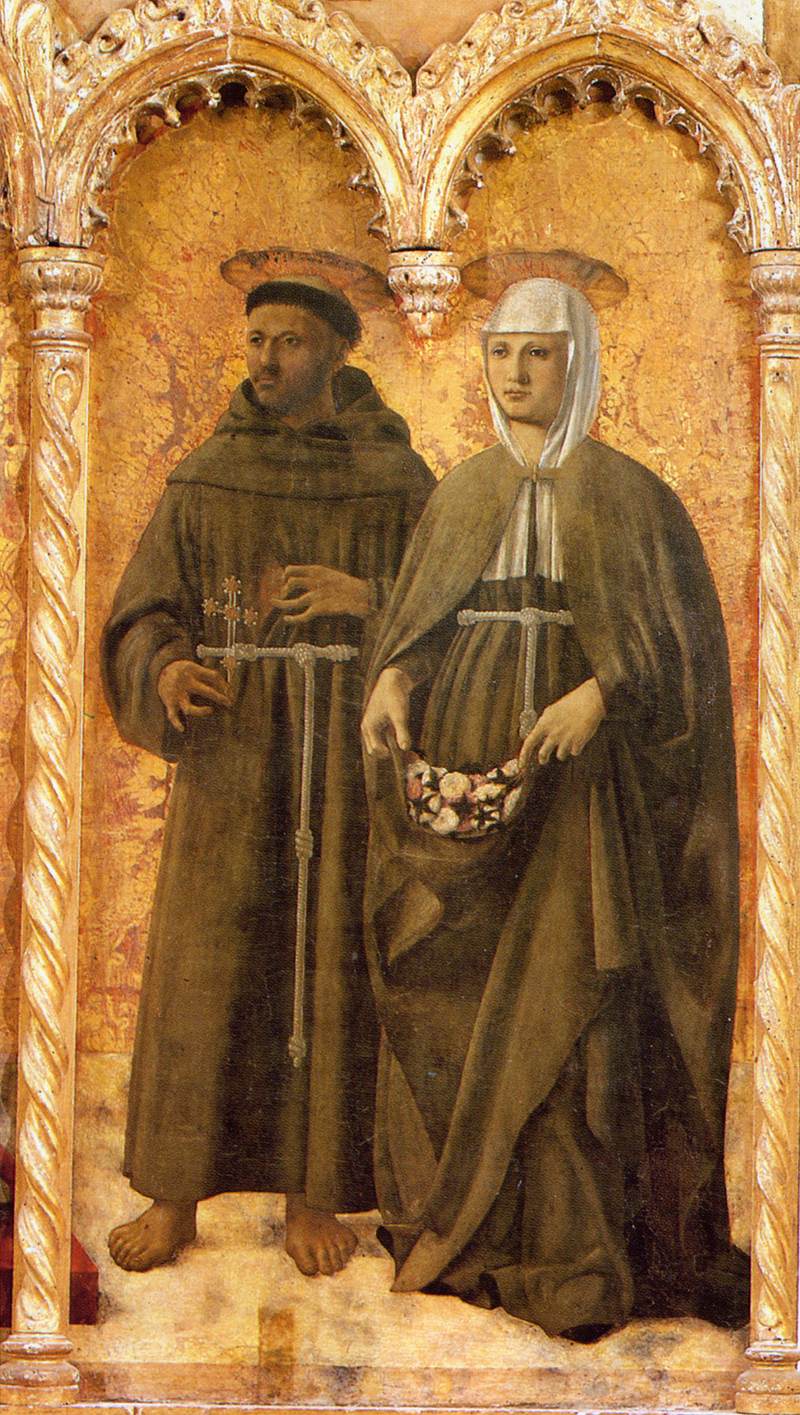
s) as depicted (at right, holding flowers; at left, St. Francis of Assisi) by Piero della Francesca in his later fifteenth-century Polyptych of Sant'Antonio (c. 1460-1470) in the Galleria Nazionale dell'Umbria in Perugia:

 http://www.wga.hu/art/p/piero/1/3anton04.jpg


t) as portrayed in a later fifteenth-century polychromed wooden statue (c. 1470; the crown is later) in the nave (near the choir screen) in the St. Elisabethkirche in Marburg an der Lahn:

https://blogger.googleusercontent.com/img/b/R29vZ2xl/AVvXsEj58nXMpcKwgjMYeh_-aDvuxVdwqr2TodBRR_xynni5CuFdgtS7nalG_Cn5TCmAsEZKYuNHBAQ6D3g-JpcN_VPU5afhH8k5Zmfr1TNJgYO9ygJmPZ3_IkSJY16AJB7PR74wzvd8mGFilHyA/s1600/196.JPG


 https://upload.wikimedia.org/wikipedia/commons/c/ca/Elisabeth_von_Th%C3%BCringen.JPG


In the statue she is holding the Elisabethkirche.

u) as depicted (witha jug and a loaf, succoring the poor) by the Master of the Drapery Studies in the central panel of the later fifteenth-century St. Elizabeth Triptych (c. 1480) in the Staatliche Kunsthalle, Karlsruhe:
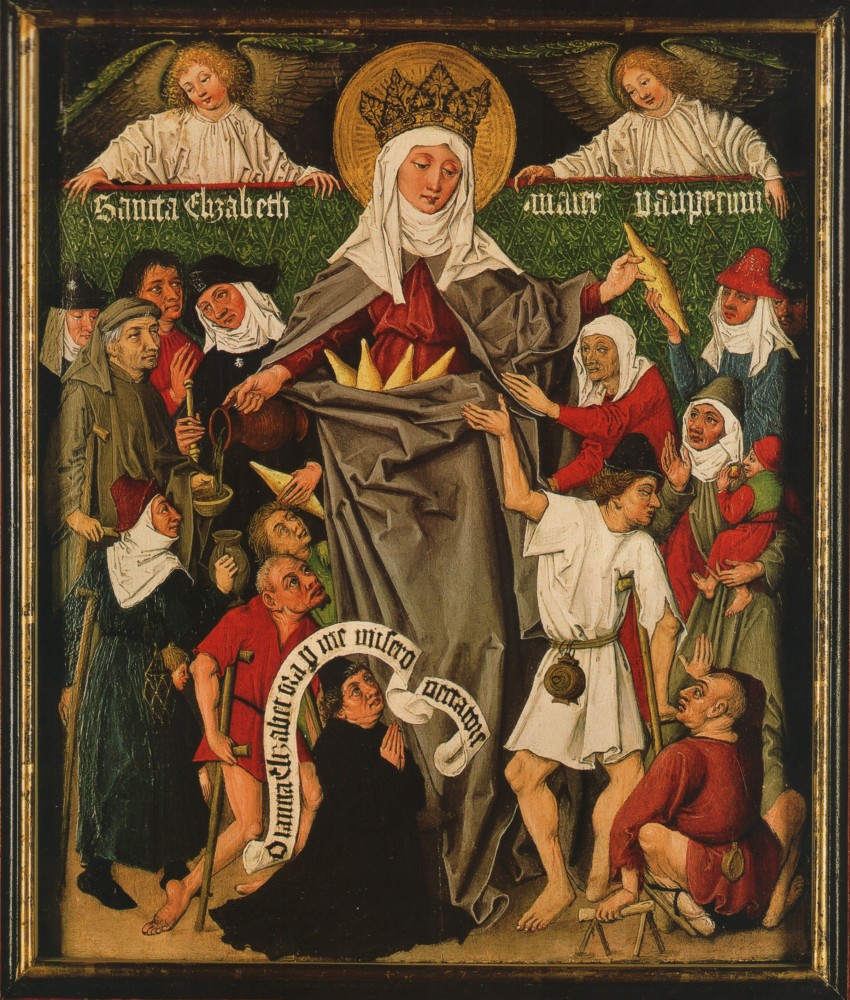
 https://www.heiligenlexikon.de/Fotos/Elisabeth_von_Thueringen8.jpg


The altarpiece as a whole:


v) as depicted (succoring the poor) in a later fifteenth-century copy of Vincent of Beauvais' Speculum historiale in its French-language version by Jean de Vignay (c. 1480-1490; Paris, BnF, ms. Français 245, fol. 175r):


w) as depicted (at top in left margin; holding a jug and a loaf) in a hand-coloured woodcut in the Beloit College copy of Hartmann Schedel's late fifteenth-century Weltchronik (Nuremberg Chronicle; 1493) at fol. CCXIr:
http://www.beloit.edu/nuremberg/book/6th_age/right_page/114%20%28Folio%20CCXIr%29.pdf

x) as portrayed (holding a loaf and a spouted jug) by the Master of the Imberger Altar in a late fifteenth-century polychromed statuette in the altarpiece of the BVM and Saints (1495) in the Kapelle St. Jakobus at Reichenbach, a locality of Oberstdorf (Lkr. Oberallgäu) in Bavaria:
1) at right here:

 http://tarvos.imareal.oeaw.ac.at/server/images/7017228.JPG

2) at left here (at right, St. Sebastian):

 http://tarvos.imareal.oeaw.ac.at/server/images/7017229.JPG


y) as portrayed (second from left, holding flowers and looking remarkably aged for someone who died at age twenty-four; at left, St. Francis of Assisi) by Andrea della Robbia in about 1500 in his great terracotta relief of the Madonna and Child with Saints in the chiesa di Sant'Agata in Radicofani (SI) in Tuscany:
http://tinyurl.com/26h953j

z) as portrayed (also elderly; holding loaves and a jug) in a late fifteenth- or earlier sixteenth-century statue in the Stiftskirche in Stuttgart:

 http://www.veranstaltungen.elk-wue.de/fileadmin/mediapool/elkwue/bilder/gedenktage/Elisabeth_von_Thueringen_EvKiStu_Schmeck.jpg


aa) as portrayed (holding a loaf and a jug) in a late fifteenth- or early sixteenth-century panel painting on an altarpiece wing in the Stiftsgalerie in Herzogenburg (Land Niederösterreich):

 http://tarvos.imareal.oeaw.ac.at/server/images/7001310.JPG


bb) as portrayed on an early sixteenth-century Guldengroschen (1502) struck in Kassel by Wilhelm II, Landgraf of Hessen:
http://www.coingallery.de/Heilige/E/Elisabeth_3.jpg

cc) as portrayed in an earlier sixteenth-century polychromed wooden statue (1511) by Ludwig Juppe on the celebrants' sedile in the east choir of the St. Elisabethkirche in Marburg an der Lahn:

 http://www.elisabethkirche.de/fileadmin/_processed_/csm_2011-04-14_EKTa_0080_e70fcbaf66.jpg

Detail view:

 http://www.rmv.de/linkableblob/de/38872-25816/original/MR_Elisabethkirche_Juppe_Elisabeth.jpg

In the statue she is again depicted holding the Elisabethkirche

dd) as portrayed in an earlier sixteenth-century statue (c. 1520) of Bavarian origin, ascribed to the workshop of Hans Leinberger, in the Musée de l'Oeuvre Notre-Dame, Strasbourg:

 https://upload.wikimedia.org/wikipedia/commons/8/80/Sainte_Elisabeth_de_Hongrie-Mus%C3%A9e_de_l%27Oeuvre_Notre-Dame.jpg


ee) as portrayed in relief in a copy of an earlier sixteenth-century sculpture by Ludwig Juppe on Marburg's City Hall (1527; the original is in the Museum für Kulturgeschichte in the Marburger Schloss):

 http://www.kirchenzeitung.de/sites/bz5.bistumspresse-zentralredaktion.de/files/imagecache/node-gallery-display-full/images/fotostrecken/Elisabeth_6.jpg


Monday, 31 August 2015

St Louis of Toulouse


August 19th was the feast of St Louis of Toulouse. He was the second son of King Charles II of Naples and his wife, Mary princess of Hungary, daughter of King Stephen V, and a relative of both St Louis IX and St Elizabeth of Hungary (or Thuringia) - both of whom became Franciscan tertiaries. As the section on his ancestry in the online biography Louis of Toulouse shows - he was indeed a very well connected young man, related to most of the ruling houses of the period.

Drawn as the life above shows to be a Franciscan friar, following the death of his elder brother he renounced his rights of succession to his younger brother Robert and was professed in 1296 in Rome and ordained priest the following year. Pope Boniface VIII decided he should be promoted at once and so he was consecrated bishop of Toulouse a few days later. He had asked permission to resign his bishopic within months of appointment, but fell ill and died at Brignolles on August 19th 1297 at the age of only 23. He was canonised in 1317.

The popularity and appeal of Franciscan spirituality combined with his royal birth and renunciation of the possibility of kingship as well, no doubt, of his youth meant that his cult was considerable in the years following his death and canonisation. However I suspect that he is not well known in the English speaking world outside the Franciscan tradition.

A somewhat similar devotion arose a generation or so around the figure of the teenage Cardinal Bl. Peter of Luxembourg (1369-87) - for whom see  Pierre de Luxembourg

The popularity of St Louis' cult in later medieval Europe gave many outstanding contemporary artists the opportunity to depict him, and John Dillon has posted this very impressive collection of images of him on the Medieval Religion discussion group, ofwhich I have opened up many of the links to thbese beautiful works of art and devotion, and to which I have added occasional comments in [ ]:

a) as depicted (presenting a crown to his younger brother Robert) by Simone Martini in his early fourteenth-century altarpiece of Louis of Toulouse (circa 1318) formerly in the possession of Naples' Franciscan church of San Lorenzo Maggiore and now in the Museo nazionale di Capodimonte in the same city (four expandable images) [This is probably the most famous depiction of St Louis, and the closest in date to his death]:


b) as depicted (at right; at left, St. Francis of Assisi) by Simone Martini in his early fourteenth-century frescoes of Franciscan saints (ca. 1318) in the transept of the lower church if the basilica di San Francesco in Assisi:

 http://www.wga.hu/art/s/simone/3assisi/transept/5saints1.jpg


c) as depicted (at right; at left, St. Louis, king of France) by Simone Martini in an early fourteenth-century fresco (ca. 1318-1320) in the cappella di San Martino in the lower church of the basilica di San Francesco in Assisi:

 https://upload.wikimedia.org/wikipedia/commons/3/30/Simone_Martini_050.jpg

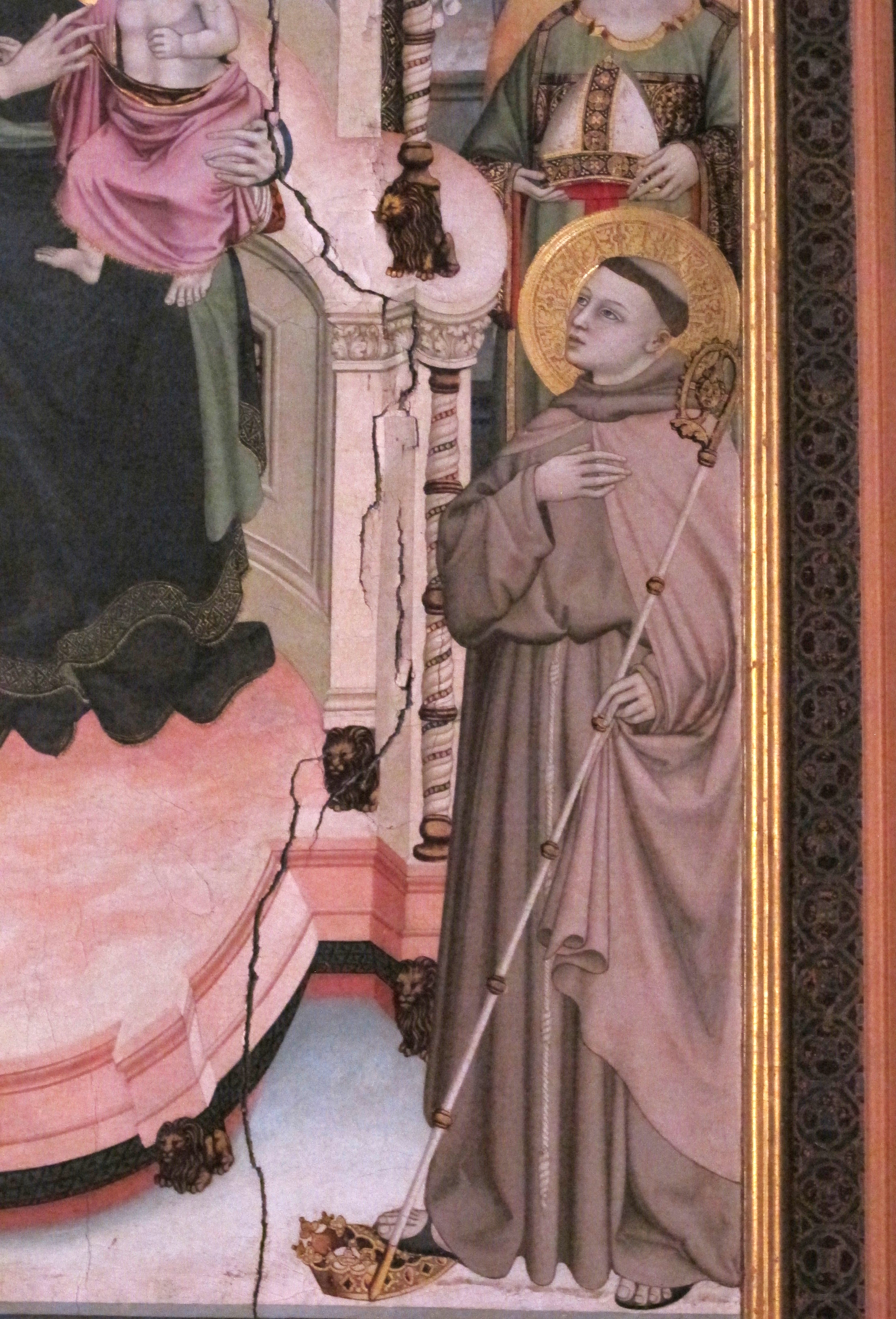
d) as depicted (bottom register at right; at left, St. Elizabeth of Hungary) by the Master of Figline in an earlier fourteenth-century panel painting (after 1317) ordinarily kept in the Museo d'arte sacra della Collegiata di Santa Maria Assunta, Figline e Incisa Valdarno (FI), Tuscany but from this past April until 11. October 2015 on display in the Galleria dell'Accademia in Florence as part of a special exhibition of early Franciscan art:
 https://upload.wikimedia.org/wikipedia/commons/9/90/Maestro_di_figline%2C_Madonna_in_trono_col_Bambino_fra_San_Ludovico_di_Tolosa_e_Sant%27Elisabetta_di_Ungheria.jpg

Detail view (Louis):

 https://upload.wikimedia.org/wikipedia/commons/3/3c/Maestro_di_figline,_maest%C3%A0_coi_santi_elisabetta_d%27ungheria_e_ludovico_di_tolosa,_post_1317,_11.JPG

Detail view (trampled crown):
http://tinyurl.com/nocqgdv

e) as depicted (at right; at left, St. Mary Magdalene) by Ugolino da Siena (Ugolino di Nerio) in an earlier fourteenth-century panel painting (ca. 1320) in the Museum of the Legion of Honor in San Francisco:
https://www.flickr.com/photos/24349544@N04/5561836647
Detail view (Louis):

 https://upload.wikimedia.org/wikipedia/commons/c/c7/Ugolino_di_nerio%2C_san_ludovico_di_tolosa%2C_1320_ca..JPG


f) as depicted in an earlier fourteenth-century fresco (ca. 1320) in the cappella di San Ludovico in the former chiesa di San Marco in Salerno, now part of the Archivio di Stato in that city:

 http://www.citizensalerno.it/wp-content/uploads/2014/02/San-Ludovico-particolare-affresco.jpg


Detail of the figure:
http://digilander.libero.it/salernostoria/c8abateconfortipc%2002.JPG

g) as depicted by Taddeo Gaddi (attrib.) in an earlier fourteenth-century glass window in the basilica di Santa Croce in Florence (betw. 1328 and 1332; finestra s VIII, pann. a2):
http://www.icvbc.cnr.it/bivi/schede/Toscana/Firenze/8scroce1.htm

h) as portrayed in an earlier or mid-fourteenth-century statue (ca. 1330-1350) from the chapelle Notre-Dame de Rieux in Toulouse, now in the Musée des Augustins in the same city:

https://upload.wikimedia.org/wikipedia/commons/5/55/Ma%C3%AEtre_de_Rieux_Saint_Louis_de_Toulouse_%28RA_555_D%29.jpg


i) as depicted (upper illumination, bottom register, second from right) in the later fourteenth-century Petites Heures de Jean de Berry (circa 1375; Paris, BnF, ms. Latin 18014, fol. 105v):
http://tinyurl.com/na53ma8

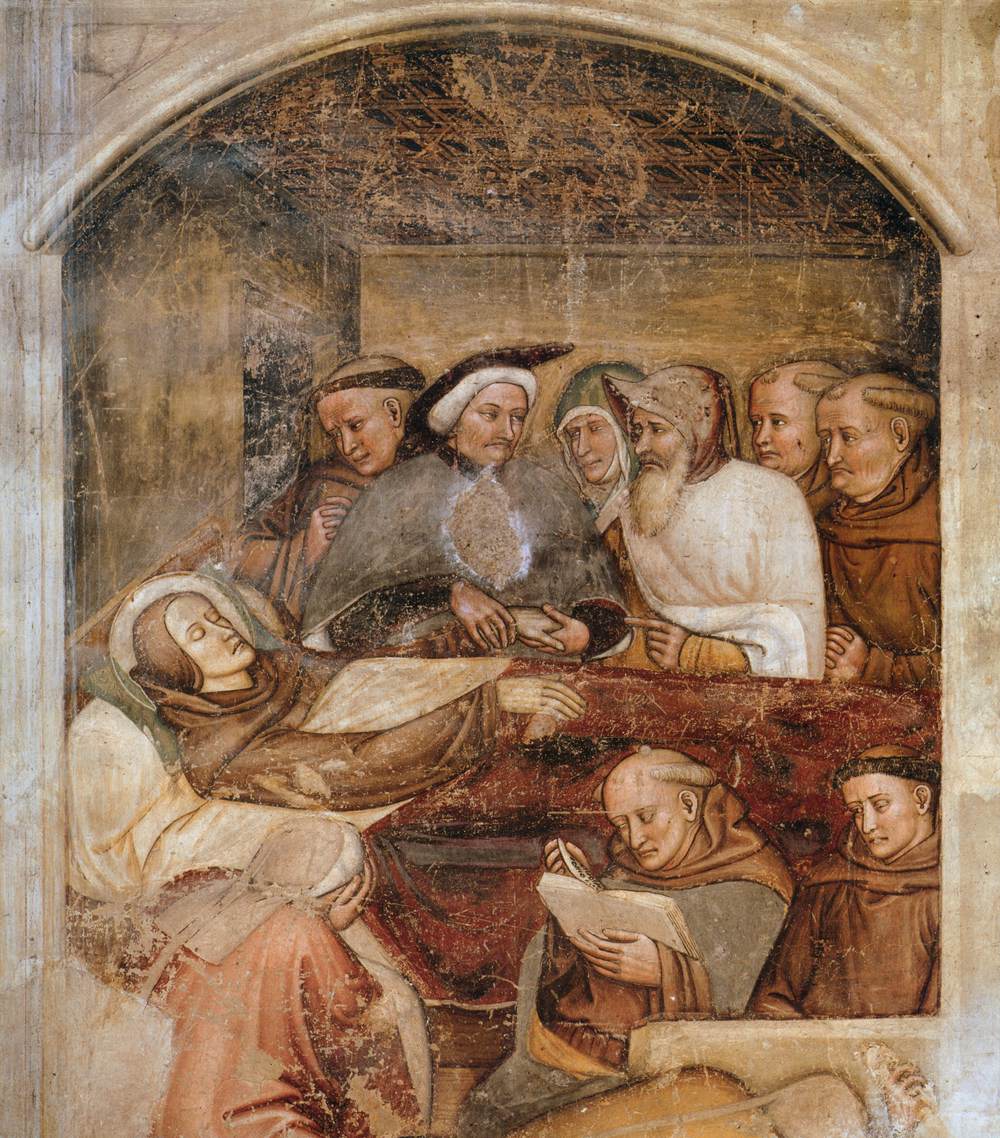
j) as depicted by Serafino Serafini in two later fourteenth-century frescoes (after 1375) in the chiesa di San Francesco in Mantua:
1) Louis' consecration by Pope Boniface VIII:

https://upload.wikimedia.org/wikipedia/commons/b/bf/Serafino_Serafini_-_St_Louis_of_Toulouse_Ordained_Bishop_by_Pope_Boniface_VIII_-_WGA21154.jpg


2) Louis' death:

 https://upload.wikimedia.org/wikipedia/commons/d/d6/Serafino_Serafini_-_Death_of_St_Louis_-_WGA21155.jpg


k) as depicted (at right; at left, St. John the Evangelist) by Tommaso del Mazza (formerly known as the Master of St. Verdiana) in a later fourteenth-century panel painting (ca. 1386) in the Museé du Petit Palais, Avignon:
http://tinyurl.com/qhwknz9

l) as portrayed in a late fourteenth-century polychromed wood reliquary bust (with gesso and gilding) in the Cleveland Museum of Art, Cleveland (OH):
https://www.flickr.com/photos/elizabethe/8601399429/
There are better photographs at the museum's own site (clevelandart.org) but that is being rebuilt at the moment (and the museum appears to have elected not to offer the public a copy of the older site on another server while the rebuilding is underway).

m) as portrayed in a late fourteenth-century limestone sculptural element from Lombardy offered for sale at Sotheby's in 2009 (view and description at bottom of the page):
http://tinyurl.com/969atrf
Enlarged image:
http://tinyurl.com/8qjmy9k

n) as portrayed in a fifteenth-century polychromed stone statue in the église Sainte-Radegonde in Giverny (Eure):
http://tinyurl.com/nted4cz

o) as portrayed in a fifteenth-century statue over the principal entrance to the chiesa di Sant'Alvise (i.e. Louis, in this case the present one) in Venice:
http://tinyurl.com/qelhbf9

p) as portrayed by Donatello in an earlier fifteenth-century gilded bronze statue originally made for the Orsanmichele in Florence (ca. 1413 or early 1420s) and now in that city's Museo dell'Opera di Santa Croce:
http://www.wga.hu/art/d/donatell/1_early/orsanmic/2louis_1.jpg
Detail views at http://tinyurl.com/99sr3wt ,[ of which I have selected one]:


q) as depicted (at right; at left, St. Francis of Assisi) in an earlier fifteenth-century hand-colored print from the Steiermark (circa 1420; Graz, Karl-Franzens-Universität, Universitätsbibliothek, Ms. 529, preliminary leaf [the ms. is from ca. 1440]):
http://tinyurl.com/q5ahysq

r) as depicted (twice; both times as a chubby-faced boy bishop) in an earlier fifteenth-century Franciscan breviary (ca. 1430; Chambéry, Bibliothèque municipale, ms. 4, fols. 589v and 595r):
1) fol. 589v: http://www.enluminures.culture.fr/Wave/savimage/enlumine/irht1/IRHT_035708-p.jpg
2) fol. 595r: http://www.enluminures.culture.fr/Wave/savimage/enlumine/irht1/IRHT_035719-p.jpg

s) as portrayed (lower register at far right ; at near right, St. Bartholomew the Apostle) in the central section of the earlier fifteenth-century polychromed wooden Marienkrönungsaltar (ca. 1440; restored in the 1870s and again in the 1990s) in the Marienkirche in Stralsund:

 https://upload.wikimedia.org/wikipedia/commons/0/00/Stralsund_Marienkirche_-_Marienkr%C3%B6nungsaltar_2a.jpg


Detail view of SS Bartholomew and Louis:

 https://upload.wikimedia.org/wikipedia/commons/0/05/Stralsund_Marienkirche_-_Marienkr%C3%B6nungsaltar_3a_Bartholom%C3%A4us_Ludwig.jpg


t) as portrayed by Donatello in a mid-fifteenth-century bronze statue (1444-1450) on the main altar in the basilica del Santo, Padua:

 http://www.wga.hu/art/d/donatell/2_mature/padova/2altar03.jpg


u) as portrayed in a mid-fifteenth-century polychromed wooden statue (ca. 1450) in the Germanisches Nationalmuseum, Nürnberg:

 https://upload.wikimedia.org/wikipedia/commons/b/b7/Heiliger_Ludwig_von_Toulouse_Nuernberg_um_1450_Lindenholz_GNM_Nuernberg-1.jpg

Detail view:
http://tinyurl.com/num264q

v) as depicted (at right; at left, St. Jerome; at centre, St. Bernardino of Siena) by Antonio Vivarini in a mid-fifteenth-century panel painting (ca. 1451-1456) in the chiesa di San Francesco della Vigna in Venice:
http://tinyurl.com/pz9solk

w) as depicted in grisaille by Jean le Tavernier in the mid-fifteenth-century Hours of Philip of Burgundy (ca. 1451-1460; Den Haag, KB, ms. 76 F 2, fol. 268v):
http://manuscripts.kb.nl/zoom/BYVANCKB%3Amimi_76f2%3A268v_min

x) as depicted by Antonio Vivarini in a mid- or later fifteenth-century panel painting (circa 1451-1475) in the collections of the Musée du Louvre in Paris:


Said to be on deposit at Avignon, Musée du Petit Palais:
http://tinyurl.com/37xuht

y) as depicted by Lorentino d'Arezzo in a mid- or later fifteenth-century fresco (ca. 1451-1475) in Arezzo's basilica di San Francesco:
http://tinyurl.com/9e9cj28

z) as depicted (at right, flanking the BVM and Christ Child; at left St. Jerome) by Andrea Mantegna in a mid-fifteenth-century panel painting (circa 1455) in the Musée Jacquemart-André in Paris [zoomable image]:
http://tinyurl.com/o8n4psy

aa) as depicted (at left; at right, St. Bernardino of Siena) by Michele Pannonio in a mid- or later fifteenth-century panel painting in the Pinacoteca nazionale in Ferrara:
http://tinyurl.com/og73lvb

bb) as depicted by Piero della Francesca in a mid-fifteenth-century fresco (1460) in the Pinacoteca comunale of Sansepolcro (AR) in Tuscany:

http://www.poderesantapia.com/images/art/pierodellafrancesca/ludovico700.jpg


cc) as depicted (at right; at left, St. John the Baptist) by Bartolomeo Vivarini and Andrea Vivarini in a later fifteenth-century panel painting (1463 or 1464) in the collections of the Musée du Louvre in Paris and on deposit in the Musée du Petit Palais in Avignon:

 http://www.culture.gouv.fr/Wave/image/joconde/0074/m094704_01-014339_p.jpg


dd) as depicted (at centre; at left St. Oswald; at right, St. Louis, King of France) in the upper right-hand panel of the later fifteenth-century principal altar (1470-1478) of the Katedrála Sv. Martina in Spišská Kapitula, a locality of Spišské Podhradie in Slovakia
[This is an interesting example of the diffusion of the cult of St Oswald from his native Northumbria. As Slovakia was part of the Kingdom of Hungary the presence of St Louis reflects interest in a saint of the Angevin ruling house of that realm]:

 http://tarvos.imareal.oeaw.ac.at/server/images/7012197.JPG

The altarpiece as a whole:

http://pamiatky.custodea.com/images/spu/7/image/7450.jpg


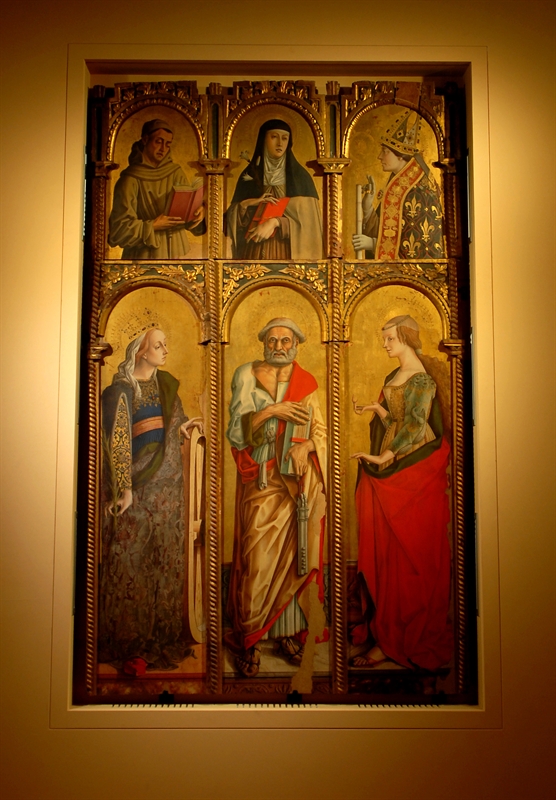
ee) as depicted (upper register at right, after Bl. John Duns Scotus and Clare of Assisi) by Carlo Crivelli in a later fifteenth-century panel painting (1471?; from his now dismembered Montefiore altarpiece) in the Polo Museale di San Francesco at Montefiore dell'Aso (AP) in the Marche:
http://sirpac.cultura.marche.it/SirpacIntraWeb/storage/Label/1282/384/32E.jpg
Detail view (Louis):

 https://upload.wikimedia.org/wikipedia/commons/f/f2/Carlo_crivelli%2C_montefiore%2C_san_ludovico.jpg


ff) as depicted (at upper right, second from right; at far right, St. Bernardino of Siena) by Vincenzo Foppa in a later fifteenth-century altarpiece (1476) in the Pinacoteca di Brera in Milan:
http://www.wga.hu/art/f/foppa/altarpie.jpg

gg) as depicted (second from right; at far right, St. Francis of Assisi) in a late fifteenth-century altarpiece (1481) by Vittore Crivelli in the Philadelphia Museum of Art, Philadelphia (PA):
https://www.flickr.com/photos/mharrsch/5895412774
Detail view (Louis):

 https://c1.staticflickr.com/7/6032/5894846043_36988814dc_b.jpg


hh) as depicted in a late fifteenth-century Roman breviary (betw. 1482 and 1500; Clermont-Ferrand, Bibliothèque du patrimoine, ms. 69, fol. 530v):
http://www.enluminures.culture.fr/Wave/savimage/enlumine/irht4/IRHT_081374-p.jpg

ii) as depicted by Cosmè Tura in a late fifteenth-century panel painting (1484?; on canvas; transferred from wood) in the Metropolitan Museum of Art, New York:
http://www.metmuseum.org/collection/the-collection-online/search/437850

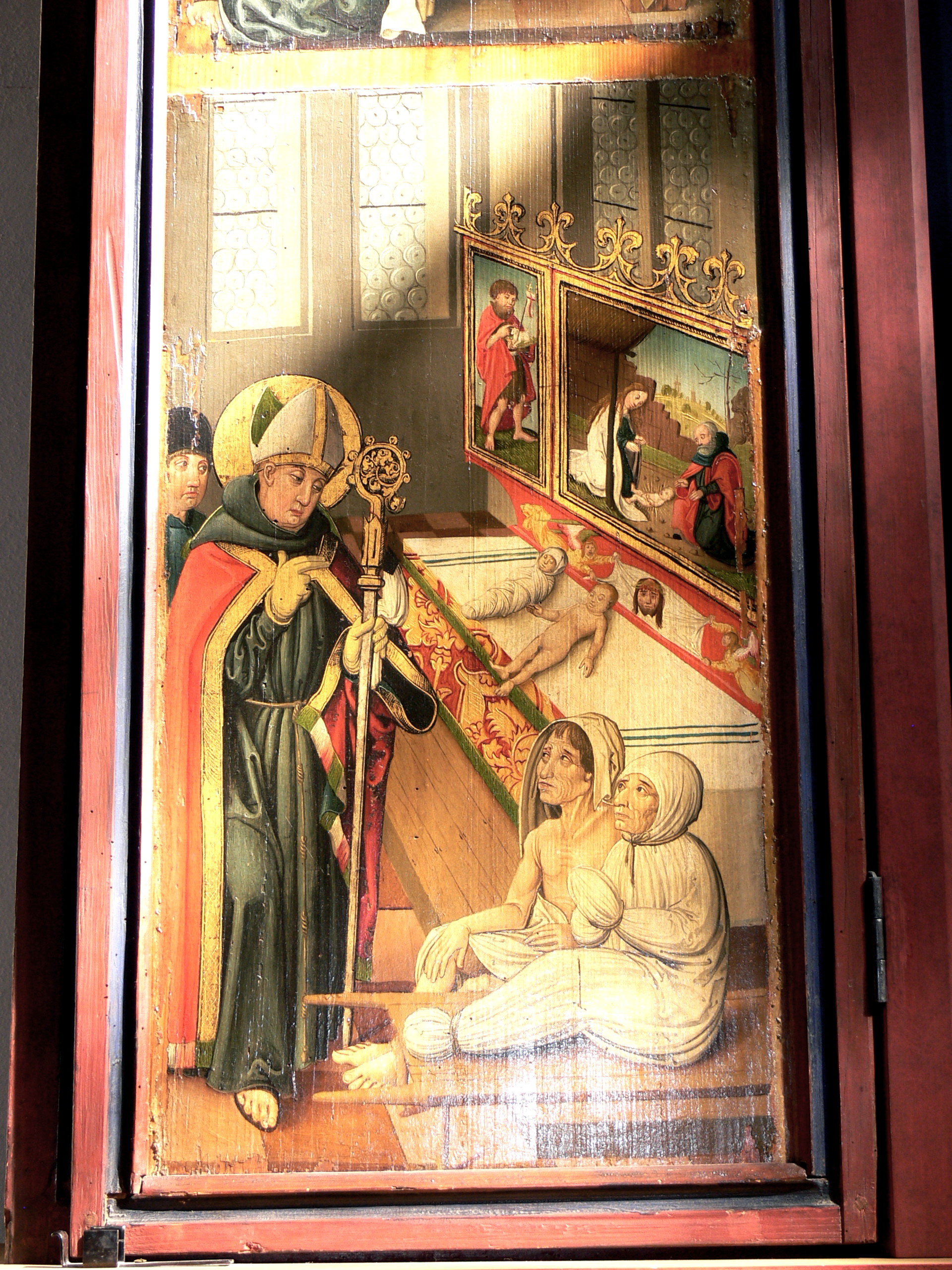
jj) as portrayed (scenes from his legend) by Jakob Mülholzer in two of his panel paintings on the wings of the late fifteenth-century St. Louis of Toulouse altar (ca. 1490-1500) in the St. Jakobskirche, Rothenburg ob der Tauber (Lkr. Ansbach) in Bavaria:

 https://upload.wikimedia.org/wikipedia/commons/9/90/St.Jakob_-_Altar_St.Ludwig_von_Toulouse_03.jpg

and

 https://upload.wikimedia.org/wikipedia/commons/0/01/St.Jakob_-_Altar_St.Ludwig_von_Toulouse_02.jpg

The altar as a whole:

 http://www.huismanfoto.eu/Album%20172%20St.-Jakobs-Kirche%20Rothenburg%202/slides/28O_0037%20Sankt%20Jakobs-Kirche%20Ludwig-von-Toulouse-Altar%2028108.jpg
The central sculpture is item nn), below.

kk) as depicted at the beginning of his Office in the late fifteenth-century Diurnal de René, roi de Sicile (1492-1493; Paris, BnF, ms. Latin 10491, fol. 210v ):
http://gallica.bnf.fr/ark:/12148/btv1b8427237h/f434.item

ll) as depicted (at far right, after St. Lawrence of Rome) by Pietro Perugino in a late fifteenth-century panel painting (1495-1496) of the Madonna and Child with Perugia's four holy protectors now in Città del Vaticano in the Pinacoteca Vaticana:
http://tinyurl.com/opz4k5h

mm) as depicted in an early sixteenth-century fresco (1504) in the chiesa di San Ludovico al Bretto (dedicated to the present Louis) in Camerata Cornello (BG) in Lombardy:
http://tinyurl.com/28bbbfc

nn) as portrayed by Tilman Riemenschneider (attrib.) in the early sixteenth-century central statue (ca. 1505?) of the St. Louis of Toulouse altar in the St. Jakobskirche, Rothenburg ob der Tauber (Lkr. Ansbach) in Bavaria:

 https://upload.wikimedia.org/wikipedia/commons/9/92/St.Jakob_-_Altar_St.Ludwig_von_Toulouse_01.jpg

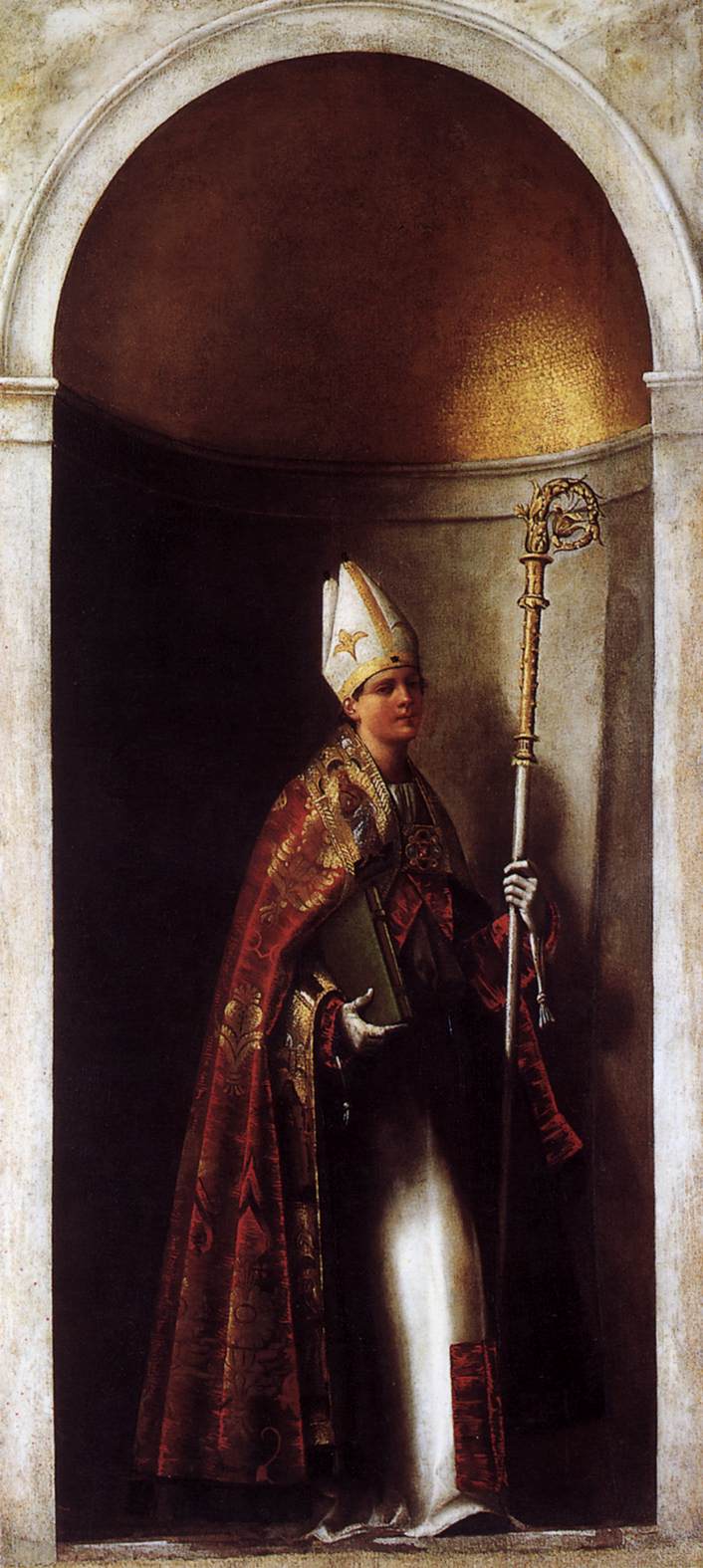
oo) as depicted by Sebastiano del Piombo in an early sixteenth-century painting (ca. 1507-1510) on an organ shutter from Venice's chiesa di San Bartolomeo and now in the Gallerie dell'Accademia in that city:
http://www.wga.hu/art/s/sebastia/organ3.jpg

pp) as depicted (at right; at left, St. Bernardino of Siena) by Moretto da Brescia (Alessandro Bonvicino) on a wing from a dismembered earlier sixteenth-century altarpiece (1529-1530) in the Musée du Louvre, Paris:

 Moretto, santi bernardino e ludovico.jpg


Detail view:
https://www.flickr.com/photos/7711591@N04/5491273910