Once I was a clever boy learning the arts of Oxford... is a quotation from the verses written by Bishop Richard Fleming (c.1385-1431) for his tomb in Lincoln Cathedral. Fleming, the founder of Lincoln College in Oxford, is the subject of my research for a D. Phil., and, like me, a son of the West Riding. I have remarked in the past that I have a deeply meaningful on-going relationship with a dead fifteenth century bishop... it was Fleming who, in effect, enabled me to come to Oxford and to learn its arts, and for that I am immensely grateful.


Showing posts with label St Oswald. Show all posts

Monday, 31 August 2015

St Louis of Toulouse


August 19th was the feast of St Louis of Toulouse. He was the second son of King Charles II of Naples and his wife, Mary princess of Hungary, daughter of King Stephen V, and a relative of both St Louis IX and St Elizabeth of Hungary (or Thuringia) - both of whom became Franciscan tertiaries. As the section on his ancestry in the online biography Louis of Toulouse shows - he was indeed a very well connected young man, related to most of the ruling houses of the period.

Drawn as the life above shows to be a Franciscan friar, following the death of his elder brother he renounced his rights of succession to his younger brother Robert and was professed in 1296 in Rome and ordained priest the following year. Pope Boniface VIII decided he should be promoted at once and so he was consecrated bishop of Toulouse a few days later. He had asked permission to resign his bishopic within months of appointment, but fell ill and died at Brignolles on August 19th 1297 at the age of only 23. He was canonised in 1317.

The popularity and appeal of Franciscan spirituality combined with his royal birth and renunciation of the possibility of kingship as well, no doubt, of his youth meant that his cult was considerable in the years following his death and canonisation. However I suspect that he is not well known in the English speaking world outside the Franciscan tradition.

A somewhat similar devotion arose a generation or so around the figure of the teenage Cardinal Bl. Peter of Luxembourg (1369-87) - for whom see  Pierre de Luxembourg

The popularity of St Louis' cult in later medieval Europe gave many outstanding contemporary artists the opportunity to depict him, and John Dillon has posted this very impressive collection of images of him on the Medieval Religion discussion group, ofwhich I have opened up many of the links to thbese beautiful works of art and devotion, and to which I have added occasional comments in [ ]:

a) as depicted (presenting a crown to his younger brother Robert) by Simone Martini in his early fourteenth-century altarpiece of Louis of Toulouse (circa 1318) formerly in the possession of Naples' Franciscan church of San Lorenzo Maggiore and now in the Museo nazionale di Capodimonte in the same city (four expandable images) [This is probably the most famous depiction of St Louis, and the closest in date to his death]:


b) as depicted (at right; at left, St. Francis of Assisi) by Simone Martini in his early fourteenth-century frescoes of Franciscan saints (ca. 1318) in the transept of the lower church if the basilica di San Francesco in Assisi:

 http://www.wga.hu/art/s/simone/3assisi/transept/5saints1.jpg


c) as depicted (at right; at left, St. Louis, king of France) by Simone Martini in an early fourteenth-century fresco (ca. 1318-1320) in the cappella di San Martino in the lower church of the basilica di San Francesco in Assisi:

 https://upload.wikimedia.org/wikipedia/commons/3/30/Simone_Martini_050.jpg

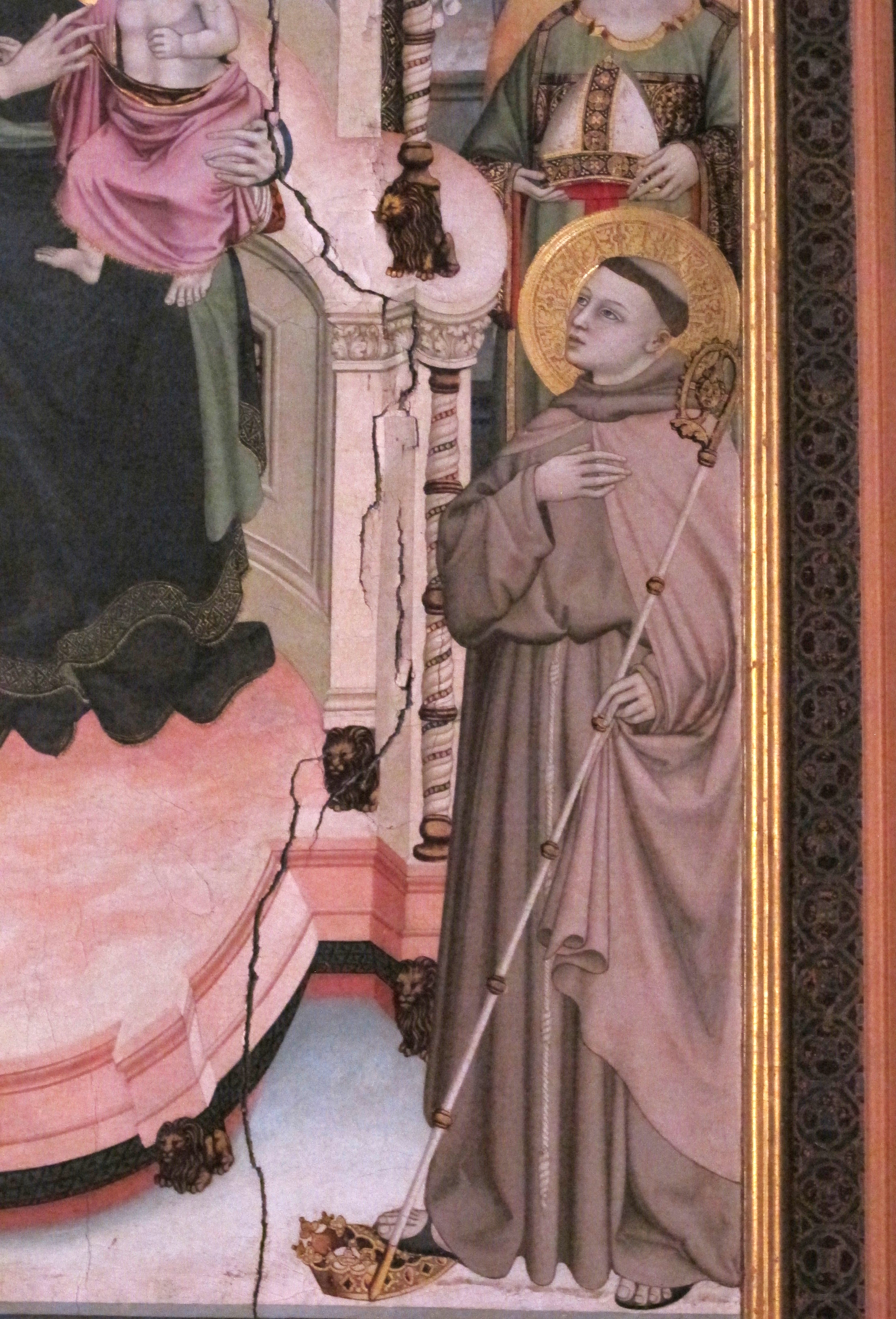
d) as depicted (bottom register at right; at left, St. Elizabeth of Hungary) by the Master of Figline in an earlier fourteenth-century panel painting (after 1317) ordinarily kept in the Museo d'arte sacra della Collegiata di Santa Maria Assunta, Figline e Incisa Valdarno (FI), Tuscany but from this past April until 11. October 2015 on display in the Galleria dell'Accademia in Florence as part of a special exhibition of early Franciscan art:
 https://upload.wikimedia.org/wikipedia/commons/9/90/Maestro_di_figline%2C_Madonna_in_trono_col_Bambino_fra_San_Ludovico_di_Tolosa_e_Sant%27Elisabetta_di_Ungheria.jpg

Detail view (Louis):

 https://upload.wikimedia.org/wikipedia/commons/3/3c/Maestro_di_figline,_maest%C3%A0_coi_santi_elisabetta_d%27ungheria_e_ludovico_di_tolosa,_post_1317,_11.JPG

Detail view (trampled crown):
http://tinyurl.com/nocqgdv

e) as depicted (at right; at left, St. Mary Magdalene) by Ugolino da Siena (Ugolino di Nerio) in an earlier fourteenth-century panel painting (ca. 1320) in the Museum of the Legion of Honor in San Francisco:
https://www.flickr.com/photos/24349544@N04/5561836647
Detail view (Louis):

 https://upload.wikimedia.org/wikipedia/commons/c/c7/Ugolino_di_nerio%2C_san_ludovico_di_tolosa%2C_1320_ca..JPG


f) as depicted in an earlier fourteenth-century fresco (ca. 1320) in the cappella di San Ludovico in the former chiesa di San Marco in Salerno, now part of the Archivio di Stato in that city:

 http://www.citizensalerno.it/wp-content/uploads/2014/02/San-Ludovico-particolare-affresco.jpg


Detail of the figure:
http://digilander.libero.it/salernostoria/c8abateconfortipc%2002.JPG

g) as depicted by Taddeo Gaddi (attrib.) in an earlier fourteenth-century glass window in the basilica di Santa Croce in Florence (betw. 1328 and 1332; finestra s VIII, pann. a2):
http://www.icvbc.cnr.it/bivi/schede/Toscana/Firenze/8scroce1.htm

h) as portrayed in an earlier or mid-fourteenth-century statue (ca. 1330-1350) from the chapelle Notre-Dame de Rieux in Toulouse, now in the Musée des Augustins in the same city:

https://upload.wikimedia.org/wikipedia/commons/5/55/Ma%C3%AEtre_de_Rieux_Saint_Louis_de_Toulouse_%28RA_555_D%29.jpg


i) as depicted (upper illumination, bottom register, second from right) in the later fourteenth-century Petites Heures de Jean de Berry (circa 1375; Paris, BnF, ms. Latin 18014, fol. 105v):
http://tinyurl.com/na53ma8

j) as depicted by Serafino Serafini in two later fourteenth-century frescoes (after 1375) in the chiesa di San Francesco in Mantua:
1) Louis' consecration by Pope Boniface VIII:

https://upload.wikimedia.org/wikipedia/commons/b/bf/Serafino_Serafini_-_St_Louis_of_Toulouse_Ordained_Bishop_by_Pope_Boniface_VIII_-_WGA21154.jpg


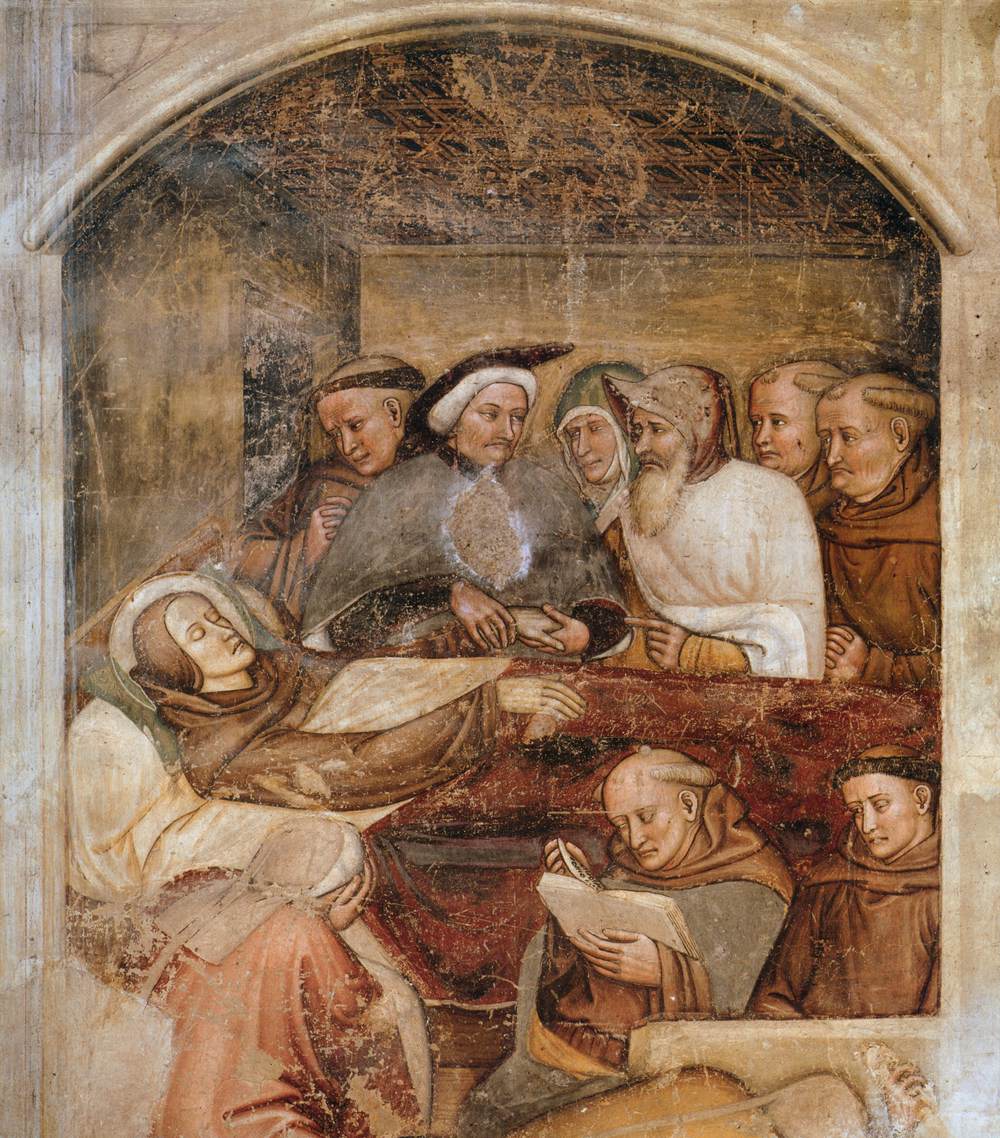
2) Louis' death:

 https://upload.wikimedia.org/wikipedia/commons/d/d6/Serafino_Serafini_-_Death_of_St_Louis_-_WGA21155.jpg


k) as depicted (at right; at left, St. John the Evangelist) by Tommaso del Mazza (formerly known as the Master of St. Verdiana) in a later fourteenth-century panel painting (ca. 1386) in the Museé du Petit Palais, Avignon:
http://tinyurl.com/qhwknz9

l) as portrayed in a late fourteenth-century polychromed wood reliquary bust (with gesso and gilding) in the Cleveland Museum of Art, Cleveland (OH):
https://www.flickr.com/photos/elizabethe/8601399429/
There are better photographs at the museum's own site (clevelandart.org) but that is being rebuilt at the moment (and the museum appears to have elected not to offer the public a copy of the older site on another server while the rebuilding is underway).

m) as portrayed in a late fourteenth-century limestone sculptural element from Lombardy offered for sale at Sotheby's in 2009 (view and description at bottom of the page):
http://tinyurl.com/969atrf
Enlarged image:
http://tinyurl.com/8qjmy9k

n) as portrayed in a fifteenth-century polychromed stone statue in the église Sainte-Radegonde in Giverny (Eure):
http://tinyurl.com/nted4cz

o) as portrayed in a fifteenth-century statue over the principal entrance to the chiesa di Sant'Alvise (i.e. Louis, in this case the present one) in Venice:
http://tinyurl.com/qelhbf9

p) as portrayed by Donatello in an earlier fifteenth-century gilded bronze statue originally made for the Orsanmichele in Florence (ca. 1413 or early 1420s) and now in that city's Museo dell'Opera di Santa Croce:
http://www.wga.hu/art/d/donatell/1_early/orsanmic/2louis_1.jpg
Detail views at http://tinyurl.com/99sr3wt ,[ of which I have selected one]:


q) as depicted (at right; at left, St. Francis of Assisi) in an earlier fifteenth-century hand-colored print from the Steiermark (circa 1420; Graz, Karl-Franzens-Universität, Universitätsbibliothek, Ms. 529, preliminary leaf [the ms. is from ca. 1440]):
http://tinyurl.com/q5ahysq

r) as depicted (twice; both times as a chubby-faced boy bishop) in an earlier fifteenth-century Franciscan breviary (ca. 1430; Chambéry, Bibliothèque municipale, ms. 4, fols. 589v and 595r):
1) fol. 589v: http://www.enluminures.culture.fr/Wave/savimage/enlumine/irht1/IRHT_035708-p.jpg
2) fol. 595r: http://www.enluminures.culture.fr/Wave/savimage/enlumine/irht1/IRHT_035719-p.jpg

s) as portrayed (lower register at far right ; at near right, St. Bartholomew the Apostle) in the central section of the earlier fifteenth-century polychromed wooden Marienkrönungsaltar (ca. 1440; restored in the 1870s and again in the 1990s) in the Marienkirche in Stralsund:

 https://upload.wikimedia.org/wikipedia/commons/0/00/Stralsund_Marienkirche_-_Marienkr%C3%B6nungsaltar_2a.jpg


Detail view of SS Bartholomew and Louis:

 https://upload.wikimedia.org/wikipedia/commons/0/05/Stralsund_Marienkirche_-_Marienkr%C3%B6nungsaltar_3a_Bartholom%C3%A4us_Ludwig.jpg


t) as portrayed by Donatello in a mid-fifteenth-century bronze statue (1444-1450) on the main altar in the basilica del Santo, Padua:

 http://www.wga.hu/art/d/donatell/2_mature/padova/2altar03.jpg


u) as portrayed in a mid-fifteenth-century polychromed wooden statue (ca. 1450) in the Germanisches Nationalmuseum, Nürnberg:

 https://upload.wikimedia.org/wikipedia/commons/b/b7/Heiliger_Ludwig_von_Toulouse_Nuernberg_um_1450_Lindenholz_GNM_Nuernberg-1.jpg

Detail view:
http://tinyurl.com/num264q

v) as depicted (at right; at left, St. Jerome; at centre, St. Bernardino of Siena) by Antonio Vivarini in a mid-fifteenth-century panel painting (ca. 1451-1456) in the chiesa di San Francesco della Vigna in Venice:
http://tinyurl.com/pz9solk

w) as depicted in grisaille by Jean le Tavernier in the mid-fifteenth-century Hours of Philip of Burgundy (ca. 1451-1460; Den Haag, KB, ms. 76 F 2, fol. 268v):
http://manuscripts.kb.nl/zoom/BYVANCKB%3Amimi_76f2%3A268v_min

x) as depicted by Antonio Vivarini in a mid- or later fifteenth-century panel painting (circa 1451-1475) in the collections of the Musée du Louvre in Paris:


Said to be on deposit at Avignon, Musée du Petit Palais:
http://tinyurl.com/37xuht

y) as depicted by Lorentino d'Arezzo in a mid- or later fifteenth-century fresco (ca. 1451-1475) in Arezzo's basilica di San Francesco:
http://tinyurl.com/9e9cj28

z) as depicted (at right, flanking the BVM and Christ Child; at left St. Jerome) by Andrea Mantegna in a mid-fifteenth-century panel painting (circa 1455) in the Musée Jacquemart-André in Paris [zoomable image]:
http://tinyurl.com/o8n4psy

aa) as depicted (at left; at right, St. Bernardino of Siena) by Michele Pannonio in a mid- or later fifteenth-century panel painting in the Pinacoteca nazionale in Ferrara:
http://tinyurl.com/og73lvb

bb) as depicted by Piero della Francesca in a mid-fifteenth-century fresco (1460) in the Pinacoteca comunale of Sansepolcro (AR) in Tuscany:

http://www.poderesantapia.com/images/art/pierodellafrancesca/ludovico700.jpg


cc) as depicted (at right; at left, St. John the Baptist) by Bartolomeo Vivarini and Andrea Vivarini in a later fifteenth-century panel painting (1463 or 1464) in the collections of the Musée du Louvre in Paris and on deposit in the Musée du Petit Palais in Avignon:

 http://www.culture.gouv.fr/Wave/image/joconde/0074/m094704_01-014339_p.jpg


dd) as depicted (at centre; at left St. Oswald; at right, St. Louis, King of France) in the upper right-hand panel of the later fifteenth-century principal altar (1470-1478) of the Katedrála Sv. Martina in Spišská Kapitula, a locality of Spišské Podhradie in Slovakia
[This is an interesting example of the diffusion of the cult of St Oswald from his native Northumbria. As Slovakia was part of the Kingdom of Hungary the presence of St Louis reflects interest in a saint of the Angevin ruling house of that realm]:

 http://tarvos.imareal.oeaw.ac.at/server/images/7012197.JPG

The altarpiece as a whole:

http://pamiatky.custodea.com/images/spu/7/image/7450.jpg


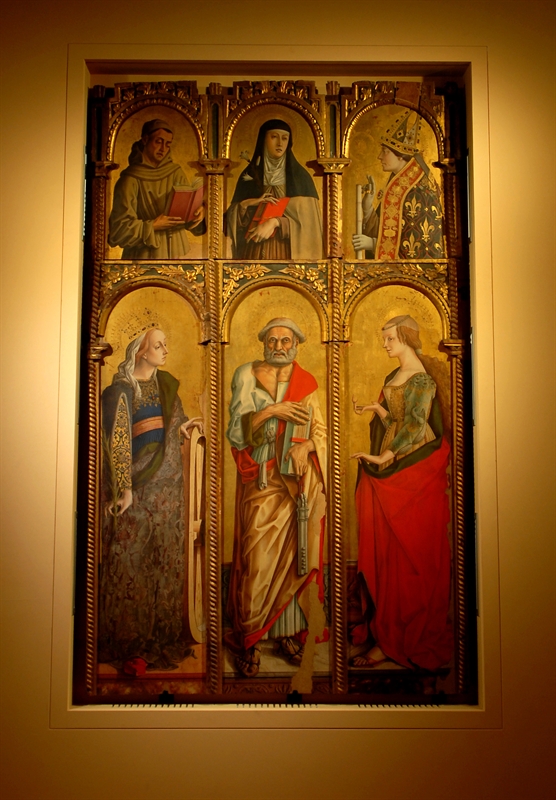
ee) as depicted (upper register at right, after Bl. John Duns Scotus and Clare of Assisi) by Carlo Crivelli in a later fifteenth-century panel painting (1471?; from his now dismembered Montefiore altarpiece) in the Polo Museale di San Francesco at Montefiore dell'Aso (AP) in the Marche:
http://sirpac.cultura.marche.it/SirpacIntraWeb/storage/Label/1282/384/32E.jpg
Detail view (Louis):

 https://upload.wikimedia.org/wikipedia/commons/f/f2/Carlo_crivelli%2C_montefiore%2C_san_ludovico.jpg


ff) as depicted (at upper right, second from right; at far right, St. Bernardino of Siena) by Vincenzo Foppa in a later fifteenth-century altarpiece (1476) in the Pinacoteca di Brera in Milan:
http://www.wga.hu/art/f/foppa/altarpie.jpg

gg) as depicted (second from right; at far right, St. Francis of Assisi) in a late fifteenth-century altarpiece (1481) by Vittore Crivelli in the Philadelphia Museum of Art, Philadelphia (PA):
https://www.flickr.com/photos/mharrsch/5895412774
Detail view (Louis):

 https://c1.staticflickr.com/7/6032/5894846043_36988814dc_b.jpg


hh) as depicted in a late fifteenth-century Roman breviary (betw. 1482 and 1500; Clermont-Ferrand, Bibliothèque du patrimoine, ms. 69, fol. 530v):
http://www.enluminures.culture.fr/Wave/savimage/enlumine/irht4/IRHT_081374-p.jpg

ii) as depicted by Cosmè Tura in a late fifteenth-century panel painting (1484?; on canvas; transferred from wood) in the Metropolitan Museum of Art, New York:
http://www.metmuseum.org/collection/the-collection-online/search/437850

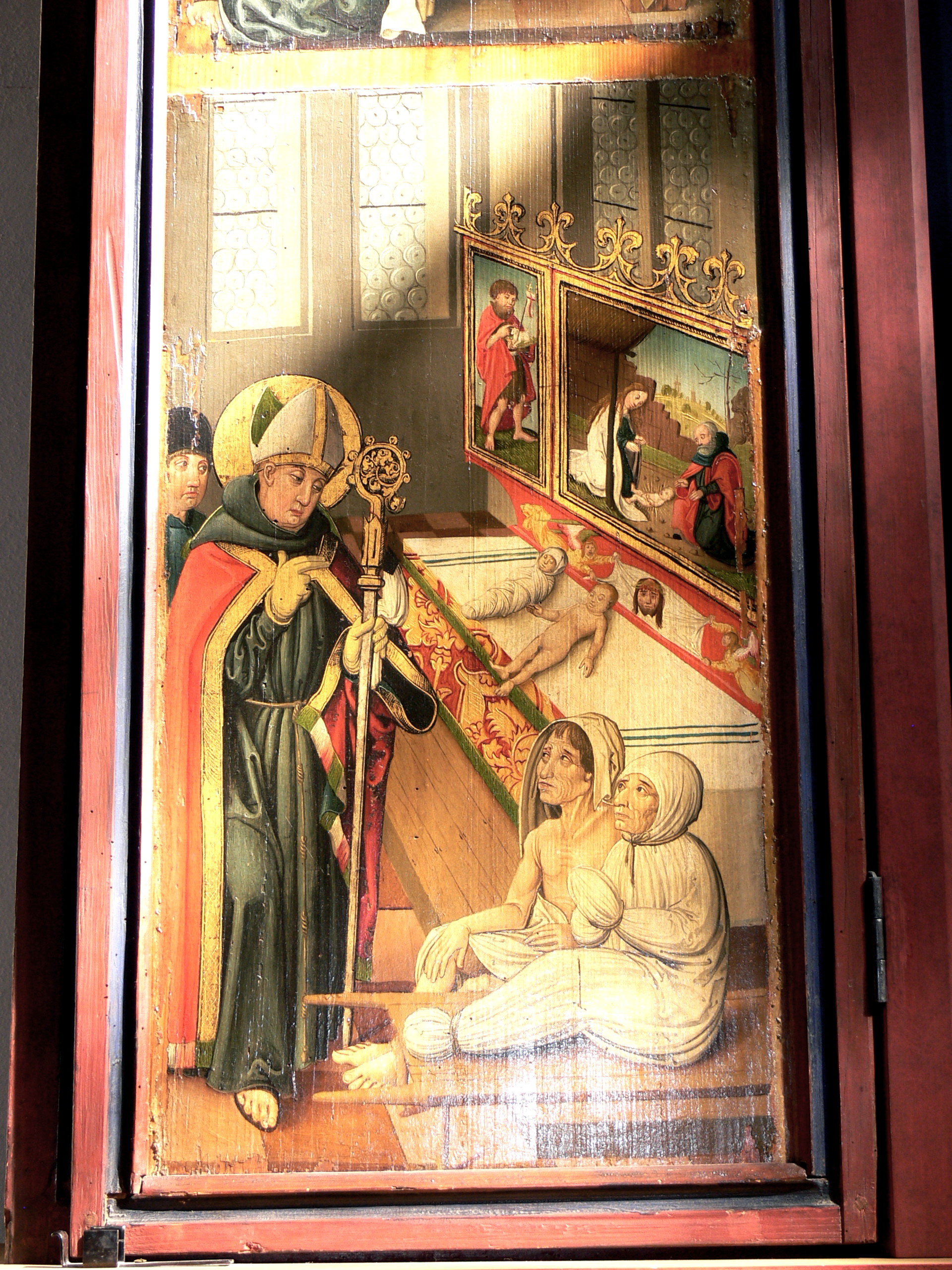
jj) as portrayed (scenes from his legend) by Jakob Mülholzer in two of his panel paintings on the wings of the late fifteenth-century St. Louis of Toulouse altar (ca. 1490-1500) in the St. Jakobskirche, Rothenburg ob der Tauber (Lkr. Ansbach) in Bavaria:

 https://upload.wikimedia.org/wikipedia/commons/9/90/St.Jakob_-_Altar_St.Ludwig_von_Toulouse_03.jpg

and

 https://upload.wikimedia.org/wikipedia/commons/0/01/St.Jakob_-_Altar_St.Ludwig_von_Toulouse_02.jpg

The altar as a whole:

 http://www.huismanfoto.eu/Album%20172%20St.-Jakobs-Kirche%20Rothenburg%202/slides/28O_0037%20Sankt%20Jakobs-Kirche%20Ludwig-von-Toulouse-Altar%2028108.jpg
The central sculpture is item nn), below.

kk) as depicted at the beginning of his Office in the late fifteenth-century Diurnal de René, roi de Sicile (1492-1493; Paris, BnF, ms. Latin 10491, fol. 210v ):
http://gallica.bnf.fr/ark:/12148/btv1b8427237h/f434.item

ll) as depicted (at far right, after St. Lawrence of Rome) by Pietro Perugino in a late fifteenth-century panel painting (1495-1496) of the Madonna and Child with Perugia's four holy protectors now in Città del Vaticano in the Pinacoteca Vaticana:
http://tinyurl.com/opz4k5h

mm) as depicted in an early sixteenth-century fresco (1504) in the chiesa di San Ludovico al Bretto (dedicated to the present Louis) in Camerata Cornello (BG) in Lombardy:
http://tinyurl.com/28bbbfc

nn) as portrayed by Tilman Riemenschneider (attrib.) in the early sixteenth-century central statue (ca. 1505?) of the St. Louis of Toulouse altar in the St. Jakobskirche, Rothenburg ob der Tauber (Lkr. Ansbach) in Bavaria:

 https://upload.wikimedia.org/wikipedia/commons/9/92/St.Jakob_-_Altar_St.Ludwig_von_Toulouse_01.jpg

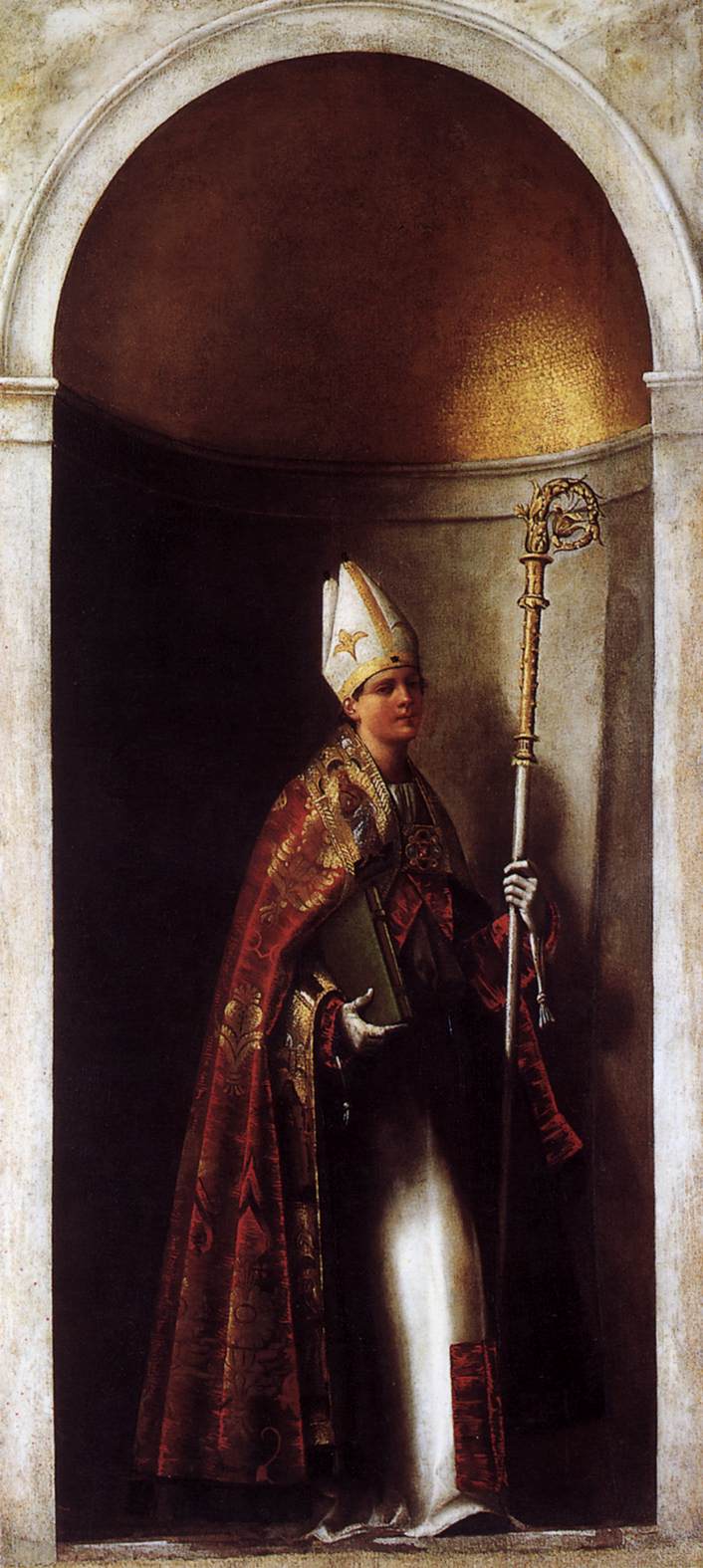
oo) as depicted by Sebastiano del Piombo in an early sixteenth-century painting (ca. 1507-1510) on an organ shutter from Venice's chiesa di San Bartolomeo and now in the Gallerie dell'Accademia in that city:
http://www.wga.hu/art/s/sebastia/organ3.jpg

pp) as depicted (at right; at left, St. Bernardino of Siena) by Moretto da Brescia (Alessandro Bonvicino) on a wing from a dismembered earlier sixteenth-century altarpiece (1529-1530) in the Musée du Louvre, Paris:

 Moretto, santi bernardino e ludovico.jpg


Detail view:
https://www.flickr.com/photos/7711591@N04/5491273910


Wednesday, 5 August 2015

St Oswald in medieval art


John Dillon has posted on the Medieval Religion discussion group some medieval images of St. Oswald of Northumbria, the seventh century martyr King, whose feast is today.

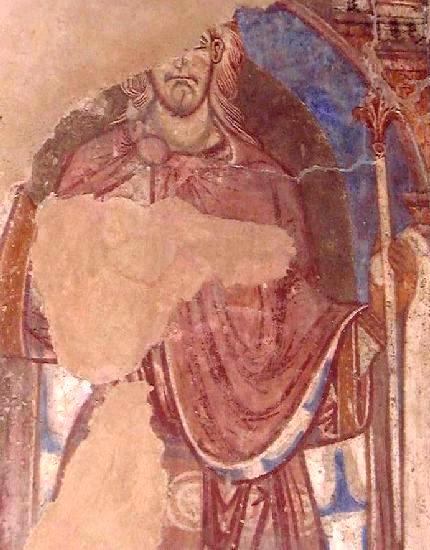
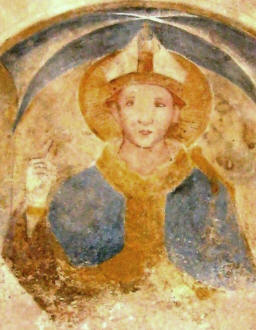
a) Oswald (very probably) as depicted in a later twelfth-century mural painting in Durham cathedral's Galilee Chapel:


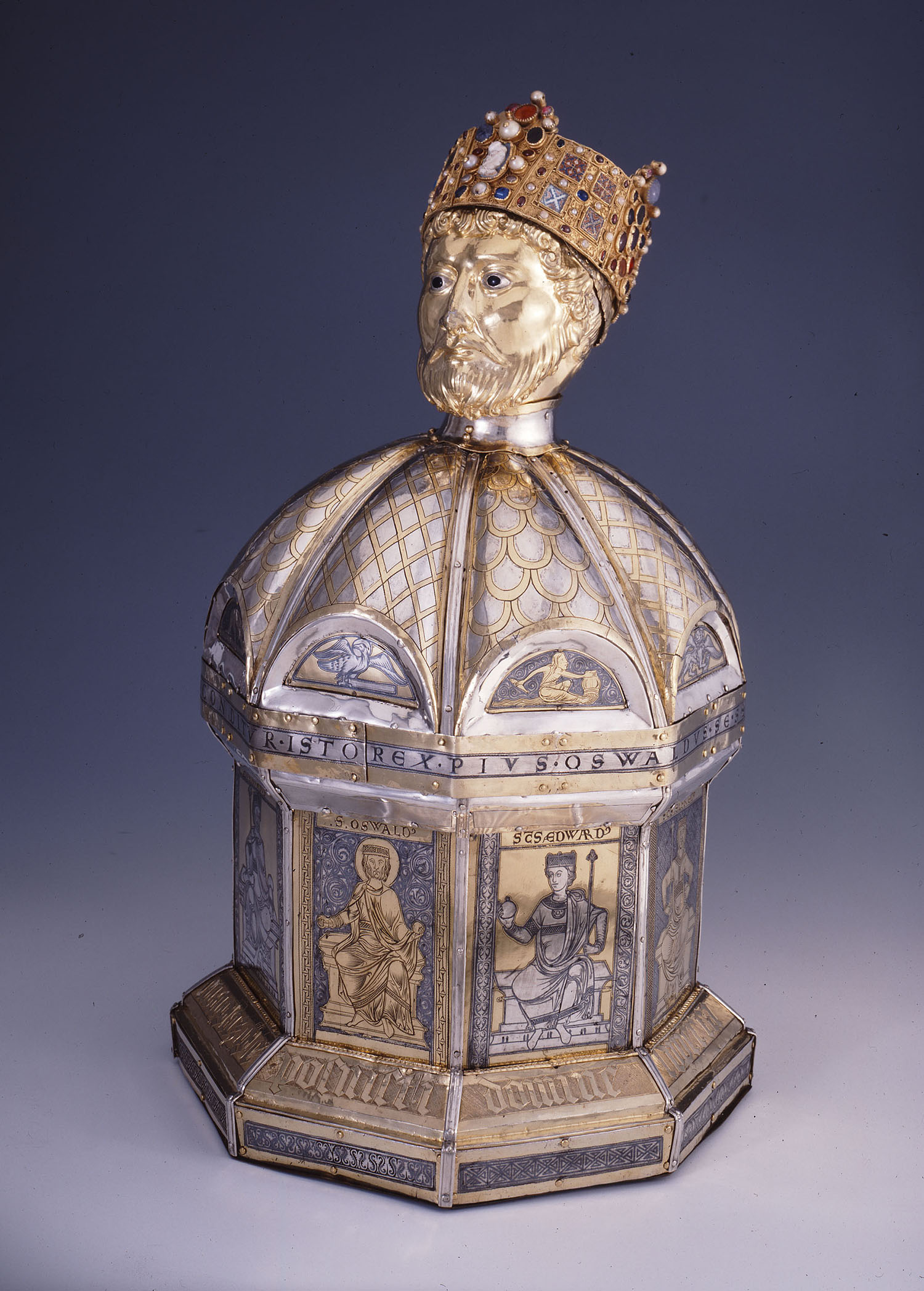
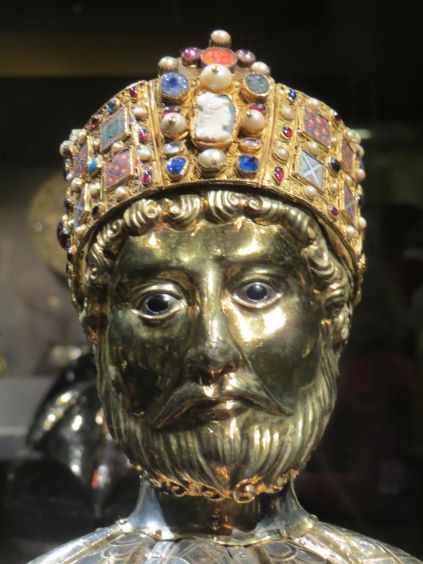
b) Oswald as portrayed on (in a plaque) and atop (in a bust) his late twelfth-century head reliquary (ca. 1185-1189; partly restored, 1779) in the cathedral museum in Hildesheim:


Another view of the bust:


The reliquary can be seen in detail and from many angles at this website:
http://www.bildindex.de/obj20313188.html#|home

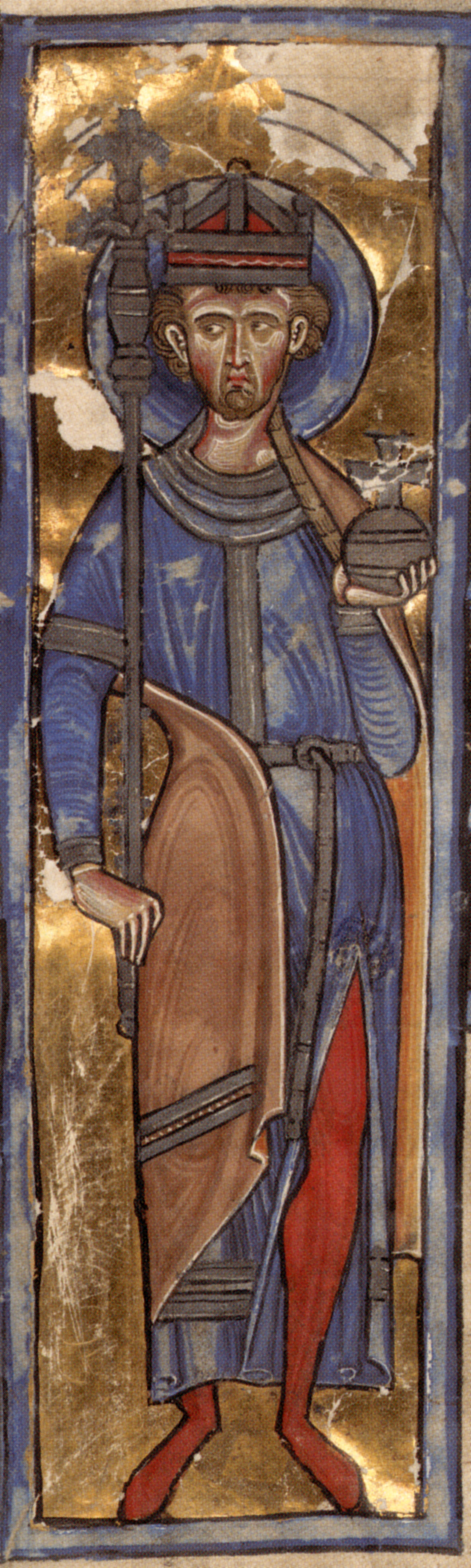
c) Oswald as depicted in an earlier thirteenth-century legendary (betw. 1200 and 1235) of south German origin (New York, New York Public Library, Spencer Collection ms. 1, fol. 89v):


d) Oswald (lower right) as depicted by Matthew Paris in a mid-thirteenth-century copy of his Abbreviatio Chronicorum (ca. 1250; London, BL, Cotton MS. Claudius D. VI, fol. 6v):


I do not know who the rather grumpy looking monarch is at St Oswald's feet - possibly the pagan King Penda of Mercia [Clever Boy]

e) Oswald at Heavenfield as depicted in an earlier fourteenth-century French-language legendary of Parisian origin (ca. 1327), with illuminations attributed to the Fauvel Master (Paris, BnF, ms. Français 183, fol. 78v):
http://tinyurl.com/37ptc2s

Gordon Plumb has posted on the same site these pictures of St Oswald in medieval stained glass:

Wells Cathedral, SII, centre figure:
https://www.flickr.com/photos/22274117@N08/14782878369

York Minster, NX, 2b:
https://www.flickr.com/photos/22274117@N08/5015571570

York Minster, CHnIX, 5b-6b:
https://www.flickr.com/photos/22274117@N08/5019617587

Oxford, Christ Church Cathedral, sVII, A3, St Cuthbert holding the head of St Oswald:
https://www.flickr.com/photos/22274117@N08/2701684119

York Minster, sVII, 3c-4c, St Cuthbert holding the head of St Oswald:
https://www.flickr.com/photos/22274117@N08/4516209022

Cockayne Hatley, St John the Baptist, nIII, 1b:
https://www.flickr.com/photos/22274117@N08/2285002795
According to a leaflet in the church this glass (of c.1300-20) was rescued from a small church in Yorkshire and reset here by the gift of the Worshipful Company of Glaziers in 1968.


Tuesday, 5 August 2014

St Oswald of Northumbria, King and Martyr


Today is the feast day of St Oswald King of Northumbria. It provides me with an opportunity to give the links to previous posts I have written about him and his cult.

They can be seen at Peterborough - which deals particularly with the relic of his holy arm once preserved at the abbey (now the cathedral) there - and at St Oswald and St Oswald King and Martyr.

May St Oswald continue to pray for all who invoke his aid.


Monday, 5 August 2013

St Oswald King and Martyr


Today is the feast of St Oswald, King of Northumbria. I wrote about him two years ago in my post St Oswald.

This year to mark the day I am reproducing some more depictions of the saint, who was a popular patron of churches not only in his own former kingdom, but further afield.

File:Saint Oswald Durham Cathedral.jpg

Image:Wikipedia


Here are pictures of the reliquary of his skull - assuming it is not with St Cuthbert in Durhan - in the cathedral treasury at Hildesheim in northern Germany. The reliquary is dated to 1185-1189, and is a wonderful example of the work of the period.

Cathedral Museum in Hildesheim,reliquary in the form of the head of St.Oswald,. ca  1185-1189,silver,gilt,niello,feligree,enamel,stone and pearl trimming,oak core.
The reliquary in the form of the head of St.Oswald.
 
It is composed of silver,with gilt and niello decoration and has filigree work and decoration in enamel, and with precious stones and pearl trimming over an oak core.
Image:pinterest.com
 
http://www.heiligenlexikon.de/Fotos/Oswald.jpg

Image; heiligenlexikon.de

At present Hildesheim cathedral is undergoing amajor restoration and fifty of its medieval treasures, including the reliquary, are being sent as an exhibition to the Mettopolitan Museum in New York from this coming September until January  next year - so any North American readers who are nearby will have the opportunity to see them you are nearby.

There is an online article about the cathedral here - although I think the first photograph is not of the cathedral, but of another church in the city - and the cathedral's own English language website can be accessed here. There is an introduction to the historic city of Hildesheim, and its post war restoration and reconstruction here.

Devotion to St Oswald outlasted the middle ages in German speaking lands, as can be seen in this eighteenth century painting:
File:St.Oswald Kirche - Hochaltar Altarbild St.Oswald.jpg
 
Painting of St Oswald as patron of cattle
Eibiswald parish church in Styria, 1764
 
Image:Wikimedia.de


Friday, 5 August 2011

St Oswald


Amongst the other feasts that occur today is that of the Northumbrian Saint-King Oswald (d.641). Last August I posted something about him and in particular his holy arm which was once preserved and venerated in the abbey at Peterborough.

My home area in Yorkshire had a long-standing tradition of devotion to him, with several ancient church dedications, the early twelfth century Augustinian priory of St Oswald at Nostell near Pontefract, and, once, a cross to his honour in the centre of my home town, which served as the meeting place of the wapentake of Osgoldcross. Other centres of devotion were at Bamburgh in Northumberland, Bardney in Lincolnshire, Durham, Peterborough and St Oswald's Priory in Gloucester.

There is an online article about him and his cult here. The following paragraphs are initially based upon Dillon's Medieval Religion Saints of the day entry, with a number of my own additional comments and reflections:

Most of what we know about Oswald comes from St. Bede' s Historia ecclesiastica gentis Anglorum. The second son of a Christian king of Northumbria who had lost his throne to pagan opponents, Oswald spent seventeen years in exile in Scotland and Ireland before returning upon the death of a brother and securing his kingdom against Welsh invaders at the battle of Heavenfield in the early 630s. Both St Adomnán in his Vita of St. Columba and Bede present Oswald. as a divinely assisted Christian victor over a pagan host (Adomnán has St. Columba appear to him in a vision and promise him victory; Bede has him erect a great wooden cross on the eve of battle).


Oswald at Heavenfield as depicted in an earlier fourteenth-century collection
of French-language saint's Lives (Paris, BnF, ms. Français 183, fol. 78v)

Memorably generous to the poor, Oswald. was instrumental in establishing Christianity in Northumbria.

Oswald was killed in battle, at what is now Oswestry in Shropshire, against an old enemy, the pagan King Penda of Mercia, although historians have suggested, quite reasonably, that, despite what Bede wrote, the conflict may have been political rather than religious. Penda had his fallen opponant's head, arms, and hands shown publicly on stakes. These relics were later recovered by Oswald's brother and successor Oswiu, who donated the head to Lindisfarne.

Miracles were attributed to Oswald, and a cult arose. One of Oswald's hands was said to be undecayed; in the late eighth century it was still displayed in a silver reliquary in the palace church at Bamburgh. This was the relic which later went to Peterborough, and Bamburgh became a cell of Nostell in the twelfth century.

Other of Oswald's relics later were dispersed still further. In the early tenth century some wound up at St Peter's Priory in Gloucester, which soon became St Oswald's Priory instead. A page on that site is here; the site lies just north-west of what is now Gloucester cathedral. There is more here on Oswald's posthumous journeys. Devotion to him was extensive, spreading to the continent, and he remained popular in England down to the reformation, and, probably thanks to the account in Bede, it has revived in the last century or so.

File:Stoswaldaskingnyplspencer1f89r.jpg

St Oswald.
Manuscript illumination of c.1220
New York Public Library MS Spencer 1, f.89v

Image: Wikipedia

Both Durham Cathedral and that of Hildesheim have heads said to be those of St Oswald. Polycephalous saints are not unknown - and the Clever Boy would not be too cynical about that - they may well all be parts of the same skull.

What Durham claims as his head is enclosed in the coffin of St Cuthbert, placed there by the monks when they fled from Lindisfarne in the face of Viking attacks. As a result the usual depiction of St Cuthbert has him holding a severed King's head.

photo


St Cuthbert holding St Oswald's head as depicted in the St Cuthbert window in York Minster.
The window was the gift of Bishop Thomas Langley of Durham, d.1437.
(window sVII in the CVMA notation)

Photograph by Gordon Plumb


There is a view of his late twelfth-century head reliquary at Hildesheim, dated to 1185-89 here.
Devotion to him on the continent also resulted in St Oswald becoming the patron of the Swiss canton of Zug, and at least one church in Carinthia is dedicated to him. This is doubtless an indication of the activities of Northumbrian missionaries working within German speaking-lands in the centuries following his life and martyrdom.

The eleventh-century Fleming Drogo of Saint-Winnoc penned three sermons on Oswald. (BHL 6362-6234), treating him not only as a Christian hero but also explicitly as a martyr. As a saint of Durham, Oswald has an impressive Vita in three books by Reginald of Durham (BHL 6365). In the 1220s the poet Henry of Avranches produced a Vita of Oswald. in hexameters (BHL 6365d).

All of which points to the vitality of devotion to him and of the Northumbrian church over many centuries. May St Oswald continue to pray for all committed to his patronage and for us all.


Friday, 27 August 2010

Peterborough


The church at which my friends were received in Peterborough was The Sacred Heart and St Oswald. I was delighted to find a modern church which by its dedication revived an ancient devotion in the city.

The story can be found in St Bede's Ecclesiastical History of how St Oswald, King of Northumbria 633-641 not only sent out the remains of a feast to the beggars outside, but ordered that the silver plate on which the food was carried be also broken up and given to the poor. His guest, St Aidan, who sensed that Oswald was not long for this world, was so moved that he took the king's right arm and blessed it, with the prayer that it should never decay. When, not long after Oswald was killed in battle at Oswestry by King Penda of Mercia his corpse was hacked to pieces by the victors and displayed. His head eventually returned to the north and is now in the coffin of St Cuthbert at Durham, carried thither by the monks of Lindisfarne when they fled the Vikings. Other relics went to Bardney abbey in Lincolnshire.

St Owald's right arm, incorrupt as a result of St Aidan's prayer, eventually came to Peterborough, and was the principal relic of the abbey. It was kept in a chapel in the south transept of the monastic church, and still venerated by pilgrims, until the dissolution of the abbey in 1539 and the later establishment of the diocese in 1541. What happened to the Holy Arm thereafter appears unrecorded. To get some idea of such a royal relic look at my recent post about the "Holy Right" of St Stephen of Hungary here.


St Oswald,
pray for us!

Photo: De Cura Animarum

In the modern church hall there were pictures from a parish pilgrimage to Lindisfarne and Durham, so there is clearly an awareness of the continuing link with St Oswald and a wish to share that with parishioners.