Once I was a clever boy learning the arts of Oxford... is a quotation from the verses written by Bishop Richard Fleming (c.1385-1431) for his tomb in Lincoln Cathedral. Fleming, the founder of Lincoln College in Oxford, is the subject of my research for a D. Phil., and, like me, a son of the West Riding. I have remarked in the past that I have a deeply meaningful on-going relationship with a dead fifteenth century bishop... it was Fleming who, in effect, enabled me to come to Oxford and to learn its arts, and for that I am immensely grateful.


Showing posts with label Epiphany. Show all posts

Monday, 6 January 2025

Epiphany


Today is the Epiphany of Our Lord, a wonderful event in the earthly life of Christ, and a wonderful event in the annual life of the Church, full of meaning and one which has shown itself to be a rich source of inspiration to artists in fulfilling commissions over many centuries.

Two of the most famous, and which regularly features on Christmas cards are in Florence. The earlier in date is Gentile da Fabriano’s The Adoration of the Magi from 1423 which was commissioned by the Strozzi family for the church of Sta Trinità, but is now in the Uffizi. The second is Benozzo Gozzoli’s fresco cycle of the journey of the Magi, which was painted in 1459 on the walls of the private chapel of the Medici Palace.

Smarthistory has two illustrated pieces about these famous works Which placed them in their historical context and bring out some of the details which draw you ever deeper into homage of the Magi, with all their wealth, as depicted for two very wealthy and cultured Florentine banking families. In one aspect these paintings are extravagant celebrations of the wealth and lifestyle that the two families had or aspired to. They are an insight, a vision indeed, of an exclusive and privileged world for fifteenth century Florentines. Yet the very fact of their having commissioned them indicate an awareness on their part that they were fortunate and both able and anxious to place themselves as humble suitors before the infant King of Kings. One difference is that the Strozzi commission was for a parish church, but the Medici chapel was very much private sacred space.That also applies to Gozzoli’s painting of the Adoration which he painted in the cell created by Cosimo de Medici for private meditation at San Marco in Florence. This is also discussed in the relevant article. In temporal terms the Medici at least had made money out of the institutional Church,  yet both commissions suggest an awareness that all the good things in the Strozzi and Medici families came from God.


Friday, 6 January 2017

Surge illuminare


" Surge illuminare"  - Rise your light has come [Isaiah 60 v.1] - is a text traditionally used at the feast of the Epiphany and provided the text for the first sermon preached by Richard Fleming as a member of the English delegation before the Council of Constance on this day seven centuries ago in 1417.

council of constance


Meeting of scholars, bishops, cardinals and Pope John XXIII (antipope) in the cathedral of Constance i.e. before John's deposition in May 1415.


Image:indianapublicmedia.org/Fb78 (wikipedia)

Chronicle of the Council of Constance [1414-1418] by Ulrich Riechental, Fol. 007r, c.1470s

A procession of clergy and religious at the Council of Constance
From the Chronicle of Ulrich von Reichental ( MS of c.1470)

Image: Pinterest


At that stage in the Council celebrating the liturgy and listening to sermons whilst they manoevered behind the scenes appears to have been th emain occupation of the Council Fathers. For Fleming this was his first, but by no means his last as a preacher in the cathedral. 

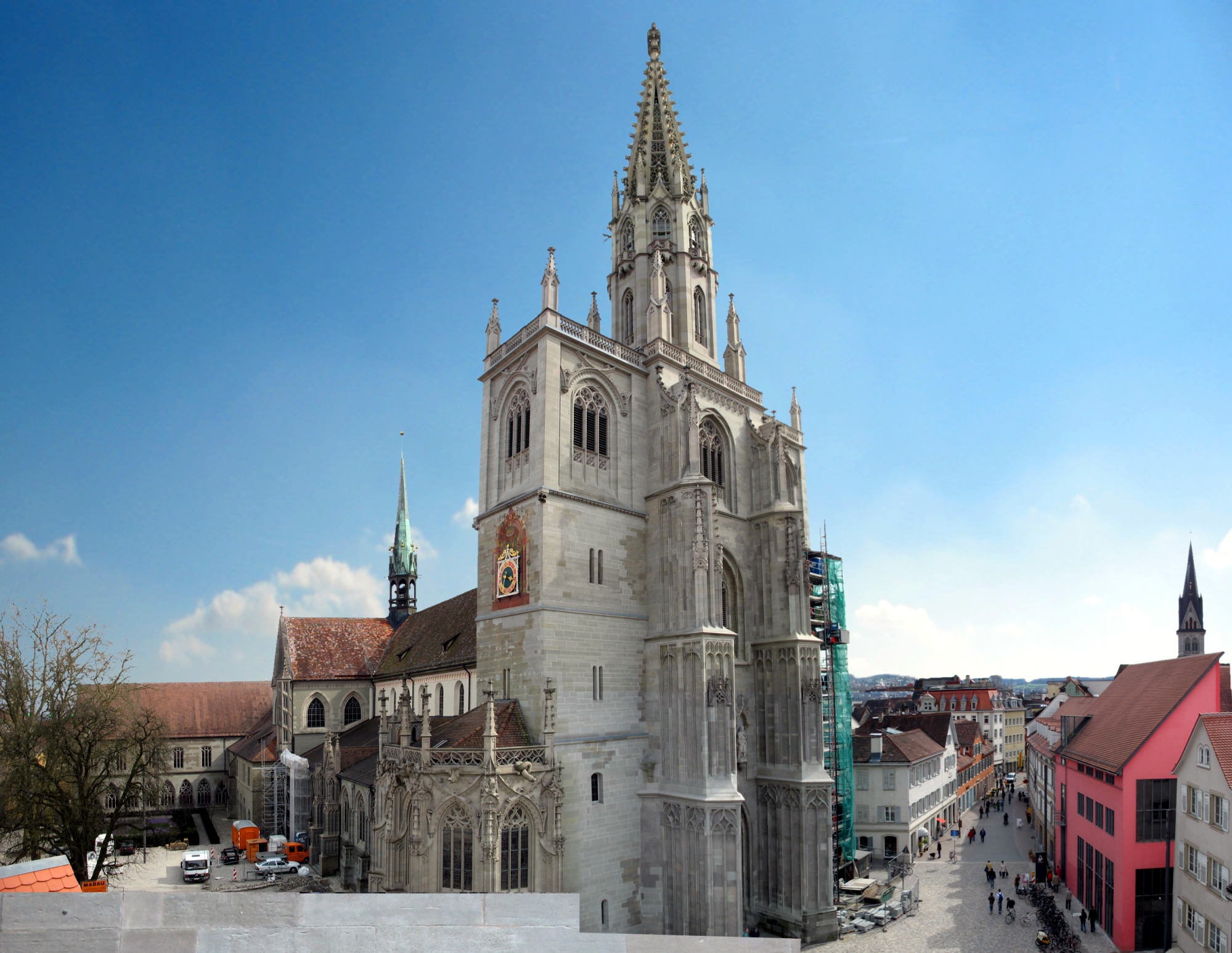
There is an account of the building in which the Council met and of its subsequent development and history at Konstanz Minster

The romanesque nave with its pillars of the basilica was built between 1052 and 1089, is the core  of the cathedral. Over the centuries the cathedral was altered and enhanced. In 1435, the side aisles of the nave were vaulted, followed by the main nave in 1680. In the baroque era, the middle choir was plastered and gilded. In 1856 the western Gothic tower pyramid was built.


 The interior of the cathedral today

Image:stanford.edu 


The west front of Constance Cathedral before the restoration of 1856

Image: Godzdogz 

 https://upload.wikimedia.org/wikipedia/commons/e/ef/MPano_07.jpg

The cathedral today

Image: Wikipedia

Thursday, 7 January 2016

Solemn EF Masses for Epiphany


Yesterday evening I attended the Solemn High Mass in the Extrordinary Form for the Epiphany at the Oxford Oratory.

There had been a Low Mass for the feast at 12.15, but the main celebration was at 6pm. This was very well attended - those who love the EF, regular 6pm attenders and those who wish to keep Epiphany on the proper day, not the nearest Sunday. On the basis of a well-filled church I am tempted, once again, to ask who it is that says Mass in the Extraordinary Form and the celebration of Epiphany on the day traditionally assigned to it are not wanted.

This was a particularly beautiful liturgy, and the calm professionalism with which it was executed brought to my mind the phrase 'noble simplicity' to describe it. This was liturgy that was both elegant and eloquent.

The Choir did a fine job of singing the Mass by Palestrina and the Propers

We had the proclamation of the moveable feasts of the coming year in Latin as well as a sermon from the Provost, Fr Daniel, which linked this celebration into the whole cycle of redemption, of giving thanks for the gifts of this life and the call to spread that news to a world that needs to know it.

Alas there appeared to be no photographs being taken which I could share with readers.

A couple of miles away to the north at SS Gregory and Augustine there was also a Solemn High Mass in the EF celbrated by Fr Saward. The friends with whom I had supper afterwards who had been there said that there were again good numbers ,and that everything was done very well. The commented in particular on the quality of  music - in this case William Byrd - and on the serving.

It is heartening to think that there were two such Masses offered yesterday, and that they were so well supported. Those of us who live in or near Oxford are very lucky, and very grateful, for such provision.

Sunday, 11 January 2015

The Baptism of the Lord


http://sunsite.icm.edu.pl/wm/paint/auth/greco/baptism-1608.jpg

 The Baptism of Christ
El Greco, 1608-14
Hospital of San Juan Bautista de Afuera, Toldedo
The painting was completed after the artist's death by his son Jorge Manuel

Image: sunsite:icm.edu.pl

Today is the Feast of the Baptism of the Lord, and the end of most of the formal liturgical Christmastide celebrations, barring their final conclusion at Candlemas on February 2nd.

As it is observed in the Novus Ordo the Feast, on the Sunday after Epiphany (or after the Sunday of Epiphany) dates from 1970. In the Vetus Ordo it is assigned to January 13th, the old Octave day of Epiphany, by both the 1955 and 1962 Missals, and indeed as a separate feast from the traditional threefold celebration of the manifestation of Christ at Epiphany ("Three wonders mark this day...") is a creation of Pope Pius XII in 1955. For that reason he re-used the Epiphany propers for the new festal observance he developed from it, and such an addition seems to me to fall within the range of things which can and should be legitimately added to the liturgy. This is the proper development of liturgy analogous to the proper development of doctrine.

In the Eastern Orthodox tradition the Great Theophany is celebrated as one commemoration. As Kurt Sherry pointed out on the Medieval religion discussion group the other day, the western feast of Epiphany commemorates the adoration of the Magi, which the eastern church commemorates on Christmas itself.  In the Eastern Orthodox tradition, January 6 is the feast of Theophany, which is the Baptism of Christ. The Baptism is called Theophany because it is the manifestation of the Holy Trinity (the Incarnate Son, the voice of the Father, and the Holy Spirit in the likeness of a dove). Thus, an Orthodox church named Holy Trinity should (there are some parishes that violate the "rules" and use Rublev's Trinity or one of the "heretical" depictions of "an old man, Christ, and a bird") have the Baptism of Christ in the position to the left of the Theotokos when facing the iconostasis. Another member of the list, who is Orthodox, added the point that although Pentecost is not taken to be so explicitly Trinitarian in the West, it is celebrated as THE revelation of the Trinity among the Orthodox. Theophany -- also called Epiphany in Orthodox circles -- and Transfiguration are both celebrated as Trinitarian revelations that are consummated by Pentecost.

The Eastern Fathers had much more to say, it would appear on the basis of the magisterial and exuberant texts in the Office of Readings for this week, about the Baptism than their Western counterparts. So establishing a Feast of the Baptism to point out its enormous significance and drawing direct attention to it as a distinct event rather than subsuming it in the visit of the Magi on January 6th seems right and fitting. In so doing the abolition of the Octave, by Pope Pius, was in part undone by Pope Paul.

There is a history of the feast day here.

The painting by El Greco conveys much of the exultation of Orthodox writers about the Baptism and its significance which the artist conveyed to the Catholic Counter-Reformation world in his unique vision of things heavenly and earthly bound inextricably together.


A revised and extended version of my post from this Feast last year


Tuesday, 6 January 2015

Epiphany publication of the calendar


The New Liturgical Movement has an interesting pair of linked posts about the venerable tradition of formally publishing after the Gospel the date of Easter, and, in the Roman Rite, of other ecclesiastical dates of the coming year at Epiphany, which can be read at Publication of the Date of Easter 2015 on the Day of the Epiphany


The Epiphany of Our Lord


Today is the Epiphany of Our Lord according to the traditional use of the Church.

As I have posted on this day in recent years I, and I think many others, would wish to see a return to the traditional date of January 6th for its observance in the Ordinary Form in England and Wales - and indeed in other countries as well - rather tham transferring it to the Sunday. I do very much hope that the Bishops will resolve to petition ther Holy See for a restoration of the customary dates for Epiphany, Ascension and Corpus Christi in the near future. It is surely not unreasonable to expect the faithful - if such they really are - to go to Mass on a day other than Sunday on three occasions during the year, or if they are in a parochial unit with several churches but only one priest to travel a slight distance - it will certainly not be as far as the Magi travelled.

I was quite happy to observe an anticipated Mass and Vespers of Epiphany in the Ordinary Form last Sunday, though otherwise I said the Office for the Second Sunday after Christmas, but, thanks to the rules governing the Extraordinary Form, I am able to observe this wonderful feast on its proper day, that is today. So, as in previous years, and as I described in my post Epiphanylast year, I am saying the Office for Epiphany, will go to the EF Low Mass at the Oxford Oratory at 12.15 and then, this evening, attend the Sung Mass at SS Gregory and Augustine at 6. Those possibilities do, I realise, make Catholic life in Oxford both richer and easier in practical terms than in many other places, and thanks be to God for that fact.


Adoration of the Magi by Gentile da Fabriano

The Adoration of the Magi

This work in tempera on wood, also called Pala Strozzi, was painted in 1423 by Gentile da Fabriano, and is one of the best known images of the Epiphany. It was commissioned by the wealthy banker and intellectual Palla Strozzi for the family chapel in the church of Santa Trinita.

 Image: uffizi.org

A Happy and Joyful Epiphany to you all.


Sunday, 12 January 2014

The Baptism of the Lord


http://sunsite.icm.edu.pl/wm/paint/auth/greco/baptism-1608.jpg

 The Baptism of Christ
El Greco, 1608-14
Hospital of San Juan Bautista de Afuera, Toldedo
The painting was completed after the artist's death by his son Jorge Manuel

Image: sunsite:icm.edu.pl

Today is the feast of the Baptism of the Lord, and the end of most of the Christmastide celebrations, barring its final conclusion at Candlemas on February 2nd.

As it is marked in the Novus Ordo the Feast, on the Sunday after Epiphany (or after the Sunday of Epiphany) dates from 1970. In the Vetus Ordo it is assigned to January 13th, the old Octave day of Epiphany, by both the 1955 and 1962 Missals, and indeed as a separate feast from the traditional threefold celebration of the manifestation of Christ at Epiphany ("Three wonders mark this day...") is a creation of Pope Pius XII in 1955. For that reason he re-used the Epiphany propers for the feast he developed from it, and such a development seems to me to fall within the range of things which can and should be legitimately added to the liturgy. This is the proper development of liturgy analogous to the proper development of doctrine.

In the Eastern Orthodox tradition the Great Theophany is celebrated as one commemoration, but the Eastern Fathers had much more to say, it would appear on the basis of the magisterial and exuberant texts in the Office of Readings for this week, about the Baptism than their Western counterparts. So establishing a feast of the Baptism to point out its enormous significance and drawing direct attention to it rather than the visit of the Magi on January 6th seems right and fitting, and in so doing the abolition of the Octave, by Pope Pius, is in part undone by Pope Paul.

There is a history of the feast day here.

The painting by El Greco conveys much of the exultation of Orthodox writers about the Baptism and its significance which the artist conveyed to the Catholic Counter-Reformation world in his unique vision of things heavenly and earthly bound inextricably together.


Monday, 6 January 2014

Epiphany


File:Fernando Gallego - Epiphany - Google Art Project.jpg

The Epiphany
Fernando Gallego c. 1480-90
National Museum of Catalunya

Image: Wikipedia

Today is the Feast of the Epiphany, and as I have said and written in previous years I hope that we shall soon see the decision to transfer it, together with the Ascension and Corpus Christi, to the nearest Sunday rescinded. I was quite happy to have an anticipated celebration of the Epiphany yesterday, but today is the day. Fortunately I was able to observe it in the Extraordinary Form, as well as saying the Office of the Epiphany on the proper day.

As it turned out I did so twice. At lunchtime I attended the Low Mass at the Oxford Oratory celebrated at the High Altar by Fr Jerome Bertram before going off for a light but celebratory lunch with a friend at a new cafe nearby.

Late in the afternoon we went up to the Missa cantata celebrated by Fr John Saward at SS Gregory and Augustine in north Oxford. This had music provided by the Newman Consort and the Schola Abelis, who sang a Palestrina Mass and a motet by Clemens Non Papa. The whole Mass was particularly beautiful in the candlelit church, still splendidly decorated for Christmastide. To one side of the altar was a reliquary containing a fragment of the Manger, empasising our coming as pilgrims with the Magi to the Christ Child.

As my friend and I reflected over dinner we are very fortunate here in Oxford not only to have regular access to the Extrordinary Form , and within the mainstream of the Church, and to celebrations conducted with such care and thoughtfulness, not least in both cases with elegant homilies.

A happy and joyful Epiphany to you all.


Sunday, 6 January 2013

Epiphany


A Joyful Epiphany to you all


detail


The Adoration of the Magi

Gentile da Fabriano c 1370- c.1427

The figure between the donkey and the third king has been identified as the artist. The figure with the hawk has been identified as Palla Strozzi, who commissioned the painting.

1423

Uffizi Gallery, Florence

Image: webhook.com

Friday, 13 January 2012

The Baptism of Our Lord


http://www.nationalgallery.org.uk/upload/img/piero-della-francesca-baptism-christ-NG665-fm.jpg

The Baptism of Christ
Piero della Francesca

Image: The National Gallery

Prior to 1955 today was celebrated as the Octave Day of the Epiphany, although as my old St Andrew's Missal points out the Gospel reading was that of the Baptism rather than the visit of the Magi, a survival of an earlier observance of the Baptism on this day. The abolition of the Octave of the Epiphany, regrettable as it was and is was balanced to some extent by restoring today as the feast of the Baptism. That can be seen as legitimate restoration and also providing for a greater degree of celebration of this event which marks the beginning of Our Lord's public ministry.

The Missal which came into use in 1962 retains this feast on this day, but the 1969 Missal moves it to the Sunday after Epiphany, or if Epiphany falls on a Sunday, or as now in England and Wales, if the obligation is transferred to the Sunday, the Baptism is observed on the Monday following. I suspect this was so that more people would attend Mass on the day, rather like the argument for transferring the Days of Obligation to the Sunday in recent years. In my opinion that is a wrong attitude to what people should be expected to do, but I understand the application of that argument if you do not challenge, or are not prepared to challenge, the faithful to practice the public observance faith as it should be done.

In terms of the calendar and the structure of the liturgical year I much prefer the 1955 arrangement, although I would also retain an Octave for Epiphany, and thereby give time to celebrate and reflect upon the manifestations of Our Lord's Divinity and mission. By giving the Baptism its own specific feast it improves on the previous practice, whereas the current Novus ordo concertinas the days together.

A related change in 1969 was moving the feast of St Hilary back one day to January 13th, from its traditional date of the 14th. When it fell on that day it was the first saint's day after the end of Epiphany, and hence its use as an indicator for terms such as those at Oxford.

Sunday, 8 January 2012

Epiphany Sunday


As today is being observed as Epiphany Sunday it provides another excuse to post one of the most famous depictions of the visit of the Magi, that by Gentile da Fabriano. Painted in 1420-23 for the church of Santa Trinita in Florence it is now on display in the Uffizzi. There is an article about Gentile here and a more detailed one about the painting here.


The Adoration of the Magi
Gentile da Fabriano
1423

http://farm1.staticflickr.com/141/382439923_1a9be15eb0_z.jpg?zz=1

The central scene

Image farm1.staticflickr

Quite apart from its considerable appeal as a devotional image or as a work of art I am also drawn to it because it was commenced in the year Bishop Fleming was consecrated in Florence by Pope Martin V, who was late to be a patron of Gentile, commissioning him to work on the nave of the Lateran basilica in 1427, although the artist died that same year. It is therefore an indication of the cultural milieu in which "my bishop" was moving in his years at the Papal court in Florence from 1418-20.

Friday, 6 January 2012

Blessed chalk for Epiphany


At the end of the Epiphany Mass at SS Gregory and Augustine this evening Fr Saward blessed and distributed chalk for the traditional blessing of homes.

With the blessed chalk you write

20+C+M+B+12

above the doorways - 2012 for the year, C, M and B for the three Magi - Caspar, Melchior and Balthasar - and Christus mansionem benedicat - May Christ Bless this House.

Whilst writing say 'Christus mansionem benedicat' and then recite this prayer:

Lord God of heaven and earth, you revealed your only-begotten Son to every nation by the guidance of a star. Bless this house and all who inhabit it. Fill us with the light of Christ, that our concern for others may reflect your love. We ask this through Christ our Lord. Amen.

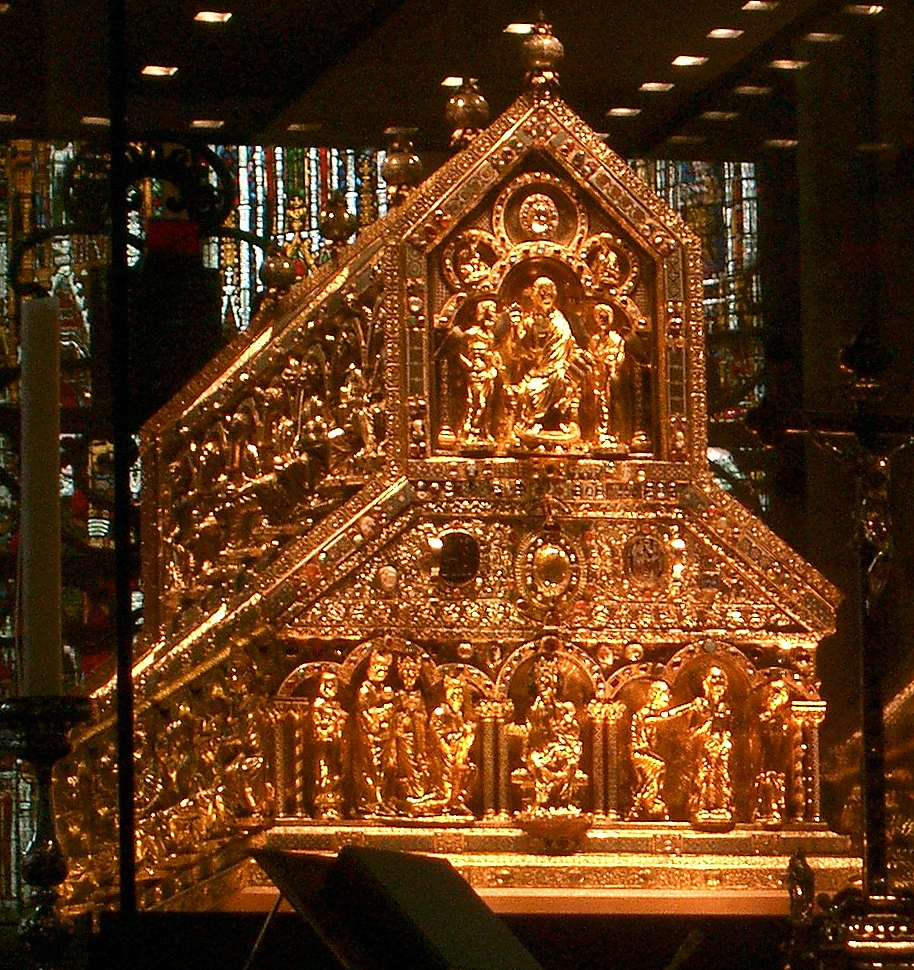
Shrine of the Three Kings


St Matthew tells us that the Magi returned to their country by another way, and so they leave the pages of the Gospel, but tradition, legend and piety has not stopped there.

They acquired names and kingdoms - Caspar, King of Tarsus -the land of Myrrh, Melchior, King of Arabia-the land of Gold, and Balthasar, King of Saba (pron SAY-ba) or Sheba- where Frankincense flows from trees. [Ancient Ind, Persia,Kasdim-Chaldea] - and were provided with a history.

"When the Children of Israel were gone out of Egypt and had won and made subject to them Jerusalem there was in the Kingdom of Ind a tall hill called the Hill of Vaws or the Hill of Victory. Twelve clerks of astronomy kept watch for the Star that was prophesied by Balaam to be the birth of Christ." The Star ascended above the hill and was seen by the three wise men. The Three Kings presented their gifts of gold, frankincense, and myrrh to the Christ child. Gold symbolized kingship, frankincense showed godliness, and myrrh death. In return, He offered charity and spiritual riches for gold, faith for incense, and truth and meekness for myrrh.

The Kings returned home by a different route and St. Thomas found them in India and baptized them. They became martyrs and were buried outside the walls of Jerusalem. They were moved to Constantinople by Emperor Constantine’s mother St Helen to the Church of Hagia Sophia, and then to Milan. Finally in 1164 Archbishop Rainald of Dassel translated what were believed to be their relics to his cathedral in Cologne, where they continue to be venerated.

The Archbishop died in 1167 and the great reliquary which holds the bones was constructed between 1180-81 and about 1225, and is arguably the greatest surviving of all medieval relic chasses.

File:Rainald von dassel.jpg

Archbishop Rainhold as depicted on the shrine

Around the relics there developed an extensive devotional and hagiographic literature. The
text of an Early English translation of The Three Kings of Cologne by John of Hildesheim in its 1886 edition can be read here

I have heard the charming story that the church bells along the Rhine spontaneously rang as the relics passed by on their journey to their new home - it may be poetic licence, but it is a rather splendid notion.


There is an illustrated article about the Three Kings Shrine here
and another with more detailed illustrations here.

As to the relics themselves and their provenence I have seen a documentary about them which pointed out that some of the wrappings were made from early and expensive Byzantine silk - these were well attested relics long before they came to Cologne.

File:Köln Dreikönigsschrein.JPG

The Shrine of the Three Kings in Cologne Cathedral

Images: Wikimedia

Celebrating the Epiphany


L'adoration des Rois Mages

The Adoration of the Magi
Juan Reixach
c.1411-1485+


I am observing the Epiphany today - on its proper day, along with the Pope in the Vatican and the overwhelming historic majority of Catholics through the centuries.

Everyone I talk to thinks we should keep the feast today - not move it to the nearest Sunday, or, strictly speaking, I know, move the obligation to that day. Before there were evening Masses, and if it was not a holiday, I could imagine a case for moving the celebration, but not now. It encourages people not to put themselves out to go to church - and we should be putting ourselves out to worship the Lord. The Magi are a rebuke to such laziness - they bothered a lot more than the Episcopal Conference appears to think the average Catholic can be bothered to do. And, if the Bishops are right about such apathy, rather than pandering to it, what are they going to do to change it? We must maintain pressure to reinstate the proper observance of Epiphany, Ascension Day and Corpus Christi on their traditional days.

So I said the Office of Epiphany last night and this morning, attended Mass in the Extraordinary Form at the Oratory at lunchtime, and will be present at a second such celebration at SS Gregory and Augustine later on, and I am wishing people a happy Epiphany for today.
Theabove passage is a re-posting of what I wrote last year as I still hold to the views I expressed then. I would add that the homily at the Mass celebrated at the Oratory stressed the point of the Epiphany is the adoration by the Magi, not their gifts. If the Epiphany is indeed about adoration, and we adore that which we hold to be paramount, then I think it right to say that we should be , and should be expected to be, willing to put ourselves out just a little to offer that adoration to the Incarnate Godhead.

Epiphany


To mark the Epiphany I am doing as I did on Christmas Day and reproducing, with a few emendations, a post from last year.

It is Stefan Lochner's depiction of the Adoration of the Magi, dated to c.1440-45. It forms the central panel of his triptych of the Virgin and Child with the saints of Cologne, which is in the Lady Chapel of Cologne Cathedral - a cathedral which houses the relics of the Magi. As I had used his Madonna of the Rose Bower on my Christmas Day post I thought I would reproduce his Epiphany picture, partly because I like his paintings and particularly as in it he re-uses the same image of Our Lady:


The following are notes on Stefan Lochner from the Web Gallery of Art site:
This German late Gothic painter, considered to be the greatest representative of the school of Cologne. He is known primarily for his highly mystical religious paintings.
Little is known of his early life, but he is thought to have studied in the Netherlands, possibly under Robert Campin (tentatively identified with the Master of Flémalle), whose influence is evident in the treatment of the drapery and the careful rendering of detail in what may be Lochner's earliest extant painting, St Jerome in His Cell (heirs of Edith von Schröder Collection).
Lochner settled in Cologne about 1430. The earliest work he did there was an altarpiece for the church of St Laurenz (centrepiece with the Last Judgment now in Wallraf-Richartz Museum, Cologne; the wings are dispersed). The abundance of minute observation reflects his continued interest in Netherlandish art. But in the central panel he bound the various themes into a unified composition through the use of a dominating rhythmic design.
In the later 1430s Lochner must have been in the Netherlands again, where he encountered the art of Van Eyck. The first work to reflect this influence is the Madonna with the Violet (c. 1443; Erzbischöfliches Diözesan-Museum, Cologne). Van Eyck's influence is most noticeable in Lochner's chief work, the great town hall altarpiece much admired by Dürer. In this Altar of the Patron Saints, now in Cologne cathedral, Lochner adds to the idealism of the older painters of the Cologne school with a wealth of naturalistic observation in the figures, while the sculpture-like draperies lend them a monumental dignity. In 1447 he became a member of the town council, and from the same year dates the splendid Presentation in the Temple (Hessisches Landesmuseum, Darmstadt), which was originally in St Katharinen. The exquisite Madonna of the Rose Bower (Wallraf-Richartz Museum, Cologne) was painted soon afterward.
Lochner became one of Cologne's greatest painters, combining naturalism with a masterful sense of colour and design into a festal solemnity of representation. His work forms perhaps the most successful visual interpretation of late medieval German mysticism before Grünewald. Book illumination was also done in his workshop.

Thursday, 6 January 2011

Celebrating the Epiphany


L'adoration des Rois Mages

The Adoration of the Magi
Juan Reixach
c.1411-1485+


I am observing the Epiphany today - on its proper day, along with the Pope in the Vatican and the overwhelming historic majority of Catholics through the centuries. Everyone I talk to thinks we should keep the feast today - not move it to the nearest Sunday, or, strictly speaking, I know, move the obligation to that day. Before there were evening Masses, and if it was not a holiday, I could imagine a case for moving the celebration, but not now. It encourages people not to put themselves out to go to church - and we should be putting ourselves out to worship the Lord. The Magi are a rebuke to such laziness - they bothered a lot more than the Episcopal Conference appears to think the average Catholic can be bothered to do. And, if the Bishops are right about such apathy, rather than pandering to it, what are they going to do to change it? We must maintain pressure to reinstate the proper observance of Epiphany, Ascension Day and Corpus Christi on their traditional days.

So I said the Office of Epiphany last night and this morning, attended Mass in the Extraordinary Form at the Oratory at lunchtime, and will be present at a second such celebration at SS Gregory and Augustine later on, and I am wishing people a happy Epiphany for today.

Epiphany


A joyful Epiphany to you all


http://www.sbarnabas.com/blog/wp-content/uploads/2009/01/magi.jpg

Detail from The Adoration of the Magi by Gentile da Fabriano, 1423