Once I was a clever boy learning the arts of Oxford... is a quotation from the verses written by Bishop Richard Fleming (c.1385-1431) for his tomb in Lincoln Cathedral. Fleming, the founder of Lincoln College in Oxford, is the subject of my research for a D. Phil., and, like me, a son of the West Riding. I have remarked in the past that I have a deeply meaningful on-going relationship with a dead fifteenth century bishop... it was Fleming who, in effect, enabled me to come to Oxford and to learn its arts, and for that I am immensely grateful.


Showing posts with label Council of Constance. Show all posts

Friday, 6 January 2017

Surge illuminare


" Surge illuminare"  - Rise your light has come [Isaiah 60 v.1] - is a text traditionally used at the feast of the Epiphany and provided the text for the first sermon preached by Richard Fleming as a member of the English delegation before the Council of Constance on this day seven centuries ago in 1417.

council of constance


Meeting of scholars, bishops, cardinals and Pope John XXIII (antipope) in the cathedral of Constance i.e. before John's deposition in May 1415.


Image:indianapublicmedia.org/Fb78 (wikipedia)

Chronicle of the Council of Constance [1414-1418] by Ulrich Riechental, Fol. 007r, c.1470s

A procession of clergy and religious at the Council of Constance
From the Chronicle of Ulrich von Reichental ( MS of c.1470)

Image: Pinterest


At that stage in the Council celebrating the liturgy and listening to sermons whilst they manoevered behind the scenes appears to have been th emain occupation of the Council Fathers. For Fleming this was his first, but by no means his last as a preacher in the cathedral. 

There is an account of the building in which the Council met and of its subsequent development and history at Konstanz Minster

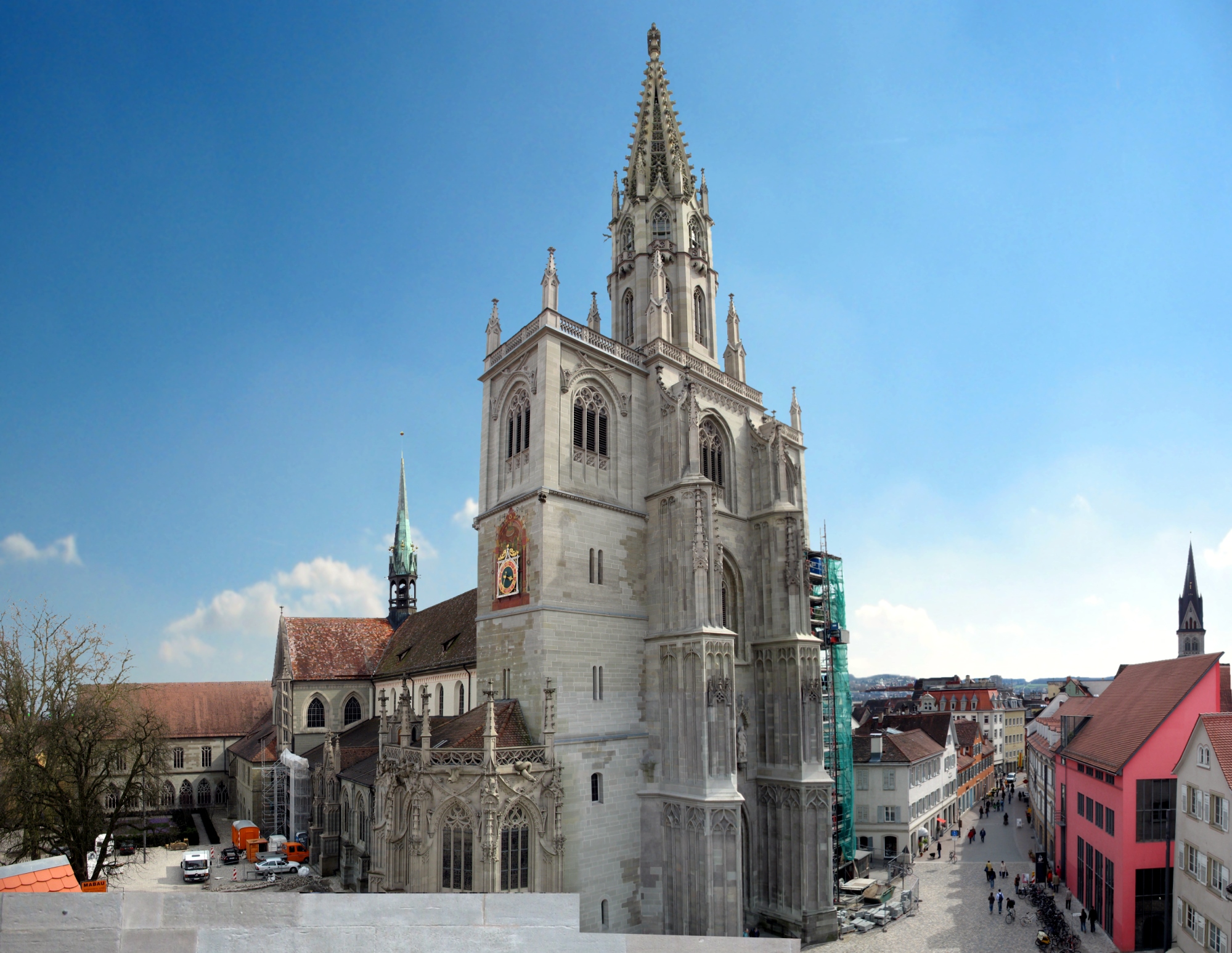
The romanesque nave with its pillars of the basilica was built between 1052 and 1089, is the core  of the cathedral. Over the centuries the cathedral was altered and enhanced. In 1435, the side aisles of the nave were vaulted, followed by the main nave in 1680. In the baroque era, the middle choir was plastered and gilded. In 1856 the western Gothic tower pyramid was built.


 The interior of the cathedral today

Image:stanford.edu 


The west front of Constance Cathedral before the restoration of 1856

Image: Godzdogz 

 https://upload.wikimedia.org/wikipedia/commons/e/ef/MPano_07.jpg

The cathedral today

Image: Wikipedia

Friday, 29 May 2015

Deposing the Pope


Today is the anniversary of the twelfth session of the Council of Constance which deposed Pope John XXII, of the Pisan line, one of the three claimants to the Papal throne.

There are online lives of the Pope at Antipope John XXIII and from the old Catholic Encyclopaedia at Antipope John XXIII

He had already fled from Constance, seeking thereby not only his own liberty but perhaps to thereby invalidate the Council. In both he was uncuccessful.

During his absence John was deposed by the Council, and upon his return he was tried for heresy, simony, schism and immorality, and found guilty on all counts. Gibbon As Edward Gibbon, with typical Enlightenment cynicism, famously wrote, "The more scandalous charges were suppressed; the Vicar of Christ was accused only of piracy, rape, sodomy, murder and incest."

The following paragraphs are adapted from an internet source:

Following this the ex-Pope, once more Baldessare Cossa, was promptly imprisoned in Germany and was just as quickly ransomed by his friend Giovanni di Bici di Medici of Florence. Powerful, cunning men often attract the interest and friendships of other powerful and cunning men and the father of the Medici fortune had become a friend of Baldassare during the young man’s time in Bologna. Giovanni di Bici di Medici had an eye for making money and Baldassare had a perpetual love and need of it. Bici must have seen the path that Baldassare was forging for himself, often with brute force, and a friendship evolved. As a supporter of Baldassare, Bici had loaned his money in an astute way at an important point in the career of the future Pope John XXIII and his reward from his friend in 1413 was for the Medici Bank to obtain the Curia account - a near monopoly of the bank account of the Papal Estates. It was a piece of business genius that laid the foundation for the wealth and power of the Medici in Florence that lasted almost 300 years.

baldassare 


The only tomb in the magnificent Baptistery in Florence is that of Baldassare Cossa.  It was commissioned by the executors of his will after his death on December 22, 1419 and completed during the 1420s. The cost of this tomb was reputed to be 800 Florins - at a time when a rich man could build an entire palazzo in Florence for 1,000 Florins. The tomb was paid forby the Medici’s to say express their gratitude; engaging the great Donatello who sculptured the figure of Baldassare whilst Michelozzo created the surrounding drapery and tabernacle. It is a masterpiece in its own right, which outraged Pope Martin V who protested in vain against the inscription on the sarcophagus: "John the former Pope".

Image and text (adapted): perfectraveller.com


Monday, 6 April 2015

Haec Sancta


Today is the anniversary of the passing of what J. N. Figgis, the early twentieth century historian of political ideas, and an Anglican priest, termed " [p]robably the most revolutionary official document in the history of the world."

What is this revolutionary text? The American Declaration of Independence? The Declaration of the Rights of Man? THe Communist Manifesto? The Ninety Five Theses? Magna Carta? The Edict of Milan?

No, none of the above. What Figgis had in mind when he wrote Political Thought from Gerson to Grotius: 1414-1625: Seven Studies (1907) which had been originally delivered as the Birkbeck Lectures at Trinity College in 1900, was the Decree Haec Sancta voted on by the Council of Constance in its Fifth Session, on this day in 1415.

Haec Sancta states that:

"Legitimately assembled in the Holy Spirit, constituting a general council and representing the Catholic church militant, it has power immediately from Christ; and that everyone of whatever state or dignity, even papal, is bound to obey it in those matters which pertain to the faith, the eradication of the said schism and the general reform of the said church of God in head and members."

Figgis'complete comment - a typically provocative rhetorical flourish - is as follows:

" Probably the most revolutionary official document in the history of the world is the decree of the Council of Constance asserting superiority to the Pope, and striving to turn into a tepid constitutionalism the Divine authority of a thousand years."

Haec Sancta was therefore the charter for Conciliarism, but it remained and remains a dead letter because although the Council of Constance was summoned by Pope John XXIII of the Pisan obedience it is only those of its Acta and decrees after it was formally summoned on July 4th 1415 by one of the other rivals for the Papacy, Pope Gregory XII, of the Roman obedience, after the Council had deposed Pope John in May, which are accounted canonical and binding.

http://dominican-friars.colourrich.co.uk/images/blogs/godzdogz/2013/06/CathedralofConstanceMEDIUM.jpg

Constance Cathedral where the Council met
A view showing it before nineteenth century restoration and improvements - there is more about the cathedral here

Image; godzdogz,op.org

All the decrees of the Council can be seen in translaton or summary at Council of Constance 1414-18

There is a brief note about Figgis and his work here and more can be found by following the link to Mark Chapman's 2001 book The Coming Crisis: The Impact of Eschatology on Theology in Edwardian England.