Once I was a clever boy learning the arts of Oxford... is a quotation from the verses written by Bishop Richard Fleming (c.1385-1431) for his tomb in Lincoln Cathedral. Fleming, the founder of Lincoln College in Oxford, is the subject of my research for a D. Phil., and, like me, a son of the West Riding. I have remarked in the past that I have a deeply meaningful on-going relationship with a dead fifteenth century bishop... it was Fleming who, in effect, enabled me to come to Oxford and to learn its arts, and for that I am immensely grateful.


Showing posts with label Lincoln Cathedral. Show all posts

Saturday, 24 May 2025

Marian Pilgrimage - Our Lady of Lincoln


The main object of Marian pilgrims in the great cathedral under her patronage in Lincoln was a bejewelled statue of the Virgin and Child by the High Altar, and close to the other shrines in the mother church of a diocese that extended from the Humber south to the Thames.

My previous posts about the shrine can be accessed from the one I composed last year at 

Marian Pilgrimage - Our Lady of Lincoln


May Our Lady of Lincoln pray for Pope Leo XIV


Saturday, 28 November 2015

Commemorating Queen Eleanor of Castile


Today is the 725th anniversary of the death in 1290 at Harby on the borders of Nottinghamshire and Lincolnshire of  Queen Eleanor of Castile, the first wife of King Edward I.


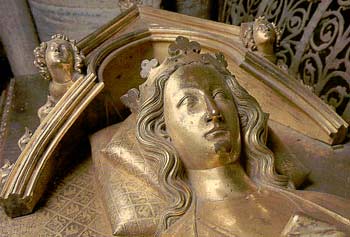
Queen Eleanor of Castile
Tomb effigy in Westminster Abbey

Image: Lady Shirley on Flickr

Recent research has suggested she may not have been as universally popular as later historians have written, but the King mourned her in an impressive and commemorative way.

Her body was embalmed at Lincoln and her internal organs buried in the Angel Choir of the cathedral. The original monument was destroyed when the cathedral was vandalised in 1643, but a nineteenth century reconstruction, based on a seventeenth century drawing of the original, now occupies the site.

 http://www.paradoxplace.com/Photo%20Pages/UK/Britain_Centre/Lincoln_Cathedral/Lincoln_Images/Aug%202007/800/Viscerial-Tomb-Aug07-D7809sAR800.jpg

The viscerial tomb of Queen Eleanor in Lincoln Cathedral 
Between the arms of England are those of the County of Ponthieu, of which she was the heiress and the Kingdom of Castle and Leon

 Image;paradoxplace.com

The places where her body rested on the journey to Westminster were marked by the erection of memorial crosses, of which three survive, at Geddington, Northampton and Waltham. These were close to the monasteries where the Queen's body rested on its jorney to London. These have inspired many later monuments, not least the 'Martyrs Memorial' in Oxford - a nice irony as it is just the type of thing Latimer and Ridley liked to destroy. Originally all of them would have been painted.


The Geddington Cross
The only one known to be on a triangular plan

Image;paradoxplace.com

http://s0.geograph.org.uk/photos/04/19/041979_dae56ccd.jpg


The Northampton  Cross

Image: geograph.org.uk


http://mauriceboddy.org.uk/pictures/Waltham-1%20(263%20x%20500).jpg  

The Waltham Cross

Image: mauriceboddy.org.uk

There is an online account of all the crosses, their fate and what, if anything, remains of the others as well as of copies of them at Eleanor cross.

This pattern of memorial crosses derived from those erected in France to mark where the body of St Louis rested on his corpse's return to St Denis from Tunis.

The last of these crosses was the original Charing Cross - now reproduced in a Victorian reconstruction outside the eponymous station - and thus linked to her burial in Westminster Abbey, where her body rests under the effigy shown above.

 http://www.victorianweb.org/art/architecture/barryem/4.jpg

 The rebuilt Charing Cross of 1863-65 by the stonemason Thomas Earp

Image:victorianweb.org
Her nephew, Master James of Spain - an illegitimate son of her brother - lived in Oxford and was the man who gave the house called 'la Oriole' to the House of Blessed Mary the Virgin in Oxford, thus giving it the name of Oriel, in 1329. A condition of this was that Queen Eleanor was made, in effect, a posthumous honorary Fellow, and was to be prayed for by the College. One of my achievements as a Bible Clerk at Oriel was to get her name restored to the list of Benefactors, whence it had slipped at some time or other.

As to Master James - well I have post coming fairly soon about him, and the lastest theories about his parentage and career.


Wednesday, 6 May 2015

St John before the Latin Gate


Today is traditionally the feast of St John before the Latin Gate. Gordon Plumb has posted these stained glass depictions of the non-martyrdom of St John on the Medieval Religion discussion group:

Lincoln Cathedral, sII, 3a:

York Minster, East window, 11a:

Glasgow, Burrell Collection (ex Rouen, St Jean, c.1510-30)

Thursday, 19 March 2015

St Joseph in medieval English glass


Regular and widespread devotion to St Joseph only really developed in the later middle ages - I read that the first statement of the Church's belief in Joseph's virginity was in Peter Damian's 1059 Letter 61:11 to Pope Nicholas II on the subject of clerical celibacy, and not until the fidfteenth century did his cult really begin to deveklop with preachers such as St Bernardino. It was St Teresa of Avila who forwarded his role as a patron with her foundation in Avila a century later and his feast was only included in the Roman Missal in 1621.

Nevertheless St Joseph was depicted in medieval art in scenes relating to the Incarnation. Gordon Plumb has posted on the Medieval Religion discussion group these medieval stained glass images of St Joseph being chosen as husband of the Virgin Mary as recounted in the second century Apocryphal Protevangelium of James and in The Golden Legend:

Newark, St Mary Magdalene, sII, 4e, Joseph chosen as husband of the BVM:
and details, early 15th century:

Lincoln Cathedral, North Transept Rose, D2, Joseph chosen as husband of BVM, c.1220-35:
and details:


Friday, 25 January 2013

Bishop Fleming, death and burial


According to his Register it was at about two hours after noon on January 25th 1431 that Bishop Richard Fleming died in his castle at Sleaford, part of his episcopal estates. He appears to have suffered a stroke, and would have been about 45 years old. 

He is buried in the north choir aisle of Lincoln cathedral, with a chantry chapel attached to the tomb. The monument is of interest as one of the first transi or cadaver tombs erected in this country, and drawing upon a fashion which had been becoming popular since the 1380s on the continent.

As it is today the monument is not quite as designed by Fleming - he certainly had a hand in its commissioning having written verses for it which indicates a concern for meditation upon the decay of a once handsome man as a corpse. The present appearance is dictated by the restoration in the 1890s by Lincoln College as a tribute to their founder. The original appearance is recorded in the drawings of tombs in the cathedral done shortly before the damage inflicted by the Parliamentarian troops in 1643.


cadaver tomb


Detail of the figures on the tomb of Bishop Fleming in Lincoln cathedral

Image:atlasobscura.com


On this his obit day I always make a particular commemoration of the Bishop in my prayers and invite others to do so.


Wednesday, 25 January 2012

Obit of Bishop Richard Fleming


Today is the obit of Bishop Richard Fleming - he died on January 25th 1431 at about two hours after noon aged about 45 and had apparently suffered an apoplectic stroke - and as he is the subject of my research, and indeed who gave the title to this blog, someone to whom I feel a close attachment.

Here are two pictures of his tomb in the Angel choir of Lincoln cathedral:


http://www.knowledgerush.com/wiki_image/c/c7/Flemtomb.JPG

The tomb and its canopy

Image: knowledgerush.com

http://www.lincolnshireguide.net/images/cc-lincoln-cathedral-tomb-of-bishop-fleming-dave-hitchborne.jpg

The tomb chest enclosing the cadaver effigy

Image: lincolnshireguide.net

As I wrote last year on this anniversary day one thing I believe I have established in my research is that the tomb as it now appears is not quite how it was designed, and that it has been altered in well-intentioned but inaccurate restoration as well as losing the top finials of the canopy.

Please join with me in praying for the repose of the soul of Bishop Fleming and perhaps also spare a thought for me that I can successfully complete my research into his life.

Thursday, 17 November 2011

St Hugh of Lincoln


Today is the feast of St Hugh of Lincoln, the Carthusian who was bishop of the diocese from 1186 until his death in 1200. My post from this day last year can be read at St Hugh of Lincoln.

http://i1044.photobucket.com/albums/b448/ammiemac/SHugh-Shrine-Sept05-DC4799s.jpg

The surviving base of the shrine of St Hugh's head in the Angel Choir of Lincoln Cathedral.
The Angel Choir was built as the setting for the shrine of St Hugh's body and head between 1256 and 1280.
The metal superstructure is a piece of highly misguided, even if well-intentioned, 1980s artwork.

Image:historicalfictiononline.com

St Hugh was the second Carthusian to be canonised, following the founder of the order, St Bruno. The impetus for Hugh's cause came not from the Order, which disdained to promote such matters, but from the reverence he had received from the wider Church, both clerical and lay.

As thefollowing pictures show devotion to him survived on the continent after the reformation in England.

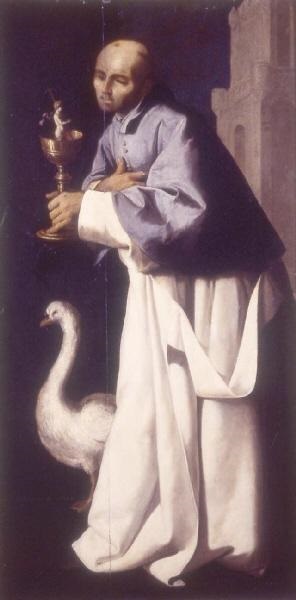
File:San hugo obispo de lincoln.jpg

St Hugh with his emblems of the swan and the Christ Child emerging from the chalice.
Francisco Zurbarán, 1637-39
Museo de Cadiz

Image: Wikipedia

http://www.regnumnovum.com/wp-content/uploads/2010/10/appearance-of-madonna-with-child-to-st-bruno-and-st-hugo-4006-mid.jpg

The Virgin and Child with St Bruno and St Hugh of Lincoln.
Sebastiano Ricci, 1704-06
Private collection

Image: regnumnovum.com


Wednesday, 17 November 2010

St Hugh of Lincoln


Today is the feast of St Hugh of Lincoln, Carthusian saint and Bishop of Lincoln 1186-1200. There is a biography here.


Saint Hugh of Lincoln with his swan,
Altarpiece from the Carthusian monastery of Saint-Honoré, Thuison, near Abbeville, France, ca 1490-1500
Art Institute of Chicago


St Hugh's holds one of his attributes, the Christ Child rising from the chalice, alluding to a vision he had. There are other recorded examples of such visions at his time, suggesting a concern for the reality of the Real Presence and Transubstantiation.

His other, better known attribute is the swan. This was a fierce swan which lived at the episcopal manor at Stow in Lindsey but which was a docile pet to the saint, followed him around and watched over him when he was asleep.

St Hugh's stole is preserved at the Carthusian house at Parkminster in Sussex. It was on display at Lincoln in 1986 as part of the octocentenary celebrations. His body is thought to still lie somewhere within the cathedral at Lincoln, where a curious bronze superstructure has been added in recent years to the remains of the base of the shrine of St Hugh's Head in the Angel Choir.

St Hugh was the principal saint of Lincoln cathedral and seen as role model for his successors. This can be seen in their referenc eto him bu adding his arms to their monuments in the cathedral. In the case of Bishop Fleming - "my bishop" - the fact that Fleming developed close links with the Carthusian order whilst Bishop of Lincoln, and that John Stone, the Carthusian of Sheen when he wrote his Metrificatio around Fleming's own tomb verses went so far as to ascribe Fleming's failure to be translated to the see of York in 1424-5 as being due to the intervention of St Hugh.

Wednesday, 8 September 2010

Our Lady of Lincoln

Today being the feast of the Nativity of Our Lady seems an appropriate day on which to post a view of one of the greatest churches built to her honour, the cathedral at Lincoln. Although I do not subscribe to the urge to list or decide which is the best amongst cathedrals or other works of art, I do consider Lincoln to be in many respects ina class of its own amongst English cathedrals, or indeed European ones.
This image is from the Churchmouse site about the cathedral, and is one of my favourite images of one of my favourite buildings.

Lincoln Cathedral (before 1808), Watercolour by Augustus Charles Pugin (1762-1832). Whitworth Art Gallery, University of Manchester.


Lincoln Cathedral

Watercolour by Augustus Charles Pugin (1762-1832)
Whitworth Art Gallery, University of Manchester.


The painting, by the father of the great architect, shows the cathedral before the removal of the spires on the western towers in 1807.

It appears likely that the towers and their spires were being completed about the time of the episcopate of Bishop Richard Fleming, which adds to the interest of the picture for me. However its real attraction is less academic - I simply think it is a beautiful painting of a beautiful building - itself one of the truly great works of medieval man. I regret, of course, that I cannot myself see the cathedral complete with its spires, but thanks to A.C.Pugin I can more easily envisage it. As a painting it captures an ethereal quality about the cathedral which I find particularly attractive. It is very much a case of dreaming spires and the last enchantments of the middle ages.