Once I was a clever boy learning the arts of Oxford... is a quotation from the verses written by Bishop Richard Fleming (c.1385-1431) for his tomb in Lincoln Cathedral. Fleming, the founder of Lincoln College in Oxford, is the subject of my research for a D. Phil., and, like me, a son of the West Riding. I have remarked in the past that I have a deeply meaningful on-going relationship with a dead fifteenth century bishop... it was Fleming who, in effect, enabled me to come to Oxford and to learn its arts, and for that I am immensely grateful.


Showing posts with label St Hugh of Lincoln. Show all posts

Sunday, 18 November 2012

A Cloud of Witnesses


The last couple of days have been replete with saints to commemorate, and I thought I would give the links to the posts I published last year about them for those readers who may not have seen them then, or for whom they are new.

So for Friday there is this post about St Margaret of Scotland and also one about St Edmund of Abingdon.

For yesterday there are posts about St Hilda and Whitby, St Hugh of Lincoln and St Elisabeth of Hungary.

May they all pray for their particular patronages and for all who seek their intercession.

Thursday, 17 November 2011

St Hugh of Lincoln


Today is the feast of St Hugh of Lincoln, the Carthusian who was bishop of the diocese from 1186 until his death in 1200. My post from this day last year can be read at St Hugh of Lincoln.

http://i1044.photobucket.com/albums/b448/ammiemac/SHugh-Shrine-Sept05-DC4799s.jpg

The surviving base of the shrine of St Hugh's head in the Angel Choir of Lincoln Cathedral.
The Angel Choir was built as the setting for the shrine of St Hugh's body and head between 1256 and 1280.
The metal superstructure is a piece of highly misguided, even if well-intentioned, 1980s artwork.

Image:historicalfictiononline.com

St Hugh was the second Carthusian to be canonised, following the founder of the order, St Bruno. The impetus for Hugh's cause came not from the Order, which disdained to promote such matters, but from the reverence he had received from the wider Church, both clerical and lay.

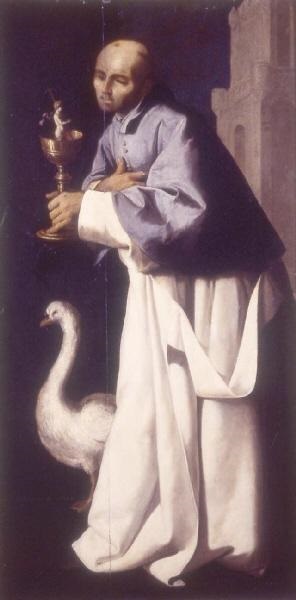
As thefollowing pictures show devotion to him survived on the continent after the reformation in England.

File:San hugo obispo de lincoln.jpg

St Hugh with his emblems of the swan and the Christ Child emerging from the chalice.
Francisco Zurbarán, 1637-39
Museo de Cadiz

Image: Wikipedia

http://www.regnumnovum.com/wp-content/uploads/2010/10/appearance-of-madonna-with-child-to-st-bruno-and-st-hugo-4006-mid.jpg

The Virgin and Child with St Bruno and St Hugh of Lincoln.
Sebastiano Ricci, 1704-06
Private collection

Image: regnumnovum.com


Wednesday, 17 November 2010

St Hugh of Lincoln


Today is the feast of St Hugh of Lincoln, Carthusian saint and Bishop of Lincoln 1186-1200. There is a biography here.


Saint Hugh of Lincoln with his swan,
Altarpiece from the Carthusian monastery of Saint-Honoré, Thuison, near Abbeville, France, ca 1490-1500
Art Institute of Chicago


St Hugh's holds one of his attributes, the Christ Child rising from the chalice, alluding to a vision he had. There are other recorded examples of such visions at his time, suggesting a concern for the reality of the Real Presence and Transubstantiation.

His other, better known attribute is the swan. This was a fierce swan which lived at the episcopal manor at Stow in Lindsey but which was a docile pet to the saint, followed him around and watched over him when he was asleep.

St Hugh's stole is preserved at the Carthusian house at Parkminster in Sussex. It was on display at Lincoln in 1986 as part of the octocentenary celebrations. His body is thought to still lie somewhere within the cathedral at Lincoln, where a curious bronze superstructure has been added in recent years to the remains of the base of the shrine of St Hugh's Head in the Angel Choir.

St Hugh was the principal saint of Lincoln cathedral and seen as role model for his successors. This can be seen in their referenc eto him bu adding his arms to their monuments in the cathedral. In the case of Bishop Fleming - "my bishop" - the fact that Fleming developed close links with the Carthusian order whilst Bishop of Lincoln, and that John Stone, the Carthusian of Sheen when he wrote his Metrificatio around Fleming's own tomb verses went so far as to ascribe Fleming's failure to be translated to the see of York in 1424-5 as being due to the intervention of St Hugh.