


As today, being Candlemas, is the annual feast day of Oriel it seems a very appropriate day on which to post about Master James of Spain. Who he? Well now...
You know how some friends keep reappearing in your life, often over many years. Even if you do not spend a lot of time with them, or know them that well, they are always there as figures in the landscape. One such for me is Master James of Spain.
I should, perhaps, point out that Master James died in 1331, but I first encountered him in the 1960s in my home town of Pontefract. He is listed, as James of Ispania, as Dean of the College of St Clement in Pontefract castle. He sounded interesting - what was a Spaniard doing in late thirteenth century England as a cleric? Then in the mid 1970s I found him as a canon of York Minster in the volume of York Minster Fasti which described him as an illegitimate son of King Alfonso X of Castile. Even more intriguing.
In October 1993 in my first week or so at at Oriel I read an essay by that great Oriel historian W.A. Pantin in The English Church and the Papacy that informed me that it was this same James of Spain who had given the house La Oriole to the college, and hence its name of Oriel, in 1329.
This led me later to Emden's Biographical Register of the University of Oxford to 1500 which has a biography and again asserts that James was the illegitimate son of King Alfonso X, who is himself a fascinating figure.
When the Obit Roll for the chapel at Oriel was being revised I managed to get James' aunt, Queen Eleanor, the consort of King Edward I, restored to it - in return for the gift of La Oriole the College added both the late Queen and James to those who participated in the spiritual benefits of membership of the foundation.
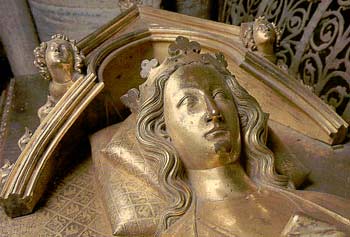
Queen Eleanor of Castile
Tomb effigy in Westminster Abbey
Image: Lady Shirley on Flickr
I did some further research on Master James, and gave atalk to the Oriel history students group, the Pantin Society. In 2005 I wrote up my research for The Oriel Record. Unfortunately it was deemed too long and I was asked to cut it. I did something of a hatchet job on it - but that was too long as well, so my draft article ' Master James of Spain: The Bastard without whom Oriel would not be Oriel' remained just that, an unpublished draft.
As I looked at his career, and what was known of King Alfonso X's illegitimate children, of whom several are known to his modern biographer, but not, significantly, including Master James, and the question as to why he had made his life in England, apart from one recorded visit to Castile as a middle-aged man, I came to the view that his father was King Alfonso and Queen Eleanor's brother, the Infante Henry (1230-1303), who spent a few years in England from 1256 until 1259. There is an online biography of the Infante - whose life is worthy of a medieval Romance, or worse, a modern historical novel, at Henry of Castile the Senator
Following his capture at the battle of Tagliacozzo in 1268 he was a political prisoner in the kingdom of Naples until 1291, despite the efforts of Queen Eleanor, who died in 1290, to obtain his release. Here then is the explanation for her concern for her illegitimate nephew's life in Oxford. La Oriole was one of the finest houses in the town and james cearly enjoyed life there, supported by various benefices and sinecures in governmental posts.

The arms of the Infante Henry the Senator
Image: Wikipedia

Oriel in 1566
This is the earliest depiction of the college, and shows the buildings on the site of Master James of Spain's house La Oriole, but they were later in date than James' time. The site was completely rebuilt as front Quad in 1620-40.
Image: bodley30.bodley.ox.ac.uk
Oriel at top left, with St Mary's Hall between it and St Mary's church. The original home of the college was in Tackley's Inn, facing the High, and on the right of the picture.
From Ralph Agas' Map of Oxford of 1578
Image:marcus-beale.com
Now, and when I was thinking, at afriend's urging, about finding another publisher for my article draft Master James turns up again quite by accident on the computer in what may well be the definitive account of his life. I have not so far had the opportunity to look at the book, but it appears to have the same theory as to his father's identity. An online feature entitled Author of 14th-century treatise revealed (Tuesday 4 August 2015) is as follows:
Professor Margaret Bent’s new book, Magister Jacobus de Ispania, Author of the Speculum musicae (Ashgate/RMA Monograph Series) argues that the author of the largest medieval treatise on music was not Jacques de Liège, as previously thought, but ‘Magister Jacobus de Ispania’. Professor Bent draws on new documentary evidence to investigate who this Jacobus might have been, enhancing our understanding of the geography and influences that played into this central document of medieval music theory.

Image: Amazon
Floreat Oriel


