Once I was a clever boy learning the arts of Oxford... is a quotation from the verses written by Bishop Richard Fleming (c.1385-1431) for his tomb in Lincoln Cathedral. Fleming, the founder of Lincoln College in Oxford, is the subject of my research for a D. Phil., and, like me, a son of the West Riding. I have remarked in the past that I have a deeply meaningful on-going relationship with a dead fifteenth century bishop... it was Fleming who, in effect, enabled me to come to Oxford and to learn its arts, and for that I am immensely grateful.


Showing posts with label King Henry IV. Show all posts

Sunday, 16 July 2017

The Coronation of King Richard II


Today is the 640th anniversary of the coronation of King Richard II in Westminster Abbey on July 16 1377.

The chronicler of St Albans Abbey Thomas Walsingham wrote of it as "a day of joy and gladness.... the long-awaited day of the renewal of peace and of the laws of the land, long exiled by the weakness of an aged king and the greed of his courtiers and servants" - as translated in May McKisack The Fourteenth Century.

The most recent piece on the occasion appears to be by Andrew Spencer 'The Coronation Oath in English Politics 1272-1399' in B.Thompson and J.Watts (eds) Political Society in Later Medieval England: A Festschrift for Christine Carpenter ( Boydell 2015 ) which can be accessed here

As Spencer points out Walsingham recorded that although only the magnates could hear the boy king assent to the Coronation Oath Archbishop Sudbury, preceded by the Marshal, repeated it to all in Abbey, asking if would accept to be so ruled.

The rubrics were revised to stress the authority of the monarch and the touching of the Crown of St Edward  by the peers when they made their homage glossed as indicating their responsibility to support the Crown.

The ceremony was a long one and at the end the ten and a half year old King had to be carried from the Abbey to his Coronation banquet in Westminster Hall in the arms of Sir Simon Burley his tutor. This story is perhaps the beginning of the emergence of Burley and what may be his 'myth' - whether Sir Simon was just the devoted retainer of the boy King's father who was  consequently dear to the monarch who tried to save him in 1388 from the Lords Appellant is a topic historians are nowadays questioning.

It was probably at this point that the King lost one of his ceremonial slippers, which came to be seen as a bad omen - but such mishaps do occur and may be no more than that, and secondly such are the things people remember; King Charles I's choice of wearing all white to his coronation became seen as a forecast of his future status as the Royal Martyr, the King in White who reigned in the Isle of Wight, or the fact that a large precious stone fell out of King George III's crown at his coronation was remembered when the American colonies rebelled.


The most recent work on the Wilton Diptych suggests that the crown the King is depicted wearing may indeed be the one he wore for the recess from the Abbey, and that it was one that had been made for the youthful King Edward III.
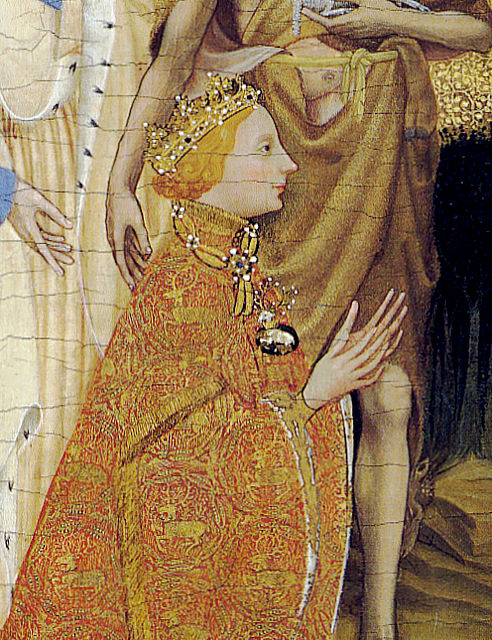
Image result for Richard II Wilton Diptych

King Richard II as he may have appeared at his Coronation in 1377
From the Wilton Diptych painted in 1397

Image:ReedDesign


Apart from the impact on those who witnessed it the most important question that arises is probably that of the impact upon the young King Richard himself. Westminster remained central to his personal spirituality and to the spirituality of his kingship, the shrine of St Edward and the recipient of his patronage, including the portrait of him presiding in Parliamentary robes with his regalia which still survives in the Abbey. Here too the crown, identical to that on the tomb effigy of his supplanter and successor King Henry IV at Canterbury, is clearly a depiction of a real item, not just an artistic convention. Shakespeare's dramatic account of the events of 1398-9 quite rightly stresses the imagery and discourse of Kingship and Deposition and central to that is the status of King Richard II as an anointed crowned monarch. That complex narrative was played out in and around Westminster over the following twenty two years, and symbolically at least it began with the rich ceremonial of this day in 1377.



Thursday, 6 July 2017

Jousting


There is an article on the Daily Telegraph online website about the degree of fitness that was required for a medieval jouster, and comparing it with that of modern athletes.

It can be read in two versions at Study reveals jousters are as fit as today's top athletes and at What it takes to be a jouster, the fittest sportsman of them all

It confirms what I have always suspected, that the men who competed in the lists, Kings and princes, aristocrats and knights, were physically very fit indeed. That it was in part training for warfare - just as modern equestrian sports derive from military training in more recent centuries for the cavalry - as indeed was hunting, is true, but, as with the chase, some practitioners were keener and more committed than others, and may well have spent a great deal of time training and keeping physically fit. It was not a hobby you could just indulge in without considerable, and expensive, preparation.

King Henry IV was a noted jouster in the 1390s and McNiven argues in a well-known article which seeks to give an analysis of the King's health, and its decline from fairly soon after his accession, that the King may have suffered from being unable to maintain his customary level of fitness but put on weight and that like some modern athletes suffered health problems as a consequence of his enforced idleness of retirement from physical competition.

It has also been suggested that King Henry VIII's last years were shaped in part by the consequences of injuries he had received  in the lists or conditions which developed as a result of jousting. Robert Hutchinson has written about this in The Last Days of Henry VIII:Conspiracies, Treason, and Heresy at the Court of the Dying Tyrant

That said, of course, both these English Kings came off better that King Henri II of France who died as a result of a joust in 1559. No amount of fitness can prepare you for something like his fate.


Saturday, 15 April 2017

The birth of Henry of Bolingbroke


Today is the 650th anniversary of the birth of the future King Henry IV at Bolingbroke Castle in Lincolnshire. At that time he was heir to the vast estates of the Dukes of Lancaster, and in line of succession to the Crown, but his accession in 1399 could not have been expected.

His parents were John of Gaunt, Duke of Lancaster and his first wife Blance of Lancaster. There is an online account of her life here. Blanche died the following year so young Henry would have had no memory of her. The link about his mother details his siblings, of whom two elder sisters lived but three brothers and another sister died in infancy.


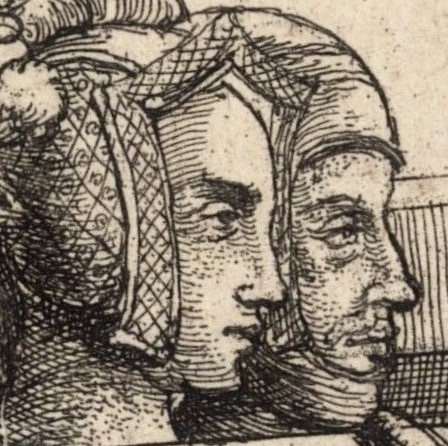
 Tomb of John of Gaunt and Blanche of Lancaster.jpg

Blanche of Lancaster and John of Gaunt
The effigies on their tomb in St Paul's Cathedral, as depicted in 1658 by Wenceslaus Hollar. The tomb itself was built between 1374 and 1380, and destroyed in the Great Fire in 1666. Anachronistic inaccuracies include Blanche's early 16th-century-style gable-headress, although that might be a result of renovation in the time of King Henry VII, and is not that dissimilar to the headress worn by Queen Philippa on her tomb at Westminster

Image Wikipedia

http://www.english-heritage.org.uk/content/properties/bolingbroke-castle/portico/bolingbroke-castle-aerial

Bolingbroke Castle

Image: english-heritage.org.uk

The castle was built by the Earl of Chester c.1220 to a typical thirteenth century plan and survived until it was demolished in 1652. Today only foundations remain and the moat is no longer water-filled. There is more about its history at History of Bolingbroke Castle | English Heritage and at Bolingbroke Castle

Image result for bolingbroke castle


The plan of the castle

Image: english-heritage.org.uk 


Image result for bolingbroke castle 

A reconstruction of the castle in the fifteenth century

Image: Black Powder blogger 

 http://www.bolingbrokecastle.com/wp-content/uploads/2014/11/bolingbrokecastle.jpg

A reconstruction of the gatehouse

Image:bolingbrokecastle.com 

https://community.lincolnshire.gov.uk/images/Community/466/bolingbroke_castle_by_weir_1820.jpg

The last standing fragment of the castle before its collapse

Image:lincolnshire.gov.uk

The castle at Bolingbroke was not one of the principal residences of the Dukes of Lancaster like Hertford, Kenilworth, Leicester and Pontefract, and that may be why it was chosen for the Duchess' lying-in, as somewhere quiet and tranquil.  Similar reasoning may explain the popularity of the manor house at Woodstock for the birth of royal children.

1n 1367 April 15th was Maundy Thursday and as Ian Mortimer points out in his very readable biography of the King The Fears of Henry IV this has resulted in uncertainty as to his actual birth in that Henry tended to mark the anniversary on Maundy Thursday however it fell by the calendar. It has also in consequence, Mortimer suggests, resulted in the practice at the Royal Maundy of English monarchs performing the pedelavium and giving alms to as many poor people as they have years, as opposed to the practice in other realms, and as in the Papacy and ecclesiastical communities, of just chosing thirteen after the Gospel accounts of the Last Supper.


Wednesday, 19 February 2014

Archbishop Thomas Arundel


Today is the 600th anniversary of the death of Archbishop Thomas Arundel of Canterbury.


  Thomas Arundel (1353–1414) illuminated initial

Archbishop Thomas Arundel
The Archbishop is surrounded by monks of the cathedral priory at Canterbury or members of his archiepiscopal household.
Image: oxforddnb.com


Born in 1352 he studied at Oxford, and lived in Oriel, where he and his father, the Earl of Arundel, built the college chapel as an expression of their thanks. Leaving Oxford he was appointed in 1373 as Bishop of Ely at 21 - his youthfulness led the Pope to comment about him being the youngest episcopal appointment he was aware of - then, in 1388, Archbishop of York. He served as Lord Chancellor and was a significant political figure in the 1390s, until his translation to Canterbury in 1396, exile the following year and return with Henry of Lancaster in 1399, serving again as Chancellor twice under King Henry IV.

An aristocrat to his fingertips he was also able and conscientious as an administrator, and was to prove a resolute defender of the Catholic Church against Lollardy. His death was as a conseqence of a stroke which might have been triggered by his exertions in the preceding weeks in suppressing the Lollard Rising of 1414.

In late 1408 he had caustic things to say about the subject of my research, Richard Fleming and his associates in Oxford whom the Archbishop saw as supporting Lollardy even if only by resisting his authority to visit the University to root out the problem at its source.

The Oxford DNB life of Arundel by Jonathan Hughes can be read here. The 1885 DNB life by James Gairdner can be read at Thomas Arundel, Archbishop of Canterbury and there is another online biographical account, with links to other sites, at Thomas Arundel.

His formal constitutions against the Lollards issued in1408 can be read in translation at Archbishop Thomas Arundel's Constitutions against the Lollards.


The nave of Canterbury Cathedral, completed under Archbishop Arundel about 1405.
His tomb was in the third bay from the east on the north side, just in front of the present pulpit, until it was destroyed by Cranmer in 1540.

Image:paradoxplace.com


The tomb of King Henry IV and Queen Joanna in Canterbury Cathedral.
Archbishop Arundel helped place the King in power and crowned him in 1399, and served him as Chancellor and advisor for much of his reign.

Image:paradoxplace.com

Wednesday, 20 March 2013

The death of King Henry IV


Today is the anniversary of the death 600 years ago of King Henry IV on March 20th 1413


http://www.anglophile.ru/uploads/posts/2012-06/1340705763_queens-50.jpg

King Henry IV

The head of the effigy on his tomb in Canterbury Cathedral

Image: anglophile.ru

The King, who had been in poor or indifferent health for several years collapsed whilst visiting the shrine of St Edward the Confessor at Westminster Abbey and was taken to the Jerusalem Chamber in the Abbot's house. When told that it was so named the King recalled that it had been prophesied that he would die in Jersusalem, which he had hitherto taken as a sign that he would die on Crusade in the Holy Land.

http://d28x33bn4x2mjg.cloudfront.net/assets/thumbnail/0008/49913/Jerusalem-Chamber-looking-s-72-Westminster-Abbey-copyright.jpg 

The Jerusalem Chamber as it is today

Image;westminster-abbey.org


http://home.gwu.edu/~jhsy/henry4-profile.jpg

The effigy of King Henry IV in profile- it suggests  a tired, careworn man

Image:home.gwu.edu

The scene of the King's deathbed is the occasion for Shakespeare in King Henry IV Part II Scene IV to examine the tensions between the King and his heir the Prince of Wales, centred on the Prince, believing his father to have died, taking the crown which had been placed by his father's pillow, and leaving, and the King, upon waking, imagining his son as being anxious for his death and the succession. How close this is to the facts of history is not clear. It can be seen as Shakespeare providing a dramatic version of the political tensions which had existed between father and son, and indeed between the Prince and his brother Thomas, Duke of Clarence, in the years since 1411 at least, exacerbated by the King's illness - which is suggested by Dr Peter McNiven in an article in the English Historical Review to have been progressively chronic heart trouble, sapping the energy of a hitherto active and fit man who died at the age of 46. 

However the various stories of Prince Henry's youthful indiscretions appear to be perhaps more than just sixteenth century dramatic licence but based on traditions handed down by the family of the Earls of Ormonde, who had been one of his intimates.

What does seem attested is that whatever rebelliousness of spirit, or impatience to take charge of government the Prince had, perhaps understandably, shown was now disciplined into that steeliness of purpose that was to mark him out as King Henry V, and to which Shakespeare indeed alludes in the two plays about the reign of his father. Following the death of the old King his son went that same night to confess to the anchorite attached to the abbey in a cell to the south of the choir and spent the night there in prayer. The remains of the cell were rediscovered after the Second World War. Writers contemporary with the young King bear witness to the disciplined, prayerful and chaste life he lived from his accession onwards. So began the reign of King Henry V.


http://upload.wikimedia.org/wikipedia/commons/thumb/3/31/King_Henry_V.jpg/552px-King_Henry_V.jpg

King Henry V


Image: Wikimedia