Once I was a clever boy learning the arts of Oxford... is a quotation from the verses written by Bishop Richard Fleming (c.1385-1431) for his tomb in Lincoln Cathedral. Fleming, the founder of Lincoln College in Oxford, is the subject of my research for a D. Phil., and, like me, a son of the West Riding. I have remarked in the past that I have a deeply meaningful on-going relationship with a dead fifteenth century bishop... it was Fleming who, in effect, enabled me to come to Oxford and to learn its arts, and for that I am immensely grateful.


Showing posts with label King Richard II. Show all posts

Friday, 14 February 2025

The death of King Richard II in 1400


February 14th is often given as the date of the death of the deposed King Richard II iin Pontefract Castle in 1400.  If that is correct then today is the 625th anniversary of that event. However if his body was publically displayed in St Paul’s in London on February 17th that would surely suggest a slightly earlier date for his death to have occurred to allow for the transportation of his body from Pontefract.

File:Richard II King of England.jpg

King Richard II
From the Westminster Abbey portrait

Image: Wikipedia 

As to what happened in the castle at Pontefract there is little hard evidence. 

The somewhat cryptic references in the Privy Council records to the former monarch in the wake of the failure of the Epiphany Plot to restore him to the throne yield little beyond that there was concern for the security of the prisoner at Pontefract and clearly rumours or reports were circulating. 

Starvation was alleged at the time as the cause of his death. The new government claimed he fell into depression and refused to eat until it was too late. This is not impossible, and might parallel the later instance of the insanity which seemingly gripped the Empress Charlotte of Mexico when in Rome in 1867.

The opponents of King Henry IV, such as Archbishop Scroogein 1405, charged the King with wilfully starving his predecessor to death.. They may, in addition, have had the allegedly similar fate of the Scottish heir, David Duke of Rothesay, in 1402 in mind.

If faced by an emergency one wonders why his keepers would wait a week to a fortnight, or maybe longer assuming that the patron of The Forme of Cury was well nourished, in an age when everyone carried a dagger and a probably a sword, unless they scrupled to spill the blood royal. Smothering as with the Duke of Gloucester in 1397, and quite possibly or probably the Princes in the Tower in 1483 would be quicker and not leave visible wounds.

The tradition of a violent bloody assault on the prisoner is the tradition of the-contemporary French chroniclers. With his marriage to the child Queen Isabel, daughter of King Charles VI there was interest in his fate and hostility to the new King from leading French figures, such as the Duje of Orleans, as well as the m longstanding view of English as regicicdal now reinforced all the more.

Shakespeare used this tradition in his play and by 1634 visitors to Pontefract were shown cuts on a pillar around which his “barbarous murderes” forced their victim to flee as they struck him down. This is the earliest specific reference to such a feature. It may have been in the Round Tower, the keep, clearly visible on the left in the picture below.

A couple of small rooms, one on the ruined entrance level of the Round Tower and the other the base of the adjacent Gascoigne Tower, being still recognisable as rooms have been pointed out on occasion since the early nineteenth century as ‘King Richard’s Cell’ but only I suspect because they were recognisable as rooms of a cell like nature. It is perhaps more likely he was kept in a larger part of the Round Tower, built as recently as 1374-78, and innermost part of the castle, or in part of the main residential apartments on the north east side of the main enclosure.

In 1530 the newly arrested Cardinal Wolsey asked, upon seeing the castle in the distance if he was being taken there to die “like a beast”, which might also refer to the fates of Rivers, Grey and Vaughn in 1483. Shakespeare gives Rivers lines referring to the castle as the scene of the 1409 regicide. Wolsey need not have worried, being lodged overnight at the neighbouring Cluniac priory.

A further weakness in Shakespeare’s version is the absence from the historical record of Sir 
Piers of Exton. The theory to explain him is that  he may be a misreading of Sir Peter Bukton, who is recorded. 

However the dramatic image of a death dealing blow to the royal skull was disproved when the grave at Westminster was opened in 1871. Although possessed of a thin nature the cranium was undamaged.

At the time the Constable of the castle was Sir Thomas Swynford, the new King’s step-brother, and the Steward of the Honour of Pontefract was Robert Waterton, who had been instrumental in meeting Bolingbroke at Spurn.the previous June. I wrote about him in a post last month at Robert Waterton. 

These were two men with everything to win or lose on the detention or final removal of Richard of Bordeaux.

When there were rumours that he had escaped and lived in Scotland as Thomas Ward until he died in 1419 and was buried in the Dominican house in Stirling one is reminded of the Danish False Okuf of 1402, the careers of Lambert Simnel and Perkin Warbeck, of the various false Kings Sebastian in Portugal after 1578, the false Ivan VI in eighteenth century Russia and of Anna Anderson in the twentieth century. When asked about such rumours in 1404 Waterton categorically assured Parliament that Richard was definitely dead - and left it at that. Interestingly he was to include King Richard II his intentions for those to be prayed for at his chantry at Methleyin his will of 1425. He must surely have known more than most ast o what happened on his watch in 1400.


Pontefract Castle in the 1630s

Image: Wakefield City Museum s/ Blogging 4 History

Ii have not yet read Helen Castor’s widely acclaimed joint biography of King Richard and King Henry The Eagle and the Hart. I have seen  her give excellent online seminars and interviews about her work on the two monarchs.

Last year I read Marie Louise Bruce’s  Usurper King which, despite its slightly sensational title and somewhat uninspired cover, attempts the same type of biography and was, I thought, well worth reading. 

Whatever his strengths and failings, his virtues and vices, and he was a complex man in so many ways, gifted yet flawed, one can at least pray for the repose of the soul of King Richard II. 


Sunday, 16 July 2017

The Coronation of King Richard II


Today is the 640th anniversary of the coronation of King Richard II in Westminster Abbey on July 16 1377.

The chronicler of St Albans Abbey Thomas Walsingham wrote of it as "a day of joy and gladness.... the long-awaited day of the renewal of peace and of the laws of the land, long exiled by the weakness of an aged king and the greed of his courtiers and servants" - as translated in May McKisack The Fourteenth Century.

The most recent piece on the occasion appears to be by Andrew Spencer 'The Coronation Oath in English Politics 1272-1399' in B.Thompson and J.Watts (eds) Political Society in Later Medieval England: A Festschrift for Christine Carpenter ( Boydell 2015 ) which can be accessed here

As Spencer points out Walsingham recorded that although only the magnates could hear the boy king assent to the Coronation Oath Archbishop Sudbury, preceded by the Marshal, repeated it to all in Abbey, asking if would accept to be so ruled.

The rubrics were revised to stress the authority of the monarch and the touching of the Crown of St Edward  by the peers when they made their homage glossed as indicating their responsibility to support the Crown.

The ceremony was a long one and at the end the ten and a half year old King had to be carried from the Abbey to his Coronation banquet in Westminster Hall in the arms of Sir Simon Burley his tutor. This story is perhaps the beginning of the emergence of Burley and what may be his 'myth' - whether Sir Simon was just the devoted retainer of the boy King's father who was  consequently dear to the monarch who tried to save him in 1388 from the Lords Appellant is a topic historians are nowadays questioning.

It was probably at this point that the King lost one of his ceremonial slippers, which came to be seen as a bad omen - but such mishaps do occur and may be no more than that, and secondly such are the things people remember; King Charles I's choice of wearing all white to his coronation became seen as a forecast of his future status as the Royal Martyr, the King in White who reigned in the Isle of Wight, or the fact that a large precious stone fell out of King George III's crown at his coronation was remembered when the American colonies rebelled.


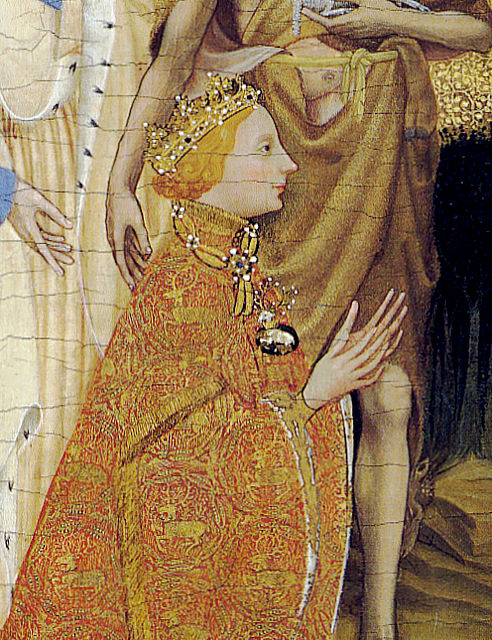
The most recent work on the Wilton Diptych suggests that the crown the King is depicted wearing may indeed be the one he wore for the recess from the Abbey, and that it was one that had been made for the youthful King Edward III.

Image result for Richard II Wilton Diptych

King Richard II as he may have appeared at his Coronation in 1377
From the Wilton Diptych painted in 1397

Image:ReedDesign


Apart from the impact on those who witnessed it the most important question that arises is probably that of the impact upon the young King Richard himself. Westminster remained central to his personal spirituality and to the spirituality of his kingship, the shrine of St Edward and the recipient of his patronage, including the portrait of him presiding in Parliamentary robes with his regalia which still survives in the Abbey. Here too the crown, identical to that on the tomb effigy of his supplanter and successor King Henry IV at Canterbury, is clearly a depiction of a real item, not just an artistic convention. Shakespeare's dramatic account of the events of 1398-9 quite rightly stresses the imagery and discourse of Kingship and Deposition and central to that is the status of King Richard II as an anointed crowned monarch. That complex narrative was played out in and around Westminster over the following twenty two years, and symbolically at least it began with the rich ceremonial of this day in 1377.


Friday, 6 January 2017

Birth of King Richard II


On January 6th 1367, 650 years ago, the future King Richard II was born in Bordeaux. He was the second son of Edward Prince of Wales and his wife Joan of Kent.

Their elder son, Edward of Angoulême, born in 1365 died in 1370, and thus Richard became heir to the throne after his father. There is a useful online account of the elder brother at Edward of Angoulême ( though I think few now believe the idea that he is depicted in the Wilton Diptych as the Christ Child ) and more about his date of death at Edward of Angoulême.

Image result for Wilton Diptych

King Richard II from the Wilton Diptych

Image:ReedDesign

This day is, of course the feast of the Epiphany and imagery of the Magi figured in later orations to Richard as well, by implication, in the Wilton Diptych of 1397 (or thereabouts) which shows him with St Edward the Confessor and St Edmund in adoration of the Christ Child.

 http://reeddesign.co.uk/inspiration/images/wilton.jpg

The Wilton Diptych

Image:ReedDesign

The connotation of the link with the Magi was further brought out by the fact or tradition that three kings were present at Richard's baptism - those of Majorca, Armenia and the exiled ruler of Castile.
 
The presence of St John the Baptist in the Wilton Diptych and a saint to whom Richard showed especial devotion - as he records on the inscription he prepared for his tomb - is another link to the future king's birth and baptism. As his birth he was first named John by the midwives and only received the name Richard at his formal baptism, and the Epiphany is also the traditonal day on which the Baptism of Christ was recalled as well as the visit of the Magi and the miracle at Cana.

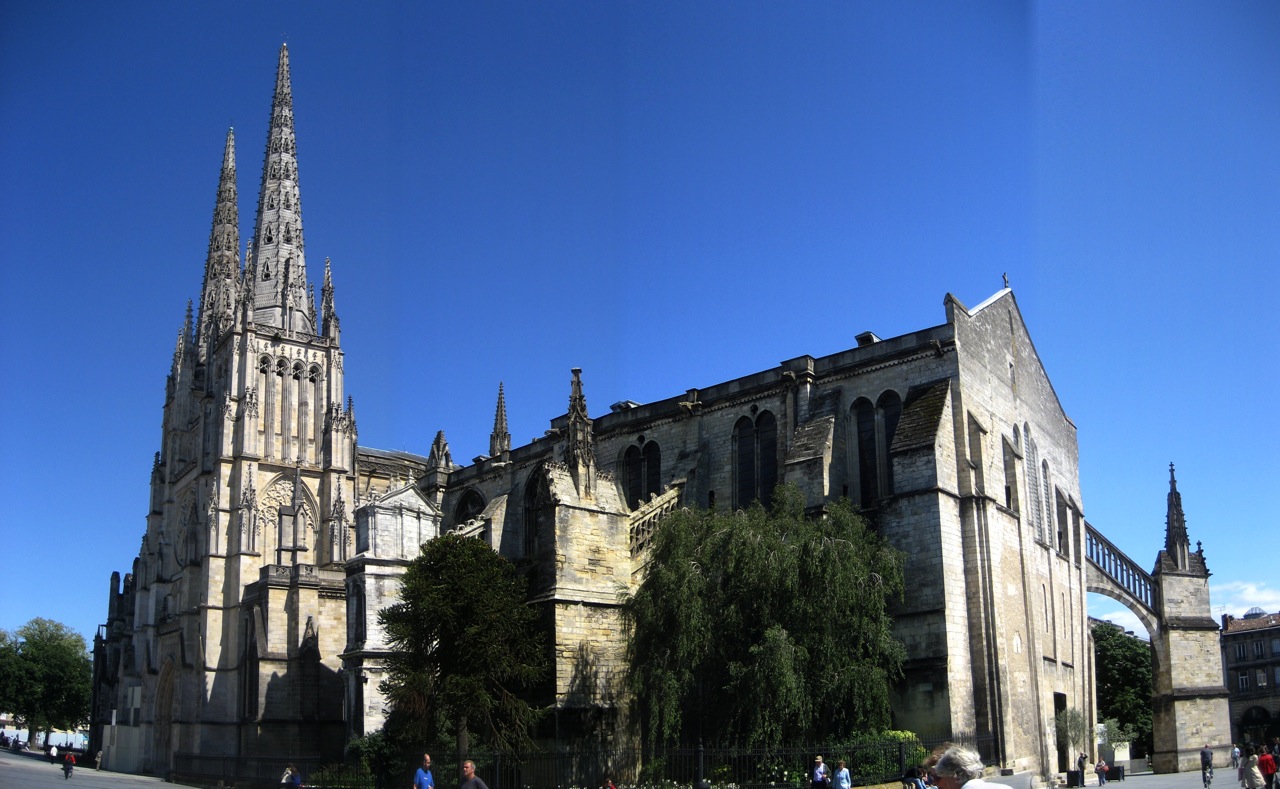
Richard was baptised in the cathedral of St Andre in Bordeaux

http://cdn.touropia.com/gfx/d/things-to-do-in-bordeaux/bordeaux_cathedral.jpg?v=1 

Bordeaux Cathedral from the north-east

Image: touropia.com 

 https://alllinedwithtrees.files.wordpress.com/2008/06/bordeaux_03.jpg
Bordeaux Cathedral from the north-west

Image: linedwithtrees.wordpress.com


The interior looking east


Image:Wikipedia


The interior looking west

 Image:Wikipedia 


There is an online account of the history and architecture of the cathedral, with a plan and photographs, here.

There are illustrated online accounts of the Ombrière, the administrative centre of English rule in Aquitaine - Guienne, at The Ombrière Palace and, in French, at Palais de l'Ombrière.

Friday, 6 May 2016

King Richard II


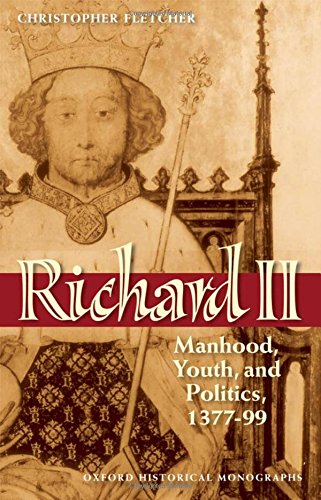
At Easter I managed to read Christopher Fletcher's Richard II: Manhood, Youth and Politics, 1377-99 ( Oxford Historical Monographs ). This is a superb book which I cannot commend too highly, and I felt rather ashamed that I had not read it before.


 Image: Amazon


Fletcher gives a very significant re-interpretation of the King's policy and aims, and of the reign in general. Those who do not know this fascinating period would probably need to read Nigel Saul's Richard II (Yale UP) or a similar narrative biography first, but Fletcher is certainly now essential reading to begin to assess the King and his reign.

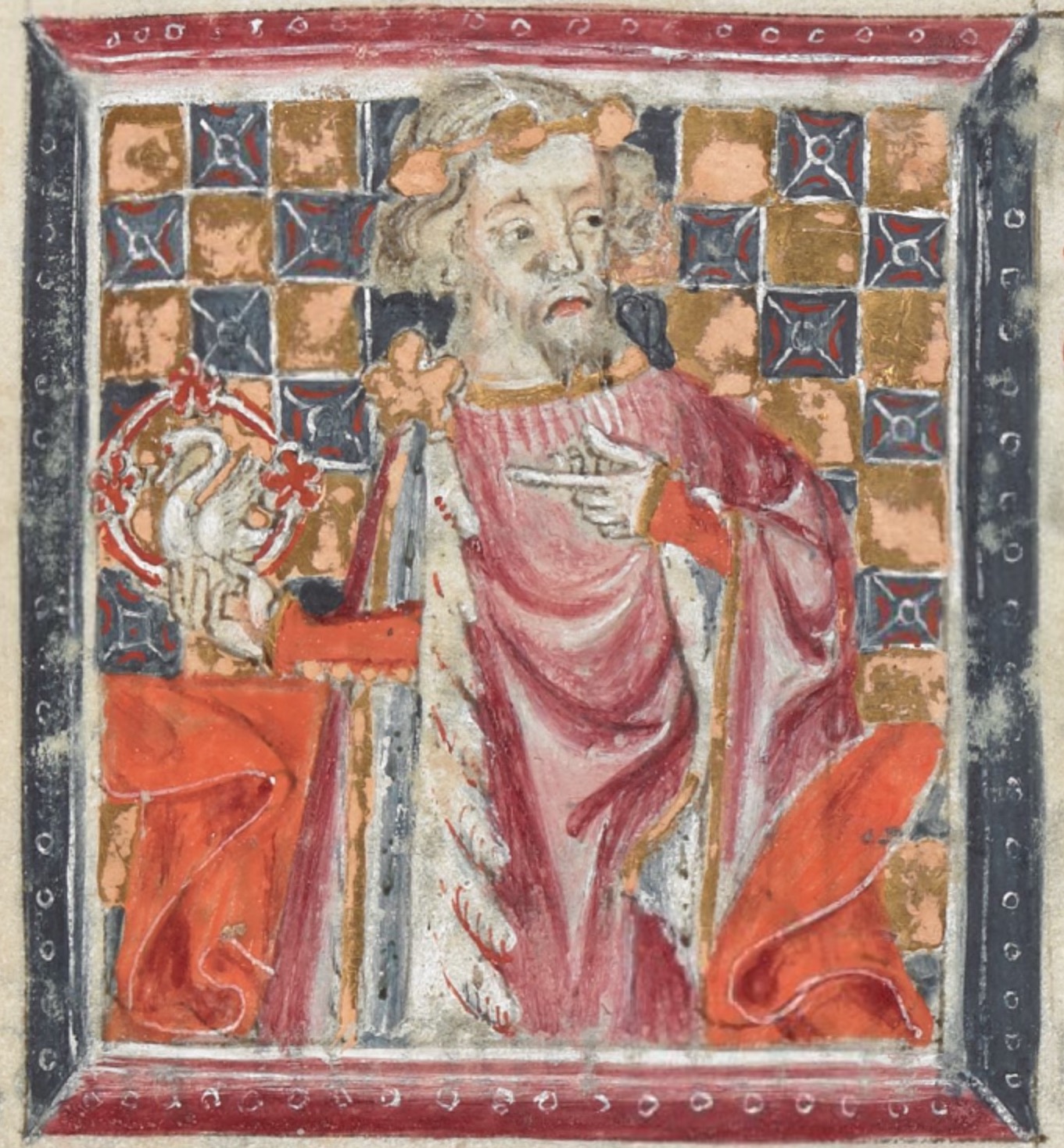
King Richard II was an image conscious monarch if he was nothing else, and this gives me the oportunity to post a photograph of one of the lesser known depiction of the King.  It is from a charter granted to Shrewsbury in 1389, and an image that has only become widely known ( if that yet indeed) in the last quarter of a century or so. This image relates, I suspect, to the use of Christ-like imagery to describe the King in 1392 at the time of his reconciliation with the city of London which Christopher Fletcher discusses in his book. 


Shrewsbury Charter
Shrewsbury Charter

Image:archivezone.org.uk
 This beautifully illuminated document is a royal charter granted by King Richard II in 1389.  In it he confirms the rights given to the people of Shrewsbury in an earlier charter of King Edward III.  The initial ‘R’ shows King Richard II and his wife, Anne of Bohemia.  Anne is depicted interceding with her husband on behalf of the people of Shrewsbury.
King Richard held parliament at Shrewsbury in 1398, probably in Shrewsbury Abbey, on Monday 28thJanuary.  Richard was not a popular king with all of his subjects, and it seems that many of the townspeople of Shrewsbury were none too pleased that he had chosen to move his entourage and court here.  The chronicler, Adam Usk, noted that ‘he paid nothing even for his provisions’.

[ Adapted from Shropshire Archives at archivezone.org.uk]

Monday, 3 March 2014

Buying books for the Oxford Union


I am a long standing member of the Library committee at the Oxford Union - almost fifteen years in two sessions - and I was asked recently to prepare a list of suggested books for the History list which we were to recommend for purchase to the membership this week.

My aim was to fill gaps in the collection. This was partly based on my recent teaching work this term, on what I felt would complete or continue series we already have and with the centenary of the outbreak of the Great War some relevant books about that. I also aimed for what would appeal to both students and to the the more general readers among the membership.  For these latter reasons I thought I would share it  with readers and recommend the books to them in case they are interestedin the topics covered. Apart from replacement copy of the text of a medieval chronicle the books I suggested - and which were accepted - are:   

J.F. Webb and D.H.Farmer (eds) The Age of Bede  Penguin Classics  
A valuable set of saints' lives in translation - including those of St Cuthbert and St Wilfrid


Michelle P. Brown  The Lindisfarne Gospels and the Early Medieval World  British Museum Publications   
This places the Gospels in their historic context of seventh and eighth century Britain.

Sarah Foot  Athelstan: The First King of England  Yale UP 
We collect the biographies in this established series, and this is an important book for historians working on the period; the other year I heard a wonderful lecture from the author, who is Regius Professor at of Ecclesiastical History at Christ Church, on the life of the King.

Edmund King King Stephen  Yale UP  

In the same series , and again an important work for understanding the Anarchy and twelfth century England.

David Abulafia The Western Mediterranean Kingdoms: The struggle for dominion 1200-1500 Routledge
 
A useful text book by a leading historian of the region and the period

Malcolm Vale The Origins of the Hundred Years War: The Angevin Legacy 1250-1340  OUP
It turned out I had missed this book which was already on the Union catalogue - I think I probably recommended it years ago. An excellent interpretive account . 

Christopher Fletcher Richard II: manhood, youth and politics 1377-1399  OUP
A potentially interesting reinterpretation of the reign in the light of the clash between the King and an older political elite, and questioning the depiction of him as effeminate.

Giles Tremlett Catherine of Aragon: Henry's Spanish Queen  Faber and Faber

The most recent biography of the Queen, by a British journalist based in Madrid.


Derek Beales  Joseph II:  Against the World 1780-1790  CUP  
We already have volume I of this major biography covering his life up to the death of his mother the Empress Maria Theresa in 1780.

Piers Paul Read The Dreyfus Affair   Bloomsbury 
I was given this as a birthday present the other year - a comprehensive account of one of the most divisive and significant events if the history of France since 1870.
          
Muriel E Chamberlain Pax Britannica? Britain's Foreign Policy 1789-1914  Pearson reprint
This ties in with some of the teaching I have been doing this term, and links foreign policy to domestic political and social dvelopments. 

R.J.W.Evans and H. Pogge van Strandmann (eds) The Coming of the First World War   OUP
A well established classic account by distingushed experts of the events leading up to 1914 

H. Afflerbach and D. Stevenson (eds) An Improbable War?: The Outbreak of World War I and European Political culture before 1914  Berghalen NY
Highly recommended by a student the book questions many received ideas about the war's causes, especially the notion of "inevitability."    
 

Greg King and Sue Woolmans The Assassination of the Archduke: Sarajevo 1914 and the murder that changed the World  Macmillan  
A new biography of the Archduke Franz Ferdinand and his wife, and of the fate of their family after the murders in 1914.Well illustrated and with new material from the Hohenburg family

I had hoped to include a secondhand copy of J.R.Strayer's The Reign of Philip the Fair, published by Princeton UP in 1980, but the affordable copy I found online had disappeared before I could submit the list to the Libraraian-in- charge. I shall have to keep looking out for this as it is the standard work in English on this very important figure and reign.

In addition I had been asked last week to look at Alec Ryrie Being Protestant in Reformation Britain  OUP and to advise on its possible purchase, it having been recommended by a member. This looks a very valuable contribution to our understanding of the mindset of the era. Prof Ryrie draws on English and Scottish sources for the period 1540-1640, and I can see this becoming a counterpart to Eamon Duffy's The Stripping of the Altars. We agreed to buy this as well, so all in all a good number of additions to the Library were proposed by the Committee.


Thursday, 14 November 2013

Watching the RSC's "Richard II" live on screen


Last night I went to the cinema here in Oxford to watch the live broadcast of the Royal Shakespeare Company's  Richard II - the Clever Boy having spotted a poster for this presentation outside the Odeon
last weekend he decided to treat himself to a bit of culture for the evening.

http://www.scalaprestatyn.co.uk/images/posters/satellite/RSC-Live-Richard-II-poster.jpg 

David Tennant and his role

Image:RSC/scalaprestatyn.co.uk

This was the first such broadcast by the RSC worldwide - but there is plan to offer all 36 First Folio plays in this way over the next few years.

Richard II is a play I have seen before both on television - starting with An Age of Kings on BBC in 1960-61 and then the BBC Shakespeare production in 1979 and stage, with Sir Derek Jacobi as the King, as well as a splendid and memorable open air production at Oriel in 1996. It is set in my particular period of historical interest, and, of course, I come from Pontefract where the King died early in 1400.

As the director Gregory Doran pointed out in a pre-broadcast interiew the play does not take sides in the conflict between the King and Bolingbroke - it carefully shifts the emphasis between them as it progresses, leaving the playgoer or reader to reflect upon the themes that are raised and explored.

In this production the King was played by David Tennant, and with established figures such as
Jane Laportaire as the Duchess of Gloucester and Michael Pennington as John of Gaunt. Other cast members are not so well known, but there was a consistency of performance that made for unity. Oliver Rix's excellent eagerly self-serving Duke of Aumerle/Earl of Rutland reminded me not a little of an Oxford acquaintance of former years who has political aspirations - no names, no pack drill, but my observation is not a very complimentary comparison!

The pace was quick, and used the redesigned RSC theatre with its thrust stage very well - I have not visited the theatre since this reordering took place, so that was quite a revelation.

In his pre-broadcast interview Gregory Doran spoke about David Tennant's ability to speak Shakespeare's words as if they were contemporary, and that he did indeed do effectively. The slight hesitation I have about that is that at times the King sounded too shrill, verging on the hysterical even, and in the early scenes his voice perhaps lacked the magisterial tone one might expect from a KIng with so clear an idea of his innate authority. The effect was to make the King sound more lightweight than the subtleties of the play demand.

The production was costumed more or less in the style of the Ricardian period, and clearly a great effort had been made to provide David Tennant with a red wig or hair extensions on the lines of King Richard's appearance in some manuscript illuminations from circa 1390.

David Tennant as Richard II in Richard II. Photo by Kwame Lestrade

The King becomes aware of his power crumbling on his return from Ireland
Bad hair day?
Image:rsc.org.uk


The effect, and whatever its historical accuracy for the years 1398-1400, was perhaps unduly luxurient, if not OTT. Similarly some of the King's ourrfits were somehow lacking the splendour which we know the real King affected, whilst the entirely unhistorical, but theatrically crucial deposition scene, found David Tennant in what looked like a modern cassock-alb and barefoot. The effect was odd more than dramatic to my mind - unless it was somehow a visual reference to depictions of the Passion of Our Lord.


David Tennant as Richard II and the cast of Richard II. Photo by Kwame Lestrade

The deposition scene
Bad heir day?

Image:rsc.org.uk

Perhaps predictably there was one ecclesiastical costume howler - the Bishop of Carlisle was provided with a splendid crozier and mitre, and a vestment that was a combination of cope and chasuble... very curious to the observant eye.

The production ended with a twist that was daring and one which I will not reveal to spoil the effect for anyone who goes to see the play. From Decvember 9th until January 25th it is on at the Barbican in London.

Overall I think I agree very much with the points made in his Daily Telegraph review by Dominic Cavendish which can be read here.

Notwithstanding the points I have made this was nevertheless an excellent production that was very well worth seeing, and which I would recommend to others - and all for £13. I shall definitely avail myself of futurte opportunities to watch the RSC live at the cinema.
One final irony - this , the most poetic of Shakespeare's Histories, is about a King who in reality, according to a contemporary biographer, the monk of Evesham, spoke abruptly and with a stammer.


Saturday, 16 February 2013

The Merciless Parliament


Today is, by my reckoning, the exact anniversary, allowing for the calendar change of 1752, of the opening on February 3 1388 of what was to be termed by Henry Knighton the chronicler of Leicester abbey, the Merciless Parliament, which sat until June of that year, and during its session by its actions earned its epiphet.

The 1388 Parliament is the third act in the political drama played out between 1386 and 1389, beginning with the Wonderful Parliament of 1386 and the "gyration" of the King round his realm during 1387 when he sought to outflank politically, miliatrily and legally his critics. The failure to do that by December 1387 had brought the country to the edge of civil war and the King to the real risk of deposition. Parliament was summoned to address the issues that underlay the crisis.

There is an account of the Parliament, but one which I am somewhat wary of recommending as it contains a number of  inaccuracies, here. It gives the basis sequence of events, but is at points inaccurate and has misleading links - but it is, I suppose, better than nothing as an introduction.


File:Richard II King of England.jpg

King Richard II
This portrait, in Westminster abbey, and dated to circa 1393, shows the King much as he may have appeared presiding over the Parliament of 1388.

Image: Wikipedia

In popular perception, such as Gordon Daviot's play Richard of Bordeaux, the events of these year tend to be presented as the youthful King being ganged up upon by nasty nobles who eliminate his friends.

Trying to understand these events historically offers a range of interpretations. The young King had an exalted view of his position and sought freedom to appoint whom he chose and pursue his own policy, notably one of a peaceful settlement with France of the English claims there - and the French appear to have been offer a considerable amount of territory in return for homage. To some of his relatives and nobles this was a betrayal of the English position and they resented exclusion for the King's circle and access to it, blaming ostensibly, and probably in part actually, the King's favourites for this - to publically blame the King himself was to risk even more conflict.

The opposition to the King, who had recently reached the age of 21,  was led by his uncle, Thomas of Woodstock Duke of Gloucester , who had just turned 33, and two of the greatest magnates, Richard Fitzalan Earl of Arundel, who was about 42, and related to the royal family through his mother and second wife, and Thomas Beauchamp Earl of Warwick, at 50 the oldest of the group. They were now joined by two younger men. One was the King's cousin and the son and heir of John Duke of Lancaster Henry Earl of Derby, later King Henry IV, who was 21 in the April of 1388, and who was probably safeguarding his own family interests as one closely in line to the throne, and who may well have resented the influence of some of the King's favourites. His wife 's elder sister was the wife of Gloucester. The other was Thomas Mowbray Earl of Nottingham,w ho at 22 may have resented his displacement as an intimate of the King. He too was a descendant of King Edward I and the son-in-law of Arundel. Anthony Goodman's The Loyal Conspiracy gives a balanced assessment of these five nobles.

These five, as the Lords Appellant brought charges in Parliament against leading figures around the King, who were found guilty of 'living in vice, deluding the said king...embracing the mammon of iniquity for themselves.'  Three of the principal victims, Michael de la Pole, 1st Earl of Suffolk, who had served as the King's Chancellor, the King's great friend Robert de Vere, Duke of Ireland and Earl of Oxford and the Archbishop of York Alexander Neville fled to the Low Countries where they died in exile in the 1390s. Less fortunate were Chief Justice Robert Tresilian and the London financier Nicholas Brembre who were executed. So too were a number of the King's Chamber Knights, most notably, and divisively even for the Appellants themselves, Sir Simon Burley, the former tutor of the King, as well as lesser figures such as the writer Thomas Usk.


Thomas of Woodstock, Duke of Gloucester
 with a swan brooch from the St Albans Book of Benefactors
British Library Cotton MS Nero D.viii, f. 0

Image: Wikipedia

The King recovered the initiative in 1389, but the events of the years 1386-8 loomed as a series of unresolved grievances and resentments through the 1390s, came to the fore with the King's move against Gloucester, Arundel and Warwick in 1397 and the consequent royal 'tyranny' led to the King's downfall in 1399.

Thursday, 14 February 2013

The skull of King Richard II


February 14th is often given as the approximate date for the death of King Richard II at Pontefract Castle in 1400. 

This is based on rather cryptic letters from the Council in London enquiring as to whether the ex-King was still alive or if he was dead, and if he was, that his body should be sent put on display. Assuming that the real Richard had not escaped to Scotland as some claimed his embalmed body was sent to London, displayed at St Pauls and then buried, first at King's Langley and then moved to its original intended burial place in Westminster Abbey by King Henry V.

With all the recent interest in the bones of King Richard III I thought this drawing, made in 1871, of the skull of King Richard II might be of interest. There is more about the drawing here. It was made during restoration work at Westminster when the tomb was opened. One thing this nineteenth century examination showed was that death was not caused by a blow to the back of the head, as in Shakespeares's King Richard II. The fact of their being no known historical figure of Sir Piers Exton, who slays the ex-monarch in the play, has led to historians looking to Sir Peter Buckton as the possible assassin but there remains a range of possibilities as to the nature of King Richard's death.
 

Eerie: A sketch of the skull of medieval King Richard II found in the National Portrait Gallery basement

Image:Daily Mail 


Wednesday, 19 December 2012

Radcot Bridge 1387


Today is the 625th anniversary of the battle of Radcot Bridge - although I see some modern books give December 20th as the date; I am not sure as to the reason for this. Radcot Bridge lies on the upper Thames, between Chipping Norton and Faringdon.

In the battle the Royalist troops led by 25 year old Robert de Vere, ninth Earl of Oxford, who had been created Marquess of Dublin in 1385 and Duke of Ireland in 1386 by his friend King Richard II were defeated and scattered at Radcot Bridge by the forces commanded by the 21 year old Earl of Derby, the future King Henry IV, on behalf of the Lords Appellant. The Duke, who fled by swimming the Thames and taking refuge in France and then at Louvain, had been attempting to bring troops from Cheshire to the aid of the King who, as a result, was left without support against the demands of the Lords Appellant. The result was to be the Merciless Parliament of 1388 and the execution or exile of many of the King's closest allies and agents in his household. The Duke of Ireland died at Louvain, still in exile. in 1392.


A late fifteenth century depiction of the battle

Image: David Nash Ford

There is an online article about the battle here, which could do with a bit of editorial tidying, and one about the history of the bridge itself and its surroundings here. 

http://www.thamespathway.com/images/chapter3/radcot-bridge.JPG

Radcot Bridge

Image: Thamespath.com

Radcot Bridge is still substantially the one which was at the centre of the battle, although considerably repaired following damage sustained in the fighting, and in 1393 was given a memorial cross to those who died.

There is an online account, with links, of the life of the Duke of Ireland here  and the recent biography of him by Anthony Tuck from the Oxford Dictionary of National Biography can be read here. 


http://images.nypl.org/index.php?id=1806200&t=w

Robert de Vere Duke of Ireland

I am not aware of the source for this print - Horace Walpole's collection was extensive and important, but the attributions not always certain.

Image: images.nypl.org

Saturday, 20 November 2010

King Richard II in a cigar box


Last week there were reports in the Daily Telegraph, on Fox News, which has photographs, and on Yahoo of the discovery in the National Portrait Gallery archives of a cigar box containing drawings done in 1871 when the tomb of King Richard II was opened at Westminster abbey. It was this examination of the King's remains which established that he had not died as a result of a blow to the skull as in Shakespeare's play.My home town is Pontefract and it was in the castle there that the dethroned Richard was imprisoned and died in early 1400 - assuming that he did not escape and another body sent to London - and after initial burial at King's Langley was buried alongside his first wife, Anne of Bohemia, in the tomb he had commissioned for himself at Westminster by King Henry V.

Click!

Effigy of King Richard II at Westminster abbey

Photo: Web Gallery of Art


It is just possibly this event perhaps more than anything else - but it is a case of perhaps - of the story of the downfall of King Richard and his death at Pontefract that first fired my enthusiasm for the later middle ages - but who would not have with any sense of the past and living in a town with castle and history like Pontefract. Alas little of the castle survives today - the demolition of 1649 reduced it essentially to foundations. Here is a picture of what we lost, and indeed not that much different from the castle Richard would have seen in his last months or weeks, although in his time the buildings were doubtless in better repair than they appear to have been in the early Stuart period. By that period the supposed site of his violent death was being shown to visitors.


http://www.pontefractheritagegroup.org.uk/wpimages/wp1d38971a_0f.jpg

Pontefract Castle in the 1630s
A painting probably commissioned by King Charles I, now in Pontefract Museum

Photo Wakefield MDC and Pontefract Heritage Group

Whilst researching this post I found a website Richard II's treasure, which I have also .added to the blogroll. This looks at the court culture which the King created around himself in the 1390s, and is a valuable addition to Ricardian studies.