Once I was a clever boy learning the arts of Oxford... is a quotation from the verses written by Bishop Richard Fleming (c.1385-1431) for his tomb in Lincoln Cathedral. Fleming, the founder of Lincoln College in Oxford, is the subject of my research for a D. Phil., and, like me, a son of the West Riding. I have remarked in the past that I have a deeply meaningful on-going relationship with a dead fifteenth century bishop... it was Fleming who, in effect, enabled me to come to Oxford and to learn its arts, and for that I am immensely grateful.


Showing posts with label King Philip IV. Show all posts

Tuesday, 3 December 2024

Sir William Wallace - two letters


When I wrote my recent post about King Philip IV of France I was not aware but a letter he wrote or authorised was about to go on show, albeit only for five hours, in Edinburgh last weekend. 

One of only two surviving documents which appear to have a direct connection with the Scottish leader it is a letter of recommendation from King Philip in late 1300 to his representatives in Rome requesting their aid for Wallace on a proposed visit to the Papal seat. It seems likely that this was one of the documents that was found on Wallace when he was captured and hence its survival in the records of the English crown. The National Archives had lent it to the Scottish equivalent in Edinburgh to mark Saint Andrew’s Day.

The display is reported upon by BBCNews online in two linked articles at Rare William Wallace letter to go on show and at William Wallace letter goes on show for five hours only

A Guardian article about the letter in connection with a previous display of it in 2018 

The other surviving document linked directly to Wallace is what is now referred to as the Lübeck Letter. This, together with one to Hamburg, which was destroyed in the Second Workd War, was sent by Wallace and his colleague Sir Andrew Murray as Guardians of Scotland to these leading cities of the Hanseatic League following the battle of Stirling Bridge in 1297 to announce that Scottish ports were again open for trade.

The letter with its seal and Wallace’s counter seal can be seen at Wars of Independence - William Wallace and the Lübeck letter, 1297

The texts of both letters can be seen in a 2012 post from The History Blog at Two William Wallace letters return to Scotland

The survival of both these documents is in many ways remarkable, defying the onslaught of time and chance.


Friday, 29 November 2024

King Philip IV of France


Today is the 710th anniversary of the death at Fontainebleau of King Philip IV of France in 1314. This was but the last in a series of dramatic events which marked out that year, and all of which involved the French King, his family, and his rule.


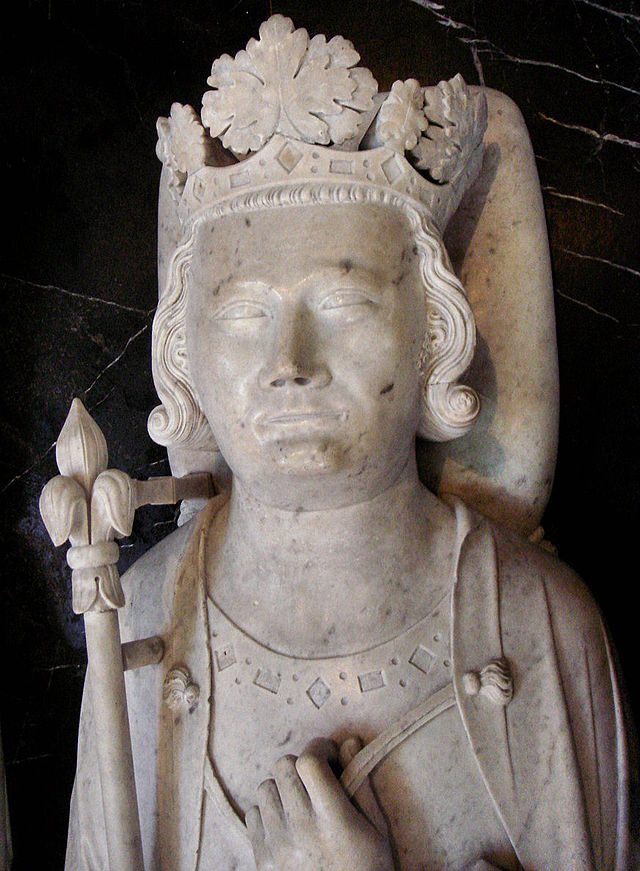
The effigy of King Philip IV from his tomb in the abbey basilica of St Denis
 
Image: Wikipedia 

In the early part of the year the suppression of the Order of the Templars, instigated by King Philip, had culminated in the burning at the stake in Paris of the last Grand Master. Shortly afterwards Pope Clement V, the first of the line of what became the Avignon Papacy, and who had been pressured by King Philip over the Templars to dissolve the Order, died. The ensuing vacancy lasted two and a quarter years. Next the French royal house had been shaken to their dynastic foundations by the affair of the Tour de Nesle, and the disgrace of the King’s daughters-in-law. In June his son-in-law King Edward II suffered the catastrophic defeat of Bannockburn. In November King Philip, aged 46, appears to have suffered a stroke whilst hunting and died shortly afterwards on this day.

If you want to read a vivid and entertaining account of these events then you should turn to the novels of Maurice Druon or to watch the ORTF adaptatuon from 1972-3 ( not the 2005 remake ) of Les Rois Maudits. 

That was just after I had studied this period as an undergraduate and since then there have been important contributions to the academic literature on the period. Much of this can be found reflected and referenced through the relevant Wikipedia articles. Their biography of the King can be seen at Philip IV of France Other relevant ones are those of Pope Clement Vof Guillaume de Nogaretof Enguerrand de Marigny and the article on the Tour de Nesle affair

Tough Facts About Philip IV, The Iron King is a slightly more pacy, and racy, account of the reign with some interesting illustrations, and some that can be ignored.


Philip IV, the Counterfeiter King - The Tontine Coffee-House looks at the debasement of the French currency in the middle years of the reign.


Few Kings of France have rivalled King Philip IV in their impact as rulers. In his reign France occupied a position that in many ways it was not to do again until the reign of King Louis XIV.
In his expansion of Royal authority, his move against not just the Templars but against the Papacy itself in the person of Pope Boniface VIII, the transfer of the institution from Rome to Avignon being a consequence, and with the prestige the French monarchy enjoyed, he can be seen as a very significant figure. 

In his clash with the Papacy he can be seen to prefigure King Henry VIII in England, or, in the modern history of France, the tension between Church and State. As State-builder he and his ministers point to future development across the whole of Europe and indeed the modern world. In his debasement of the currency he also resembles his English descendent. He was a ruler who seemingly made up his own rules and enforced them on his subjects and neighbours.

Handsome and inscrutable he was an enigma to his contemporaries, and he remains enigmatic to historians and commentators today. A great king, a great state builder, but in many ways unsuccessful both within and beyond France, the powerful ruler whose achievements were often enduring, but which sometimes proved to be a house of cards. Personally devout yet implacable and unscrupulous in his dealings with the Church as a public figure. 

Thus his reign can also be presented as the origin of what was to become the Hundred Years War, and all that was to inflict upon France. His financial and political cynicism can be seen as entering the bloodstream of French political life. The decline of France in the early decades of Valois rule after 1328 can be seen as a consequence of events that had happened in the reign of King Philip IV, however contrary that course of events was to what were his intentions.

By coincidence in Paris today, the cathedral of Notre Dame has been opened up following its restoration. after the fire in 2019. I will say that looking at the pictures of the interior it looks infinitely superior to the rather dismal and dreary aspect it presented when I visited in 1992. The cathedral would have been well known to King Philip who lived nearby in the ancient Royal Palace, now better known as the Conciergerie, and it was in Notre Dame that in 1302 the first meeting of the Estates General was held. This was convoked by the King to strengthen the kings position in his dispute with Pope Boniface VIII. 

Another link between the King and the cathedral was an equestrian statue of him in the choir. This appears to have been an ex voto given after his Flanders campaign in 1304. This alas does not survive, having been destroyed during a drastic makeover of the cathedral in 1772. Although not as old as the Rider of Augsburg - who may well be the Emperor Frederick II - this was one of the first equestrian statues created in medieval Europe.

Given the delicate, indeed curious, relationship of Church and State since 1905 the visit to the cathedral today and on the occasion of its formal liturgical reopening next weekend by M.Macron has involved not a little discreet negotiation. This can be seen as one of the continuing legacies of the reign of King Philip the Fair.

Political turmoil is nothing new in France. It does strike me some of the issues that are confronting the country at the moment do strike interesting parallels with the events of seven and more centuries ago. Just as King Philip debased the currency because of debt so the present French government faces a very uncertain future over its budget and over dealing with its debt obligations. The regional issues and tension between different parts of the national community that has surfaced in recent years are in many ways resonant of both the profound regional loyalties of mediaeval France and something that at times can look like a peasant revolt. France in 1314 and France in 2024 had and has a grand vision of itself as a leading nation as a centre of intellectual and cultural life and as a power in the world. At the same time, both times were and are fraught with uncertainty, both within and without, as to the future.

Plus ça change……as the French might very well say.

Saturday, 29 November 2014

King Philip IV


Today is the seventh centenary of the death of King Philip IV of France in 1314.

The King died at Fontainebleau, where he had been born in 1268, following a stroke which he suffered whilst he was hunting.

File:Bust of Philippe le Bel SaintDenis.jpg

King Philip IV
The effigy at St Denis

Image:Wikimedia

There is an online account of his life and reign at Philip IV of France. He was succeeded by his eldest son King Louis X, who was already King of Navarre through his mother, King Philip's late wife, Joan. There is a life of King Louis at Louis X of France. 


The first seal of King Philip IV of France, 1286.

Image:heraldica.org from Base de données Archim


The King is often known as Philip the Fair - Philippe le Bel - on account of his being esteemed by contemporaries to be handsome. The striking effigy at St Denis conveys a curious impression - serene and almost smiling, yet distant and slightly disturbing. There is in it a family resemblance to the effigies of his three sons who succeeded him as King and to the best portrait of his daughter Queen Isabella, in a label stop in the nave of St Albans. However the broad, smiling face was a convention of late-thirteenth and early-fourteenth century French sculpture, such as the Smiling Angel of Rheims.


King Philip IV of France flanked, left to right, by his sons the future King Charles IV and King Philip V, his daughter Queen Isabella, wife of King Edward II, and by his eldest son King Louis X, King of Navarre, and his brother Charles, Count of Valois, father of King Philip VI

Image:Wikipedia

I have posted before about the clash between King Philip and Pope Boniface VIII, culminating in the events of 1302-3 in Unam Sanctam and about the King's attack on the Knights Templar in  The deaths of Jacques de Molay and Geoffrey de Charnay in 1314

The conflict with the Papacy and the suppression of the Templars invites some comparisons with the reign of King Henry VIII in England, as does the very public scandal around the adultery of King Philip's daughters-in-law in 1314. There is more about that in the online article at Tour de Nesle Affair.

That in turn was to have a significant effect on the succession to the French crown, with the death of King Philip IV in 1314 being followed by that of  King Louis X in 1316, the birth and death of his posthumous son King John I in the same year, and the deaths of the next two monarchs, the younger brothers of  King Louis, King Philip V in 1322 and King Charles IV in 1328, leaving only daughters whose right to succeed was discounted - that is before the final formulation of the concept of the Salic Law later on in the century - and the inheritance passing to King Philip VI, son of Charles of Valois, and the opening up of the claim of King Edward III of England. There is more about this at the online article Succession to the French throne

By his conflict with King Edward I over Gascony in the 1290s the King had raised English suspicions as to French intentions towards the Duchy which helped to pave the way for conflict in the next century, compounded by the claim to the French throne of King Edward III through his mother, King Philip's daughter Isabella, whose marriage to King Edward II had, ironically, been designed to bind the two realms together in peace.

In preparing this post I incidentally discovered a useful resource and summary on French royal usages and titles, which I recommend to anyone interested at French Royal Family: Titles and Customs 


Earthly power: funeral of Philip IV at Saint-Denis, 1314, 14th-century chronicle. AKG Images / British Library  The funeral of King Philip IV at Saint-Denis in 1314 From a 14th-century chronicle  Image:AKG Images / British Library/historytoday.com

King Philip IV is, of course, the eponymous monarch in Druon's The Iron King, the first of his series  of novels in the series The Accursed Kings. These have recently been reissued in paperback and the really splendid ORTF 1973-4 television adaptation can be found on YouTube. I gather the remake of about a decade ago should definitely be avoided, desite its impressive cast.

King Philip IV was a handsome, seemingly detached, remote figure. The events around the deaths of his older and younger brothers Louis and Robert in May 1276, and the suspicions of some that they had been poisoned by his stepmother, may account for his reserved nature. Famously described by the Bishop of Pamiers who said of the King "He is neither man nor beast. He is a statue" he remains something of an enigma. The debate continues as to how far he controlled policy and how much that was the work of his ministers - again rather like King Henry VIII in England. His detachment and restraint - he appears to have been faithful to his Queen, and did not remarry after her death - and his concern for the royal dignity of his office - suggests an austere personality. Supremely concious of his kingship in his last days he was concerned to ensure the faithful transmission to his heir of the specifics of the touching for the King's Evil. His reign, and that of the last of the direct line of the Capetians, is a fascinating period to study, an era of extremes, a turning point in French and European history.

Thursday, 10 April 2014

The reissue of Druon's "The Accursed Kings"


A friend kindly forwarded to me the link to an article in the BBC Magazine about the way in which Maurice Druon's set of seven novels The Accursed Kings (Les Rois Maudits), about the last Capetian Kings of France and the origins of the Hundred Year War were an inspiration for the currently very popular Game of Thrones novels of George R. R. Martin and the television series based thereupon. It can be read here.

I do not know, other than by name, The Game of Thrones series, with its Tolkienesque setting. However I do esteem the Druon novels, and the original 1973-4 ORTF tv production - you can find the six dramas on YouTube - and I am delighted to see that the novels are being reissued.


File:Philip iv and family.jpg

 The Accursed Kings
King Philip IV of France flanked, left to right, by his sons the future King Charles IV and King Philip V, his daughter Queen Isabella, wife of King Edward II, and by his eldest son King Louis X, King of Navarre, and his brother Charles, Count of Valois, father of King Philip VI

Image:Wikipedia

Their attraction is the way in which they use real historical events and present them in extremely readable form and in accessible modern language, and bring out the subtleties and cut and thrust of political life. These are flesh and blood people dealing with matters of life and death - literally. As a friend said in the 1970s of the television version, it had actors who behaved as if they were used to living in medieval clothes, not just dressed up for the part. 

In addition the novels have a series of historical endnotes to accompany their interpretation of events. Druon was writing with dramatic effect in mind, and he does exercise artistic freedom at times, but not such as to reduce the historic credibility of the books. One may question the interpretation he gives of some of the figures - notably King Louis X and King Charles IV - but the novels are a thoroughly good introduction to the period and a wonderful evocation of medieval political machinations.


Tuesday, 18 March 2014

The deaths of Jacques de Molay and Geoffrey de Charnay in 1314


This evening is the 700th anniversary of the burning at the stake of Jacques de Molay, the last Grand Master of the Order of the Temple, and Geoffrey de Charnay, the Master of the Order in Normandy in Paris. There is an online life of the Grand Master here, and there is one of Geoffrey de Charnay here. The Charnay family in later generations had custody of the Shroud of Turin as set out in Ian Wilson's book The Holy Shroud, which links its transmission to the west to the Templars.

There is an illustrated online blog post today on the Daily Telegraph website by Dominic Selwood about the events in the years 1307-1314 that occurred leading to the suppression of the Order of the Temple and the deaths of Molay and Charnay. It can be viewed here.

Malcolm Barber has written what is, I suppose, now the standard book on the topic in The Trial of the Templars.  The executions of 1314 also appear in the first part of Maurice Druon's splendid series of novels The Accursed Kings - the first of these The Iron King begins with the burnings of the Templars and ends with the death of the King in November that same year, and covers the intervening crises which in Druon's interpretaion led to the Hundred Year War. A really splendid series of novels and wonderful televison in the original 1973-4 version - but do ignore the remake!

These days I tend to ignore anything about the Knights Templar that is not solid history like the work of historians like Barber, or clear dramatic recounting of specific events such as in Druon's books. Whatever the Templars did do - and they did much that was certainly good - or did not do - the allegations against them appear to be a mixture of some truth, falsehood, misunderstanding and very serious political manipulation - they do not deserve their continuing current fate of attracting so many loopy theories and associations.

The downfall of the Templars is a far from edifying episode - and really is so for all concerned. The Papacy was weak and vacillating, the French Crown cynical and mercenary, the Templars had perhaps lost something of their origibal vision as well as purpose - possible or actual abuses by a few of them could be made to besmirch the whole Order, which seems a rather contemporary point.  


Monday, 3 March 2014

Buying books for the Oxford Union


I am a long standing member of the Library committee at the Oxford Union - almost fifteen years in two sessions - and I was asked recently to prepare a list of suggested books for the History list which we were to recommend for purchase to the membership this week.

My aim was to fill gaps in the collection. This was partly based on my recent teaching work this term, on what I felt would complete or continue series we already have and with the centenary of the outbreak of the Great War some relevant books about that. I also aimed for what would appeal to both students and to the the more general readers among the membership.  For these latter reasons I thought I would share it  with readers and recommend the books to them in case they are interestedin the topics covered. Apart from replacement copy of the text of a medieval chronicle the books I suggested - and which were accepted - are:   

J.F. Webb and D.H.Farmer (eds) The Age of Bede  Penguin Classics  
A valuable set of saints' lives in translation - including those of St Cuthbert and St Wilfrid


Michelle P. Brown  The Lindisfarne Gospels and the Early Medieval World  British Museum Publications   
This places the Gospels in their historic context of seventh and eighth century Britain.

Sarah Foot  Athelstan: The First King of England  Yale UP 
We collect the biographies in this established series, and this is an important book for historians working on the period; the other year I heard a wonderful lecture from the author, who is Regius Professor at of Ecclesiastical History at Christ Church, on the life of the King.

Edmund King King Stephen  Yale UP  

In the same series , and again an important work for understanding the Anarchy and twelfth century England.

David Abulafia The Western Mediterranean Kingdoms: The struggle for dominion 1200-1500 Routledge
 
A useful text book by a leading historian of the region and the period

Malcolm Vale The Origins of the Hundred Years War: The Angevin Legacy 1250-1340  OUP
It turned out I had missed this book which was already on the Union catalogue - I think I probably recommended it years ago. An excellent interpretive account . 

Christopher Fletcher Richard II: manhood, youth and politics 1377-1399  OUP
A potentially interesting reinterpretation of the reign in the light of the clash between the King and an older political elite, and questioning the depiction of him as effeminate.

Giles Tremlett Catherine of Aragon: Henry's Spanish Queen  Faber and Faber

The most recent biography of the Queen, by a British journalist based in Madrid.


Derek Beales  Joseph II:  Against the World 1780-1790  CUP  
We already have volume I of this major biography covering his life up to the death of his mother the Empress Maria Theresa in 1780.

Piers Paul Read The Dreyfus Affair   Bloomsbury 
I was given this as a birthday present the other year - a comprehensive account of one of the most divisive and significant events if the history of France since 1870.
          
Muriel E Chamberlain Pax Britannica? Britain's Foreign Policy 1789-1914  Pearson reprint
This ties in with some of the teaching I have been doing this term, and links foreign policy to domestic political and social dvelopments. 

R.J.W.Evans and H. Pogge van Strandmann (eds) The Coming of the First World War   OUP
A well established classic account by distingushed experts of the events leading up to 1914 

H. Afflerbach and D. Stevenson (eds) An Improbable War?: The Outbreak of World War I and European Political culture before 1914  Berghalen NY
Highly recommended by a student the book questions many received ideas about the war's causes, especially the notion of "inevitability."    
 

Greg King and Sue Woolmans The Assassination of the Archduke: Sarajevo 1914 and the murder that changed the World  Macmillan  
A new biography of the Archduke Franz Ferdinand and his wife, and of the fate of their family after the murders in 1914.Well illustrated and with new material from the Hohenburg family

I had hoped to include a secondhand copy of J.R.Strayer's The Reign of Philip the Fair, published by Princeton UP in 1980, but the affordable copy I found online had disappeared before I could submit the list to the Libraraian-in- charge. I shall have to keep looking out for this as it is the standard work in English on this very important figure and reign.

In addition I had been asked last week to look at Alec Ryrie Being Protestant in Reformation Britain  OUP and to advise on its possible purchase, it having been recommended by a member. This looks a very valuable contribution to our understanding of the mindset of the era. Prof Ryrie draws on English and Scottish sources for the period 1540-1640, and I can see this becoming a counterpart to Eamon Duffy's The Stripping of the Altars. We agreed to buy this as well, so all in all a good number of additions to the Library were proposed by the Committee.


Sunday, 18 November 2012

Unam Sanctam


Today is the 710th anniversary of the issue in 1302 by Pope Boniface VIII of his bull Unam Sanctam.

Bonifatius VIII Grabstatue.JPG

Pope Boniface VIII

Image: fr.wikipedia.org

The bull, withits resounding concluding sentence "Furthermore, we declare, we proclaim, we define that it is absolutely necessary for salvation that every human creature be subject to the Roman Pontiff ", is often regarded as the ultimate official expression of Papal claims to hegemony over both ecclesiastical and secular matters.

The bull was seen to be directed in particular against King Philip IV of France, with whom the Pope had been in dispute over their calims and ambitions to control the Church in France.


King Philip IV
The tomb effigy at St Denis

Image:paradoxplace.com

The text of Unam sanctam can be read in translation here

There is an online article about the bull and the events that led the Pope to issue it which can be read here. An online biography of Pope Boniface VIII can be here and one of King Philip IV here.


Pope Boniface VIII
Statue by Arnolfo di Cambio
Museo dell'Opera dell Duomo Florence
The position of the Papal pallium looks utterly impractical - I think it must be attributed to artistic licence, not actual liturgical practice.

Image:paradoxplace

However Unam Sanctam is not just something for historians of the Papacy and the Middle Age. It remains part of the living tradition of Papal claims to exercise its plenitudo potestatis and to its exercise of the Petrine ministry.

Thus Pope Pius XII in Mystici Corpus Christi ( June 29 1943) wrote: " That Christ and His Vicar constitute one only Head is the solemn teaching of Our predecessor of immortal memory Boniface VIII in the Apostolic Letter Unam Sanctam."