Once I was a clever boy learning the arts of Oxford... is a quotation from the verses written by Bishop Richard Fleming (c.1385-1431) for his tomb in Lincoln Cathedral. Fleming, the founder of Lincoln College in Oxford, is the subject of my research for a D. Phil., and, like me, a son of the West Riding. I have remarked in the past that I have a deeply meaningful on-going relationship with a dead fifteenth century bishop... it was Fleming who, in effect, enabled me to come to Oxford and to learn its arts, and for that I am immensely grateful.


Showing posts with label Croyland Abbey. Show all posts

Tuesday, 11 April 2017

St Guthlac


Today, were it not Holy Week, is the feast day of St Guthlac, the seventh/eighth century patron of Crowland (Croyland) Abbey in Lincolnshire, and indeed a monastic community with which in his time Bishop Richard Fleming clearly enjoyed good relations

There is an online life of the saint at St Guthlac of Crowland

Medieval Histories last October had the following piece about him and his cult, which I have very slightly amended. At the end are links to a whole serie sof article son the medieval Fens and on Anglo-Saxon England:


Crowland Abbey © Rex Slye

Crowland Abbey in the Fens

 Image: Rex Slye/ Medieval Histories

St. Guthlac and Crowland Abbey


The Anglo-Saxon hermit, St. Guthlac, had a career reaching from aristocratic warrior over monastic visionary to patron saint of Crowland Abbey

They were ferocious in appearance, terrible in shape with great heads, long necks, thin faces, yellow complexions, filthy beards, shaggy ears, wild foreheads, fierce eyes, foul mouths, horses’ teeth, throats vomiting flames, twisted jaws, thick lips, strident voices, singed hair, fat cheeks, pigeons breasts, scabby thighs, knotty knees, crooked legs, swollen ankles, splay feet, spreading mouths, raucous cries. For they grew so terrible to hear with their mighty shrieking that they filled almost the whole intervening space between earth and heaven with their discordant bellowing.
 From: Felix’s Life of Saint Guthlac ed. by Bertram Colgrave, Cambridge University Press (1985), p. 103

The historical Guthlac was born sometime around AD 670. In his earliest Vitae we are told that he belonged to a line of the Mercian royal stirps and this was the reason for his initial career as an Anglo-Saxon warrior. However, at some point in his youth he became a monk at Repton in Derbyshire. Two years later, he moved further east where he took up the life of a hermit at Crowland on the border of the fens finding shelter in an ancient British burial mound. Later, in the 10th century, his hermitage became a very wealthy monastery.

Liminal World
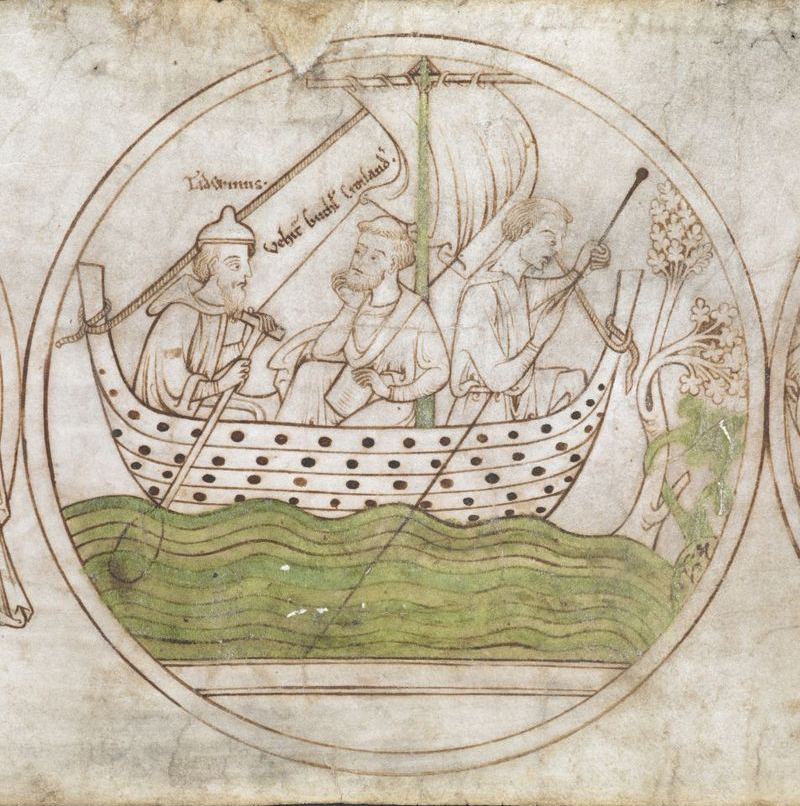


Guthlac sailing to Crowland with Tatwin. © British Library, Harley Roll, Y 6, roundel 4
 
Guthlac sailing to Crowland with Tatwin. 
© British Library, Harley Roll, Y 6, roundel 4
Politically, Crowland, was originally located at the border between the old Mercian kingdom and that of the Gyrwe, situated on the western border of the Fenland, by Bede called the “regione Girviorum”.
In the Tribal Hidage, this region was divided into a northern and a southern part, each assessed at 600 hides. The border was formed by the River Nene, which ran from Peterborough just south of Crowland to the Wash. Later in 749 Mercia established a hegemony over East Anglia, but Guthlac did not live to experience this. Nevertheless, he may have felt the encroachment of his former life into his new world.

Geographically, the landscape offered a fluid liminality constantly recreated through the shifting courses of rivers and streams through the fenland and into the Wash. In spring, when the rivers would flood, heavy sediments from the erosions of winter would end up clotting the waterways and channel the streams along new and constantly shifting routes.

Socially this landscape was barely livable and although spiritual friendship was established between Guthlac and some followers, this was initially not a site intended for a religious community.
Here at the crossroad of water and land, Guthlac would try to bridge the abyss between his semi-pagan past (the burial mound), his warrior ancestry (mirrored in his spiritual fights with Britons) and the new Christian thinking about people and places, which was in the Mercian crucible (from warrior-economy based on people to lordship based on land). This would later be unpacked in detail by his early chronicler, St. Felix, who wrote his first Vita soon after the death of the saint in 714.
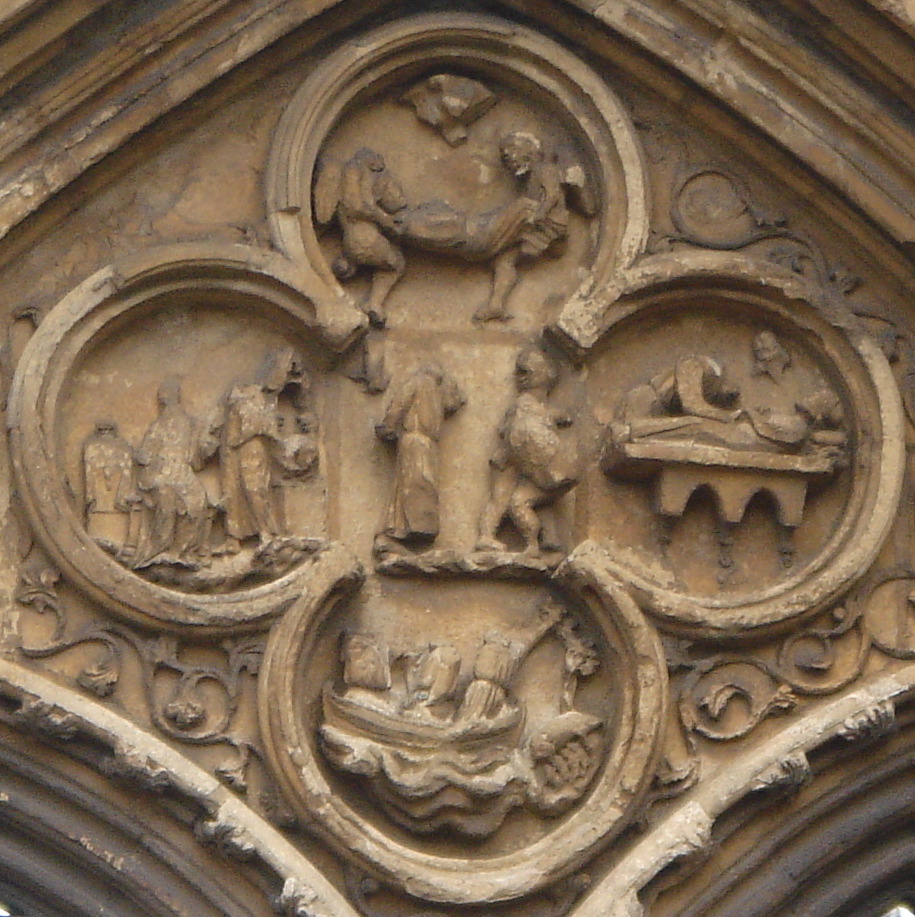


Quatrefoil with stories from the life of St. Guthlac, Crowland Abbey
 
Quatrefoil with stories from the life of St. Guthlac, Crowland Abbey.
 
Source: Wikpedia
According to the close reading of the vita, recently carried out by Lisa M. C. Weston, Guthlac was – in the words of Felix – constantly negotiating models of these past and present communities and lifestyles – the old warrior-world and the new monastic (Christian) thinking of lordship as based on the exploitation of landed resources and the accompanying new behavioural and cultural models and mind-sets.

Central to this conflict was the movement between two different literary cultures – that of the old oral warrior poetry and the new world of literacy and liturgy.

Above all, this became framed in his Vita through a series of nightly spiritual battles between British-speaking demons and the newly converted hermit, throwing verses from psalms and other scripture in their faces.

In the first night he is called to battle the temptation to return to his former life as a warrior and potential hero. In the second he is tempted by the demons to adopt an extreme asceticism and immoderate fasting. Finally, the third night he is demonised by multiple shrieking and frightening monsters trying to drag him into the fens or devouring by setting his hermitage on fire while raising him up on spears. However, it is at this point he identifies the monsters as a delusion because they speak the British tongue of his youth; and he is able to expel them in favour of a solitary austere existence.

On the basis of this he is able to transcend the old world and wholeheartedly enter the new, playing out his role as miles Christi and divine councillor for the future king of Mercia, Æthelbald, who gained sanctuary with Guthlac while exiled to the east. It is Æthelbald who according to the Vita, founded a monastery at Crowland immediately after the death of the saint in  716. During the next 200 years, the cult continued to grow and in   the monastery was turned into a Benedictine Abbey. The popularity of the cult is witnessed by a series of the survived manuscripts containing the Vita of Felix as well as later poetic rewritings of his life and deeds. It was during these rewritings Guthlac changed his shape from solitary spiritual warrior and into a more ordinary post-conquest saint.

Crowland Abbey
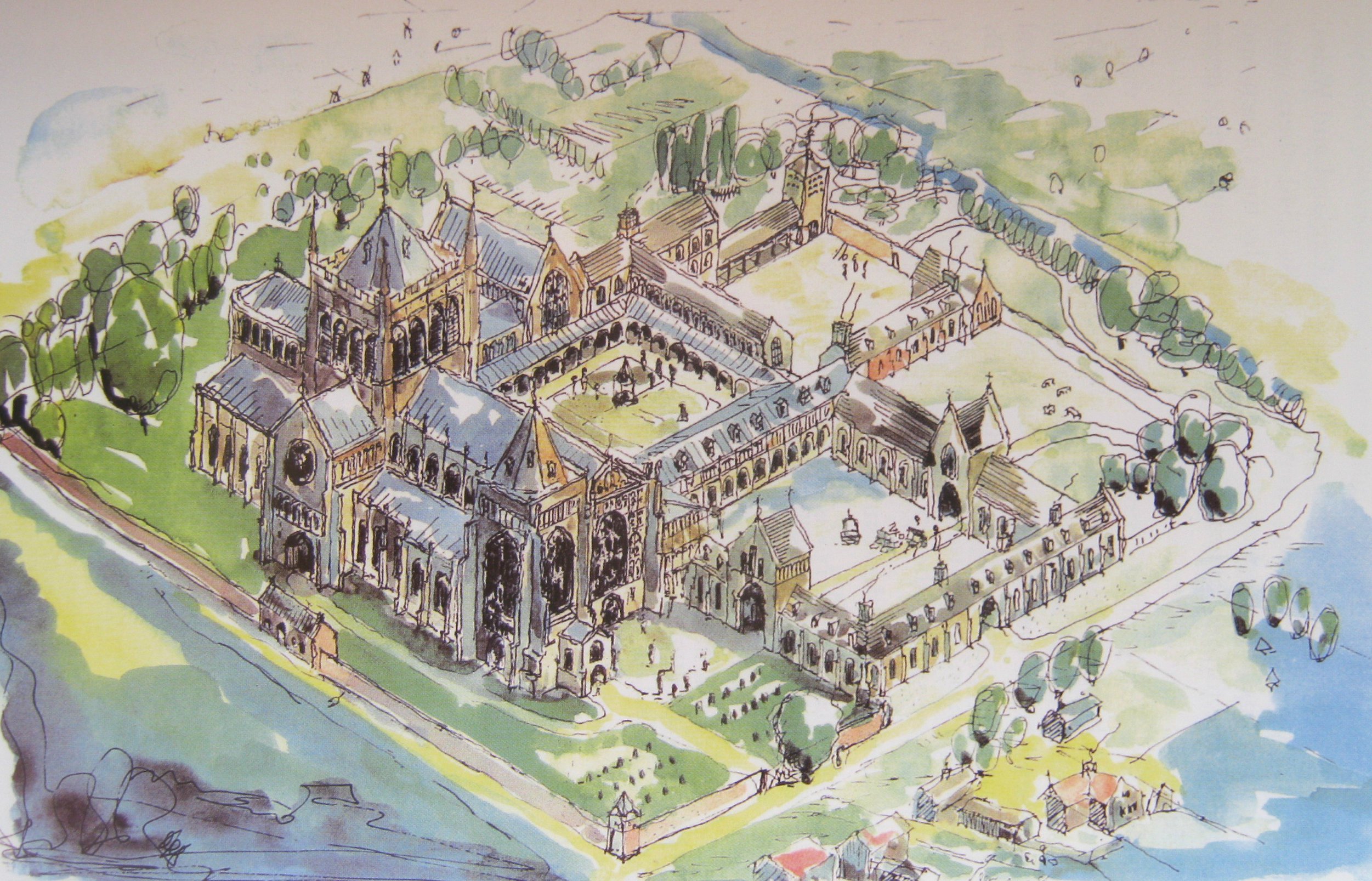


An Artist's Impression of Crowland Abbey © Crowland Abbey
 
An artist’s Impression of Crowland Abbey in the late middle ages 
© Crowland Abbey
As it stands today, the Abbey at Crowland is partly a ruin. Nevertheless it is a fascinating witness to the local history of the Fens in the 13th century.

The remains of the present building are the remains of a concerted effort of Henry de Longchamp, the abbot of Crowland from 1191-1236 and his successors to rebuild the church after a fire in 1179. They worked hard to recreate Crowland as an important pilgrimage centre publishing new variations of his legend and making the life of the saint a central feature of the decorative scheme of the new Abbey Church. This turned it into one of the most opulent and flamboyant of the East Anglian abbeys.
The Abbey Church had a nave with three aisles covered by nine bays and an apsidal choir of five bays. It measured 83 m x 27 m. As it stands today, only the northern aisle is roofed; this is used for the modern parish church.

However, an inkling of the decorative scheme, which used to embellish the church can be found on the facade of the still-standing west front. This was once brightly coloured. Right on top of the doorway arches is a quatrefoil illustrating the high-medieval and more placid version of Guthlac. Now the focus was on the traditional accoutrements of a typical medieval saint: miraculous healings, books, buildings etc.

Exactly the same shift can be discerned through a careful exploration of the so-called Guthlac roll, which stresses the saint building a chapel – something which the early Vita does not mention at all. Instead the Vita tells us that Guthlac turned a ruined burial mound or tumulus into his rustic ascetic cell. Thus Guthlac became – in the words of John Black – “primarily the defender of a religious foundation in its battles to retain holdings and power”.
Inside the church is a small museum telling the story of Guthlac and Crowland Abbey.

SOURCES:

Tradition and Tranformation in the Cult of St. Guthlac in Early Medieval England
By John R. Black
In: The Heroic Age. A Journal of Early Medieval Northwestern Europe. (2007) Issue 10.
Guthlac Betwixt and Between: Literacy, Croos-Temporal Affiliation and an Anglo-Saxon Anchorite.
By Lisa M. C. Weston
In: The Journal of Medieval Religious Cultures (2016) Vol. 42, No 1, 2016

READ MORE:

From the same edition here are other links to articles on

Anglo Saxon and Medieval Fenlands...

Gutlac puntingin the Fens (Guthlac sailing to Crowland with Tatwin. from: British Library, Harley Roll Y 6, oundel 4

Medieval Fenlands

For a long time a number of research projects have explored the culturally fluid landscape of the Medieval Fenlands in Eastern England. New book tells the story   Read more.
Highland Cattle grazing in theWicken Fen

Culture and Identity in the Early Medieval Fenlands

New studies of the use of the fluid landscape in the Early Medieval Fenlands point to a continuity in the settlement-structure from pre-Roman times   Read more.
Nydamboat from Gottorp Castle c. AD310 - 20. The construction of this boat is similar to that which was used at Sutton Hoo. © Gottorp Castle

Hoch and his family in Oakington

On the edge of the Fenlands at Oikington an Anglo-Saxon man named Hoch built a farm sometime in the 5th century. here, his family was buried   Read more.
European Eel ©Environment Agency

Eels in the Medieval Fenlands

The eel is a curious animal. Now listed on the international red list of threatened species, it used to be the ubiquitous food for smallholders and poor peasants in the early middle ages   Read more.
Boiling the Soup the medieval way

Recipes for Medieval Eels

In the Early Middle Ages eels were abundant and served as comfort food for hungry peasants. Later it turned into a very expensive delicatessen.   Read more.

There are other articles on contemporary events inn East Anglia and Mercia at:

River Debennear Sutton Hoo © River Deben Association

Rendlesham – An Anglo-Saxon Royal Palace Near Sutton Hoo

Rendelsham is known as an early Anglo-Saxon emporium. Recently a royal mead-hall was discovered there   Read more.


Staffordshire Hoard Item 550: strip with inscription © Staffordshire Hoard 
The Mercian Kingdom in Turmoil and the Staffordshire Hoard


Monday, 11 April 2016

St Guthlac


Today is the feast day of St Guthlac the founder, or at least the holy man around whose grave there developed the commuity, of the abbey at Crowland ( Croyland) in Lincolnshire.

The remains of the abbey church are an enduring symbol of the destruction of the monasteries and all that went with that cataclysm. The north aisle of the nave survives as the parish church of the town. The remains are, I consider, profoundly evocative and deeply moving - a haunting image of a lost culture and way of life.

I have known the abbey remains from photographs since I was very young and have visited them on several occasions since I was about nine.
 
My reasearch on Bishop Fleming revealed that he had a connection with the abbey, acting as an arbitrator in along-running dispute involving the abbey and its claims, which is set out in the earlier continuation of the Croyland Chronicle ( not the more famous part with the account of the seizure of the throne by King Richard III in 1483).

John Dillon posted the following piece on the Medieval Religion discussion group about St Guthlac:

According to his earlier eighth-century Vita by a learned East Anglian monk named Felix (BHL 3723; c. 740 - available in a twentieth century translation by Bertram Colgrave), Guthlac was a Mercian warrior who underwent a religious conversion, spent two years at the monastery at Repton in today's Derbyshire, and then became an hermit in the East Anglian fens before establishing himself at Croyland, now spelled as Crowland, in Lincolnshire.  Like the eremitically paradigmatic St. Anthony of Egypt, Guthlac is said to have been visited by angels and to have emerged victorious from repeated contests with demons.  His death in 714 is recorded in the Anglo-Saxon Chronicle; in his entry s.v. "Guthlac" for the Oxford DNB Henry Mayr-Harting places it in the year 715.  Still according to Felix, Æthelbald king of the Mercians while in exile spent time with the saint at Croyland before the latter's death and, returning to his oratory, received a vision of him; a year after Guthlac's death his sister St. Pega opened his grave, found his body to be incorrupt, and placed it in a memorial chapel; his relics operated miracles.  Croyland Abbey (not shown to have existed before the tenth century) grew up at the site.

Today is Guthlac's feast day as recorded in the Old English Martyrology.  It is also his feast day in the Church of England and his day of commemoration in the Roman Martyrology.

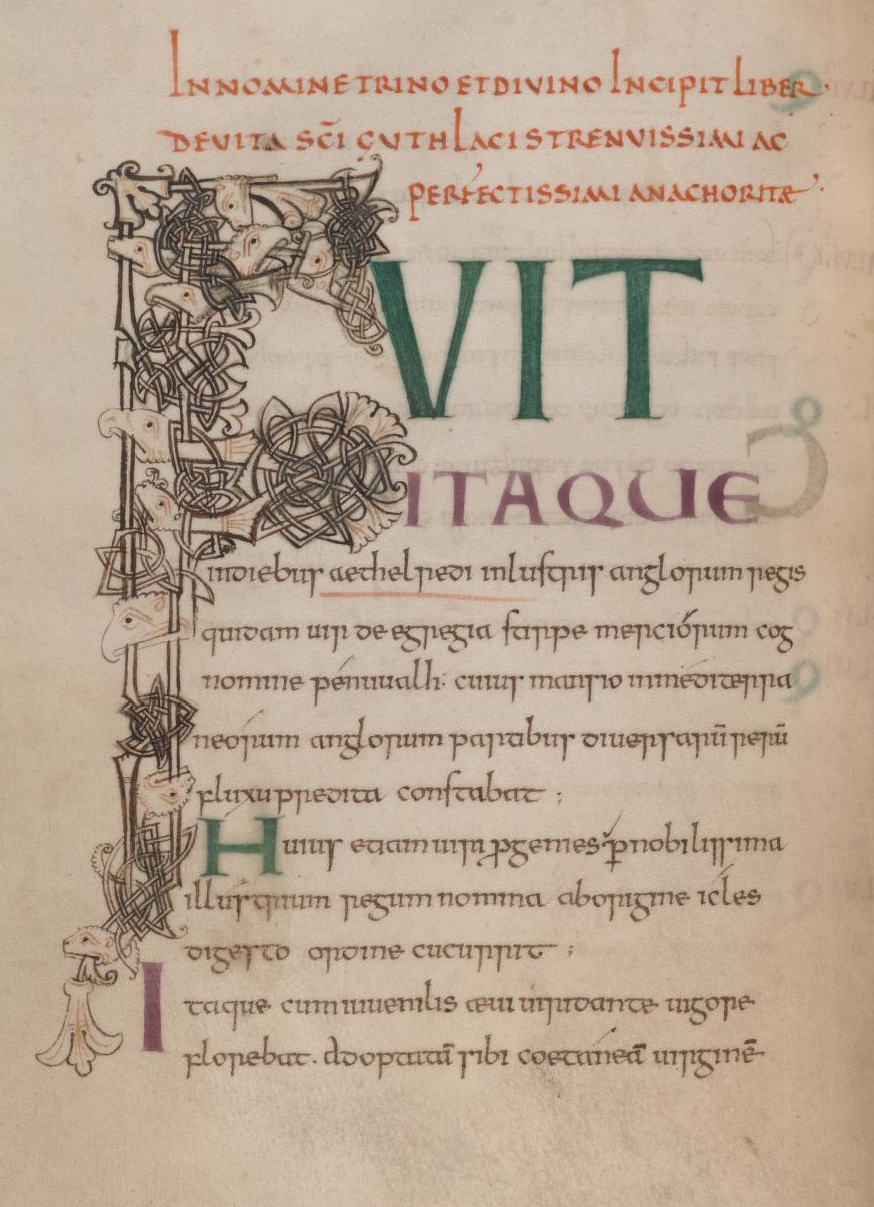
A view of the opening of Felix' Vita sancti Guthlaci in an eighth- or ninth-century copy formerly at St Augustine's, Canterbury (Cambridge, Corpus Christi College, MS 389, fol. 18r):

 https://upload.wikimedia.org/wikipedia/commons/3/3b/Vita-Guthlaci-Parker-Library-Corpus-Christi-Cambridge.png


Two Old English poems preserved in the later tenth-century Exeter Book (Exeter Cathedral Library, MS 3501), "Guthlac A" and "Guthlac B", respectively recount aspects of the saint's heroic life and of his holy death.  Aaron K. Hostetter's modern English-language translations of them are here ("Guthlac A"):
https://anglosaxonpoetry.camden.rutgers.edu/guthlac-a/
and here ("Guthlac B"):
http://anglosaxonpoetry.camden.rutgers.edu/guthlac-b/

An expandable view of the opening of an early twelfth-century copy of Felix' Vita sancti Guthlaci (1110; London, BL, Cotton MS Nero C VII, fol. 29v):

 St Guthlac, In A Passionale


London, BL, Harley Roll Y6 (probably c. 1210), consists of eighteen roundels with engaging pen-and-ink drawings illustrating Guthlac's life and early cult.  A brief, illustrated description is here:
The Guthlac Roll is also on display in the British Library’s newly refurbished Treasures Gallery.
Harley_roll_y_6_f008r
Drawing of Guthlac being carried to the gates of Hell by demons and being given a scourge by St Bartholomew with which to repel them,
Harley Roll Y 6, roundel 8.  For more Hell-mouths in BL manuscripts, see ‘Prepare to Meet Your Doom’.
The Guthlac Roll was made around the late twelfth or early thirteenth centuries.  It is regrettably incomplete: a fifth piece of parchment, containing perhaps two or three roundels illustrating the earlier stages of his life, has been lost.  What survives is a series of seventeen compelling and skilful pen-drawings in roundels of Guthlac’s life and deeds – including an entertaining trio illustrating his torment by and ultimate vanquishing of demons, aided by St Bartholomew – plus a final roundel illustrating the benefactors of his shrine at Crowland, in present-day Lincolnshire.
Harley_roll_y_6_f001r
Drawing of Guthlac deciding to devote himself to a life of religion,
Harley Roll Y 6, roundel 1 (incomplete).
Born into the Mercian royal dynasty, Guthlac spent his early adult life as a warrior, leading apparently successful raids and battles against hostile neighbouring tribes.  The roll in its present state opens with half of a roundel that illustrates the sleepless night on which the young Guthlac, surrounded by his slumbering fellow-soldiers, resolved to devote himself to a life of religion.
Harley_roll_y_6_f002r
Drawing of Guthlac leaving military service,
Harley Roll Y 6, roundel 2.
The roundel scenes are given particular animation by the skill with which the anonymous artist captured facial expressions.  Note the bewilderment of Guthlac’s men as he bade them and the military life farewell.  Stumped by his decision, they turn to one another questioningly; one looks down at the ground, seemingly lost in a moment of doubt.  The soldier at the front appears to be appealing to Guthlac – but too late: his back turned, he is departing with a simple wave.
Harley_roll_y_6_f004r
Drawing of Guthlac sailing to Crowland with Tatwin,
Harley Roll Y 6, roundel 4.
Having received the tonsure at Repton Abbey, Guthlac set sail for Crowland, at that time an island amidst the Fens.  The roundel shows that his life of contemplation had already begun: with an open book on his lap, his gaze tilted upwards, he is lost in thought, oblivious to the paddling of Tatwin and his helper
Drawing of Guthlac exorcising a demon from Ecgga,
Harley Roll Y 6, roundel 10.
In a later roundel, two men look on in wonderment, one open-mouthed, as Guthlac is exorcising a demon from Ecgga.  The scene reinforces Guthlac’s saintliness: that he possessed holy powers that were witnessed by his contemporaries.
Harley_roll_y_6_f012r
Drawing of Guthlac counselling
Æthelbald, Harley Roll Y 6, roundel 12.
According to Felix of Crowland’s Vita Sancti Guthlaci, the main source for the roll, word of Guthlac’s deeds attracted wide attention.  While in exile, Æthelbald, King of the Mercians, sought Guthlac’s advice.  The artist depicted Æthelbald sitting with his eyes fixed upon Guthlac, listening intently to his teachi.
Harley_roll_y_6_f015r
Drawing of Pega setting sail for Crowland with Beccelm,
Harley Roll Y 6, roundel 15.

Harley_roll_y_6_f016r
Drawing of Guthlac’s burial,
Harley Roll Y 6, roundel 16.
The next roundel illustrates Guthlac’s burial.  Observe the care with which one of the monks is holding Guthlac’s legs, how tenderly Pega is cradling the saint’s head in the crook of her arm, as they lower his shrouded body gently into the coffin.  The depiction of Guthlac in silhouette – rather than wrapped in d
The Guthlac Roll is also on display in the British Library’s newly refurbished Treasures Gallery.
Harley_roll_y_6_f008r
Drawing of Guthlac being carried to the gates of Hell by demons and being given a scourge by St Bartholomew with which to repel them,
Harley Roll Y 6, roundel 8.  For more Hell-mouths in BL manuscripts, see ‘Prepare to Meet Your Doom’.
The Guthlac Roll was made around the late twelfth or early thirteenth centuries.  It is regrettably incomplete: a fifth piece of parchment, containing perhaps two or three roundels illustrating the earlier stages of his life, has been lost.  What survives is a series of seventeen compelling and skilful pen-drawings in roundels of Guthlac’s life and deeds – including an entertaining trio illustrating his torment by and ultimate vanquishing of demons, aided by St Bartholomew – plus a final roundel illustrating the benefactors of his shrine at Crowland, in present-day Lincolnshire.
Harley_roll_y_6_f001r
Drawing of Guthlac deciding to devote himself to a life of religion,
Harley Roll Y 6, roundel 1 (incomplete).
Born into the Mercian royal dynasty, Guthlac spent his early adult life as a warrior, leading apparently successful raids and battles against hostile neighbouring tribes.  The roll in its present state opens with half of a roundel that illustrates the sleepless night on which the young Guthlac, surrounded by his slumbering fellow-soldiers, resolved to devote himself to a life of religion.
Harley_roll_y_6_f002r
Drawing of Guthlac leaving military service,
Harley Roll Y 6, roundel 2.
The roundel scenes are given particular animation by the skill with which the anonymous artist captured facial expressions.  Note the bewilderment of Guthlac’s men as he bade them and the military life farewell.  Stumped by his decision, they turn to one another questioningly; one looks down at the ground, seemingly lost in a moment of doubt.  The soldier at the front appears to be appealing to Guthlac – but too late: his back turned, he is departing with a simple wave.
Harley_roll_y_6_f004r
Drawing of Guthlac sailing to Crowland with Tatwin,
Harley Roll Y 6, roundel 4.
Having received the tonsure at Repton Abbey, Guthlac set sail for Crowland, at that time an island amidst the Fens.  The roundel shows that his life of contemplation had already begun: with an open book on his lap, his gaze tilted upwards, he is lost in thought, oblivious to the paddling of Tatwin and his helper (who appears to be using a quant pole).
Harley_roll_y_6_f010r
Drawing of Guthlac exorcising a demon from Ecgga,
Harley Roll Y 6, roundel 10.
In a later roundel, two men look on in wonderment, one open-mouthed, as Guthlac is exorcising a demon from Ecgga.  The scene reinforces Guthlac’s saintliness: that he possessed holy powers that were witnessed by his contemporaries.
Harley_roll_y_6_f012r
Drawing of Guthlac counselling
Æthelbald, Harley Roll Y 6, roundel 12.
According to Felix of Crowland’s Vita Sancti Guthlaci, the main source for the roll, word of Guthlac’s deeds attracted wide attention.  While in exile, Æthelbald, King of the Mercians, sought Guthlac’s advice.  The artist depicted Æthelbald sitting with his eyes fixed upon Guthlac, listening intently to his teaching, his attentive pose echoed by the rapt gaze of his attendant.
Harley_roll_y_6_f015r
Drawing of Pega setting sail for Crowland with Beccelm,
Harley Roll Y 6, roundel 15.
After Guthlac’s death, his sister Pega came to Crowland for his burial.  The fifteenth roundel shows her, grief-stricken, being met by Guthlac’s disciple, Beccelm.  Her brow is wrinkled, her eyes downcast; she is holding one hand up to her face mournfully.  Her emotional state is echoed by her unsteady pose: with one foot on land and the other on the boat, she is balanced by Beccelm, who is lending her his hand.
Harley_roll_y_6_f016r
Drawing of Guthlac’s burial,
Harley Roll Y 6, roundel 16.
The next roundel illustrates Guthlac’s burial.  Observe the care with which one of the monks is holding Guthlac’s legs, how tenderly Pega is cradling the saint’s head in the crook of her arm, as they lower his shrouded body gently into the coffin.  The depiction of Guthlac in silhouette – rather than wrapped in dramatic loops and whorls of drapery as in the earlier death-bed scenes – was a deliberate artistic decision.  It encapsulates the sudden absence of the central figure in this cycle of roundels and the emptiness of his mortal remains following the departure of his soul.
Harley_roll_y_6_f017r
Drawing of Guthlac’s appearance in a vision to King
Æthelbald during the vigil at his tomb, Harley Roll Y 6, roundel 17.
It also emphasises the miraculousness of Guthlac’s startling reappearance in the next roundel: standing before Æthelbald, who is now looking up in wonder at the newly designated saint.
- James Freeman
- See more at: http://britishlibrary.typepad.co.uk/digitisedmanuscripts/2014/04/on-a-roll.html#sthash.jjLWWkRH.dpuf
It also emphasises the miraculousness of Guthlac’s startling reappearance in the next roundel: standing before Æthelbald, who is now looking up in wonder at the newly designated saint.

- See more at: http://britishlibrary.typepad.co.uk/digitisedmanuscripts/2014/04/on-a-roll.html#sthash.jjLWWkRH.dpuf
http://britishlibrary.typepad.co.uk/digitisedmanuscripts/2014/04/on-a-roll.html
and a complete digitisation starts here:
http://www.bl.uk/manuscripts/Viewer.aspx?ref=harley_roll_y_6_fs001r

The Clever Boy has seen the argument - and it seems a very reasonable one - that these are designs for stained glass to decorate the abbey.

Gordon Plumb added the following photographs of  the west doorway tympanum at Crowland, four scenes of the life of St Guthlac:
and details:
https://www.flickr.com/photos/22274117@N08/11350859623


The nave of Crowland Abbey today

Image: richardiiiworcs.co.uk


A modern reconstruction of the abbey in its last years as a monastery

Image:crowlandabbey.org.uk

Friday, 20 March 2015

St Wulfram


Today is the feast of St Wulfram who died in 703. He was Archbishop of Sens, and according to legend at least, a missionary to the Frisians. There is an online account of his life and cult at Wulfram_of_Sens

There are two old English churches dedicated to him, at Ovingdean in Sussex and at Grantham in Lincolnshire. As is explained in the article linked to above one of the saint's arms appears to have been given by King William the Conqueror to Abbot Ingulph of Croyland, and then, following a fire at the abbey was preserved at Grantham. It appears to have been venerated there until the reformation in the sixteenth century.

There is an account of the building and its development at St Wulfram's Church, Grantham

The church of Grantham was given to Salisbury Cathedral and supported from the revenue it yielded two prebends, those of Grantham Australis and Grantham Borealis.

The article linked to about the church speculates that there was Salisbury influence in the spire. This is possible, indeed quite probable, but Lincolnshire is very much spire country, so maybe too much should not be made of the Salisbury link.

Saint Wulfram's church

The Church of St Wulfram, Grantham

Image: genuki.org.uk/copyright Ron Cole 


It is certainly true that in a county of spectacular spires Grantham is one of the finest - whether it is the finest in the country, as Simon Jenkins asserts, is perhaps open to discussion, but it is serious contender.
The rest of the church is fine, but as it lacks a clerestory the overall impression is of a somewhat sombre and long interior, despite the large fourteenth and fifteenth century windows visible in the photograph. A church very well worth visiting in a county full of wonderful but surprisingly still little known medieval churches.


Wednesday, 14 April 2010

St Guthlac


Sunday, had it not been Sunday, would have been the feast day of St Guthlac of Croyland. The abbey, deep in the Fens of Lincolnshire, is one of those sites which holds a particular affection for me. I have visited the remains over many years, having relatives in the area, and the interest has been re-inforced by the fact that Richard Fleming was a friend of the Benedictine community there, both as a canon, and then as Bishop, of Lincoln in the early fifteenth century.


The west front of Croyland Abbey


The following notes on St Guthlac are based initially on those submitted to the Medieval Religion discussion list by John Dillon from Wisconsin University, together with several links to images he has provided, to which I have added observations of my own.

St Guthlac (d. 715). Guthlac was a young Mercian warrior, probably from the royal house or one of the great families of the kingdom who underwent a religious conversion, spent two years at the monastery at Repton in today's Derbyshire, and then became a hermit in the Fens before establishing himself at Croyland, now spelled as Crowland, in Lincolnshire. This we must assume was his equivalent of going into the desert or to a remote island. The abbey website suggests the name Croyland means marsh, and the region produced a number of other major Benedictine house that emerged from secluded monastic foundations in the remote, undrained and often impassible Fens - Ely, Peterborough, Ramsey and Thorney.

Here he underwent violent assaults from what monastic writers considered diabolic opponents. Modern historians have suggested that these may have been attacks of marsh-borne malaria, but a lecture I once attended drew attention to the similarities between description of his attackers and to the symptoms of starvation - he may have been the victim of starving peasants, or at least that was how Guthlac or his biographer, Felix, envisaged them. Whatever their cause he overcame these assaults to lead a life of piety in a hermitage on the site of the west end of the present abbey church.

His sister St. Pega (who is said to have given her name to the nearby settlement of Peakirk) opened his grave a year after his death, found his body to be incorrupt, and placed it in a memorial chapel.

The latter was soon honoured by Æthelbald, king of the Mercians, who before he was king is said to have spent time with Guthlac at Croyland and who clearly had a special devotion to him. Æthelbald was to be the ruler who established Mercian hegemony in the eighth century. Croyland Abbey grew up around his shrine. In the eighth century Guthlac's Vita was written by Felix of Croyland (BHL 3723). This is available in a translation by Bertram Colgrave. The abbey church was rebuilt on a number of occasions, and the remains today are a mixture of twelfth to fifteenth century work

The early thirteenth-century Guthlac Roll in the British Library (Harley Roll, Y.6) - thought to be a set of designs for stained glass commemorates Guthlac pictorially. Here is a view of its depiction of Guthlac, aided by St. Bartholomew, the other patron of the abbey, preparing to defend himself against demons intent on carrying him off to Hell:
A detail from one of this manuscript's roundels, showing Pega and Guthlac, and reproductions of two further roundels are here:
An expandable view of the opening of Felix' Vita of Guthlac. (London, BL, Cotton MS Nero C VII, f.29v) is here:
An expandable view of the thirteenth-century Croyland Gradual's decorated initial and music for Guthlac's feast is here:

I would add to these links the Catholic Encyclopaedia account of the abbey, Croyland abbey's own website, and some images courtesy of Wikimedia which show architectural and sculptural details of the remains, including carvings depicting St Guthlac.

The nave of the monastic church was retained at the dissolution, but the damage wrought in the Civil War and the collapse of the main nave roof later in the seventeenth century means that only the north nave aisle now serves as the parish church.

The ruins of Croyland are striking, in part romantic and numinous, dominating the local landscape, and in another way shocking and raw. They still convey a sense of shock at the destruction of what was once a beautiful and noble church in a way that many other Ancient Monuments do not. By a strange twist of the mind - a legacy of early nineteenth century Romanticism perhaps - they can seem right as ruins, as if they were built that way. That is, of course, ridiculous, but it lurks in the mind of far too many people. Croyland is a corrective to that. Perhaps the combative spirit of St Guthlac taking on the demons is speaking to the pilgrim.