Once I was a clever boy learning the arts of Oxford... is a quotation from the verses written by Bishop Richard Fleming (c.1385-1431) for his tomb in Lincoln Cathedral. Fleming, the founder of Lincoln College in Oxford, is the subject of my research for a D. Phil., and, like me, a son of the West Riding. I have remarked in the past that I have a deeply meaningful on-going relationship with a dead fifteenth century bishop... it was Fleming who, in effect, enabled me to come to Oxford and to learn its arts, and for that I am immensely grateful.


Saturday, 11 May 2013

The Coronation of King Edgar 973


May 11th 973 was Pentecost Sunday and the day chosen for the coronation - or perhaps or probably - re- coronation of King Edgar at Bath abbey. Today is therefore the 1040th anniversary of that event.


http://www.nndb.com/people/748/000093469/edgar-i-1-sized.jpg

King Edgar
This illumination from 966 shows him already crowned, seven years before the ceremony of 973

Image:nndb.net

The life of the King by Ann Williams from the Oxford Dictionary of National Biography can be read here. He may not have been the most physically impressive of monarchs - William of Malmesbury (c.1080-1143) described his as being " extremely small both in stature and bulk..."  in his Gesta Regum Anglorum - but he was an extremely successful ruler, and his coronation at Bath proved to be the precedent for all subsequent such ceremonies. Thus the coronation of the present Queen 980 years later in 1953, followed the lines laid down for her ancestor.

It was not the first coronation of an English king - Mercian and West Saxon rulers had been crowned before him, but the ceremony at Bath appears to have been conceived to emphasise the divinely sanctioned royal authority of king as not hitherto. It may have originate d in a reworking of the idea of a ceremonial crown wearing, as was certainly the later practice of Anglo-Norman kings at Christmas, Easter and Pentecost, and elevated to a new, amplified  rite of coronation.
King Edgar may had been consecrated first time upon his accession in Mercia c. 957 or in Wessex c. 959, but there is no contemporary source to verify it. A doubtful evidence is given in the work of Ralph of Diceto, who recorded two consecrations of Eadgar. According to Ralph, the allegedly first consecration was performed by Archbishop Oda at Canterbury:
Edgarus rex Anglorum Dunstanus abbas ab eo revocatus, ecclesiae Wigonensis electus antistes, consecratus est ab Odone Cantuariensi archiepiscopo apud Cantuariam.
If Ralph recorded a true historical fact, it could not have happened later than in 961, when Archbishop Oda died, but the validity of this claim is hard to prove. On the contrary, the consecration of Eadgar at Bath in 973 is well documented in the Anglo-Saxon Chronicle, which includes a poetic account of this solemn ceremony held on Pentecost day (11 May 973). Further details are found in John of Worcester's entry for 973:
Edgar the Pacific, king of England, received the benediction of the bishops SS. Dunstan and Oswald, and all the other bishops of England; and was crowned and anointed as king with great pomp and ceremony at the city of Acamann [Bath?] ... on the fifth of the ides of May, being Whitsunday.
Ralph of Diceto recorded that this consecration was performed by two archbishops, Dunstan of Canterbury and Oswald of York:

Eadgarus rex Anglorum ab archiepiscopis Dunstano Dorobernensi et Oswaldo Eboracensi consecratus est in regem in civitate Acheman, qui duos filios Eadmundum et Egelredum ex Ælfritha Ordgari ducis filia suscepit.

The choice of Bath for this great occasion seems likely to have been dictated by several factors. As the largest town in Somerset it was at the heaert of both the West Saxon dynasty's patrimony, and close to Dunstan's base at Glastonbury abbey. Bath was a Roman settlement in origin, and Anglo-Saxon kings often liked to emphasie ther inhertance from the Roman empire. Like Aachen, coronation place and administrative centre for Charlemagne and his successors, Bath had thermal springs which had been a Roman spa, and continued to be used for healing. The symbolism of baptism and regeneration, of healing and life giving waters would be appreciated by those attending.

The choice of Pentecost also emphasied the King's sacrality, marked out to rule on the great feast of the bestowal of the Holy Spirit. The King and Archbishop stressed this further by holding the coronation when the King was  29, or, more signifiantly, in his 30th year - 30 being the minimum age for episcopal consecration.

Following the coronation the King travelled to Chester, where he was ceremonially rowed along the river Dee from the city to the church of St John the Baptist by six or, according to later writers, eight tributary kings. This symbolised King Edgar's ascendancy as head of the the rulers of Britain. In later centuries it was recalled, notably in the Stuart era, where the scene was depicted on King Charles I's great ship Sovereign of the Seas - and one of the shortlived sons of the future King James II was named Edgar in honour of the Anglo-Saxon monarch.


Something of the politico-religious ethos and culture of the reign can be seen in this complete view of Winchester New Minster charter of 966 - one of the great surviving treasures of the period - showing the King, flanked by saints, offering his charter for the abbey to Christ in Majesty:


New Minster charter of 966
 BL Cottonian MS  Vespasian A viii

Image: Wikipedia

A similar idea of the royal state kept by the King and his archbishop can also be seen here:


King Edgar and St Dunstan


King Edgar and St Dunstan from the Canterbury Regularis Concordia 

Image:traditioninaction.com 

John Donne preaching at Paul's Cross


I have adapted the text of this post from one on the Medieval Religion discussion group about what appears to be a very interesting blend of historical and literary scholarship with modern technology.


Old St Paul’s (sermon at St Paul’s Cross)

A sermon at Paul's Cross
Panel painting by John Gipkyn (fl 1594–1629) of 1616
The view is from the north-east

Image:Society of Aniquaries

John N. Wall, Project Director and Professor of English Literature at North Carolina State University, announces that the Virtual Paul’s Cross Project website is now available for exploration online here.  The Virtual Paul’s Cross Project has been supported by a Digital Start-Up Grant from the National Endowment for the Humanities.

The Project uses visual and acoustic modeling technology to recreate the experience of John Donne, then Dean of St Paul's,  sermon at Paul’s Cross for November 5th1622. 

The aim of this initiative is to integrate what is known, or can be surmised, about the look and sound of this space, destroyed by the Great Fire of London in 1666, and about the course of activities as they unfolded on the occasion of a Paul’s Cross sermon, so that we may experience a major public event of early modern London as it unfolded in real time and in the context of its original surroundings.

The Project has sought the highest degree of accuracy in this recreation. To do so, it combines visual imagery from the sixteenth and seventeenth centuries with measurements of these buildings made during archaeological surveys of their surviving foundations. The visual presentation also integrates into the appearance of the visual model the look of a November day in London, with overcast skies and an atmosphere thick with smoke.  The acoustic simulation recreates the acoustic properties of Paul’s Churchyard, incorporating information about the dispersive, absorptive or reflective qualities of the buildings and the spaces between them.  

This website allows us to explore the northeast corner of Paul’s Churchyard, outside St Paul’s Cathedral, in London, on November 5th 1622, and to hear John Donne’s sermon for Gunpowder Day, all two hours of it, in the space of its original delivery and in the context of church bells and the random ambient noises of dogs, birds, horses, and crowds of up to 5,000 people.

There is a concise guide to the whole site here.

In keeping with the desire for authenticity, the text of Donne’s sermon was taken from a manuscript prepared within days of the sermon’s original delivery that contains corrections in Donne’s own handwriting. It was recorded by a professional actor using an original pronunciation script and interpreting contemporary accounts of Donne’s preaching style.

John Donne's Paul's Cross sermon for November 5th, 1622 (in 15-minute segments), as heard from two different positions in the Churchyard, can be heard by clicking here.  

On the website, the user can learn how the visual and acoustic models were created and explore the political and social background of Donne’s sermon. In addition to the complete recordings of Donne’s Gunpowder Day sermon, one can also explore the question of audibility of the unamplified human voice in Paul’s Churchyard by sampling excerpts from the sermon as heard from eight different locations across the Churchyard and in the presence of four different sizes of crowd. For excerpts of the sermon from these eight different locations and in the presence of these differing crowd sizes click here.
 
The website also houses an archive of materials that contributed to the recreation, including visual records of the buildings, high resolution files of the manuscript and first printed versions of Donne’s sermon for Gunpowder Day 1622, and contemporary accounts of Donne’s preaching style. 

In addition, the website includes an acoustic analysis of the Churchyard, discussion of the challenges of interpreting historic depictions of the cathedral and its environs, and a review of the liturgical context of outdoor preaching in the early modern age.

The visual model in detail on a fly around video can be seen here.  This is especially dramatic if viewed in HD video and at Full Screen display. 

The Project is the work of an international team of scholars, engineers, actors, and linguists.  In addition to the Project Director, they include David Hill, Associate Professor of Architecture at NC State University;  Joshua Stephens, Jordan Grey, Chelsea Sacks, and Craig Johnson, graduate students in architecture at NC State University;  John Schofield, Archaeologist at St Paul’s Cathedral and author of St Paul’s Cathedral Before Wren (2011); David Crystal, linguist; Ben Crystal, actor; Ben Markham and Matthew Azevedo, acoustic engineers with Acentech, Inc; and members of the faculty in linguistics and their graduate students at NC State University, especially professors Walt Wolfram, Erik Thomas, Robin Dodsworth, and Jeff Mielke.

Wall’s team is now planning a second stage of this Project, with the goal of completing the visual model of Paul’s Churchyard, including a complete model of St Paul’s Cathedral as it looked in the early 1620s, during John Donne’s time as Dean. 

This visual model will be the basis for an acoustic model of the cathedral interior, especially the Choir, which will be the site for restaging a full day of worship, including Bible readings, prayers, liturgies from the Book of Common Prayer, sermons, and music composed by the professional musicians on the cathedral staff for performance by the organist and choir of men and boys.  

They will be competing for our attention, as they did in the 1620’s, with the noise of crowds who gathered in the cathedral nave, known as Paul’s Walk, to see and be seen and to exchange the latest gossip of the day.


  JohnDonne.jpg

John Donne

Image: Wikipedia


Thursday, 9 May 2013

Ascension Day


Today has been Ascension Day, a feast I prefer to observe on the traditional day rather than the transferred solemnity of next Sunday - though as I have always been drawn to the rich imagery of Ascension I do not objrect to keeping it all over again on Sunday. 

Personally I regret the decsion a few years ago to transfer the obligation to the following Sunday, and would wish, with all due respect, the Bishops of England and Wales to reverse their request for the transfer of the day to the Vatican.  Not only is the traditional day scriptural, it is also the day still observed in Scotland by Catholics, and by the other Christian communities in England and Wales. in a country where the Catholic Church represents a minority of the total population it does appear to be lacking in sensitivity to one's neighbours not to observe one of the main feasts of Our Lord on the same day as everyone else.

Fortunately one of the benefits of Summorum Pontificum has been the ability of priest to celebrate according to the calendar of the Missal as promulgated by Bl.John XXIII, and as aresult I was able to attend the Low Mass for the Ascension at the Oxford Oratory this lunchtime.

To continue the mood of celebration, after afternoon tea with a friend, I was able to go to a beautiful Missa cantata at SS Gregory and Augustine in north Oxford, which was celebrated by Fr Saward. Had I not done that I would have had the option of going out to Dorchester on Thames where there was a sung Hugh Mass at the church of St Birinus.

As it was we joined another friend to go to a celebratory dinner with others at a house in Headington, and maintained the mood of exultation by filling the car with the strains of the Hallelujah Chorus from the CD player as we drove through north Oxford.


http://uploads8.wikipaintings.org/images/el-greco/ascension-of-jesus.jpg!HalfHD.jpg
 
The Ascension
El Greco, 1577 
The Prado

Image: Wikipedia

Last year I posted some reflections on this great painting by El Greco, and I am returning to the themes it contains. As a painting it could as well be designated the Holy Trinity, but I see it described in catalogues as being the Ascension.

Unlike othe paintings of the subject it has a dynamic that goes beyond the tableau vivante. It conveys in the exhausted physicallity of the Son the cost of winning our redemption, and indeed the dramatic surge of Ascension in terms that point to the fact that salvation was wrought in human flesh taken on in the Incarnation by the Divine. Christ in His flesh pleads His wounds to His Father on our behalf, the point Fr Saward stressed in his homily this evening.


The Ascension - a twelfth century view


The Ascension
 
Image:english.cam.ac.uk
 
This strikingly-coloured and composed Romanesque image of the Ascension is from the York Psalter, which was painted circa 1170 in the north of England, in the era of Archbishop Roger of Pont-l'Évêque (1154-1181). It is now Glasgow University Library, MS Hunter 229 (U.3.2), fol 14

Christ's feet are seen disappearing into stylized layers of multi-coloured clouds, while two angels swoop below with outstretched wings, bearing scrolls. Below, ten apostles, some with upturned faces and pointing in astonishment, flank the central figure of the Virgin Mary who also gazes upwards with her expressive hands raised. The scene takes place against a golden background.

Other images from the psalter can be seen
here , here , herehere and  here. With this manuscript one gets an idea of the use of colour in the churches of twelfth century northern England - not dull and dark as they so often appear today to the visitor, but vibrant with colour and devotion. Moreover the use of colour is sophisticated and confident and far from garish or crude.


Wednesday, 8 May 2013

A new face for Pope Celestine V


Pope Celestine V
An early mural painting and the new face mask
 
Image:news.discovery.com


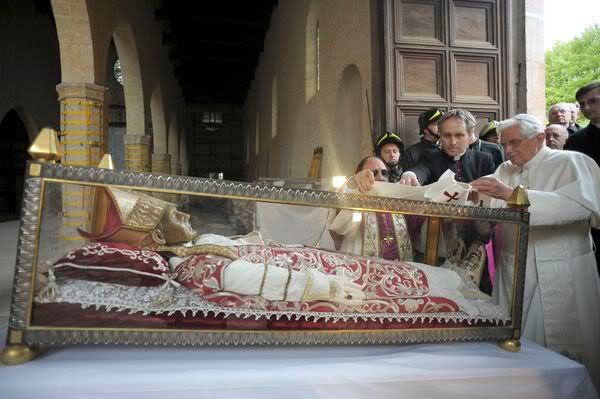
I see from a post on the Medieval religion discussion group that over the course of several months the remains of Pope Celestine V - St Peter of Morrone  - have been examined, and a new funerary mask has been created. Born in 1215, and a hermit-monk, he was elected as Pope in 1294, and abdicated later on that year, and died as, in effect, a prisoner of his successor, Pope Boniface VIII, in 1296. He was canonised in 1313, and his feast day falls on May 19th.

There is an illustrated introduction to his life here, and there is another one here, with some additional illustrations.  A further account, with amore hagiographic emphasis with more pictures can be found on the link to the blog post here.

The remains are preserved at L'Aquila and survived the serious earthquake there in 2009, and indeed were visited in its wake by Pope Benedict XVI, who have his inauguration pallium for his predecessor to wear:


Image:365rosaries.blogspot.co.uk

Amongst the results of this latest examination of the relics was  confirmation (not for the first time) that the hole in his skull was made after his death, and so he definitely was not murdered, according to legend, by having a nail driven into his skull.


Murder Examination of Pope Celestine V

The skull of Pope Celestine V

Image: archelaos.com

The examination also indicated his height - five foot five inches - and much of his medical history.

A careful study was done of his cranium, leading to afacial reconstruction. However this was of a fifty year old, so the artist who made the silver mask had then to interpret that to produce an idea of what he looked like at the time of his death, when he was eighty or thereabouts.

There is an account of the discoveries in English here and two more accounts, with different illustrations, in Italian here and here.


Tuesday, 7 May 2013

Pilgrimage to Birmingham


Yesterday I went on a pilgrimage to mark the Year of Faith organised for parishes from the North Oxford Deanery. The idea was to link together visits to places associated with, and indeed the relics, of St Chad, patron of the Archdiocese and cathedral, Bl. John Henry Newman,  and Bl.Dominic Barberi, and to see in them men who had lived by faith.

Our first stop was at the Birmingham Oratory. We joined member sof the congregation in saying the rosary before the  statue of Our Lady, splendidly coped and crowned for May, before Fr Richard Duffield C.O., the main organiser of the pilgrimage, gave a talk about the life of Bl. John Henry and the building of the church - the present structure was erected as a memorial to Newman in the early years of the twentieth century.

photo


The High Altar at the Birmingham Oratory
 
Image: Catholic Church (England and Wales) on Flickr


We then went through to the shrine chapel, the only part of Newman's church to survive, and redecorated in advance of his beatification in 2010. Here we had atime to pray, to view some relics of the Cardinal, including his mitre and crozier and the bull creating him a Cardinal, as well as seeing the modern chasse that contains such few fragments of bone as were found in his grave at Rednall, and which also incorporates the original handles from his coffin. There are mounted so that pilgrims may indeed touch them to establish a tangible, tactile contact with him.


The altar in the shrine chapel of Bl. John Henry Newman

Image:anglicanpatrimony.blogspot

There were too many of us to visit Newman's room, which has been preserved as it was at the time of his death. I have been fortunate enough to do so on three previous visits to the Oratory, and that is very remarkable exprience indeed - it is not areconstruction or redecoration, it is a genuine, undisturbed nineteenth century room, and that of one of the great voices of the age.

I think we could all have spent more time exploring the Oratory church and the other displays about Bl. John Henry, but the exigencies of timing sent us on to the cathedral in the centre of the city for the next stage of our pilgrimage.


photo

The Cathedral and Basilica of St Chad Birmingham

 Image: Simon_K on Flickr


If the Oratory is wonderfully Philippine in its baroque style and decoration, St Chad's cathedral is one of the great workks of A.W.N. Pugin, and built in 1839-41. In recent years a lot of work has been done to restore and reinstate aspects of Pugin's scheme, and the interior is striking and beautiful. like the oratory church, very much a place of prayer.

photo

Interior of St Chad's Cathedral


Aidan MCRae Thomson on Flickr

In the cathedral we had a votive Mass of St Chad, whose relics are preserved in the shrine above the High Altar. and time to look around before having our packed lunch and then back into the cathedral for a group photograph on the steps leading to the altar.

The cathedral has some splendid treasures amongst its furnishings, including late medieval items which were acquired from the Low Countries by Pugin. In the oils chapel is a reliquary with some hair of Bl.John Henry, one of his Cardinal's red zucchettos and his ring.

Either side of the steps leading to the altar are the Coenopium or Ombrellino and the tintinnabulum which indicate its status as a Minor Basilica, and honour granted to mark its centenary in June 1941, and about which there is more here.  

The last stage of our pilgrimage took us north of the city centre to the inner suburb of handsworth and to the Convent of the Sisters of Mercy, and built by Pugin for them in 1841 on land given bt his collaborators the Hardman family. A daughter of the family, Juliana, became the first Mother Superior of the house, and in those early months the foundress of the Sisters, Ven. Catherine McAuley stayed there, before returning to Dublin to die the same year.


http://www.birminghamheritage.org.uk/images/members/stmary.jpg

St Mary's Convent Handsworth

Image: birminghamheritage.org.uk

The convent is typical of Pugin, and was supported not only by the Hardman family but also by his great patron the 16th Earl of Shrewsbury. The church to the east which served as both the sister's church and as parish church was, alas, wrecked by a bomb in 1942, which also destroyed the House of Mercy which had provided shelter for vulnerable women. The descending cloister whuich linke dteh convent and church, atypically Puginesque feature, survives in part, and there are pictures of the lost church - rather like those he designed in Marlow and in Salisbury - on display in the extended house chapel, togetehr with examples of Hardman plate and furnishings.


http://www.english-heritage.org.uk/content/galleries/nuns-and-convent-building/design-by-awn-pugin-for-st-marys-convent-handsworth.jpg

Pugin's original design
Image: English Heritage

In the chapel is a chair and table which were used by Bl. Dominic Barberi when he visited the Sisters as their Extrordinary Confessor. It is also known that Bl. John Henry Newman used to visit the convent as a place of quiet.

Today the conevent continues to work with the local community, serves as a focus for Mercy Associates, and also is a heritage centre, open to visitors, which recounts the history of the Sisters in Handsworth and in the life of the Church and country.

The whole pilgrimage was very enjoyable, and we were blessed with beautiful weather, and the sight of the countryside finally bursting into leaf and flower as we travelled to and from Birmingham.


Monday, 6 May 2013

The Acclamation of King Manuel II in 1908


Today is the 105th anniversary of the ceremonial Acclamation of King Manuel II as King of Portugal and the Algarve in 1908. The formal oath taking before the Cortes was, it would appear, very similar in form to the inauguration of the present King of the Netherlands which took place last week. That is to say, it was ceremonial oath-taking before the representitives of the realm, and in the presence of the regalia. No King of Portugal was crowned after 1640 when the newly crowned King John IV, the first monarch of the house of Braganza, bestowed his crown upon the Virgin Mary as true Queen of the realm. The tradition odf anointing and coronation was particularlya feature of the house of Aviz, Kings from 1385/6 until 1580, and deriving from English influences and contacts in the deacades when they established themselves as rulers of the kingdom.


File:SMF Manoel II.jpg

King Manuel II on the day of his Acclamation

At his side are the Crown and sceptre of King John VI. The King is wearing the mantle of King Luis I,
and his Orders include the Collar of the Order of the Tower and the Sword, and the red, green and violet riband of the Three Orders, that is the ancient crusading Orders of Christ, Aviz and Santiago.
 
Image: Wikipedia

File:Mantel of Luís I.jpg

The Mantle of King Luis I, used also by King Carlos I and King Manuel II

Image: Wikipedia

File:Crown of João VI.png

The Crown and Sceptre of King John VI, made in Rio de Janeiro in 1817

Image: Wikipedia

There is more about the Portuguese regalia at the link Portuguese Crown Jewels.

I found on YouTube this very interesting compilation of photographs of the events of the day of the Acclamation in 1908:


Wednesday, 1 May 2013

The King of the Netherlands


The ceremonies for the abdication of Queen Beatrix and the formal accession of King Willem-Alexander as the first King of the Netherlands for 123 years in Amsterdam yesterday appear to have been suitably splendid, and well supported by both the people of the kingdom and by the other royal houses of Europe and the world.


King Willem-Alexander at his inauguration ceremony.
The King's mantle dates from the establishment of the kingdom in 1815 

Image: Zimbio


King Willem-Alexander and Queen Maxima

The King is wearing the star and riband of the Military Order of William, the highest Order of the monarchy.
The Queen is wearing the star and riband of the Civil Order of the Netherlands Lion. Her tiara was made for Queen Emma, the consort of King Willem III

Image: Zimbio

There is an illustrated report from the BBC website here and one with additional links to background articles from the Daily Telegraph here. One of those links is to a photo-gallery, which can be seen here,and there is another good selection of photographs here. The Zimbio website appears to offer a much greater selection, particularly of the actual accession ceremony, and can be seen here.

From all these I copied this one of the crown of the Netherlands, made for King Willem II in 1840, because it is not often featured in photographs:


The Dutch Crown is seen at the credence-table prior to the inauguration of Dutch King Willem-Alexander at Nieuwe Kerk church in Amsterdam.

The Dutch Crown is seen at the credence-table prior to the inauguration of  King Willem-Alexander at Nieuwe Kerk church in Amsterdam.

Image: Reuters/Daily Telegraph


Looking at pictures of yesterday's events and also at other background material on the Dutch monarchy I was reminded of the fact that despite the really tired, but oft-repeated, cliches about its bicycling image - presented too often here by the mean spirited or ignorant as a criticism of our own monarchy as being too remote or grandiose - the fact is that occasions such as the transfer of authority from one monarch to another, the ceremonial opening of the States General, and for Royal weddings and funerals the monarchy in the Netherlands is as ceremonious and splendid as the British or any other when it considers it necessary. Long may it continue to do so.