Once I was a clever boy learning the arts of Oxford... is a quotation from the verses written by Bishop Richard Fleming (c.1385-1431) for his tomb in Lincoln Cathedral. Fleming, the founder of Lincoln College in Oxford, is the subject of my research for a D. Phil., and, like me, a son of the West Riding. I have remarked in the past that I have a deeply meaningful on-going relationship with a dead fifteenth century bishop... it was Fleming who, in effect, enabled me to come to Oxford and to learn its arts, and for that I am immensely grateful.


Showing posts with label Ascension Day. Show all posts

Thursday, 5 May 2016

Celebrating the Ascension


Today has been Ascension Day and I was able to observe it in traditional, if not indeed to say Traditional, style. It is worth pointing out that non-Catholic Christians in Oxford observe this as the Solemnity with the tradition of beating the parish bounds and the choir of Merton singing from the tower of the college chapel early in the morning.

Last night our Benedictine Oblate group which meets at SS Gregory and Augustine had First Vespers as an addition to our usual devotions.

Today I attended the EF Low Mass at the Oxford Oratory at 12.15pm and then was able to go to the EF High Mass there at 6pm. This is a recent but very welcome initiative by the Fathers of the Oratory to provide a full ceremonial celebration for those who want to observe the Ascension on the proper day.


Image:Breviary.net


Thursday, 14 May 2015

The Ascension in medieval stained glass


Gordon Plumb has posted these medieval images of the Ascension of Christ on the Medieval Religion discussion group:

Le Mans Cathedral, Bay 16, remaining panels of Ascension window, c.1140-45:
and detail:

Canterbury Cathedral, Corona East window, Ascension surrounded by four types - the High Priest in the Holy of Holies, the Ascension of Elijah, the Sundial of Ahaz, and the Ascension of Enoch :

Chartres Cathedral, Bay 0:

East Harling, St Peter & St Paul, Norfolk, I, 1c:

Newark, St Mary Magdalene, Nottinghamshire, sII, 2c: https://www.flickr.com/photos/22274117@N08/2879638239

Leicester, Jewry Wall Museum:


Ascension Day


Today is the Ascension of Our Lord.


The Ascension of Christ

Andrea Mantegna, 1460-64

Image: New Liturgical Movement

I shall observe the Solemnity liturgically at a High Mass in the Extrordinary Form at the Oxford Oratory this eveving at 6pm. Like, I think, virtually all my friends I wish to observe the Ascension on Ascension Day, not transfer it three days hence. Other Christians in this country keep the feast today- it makes sense to do so as Catholics with them and in communion with past centuries.


Sunday, 1 June 2014

St Bede on the Ascension


This morning at the end of the Mass for the transferred Solemnity of the Ascension at the Oratory the recessional hymn was, as is usual on the feast there, Mgr Ronald Knox's translation of St Bede's hymn for the Ascension, and sung to the tune of Immortal, Invisible,God only wise. Like others of Knox's translations the text is sometimes awkward, and I realise that I am not alone in thinking that. That slightly unmusical style is perhaps surprising given Knox's felicity in producing the elegant pieces containedin Essays in Satire or Let Dons Delight :

New praises be given to Christ newly crowned,
who back to his heaven a new way hath found;
God’s blessedness sharing before us he goes,
what mansions preparing, what endless repose!


His glory still praising on thrice-holy ground
the apostles stood gazing, his mother around;
with hearts that beat faster, with eyes full of love,
they watched while their Master ascended above.


‘No star can disclose him’ the bright angels said;
‘Eternity knows him, your conquering head;
those high habitations he leaves not again,
till, judging all nations, on earth he shall reign.’


Thus spoke they and straightway, where legions defend
heaven’s glittering gateway, their Lord did attend,
and cry, looking thither, ‘Your portals let down
for him who rides hither in peace and renown.’

They asked, who keep sentry in that blessed town,
‘Who thus claimeth entry, a king of renown?’
‘The Lord of all valiance,’ that herald replied,
‘Who Satan’s battalions laid low in their pride.’

 
Grant, Lord, that out longing may follow thee there,
on earth who are thronging thy temples with prayer;
and unto thee gather, Redeemer, thine own,
where thou with thy Father dost sit on the throne.


Source:minipilgrim.com


 I found another translation online, which is by Benjamin Webb (1820-1885), and sung to "Lasst uns erfreuen": 
A hymn of glory let us sing:
New songs throughout the world shall ring:
Alleluia! Alleluia!
Chirst, by a road before untrod,
Ascendeth to the throne of God.
Alleluia! Alleluia! Alleluia! Alleluia! Alleluia!

The holy apostolic band

Upon the Mount of Olives stand;
Alleluia! Alleluia!
And with his followers they see
Jesus' resplendent majesty.
Alleluia! Alleluia! Alleluia! Alleluia! Alleluia!

To whom the angels, drawing nigh,

"Why stand and gaze upon the sky?
Alleluia! Alleluia!
This is the Saviour!" thus they say;
"This is his noble triumph-day."
Alleluia! Alleluia! Alleluia! Alleluia! Alleluia!

"Again shall ye behold him so

As ye today have seen him go
Alleluia! Alleluia!
In glorious pomp ascending high,
Up to the portals of the sky."
Alleluia! Alleluia! Alleluia! Alleluia! Alleluia!

Oh, grant us thitherward to tend

And with unwearied hearts ascend
Alleluia! Alleluia!
Unto thy kingdom's throne, where thou,
As is our faith, art seated now.
Alleluia! Alleluia! Alleluia! Alleluia! Alleluia!

Be thou our Joy and strong Defence

Who art our future Recompense:
Alleluia! Alleluia!
So shall the light that springs from thee
Be ours through all eternity.
Alleluia! Alleluia! Alleluia! Alleluia! Alleluia!

O risen Christ, ascended Lord,

All praise to thee let earth accord,
Alleluia! Alleluia!
Who art, while endless ages run,
With Father and with Spirit One.
Alleluia! Alleluia! Alleluia! Alleluia! Alleluia! 
Source:fministry.com

Not having Bede's Omnia Opera to hand I do not know how long is the original text - both Knox and Webb appear to have made a selection of stanzas from a lengthy original.

Two thoughts arise. Firstly what might John Mason Neale have done with the text is he had translated it, given his immense skill as a translator, or what might Edward Caswell produced?

Secondly, and assuming that Kox was not taking undue liberties with the text - and his style might very well suggest that he was in this case being very literal in his translation - what were the sights that inspired St Bede with his images of fortifications and gateways? In addition to the Apocalypse did he have in mind the undoubtedly extensive remains in his lifetime of Roman town defences and buildings in his native Northumbria? Was he thinking of Hadrian's Wall or Eboracum (York) and peopling them with the Angelic host? What also might his imagery suggest, in a reflex way, about the outward state and display about Northumbrian kingship?


Thursday, 29 May 2014

Ascension Day


Today is Ascension Day, and I shall observe it with Mass in the Traditional rite at the Oxford Oratory at lunchtime. I am quite happy to celebrate it again on Sunday as being the Sunday in Ascensiontide, but do beleive the feast itself should be kept on the fortieth day after Easter.


http://www.cruzblanca.org/hermanoleon/sem/c/pasq/ascension/nuevos/ascension.JPG

Image:cruzblanca.org


There is a reflective post from 2011 from Father Z, quoting from writings of Pope Benedict XVI, which can be read at The Ascension and Feet, and Fr Zuhlsdorf has two posts about the unwise choice to allow the transfer of the celebration of the Ascension to the following Sunday. The first one, Fr. Z's annual rant about Ascension Thursday Sunday, is from 2011, and the second, Ascension Thursday,
citing an article in the Catholic Herald by Fr Alexander Lucie-Smith, is from 2012.

Thursday, 9 May 2013

Ascension Day


Today has been Ascension Day, a feast I prefer to observe on the traditional day rather than the transferred solemnity of next Sunday - though as I have always been drawn to the rich imagery of Ascension I do not objrect to keeping it all over again on Sunday. 

Personally I regret the decsion a few years ago to transfer the obligation to the following Sunday, and would wish, with all due respect, the Bishops of England and Wales to reverse their request for the transfer of the day to the Vatican.  Not only is the traditional day scriptural, it is also the day still observed in Scotland by Catholics, and by the other Christian communities in England and Wales. in a country where the Catholic Church represents a minority of the total population it does appear to be lacking in sensitivity to one's neighbours not to observe one of the main feasts of Our Lord on the same day as everyone else.

Fortunately one of the benefits of Summorum Pontificum has been the ability of priest to celebrate according to the calendar of the Missal as promulgated by Bl.John XXIII, and as aresult I was able to attend the Low Mass for the Ascension at the Oxford Oratory this lunchtime.

To continue the mood of celebration, after afternoon tea with a friend, I was able to go to a beautiful Missa cantata at SS Gregory and Augustine in north Oxford, which was celebrated by Fr Saward. Had I not done that I would have had the option of going out to Dorchester on Thames where there was a sung Hugh Mass at the church of St Birinus.

As it was we joined another friend to go to a celebratory dinner with others at a house in Headington, and maintained the mood of exultation by filling the car with the strains of the Hallelujah Chorus from the CD player as we drove through north Oxford.


http://uploads8.wikipaintings.org/images/el-greco/ascension-of-jesus.jpg!HalfHD.jpg
 
The Ascension
El Greco, 1577 
The Prado

Image: Wikipedia

Last year I posted some reflections on this great painting by El Greco, and I am returning to the themes it contains. As a painting it could as well be designated the Holy Trinity, but I see it described in catalogues as being the Ascension.

Unlike othe paintings of the subject it has a dynamic that goes beyond the tableau vivante. It conveys in the exhausted physicallity of the Son the cost of winning our redemption, and indeed the dramatic surge of Ascension in terms that point to the fact that salvation was wrought in human flesh taken on in the Incarnation by the Divine. Christ in His flesh pleads His wounds to His Father on our behalf, the point Fr Saward stressed in his homily this evening.


The Ascension - a twelfth century view


The Ascension
 
Image:english.cam.ac.uk
 
This strikingly-coloured and composed Romanesque image of the Ascension is from the York Psalter, which was painted circa 1170 in the north of England, in the era of Archbishop Roger of Pont-l'Évêque (1154-1181). It is now Glasgow University Library, MS Hunter 229 (U.3.2), fol 14

Christ's feet are seen disappearing into stylized layers of multi-coloured clouds, while two angels swoop below with outstretched wings, bearing scrolls. Below, ten apostles, some with upturned faces and pointing in astonishment, flank the central figure of the Virgin Mary who also gazes upwards with her expressive hands raised. The scene takes place against a golden background.

Other images from the psalter can be seen
here , here , here,  here and  here. With this manuscript one gets an idea of the use of colour in the churches of twelfth century northern England - not dull and dark as they so often appear today to the visitor, but vibrant with colour and devotion. Moreover the use of colour is sophisticated and confident and far from garish or crude.


Thursday, 17 May 2012

Ascension Day


I am observing today as Ascension Day, and will, if plans work out, be able to attend two Extraordinary Form Masses here in Oxford to celebrate the feast. I personally prefer to keep the feast today, though I am quite happy to celebrate it all over again on Sunday - or do I mean the Sunday in Ascensiontide? It is one of my favourite days of the calendar, and rich in imaginative imagery.

However, looking online, I realise that depicting the Ascension has proved rather surprisibgly difficult for artists. There are, of course, the ratehr delightfully naive medieval depictions of Our Lord's feet disappearing into a cloud as the apostle slook on - as in the boss in the nave of York Minster dating from the early fourteenth century (replaced after the fire of 1840 from drawings of the original).

The other main types are those of the icon tradition, and the swirling figures and drapery of the Baroque.


https://blogger.googleusercontent.com/img/b/R29vZ2xl/AVvXsEgTTJZ1aRhwAC2e6tM6nyrLF1MAG6sHrEJOSa_ZlTYCVMQY3w0TnK9j3wjYt4gPNPA4U1La7avLy9x3BpUUXznfyDARbjDz-Ezief8JqguOnP75g9bEzeilTsDuY3te6kzdGM7PrWNG6Eo/s1600/ascensn.jpg

Image:romancatholichomilies.blogspot

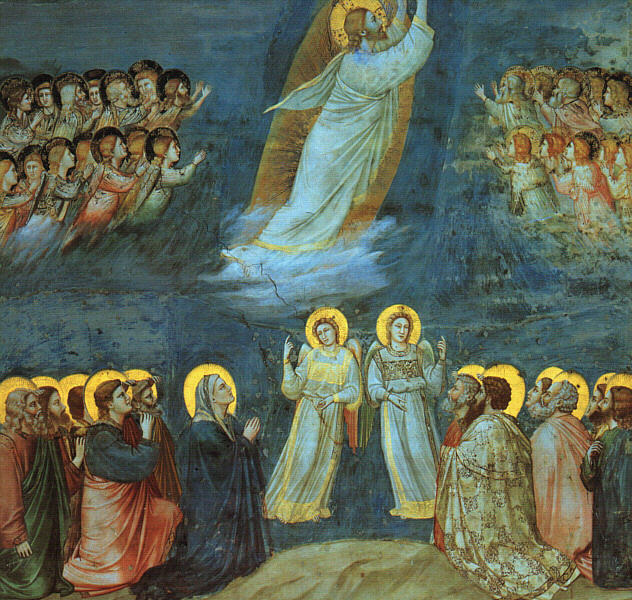
This tradition continued in manuscrpts as well as icons for centuries, even when presented with greater animation as by Giotto (1267-1337) in the early fourteenth century. Nonetheless there is an awkwardness in the central figure:


http://www.artinthepicture.com/artists/Giotto/ascension.jpeg

Image:artinthepicture.com

Noneteless the hierarchical tableaux vivante deriving from the icon tradition was still powerful at the end of the fifteenth century as in   Pietro Perugino's painting of 1494-98:

http://www.christchurchcarnforth.co.uk/wp-content/uploads/2010/05/Ascension4.jpg

Image:christchurchcarnforth.co.uk

Tintoretto's painting, begun circa 1576 and completed in 1581 conveys a dynamic energy lacking in other representations:


http://uploads6.wikipaintings.org/images/tintoretto/ascension-of-christ-1581.jpg!Large.jpg

Image:wikipaintings.org

After that the full Baroque style developed, with which we are familiar. The results may be impressive - and indeed seem designed for architectural settings in churches with soaring columns and soaring music to accompany the liturgy - but they can at times be accidentally somewhat comic in their effect. They appear to be more concerned with the mechanics of the ascension rather than with its theology, whereas the earlier tradition tended to place the emphasis on the theology at the expense of narrative, or at least naturalism.

However there is one painting which does, to my mind, manage to combine both theology and naturalism in its narrative of the Ascension, although it is not simply a depiction of that event alone in the economy of Salvation - and I shall write about it in my next post...


Thursday, 2 June 2011

Hail the day that sees Him rise


Today is Ascension Day.

That is to say that I have said the Office for the Ascension of Our Lord and I went to the well attended Extrordinary Form Mass at the Oratory at lunchtime. I shall keep this coming Sunday as the Sunday within the Octave, or if you, prefer, Sunday in Ascensiontide.


The Ascension
Giotto 1266-1337
Capella de Scrovegni, Padua

I accept and respect the right of the Hierarchy to have petitioned for the transfer of the three days of obligation to the Sunday nearest or following, but I prefer to keep all three feasts on their proper day. That shows fidelity to past generations of Christians, and the fidelity that says one does not keep religion for weekends only

There are strong rumours that the Bishops are thinking about returning to the historic days for Epiphany, Ascension and Corpus Christi, and this would be welcome indeed. It is something we can pray and hope for, as well as encourage by appropriate lobbying.

Here in Oxford the traditional practice of beating the bounds was being observed this morning, and moving our observance of the feast is distinctly un-ecumenical and confusing.

Let us hope that we are all celebrating this wonderful feast on its proper day, 40 days after Easter, in 2012.

Thursday, 13 May 2010

Ascension Day


Today is Ascension Day and I am observing it as such. That is to say that I have said the Office for the day and will attend the Sung Mass in the Extraordinary Form at the Oxford Oratory at lunchtime. Like many people I very much regret the decision to transfer observance of the Solemnity in the Ordinary form to the Sunday after Ascension Day, though I must admit I quite enjoy getting a second chance to celebrate one of my favourite feasts. However one always did that in effect with that Sunday as being in Ascensiontide.

Quite apart from its disregard of the specified forty days after the Resurrection, the discontinuity with the historic tradition of the Church, and its concession to modern laziness in getting to church at some point today - as if those were not overwhelming arguments - I would also stress the point that other Christians observe the Ascension today. So here in Oxford Merton choir have, I assume, climbed to the top of their chapel tower to sing 'Hail the day that sees Him rise' at breakfast time - always a delight to hear wafting over the rooftops when I lived in Oriel - and the ancient parishes of the city will be beating the bounds today. So at Oriel the choir of St Mary the Virgin would solemnly march across the middle of Front Quad to follow the ancient boundary between their parish and that of St John the Baptist (a parish that disappeared as a separate entity in the nineteenth century, but is represented by Merton Chapel). The most intriguing bit of boundary beating takes place, I am told, though I have never witnessed it, in the middle of Marks and Spencer. There amidst the shoppers the little procession comes in to beat and take note of the parish boundary marker.

There is, however, one incidental benefit of the transfer of the Solemnity - not that that excuses it. It does mean that we do not lose the feast of Our Lady of Fatima in the Ordinary Form. So I can go back to church to attend a second Mass early this evening to mark that feast as well today.