Over
the centuries St George has been an immensely popular saint, and
consequently many artists have received commissions to depict him. I
have posted about some of these, and about devotion to him, in previous years in
St George's Day,
Hymn to St George,
St George,
St George and the Dragon and
St George at Fordington.Here are a few more which caught my eye as I looked on the internet.
When he is not shown as a standing, solitary figure the most usual
image of St George is, of course, that of him slaying the dragon. More
than the Renaissance and Baroque versions I particularly like the late
medieval depictions of the event, such as this one:

An
image of St George taken from a Book of Hours, Use of Sarum,
Pink Canopies
Group, Bruges, circa 1390-1400, 197 x 123 mm, Sloane MS 2683, f. 14v
Copyright © The British Library Board
Here is one of 1432-5 by Roger van der Weyden, now in the National Gallery in Washington:
Image;
ca.wikipedia
or this one, now in Chicago, by the fifteenth century Catalan artist
Bernat Martorell and dated to 1434-5:

Image: Wikipedia
Part
of the appeal of such paintings is the delight in details of
contemporary life - hence I suppose my own interest as a historian of
the period. Renaissance painters tended towards a more idealised style,
sometimes with results they may not have entirely intended.
Thus this standing figure of the saint by
Carlo Crivelli from
1472 is undoubtedly a beautiful painting, and expresses the concept of
George as a pure and noble youth, but to modern eyes it does look, well,
a little effete...:
Image: Wikipedia
There is something of both traditions, of the late medieval gothic and
the classicised ideal, in this painting in the Accademia in Venice by
Andrea Mantegna of
circa
1460:
 Image:Wikipedia
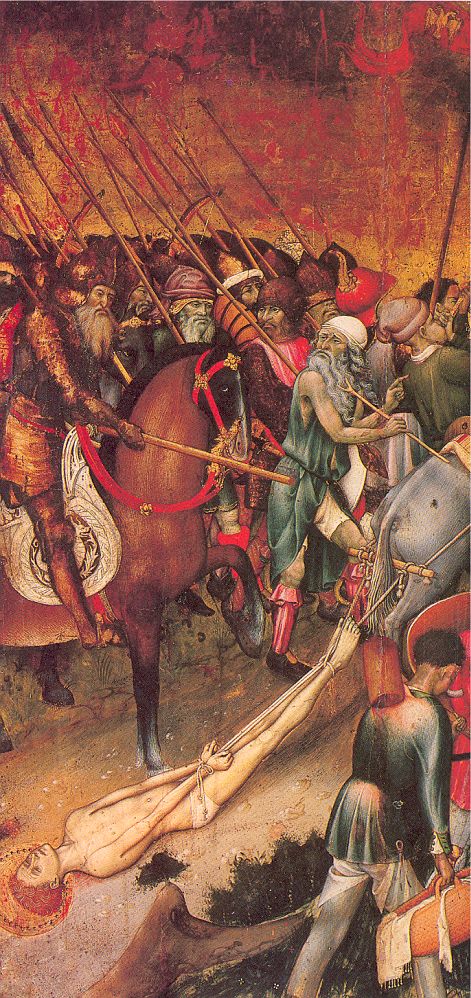
The story of St George's martyrdom itself has produced fewer
pictures, perhaps because his Acta seems too fantastical. Here is one of
him being dragged to his execution, again by Martorell:
Image: Wikipedia
I was interested to find this following one online. It shows the saint being roasted in a brazen bull, then dragged through the
streets, before being beheaded and buried:
The martyrdom of
St George
Unknown artist, Bruges 1500-1510, now in the
Groeningemuseum
Image: Wikipedia
The martyrdom did attract later artists, but their more epic and florid style is one I
tend to find less appealing, historically and artistically as well as devotionally.