Once I was a clever boy learning the arts of Oxford... is a quotation from the verses written by Bishop Richard Fleming (c.1385-1431) for his tomb in Lincoln Cathedral. Fleming, the founder of Lincoln College in Oxford, is the subject of my research for a D. Phil., and, like me, a son of the West Riding. I have remarked in the past that I have a deeply meaningful on-going relationship with a dead fifteenth century bishop... it was Fleming who, in effect, enabled me to come to Oxford and to learn its arts, and for that I am immensely grateful.


Showing posts with label Cult of St George. Show all posts

Monday, 14 September 2015

John Duke of Bedford


Today is the 580th anniversary of the death of John of Lancaster, Duke of Bedford (1389–1435), the third son of King Henry IV, and, after the death in 1422 of his eldest brother King Henry V, Regent of France and, when in England, of this realm also for King Henry VI.


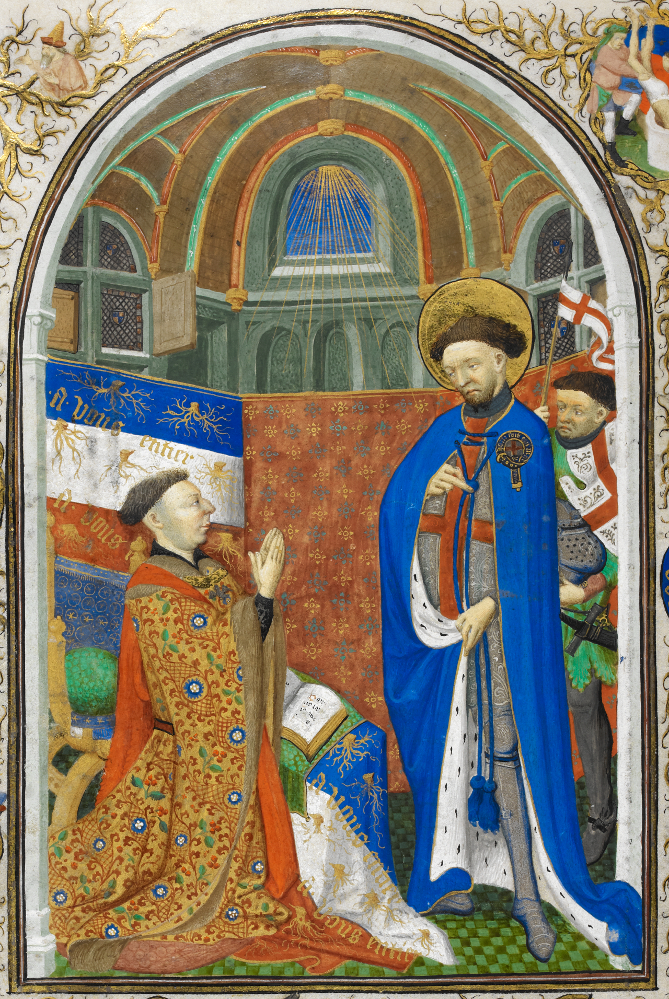
 Duke John kneels before St George, who wears the mantle and garter of the Order of the Garter.
The Duke's badge of a root forms the background to the border.
From the Bedford Book of Hours, circa 1423.
  Image: Wikimedia


http://photos.geni.com/p13/da/51/6c/ff/5344483dc85717bb/john_duke_of_bedford_kg_-_stall_plate_large.jpg


The Duke's Garter Plate at Windsor 

Image:geni.com
 
Jenny Stratford's life of Duke John in the Oxford DNB can be read here. There is a short, illustrated, online account of him at  John of Lancaster, 1st Duke of Bedford

https://upload.wikimedia.org/wikipedia/commons/thumb/e/e2/John,_Duke_of_Bedford_-_British_Library_Add_MS_18850_f256v_-_detail.jpg/220px-John,_Duke_of_Bedford_-_British_Library_Add_MS_18850_f256v_-_detail.jpg
  
 The Duke in close-up from the image shown above


 Image: Wikipedia

An able soldier and administrator under both his father and brother he spent the years of his regency in actively pursuing the Lancastrian cause in France, winning the battle of Verneuil in 1424 - as I often point out to people this was the last major English military victory on the continent until Blenheim, almost exactly 280 years later to the day, in 1704. He was involved in keeping political peace at home with the feuds between his younger brother Humphrey Duke of Gloucester and their uncle Bishop, and later Cardinal, Beaufort, and between wavering allies in the Dukes of Brittany and Burgundy.  His death was a major blow to the English cause in France. A cultured intelligent and able prince he was to prove irreplaceable.

The Duke was also a notable collector and patron of the arts and two pages from his earlier Book of Hours and Psalter from 1414 which went to the British Library in 1928-30 can be seen at http://www.artfund.org/supporting-museums/art-weve-helped-buy/artwork/816/the-psalter-and-book-of-hours-of-john-duke-of-bedford-medieval


Anne, Duchess of Bedford (detail) - British Library Add MS 18850 f257v cropped.jpg

The Duke's first wife, Anne of Burgundy
Detail from the Bedford Book of Hours

Image:Wikipedia


Duchess Anne kneels before St Anne, the Virgin Mary and the Christ Child

From the Bedford Book of Hours

Image: Wikimedia 


Sunday, 12 July 2015

St George ring from Norfolk


The BBC News website has this interesting report about the discovery at South Creake in Norfolk of a medieval ring decorated with the image of St George. It is being dated to the period 1350-1430. This is being linked to devotion to the saint in Norwich, a city with a major Guild of St George in the later middle ages, founded in 1385, and on which I have posted in part in English Iconoclasm II - the fate of the cult of St George.

The report, with pictures, can be seen at Rare medieval St George ring found in Norfolk

I see from the BBC webpages that a very similar ring found in Somerset was sold last month: the illustrated report about that example can be seen at St George medieval ring sold for £7,000 at auction


Saturday, 9 August 2014

English Iconoclasm II - the fate of the cult of St George


By the time of the English reformation St George was well-established as the national patron saint, but this did not necessarily protect his images from assault and destruction.

We do not know if there was in medieval England anything comparable to Berndt Notke's great figure of the saint from 1489 in what is now Stockholm cathedral:


St George slaying the Dragon by Berndt Notke 1489
Stockholm cathedral

Image;lib-art.com 

There is more about this wonderful piece in my post St George and the Dragon.

It is possible that England had similar sculptures, and something along these lines is suggested by the following mid-fifteenth century illumination:


Altar with St George and the Dragon, from a manuscript presented to Queen Margaret of Anjou, wife of King Henry VI by the first Earl of Shrewsbury, and made in Rouen in 1445. Kneeling at the altar are the Knights of the Garter.

Image: wars of theroses.devhub.com

When English statues of St George do survive they are usually damaged, and no longer objects of direct devotion or in their original places: 

 File:Saint George and the Dragon alabaster sculpture.jpg

St George and the Dragon
English polychromed alabaster, 1375-1420

National Gallery of Art, Washington D.C.

Image:Wikipedia 

Indeed the ceremonies of the Order of the Garter were purged of "superstition" under King Edward VI.

The fate of the cult, and of images generally is well illustrated by Prince Arthur's chantry in Worcester cathedral.

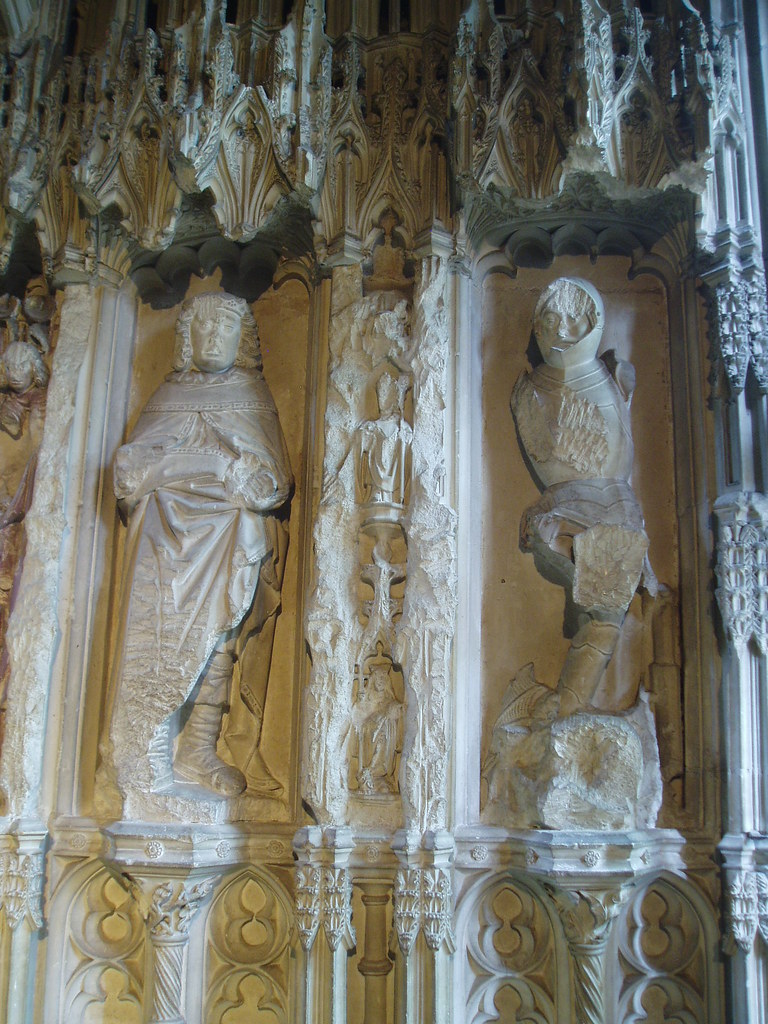
When the Prince died at Ludlow in 1502 - an event wghich may well be seen as the germ of the English reformation - or at very least the break with Rome in 1533 - he was buried at Worcester and his sorrowing parents commissioned and erected the beautiful chantry that still surrounds his tomb.  On the outside there are still small figures of saints, but the reredos inside bears shocking witness to the events of a generation or so later.


Prince Arthur's Chantry, Worcester Cathedral

The interior of Prince Arthur's Chantry, Worcester Cathedral

 Image:whub.org.uk

At some point - probably at or after the suppression of the chantries in 1548 - ahammer was brought to bear on the statues, as can be seen below:

photo

Detail of the reredos in Prince Arthur's Chantry

Image: Aidan Macrae thompson on Flickr

By contrast in the royal mausoleum of Westminster Abbey the statues survived more or less intact in King Henry VII's chapel there, and on the chantry of King Henry V - chance played no small part in these matters.

A generation later and the Prince's neice, Queen Elizabeth I, was due to visit Worcester in the 1570s. She visited the  tomb, and presumably in advance of her visit, the doubtless embarrassed cathedral authorities had the reredos plasterd over and the Royal Arms ( which had replaced the Rood in parish churches as a focus of alliegance) painted on the blank wall. So it remained until the restoration of the cathedral in the reign of Queen Victoria.

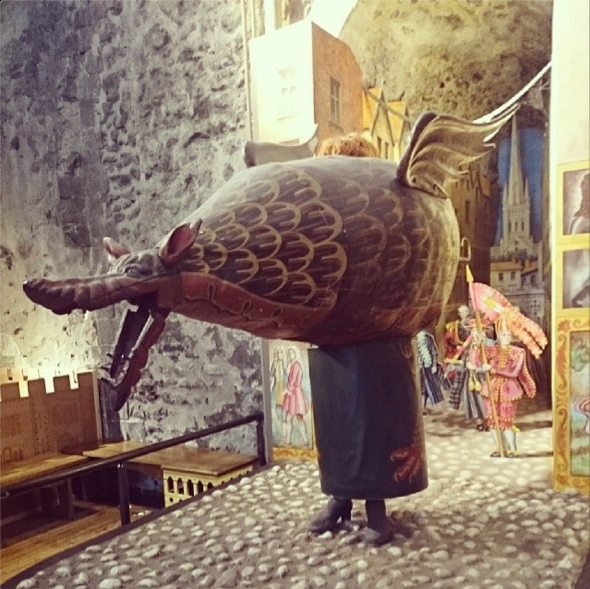
However devotion to aspects of the story of St George did survive. In the city of Norwich, despite its  Protestant tradition, the procession at the Mayor making retained part of the traditional feature of St George, the Dragon and the maiden. Well, at least the Dragon survived...


2014-04-10-SnapDragonNorwichCastleMuseum.png

Snap, the Norwich Dragon

Image: huffingtonpost.co.uk

I have adapted the following from a piece on the Norwich12 website account of Snap:

An organisation credited with establishing a significant role for dragons in Norwich is the Guild of St George, founded as a religious guild in 14th-century Norwich to observe St George's Day. It became one of the most powerful and wealthy guilds in the city and developed close ties to the city government. The Guild of St George introduced its annual procession - Guild Day - on 23 April, the date of the saint's martyrdom. St George and Margaret, the maiden he rescued, were represented, and to bring the legend to life Snap the dragon was also introduced. Rushing around, taunting the crowds with wings flapping and smoke shooting from its mouth, Snap soon became a popular element of the procession.
In the late 16th century Guild Day merged with the swearing-in of the city's new mayor. Although St George and Margaret no longer featured in the procession, Snap remained and the procession evolved into a grand civic occasion. Then came the Municipal Corporation Act of 1835, which set out to reform municipal institutions. Civic purse strings were cut and much of the pomp and circumstance of the civic processions disappeared. Snap refused to go quietly, though, and continued to appear occasionally until 1850. 

In 1997 the Norwich Whifflers revived Snap, whose traditional design is based on originals now housed in Norwich Castle Museum, and so after a lengthy period of absence Snap is once more part of the Lord Mayors' celebration.

For more detail on the history of ceremonial dragons in Norwich there is  this article by Frank Meeres from the Norfolk Record Office.

There is a more detailed history of the Guild of St George and Snap here and something about its modern revival since 1997 from the website of the Norwich Wifflers here.

It seems to prove that whilst you may be able to keep a good man down you can't keep a good dragon down.

To be continued


Wednesday, 24 April 2013

St George Altarpiece


Fr Blake's post for yesterday, Dragon Slaying Glorious Martyr, featured the St George Altarpiece from Valencia of circa 1420 which is now in the Victoria and Albert Museum. I have posted before using the main painting of the saint as dragon slayer, but thought I would post the a picture of the whole composition as a further example of depictions of the story of the martyr saint:


The St George Altarpiece

Image:Victoria and Albert Museum


This large altarpiece is a fine example of the Valencian school during the International Gothic Style in the first quarter of the 15th century. It was traditionally attributed to the German painter established in Valencia, Andrès Marçal de Sas (ca.1393-1410) although this attribution is still subject to debate and leads to more cautiously call the artist responsible for this work 'Master of the Centenar' according to the provenance of the retable most likely executed for the chapel of the Confraternity of the Centenar de la Ploma.

The altarpiece illustrates the legend of the St George. It is composed of three superimposed central panels surmounted by the Holy Spirit and Christ enthroned flanked by two prophets. On each side are depicted ten scenes of the life of the saint, combining two different narrative cycles: the victory of St George against the dragon and the martyrdom of the saint. The predella panel illustrates ten scenes of the Passion of Christ.


St George slaying the dragon
 
Image: Victoria and Albert Museum

Relics of St George


Yesterday evening I went to Mass in the extraordinary Form at SS Gregory and Augustine here in Oxford to mark the Solemnity of St George. Following the celebration we were invited back to the altar rail to venerate a relic of St George, which we all did. This obviously gave a greater sense of immediacy to the celebration of the nation's patron saint, although it must be conceded that the reliquary was rather less splendid than this example from the Wittelsbach collection at the Residenz in Munich:

Picture: Statuette of St George

The Statuette of St George

Image: Residenz Munich
  
The statuette, made of gold, enamel, silver-gilt, diamonds, rubies, emeralds, opals, agate, chalcedony, rock crystal, other precious stones and  pearls, and standing 50 cm high, was made in Munich between 1586 and 1597 to house a relic of St George that Archbishop Ernst of Cologne sent in 1586 to his brother Duke Wilhelm V of Bavaria. The bearded face of the saint behind the movable visor is carved from boxwood and resembles that of the man who commissioned the statuette, Duke Wilhelm V.

In the seventeenth century, the statuette was displayed on important feast days on the altar of the Reiche Kapelle (Ornate Chapel) in the Munich Residenz.

From the foundation in 1726 of the Royal Military Order of Saint George for the Defence of the Faith and the Immaculate Conception the reliquary featured in the celebrations of the Order, which still exists and about which there is an online account here.

The Grand Master of the Order is the Bavarian Sovereign and Head of the House of Wittelsbach.

King Ludwig II of Bavaria


King Ludwig II in the robes of Grand Master of the Order

Image:bundesliga. the offside.com

Tuesday, 23 April 2013

St George in art - dragon slaying and martyrdom


Over the centuries St George has been an immensely popular saint, and consequently many artists have received commissions to depict him. I have posted about some of these, and about devotion to him, in previous years in St George's Day, Hymn to St George, St George, St George and the Dragon and St George at Fordington.Here are a few more which caught my eye as I looked on the internet.

When he is not shown as a standing, solitary figure the most usual image of St George is, of course, that of him slaying the dragon. More than the Renaissance and Baroque versions I particularly like the late medieval depictions of the event, such as this one:

Image of St George taken from the Book of Hours


An image of St George taken from a Book of Hours, Use of Sarum,
Pink Canopies Group, Bruges, circa 1390-1400, 197 x 123 mm, Sloane MS 2683, f. 14v
Copyright © The British Library Board


Here is one of 1432-5 by Roger van der Weyden, now in the National Gallery in Washington:

Fitxer:Rogier van der Weyden - Saint George and the Dragon, NGA, Washington.jpg

Image; ca.wikipedia

or this one, now in Chicago, by the fifteenth century Catalan artist Bernat Martorell and dated to 1434-5:

http://upload.wikimedia.org/wikipedia/commons/thumb/b/b9/Martorell_-_Sant_Jordi.jpg/478px-Martorell_-_Sant_Jordi.jpg

Image: Wikipedia


Part of the appeal of such paintings is the delight in details of contemporary life - hence I suppose my own interest as a historian of the period. Renaissance painters tended towards a more idealised style, sometimes with results they may not have entirely intended.

Thus this standing figure of the saint by Carlo Crivelli from 1472 is undoubtedly a beautiful painting, and expresses the concept of George as a pure and noble youth, but to modern eyes it does look, well, a little effete...:

http://upload.wikimedia.org/wikipedia/commons/thumb/4/48/Saint_George_-_Carlo_Crivelli.jpg/274px-Saint_George_-_Carlo_Crivelli.jpg


Image: Wikipedia


There is something of both traditions, of the late medieval gothic and the classicised ideal, in this painting in the Accademia in Venice by Andrea Mantegna of circa 1460:


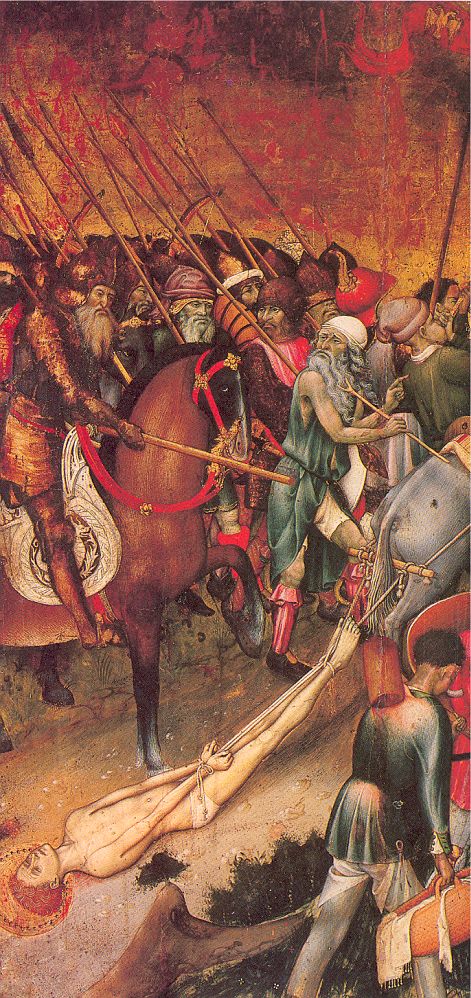
The story of St George's martyrdom itself has produced fewer pictures, perhaps because his Acta seems too fantastical. Here is one of him being dragged to his  execution, again by Martorell:


Image: Wikipedia
I was interested to find this following one online. It shows the saint being roasted in a brazen bull, then dragged through the streets, before being beheaded and buried:

File:16th-century unknown painters - Scenes from the Legend of St George - WGA23611.jpg

The martyrdom of St George
Unknown artist, Bruges 1500-1510, now in the
Groeningemuseum

Image: Wikipedia

The martyrdom did attract later artists, but their more epic and florid style is one I tend to find less appealing, historically and artistically as well as devotionally.


Praying to St George


John Duke of Bedford, Regent of France, kneels in prayer before St George. The saint is shown wearing the mantle of a Knight of the Garter. The Garter can be seen below his left knee.

From the Bedford Book of Hours

Image;Wikipedia

This part of the manuscript can be dated to 1423-30. The Book of Hours is now in the British Library as Addnl.MS 18850. There is an online article about the Bedford Hours here.

The extremely useful biography of the Duke by Jenny Stratford from the Oxford Dictionary of National Biography can be read here, and there is a shorter online account with some useful links here.


May St George pray for all those nations and foundations under his patronage.


Monday, 2 May 2011

St George


Today is the transferred Solemnity of St George.

There is an online article about him here and one about devotion to him and his cult here.These bring out the extent of his popularity as a patron and the way in which different countries and cultures have appropriated him.Both of the articles have a selection of images of the saint produced by artists over the centuries.


St George killing the Dragon
Raphael 1505-06
National Gallery Washington DC

This psinting was commissioned by the Duke of Urbino to commemorate his admission as a Knight of the Garter, and St George is depicted wearing the Garter below his left knee.

May St George pray for us and all those who have sought his patronage!