Once I was a clever boy learning the arts of Oxford... is a quotation from the verses written by Bishop Richard Fleming (c.1385-1431) for his tomb in Lincoln Cathedral. Fleming, the founder of Lincoln College in Oxford, is the subject of my research for a D. Phil., and, like me, a son of the West Riding. I have remarked in the past that I have a deeply meaningful on-going relationship with a dead fifteenth century bishop... it was Fleming who, in effect, enabled me to come to Oxford and to learn its arts, and for that I am immensely grateful.


Showing posts with label Roger of Pont L'Evêque. Show all posts

Tuesday, 11 June 2013

The Young King


Today is the 830th anniversary of the death at Martel near Limoges of Henry the Young King, the eldest of the sons of King Henry II and Queen Eleanor of Aquitaine to reach maturity. Their second son he was born on February 28th 1155, just after his father's accession and coronation. He himself was crowned in his father's lifetime as King in 1170 - an action which enraged St Thomas of Canterbury as the coronation, a privilege of his see, was performed by Archbishop Roger Pont L'Evêque of York - but died in 1183, six years before his father. As a result he has tended to disappear from regnal lists, and indeed he has no numeral indicator; maybe we should follow the German practice and designate him King Henry (III), but that would cause confusion. Still it should be remembered that there have been nine, not merely eight, crowned English Kings called Henry - and if you are Jacobite in sympathies, then there is also Cardinal York...

One attempt to draw attention to his life is a blog Henry the Young King which offers interesting posts about him.

There is an online account of him here, which cites this description of him :  

A Latin poem by a court official written to commemorate the coronation hints at the charisma of this young prince. There he is described as a charming youth of striking beauty, tall but well proportioned, broad-shouldered with a long and elegant neck, pale and freckled skin, bright and wide blue eyes, with a thick mop of the reddish-gold hair characteristic of his dynasty.


Henry the Young King.jpg

The Coronation of Young King Henry

Image; Wikipedia

As that online account and Elizabeth Hallam's life of him in the Oxford DNB, which can be read here, show he was not universally popular with his contemporaries. This aspect is discussed in the post
A Lovely Place of Sin from the blog about his life.


Given little real authority by his father he spent much of his time jousting. A popular and affable young man, but perhaps not the strongest character - Gerald of Wales wrote of him and his brother Richard that they were "both tall in stature, rather above the middle size, and of commanding aspect. In courage and magnanimity they were nearly equal; but in the character of their virtues there was great disparity... [Henry] was admirable for gentleness and liberality...had a commendable suavity... commended for his easy temper... remarkable for his clemency... the vile and undeserving found their refuge in [Henry]... was the shield of bad men... was bent on martial sports... bestowed his favours on foreigners... [Henry's] ambition magnanimously compassed the world." 

His father's reported statement about him has genuine pathos - "He cost me much, but I wish he had lived to cost me more."


http://theplantagenets.com/wp-content/uploads/2010/10/Yungking.jpg 

The head of the effigy of theYoung King in Rouen cathedral

Image: the plantagenets.com

His Queen was Margaret of France, daughter of King Louis VII and his second wife Constance of Castile; Margaret's elder half sisters, being the daughters of Queen Eleanor from her first marriage, were thus the Young King's half sisters as well. They had a son William who lived for three days in 1177. Following Henry's death she returned to the French court and married secondly King Béla III of Hungary  - thus becoming the only Queen of both England and Hungary.


Henry the Young King

The effigy in the choir ambulatory at Rouen cathedral

Image:professor-moriarty.com


Henry the Young King

A close-up of the face

Image:professor-moriarty.com


One consequence of his death was that when his brother Richard succeeded their father as King in 1189 there was not a division of the Angevin empire within France, as might have happened if the Young King and lived and Ricahrd had been left as Duke of Aquitaine. As it was the Duchy remained linked to the English crown until 1453.
 
In the weeks before his death the Young King had been plundering shrines such as St Martial at Limoges and Roqueamadour to fund a campaign against his father; struck down by dysentery he spent his last days, as is recounted in the Wikipedia article cited above, in penitence and seeking forgiveness. This, and doubtless the reaction to the death of a handsome young ruler who had a considerable following, led to an attempt to present him as a potential saint. As a result his body, on its journey for interment was Rouen as he had requested, was seized for burial at Le Mans by the Bishop before being recovered by the Dean of Rouen and taken to the cathedral there, where it was finally buried on July 22nd. The effigy over his tomb appears similar to that over the heart burial of his brother King Richard I which is also in the choir, and probably dates from the years after 1200.

 
The seal of Henry the Young King

Image; Henry the Young King blogspot


Thursday, 9 May 2013

The Ascension - a twelfth century view


The Ascension
 
Image:english.cam.ac.uk
 
This strikingly-coloured and composed Romanesque image of the Ascension is from the York Psalter, which was painted circa 1170 in the north of England, in the era of Archbishop Roger of Pont-l'Évêque (1154-1181). It is now Glasgow University Library, MS Hunter 229 (U.3.2), fol 14

Christ's feet are seen disappearing into stylized layers of multi-coloured clouds, while two angels swoop below with outstretched wings, bearing scrolls. Below, ten apostles, some with upturned faces and pointing in astonishment, flank the central figure of the Virgin Mary who also gazes upwards with her expressive hands raised. The scene takes place against a golden background.

Other images from the psalter can be seen
here , here , herehere and  here. With this manuscript one gets an idea of the use of colour in the churches of twelfth century northern England - not dull and dark as they so often appear today to the visitor, but vibrant with colour and devotion. Moreover the use of colour is sophisticated and confident and far from garish or crude.


Tuesday, 22 November 2011

A scandalous Archbishop?


Depending on whether one follows his younger contemporary Roger of Hovedon who assigns his death to November 22nd or Thomas Stubbs in the fourteenth century, who gives November 26th (our old friend scribal error may explain it - reading xxii as xxvi) hereabouts is the anniversary of the death 830 years ago in 1181 of Roger of Pont L'Evêque, born in Normandy about 1115 and who had been Archbishop of York since 1154.

The Oxford DNB life of Roger by Frank Barlow can be read here.
There is a similar online article here, which mistakenly places his burial at Durham, not York.

As Archbishop he is perhaps most famous for his being seen as an opponent of Thomas Becket, not least over the respective claims of the two archiepiscopal sees. As a friend and I recently agreed Roger was perhaps unlucky to have as his opposite number a future martyr for the liberties of the Church, and to have clashed with St Thomas over the exclusive claims of Canterbury to crown the English monarch. Roger's coronation of the Young King Henry on June 14th 1170 was the final breach between the two men.


Given other circumstances Archbishop Roger might have been remembered as a great servant of church and country and as a magnificent builder and patron. Little of what he built or knew now survives.

York Minster had been badly damaged by fire in 1137 and as Archbishop Roger set about remodelling the choir and crypt in 1154. The new eastern end of the cathedral was completed in 1175 producing an aisled choir, with its own transepts 40 feet longer than its predecessor. The eastern end was squared off and the whole choir raised over a large crypt. This may have been inspired by that at Canterbury which he would have known as Archdeacon to Archbishop Theobald.That is all that survives, as the choir was replaced after 1361 by Archbishop Thoresby's even grander structure. Even then its survival was accidental - the top of the vault was hacked away, and the crypy filled in until it was excavated after the 1829 fire. Part of the rubble from the old choir was used to create the eastern crypt as aplatform for the new fourteenth century altar and shrine of St William. What survives of Roger's crypt can now be viewed as part of the Minster undercroft. Archbishop Roger also extended the transepts by 40 feet and added two western towers, which disappeared with the early fourteenth century rebuilding of the nave.


The remains of Archbishop Roger's crypt at York

Image: York Minster website

In the north aisle of the nave there survives one panel of glass which is thought to have originated in Archbishop Roger's choir glazing. It is a figure from a Tree of Jesse:

http://images.travelpod.com/users/flyin_bayman/castles_beer-06.1146589200.york_minster_-_rare_medieval_stained_glass.jpg

Image: travelpod.com

To the north, behind the Minster, there survives part of a cloister arcade from the Archiepiscopal palace which is normally ascribed to him, as was the foundation of the collegiate church of St Mary and the Holy Angels for his clerks and which adjoined the palace gate. With the expansion of the Minster nave, this became joined to the cathedral in the early fourteenth century, but was a casualty of the reformation; its foundations were uncovered in the 1960s restoration.


https://blogger.googleusercontent.com/img/b/R29vZ2xl/AVvXsEihomZLcKV3czwI83OyteBI2yZ9QYh226J86g_xPOja4QJa87Kwp4VNddkVr7KcSof8G4_c6L6zkJs3OcVXmbTV0Crd_L1UGBvz4DAgr07K92ljAevLXFqM8wFc4kp5uY0U3uxcvI2_mJA/s400/York+Bish+palace+4.jpg

The remains of the palace cloister

Image:matthewpemmott.co.uk

http://farm5.static.flickr.com/4153/5440532377_0f81317a56_z.jpg

The cloister with Archbishop Grey's early thirteenth century chapel

Image: farm5 on Flickr

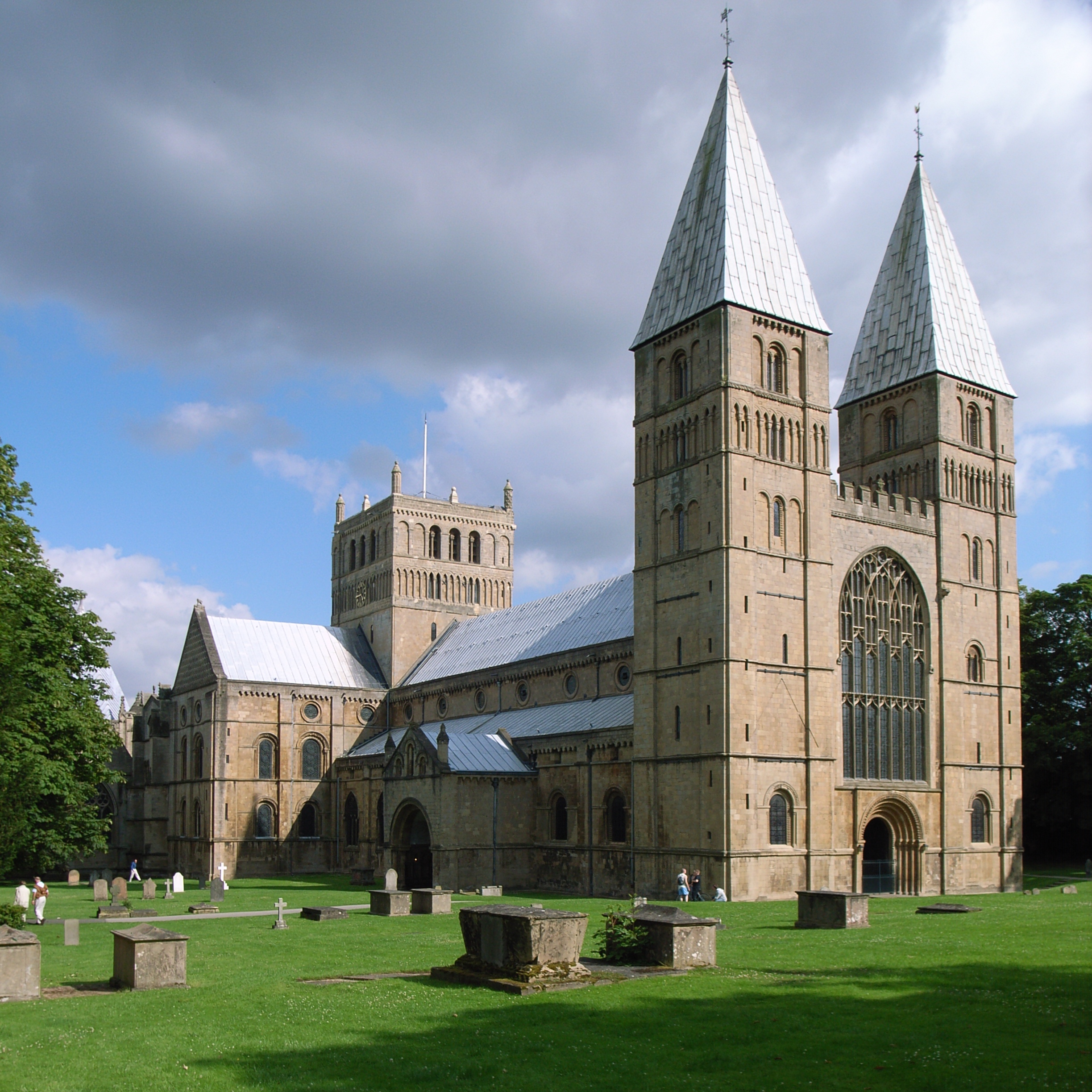
Of the three great daughter churches that functioned as pro-cathedrals in the diocese of York his work of the 1170s at Ripon survives in some nineteenth century reconstruction, but at Beverley anything he did has totally disappeared. At Southwell the church appears to have been completed just before his time, and he would doubtless recognise it, even with its great perpendicular window.


Southwell Minster

Image:Wikipedia

Probably the only other church he would recognise is the fine twelfth century nave of the church on the archiepiscopal manor at Sherburn in Elmet, which was sometimes used by Archbishops for ordinations and meetings.

There is more than a whiff of scandal attached to Roger. According to a letter attributed to John of Salisbury, who first reported this story in 1172 two years after the death of Thomas Becket, and nine years before Roger's own death, as a young and ambitious clerk in the household of Archbishop Theobald of Canterbury, and his Archdeacon from 1148, Roger was involved in a scandal involving a homosexual relationship with a boy named Walter. After Walter made the relationship public, Roger reacted by embroiling Walter in a judicial case that ended with Walter's eyes being gouged out. When Walter then accused Roger of responsibility for this crime, Roger persuaded a judge to condemn Walter to death by hanging. Becket supposedly was involved in the cover-up afterwards, by arranging with bishops Hilary of Chichester and John of Coutances for Roger to swear an oath that he was innocent. According to John of Salisbury, Roger then went to Rome in 1152 and was cleared of involvement by Pope Eugenius III. John of Salisbury further alleges that it was only after bribery that the Pope cleared Roger. Frank Barlow points out in his biography of Becket that while Roger was accused of these crimes, and may even have been guilty of some sort of criminal homosexuality, John of Salisbury, a noted partisan of St Thomas, could almost certainly have had the motive for bringing up this story in 1172 as a means of defaming Roger.The story would naturally have put Roger in the worst possible light. The story does not put Becket in too good a light, and if it is not true or exaggerated then John of Salisbury, distinguished scholar and churchman that he was, does not look so good either- if he actually wrote the letter in question.

The story, whether true, exaggerated or false, is better than most fiction - once again it would make for a good novel or drama, let alone modern newspaper style headlines "Archbishop of York arranged to have ex Gay-lover blinded and hanged" would be quite a good line - with or without phone-hacked evidence.

More seriously the story is a reminder that there have always been scandals and alleged scandals in the Church. That is not to minimise them, but it is also to say that we need to be sure when we pass judgement. The truth or otherwise about Archbishop Roger and Walter is now, presumably, unknowable. Contemporary allegation of scandal should be examined with the utmost seriousness, caution and care.