The announcement by
the Queen of the Netherlands that she will abdicate the throne on April
30th in favour of her son the Prince of Orange appears to have taken
people by surprise - and no bad thing in that.
Such a decision by Queen
Beatrix should not, of course, really have caused surprise. Of the six
Kings and Queens of the Netherlands only two, King William II in 1849
and King William III in 1890, have died in office, and Queen Wilhelmina, influenced by her own account of the abdication of the Emperor Charles V in 1556,
established the modern practice of the Sovereign retiring in 1948.
Indeed the present Queen's announcement is very similar in its timing to
that by her mother Queen Juliana in 1980.
The text of Queen Beatrix's broadcast to her people is as follows:
As you all know I hope to celebrate my 75th birthday in a few days. I
am grateful that I have been allowed to approach that day in good
health. At the end of this year we will commemorate the 200th
anniversary of our kingdom, a day which opens a new chapter in our
history.
The coinciding of these two special events has been the reason for me to decide this year to resign from my office.
Until today, this beautiful task has given me a lot of satisfaction.
It is inspiring to feel close to people, to sympathise in grievances and
share times of joy and national pride.
It is with great confidence, that on April 30 this year I will pass
my kingship to the Prince of Orange. He and Princess Maxima are fully
prepared for their future task.
They will serve our country with devotion, faithfully serve the
constitution, and with all their talents give substance to their
kingship.
I hope I will be able to continue to meet many of you frequently. I
am deeply grateful for the
trust you gave me during the many beautiful
years I was allowed to be your Queen.
There
is an informative blog article about the change of monarch which can be
read
here, and a profile of the future King
here.
Queen Beatrix with her son Prince Willem-Alexander
Image: AFP/Daily Telegraph
What makes this change of particular interest is that for the first time
in 123 years there will be a King of the Netherlands. The last one was
King William III who died in 1890 - a gap as long as that in this
country between Queen Anne and Queen Victoria. Three long and
essentially stable reigns of thre Queens regnant have contributed to the
stability of the Dutch monarchy.
The House of Orange appear to operate very much as a family business,
and are often, and doubtless unfairly, perceived in this country as a
rather stolid family, whose public lives are periodically exposed to
public scrutiny and criticism through their choice of spouse. The Orange
dynasty has been intextricably involved with the history of the country
ever since the career of William the Silent, and long may that
continue. There is an online account of the Princes of Orange, the title
and the original territory, as well as other claimants to that dignity
here.
I recall that in 1980 that the majority of British newspaper coverage of
the transition between Queen Juliana and Queen Beatrix even in the
conservative press concentrated on the minority of the Dutch population
who were critical of or opposed to the monarchy. On the day, of course,
the vast majority were happy to celebrate the transfer of the crown.
The new King will be inaugurated on April 30th. The Dutch monarch's ceremonial assumption of their kingship is a ceremonious occasion - one which stands in contract to the overworked cliche beloved of the media about the bicycling royal family.
 The inauguration of Queen Beatrix in 1980
Image:Tindra_1 on Flickr
The inauguration of Queen Beatrix in 1980
Image:Tindra_1 on Flickr
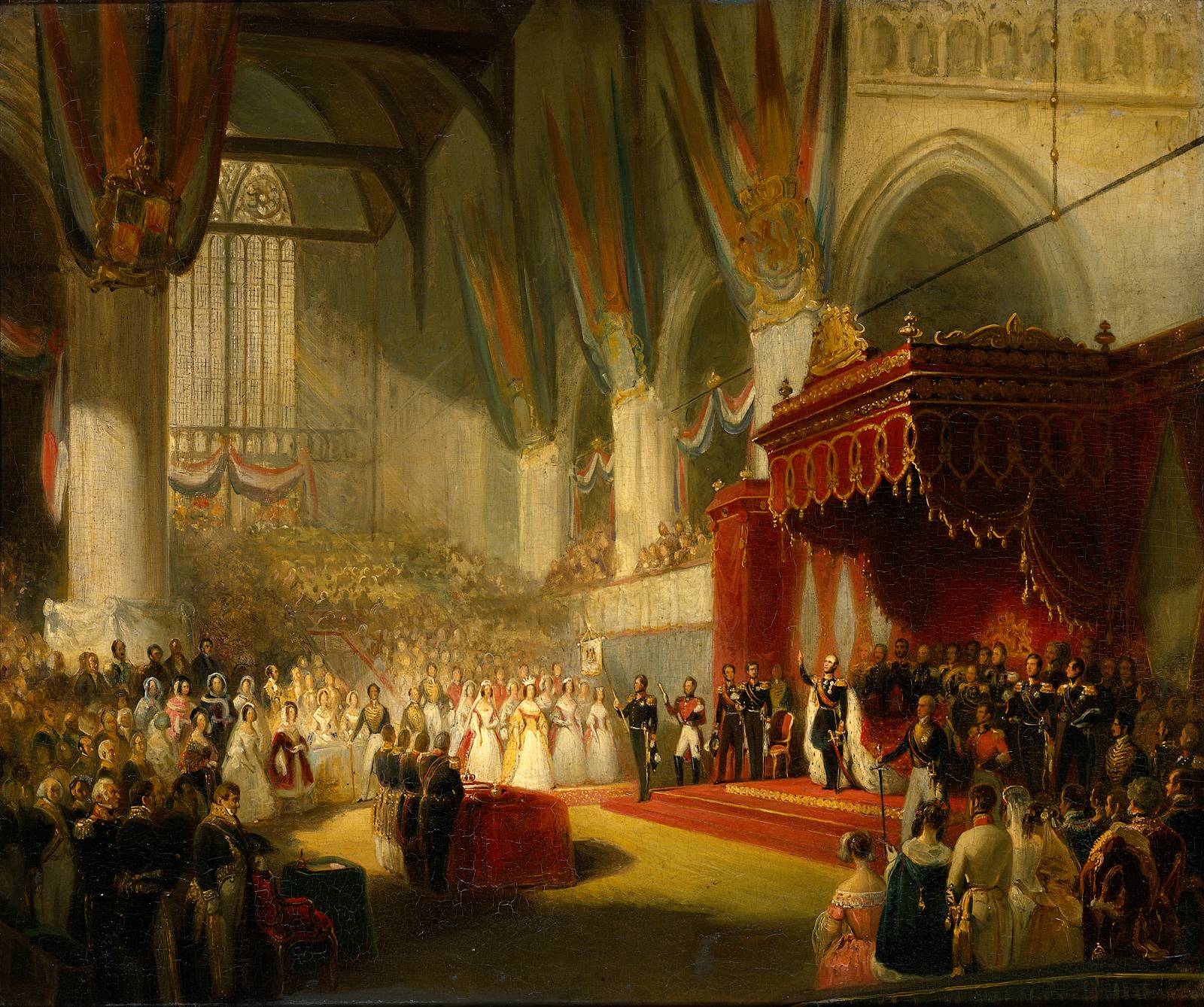
The ceremony is not a coronation as such, the crown and other regalia, have never been physically bestowed upon any Dutch monarch. Queen Beatrix, like each of her predecessors, had an inauguration
ceremony rather than a coronation. This was held at the
Nieuwe Kerk in Amsterdam.
The crown, orb and sceptre, about which there is an online article
here, were placed on cushions
surrounding a copy of the Dutch constitution on a table facing the throne. The crown is seen as symbolising sovereignty and dignity, the
sceptre authority and the orb the territory of the Kingdom. The
other two regalia - the sword of state, symbolising power, and the
standard of the kingdom bearing the coat of arms of the Netherlands -
are carried by two senior military officers. These regalia have been in
use since they were made for the investiture of King William II in 1840. The Queen, wearing the state mantle, was seated on a
throne opposite them as she took her formal oath to uphold the
kingdom's fundamental law. After the Queen took her oath, all members of
the
States General took an oath of loyalty to the new Queen.
On 30 April the Queen will sign the instrument of abdication
in the Royal Palace, Amsterdam. The new King and the former Queen will
then give a short address from the balcony of the Palace. Following the
appearance on the balcony, the investiture of the new King will take
place on the same day in the Nieuwe Kerk in Amsterdam. The ceremony
takes the form of a joint session of the two Houses of the States
General. During the investiture the new King is confirmed in office and
swears to be faithful to the Constitution and to faithfully discharge
the duties of his office. In return, the members of the two Houses swear
to uphold the constitution and the rights of the monarchy.
The Inauguration of King William II on November 28th 1840
Nicholas Pieneman
Image: Wikipedia