Once I was a clever boy learning the arts of Oxford... is a quotation from the verses written by Bishop Richard Fleming (c.1385-1431) for his tomb in Lincoln Cathedral. Fleming, the founder of Lincoln College in Oxford, is the subject of my research for a D. Phil., and, like me, a son of the West Riding. I have remarked in the past that I have a deeply meaningful on-going relationship with a dead fifteenth century bishop... it was Fleming who, in effect, enabled me to come to Oxford and to learn its arts, and for that I am immensely grateful.


Showing posts with label Pope Celestine V. Show all posts

Wednesday, 8 May 2013

A new face for Pope Celestine V


Pope Celestine V
An early mural painting and the new face mask
 
Image:news.discovery.com


I see from a post on the Medieval religion discussion group that over the course of several months the remains of Pope Celestine V - St Peter of Morrone  - have been examined, and a new funerary mask has been created. Born in 1215, and a hermit-monk, he was elected as Pope in 1294, and abdicated later on that year, and died as, in effect, a prisoner of his successor, Pope Boniface VIII, in 1296. He was canonised in 1313, and his feast day falls on May 19th.

There is an illustrated introduction to his life here, and there is another one here, with some additional illustrations.  A further account, with amore hagiographic emphasis with more pictures can be found on the link to the blog post here.

The remains are preserved at L'Aquila and survived the serious earthquake there in 2009, and indeed were visited in its wake by Pope Benedict XVI, who have his inauguration pallium for his predecessor to wear:
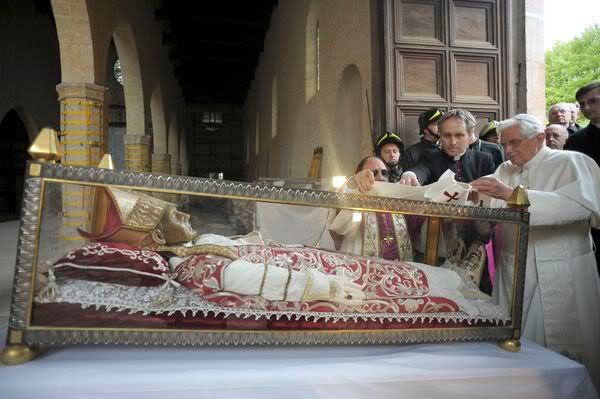

Image:365rosaries.blogspot.co.uk

Amongst the results of this latest examination of the relics was  confirmation (not for the first time) that the hole in his skull was made after his death, and so he definitely was not murdered, according to legend, by having a nail driven into his skull.


Murder Examination of Pope Celestine V

The skull of Pope Celestine V

Image: archelaos.com

The examination also indicated his height - five foot five inches - and much of his medical history.

A careful study was done of his cranium, leading to afacial reconstruction. However this was of a fifty year old, so the artist who made the silver mask had then to interpret that to produce an idea of what he looked like at the time of his death, when he was eighty or thereabouts.

There is an account of the discoveries in English here and two more accounts, with different illustrations, in Italian here and here.


Tuesday, 12 February 2013

The Pope's Abdication


It was not until late afternoon yesterday that I learned of the Pope's announcement of his intention to abdicate as of the evening of February 28th. His announcement appears to have caught virtually everyone by surprise, though I recall that he had said in an interview with Peter Seewald that he would consider abdication if he thought he was no longer physically able to exercise the Papal office as he thought it should be done. He has been a Pope of surprises, and in this final announcement has continued that way of operating.


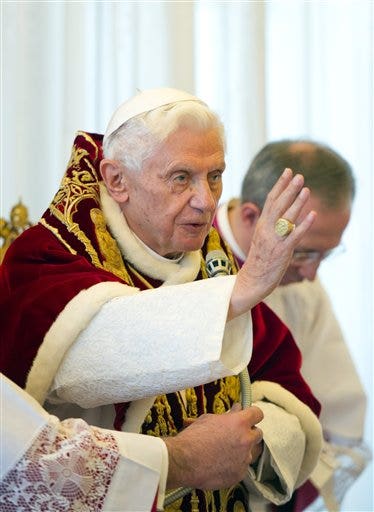
The Pope gives his benediction after his announcement

Image:Fox News

This is clearly the Holy Father's free personal choice, after prayer and reflection, as he said. It should be accepted with respect, and without the wilder theories that will doubtless go the rounds of the internet. He clearly wishes not only to avoid personal distress through infirmity, but to spare the Church another period of leadership by an ailing Pope. That is something he himself will well understand from the latter years of Pope John Paul II. From yesterday's pictures he appears more aged than hitherto, though the emotion of the choice and occasion must have taken its toll.

I am saddened by this news for two reasons. Firstly I am very sorry that someone for whom I have enormous, boundless, respect and admiration considers that they are too frail to continue in office. I have real human sympathy for the Pope, and wish him well in his retirement, the chance to relax and to spend time with his brother, and with God in prayer.

Secondly I am sorry that he will not continue to lead the Church along the lines he has led it since his election - despite his age I looked forward to new initiatives and genuine renovation coming from him.

I also feel great gratitude for all that the Pope has achieved in his pontificate and all that he has given to the life of the Church over so many years. This will be, I am sure, an enduring legacy of writings, formation, liturgical renewal - not just Summorum Pontificum but the new English translation and a real concern for the dignity and tradition of worship in and around the Papacy itself - the initiation and establishment of the Ordinariates, and the intellectual confrontation with secularism.

As someone who was received into full peace and communion two days before Pope John Paul II died I have been so far,  ipso facto, a Pope Benedict XVI Catholic, and consider myself very fortunate indeed to have had him as the visible head of the Church as I have grown into its life and practice.

The precedents for Papal abdication are few. He will apparently return to the status of being a Cardinal again, as did Popes Gregory XII and Pope John XXIII in the early fifteenth century. Will a life of cloistered prayer within the Vatican be possible for him without having the real opportunity to publish or speak again for fear of it being seen as a criticism of his successor? Will he be left in peace to do what he wishes?


Pope benedict XVI in 2009 visiting the reliquary of Pope Celestine V - St Peter of Morrone - who abdicated in 1294, the last Pope of an undivided Western Church to abdicate.

Images:New Liturgical Movement

As loyal Catholics we must continue to pray for the Pope, and for the Cardinals who will elect his successor, for that successor and for the Church.


Thursday, 20 May 2010

St Peter of Morrone - Pope Celestine V


May 19th is also the feast day of St Peter of Morrone, who was briefly, in 1294, Pope Celestine V, and who died in 1296. The hermit Peter of the Morrone founded the Benedictine congregation of the Celestines. He became Pope as Celestine V in 1294 and abdicated within a year. His successor, Boniface VIII, imprisoned him in a castle in southern Lazio. Peter was canonized in 1313. This may have been in part, and not withstanding Peter's personal sanctity, part of the reaction against Boniface VIII following his death in 1303 at the height of his quarrel with Philip IV of France.There is more about Peter-Celestine here from Wikipedia and here from the Catholic Encyclopaedia.

Here is a view of the castle of Fumone (near Alatri and Ferentino) where after his abdication Peter resided as Boniface's "guest".
This is the Italia nell'Arte Medievale page (views expandable) on the church of Santa Maria di Collemaggio at L'Aquila in Abruzzo, said to have been begun at Peter's behest in 1287 and his resting place since 1327, when most of his remains were surreptitiously brought from Ferentino to L'Aquila (Peter's heart is said still to remain at Ferentino in its chiesa di Santa Chiara).
Peter's tomb in that church is here and his effigy reliquary in the tomb is shown here, and here, and here. Peter's skull exhibits a rectangular hole in the left forehead that has provoked some suspicion about the manner of Peter's end; there is another photograph here.

The views of Santa Maria di Collemaggio were taken before the terrific earthquake of April 6th 2009 in which the church was seriously damaged. There are four pages of recent views beginning
here.

Thanks perhaps to the power of the saint, his tomb survived undamaged.
In the weeks after the earthquake the present Pope visited L'Aquila on April 28th last year.
As the Zenit website said:
Benedict XVI next travelled to the Collemaggio Basilica in L'Aquila, where he prayed in front of the casket with the remains of Pope St. Celestine V. To emphasize his spiritual solidarity, the Pontiff left there the pallium which he received at the beginning of his pontificate.
One might be cynical and think that was a decent way of disposing of it, but then one might not...

The New Liturgical Movement website had these pictures - one of the rare occssions when you will see two Popes together in a photograph - note for pedants, not just those of cardinals who became Pope later- that does not count:


To mark the 800th anniversary of Peter's birth in 1209 Pope Benedict has proclaimed the Celestine Year from August 28th 2009 to August 29 2010.

Here is a view of a late thirteenth- or early fourteenth-century fountain, said to have been erected in Peter's honour, in Isernia in Molise (Isernia is one of the candidates for the distinction of being Peter's birthplace):

This page offers a greatly enlargeable view of
Peter's portrait (before 1375) formerly in the abbey of Santa Maria at Casaluce (CE) in Campania and now in the cappella di Santa Barbara in the Castel Nuovo in Naples:

Based again on John Dillon's posting on the Medieval Religion discussion group, with my own additions of the visit of the present Pope last year.