Once I was a clever boy learning the arts of Oxford... is a quotation from the verses written by Bishop Richard Fleming (c.1385-1431) for his tomb in Lincoln Cathedral. Fleming, the founder of Lincoln College in Oxford, is the subject of my research for a D. Phil., and, like me, a son of the West Riding. I have remarked in the past that I have a deeply meaningful on-going relationship with a dead fifteenth century bishop... it was Fleming who, in effect, enabled me to come to Oxford and to learn its arts, and for that I am immensely grateful.


Wednesday, 11 November 2015

St Martin


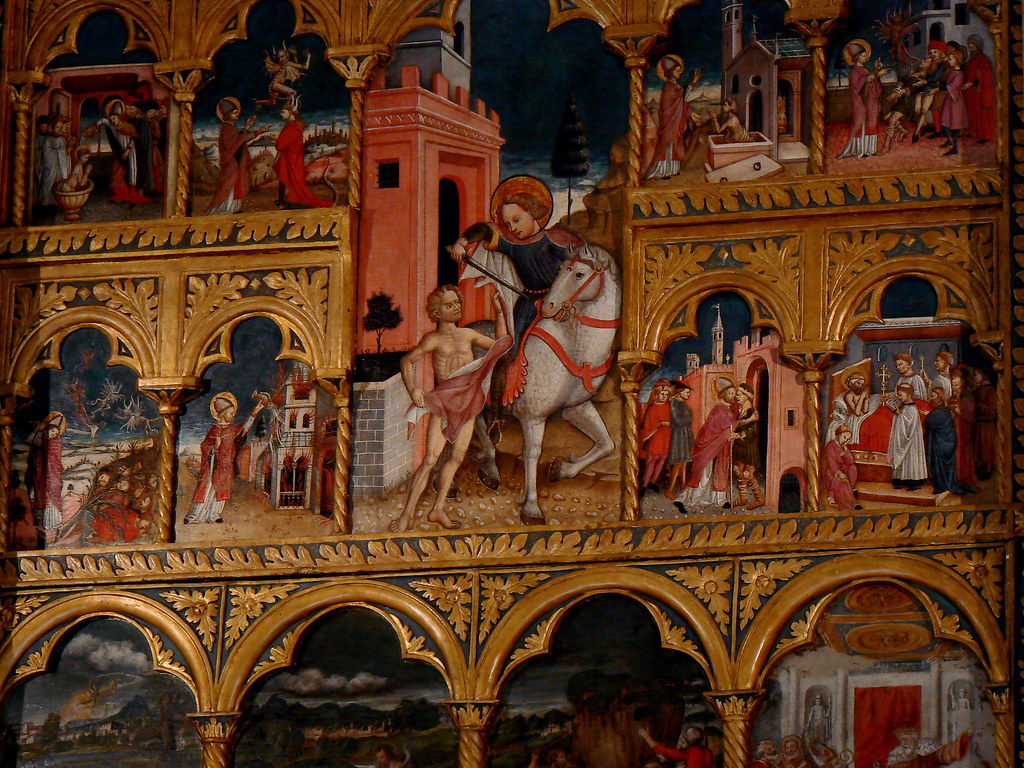
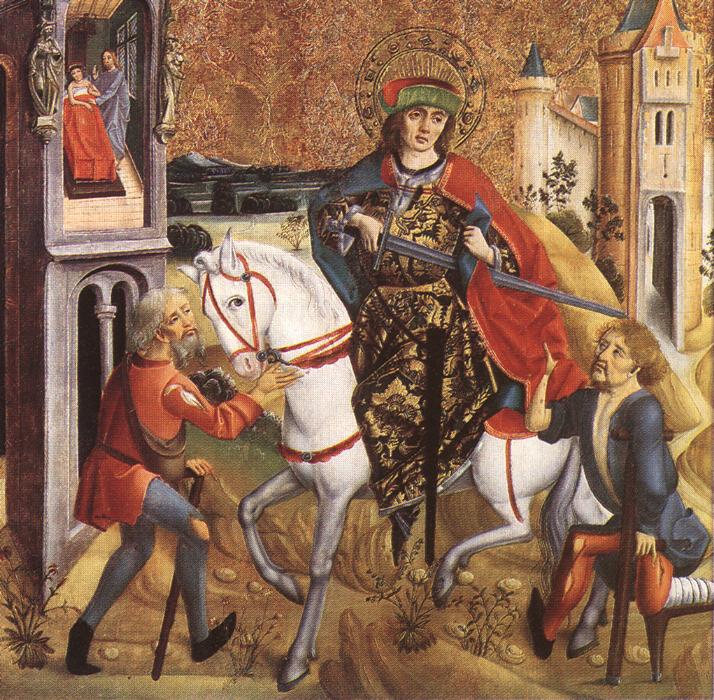
Today is the feast of St Martin of Tours, the first non-martyr to have a recognised cult, and a very popular saint in the middle ages - as is indicated by the wide distribution of the images below.

On the Medieval Religion discussion group Gordon Plumb posted the following stained-glass depictions of St Martin:

Beverley Minster, east window, panels of c.1235:
1e, Martin dividing cloak with beggar:
https://www.flickr.com/photos/22274117@N08/3370751437
2a: St Martin among robbers:
https://www.flickr.com/photos/22274117@N08/3370748595
2h: Dream of St Martin:
3h: St Martin chosen as bishop:
https://www.flickr.com/photos/22274117@N08/3370766983
https://www.flickr.com/photos/22274117@N08/3371577724
3b: Miraculous mass of St Martin:
https://www.flickr.com/photos/22274117@N08/3371584594
4h: Death of St Martin:
https://www.flickr.com/photos/22274117@N08/3371590234

Tours Cathedral, bay4, St Martin window, c.1300:
https://www.flickr.com/photos/22274117@N08/14915306224
and detail:
register 4, Martin and the miracle of the pine; Martin baptizes:
https://www.flickr.com/photos/22274117@N08/15536918582

Exeter Cathedral, Choir Clerestory, east window, c.1301-1304:
https://www.flickr.com/photos/22274117@N08/2886163886

York St Martin cum Gregory, sII, 2b-3b, Martin dividing cloak with beggar, c.1340.:
https://www.flickr.com/photos/22274117@N08/4093266976
and detail:
https://www.flickr.com/photos/22274117@N08/4093261040

York St Martin--le-Grand, Coney Street, nII, Life of St Martin, a set on images of the window, c.1440:
https://www.flickr.com/photos/22274117@N08/albums/72157603903400734

Dewsbury Minster, north transept window, 2c, arms of St Martin:
https://www.flickr.com/photos/22274117@N08/4009638434

Shrewsbury, St Mary, south aisle, south-west window, glass from Musterbilzen in Belgium:
https://www.flickr.com/photos/22274117@N08/3180236634

St Nicholas-de-Port, bay 20, St Martin and the beggar, 1514-20 by the workshop of Valentin Bousch:
https://www.flickr.com/photos/22274117@N08/15603129316

John Dillon supplemted Gordon Plumb's posting by adding additional period-pertinent images of St. Martin of Tours:

a) as depicted (at far left) in the heavily restored later sixth-century mosaics (c. 560) in the nave of Ravenna's basilica di Sant' Apollinare Nuovo:

 https://blogger.googleusercontent.com/img/b/R29vZ2xl/AVvXsEiUlfvXORG2JtV4s-b02823lFTyBQre0XH2hc8E6oRAQlfxjxgfM0vRMLUxICpsxXhfQ8WDsCqvCjKXMSpVHhtFSRTIryKFf7Gku-vFIhVt18S5EAImM51sUaZ9VoA7E1ruPDGPRZwSGy5u/s1600/IMG_3936med.jpg

b) as portrayed on one of the very late eleventh-century capitals in the cloister (consecrated, 1100) of the abbaye de Saint-Pierre at Moissac:
http://p2.storage.canalblog.com/28/53/610887/78802475_o.jpg

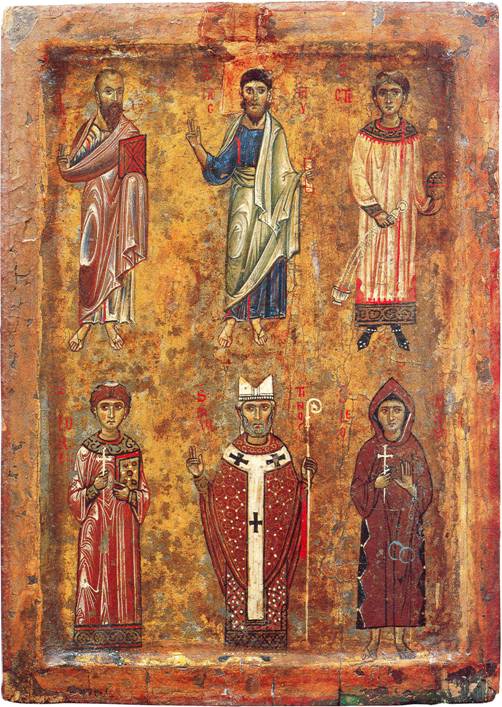
c) as depicted (at centre in lower register, between Sts. Lawrence of Rome and Leonard of Noblac) in a twelfth-century icon of Byzantine origin or inspiration in the Holy Monastery of the God-trodden Mount Sinai in St. Catherine (South Sinai governorate):

 http://www.forum-orthodoxe.com/images/stmartindetours.jpg


d) as depicted in a somewhat restored seemingly earlier twelfth-century mosaic in the diaconicon of the basilica (ex-cattedrale) di Santa Maria Assunta on Torcello:
http://tinyurl.com/26vvdrv
http://tinyurl.com/25a2z44

e) as depicted in an earlier twelfth-century legendary from the abbey of Cîteaux (between 1101 and 1133; Dijon, Bibliothèque municipale, ms. 641, fol. 113r):

http://www.culture.gouv.fr/Wave/savimage/enlumine/irht6/IRHT_094818-p.jpg


f) as depicted (at far left) in the late twelfth-century mosaics (c. 1182) in the sanctuary of the basilica cattedrale di Santa Maria Nuova in Monreale:
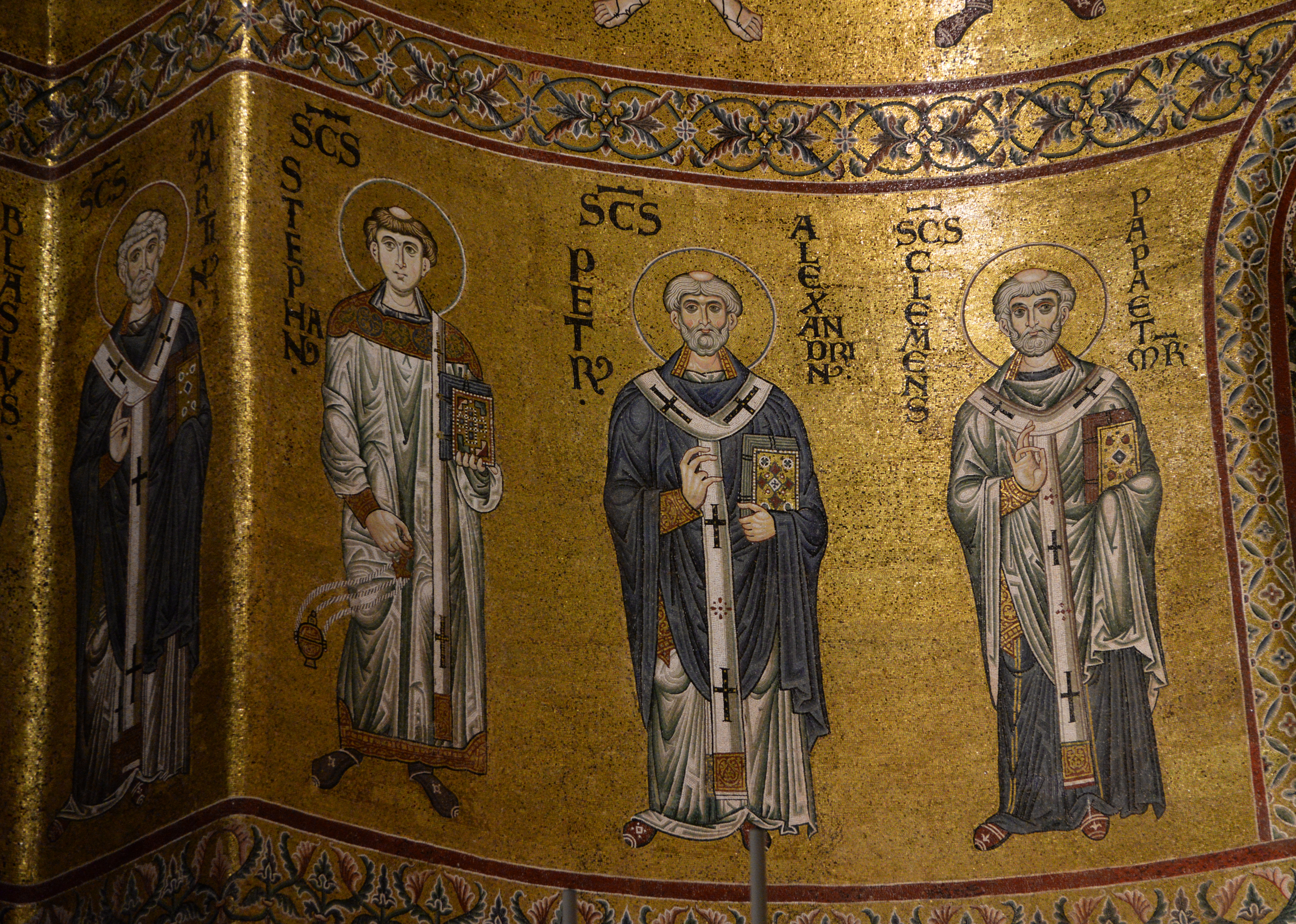


g) as portrayed in high relief in two locations on the right portal of the late twelfth or earlier thirteenth-century south porch of the basilique cathédrale Notre-Dame in Chartres:
1) On the right jambs (at left; at right, St. Jerome):
http://tinyurl.com/ostx422
Detail view:


2) On the tympanum (cutting his cloak):
http://tinyurl.com/ou6mnb5
Detail view:
http://tinyurl.com/nqfmnwc

h) as portrayed (scenes from his Vita) in four earlier thirteenth-century reliefs on the facade of the cattedrale di San Martino in Lucca:
http://tinyurl.com/27df48s
http://tinyurl.com/26rpoeb
http://tinyurl.com/2agms7o
http://tinyurl.com/29zfghw
There are detail views on this page:
http://tinyurl.com/32c6gkz

i) as depicted in the early thirteenth-century Life of St. Martin window (bay 7; c. 1215) in the cathédrale Saint-Étienne in Bourges:
http://www.medievalart.org.uk/bourges/07_pages/Bourges_Bay_07_key.htm
Detail view (cutting his cloak):
http://www.medievalart.org.uk/bourges/07_pages/Bourges_Bay_07_panel_01.htm

j) as depicted in the earlier thirteenth-century Life of St. Martin window (bay 102; c.1215-1225; restored, 1922 and 1995-1996) in the basilique cathédrale Notre-Dame in Chartres:
http://tinyurl.com/na6elhu
Detail view (cutting his cloak):

 https://s-media-cache-ak0.pinimg.com/736x/b2/4b/31/b24b312d70efcdb809034dc8c36a9aaf.jpg


k) as depicted (cutting his cloak) in an earlier thirteenth-century copy (c.1236-1250) of part of the Magnum legendarium Austriacum (Zwettl, Stiftsbibliothek, cod. 14, fol. 149r):
http://tarvos.imareal.oeaw.ac.at/server/images/7002565.JPG

l) as depicted in the earlier thirteenth-century Life of St. Martin window (bay 102b; c. 1240) in the cathédrale Saint-Maurice in Angers:
http://www.medievalart.org.uk/Angers/Bay_102b/Angers_Bay102b_Key.htm

m) as depicted (enthroned) in a mid-thirteenth-century pontifical from Mainz (between 1241 and 1251; Paris, BnF, Ms. Latin 946, fol. Av):


n) as depicted (cutting his cloak) in a late thirteenth-century copy of French origin of the Legenda aurea (San Marino, CA, Huntington Library, ms. HM 3027, fol. 156r):
http://digitalassets.lib.berkeley.edu/ds/huntington/images//000913A.jpg

o) as depicted (cutting his cloak) in the late thirteenth-century Livre d'images de Madame Marie (c. 1285-1290; Paris, BnF, ms. Nouvelle acquisition française 16251, fol. 89r):


p) as depicted (cutting his cloak) in an early fourteenth-century fresco in the cathédrale Saint-Gatien in Tours:
https://www.flickr.com/photos/biron-philippe/7585653434/

q) as depicted (scenes from his Vita) by Simone Martini in a series of early fourteenth-century frescoes (between 1312 and c. 1318) in the cappella di San Martino in the lower church of the basilica di San Francesco in Assisi:

 http://www.wga.hu/art/s/simone/3assisi/00view3.jpg


http://www.wga.hu/art/s/simone/3assisi/00view2.jpg
Detail views with captions:
http://www.wga.hu/frames-e.html?/html/s/simone/3assisi/index.html

r) as depicted (at top right in the major panels) by Giovanni di Bonino, perhaps working from a design by Simone Martini, in one of the three earlier fourteenth-century windows (after 1312) in the cappella di San Martino in the lower church of the basilica di San Francesco in Assisi:
http://www.wga.hu/art/s/simone/3assisi/scenes/99window.jpg
Detail view:

 http://www.akg-images.fr/Docs/AKG/Media/TR3_WATERMARKED/2/6/e/1/AKG286952.jpg


s) as portrayed in an earlier fourteenth-century elephant ivory statuette of German origin (c. 1320; Köln or Mainz) in the Victoria and Albert Museum, London:
http://tinyurl.com/nsnqkgh

 http://sargasso.nl/wp-content/uploads/2014/11/martinus_tours_1320_cologne_vam.jpg


t) as depicted (cutting his cloak) in an earlier fourteenth-century French-language legendary of Parisian origin with illuminations attributed to the Fauvel Master (c. 1327; Paris, BnF, ms. Français 183, fol. 165v):
http://tinyurl.com/nnuec2h

u) as depicted (at left; at right, St. Theodore the Stoudite) in the earlier fourteenth-century frescoes (between 1335 and 1350) in the narthex of the church of the Holy Ascension at the Visoki Dečani monastery near Peć in, depending on one's view of the matter, either the Republic of Kosovo or Serbia's province of Kosovo and Metohija:


v) as portrayed in high relief (consecration as bishop; cutting his cloak) on a mid-fourteenth-century polychromed ivory diptych (c. 1340-1350) of northern French or Flemish origin in the Cleveland Museum of Art:


w) as depicted (at lower right; cutting his cloak) in the mid-fourteenth-century San Martino altarpiece (seemingly later 1340s) from Oristano in the Antiquarium Arborense - Museo archeologico Giuseppe Pau, Oristano:

 http://www.antiquariumarborense.it/it/Museo/Sale/Immagini/retabloSanMartino1.jpg


x) as depicted (cutting his cloak) in a mid-fourteenth-century copy, from the workshop of Richard and Jeanne de Montbaston, of the Legenda aurea in its French-language version by Jean de Vignay (1348; Paris, BnF, ms. Français 241, fol. 300r):
http://tinyurl.com/pua5rvp

y) as depicted (cutting his cloak) in a mid-fourteenth-century vault painting (c. 1350) in Skibby Kirke at Skibby, Lejre Kommune, Sjælland:

 https://upload.wikimedia.org/wikipedia/commons/4/4c/Martin_af_Tours_(Skibby_Kirke).jpg


z) as portrayed in a late fourteenth-century reliquary bust (from Avignon?; restored in the twentieth century) in the Musée du Louvre in Paris:
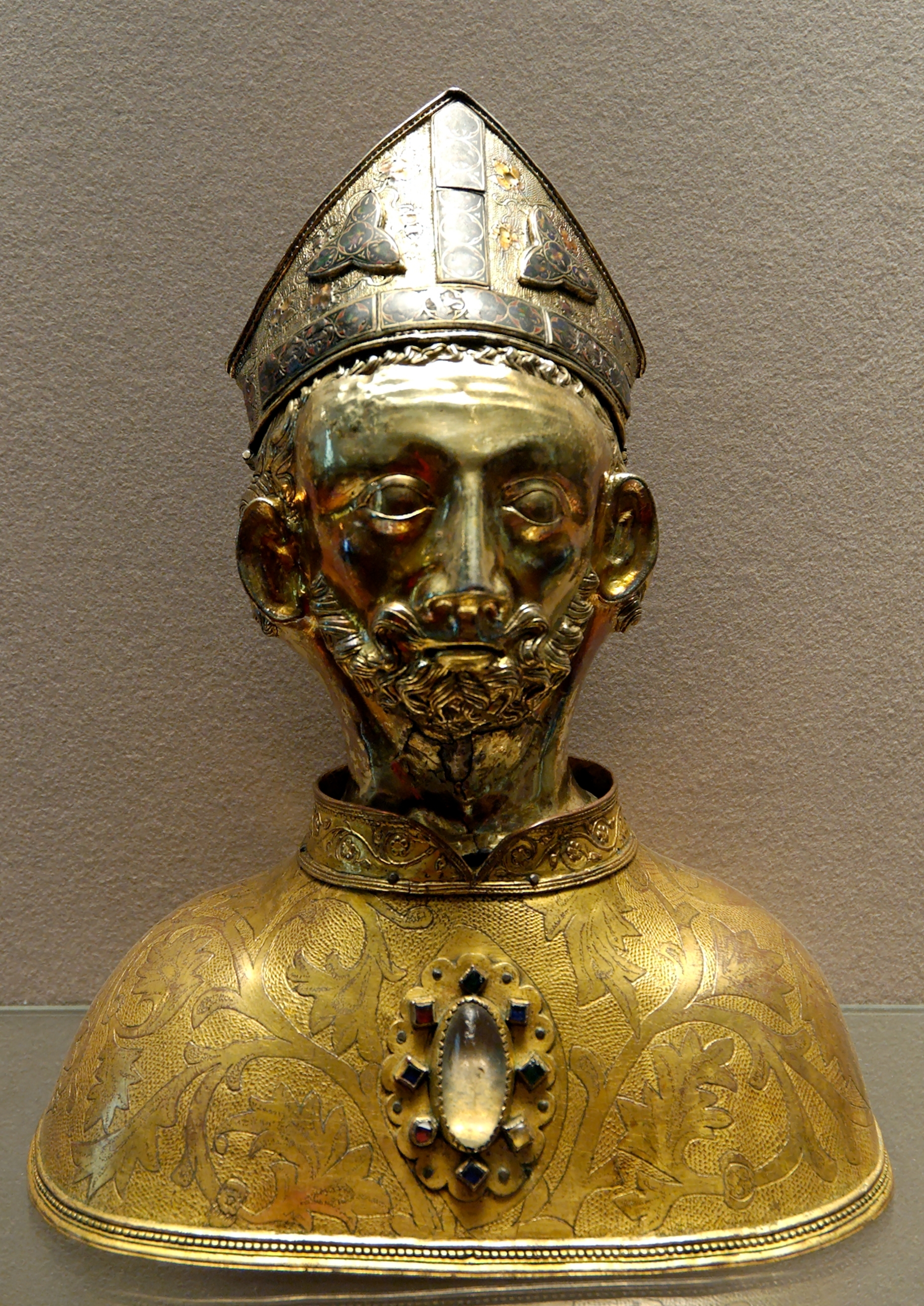
 
 https://upload.wikimedia.org/wikipedia/commons/7/74/Head_reliquary_Martin_Louvre_OA6459.jpg


aa) as depicted (at top in the right margin; demanding a steep price of Clovis for the return of a horse) in the numerous pen-and-ink illustrations in the margins of an early fifteenth-century copy of the Chronicon a mundi creatione ad annum 1220, an abbreviation and continuation of the Pantheon of Godfrey of Viterbo (c. 1400-1415; Paris, BnF, ms. Latin 4935, fol. 8v):
http://gallica.bnf.fr/ark:/12148/btv1b8455934w/f26.image

bb) as depicted (at left; at right, brigands) in an earlier fifteenth-century embroidery of southern Netherlandic origin (c. 1430) in The Cloisters Collection of the Metropolitan Museum of Art, New York:

Saint Martin and the Brigands


cc) as depicted in grisaille (cutting his cloak) by Jean le Tavernier in the mid-fifteenth-century Hours of Philip of Burgundy (c. 1451-1460; Den Haag, KB, ms. 76 F 2, fol. 264v):
http://manuscripts.kb.nl/zoom/BYVANCKB%3Amimi_76f2%3A264v_min

dd) as depicted (upper right; cutting his cloak) by Girolamo di Giovanni of Camerino in a later fifteenth-century triptych (c. 1473) in the chiesa di San Martino Vescovo in Monte San Martino (MC) in the Marche:
http://tinyurl.com/q74m33o

Detail view:

 http://www.liricigreci.it/blog/wp-content/uploads/2013/06/polittico_girolamo_giovanni_monte_san_martino04.jpg


ee) as depicted (cutting his cloak) in a later fifteenth-century vault painting (c. 1474) in Jetsmark Kirke at Pandrup, Jammerbugt Kommune, Nordjylland:
http://tinyurl.com/pu5sh97

ff) as depicted (cutting his cloak and other scenes from his Vita) by the Master of the Galletti Chapel in a later fifteenth-century painted altarpiece (c. 1475-1480) in the crypt of the basilica cattedrale di San Martino in Belluno:
https://c1.staticflickr.com/3/2397/2177982293_8c1e640b3d_b.jpg

gg) as portrayed (with the beggar) in a later fifteenth-century statue (c. 1475-1480) of German origin in the Seattle Art Museum, Seattle (WA):

 http://www.wga.hu/art/m/master/zunk_ge/zunk_ge8/5martin.jpg


hh) as depicted in two late fifteenth-century panel paintings (c. 1490) on either side of a wing from a dismembered altarpiece in the Magyar Nemzeti Galéria, Budapest:
1) Cutting his cloak:

 http://www.wga.hu/art/m/master/zunk_hu/zunk_hu1/06martin.jpg


2) Celebrating Mass in shabby dress:


 http://www.wga.hu/art/m/master/zunk_hu/zunk_hu1/04martin.jpg


ii) as depicted (center panel; cutting his cloak) by Bartolomeo Vivarini in his late fifteenth-century Triptych of St. Martin (1491) in the Accademia Carrara, Bergamo:

 http://passaggioadovest.ilserio.it/immagini/Trittico.JPG


jj) as portrayed (cutting his cloak) in high relief in a late fifteenth- or early sixteenth-century sculpture (c. 1500), from Bjæverskov Kirke in Sjælland, in the Nationalmuseet, Copenhagen:


 https://wuhstry.files.wordpress.com/2015/10/imag0667_burst0021.jpg


kk) as depicted (cutting his cloak) in an embroidered early sixteenth-century cope shield (between 1500 and 1509) in the Museum Catharijneconvent in Utrecht:

 https://upload.wikimedia.org/wikipedia/commons/thumb/2/29/MCC-31218_Koorkapschild_met_St._Maarten_te_paard_en_bedelaar%2C_ingelijst_%281%29.tif/lossy-page1-1024px-MCC-31218_Koorkapschild_met_St._Maarten_te_paard_en_bedelaar%2C_ingelijst_%281%29.tif.jpg?1447199959777


Sunday, 8 November 2015

Bl. John Duns Scotus


November 8th is the commemoration of Bl. John Duns Scotus OFM, who died in 1308. John Dillon posted on the Medieval Religion discussion group one of his selections of early images of him, and given the Oxford link and the recent excavations of more of the site of the medieval Greyfriars here it seems very apposite to share, and also adapt slightly, his post:


Born at Duns in Scotland andordained priest at Northampton in 1291 and trained at Oxford, he lectured at Paris ( " who fired Paris for Mary without spot" - Hopkins ) and, from 1307, at Köln. His cult was confirmed in 1993 at the level of Beatus. The Subtle Doctor now reposes in a modern sarcophagus in Köln's thirteenth-century Minoritenkirche Mariae Empfängnis (Franciscan Church of the Immaculate Conception), formerly a church for foreign teachers and students. His entry in the Stanford Encyclopedia of Philosophy can be seen here: http://plato.stanford.edu/entries/duns-scotus/

Some period-pertinent images of Bl. John Duns Scotus:

a) as depicted on the opening pages of text of each volume of a two-volume thirteenth- or fourteenth-century copy, from Genoa, of his commentaries on the Sententiae of Peter Lombard (Paris, Bibliothèque Mazarine, mss. 882, 883):
1) ms. 882, fol. 5r: http://www.enluminures.culture.fr/Wave/savimage/enlumine/irht17/IRHT_11877-p.jpg
2) ms. 883, fol. 1r: http://www.enluminures.culture.fr/Wave/savimage/enlumine/irht17/IRHT_11881-p.jpg

b) as depicted at the outset of an early fourteenth-century copy, of East Anglian origin, of his commentaries on the Sententiae (Paris, BnF, ms. Latin 3061, fol. 1r):
http://gallica.bnf.fr/ark:/12148/btv1b525038815/f9.item.zoom

c) as depicted at the outset of of an earlier fourteenth-century copy (c. 1320) of his Quodlibet (Munich, BSB, Clm 8717, fols. 61r-100r, at fol. 61r):
http://faculty.cua.edu/hoffmann/scotus-bibliography.htm

d) as depicted by Benozzo Gozzoli in his mid-fifteenth-century frescoes (between 1450 and 1452) in the chiesa di San Francesco in Montefalco (PG) in Umbria:
http://tinyurl.com/ofe2g99

e) as depicted at the outset of a later fifteenth-century copy (1470s?) of a commentary of his on Book One of the Sententiae (Rovigo, Biblioteca dell'Accademia dei Concordi, Biblioteca Silvestriana cod. 215, fol. 1r):
http://tinyurl.com/pewxzww

f) as depicted by Carlo Crivelli in a later fifteenth-century panel painting (1471?; from his now dismembered Montefiore altarpiece) in the Polo Museale di San Francesco at Montefiore dell'Aso (AP) in the Marche:

 https://upload.wikimedia.org/wikipedia/commons/6/64/Carlo_crivelli%2C_montefiore%2C_santo_francescano.jpg


g) as depicted in a later fifteenth-century panel painting (c. 1476) variously attributed to Joos van Gent (Justus of Ghent, etc., etc.) or to Pedro Berruguete in the Galleria nazionale delle Marche in the ducal palace at Urbino:

 http://paradjanov.biz/works/wp-content/uploads/2015/07/duns-scotus.jpg


On display (lower right) on the east wall of Federico da Montefeltro's studiolo:
http://www.gutenberg-e.org/kirkbride/detail/us_2_east_wall_men.html

h) as depicted by Nardo Rapicano at the outset of a later fifteenth-century copy (c. 1480), of Neapolitan origin, of a commentary of his on Book Two of the Sententiae (Paris, BnF, ms. Latin 3063, fol. 1r):
http://gallica.bnf.fr/ark:/12148/btv1b8446954p/f11.item.zoom

i) as depicted (left margin at top) in a hand-colored woodcut in the Beloit College copy of Hartmann Schedel's late fifteenth-century Weltchronik (Nuremberg Chronicle; 1493) at fol. CCXXIr):
http://www.beloit.edu/nuremberg/book/6th_age/right_page/124%20%28Folio%20CCXXIr%29.pdf

j) as depicted (at right; at left, St. Albertus Magnus) by Amico Aspertini in an earlier sixteenth-century panel painting (1521) in the Pinacoteca civica of Como:

 http://cultura.comune.como.it/uploads/images/prestiti/dipinti/P594_A.%20Aspertini,%20Ritratto%20di%20Alberto%20Magno%20e%20Duns%20Scoto.jpg


Thursday, 5 November 2015

The Ecumenical Patriarch at the Oxford Union


Last night I attended a speech and question and answer session with the Ecumenical Patriarch at the Oxford Union.

 https://upload.wikimedia.org/wikipedia/commons/2/29/Bartolomew_I.jpg

 Patriarch Bartholomew I

Image: Wikimedia

Patrirach Bartholomew I, who, to give him his full title is His All Holiness the Ecumenical Patriarch and Archbishop of Constantinople - New Rome, and that is a tittle to conjure with if you have any sense of history or ecclesiology, has held office since November 1991, and is the 270th occupant of that throne. There is an online account of him at Bartholomew I of Constantinople

http://theorthodoxchurch.info/main/wp-content/uploads/2011/12/17ea49abd6riarch.jpg.jpg

The Patriarch vested and enthroned

Image: theorthodoxchurch.info

The meeting in the Debating Chamber was well attended, and in addition to the Patriarchal suite the
Archbishop of Birmingham (himself aormer Union Treasurer) and an Anglican bishop were present.

His All Holiness spoke about the Environment, an issue he has made very much a theme of his Patriarchate.

He stressed that Religion had something to say about the issues and that this was a matter of solidarity. The Economy should serve mankind, and pointed out that the words economy, ecology, and ecumenism have the same Greek root. He rejected the subordination of individual to economics.
He raised the question as to whether we should sacrifice western aspirations in regard to combatting global-warming - this would potentially safeguard the most vulnerable who are at risk in the future.

For him global warming is a moral crisis. He asserted that there is a moral dimension with regard to our attitude to the environment, and called for a metanoia in our attitude to world we inhabit.

We  still act against our knowledge of the situtation. However the future is open, the choice is ours.
Future generations are entitled to live in a peaceful world that environmentally safe, and unlike past generations we cannot claim not to know.

The forthcoming Paris Conference is an opportunity to be grasped and to make progress.

Why the issue matters to religion is that it involves us in our mutual obligation one to another. He holds to a vision of participation, of life as communion, and that Christians must voice their opinion on this vital issue.

Following his speech questions were answered on behalf of the patriarch - as is customary - by his  spokesman, who is his theological advisor.From this we learned that on the environment the Patriarch's views are same as those set out by the Pope in Laudato Si, and that there was no separation on such matters.

 http://saltandlighttv.org/blog/wp-content/uploads/2014/11/FrancisBart.jpg

Image:saltandligttv.org

In 1989 a Day of Prayer for the Environment was established by his predecessor Patriarch Demetrios I, a precedent followed this year by Pope Francis who established it this this year for September 1st and by the Archbishop of Canterbury also

Orthodox Christians are now a tiny minority community, interfaith dialogue is what they have to do - and Interfaith interdisciplinary symposia occurred in the period 1995-2009.

In the wake of the recent Turkish election  it is necessary to work with the current situation, bearing in mind past expulsions and the closing of the seminary in 1971, where the Patriarch himself trained, and which he is working to get reopened.

Since 1991 his personality has helped to open up dialogue with Turkish establishment, and the advisor expressed the hope that President Erdogan lives up to his pledges to Greeks and Jews in the country.

Asked about relations with and between the Russian Orthodox and Vladimir Putin the point was made that Orthodoxy consists of 14 autocephalous churches. A lot unites them theologically and liturgically, but administrative structures differ. The function of the Ecumenical Patriarch is to guard that unity

The forthcoming Council of the Orthodox Church has been a hundred years in planning, with thirty years active work. This is scheduled for next year  and is something not seen for 1200 years. Since 2009 the churches have planned for this.

On how to speak to the secular world about the environment the emphasis should be on justice, on what we have in common.

Asked about the reaction to militant Islam the answer was that the religious response of caring for neighbours was what the Church was going to do, and concluded with the suggestion that Greek islanders caring for Muslim refugees may assist Muslim-Christian dialogue for the future.

This was a most interesting occasion, full of history hanging in the air for someone with my interests, and Patriarch Bartholomew speaks with an authority that is both personal and veted in his office.


Wednesday, 4 November 2015

A new Acolyte at the Oxford Oratory


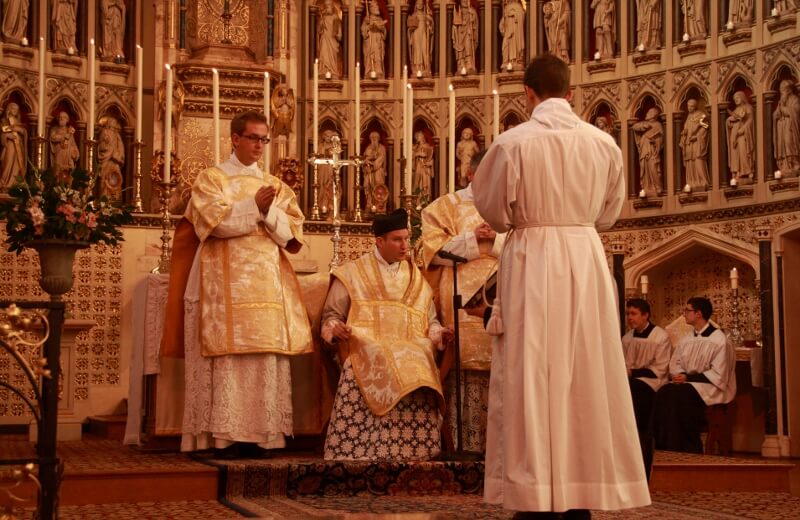
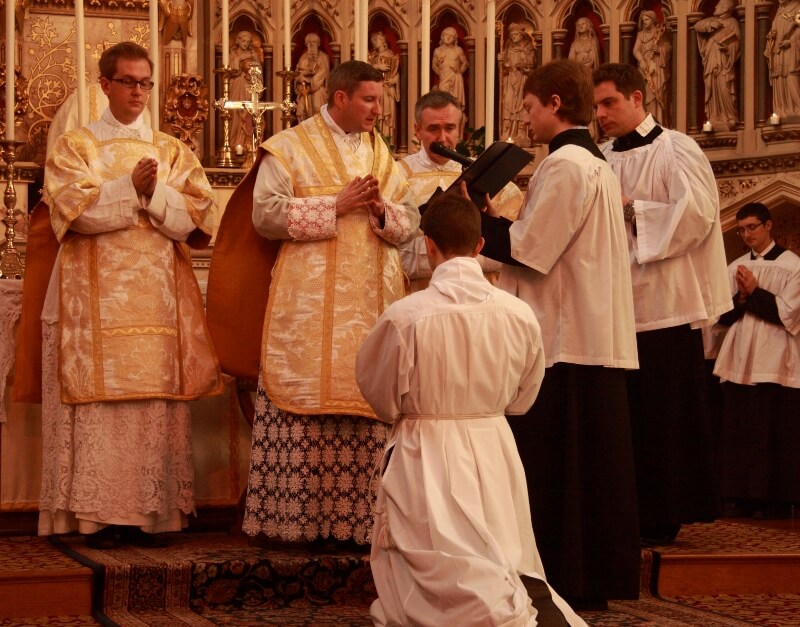
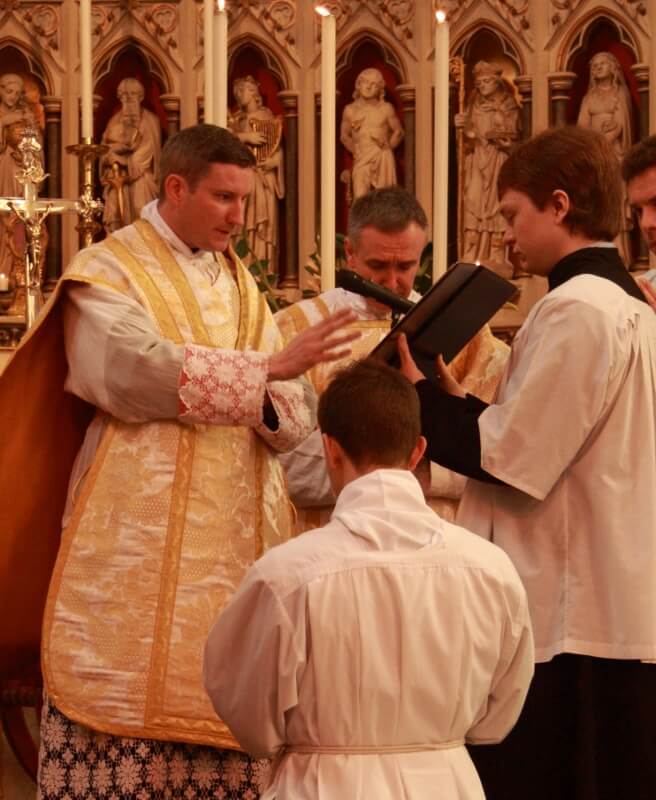
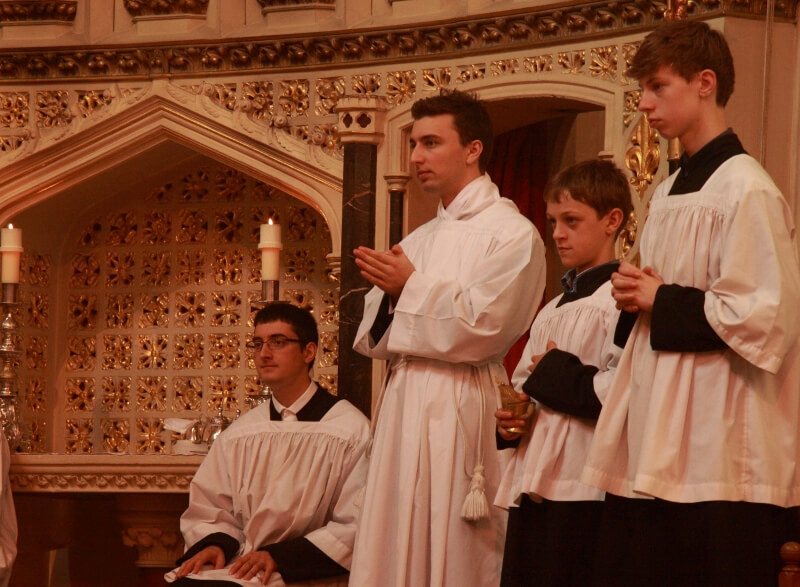
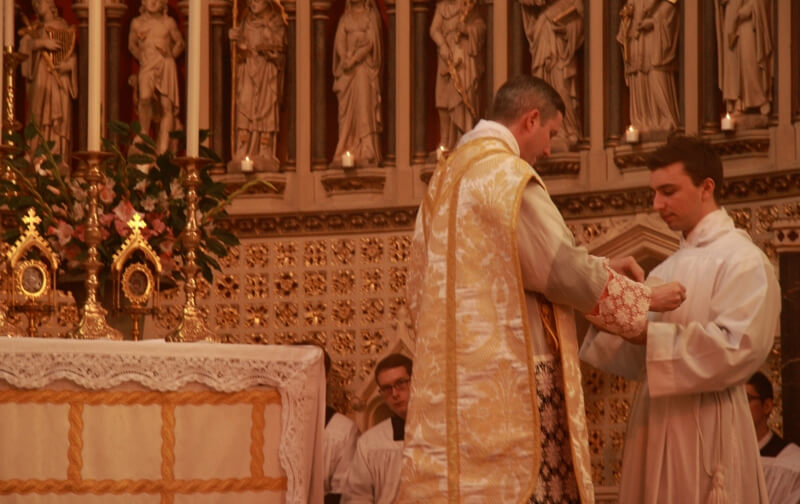
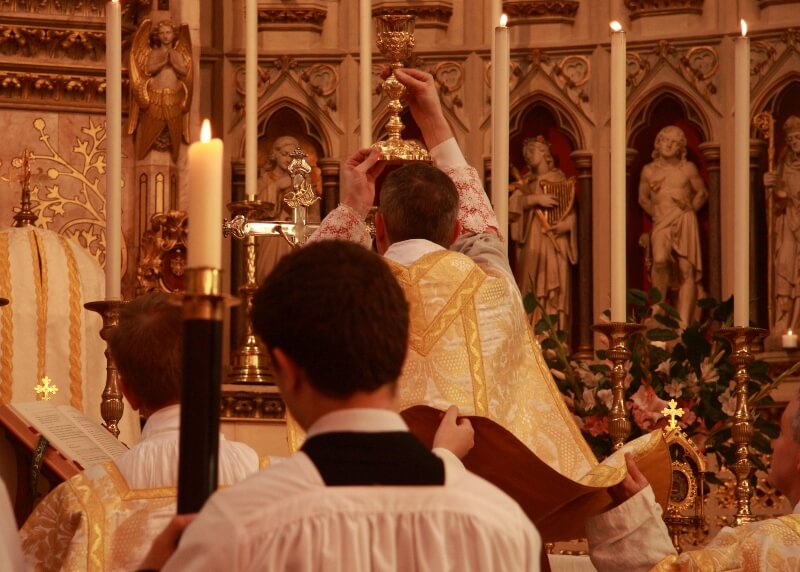
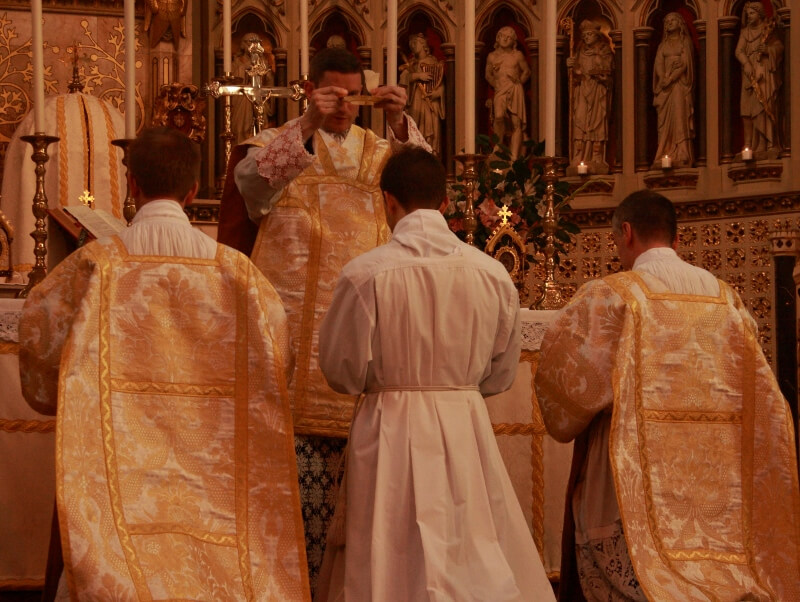
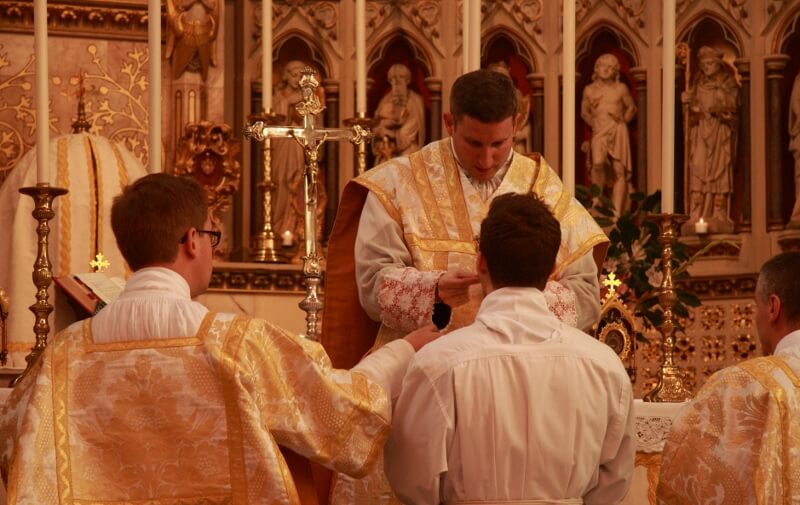
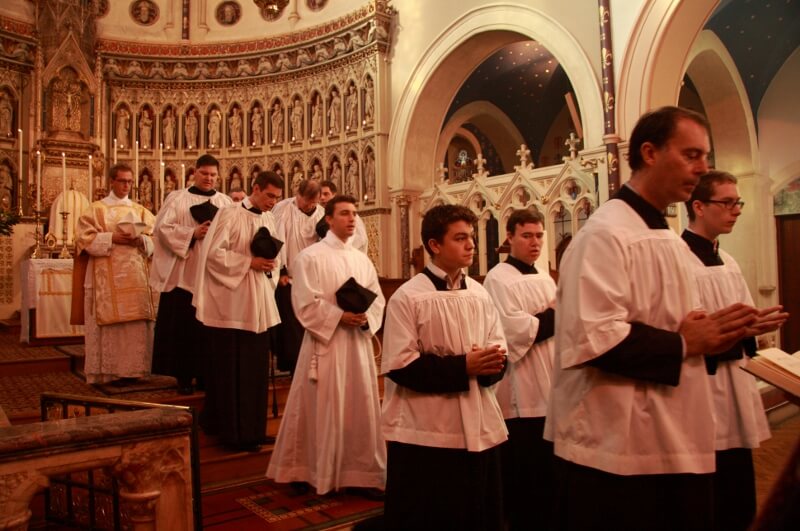
At the High Mass last Sunday, the Solemnity of All Saints, Br Oliver Craddock was instituted as an Acolyte at the Oxford Oratory by the Provost, Fr Daniel Seward.

IMG_0289 (800x588)

The acolytate is one of the 'ministries', formerly called 'minor orders', on the way to the priesthood. Anciently, the acolyte carried candles and tapers for the liturgy, and took a fragment of the Pope's Host to Masses elsewhere in the City of Rome. This state is one that reminds us of the holiness of the liturgy therefore.

The candidate is called forward:

IMG_0291 (800x520)

He is blessed:

IMG_0292 (800x627)


IMG_0293 (656x800)

He is handed the ciborium, containing the bread which will be offered at the Mass, as a sign of his service of the altar:

IMG_0294 (498x800)

He assists the Deacon in preparing the altar:

IMG_0295 (800x587)

He washes the Celebrant's hands:

IMG_0296 (800x504)

The elevation of the Chalice:

IMG_0302 (800x572)

The Ecce Agnus Dei:

IMG_0305 (800x602)

Holy Communion:

IMG_0306 (800x505)

The recessional of the Mass:

IMG_0310 (800x531)

IMG_0311 (800x585)

Photographs by Hannah Chegwyn.

Images and text(adapted) : Oxford Oratory website 

Tuesday, 3 November 2015

How Far to Extend the Hands at Mass


I thought this post on the Liturgy section of the Zenit website might be of interest to readers, blending historical understanding with issues around liturgical practice:

How Far to Extend the Hands at Mass:
There Are No Strict Specifications


Rome, October 13, 2015 (ZENIT.org) Father Edward McNamara | 8849 hits

Answered by Legionary of Christ Father Edward McNamara, professor of liturgy and dean of theology at the Regina Apostolorum university.

Q: One local priest at Mass extends his hands almost to the fullest extent possible, elbows well out from the body; most others keep their elbows close to the body. Are there any official guidelines regarding this gesture? -- O.K., Dallas, Texas

A: Unlike the rubrics of the extraordinary form of the Roman rite, the current rubrics do not give detailed specifications regarding what is meant by "hands extended." This does not mean that they are arbitrary but presume that a priest, through his formation and observation, knows what this expression means and how to apply it in accordance with liturgical tradition and his own physical makeup.

The extraordinary form is much more specific. As one popular ceremonies book describes the gesture at the collect: "While [the priest] says 'oremus' he extends the hands and joins them again, and he bows his head to the missal. Then he reads the collect, holding the hands uplifted -- but not exceeding the height or width of the shoulders -- and extended, the fingers held close together and bowing towards the missal should the name of the saint in whose honor the Mass is celebrated occur. When he says 'Per Dominum nostrum' etc., he joins his hands."

While a priest celebrating the ordinary form may not be strictly bound to these exact norms, I would say that they do provide a good rule of thumb as to what the Church understands when it asks priests to pray with hands extended. These rules were not invented by some obscure 16th-century curial official but are rather the codification of an already existing custom that had developed over several centuries.

A priest could follow the above rule. However, since the post-conciliar liturgy deliberately left out a strict specification of the gesture, it is also legitimate to extend the hands a little further if he considers it appropriate. For example, some modern vestments tend to require a somewhat more ample gesture than the traditional Roman chasuble. The above rule, however, does caution against exaggerated gestures that tend to draw attention toward the celebrant himself and not the prayer he is reciting.

The gesture of extending and raising the hands in prayer is found in some form in almost all religions. In the Bible we have the example of Moses during the battle against Amalek (Exodus 17:11-12), as well as references in the Psalms and prophets. Thus Isaiah declares to Israel: "When you spread out your hands, I will close my eyes to you; / Though you pray the more, I will not listen. Your hands are full of blood!" (1:15).

These gestures are also found in the New Testament and the early Christians who prayed with uplifted hands, although here there is the added meaning of being united to Christ who extended his hands on the cross. At the beginning it would appear that the practice was to stretch out both arms and hands to resemble the form of a cross. Thus the early Christian writer Tertullian writes, "But we not only lift them [the hands] up, but even spread them out, modeling them after the Lord's Passion, and, while we pray, we confess Christ" (De Oratione, 14). However, he also warns against exaggerated gestures in this respect: "In praying with modesty and humility, we shall the rather commend our prayers to God, not even our hands being lifted up too high, but being lifted up with moderation and seemliness, not even our face being raised upward with boldness" (De Oratione, 17).

There are also many images in the catacombs and other places showing how early Christians made this gesture. These sometimes represent biblical figures such as Daniel or Susanna or a female figure whom some scholars believe represents the souls of those buried in the catacombs interceding for the living.

Although it is not certain, it is probable that early Christians used this posture for both private and public prayer. As time progressed, however, it gradually became an exclusively priestly gesture, at least within the context of the liturgy. It might have died out due to practical considerations, as the number of Christians expanded, churches became more crowded and there was less space to carry out this gesture.

The gesture of the priest stretching out the arms crosswise in certain parts of the Mass also diminished over time, although it continued in some religious orders such as the Carmelites and Dominicans. In general during the Middle Ages the gesture became similar to current practice: thus the "Micrologus," written in the 11th century says: "We extend our arms at the Collects and during the whole of the Canon but only the breadth of the chest, in such wise that the palms of the hands face each other. The fingers are joined together, and their tips must not reach higher than the shoulders nor exceed their breadth, and this must be observed whenever the hands are to be spread ante pectus. In taking up this attitude the priest shows forth in his person Our Lord upon the Cross."

St. Thomas Aquinas also says that "the actions performed by the priest in Mass are not ridiculous gestures, since they are done so as to represent something else. The priest in extending his arms signifies the outstretching of Christ's arms upon the Cross. He also lifts up his hands as he prays, to point out that his prayer is directed to God for the people, according to Lamentations [3:41]: 'Let us lift up our hearts with our hands to the Lord in the heavens" (III, q. 83, a. 5).

We can thus see that from relatively early the gesture became reserved to the priest, at least in the context of the liturgy, and became the fairly austere gesture we know today. This remains the overall spirit of how this gesture should be carried out in the liturgical context.

The faithful may use this gesture outside the liturgy for private prayer, in prayer groups, and, in those countries where it has been approved, during the recitation of the Our Father during Mass.

Some liturgists believe that this practice is an anomaly. It represents the only occasion when a priest prays with hands extended together with the people. In all other occasions in which he extends his hands, he prays alone in representation of the people. Indeed when the Our Father is recited during the Divine Office the priest has his hands joined and not extended. These experts believe that having the priest extending his hands during Mass was a rubrical oversight from 1958 when Pope Pius XII allowed the Our Father to be recited by the people, in Latin, and not just by the priest as had been the practice hitherto. It was logical for the priest to extend his hands before this change but not afterward. They recommend a change of rubric so that the priest, and people, pray with hands joined.

Others sustain that the Our Father, being the Lord's Prayer, is a special case. For the moment this remains a technical debate; the rubrics specify that the priest and concelebrants pray with hands extended.

Finally, for some of the historical data mentioned in this article, I wish to acknowledge my debt to an article written in 1926 by Joseph F. Wagner for the Homiletic and Pastoral Review and made available online by CatholicCulture.org.

* * *
November 3

Regarding the hypothesis that the norm for the priest to extend hands might have been an oversight, a Dominican priest comments, referring to the rite of that venerable order: "I agree that it should have been abolished as the priest is not praying for the people but with them. And in the 1960 Dominican Rite Holy Week Missal (Ordo Hebdomadae Sanctae iuxta Ritum Ordinis Praedicatorum Instauratus, Romae: Ad S. Sabinae, 1960), p. 67, in the rubrics of Good Friday (the only place where the people joined the priest in the Pater at that date in our rite), it says that the priest recites 'item iunctis manibus' -- the 'item' is there because the rubric for the invocation of the prayer was also 'iunctis manibus.' Obviously some Dominican rubricist understood the logic of the gesture. Sadly, in the last edition of our Missal (1965), the rubric is changed to 'extensis manibus.' So someone must have dedicated to mimic the bad logic of the modified Roman Missal."

Other readers asked if the deacon can extend his hands during the Our Father and if the rite is optional where permitted.

The answer to this depends on the country. In those countries where the bishops' conference, with the approval of the Holy See, has allowed the faithful to extend their hands during the Our Father, this obviously includes the deacon. In countries where the practice does not exist for the faithful it does not apply to the deacon.

However, outside of Mass, if a deacon presides at a communion service in the absence of a priest, he may extend his hands at the prescribed moments.

In all countries where it has been approved it is an option and neither faithful nor the ministers, other than priests, are obliged to carry it out.

* * *

Readers may send questions to zenit.liturgy@gmail.com. Please put the word "Liturgy" in the subject field. The text should include your initials, your city and your state, province or country. Father McNamara can only answer a small selection of the great number of questions that arrive.

(October 13, 2015) © Innovative Media Inc.
Tweet
Comment on this article


Name

Email

Comment

Send
In this article
Subjects: liturgy
Related articles
Readings for Sunday, Oct. 11
LITURGY: Rinsing of Hands After Distribution of Communion
No Liturgy Column Today
Both Species for Concelebrants
Proper Readings on a Saint's Day
Latest Tweets
ZENIT Tweets

Thought for the day


"Those who seek to legitimate a claim to power in the present often have recourse to the idea of tradition. They decorate themselves with its cultural authority. But the encounter between the self-proclaimed inheritors of tradition and the historical record rarely takes place on equal terms."

Christopher Clark Iron Kingdom: The Rise and Downfall of Prussia 1600-1947, p.662

Sunday, 1 November 2015

All Saints


Today is the Feast of All Saints, and John Dillon has posted some images of them on the Medieval Religion discussion group:

Today, being both November 1st and the Sunday in the octave around November 1st, is in Latin-rite churches and in others influenced by their festal calendars, the feast of All Saints (in Eastern-rite churches, where the observance arose, their celebration falls rather on the first Sunday after Pentecost). Herewith some period-pertinent images associated directly with this veneration in that they either accompany texts for or describing the feast in question or else are parts of altars devoted principally to the cult of All Saints (as opposed, say, to images of the Coronation of the BVM drawing upon the traditional imagery of All Saints). Also included (item k) is one well known image of the saints in their multitude arrayed about the Godhead where a direct connection to the liturgical celebration is not immediately evident.

a) as depicted in a later tenth-century sacramentary from Fulda (c. 975; Göttingen, Niedersächsische Staats- und Universitätsbibliothek, 2 cod. Ms. theol. 231 Cim., fol. 111r):

 https://upload.wikimedia.org/wikipedia/commons/0/09/G%C3%B6ttinger_Sakramentar_fol._111r.jpg


b) as depicted in the earlier eleventh-century Sacramentary of Robert of Jumièges (c. 1020; Rouen, Bibliothèque Jacques Villon, ms. 274, fol. 158v):

 http://www.culture.gouv.fr/Wave/savimage/enlumine/irht6/IRHT_100581-p.jpg

Detail view (losing most of the frame):
http://www.culture.gouv.fr/Wave/savimage/enlumine/irht6/IRHT_100582-p.jpg

c) as depicted in a later twelfth-century sacramentary for the abbaye de St.-Martin in Tours (c. 1170-1180; Tours, Bibliothèque municipale, ms. 193, fol. 115r):

 http://www.culture.gouv.fr/Wave/savimage/enlumine/irht9/IRHT_150416-p.jpg


d) as depicted in a later twelfth-century sacramentary from the abbaye de St.-Amand in Saint-Amand (c. 1170-1180; Valenciennes, Bibliothèque de Valenciennes, ms. 108, fol. 46v):
http://www.culture.gouv.fr/Wave/savimage/enlumine/irht4/IRHT_075465-p.jpg

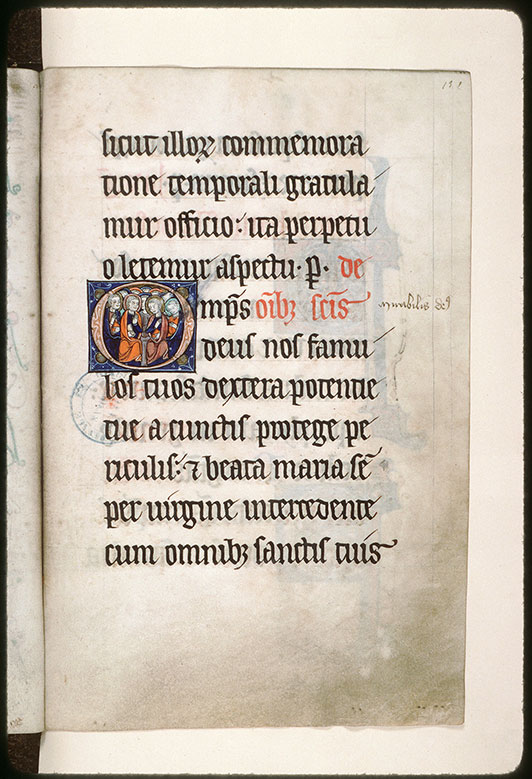
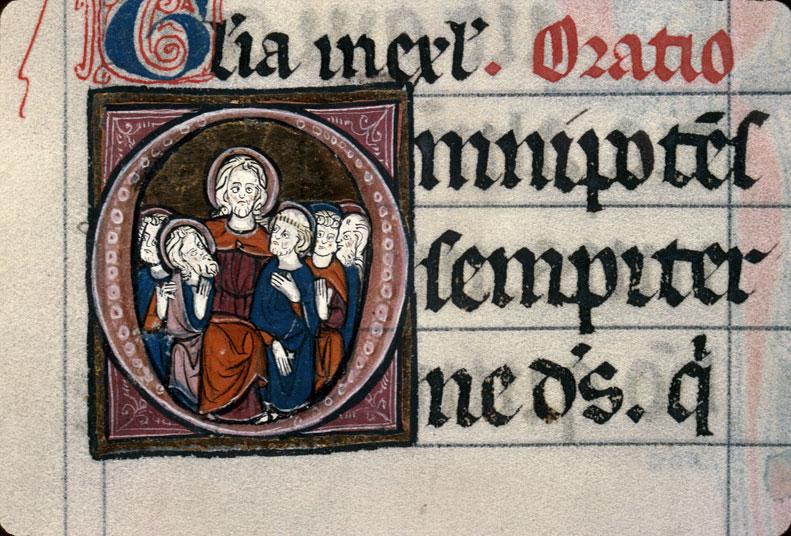
e) as depicted in a perhaps mid-thirteenth-century pontifical and collects concordant with the Use of the abbaye de St.-Pierre at Corbie (Amiens, Bibliothèque Louis Aragon, ms. 195, fol. 132r):
http://www.culture.gouv.fr/Wave/savimage/enlumine/irht3/IRHT_061417-p.jpg
Textual context:
http://www.culture.gouv.fr/Wave/savimage/enlumine/irht3/IRHT_061416-p.jpg

f) as depicted in a later thirteenth-century breviary perhaps from Cambrai (c. 1275-1300; Den Haag, KB, ms. 76 J 18, fol. 470v):
http://manuscripts.kb.nl/zoom/BYVANCKB%3Amimi_76j18%3A470v_init

g) as depicted in a late thirteenth-century missal from Auvergne (c. 1280-1290; Clermont-Ferrand, Bibliothèque du Patrimoine, ms. 62, fol. 267v):
http://www.culture.gouv.fr/Wave/savimage/enlumine/irht4/IRHT_081167-p.jpg

h) as depicted in a late thirteenth-century copy of French origin of the Legenda aurea (c. 1280-1300; San Marino, CA, Huntington Library, ms. HM 3027, fol. 150v):
http://digitalassets.lib.berkeley.edu/ds/huntington/images//000921A.jpg

i) as depicted in the earlier fourteenth-century Taymouth Hours (c. 1326-1350; London, BL, Yates Thompson MS 13, fol. 87v):
http://www.bl.uk/manuscripts/Viewer.aspx?ref=yates_thompson_ms_13_f087v

j) as depicted in a later fourteenth-century Roman Missal of north Italian origin (c. 1370; Avignon, Bibliothèque-Médiathèque Municipale Ceccano, ms. 136, fol. 279r):
http://tinyurl.com/6edcqwo

k) as depicted by Giusto de' Menabuoi in his later fourteenth-century frescoes (later 1370s) in the central cupola of the battistero di San Giovanni in Padua:

 http://www.conciliarpost.com/wp-content/uploads/2015/01/Padua-Baptistry-Ceiling.jpg


l) as depicted in a late fourteenth-century missal from Autun concordant with the Use of Beaune (1394; Dijon, Bibliothèque municipale, ms. 110, fol. 387r):
http://www.enluminures.culture.fr/Wave/savimage/enlumine/irht6/IRHT_093978-p.jpg

m) as depicted in a late fourteenth- or early fifteenth-century altarpiece of Spanish origin in the Metropolitan Museum of Art, New York:

 The Trinity Adored by All Saints


n) as depicted in an early fifteenth-century missal concordant with the Use of Tours (Tours, Bibliothèque municipale, ms. 185, fol. 251r):
http://www.enluminures.culture.fr/Wave/savimage/enlumine/irht9/IRHT_150324-p.jpg

o) as depicted in the early fifteenth-century Belles Heures of Jean de France, Duc de Berry (New York, Metropolitan Museum of Art, The Cloisters Collection, ms. 1954 (54.1.1), fol. 218r):
 http://blog.metmuseum.org/artofillumination/images/BH_Lg13V_218r.EL.JPG


p) as depicted (right-hand column) in the early fifteenth-century Hours of René of Anjou (c. 1405-1410; London, BL, Egerton MS 1070, fol. 103v; image zoomable):
http://www.bl.uk/catalogues/illuminatedmanuscripts/ILLUMIN.ASP?Size=mid&IllID=48373

q) as depicted by the Boucicaut Master in an earlier fifteenth-century book of hours made in Paris (c. 1415-1420; Los Angeles, The J. Paul Getty Museum, ms. 22):
http://tinyurl.com/p4jnyxy

r) as depicted by Beato Angelico (probably) in two corresponding panels, flanking the central one of Christ in glory with angels, on the predella of his earlier fifteenth-century San Domenico Altarpiece (1423-1424) in the National Gallery of Art, London:
1) http://tinyurl.com/q4tbmb2
2) http://tinyurl.com/p9ac548
The predella in its entirety:
http://www.wga.hu/art/a/angelico/00/11fieso1.jpg

s) as depicted in the earlier fifteenth-century Breviary of Marie de Savoie (c. 1430; Chambéry, Bibliothèque municipale, ms. 4, fol. 637v):
http://www.culture.gouv.fr/Wave/savimage/enlumine/irht1/IRHT_035765-p.jpg

t) as depicted in the Suffrages in an earlier fifteenth-century prayer book seemingly from Brabant (c. 1430-1440; Baltimore, Walters Art Museum, Walters ms. W.164, fol. 177r):
http://tinyurl.com/o5ch3by

u) as depicted in a mid-fifteenth-century missal concordant with the Use of Nantes (Le Mans, Médiathèque Louis Aragon, ms. 223, fol. 201r):
http://www.enluminures.culture.fr/Wave/savimage/enlumine/irht5/IRHT_082520-p.jpg

v) as depicted in grisaille by Jean le Tavernier in the mid-fifteenth-century Hours of Philip of Burgundy (c. 1451-1460; Use of Paris; Den Haag, KB, ms. 76 F 2, fol. 283r):
http://manuscripts.kb.nl/zoom/BYVANCKB%3Amimi_76f2%3A283r_min

w) as depicted by Jean Fouquet at the conclusion of the Suffrages in the now dismembered mid-fifteenth-century Hours of Étienne Chevalier (1450s; this folio in the Musée Condé, Chantilly [Oise], ms. 71, fol. 113r):


x) as depicted at the conclusion of the Suffrages in a later fifteenth-century book of hours made in Bruges (c. 1460; Baltimore, The Walters Art Museum, Walters ms. W.186, fol. 293r):
http://tinyurl.com/okqny92

y) as depicted by Willem Vrelant in the later fifteenth-century Arenberg Hours (early 1460s; Los Angeles, J. Paul Getty Museum and Library, Ms. Ludwig IX 8, fol. 81v):
http://tinyurl.com/pe8l4p8

z) as depicted in a later fifteenth-century prayer book of Viennese origin (c. 1460-1470; Vienna, ÖNB, cod. s. n. 2599, fol. 160r):
http://tarvos.imareal.oeaw.ac.at/server/images/7008981.JPG

aa) as depicted in the later fifteenth-century Ranworth Antiphonal (c. 1460-1480; Ranworth [Norfolk], church of St. Helen, unnumbered ms., fol. 271v):

 http://www.english.cam.ac.uk/medieval/images/uea-19allsaints.jpg


bb) as depicted by Lieven van Lathem in the later fifteenth-century Prayer Book of Charles the Bold (1469; Los Angeles, J. Paul Getty Museum and Library, Ms. 37, fol. 43r):
http://tinyurl.com/q3fs4p4

cc) as depicted in a late fifteenth-century copy of the Legenda aurea in its French-language version by Jean de Vignay (1493; Angers, Université Catholique de l'Ouest, Bibliothèque universitaire, incunable non coté, fol. 241v):

 http://www.enluminures.culture.fr/Wave/savimage/enlumine/irht16/IRHT_043113-p.jpg


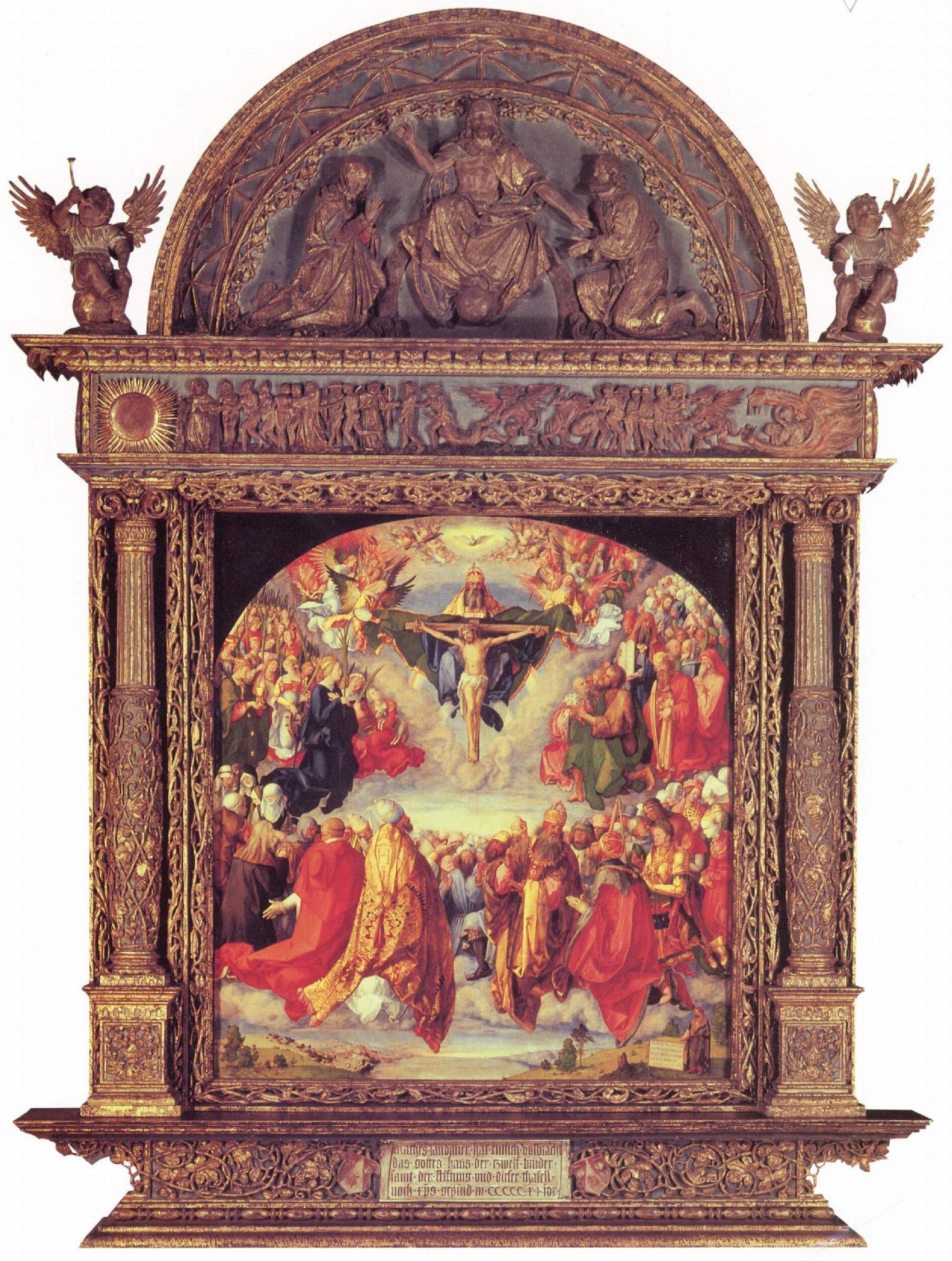
dd) as depicted by Albrecht Dürer in his early sixteenth-century All Saints altarpiece (1511; a.k.a. the Landauer Altar) in the Kunsthistorisches Museum in Vienna:

 https://upload.wikimedia.org/wikipedia/commons/4/4e/Albrecht_D%C3%BCrer_053.jpg

The painting at higher resolution:

 https://upload.wikimedia.org/wikipedia/commons/6/61/Albrecht_D%C3%BCrer_-_Adoration_of_the_Trinity_%28Landauer_Altar%29_-_Google_Art_Project.jpg

ee) as portrayed in high relief on the early sixteenth-century altar (1518) in the Allerheiligenkapelle of the Pfarrkirche St. Benedikt in Altmünster (Land Oberösterreich):

 http://tarvos.imareal.oeaw.ac.at/server/images/7017914.JPG

Detail view:

 http://tarvos.imareal.oeaw.ac.at/server/images/7017915.JPG


November


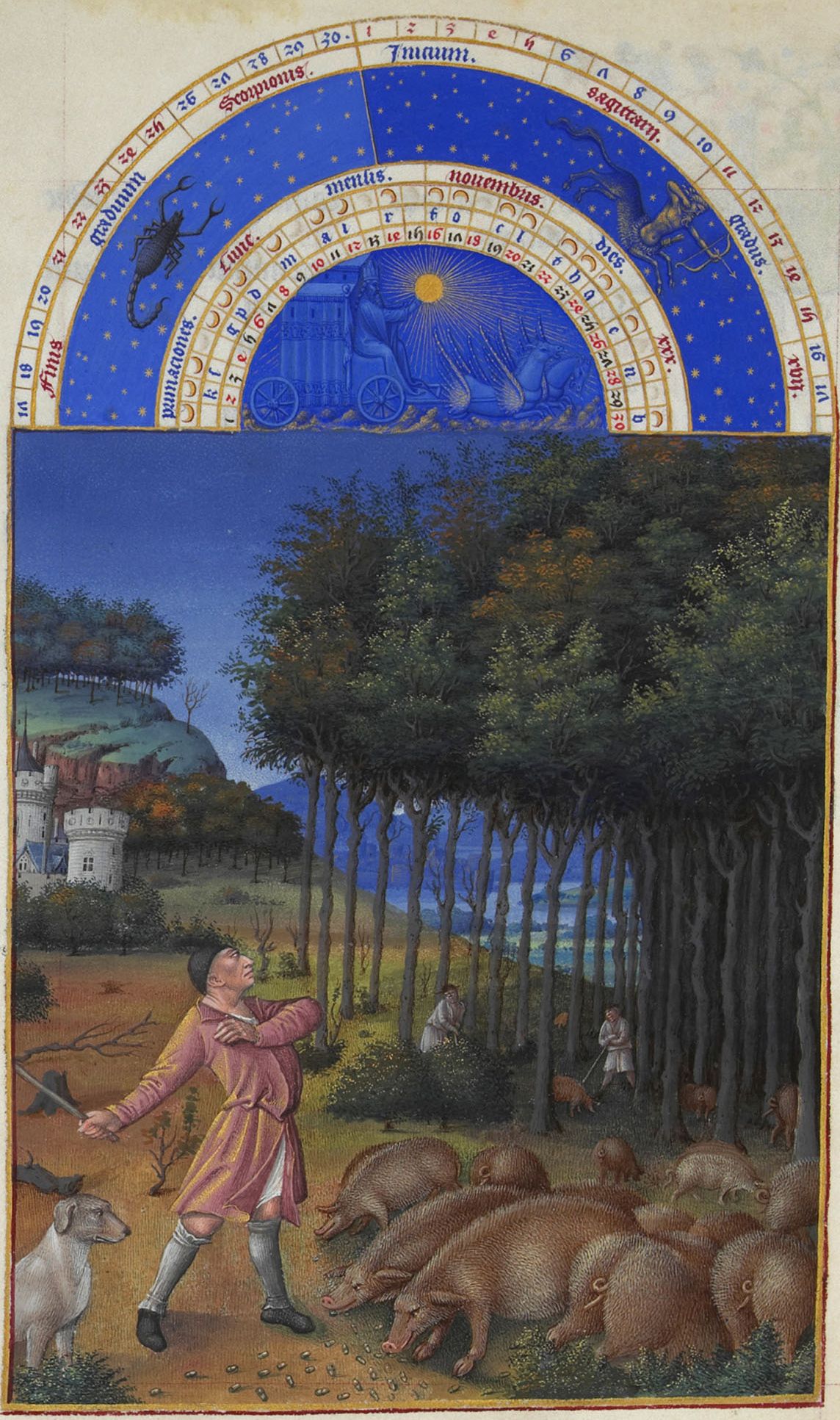
The November page in the Très Riches Heures is attributed entirely to Jean Colombe and dates from the completion of the manuscript in the later 1480s. Unlike the other pages by the Limbourg brothers seventy or so years earlier it does not show a specific place, but rather a scene of rustic life. In that sense it is, I think, less interesting than the other calendar pages. The landscape does perhaps suggest that of Savoy, for whose Duke Colombe worked. What is depicted is the fattening of pigs on acorns and beech mast - the right of pannage. There is presumably the suggestion of plenty of pork and pork products to eat at the approaching Christmas season.

November 1415 witnessed the triumphant entry of King Henry V into London following his victory at Agincourt.