Once I was a clever boy learning the arts of Oxford... is a quotation from the verses written by Bishop Richard Fleming (c.1385-1431) for his tomb in Lincoln Cathedral. Fleming, the founder of Lincoln College in Oxford, is the subject of my research for a D. Phil., and, like me, a son of the West Riding. I have remarked in the past that I have a deeply meaningful on-going relationship with a dead fifteenth century bishop... it was Fleming who, in effect, enabled me to come to Oxford and to learn its arts, and for that I am immensely grateful.


Showing posts with label Duns Scotus. Show all posts

Sunday, 15 November 2015

St Albert the Great


Today would, had it not been a Sunday, have been the feast of St Albert the Great, and John Dillon has posted about him on the Medieval Religion discussion group as follows

The Swabian Albert of Lauingen (later Albert the Great; in Latin, Albertus Magnus) had been studying at Padua when in 1223 Bl. Jordan of Saxony accepted him into the Dominican Order. He completed his novitiate at Köln and then served as a lector in various houses in his order's German-speaking province. From 1243 to 1248 Albert studied and then taught at Paris. He returned to Köln in 1248 as head of his order's university there. In 1254 Albert was elected provincial of the aforementioned province. For the remainder of his life, though there were times when he was able to teach, he acted primarily as an ecclesiastical administrator. Consecrated bishop of Regensburg in 1260 at the behest of pope Alexander IV, he served unwillingly and returned to his order in 1262. As a papal legate in 1263 and 1264 he preached the Crusade in Germany and Bohemia. In 1274 he participated in the Second Council of Lyon.

Albert was a prolific author from early in his career until about ten years before his death in Köln in the year 1280. Like his student Thomas Aquinas, he wrote commentaries on the Bible in addition to a corpus of influential philosophical works that helped to define the medieval Christian reception of Aristotle. Albert was beatified in 1622 and canonized in 1931. His entry in the Stanford Encyclopedia of Philosophy begins here:http://plato.stanford.edu/entries/albert-great/

Albert's sarcophagus in Köln's Dominican church of Sankt Andreas:


Some period-pertinent images of Albertus Magnus:

a) as depicted in the opening initial of a late thirteenth-century copy of his De mineralibus (Paris, BnF, ms. Latin 6514, fol. 1r):
http://tinyurl.com/yhpxef4

b) as depicted (mitred, sharing a book [the metaphoric Book of Nature?] with Aristotle) in the opening initial of a fourteenth-century copy of his De animalibus (c. 1334-1366; Paris, BnF, ms. Latin 16169, fol. 2r):
http://gallica.bnf.fr/ark:/12148/btv1b85409542/f5.item.zoom
http://tinyurl.com/np8y4q2

c) as depicted by Tommaso da Modena in his mid-fourteenth-century portraits of Dominican worthies (1351/52) in the chapter room of the former Dominican convent (now a diocesan seminary) adjacent to the chiesa di San Nicolò at Treviso:
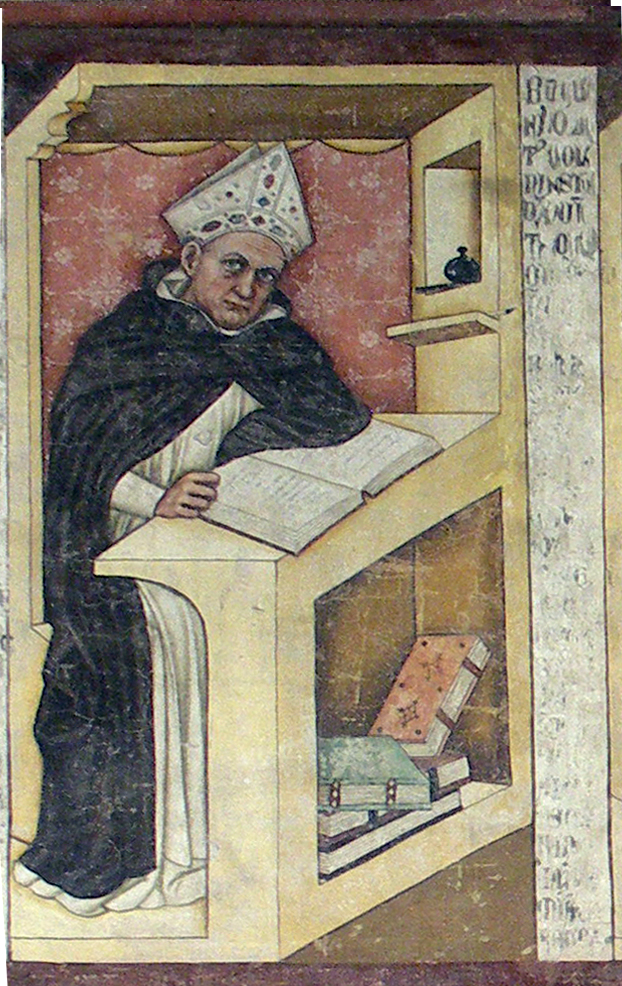
 https://upload.wikimedia.org/wikipedia/commons/4/49/07_Alberto_Magno.jpg

d) as depicted by Hugo of Schleusingen in the Bartholomaeus Anglicus portion of a late fourteenth-century miscellany from Schmalkalden (1388; München, BSB, Clm 27029, fol. 88r):
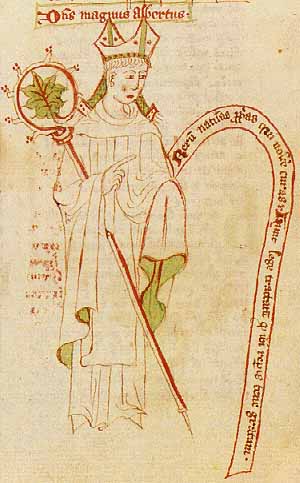
 https://www.hs-augsburg.de/~harsch/Chronologia/Lspost13/AlbertusMagnus/alb_pman.jpg

http://daten.digitale-sammlungen.de/bsb00103280/image_179
There is a larger grayscale view in S. Foster Damon, "A Portrait of Albertus Magnus", Speculum 5, no. 1 (Jan., 1930), pp. 102-103.

e) as depicted by Beato Angelico in the roundels of Dominican worthies beneath his earlier fifteenth-century fresco (early 1440s) of the Crucifixion and Saints in the chapter room of the convento (now Museo nazionale) di San Marco in Florence:

 http://www.museobenozzogozzoli.it/filecomuni/38004_003.jpg


f) as depicted (upper register at far right, accompanying St. Thomas Aquinas; at left, Beatrice and Dante) by Giovanni di Paolo in a mid-fifteenth-century copy of the Divina Commedia (ca. 1450; London, BL, Yates Thompson 36, fol. 147r):

 https://upload.wikimedia.org/wikipedia/commons/1/18/Paradis_de_Dante_-_Premier_cercle_des_professeurs_du_royaume_%28miniatures_de_Giovanni_di_Paolo%2C_XVe_si%C3%A8cle%29.png


g) as depicted by someone in the circle of Friedrich Walther in a mid- or later fifteenth-century panel painting in the Metropolitan Museum of Art, New York:

 Sermon of Saint Albertus Magnus


h) as depicted (lower register, centre right) with other physicians in a later fifteenth-century (c. 1471) copy of Giovanni Cadamosto, Libro de componere herbe et fructi (Paris, BnF, ms. Italien 1108, fol. 7v):


i) as depicted in a later fifteenth-century panel painting (c. 1476) variously attributed to Joos van Gent (Justus of Ghent, etc., etc.) or to Pedro Berruguete in the Galleria nazionale delle Marche in the ducal palace at Urbino:

 https://upload.wikimedia.org/wikipedia/commons/8/83/Alberto_Magn_(Alberto_Magno)_-_Studiolo_di_Federico_da_Montefeltro.jpg

On display (lower register, second from right) on the south wall of Federico da Montefeltro's studiolo:
http://www.gutenberg-e.org/kirkbride/detail/us_3_south_wall_men.html

j) as depicted (roundel in the right margin) by Gioacchino di Giovanni in a later fifteenth-century copy of Neapolitan origin of his De laudibus beate Mariae Virginis (1476; Valencia, Universitat de València, Biblioteca Històrica, BH ms. 399, fol. 1r):
http://tinyurl.com/qzt8z5h

k) as depicted by Nardo Rapicano in a later fifteenth-century copy of Neapolitan origin of his  De mirabili scientia Dei (c. 1484; Valencia, Universitat de València, Biblioteca Històrica, BH ms. 390, fol. 7r):
http://tinyurl.com/q9j6h39

l) as portrayed by Vincenzo Onofri in a late fifteenth-century bust (c. 1493) in the Museo civico medievale in Bologna:

 https://upload.wikimedia.org/wikipedia/commons/5/5c/Vincenzo_onofri%2C_sant%27alberto_magno%2C_1493.JPG

http://tinyurl.com/q3ufjl7

m) as depicted (left margin) in a hand-coloured woodcut in the Beloit College copy of Hartmann Schedel's late fifteenth-centuryWeltchronik (Nuremberg Chronicle; 1493) at fol. CCXIIIIr:
http://www.beloit.edu/nuremberg/book/6th_age/right_page/117%20%28Folio%20CCXIIIIr%29.pdf

n) as depicted (at left; at right, Bl. John Duns Scotus) by Amico Aspertini in an earlier sixteenth-century panel painting (1521) in the Pinacoteca civica in Como:

 http://cultura.comune.como.it/uploads/images/prestiti/dipinti/P594_A.%20Aspertini,%20Ritratto%20di%20Alberto%20Magno%20e%20Duns%20Scoto.jpg

Sunday, 8 November 2015

Bl. John Duns Scotus


November 8th is the commemoration of Bl. John Duns Scotus OFM, who died in 1308. John Dillon posted on the Medieval Religion discussion group one of his selections of early images of him, and given the Oxford link and the recent excavations of more of the site of the medieval Greyfriars here it seems very apposite to share, and also adapt slightly, his post:


Born at Duns in Scotland andordained priest at Northampton in 1291 and trained at Oxford, he lectured at Paris ( " who fired Paris for Mary without spot" - Hopkins ) and, from 1307, at Köln. His cult was confirmed in 1993 at the level of Beatus. The Subtle Doctor now reposes in a modern sarcophagus in Köln's thirteenth-century Minoritenkirche Mariae Empfängnis (Franciscan Church of the Immaculate Conception), formerly a church for foreign teachers and students. His entry in the Stanford Encyclopedia of Philosophy can be seen here: http://plato.stanford.edu/entries/duns-scotus/

Some period-pertinent images of Bl. John Duns Scotus:

a) as depicted on the opening pages of text of each volume of a two-volume thirteenth- or fourteenth-century copy, from Genoa, of his commentaries on the Sententiae of Peter Lombard (Paris, Bibliothèque Mazarine, mss. 882, 883):
1) ms. 882, fol. 5r: http://www.enluminures.culture.fr/Wave/savimage/enlumine/irht17/IRHT_11877-p.jpg
2) ms. 883, fol. 1r: http://www.enluminures.culture.fr/Wave/savimage/enlumine/irht17/IRHT_11881-p.jpg

b) as depicted at the outset of an early fourteenth-century copy, of East Anglian origin, of his commentaries on the Sententiae (Paris, BnF, ms. Latin 3061, fol. 1r):
http://gallica.bnf.fr/ark:/12148/btv1b525038815/f9.item.zoom

c) as depicted at the outset of of an earlier fourteenth-century copy (c. 1320) of his Quodlibet (Munich, BSB, Clm 8717, fols. 61r-100r, at fol. 61r):
http://faculty.cua.edu/hoffmann/scotus-bibliography.htm

d) as depicted by Benozzo Gozzoli in his mid-fifteenth-century frescoes (between 1450 and 1452) in the chiesa di San Francesco in Montefalco (PG) in Umbria:
http://tinyurl.com/ofe2g99

e) as depicted at the outset of a later fifteenth-century copy (1470s?) of a commentary of his on Book One of the Sententiae (Rovigo, Biblioteca dell'Accademia dei Concordi, Biblioteca Silvestriana cod. 215, fol. 1r):
http://tinyurl.com/pewxzww

f) as depicted by Carlo Crivelli in a later fifteenth-century panel painting (1471?; from his now dismembered Montefiore altarpiece) in the Polo Museale di San Francesco at Montefiore dell'Aso (AP) in the Marche:

 https://upload.wikimedia.org/wikipedia/commons/6/64/Carlo_crivelli%2C_montefiore%2C_santo_francescano.jpg


g) as depicted in a later fifteenth-century panel painting (c. 1476) variously attributed to Joos van Gent (Justus of Ghent, etc., etc.) or to Pedro Berruguete in the Galleria nazionale delle Marche in the ducal palace at Urbino:

 http://paradjanov.biz/works/wp-content/uploads/2015/07/duns-scotus.jpg


On display (lower right) on the east wall of Federico da Montefeltro's studiolo:
http://www.gutenberg-e.org/kirkbride/detail/us_2_east_wall_men.html

h) as depicted by Nardo Rapicano at the outset of a later fifteenth-century copy (c. 1480), of Neapolitan origin, of a commentary of his on Book Two of the Sententiae (Paris, BnF, ms. Latin 3063, fol. 1r):
http://gallica.bnf.fr/ark:/12148/btv1b8446954p/f11.item.zoom

i) as depicted (left margin at top) in a hand-colored woodcut in the Beloit College copy of Hartmann Schedel's late fifteenth-century Weltchronik (Nuremberg Chronicle; 1493) at fol. CCXXIr):
http://www.beloit.edu/nuremberg/book/6th_age/right_page/124%20%28Folio%20CCXXIr%29.pdf

j) as depicted (at right; at left, St. Albertus Magnus) by Amico Aspertini in an earlier sixteenth-century panel painting (1521) in the Pinacoteca civica of Como:

 http://cultura.comune.como.it/uploads/images/prestiti/dipinti/P594_A.%20Aspertini,%20Ritratto%20di%20Alberto%20Magno%20e%20Duns%20Scoto.jpg


Monday, 20 February 2012

Medieval Franciscans in Oxford


An early morning meeting at Christ Church last Friday took me on a slightly different route into the centre of Oxford and through the site of the medieval Oxford Greyfriars.

The buildings had been largely demolished by the time Ralph Agas drew his pictorial map of the city in 1578, but excavations in 1971 and 1972 revealed the plan of the church and some of the conventual buildings - the foundations had been largely robbed out. The church had a very unusual extended north transept to accommodate more altars, and was cut into the city wall. Part of the site of the choir is still visible as a grass plot in Old Greyfriars Street, whilst the multi-storey car to the south covers the site of the domestic ranges.

The founding Prior, Bl. Agnellus of Pisa, is buried there. The house, along with the whole Franciscan mission in England, attracted the support of the diocesan bishop, Robert Grosseteste, who held the see of Lincoln from 1235 until his death in 1253. The Oxford friary had his library and relics such as his sanctuary slippers until the dissolution. I strongly suspect that "my bishop" Richard Fleming used the library in his own time as a student and Regent Master in Oxford. Grosseteste's close friend Adam Marsh was trained and lectured at the friary.

Other notable Franciscan s who lived and studied there were Roger Bacon, who is now commemorated by a plaque on the wall adjacent to the site of the choir and by the nearby Roger Bacon Lane, John Duns Scotus, William of Ockham and Peter Phillages, who from 1409-10 reigned as the conciliar Pope Alexander V.

File:William of Ockham - Logica - 1341.jpg

William of Ockham

The sketch is labelled "frater Occham iste", from a manuscript of Ockham's Summa Logicae, 1341.

I understand that just as Ockham's former home in Oxford is now covered by a supermarket car park, so to is his presumed grave in Munich.

Image: Wikipedia


Statue of King Richard from 1260 in the choir of Meissen cathedral

Image: hubert-herald.nl/DeuRichardCornwall.htm

There is an illustrated website about Richard of Cornwall here, and there are biographies by N.Denholm-Young Richard of Cornwall and by T.W.E. Roche The King of Almayne, which includes a photograph of a stained glass panel depicting Queen Beatrix, which does not appear to be available on the internet.

And all that within a few yards of Oxford city centre.


Thursday, 8 July 2010

The Pope on Duns Scotus

In his general audience yesterday the Pope spoke about Bl. John Duns Scotus, who was, of course, one of the outstanding products of late thirteenth century Oxford and the Franciscan school here. The Pope's speech can be found here.


Modern monument to Duns Scotus in St Mary's church in the High here in Oxford. Photo from Catholic Oxford