Once I was a clever boy learning the arts of Oxford... is a quotation from the verses written by Bishop Richard Fleming (c.1385-1431) for his tomb in Lincoln Cathedral. Fleming, the founder of Lincoln College in Oxford, is the subject of my research for a D. Phil., and, like me, a son of the West Riding. I have remarked in the past that I have a deeply meaningful on-going relationship with a dead fifteenth century bishop... it was Fleming who, in effect, enabled me to come to Oxford and to learn its arts, and for that I am immensely grateful.


Showing posts with label Bl. Agnellus of Pisa. Show all posts

Tuesday, 10 September 2024

Bl. Agnellus of Pisa and the Oxford Franciscans 1224-2024


Today is the feast of Bl. Agnellus of Pisa, who was sent eight centuries ago to establish the Franciscans in Oxford. This octocentenary of the arrival of the Greyfriars in England is being marked by a series of celebratory events which began at Dover and Canterbury last Sunday. They conclude with a High Mass in the Dominican church in Oxford at 4pm on September 21st.

Bl. Agnellus dies in 1236 and his remains were preserved in the friary church until its destruction in the sixteenth century. It is possible they are still there. One suggestion is that they are in a garden adjacent to the site. Another, made by the late Fr Jerome Bertram, Cong. Orat.,who helped excavate the friary in the 1970s, is that they are under the fish counter in the Sainsbury's which now occupies part of the site…

I have posted about Bl. Agnellus in 2010 at Bl. Agnellus of Pisa, in 2011 at Bl Agnellus of Pisa, and in 2015 at Bl Agnellus of Pisa

I have posted more about the medieval Greyfriars house in Oxford in 2012 in Medieval Franciscans in Oxford and, slightly more generally along with the other friaries of the town and University, in a 2015 post Out and about Oxford with Friars

The Franciscan Capuchins established a new community at the church of St Edmund and St Frideswide together with an academic Hall of the University - now sadly closed - in 1928. The Capuchins are one of the later reformed Franciscan communities established in 1525. The return of the Conventual Franciscans, the successors of the medieval friars, to Oxford occurred in 2014 and that is is covered in Greyfriars return to Oxford


May St Francis, Bl.Agnellus, and all the Franciscan saints and beati pray for the Franciscan community and for us all.


Thursday, 10 September 2015

Bl Agnellus of Pisa


 Bl.Agnellus of Pisa
1195-1236

 Image: Franciscan Province of Great Britain website/Supremacy and Survival blogspot 

Today is the feast in the Birmingham archdiocese of Bl. Angnellus of Pisa, who led the Franciscan mission to England in 1224 and who was buried - and venerated - in the medieval Oxford Greyfriars.


In 1224 Francis decided to send some friars to England and appointed Agnellus of Pisa to lead a small expedition. On Tuesday, 10 September of the same year, a small boat landed near Dover and nine roughly-dressed figures disembarked, and so the Franciscan Order was implanted in England. The nine friars were led by an Italian, Agnellus of Pisa, who had previously been Custos in Paris. It included three Englishmen who had joined the Order, probably in Paris where many Englishmen of the time went to study, five Italians and one Frenchman. Within seven weeks of arrival they had established friaries in Canterbury, London and Oxford, the ecclesiastical, political and intellectual capitals of England.

From the Franciscan Province website

My previous posts about him and the medieval Greyfriars of Oxford can be read at Bl. Agnellus of Pisa, from 2010, Bl Agnellus of Pisa from 2011, Medieval Franciscans in Oxford
and  Commemorating Bl. Agnellus of Pisa  from 2012, and, from earlier this year, Out and about Oxford with Friars


Fr Cuthbert, the founder of the Capuchin house in Oxford, produced a translation of Thomas of Eccleston's  De adventu F.F.minorum in Angliam in 1903 which can be read online at
The friars and how they came to England 

Now we have both the Capuchins and the Conventuals in Oxford, reviving and continuing a venerable spiritual and academic tradition.


Tuesday, 31 March 2015

Out and about Oxford with Friars


This morning I gave a tour for the community of the Oxford Franciscan Conventuals of the sites of the four medieval friaries in the city.We arranged to meet in Radcliife Square and thus I set off leading my group of Franciscans in their monastic habits around the city.

It has to be said that not much remains, indeed very little above ground of any of the four houses, but excavations, surviving records and texts and the eye of faith help. The buildings of the friaries had largely gone in all four cases by 1578 when Ralph Agas drew his aerial map of Oxford.

All four were situated just outside the city walls, and, as in other cities, strategically placed to minister to a particular quarter of the urban community. Certainly here in Oxford they all had extensive open space around them, and one of the Friars pointed out to me that the radical Franciscan Peter John Olivi (d.1298) defended the Franciscans right to have gardens for recreation in the debate on poverty within the Order. 

I understood also that one of the present community had seen a manuscript of receipts from one of the medieval friaries in Oxford which suggested they made an income from baking altar breads and from tanning.

We started with the Austin friary - now represented by the site of Wadham, including the King's Arms, and parts at least of the sites of Rhodes House and Harris-Manchester. At the south-east corner there a late medieval doorway can be seen from Mansfield Road which is probably part of the perimeter wall of the friary complex. The friary hosted regular academic disputations, known as "doing the Austins", after one of which Wyclif was informed of his censure by a Church council.

The Carmelite house started on the site of what is now Worcester College. King Edward II fleeing from the defeat of Bannockburn is said to have vowed a new site for the Oxford Carmelites if he escaped, and fulfilled it by giving the royal residence of Beaumont Palace, birthplace of King Richard I and King John, to them in 1317. Apart from the lane called Friars Entry - presumably on the site of the gatehouse - all that can be seen above ground is some pieces of window tracery in a garden behind Beaumont Street (developed at the beginning of the nineteenth century and crossing the site). It is not clear if this does come from the friary or has been rescued from another site in the city. I understand foundations of two substantial walls have been found either side of Beaumont Street itself which may well be those of the church - or possibly an earlier great hall of the palace.

We then crossed the western side of the medieval walled urban area, and out by the site of Littlegate, to look at what remains of the Dominican gatehouse, now built into the Centre for the Deaf. East of it was the church - its plan recovered in part by excavations in the early 1970s - and now covered by modern housing and part of the Magistrates court. This was the burial place from 1312-1315 of Piers Gaveston, and I gather what may have been his tomb was found in the cloister during the excavations. As Gaveston was excommunicate at the time of his death he would not have been interred in the church. His body was subsequently removed to King's Langley and the Dominican house there.

Just to the west and straddling the town wall was the Franciscan friary. Today a piece of grass protects the remains of the choir of the church - like the Dominican site the stone foundations were largely robbed away - and there is a plaque to commemorate Roger Bacon (1214?-1292?), as well as the nearby street Roger Bacon Lane. He lived on in folk memeory as the bridge gate on the old Folly Bridge, demolished in 1779, became known, erroneously, as Friar bacon's study. The excavations of the early 1970s revealed the plan of the church - like the Dominican church it had a typical friary plan of unaisled choir and aisled nave, but here there was also an elongated north transept to house more altars along its east wall. This looks to be a unique feature, suggesting both the numbers of the friars and popular demand for Masses. 

At the moment building work is going on opposite the site of the church as part of the rebuilding of the back of the Westgate centre - one might hope this process will yield more about the history of the site.

The grassy area of the choir once held the shrine of Bl. Agnellus of Pisa, who led the first Franciscans to England and who died in 1236.


Bl.Agnellus of Pisa, 1195-1236

 Image: Franciscan Province of Great Britain website/Supremacy and Survival blogspot 

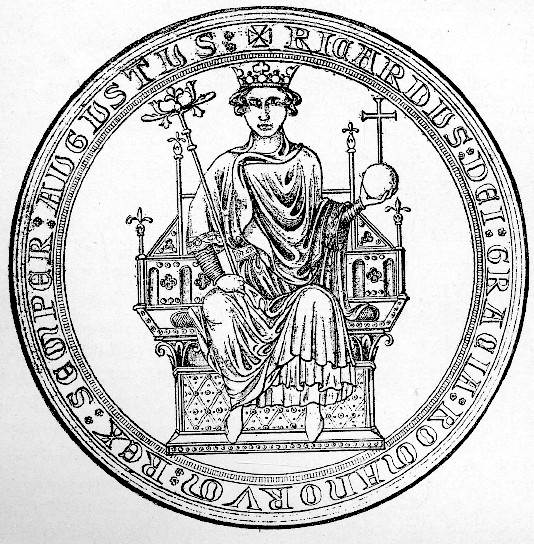
Also in the church was the heart of Richard of Cornwall, King of the Romans and brother of King Henry III, who died in 1270, and the  body of his third wife and Queen Beatrix of Falkenburg. King Richard himself was buried at Hailes, his  Cistercian foundation in the Cotswolds that housed the relic of the Holy Blood.


The Great Seal of King Richard of the Romans

Image:Wikimedia

In the 1380s the community included Peter of Candia, born in Crete and one of the Greek-speaking Franciscans who were sometimes resident in medieval Oxford; he was elected as Pope Alexander V in the Pisan obedience in 1409, but died the following year.


Pope Alexander V

Image:www2.ucy.ac.cy

I also drew attention to the important library of the Oxford Greyfriars. They possessed the manuscripts, and also the sanctuary slippers, of Bishop Robert Grosseteste of Lincoln (d.1253), who had been a friend and patron of the Order.

http://simon2014.com/wp-content/uploads/2012/06/Grosseteste-e1352234580586.gif

 Bishop Robert Grosseteste

Image:simon1214.com

Sadly the library which had been an important centre for study appears to have been in decay on the eve of the dissolution when John Leland visited it.

This was a most enjoyable morning, and it was a pleasure to show the present Conventual Franciscans where their predecessors had lived, as well as to relax with them over coffee afterwards and share ideas about the life of medieval friars.


Monday, 10 September 2012

Commemorating Bl. Agnellus of Pisa


Here is Oxford today is the feast day of Bl. Agnellus of Pisa, the founder of the original Oxford Franciscan priory in the city in the thirteenth century. My post from this day last year about him, with a link to other posts on him, can be read at Bl. Agnellus of Pisa.

Monday, 20 February 2012

Medieval Franciscans in Oxford


An early morning meeting at Christ Church last Friday took me on a slightly different route into the centre of Oxford and through the site of the medieval Oxford Greyfriars.

The buildings had been largely demolished by the time Ralph Agas drew his pictorial map of the city in 1578, but excavations in 1971 and 1972 revealed the plan of the church and some of the conventual buildings - the foundations had been largely robbed out. The church had a very unusual extended north transept to accommodate more altars, and was cut into the city wall. Part of the site of the choir is still visible as a grass plot in Old Greyfriars Street, whilst the multi-storey car to the south covers the site of the domestic ranges.

The founding Prior, Bl. Agnellus of Pisa, is buried there. The house, along with the whole Franciscan mission in England, attracted the support of the diocesan bishop, Robert Grosseteste, who held the see of Lincoln from 1235 until his death in 1253. The Oxford friary had his library and relics such as his sanctuary slippers until the dissolution. I strongly suspect that "my bishop" Richard Fleming used the library in his own time as a student and Regent Master in Oxford. Grosseteste's close friend Adam Marsh was trained and lectured at the friary.

Other notable Franciscan s who lived and studied there were Roger Bacon, who is now commemorated by a plaque on the wall adjacent to the site of the choir and by the nearby Roger Bacon Lane, John Duns Scotus, William of Ockham and Peter Phillages, who from 1409-10 reigned as the conciliar Pope Alexander V.

File:William of Ockham - Logica - 1341.jpg

William of Ockham

The sketch is labelled "frater Occham iste", from a manuscript of Ockham's Summa Logicae, 1341.

I understand that just as Ockham's former home in Oxford is now covered by a supermarket car park, so to is his presumed grave in Munich.

Image: Wikipedia


Statue of King Richard from 1260 in the choir of Meissen cathedral

Image: hubert-herald.nl/DeuRichardCornwall.htm

There is an illustrated website about Richard of Cornwall here, and there are biographies by N.Denholm-Young Richard of Cornwall and by T.W.E. Roche The King of Almayne, which includes a photograph of a stained glass panel depicting Queen Beatrix, which does not appear to be available on the internet.

And all that within a few yards of Oxford city centre.


Saturday, 10 September 2011

Bl Agnellus of Pisa


On this day last year I posted about Bl. Agnellus of Pisa, whose diocesan feast day it is, and thought I would link to that post which gives a biography of the founder of the medieval Franciscan house in Oxford.

He died there on May 7 1236, and some years afterwards his body was exhumed and found to be incorrupt, and yielding a supply of fragrant oil. The incorrupt body was preserved with great veneration until the dissolution of the house in the sixteenth century. Indeed it may well still be there on an as yet unexcavated part of the friary site.

His cultus was confirmed by Pope Leo XIII in 1882, and his feast is kept by the Order on May 7.

photo

Bl. Agnellus of Pisa
Modern glass in Greyfriars Church,
Oxford

Image: Lawrence Lew OP on Flickr


Friday, 10 September 2010

Bl. Agnellus of Pisa


Today is the feast appointed for Bl. Agnellus of Pisa OFM. in the Oxfordshire part of the Archdiocese of Birmingham.

I have based the following account on that in the 1913 Catholic Encyclopedia.

The founder of the English Franciscan Province Bl. Agnellus was born at Pisa c. 1195, of the noble family of the Agnelli, and died at Oxford, 7 May, 1236. In early youth he was received into the Franciscan Order by St Francis himself, during the latter's sojourn in Pisa, and soon became an accomplished model of religious perfection. Sent by St Francis to Paris he erected a convent there and became custos.

Having returned to Italy, he was present at the so-called Chapter of Mats, and was sent thence by St Francis to establish the Order in England. Agnellus, then in deacon's orders, landed at Dover with nine other friars on 12 September, 1224, having been charitably conveyed from France by the monks of Fecamp. A few weeks afterwards they obtained a house at Oxford and there laid the foundations of the English Province, which became the exemplar for all the provinces of the order. Though not himself a learned man, he established a school for the friars at Oxford, which was destined to play no small part in the development of the University.However his solicitude extended beyond the immediate welfare of his brethren. He sent his friars about to preach the word of God to the faithful, and perform the other offices of the sacred ministry. Agnellus wielded considerable influence in affairs of state and in his efforts to avert civil war between King Henry III and the Earl Marshal, who had leagued with the Welsh, he contracted a fatal illness.

Thomas de Eccleston, the chronicler of the early Franciscans in England in his De Adventu Fratrum Minorum in Angliam , and a student at the Oxford house in the 1230s, has a brief account of his death. Agnellus's body, incorrupt, was preserved with great veneration at Oxford up to the dissolution of the religious houses in the time of Henry VIII.

The cultus of Blessed Agnellus was formally confirmed by Pope Leo XIII in 1882, and his feast is[or was?] kept in the Order on 7 May.


There is a detailed history of the Oxford Greyfriars from the Victoria County History of Oxfordshire vol ii (1907) here which is well worth reading through, and gives details of the building work in the time of Bl. Agnellus.

Excavations before the building of the Westgate Centre in the early 1970s revealed much of the plan of the house, including the remarkable layout of the church, which added to the usual friary plan of unaisled choir and aisled nave an enormous north transept, elongated northwards in plan, with a series of chapels, presumably to provide for the number of Masses being offered by the friars. There are plans in Oxoniensia and in the medieval volumes of the History of the University of Oxford.

Today there is very little to see of what was once a leading house of prayer and study. A patch of grass in the angle of the road below the Westgate Centre indicates the site of the choir. On an adjacent wall is a plaque commemorating Roger Bacon OFM. Apart from an archway built into another building that is really all there is to see. In terms of quiz trivia however this is a site with the body of a Beatus (Agnellus himself), the heart of a King (Richard of Cornwall, brother of Henry III, and King of the Romans 1257-72. His body was buried at Hailes Abbey), the body of a Queen (Richard's third wife Beatrix of Falkenburg, who died in 1277) and the site of the residence of a future Pope (Peter of Candia OFM, later Pope Alexander V 1409-10).

The website of the restored foundation of Franciscans in Oxford can be found at Oxford Greyfriars.