Once I was a clever boy learning the arts of Oxford... is a quotation from the verses written by Bishop Richard Fleming (c.1385-1431) for his tomb in Lincoln Cathedral. Fleming, the founder of Lincoln College in Oxford, is the subject of my research for a D. Phil., and, like me, a son of the West Riding. I have remarked in the past that I have a deeply meaningful on-going relationship with a dead fifteenth century bishop... it was Fleming who, in effect, enabled me to come to Oxford and to learn its arts, and for that I am immensely grateful.


Showing posts with label Emperor Charles IV. Show all posts

Tuesday, 4 October 2016

Bohemian Coronation


Last month Prague witnessed a re-enactment of the coronation of the Emperor Charles IV as King Charles I of Bohemia in 1347 - as regular readers will be aware this year is the 700th anniversary of the birth of the Emperor.

The online journal Medieval Histories has a report about the events in Prague which I have copied below:


Couple playacting as Charles IV and Queen Blanche 1347 - 2016 Honza Keokotah

Photo from official presentation of the couple playing the roles of Charles IV and Blanche of Valois. © Honza Keokotah

Invitation to the Coronation of Charles IV 2016


The re-enactment of the Coronation of Charles IV in Prague is a recurrent event. This year, however, the professionals have fully taken over. They promise not just a re-enactment, but a faithful and scientifically based recreation
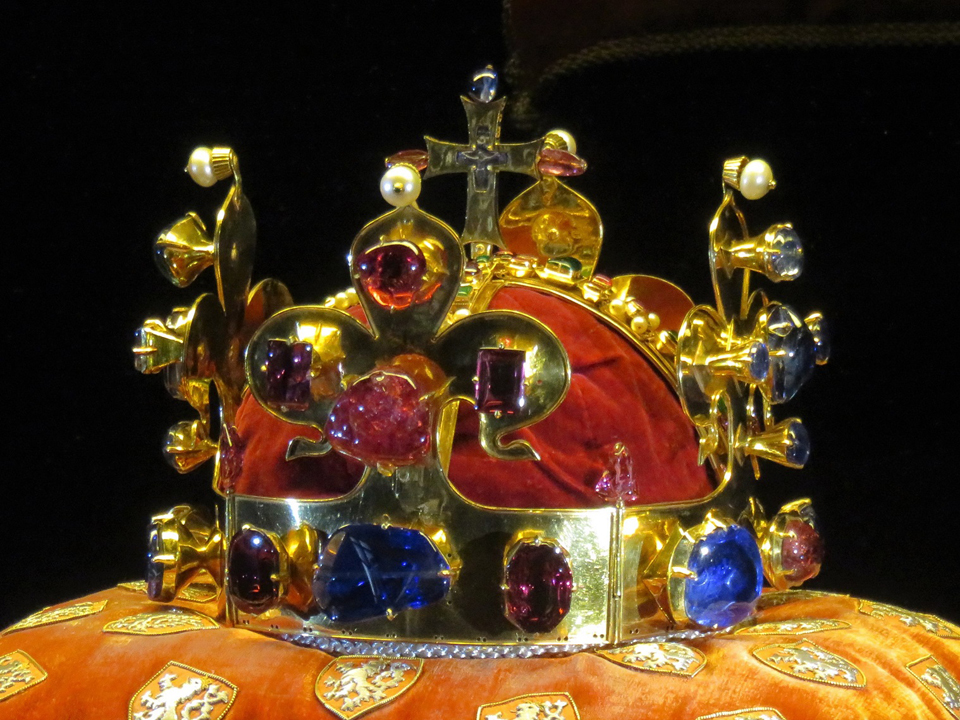


Bohemian Crown May 2016. Source: Wikipedia
 
Bohemian Crown May 2016. 
 
Source: Wikipedia
This year is the 700th anniversary of the birth of Emperor Charles IV, and one of the highlights is a faithful recreation of his coronation, celebrating the event, which took place on the 2nd of September 1347. The coronation itself takes place on the 4th of September at 1 pm at St Vitus’ Cathedral, but only for invited guests due to space limitations. It will be projected on a screen in nearby Hradčanské náměstí. – http://prague-stay.com/lifestyle/review/1597-hradcanske-namesti/ – Other parts of the re-creation such as processions and medieval markets will be open to the “burghers” and “peasants”.

The clothes and crowns for Charles IV and his wife, Blanche of Valois, have been faithfully copied, although some guesswork was involved on the part of historians from the Academy of Sciences and other institutions, which have collaborated on the project. Some is of course based on guesswork. For instance, the sceptre and orb, which survive are from the 16th century, so what they used like in the 14th century is a matter of conjecture. In the same way, the church where the coronation took place no longer exists, and the more modern cathedral now has to stand in its place.

Nevertheless, there exists a rather detailed description of the events as Charles personally wrote the manual: Ordo at coronandum regem Boemorum 1347. The recreation is based on this plus information gathered from chronicles and other sources.

Programme
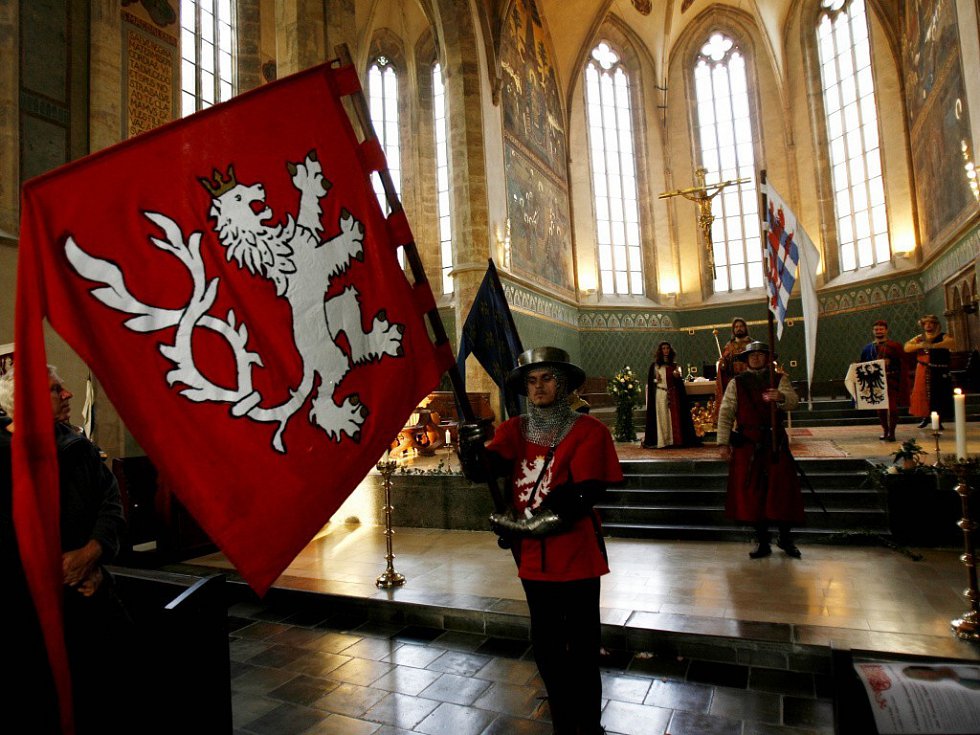


Reconstruction of the coronation of Charles Iv in 2007
 
Reconstruction of the coronation of Charles IV in 2007
The festivities start on the 3rd of September with a medieval market from 10 am to 6 pm at the Karolinum, at Ovocný trh 3, across from the Estates Theatre. There will be juggling, music and dancing, and workshops for kids. In the evening, there will be a mass at Vyšehrad, a visit to the St Martin Rotunda and a penitential procession to the Karolinum and further on to the Old Town Square and Prague Castle. Festivities at Vyšehrad begins at 3:30 pm, and the procession starts at 6 pm. The day will end with prayers at St Vitus Cathedral at 9 pm. The King will at this event wear bast sandals. In the 14th century, we may believe, he walked barefooted.

The next day, Sept. 4, sees another medieval market at the Karolinum for 10 am to 6 pm. Festivities at St Vitus Cathedral begin at 12:50 for the invited, others are directed to go to Hradčanské náměstí. A procession will leave from Hradčanské náměstí at 3 pm, arriving at Old Town Square at 4 pm for fanfare, music, dancing and other festivities. A knight’s tournament with horses will take place at 6 pm, and events will end at 8:30 pm.

Performers in the pilgrimage and the coronation event have been chosen from local re-enactors, who have been instructed to wear precise period-close outfits. Suitable liturgical vestments have been borrowed from the depositories of the Royal Collegiate Chapter of Vyšehrad and the Roman Catholic parish at the Church of Our Lady before Tyn, while liturgical objects have been lent by the Archbishopric of Prague and the Chapter of St. Vitus. The actual crown will be the exact replica which is usually exhibited in the castle, but new sceptres and orbs have been created. Another huge effort has been invested in recrating the presumable outfits which were worn by the king and queenas well as some of the other major actors. Other work has been invested in the reproduction of a canopy, silk brocade banners, a reconstructed throne etc.

Cathedral of St. Vitus

At an early point a controversy existed about where to “perform” the actual coronation. Suggestions were to have it either performed in the other church in the Castle, St. George’s. Or, alternatively the Church of St. Mary and St. Jerome, which was founded by Charles in 1347. However, after long negotiations an agreement was finally reached to have the coronation recreated in St. Vitus.

Organisers

The quality of the event has been carefully secured by engaging the official support of the Ministry for Culture, the University and the Catholic Church in Prague as well as numerous other institutions.
The scientific panel, which guarantees the faithful recreation consist of
National Czech television will broadcast the event, which – of course – will make it impossible for anyone outside Czechia to see the recreation as it takes place. Once again, copyright rules prevents the European broadcasting of the event.
A full programme for the coronation can be found at Korunovační slavnosti v Praze 3. – 4. 9. 2016  (CZ)

READ MORE:
cover_coruna karl IV 
Ed. and translated by Jiří Kuthan, Miroslav Šmied, Joseph Cibulka and Jaromír Homolka
Nakladatelské údaje: Praha : Filozofická fakulta Univerzity Karlovy, 2009
ISBN:978-80-7308-266-6


The re-enactment was videoed and can be found on YouTube at https://youtu.be/01xRjoq7ib0
It lasts for an hour and three-quarters, but from what I have seen looks impressive. From reseaching the link such historical re-enactments are popular amongst modern Czechs.

Now all this is very interesting to the Clever Boy, but being the man he is, he is more than tempted to point out that the most genuine recent Bohemian coronation was that of King Ferdinand V in 1836 and to suggest that the cathedral of St Vitus might do well to be used for the coronation of the present de jure King of Bohemia, King Charles V...


Saturday, 3 September 2016

Emperor Charles IV - 700th anniversary


The online site from Denmark Medieval Histories is always well worth receiving - I would recommend readers to sign up to this free service - and their latest edition is truly splendid being devoted almost entirely to articles about the Holy Roman Emperor Charles IV, the 700th anniversary of whose birth falls this year. These give remarkable insights, accompanied by splendid illustrations, into the life and times of the Emperor. I have copied and pasted their entry page, which has some other articles of interest at the end.

MEDIEVAL NEWS
02.09.2016

Charles IV, King of Bohemia and Holy Roman Emperor, lived from 1316 – 1478. All year, Czechia have celebrated their national hero culminating this weekend with a scientifically based recreation of his coronation in 1347. Read all about this event, the exhibitions in both Prague and Nuremberg (coming-up), the many portraits of him, his autobiography, his spectacular crowns and much more. If you miss an angle – don’t despair. There will be a follow-up!
Couple playacting as Charles IV and Queen Blanche 1347 - 2016 Honza Keokotah

Invitation to the Coronation of Charles IV 2016

The re-enactment of the Coronation of Charles IV in Prague is a recurrent event. This year, it will be a faithful, scientifically based recreation
Banner with exhibition Charles IV 1316 - 2016

Charles IV – 1316 - 2016

This year Prag and Nuremberg celebrates the birth of Charles IV (1316 – 1378) with two major exhibitions and a number of other events.
Charles IV - Statue in prague from 1848 by Ernst Julius Hähnel

Charles IV – Adventurer or National hero?

In 2005 the Czech cast their vote as to who was the greatest Czech hero. Curiously enough a medieval king, Charles IV, came out on top by 68.713 votes.   Read more.
Charles IV carried into Paris- BnF, FR 2813 f 469

Charles IV – Boisterous Youth and Crippled King

Charles IV was known as an agile youth with a penchant for taking part in tournaments. However, in 1350 he was severely crippled
Portrait of Charles IV in Prague detail

Charles IV and His Autobiography

The Vita Caroli Quarti of Charles IV (1316 – 1378) is one of the earliest royal autobiographies written. A new edition celebrates the 700-year anniversary
The Last Judgement at the Golden Gate of St. Vitus in Prague. Source: Wikipedia

The Curious Mind of Charles IV

Charles IV was an extremely sensual person possessing a creative and curious mind. A vast number of sources witness to this remarkable leader
Adoring the cross at Karlsteijn

The Portraits of Charles IV of Bohemia

Charles IV belongs to a group of 14th century rulers who commissioned artists to render them as personally recognizable individuals when acting as kings   Read more.
Relief showing the Coronation of Charles in Milan 1354. Notice the crowns hanging above the altar and the bearer of the sword. Workshop of Matteo da Campione. . © Museo e Tesoro del Duomo di Monza

Crowns of Charles IV of Bohemia

Charles IV was obsessed with organising impressive medieval spectacles. One of the important props were his crowns, of which we know several.
Old part of Prague Castle

Prague – Centre Stage for Charles IV

Charles IV was a king obsessed with organising feasts and processions of all sorts. His rebuilding of Prague is a witness to this.

Medieval Travels....

Karlstejn © pstours

The Castle of Karlštejn

Karlstejn is a remarkable witness to the creative energy of Charles IV, king of Bohema and Holy Roman Emperor 1316 - 1378
Reconstructed medieval outfits from the time of Charles IV

Karlštejn Castle and its Treasure

The Karlštejn Treasure is a collection of around 400 objects dating back to the 14th century, when Charles IV commissioned the building of the Castle.
Castle in Lauf - Wenzelschloss-gallery of coat of arms -detail

The Castle in Lauf -  Wenzelschloss –

The Castle in Lauf – also known as the Wenzelschloss – was constructed by Charles IV in 1356 on the road between Prague and Nuremberg.

Medieval Exhibitions...

Pavillon de l’Horloge Medievale musée du Louvre Thierry Ollivier WEB

Medieval Louvre

To all medievalists: skip queuing for Mona Lisa and visit the newly opened parts of Louvre where its medieval history is told
Hans Memling Triptych of Jan Crabbe

Triptych of Jan Crabbe

Hans Memling's Triptych of Jan Crabbe is reunited in Landmark Exhibition at the Morgan in the autumn

New Research....

descendants-of-Suleiman-shown-around-Szigetvar

Tomb of Suleiman the Magnificent in Szigetvár

When Suleiman the Magnificent died in Szigetvár his heart and entrails were buried there. His newly discovered mausoleum is hoped to be a new tourism magnet    Read more.

Saturday, 14 May 2016

Birth of Emperor Charles IV


Today is the 700th anniversary of the birth in 1316 of the future Holy Roman Emperor Charles IV.


Charles IV-John Ocko votive picture-fragment.jpg 

Emperor Charles IV
A detail from the votive panel of Archbishop John Ocko

Image: Wikipedia 

There is an online biography of the Emperor at Charles IV

Born in 1316 , King of Bohemia from 1346 and holy Roman Emperor from 1348 he died in 1378 and was one of the most remarkable rulers of both Bohemia and the Empire, the ruler who developed Prague as a capital city ofd first class rank. He sponsored the rebuilding of the cathedral of St Vitus there - not completed until the 1920s, founded the Charles University - the first such institution within the Empire, developed the cult of St Wenceslaus and had made the crown of Bohemia, known as that of St Wenceslaus. As apatron of the visual arts his work in Prague and at his castle at Karlstejn survives as atestimony to the brilliance of his era. For the Empire the issued the Golden Bull which regulated that territory and institution until its dissolution in 1806.


Image:realhistoryww.com

In terms of English history he was the father of Queen Anne of Bohemia, the consort of King Richard II, and it was, less happily, under the Anglo-Bohemia contacts of those years that the ideas of Wyclif spread to Bohemia and led to the misdirection of the Emperor's laudable and orthodox aim of reinvigourating the Bohemian church into Hussitism.

One of the books I am reading at the moment is Fr Bede Jarrett's biography of the Emperor which includes a translation of the Emperor's own autobiography of his years before his accession.

A remarkable ruler in a glittering and cultured age, he was also one concerned to stamp his image and personality on his realms through the visual arts and enduring memorials.


Wednesday, 25 December 2013

O Come Let Us Adore Him


A Holy, Blessed and Joyful Christmas to you all


http://upload.wikimedia.org/wikipedia/commons/thumb/c/c1/Meister_Theoderich_von_Prag_%28Umkreis%29_001.jpg/399px-Meister_Theoderich_von_Prag_%28Umkreis%29_001.jpg

Image:Wikimedia


My choice of a Christmas image this year is the votive panel of John Ocko of Vlasim, Archbishop of Prague and dated to circa 1370. Not only does it contain an image of the Virgin and Child but seems to capture so many of the themes I have touched upon in my posts over this last year, so it seemed an appropraite image to use. The Virgin and Christ Child are flanked by the kneeling figures of the Holy Roman Emperor Charles IV, sponsored by his Burgundian patron St Sigismund, and his son, King Wenceslas IV of Bohemia and also King of the Romans, sponsored by St Wenceslas. In the lower register the kneeling figure of Archbishop John is surrounded by his patrons. 


Friday, 29 November 2013

Holy Roman Emperor Charles IV


Today is the 635th anniversary of the death in 1378 of the Holy Roman Emperor Charles IV, of whom there is an illustrated online biography here. There is another online account here, also with illustrations, but in occasionally quaint English  and a third one, with links to accounts of other aspects of Bohemian history and places of interest, can be accessed here.

http://www.oocities.org/theodoricus/charlesiv.jpg

Emperor Charles IV kneeling before the Virgin and Child
The Emperor, who is sponsored by St Sigismund, wears the Imperial Crown with the white mitre which was worn with it until the sixteenth century, and inspired the form of the crown of Emperor Rudolf II - the later Austrian crown

From the votive painting of Archbishop Jan Ocko (from the atelier of Master Theodoric), before 1371

Image:oocities.org 


As those accounts all show it is with his kingdom of Bohemia that the Emperor Charles and his artistic patronage is always particularly associated. He encouraged the building of St. Vitus Cathedral in Prague, which had been begun in 1344, two years before his accession, with its shrine chapel of the national patron St Wenceslas, to whom Charles, whose own original name was indeed Wenceslas, a name he also gave to at least two of his sons, was devoted. He commisioned the Crown of St Wenceslas  in 1347,  founded the Charles University, the first within the Holy Roman Empire, built the Charles Bridge with its great ceremonial gateway, redolent of Imperial glory, and created the palace fortress of Karlštejn, south west of Prague.Under his influence and encouragement mid-fourteenth century Bohemia had a rich and vibrant court culture, with a wonderful legacy in art and architecture. The religious revival encouraged by the Emperor was to bear fruit in these aspects as well as eventually leading to the rise of Hussitism - a legacy that would no doubt have horrified him.

Within the wider Empire he is best remembered for the Golden Bull of 1356 which regulated the election of subsequent Kings of the Romans and Holy Roman Emperors down to 1806.

One of his daughters by his fourth marriage was Anne of Bohemia, who married King Richard II in 1382, and there were clear and important links between the two courts and countries - one can see obvious parallels between the courts of the Emperor Charles and of King Richard, as well, of course, as the Wyclif-Hus nexus.

Nicolas Wurmser of Strasbourg.Emperor Charles IV and his wife Anne of Swidnica adore the cross.1350s.KarlstejnCastle,Ch. of Relics of Suffering of the Lord.W.wall 

Emperor Charles IV and his third wife Anne of Swidnica (Schweidnitz) - who died in 1362 - adore the Cross 
Karlstejn Castle, on the west wall of the Chapel of Relics of the Suffering of the Lord 
Nicholas Wurmser of Strasbourg, late 1350s.

Image: 'German 1' by arthistory390 on Flickriver 


Thinking and writing about the Emperor and his life and times has inspired me to go and hunt down a copy of Fr Bede Jarrett's biography of him.

Wednesday, 26 September 2012

Imperial purple


I recently found on the internet these pictures of a spectacular dalmatic, which as the picture indicates, comes from south Germany and is dated to the first half of the fourteenth century. The fabric is Chinese purple damask of circa 1300.
Unfortunately the website does not indicate in which treasury or museum the dalmatic may be seen. However from the context it appears to be in the Kunsthistorische Museum, Vienna, and to be part of the Imperial vesture. The Imperial eagle and the crowned figures in the embroideries would all point to that. One can presume that it was made for an Emperor such as Henry VII, Louis IV or Charles IV. It is certainly a wonderful vestment.
http://www.virtue.to/articles/images/1300s_real_dalmatic_lg.jpg

http://www.virtue.to/articles/images/1300s_real_dalmatic_close.jpg
Detail of the sleeve and embroidery
Images: virtue.to

Thursday, 13 October 2011

Novena for the canonization of Emperor Charles


As I did last year I have started the Novena for the canonization of the Emperor Charles of Austria in the lead up to his feast day on October 21st. The text of the Novena, with its reflections on his life, can be found here. The website for his cause is that of the Emperor Charles League of Prayer

http://www.emperorcharles.org/images/JPG%20800/cd%202/07--The%20New%20Emperor/Cat%20No%20114--His%20Majesty%20Kaiser%20Karl%20I--Photograph,%20Atelier%20.jpg

Bl. Emperor Charles

Image: Emperor Charles League of Prayer


Thursday, 29 September 2011

Treasures of Heaven


Yesterday I went with a party from the Oxford Oratory to visit the exhibition Treasures of Heaven at the British Museum. The exhibition looks at relics, reliquaries and pilgrimage from the end of the Western Empire until the reformation and beyond. In addition to the Museum's own holdings there are items from the Vatican collections, from elsewhere in Britain, together with France, Germany and Belgium, as well as museum collections in the USA.

The exhibition is housed in the former Reading Room of the Museum, and is a wondrous display of treasures and a record of devotion. Here are reviews from the Guardian (by Eamonn Duffy) and the Daily Telegraph ( complete with predictable mad anti-Papal rant in the appended comments). Both reviews have illustrations of some of the items on display, so do follow the links.

It is an exhibition to take one's time over, and the objcts repay careful study. Accompanying the exhibition is handsome catalogue, available at a special price of a third off to visitors, and a fine array of souvenirs and related books.


Reliquary of St Baudime
Mid-twelfth century

Image: British Museum exhibition website

The relics and relquaries on show are but a fraction of what still survives on the continent, and infinitely less than once existed. In that sense one might be depressed at the greed and stupidity which destroyed so much that was expressive of faith, love and beauty, but one marvels all the more at the skill of medieval craftsmen - just how did they manage to see to produce such miniscule and exquisite detail? - and the joyful vitality of the pieces they created - there are two absolutely delightful figures of a pair of saintly Belgian bishops peering up from the base of their reliquary chasse, rather as if responding to a polite request to put in an appearance or perform some act of intercession.


Reliquary thought to be of one of the companions of St Ursula.
Netherlandish 1520-30

Image: British Museum exhibition website

As always it is invidious to pick out individual objects, but in addition to the episcipal figures I mentioned above, I was particularly interested to see St Cuthbert's portable altar - a sliver of wood used by the great monk-Bishop of Lindisfarne who died in 687 - as well as a fine late medieval Irish bell reliquary, relics of the Crown of Thorns distributed by St Louis, including the reliquary for one thorn made for the Duke of Berry in the late fourteenth century, other exquisite reliquaries of a a few years earlier associated with the court at Prague of the Emperor Charles IV (well it was the feast of St Wenceslaus), and relics and jewellery associated with Mary Queen of Scots and her grandson King Charles I.

In addition to the fine weather the day was all the more pleasant for being a visit with friends, and I appreciated the fact that I was able to spend much of my time with Dr Robert Beddard, formerly my college advisor at Oriel, and with whom I could swap historical observations on the objects we were looking at.

If you have not already been to the exhibition do try to find the time before it closes on October 9th.


Wednesday, 28 September 2011

The Crown of St Wenceslas


Last year I posted about the Bohemian regalia in The Crown of St Wenceslas and with a following article about Treasure from the age of Charles IV.

I have subsequently found some other websites about the regalia. There is an illustrated official Czech website here. There is another account of the crown here, which has two splendid illustrations which I have copied below.

The Crown of Saint Wenceslas


The Crown of Saint Wenceslas

I also found another article whichI have copied and edited - the original version can be seen here.

The Czech Royal Coronation Jewels

The royal crown was dedicated to St. Wenceslas, the principal saint of the kingdom. At the request of the Emperor Charles IV this was confirmed by a bull of Pope Clement VI, which authorised excommunication for any unauthorized person handling the crown. The crown was supposed to be permanently placed on the head of St. Wenceslas and removed only for a coronation or an exceptionally solemn event in Prague or its nearest environs - and for one day only. The crown was in the care of the Metropolitan Chapter attached to St.Vitus's Cathedral.

However these prescribed strict measures were in force up to the end of the fourteenth century at the latest. The coronation jewels were then deposited in Karlštejn Castle. After the outbreak of the Hussite wars in 1419 Sigismund of Luxembourg took them to Hungary, from where they were returned to Karlštejn in 1436. For a short time before the mid-fifteenth century they were also kept at Velhartice Castle and from 1453 to 1619 they were again guarded by two Karlštejn burgraves. From 1619 to 1620 they were kept in a room of the Land Rolls. During the stormy period of the Thirty Years' War the jewels were alternately kept in a cellar in front of the chapel and in secret places outside Prague, for example, in the cellar of the parish church at Ceske Budejovice.

From the 17th century they were permanently kept in Vienna, returning to Prague only on the occasion of a coronation. In 1791, under the Emperor Leopold II the jewels were finally taken to Prague Castle, displayed for a whole afternoon for the first time and then placed in safe-keeping along with the crown archives.

After a short period during which they were deposited in Vienna in the course of the Prussian-Austrian war they were solemnly returned to Prague in a festively decorated train in 1867, this being their last journey. After being exhibited they were placed in the newly adapted Crown Chamber, where they have remained to the present apart from a short period in 1938 (when they were secretly taken to a safe in a bank in Zilina) and in 1945 (when they were walled-up in the floor of the Old Royal Palace).

The Crown Chamber is one of the least accessible places at Prague Castle. The only entrance to it is a metal-plated door in the south-western corner of St.Wenceslas's Chapel. In order to open in the seven keepers of the keys have to get together. These person are: the president of the Republic, the prime minister of the government, the archbishop of Prague, the Chamber of Deputies, the president of the Senate, the Metropolitan Chapter of St. Vitus and the mayor of Prague.
In the course of the twentieth century the coronation jewels were exhibited eight-times - in 1929, 1945, 1955, 1958, 1968, 1975, 1978 and 1993.

The crown, known as the St. Wenceslas
crown, was most likely made in 1347 of gold plate. It has the form of a coronet consisting of four parts, each of which terminates with a large fleur -de-lys. The individual parts are joined at the top by two curved pieces on which the decorations of an older jewel (coronet or belt) are fastened. At the place where the curved pieces intersect there is a gold cross with a sapphire cameo. In all there are 19 sapphires, 44 spinels, 1 ruby, 30 emeralds and 22 pearls on the crown. The total weight of the crown without the parts made of material is 2,475.3 grammes. It is always exhibited on a special cushion of red velvet with the embroidered Czech emblems of 1867.

The sceptre of the first half of the sixteenth century is 670 millimetres in length, its weight being 1.013 grammes. It is gold and decorated with 4 sapphires, 5 spinels, 66 pearls and hammered and enamel ornaments.

The orb of the first half of the sixteenth century is also made of gold. It is 220 millimetres in height. On the lower hemisphere there is a hammered relief with scenes from Genesis, while on the upper one there are scenes from the life of King David. In all 8 sapphires, 6 spinels and 31 pearls were used for its decoration.

The coronation mantle, with an ermine stole, belt and maniple of red fabric with a pattern woven with gold are kept in the depository of historic textiles in another place. They originated in the first third of the seventeenth century as a part or the collection of Czech coronation, royal and electorate textiles, whose other parts are now in Vienna.

As a rule the St. Wenceslas sword and coronation cross are exhibited with the coronation jewels. Both form parts of the St. Vitus treasure.

Coronation Jewels

The Bohemian regalia
Foto: Jiri opriva