Once I was a clever boy learning the arts of Oxford... is a quotation from the verses written by Bishop Richard Fleming (c.1385-1431) for his tomb in Lincoln Cathedral. Fleming, the founder of Lincoln College in Oxford, is the subject of my research for a D. Phil., and, like me, a son of the West Riding. I have remarked in the past that I have a deeply meaningful on-going relationship with a dead fifteenth century bishop... it was Fleming who, in effect, enabled me to come to Oxford and to learn its arts, and for that I am immensely grateful.


Showing posts with label Prague cathedral. Show all posts

Tuesday, 4 October 2016

Bohemian Coronation


Last month Prague witnessed a re-enactment of the coronation of the Emperor Charles IV as King Charles I of Bohemia in 1347 - as regular readers will be aware this year is the 700th anniversary of the birth of the Emperor.

The online journal Medieval Histories has a report about the events in Prague which I have copied below:


Couple playacting as Charles IV and Queen Blanche 1347 - 2016 Honza Keokotah

Photo from official presentation of the couple playing the roles of Charles IV and Blanche of Valois. © Honza Keokotah

Invitation to the Coronation of Charles IV 2016


The re-enactment of the Coronation of Charles IV in Prague is a recurrent event. This year, however, the professionals have fully taken over. They promise not just a re-enactment, but a faithful and scientifically based recreation
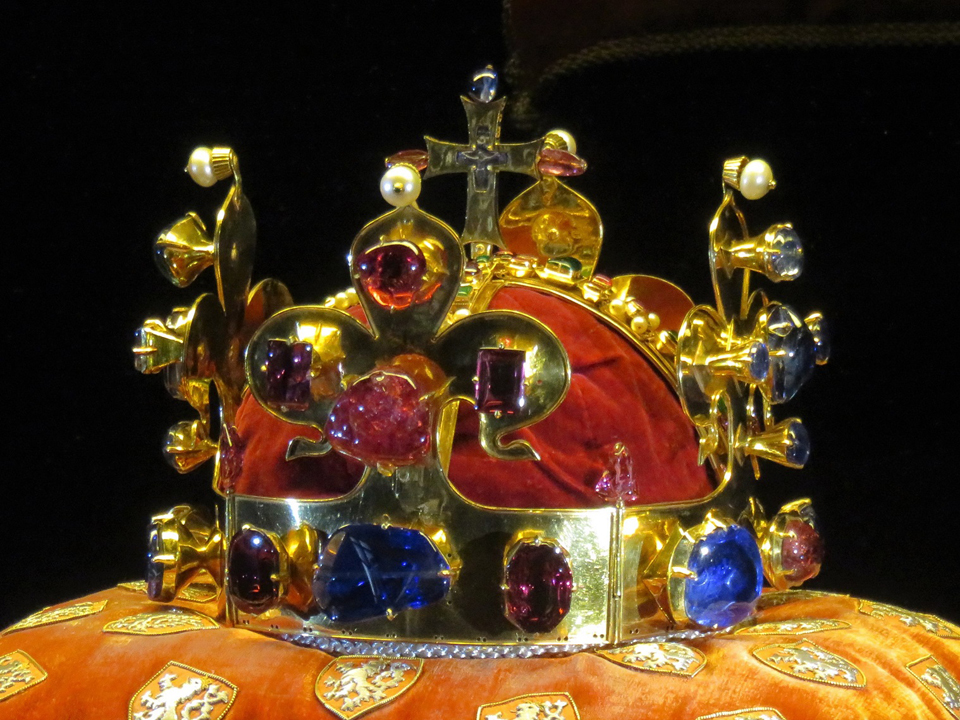


Bohemian Crown May 2016. Source: Wikipedia
 
Bohemian Crown May 2016. 
 
Source: Wikipedia
This year is the 700th anniversary of the birth of Emperor Charles IV, and one of the highlights is a faithful recreation of his coronation, celebrating the event, which took place on the 2nd of September 1347. The coronation itself takes place on the 4th of September at 1 pm at St Vitus’ Cathedral, but only for invited guests due to space limitations. It will be projected on a screen in nearby Hradčanské náměstí. – http://prague-stay.com/lifestyle/review/1597-hradcanske-namesti/ – Other parts of the re-creation such as processions and medieval markets will be open to the “burghers” and “peasants”.

The clothes and crowns for Charles IV and his wife, Blanche of Valois, have been faithfully copied, although some guesswork was involved on the part of historians from the Academy of Sciences and other institutions, which have collaborated on the project. Some is of course based on guesswork. For instance, the sceptre and orb, which survive are from the 16th century, so what they used like in the 14th century is a matter of conjecture. In the same way, the church where the coronation took place no longer exists, and the more modern cathedral now has to stand in its place.

Nevertheless, there exists a rather detailed description of the events as Charles personally wrote the manual: Ordo at coronandum regem Boemorum 1347. The recreation is based on this plus information gathered from chronicles and other sources.

Programme
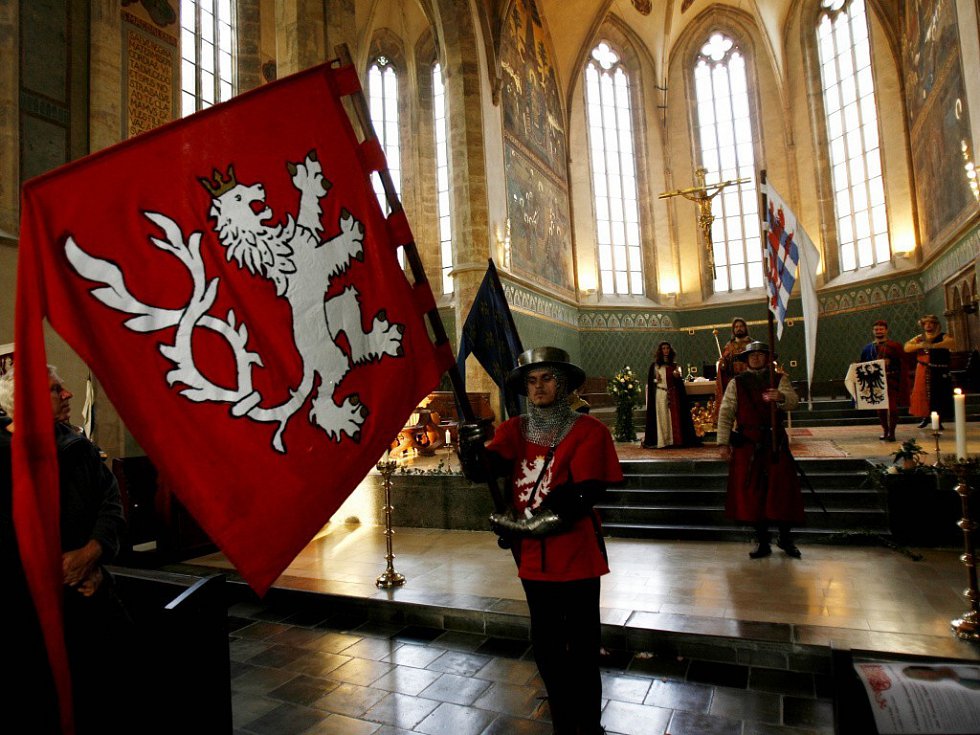


Reconstruction of the coronation of Charles Iv in 2007
 
Reconstruction of the coronation of Charles IV in 2007
The festivities start on the 3rd of September with a medieval market from 10 am to 6 pm at the Karolinum, at Ovocný trh 3, across from the Estates Theatre. There will be juggling, music and dancing, and workshops for kids. In the evening, there will be a mass at Vyšehrad, a visit to the St Martin Rotunda and a penitential procession to the Karolinum and further on to the Old Town Square and Prague Castle. Festivities at Vyšehrad begins at 3:30 pm, and the procession starts at 6 pm. The day will end with prayers at St Vitus Cathedral at 9 pm. The King will at this event wear bast sandals. In the 14th century, we may believe, he walked barefooted.

The next day, Sept. 4, sees another medieval market at the Karolinum for 10 am to 6 pm. Festivities at St Vitus Cathedral begin at 12:50 for the invited, others are directed to go to Hradčanské náměstí. A procession will leave from Hradčanské náměstí at 3 pm, arriving at Old Town Square at 4 pm for fanfare, music, dancing and other festivities. A knight’s tournament with horses will take place at 6 pm, and events will end at 8:30 pm.

Performers in the pilgrimage and the coronation event have been chosen from local re-enactors, who have been instructed to wear precise period-close outfits. Suitable liturgical vestments have been borrowed from the depositories of the Royal Collegiate Chapter of Vyšehrad and the Roman Catholic parish at the Church of Our Lady before Tyn, while liturgical objects have been lent by the Archbishopric of Prague and the Chapter of St. Vitus. The actual crown will be the exact replica which is usually exhibited in the castle, but new sceptres and orbs have been created. Another huge effort has been invested in recrating the presumable outfits which were worn by the king and queenas well as some of the other major actors. Other work has been invested in the reproduction of a canopy, silk brocade banners, a reconstructed throne etc.

Cathedral of St. Vitus

At an early point a controversy existed about where to “perform” the actual coronation. Suggestions were to have it either performed in the other church in the Castle, St. George’s. Or, alternatively the Church of St. Mary and St. Jerome, which was founded by Charles in 1347. However, after long negotiations an agreement was finally reached to have the coronation recreated in St. Vitus.

Organisers

The quality of the event has been carefully secured by engaging the official support of the Ministry for Culture, the University and the Catholic Church in Prague as well as numerous other institutions.
The scientific panel, which guarantees the faithful recreation consist of
National Czech television will broadcast the event, which – of course – will make it impossible for anyone outside Czechia to see the recreation as it takes place. Once again, copyright rules prevents the European broadcasting of the event.
A full programme for the coronation can be found at Korunovační slavnosti v Praze 3. – 4. 9. 2016  (CZ)

READ MORE:
cover_coruna karl IV 
Ed. and translated by Jiří Kuthan, Miroslav Šmied, Joseph Cibulka and Jaromír Homolka
Nakladatelské údaje: Praha : Filozofická fakulta Univerzity Karlovy, 2009
ISBN:978-80-7308-266-6


The re-enactment was videoed and can be found on YouTube at https://youtu.be/01xRjoq7ib0
It lasts for an hour and three-quarters, but from what I have seen looks impressive. From reseaching the link such historical re-enactments are popular amongst modern Czechs.

Now all this is very interesting to the Clever Boy, but being the man he is, he is more than tempted to point out that the most genuine recent Bohemian coronation was that of King Ferdinand V in 1836 and to suggest that the cathedral of St Vitus might do well to be used for the coronation of the present de jure King of Bohemia, King Charles V...


Saturday, 14 May 2016

Birth of Emperor Charles IV


Today is the 700th anniversary of the birth in 1316 of the future Holy Roman Emperor Charles IV.


Charles IV-John Ocko votive picture-fragment.jpg 

Emperor Charles IV
A detail from the votive panel of Archbishop John Ocko

Image: Wikipedia 

There is an online biography of the Emperor at Charles IV

Born in 1316 , King of Bohemia from 1346 and holy Roman Emperor from 1348 he died in 1378 and was one of the most remarkable rulers of both Bohemia and the Empire, the ruler who developed Prague as a capital city ofd first class rank. He sponsored the rebuilding of the cathedral of St Vitus there - not completed until the 1920s, founded the Charles University - the first such institution within the Empire, developed the cult of St Wenceslaus and had made the crown of Bohemia, known as that of St Wenceslaus. As apatron of the visual arts his work in Prague and at his castle at Karlstejn survives as atestimony to the brilliance of his era. For the Empire the issued the Golden Bull which regulated that territory and institution until its dissolution in 1806.


Image:realhistoryww.com

In terms of English history he was the father of Queen Anne of Bohemia, the consort of King Richard II, and it was, less happily, under the Anglo-Bohemia contacts of those years that the ideas of Wyclif spread to Bohemia and led to the misdirection of the Emperor's laudable and orthodox aim of reinvigourating the Bohemian church into Hussitism.

One of the books I am reading at the moment is Fr Bede Jarrett's biography of the Emperor which includes a translation of the Emperor's own autobiography of his years before his accession.

A remarkable ruler in a glittering and cultured age, he was also one concerned to stamp his image and personality on his realms through the visual arts and enduring memorials.


Thursday, 18 June 2015

St Vitus


John Dillon posted twice about St Vitus and his companions, Modestus and Crescentia, whose feast day it was on Monday on the Medieval Religion discussion group.

The interest of St Vitus lies perhaps in that we have all heard of St Vitus Dance, and also the way in which the saint was depicted on central Europe in the later medieval centuries, and his popularity as one of the Fourteen Holy Helpers - a devotion particularly strong in central Europe.

Here are the Dillon posts combined:

.Vitus, Modestus, and Crescentia (d. ca. 304, supposedly). We know nothing about the historical Vitus (Vito, Veit, Vid, Gui, Guy, etc.). His cult is ancient: there is evidence from the fifth century of a church in Rome dedicated to him and from the correspondence of pope St. Gregory the Great we learn that in the sixth century there were monasteries dedicated to him in Sicily and in Sardinia.

Vitus has a legendary Passio (BHL 8711-8716) whose earliest version is thought to be of the seventh century. According to this, he was a boy of seven years (in some versions, twelve years) at Lilybaeum in Sicily (today's Mazara del Vallo [TP]), a professed Christian, and a miracle-worker. His pagan father had him tortured and thrown in prison in an attempt to get him to renounce his faith. But an angel freed him together with his nurse Crescentia and his tutor Modestus (in some versions, Crescentia's husband), whereupon Vitus, together with these surrogate parent figures, removed to Lucania and continued to profess Christianity and to perform miracles. In time Vitus' fame reached the ears of the Emperor Diocletian, who called him to Rome to cure his demonically possessed son. Vitus obtained this cure but refused to sacrifice to Rome's pagan gods. Diocletian had the saints tortured anew, this time lethally. An angel brought them back to Lucania near the river Sele, where after a final prayer by Vitus they soon expired. Thus far the Passio of Vitus and his companions.

The seemingly very late seventh- or early eighth-century (pseudo-)Hieronymian Martyrology appears to be following the legend when it says of Vita only In Lucania, Viti ("In Lucania, Vitus") without naming a specific cult site. A church ancestral to the present chiesa di San Vito al Sele near Eboli (SA) in a part of southern Campania that prior to 1927 belonged to Lucania / Basilicata is first recorded from 1042. Archeological investigation in the 1970s found remains of an ancient settlement in the vicinity that has been interpreted as the home of Vitus' very early cult. From at least the ninth century until quite recently Modestus and Crescentia were celebrated jointly with Vitus in Roman Catholic liturgies of the Roman rite. Dropped from Vitus' feast in the reform of the general Roman Calendar promulgated in 1969 and excluded from the RM in the latter's revision of 2001, they continue as titulars of some churches and of a Roman cardinal deaconry and are celebrated along with Vitus in some Orthodox churches.

In Serbia Vitus is celebrated secularly on 28. June (Gregorian calendar) and liturgically on 15. June (Julian calendar) in commemoration of the Battle of Kosovo, reputed to have occurred on his day in 1389. He is also one of the late medieval and early modern Fourteen Holy Helpers, invoked as a protector of animals and in cases of epilepsy; from the same period comes his association with various saltatory disorders.

Some medieval images of Vitus (and, occasionally, of Modestus and Crescentia as well):

a) Vitus (image at left) as portrayed on a thirteenth- (or fourteenth- ?) century morse from the former women's abbey of St. Vitus in Hochelten, now in the treasury of the St. Martinikirche in nearby Emmerich am Rhein (Kr. Kleve) in Nordrhein-Westfalen:

b) Vitus' martyrdom (with Modestus and Crescentia at the lower corners) as depicted in a late thirteenth-century copy of French origin of the _Legenda aurea_ (San Marino, CA, Huntington Library, ms. HM 3027, fol. 66v; image greatly expandable):

c) The martyrdom of Vitus, Modestus, and Crescentia as depicted in an earlier fourteenth-century copy (1326-1350) of a French-language collection of saint's lives (Paris, BnF, ms. Français 185, fol. 233r):
The BnF's description of this scene with three martyrs, one of whom is surely Crescentia, simply as the martyrdom of Vitus and Modestus is at best unfortunate (if not downright sexist).

d) Vitus as depicted in the earlier fourteenth-century frescoes (1330s) in the nave of the church of the Hodegetria in the Patriarchate of Peć at Peć in, depending upon one's view of the matter, either Serbia's province of Kosovo and Metohija or the Republic of Kosovo:

e) Vitus as depicted undergoing torture in a cauldron as portrayed in a mid-fifteenth-century panel painting of German origin now in the National Museum in Warsaw:
The unhappy-looking lady and gent at the right rear center are presumably Crescentia and Modestus.

f) Vitus undergoing torture in a cauldron as portrayed in a late fifteenth-century limewood statue (ca. 1490) from the Tyrol, now in the Bode Museum in Berlin:

g) Vitus as depicted in a hand-colored woodcut in the Beloit College copy of Hartmann Schedel's _Nuremberg Chronicle_ (1493) at fol. CXXVr:

h) Vitus undergoing torture in a cauldron as portrayed in a late fifteenth- or early sixteenth-century wooden statue from southern Germany, now in the Zeppelin-Museum in Friedrichshafen:

i) Scenes from Vitus' Passio adorn the wings and predella of the early sixteenth-century altarpiece (1514 or 1517) in the now mostly neo-romanesque Evangelische Pfarrkirche St. Veit in Flein (Rems-Murr-Kreis) in Baden-Württemberg:
The predella (one scene showing Modestus and Crescentia as well):
Detail view of that scene (Vitus boiled in a cauldron)


Prague cathedral is dedicated to St Vitus,and although the building  - the nave and west front - was only completed in the twentieth century rather than being all medieval, it remains awonderful witness to the age of the Emperor Charles IV which commenced it in the mid-fourteenth century.

Herewith a few further medieval images of St. Vitus and, in one instance, his companions:

1) Vitus guiding abbot Wernher as depicted in an earlier twelfth-century pen-and-ink drawing (betw. 1143 and 1147) at the beginning of Munich, BSB, clm 536, a composite manuscript partly written at Wernher's command for the abbey of St. Vitus at Prüll (now part of Regensburg):
http://daten.digitale-sammlungen.de/~db/bsb00007208/images/index.html?seite=5&fip=193.174.98.30

2) Vitus accompanied by angels and enforcing the submission of a lion as depicted in a later twelfth-century illumination in the Weissenau Passional (ca. 1170-1200; Cologny, Bibliotheca Bodmeriana, Cod. Bodmer 127, fol. 103r):
http://tinyurl.com/ospw6pz
In the Vita, Vitus' emergence unscathed from the boiling cauldron is followed by his exposure to lions who submit themselves to him affectionately.

3) Vitus (lower register, second from right) as depicted in the later fourteenth-century votive painting of Archbishop Jan Očko of Vlašim now in the National Gallery in Prague:
http://tinyurl.com/ocwdo3z
Detail view (Vitus):
http://tinyurl.com/qjax2w5
 
4) Vitus (at center), Crescentia, and Modestus as depicted in a fifteenth-century fresco in the Pfarrkirche Hl. Maria und Leonhard in Lofer (Land Salzburg):
http://tinyurl.com/oc5jbnw

5) Vitus as depicted by Bartolomeo Vivarini in a later fifteenth-century panel painting from a polyptych (ca. 1470) in the chiesa matrice della Santissima Assunta in Polignano a Mare (BA) in Apulia:
http://www.chiesadisanvito.it/BVivarini.JPG 
 
6) Vitus in an enclosure with submissive lions as depicted on a later fifteenth-century altarpiece (ca. 1470-1480) from St. Veit an der Glan now in the Landesmuseum Kärnten in Klagenfurt:
http://tarvos.imareal.oeaw.ac.at/server/images/7001929.JPG
Detail view (Vitus and lions):
http://tarvos.imareal.oeaw.ac.at/server/images/7001932.JPG