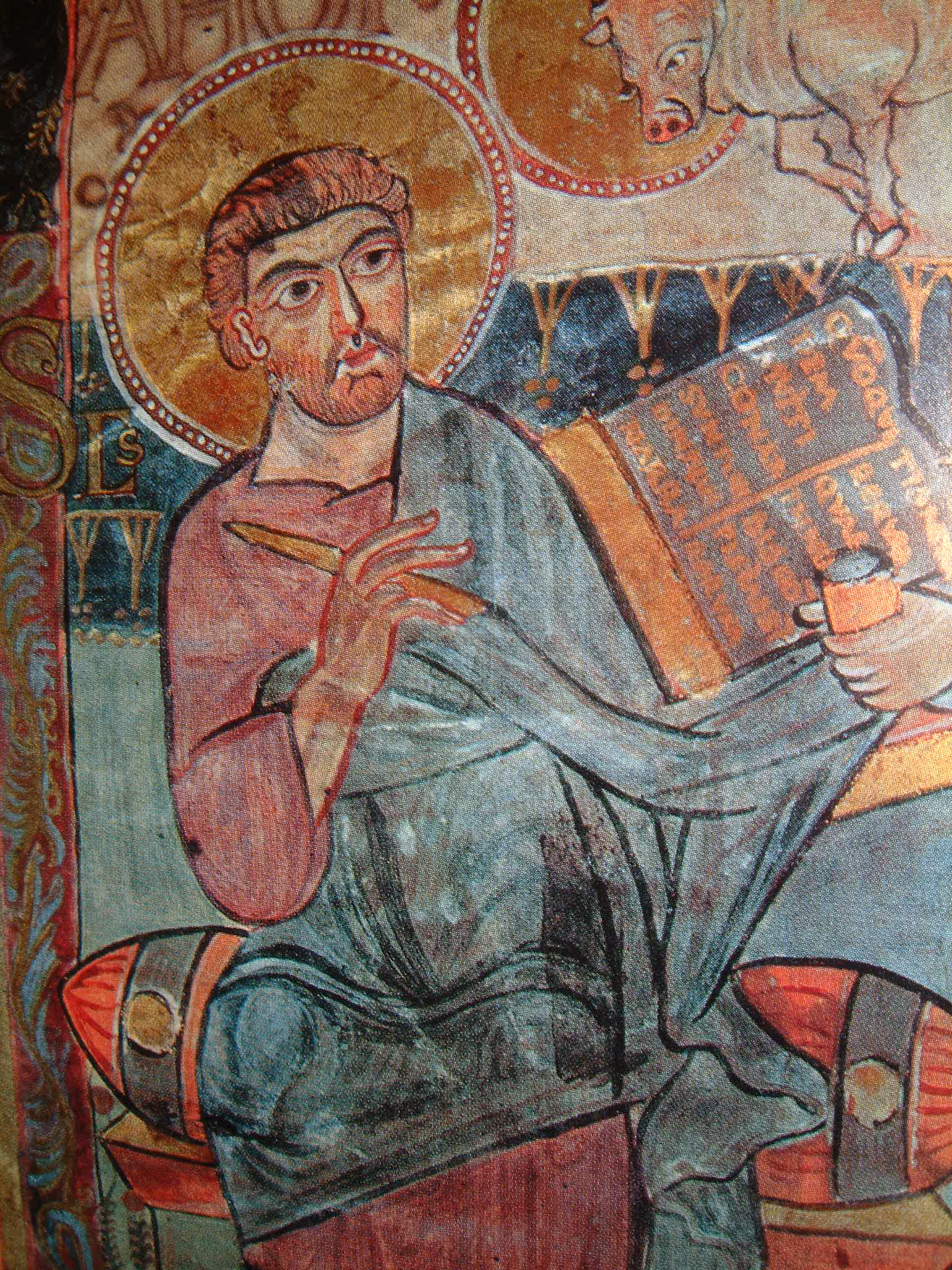
The day before yesterday, had it not been Sunday, would have been the feast of St Luke. John Dillon posted this impressive selection of images of St Luke on the Medieval Religion discussion group:
Herewith some period-pertinent images of Luke, Apostle and Evangelist. Though these do not include images of Luke's tetramorphic symbol that are essentially zoomorphic in nature, they do include a few images of the evangelist in which he is shown with human hands and feet but with the head -- and / or the wings -- of his celestial figure. Reflecting different underlying textual sources for the construction of the tetramorph, that figure sometimes appears as a calf and sometimes as an ox. Whereas it is easy to distinguish between a calf and an ox, many medieval versions of the symbol present an intermediate form that probably could best be described as a steer (or even as a young steer). To avoid having to make such distinctions, I refer throughout to the bovid in question as Luke's "calf / ox". Also not included are images of Luke painting the BVM or presenting a portrait of her that he is presumed to have painted. But I have included one image showing on an easel in Luke's study a daub of the BVM making one all the more grateful for the existence of Antonello da Messina.
a) as depicted (second from bottom at right; below him, St. James) among the roundels of apostles framing the Theotokos and Christ Child in a sixth-century tapestry icon from Egypt in the Cleveland Museum of Art:
Detail view:
b) as depicted (with his calf / ox) in an earlier sixth-century mosaic (between 527 and 548) on the north wall of the presbytery of Ravenna's basilica di San Vitale:
c) as depicted (with his calf / ox) in the late seventh- or early eighth-century Lindisfarne Gospels (London, BL, Cotton MS Nero D IV, fol. 137v):
http://imageweb-cdn.magnoliasoft.net/britishlibrary/supersize/pod86.jpg
d) as depicted (with his calf / ox) in a full-page illumination in the late eighth-century Godescalc Gospels (between 781 and 783; Paris, BnF, ms. Nouvelle acquisition latine 1203, fol. 2r):
http://tinyurl.com/proz2av
Detail view:
http://rubens.anu.edu.au/htdocs/bytype/manuscripts/survey/0001/150.JPG
e) as depicted in a later eighth- or earlier ninth-century pocket Gospels from Ireland (London, BL, Add. MS 40618, fol. 21v):
http://tinyurl.com/npr73rp
f) as depicted (with his calf / ox) in the Luke and John portion of the very late eighth- or early ninth-century Lorsch Gospels (before 814; Città del Vaticano, BAV, cod. Pal. lat. 50, fol. Iv):
http://bibliotheca-laureshamensis-digital.de/bav/bav_pal_lat_50/0008
g) as depicted (with his calf / ox) in a ninth-century Gospels of Breton origin (Alençon, Bibliothèque municipale, ms. 84, fol. 66v):
http://www.enluminures.culture.fr/Wave/savimage/enlumine/irht2/IRHT_052521-p.jpg
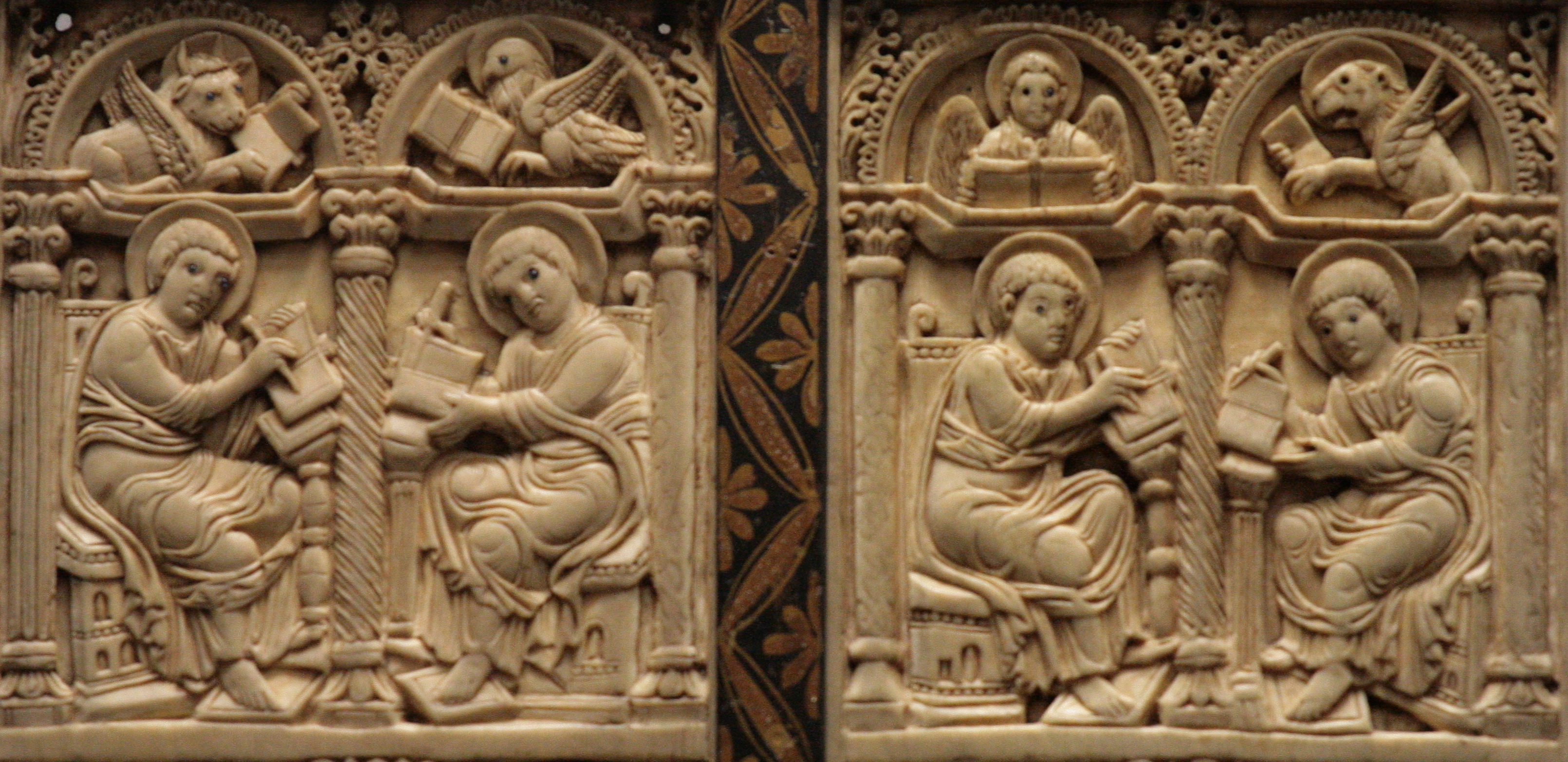
h) as depicted (in the leaf at left at upper left, with his calf / ox and facing St. John the Evangelist) on the early ninth-century Harrach Diptych (c. 810; a Carolingian ivory from Aachen) in the Schnütgen Museum in Köln (on long-term loan from the Sammlung Ludwig):
https://www.flickr.com/photos/27305838@N04/8405620365
Detail view of the uppermost registers of those two leaves:
http://rationalfaiths.com/wp-content/uploads/2012/04/IMG_0857b2.jpg
i) as depicted (with his calf / ox) in the earlier ninth-century Ebbo Gospels (betw. 816 and 835; Épernay, Bibliothèque municipale, ms. 1, fol. 90v):
http://tinyurl.com/nw2nc3a
j) as depicted in a full-page illumination in a late ninth- or early tenth-century Gospels from Landévennec (Oxford, Bodleian Library, MS Auct. D. 2. 16, fol.101v):
http://image.ox.ac.uk/images/bodleian/ms.auct.d.2.16/101v.jpg
k) as depicted in a tenth-century Gospels from Constantinople (Paris, BnF, ms. Coislin 195, fol. 240v):
http://tinyurl.com/299thvo
l) as depicted in an early tenth-century Gospels of Breton origin, perhaps from Landévennec (908-909; Troyes: Médiathèque Grand-Troyes [until very recently: Médiathèques de l'Agglomération Troyenne], ms. 960, fol. 71v):
http://www.enluminures.culture.fr/Wave/savimage/enlumine/irht2/IRHT_052416-p.jpg
m) as depicted in a partly preserved mid-tenth-century New Testament probably from Constantinople (London, British Library, MS Add 28815, fols. 76v and 162v):
http://www.bl.uk/manuscripts/Viewer.aspx?ref=add_ms_28815_f076v
http://www.bl.uk/manuscripts/Viewer.aspx?ref=add_ms_28815_f162v
Another portion of the same manuscript is now BL, Egerton MS 3145
n) as portrayed in high relief (second from right) on one side of a later tenth-century ivory reliquary casket, probably from Constantinople, in the Metropolitan Museum of Art, New York:
http://www.metmuseum.org/collection/the-collection-online/search/464238?img=3
o) as depicted (with his calf / ox) in the late tenth- or early eleventh-century Gospels of Otto III (Munich, BSB, clm 4453, fol. 139r):
p) as depicted in a full-page miniature in the late tenth- or eleventh-century Codex Theodosianus (a Gospels lectionary) belonging to the Holy Monastery of the God-trodden Mount Sinai in St. Catherine (South Sinai governorate) in Egypt (cod. gr. 204, fol. 12r):
http://www.icon-art.info/hires.php?lng=en&type=1&id=2466
q) as depicted (with his calf / ox) in an eleventh-century Gospels of northern French origin (Paris, BnF, ms. Arsenal 592, fol. 105v):
http://tinyurl.com/qjphnha
r) as depicted (with his calf / ox) in the early eleventh-century Limburg Gospels (Köln, Dombibliothek, Codex 218, fol. 108v):
http://tinyurl.com/p6czmca
s) as depicted (with his calf / ox) in the early eleventh-century Reichenau Gospels (Munich, BSB, clm 4453, fol. 127v):
http://daten.digitale-sammlungen.de/bsb00004502/image_264
t) as depicted in the earlier eleventh-century mosaics (restored between 1953 and 1962) in the narthex of the church of the Theotokos in the monastery of Hosios Loukas near Distomo in Phokis:
http://tinyurl.com/nphh2vm
u) as depicted in an earlier eleventh-century Gospels from Constantinople (Paris, BnF, ms. Grec 64, fol. 101v):
http://gallica.bnf.fr/ark:/12148/btv1b105157462/f212.image
v) as depicted (with his calf / ox) in a later eleventh-century Gospels seemingly from southeastern France, perhaps Arles (Reims, Bibliothèque municipale, ms. 13, fol. 92v):
http://www.enluminures.culture.fr/Wave/savimage/enlumine/irht6/IRHT_097742-p.jpg
w) as depicted in the later eleventh-century mosaics (c. 1065) in the niches in front of the main door in the narthex in Venice's basilica cattedrale patriarcale di San Marco:
Detail view:
https://www.flickr.com/photos/28433765@N07/5319481115
x) as depicted in the later eleventh-century Cologne Gospels (c. 1076-1100; London, BL, Harley MS 2820, fol. 120r):
http://www.bl.uk/manuscripts/Viewer.aspx?ref=harley_ms_2820_f120r
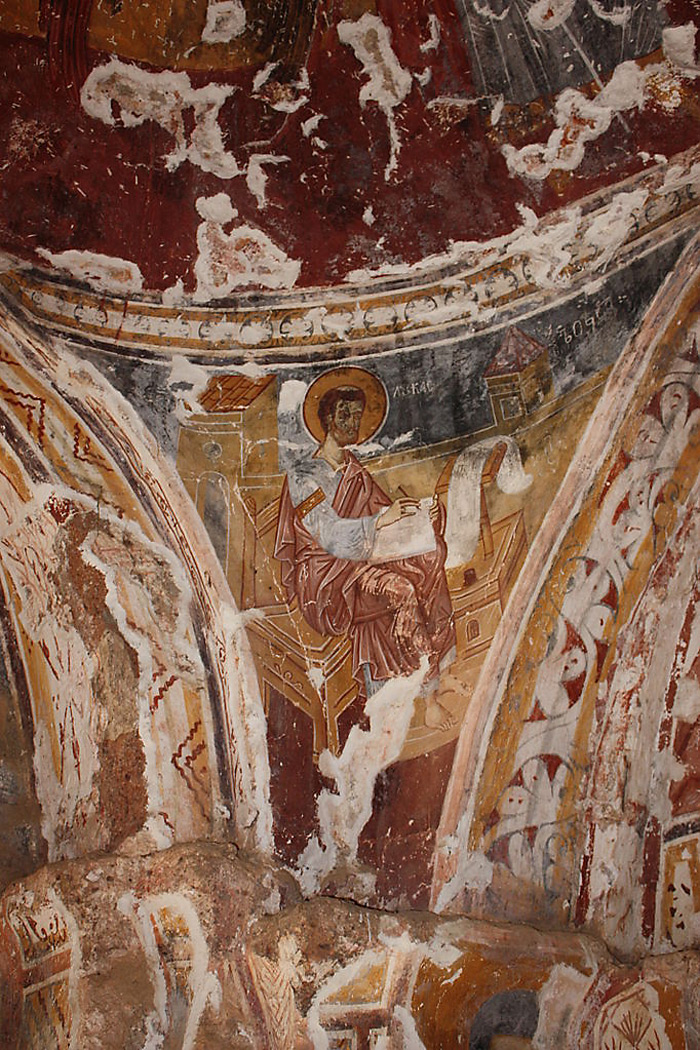
y) as depicted in the eleventh- and twelfth-century frescoes of the Elmali Church (Apple Church) at Göreme (Nevşehir province) in Turkey:
http://www.pbase.com/dosseman/image/41536848
z) as depicted (with his calf / ox) in a fragmentary leaf from a late eleventh- or early twelfth-century bible (c. 1100) from the abbey of Cluny in the Cleveland Museum of Art:
aa) as depicted in a twelfth-century Gospels, perhaps from Constantinople, with commentary (Paris, BnF, ms. Grec 189, fol. 206v):
http://tinyurl.com/ojfbdcb
bb) as depicted (with his calf / ox) in a twelfth-century Gospels from Metz (Paris, BnF, ms. Latin 9395, fol. 93r):
http://gallica.bnf.fr/ark:/12148/btv1b103088868/f187.item
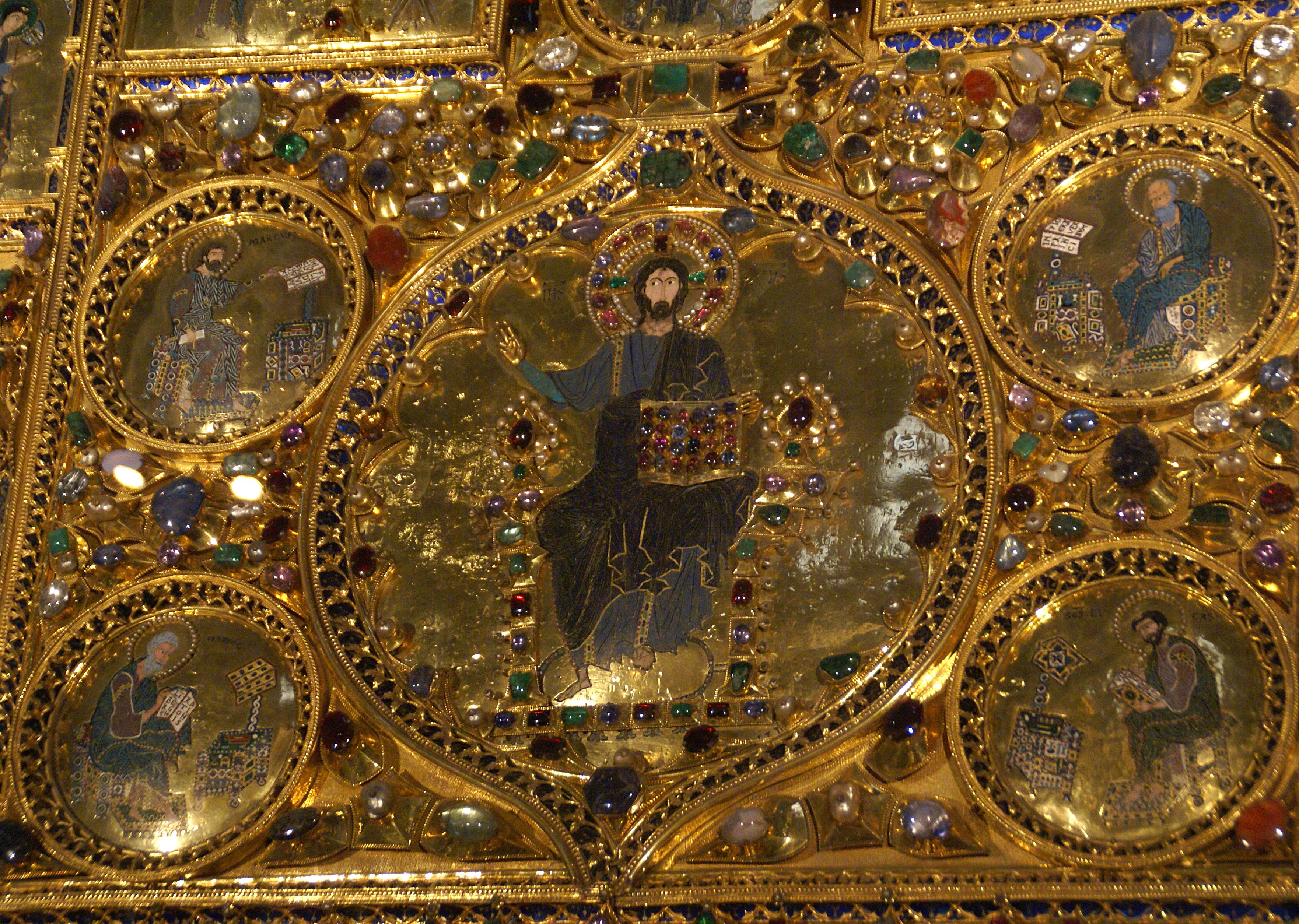
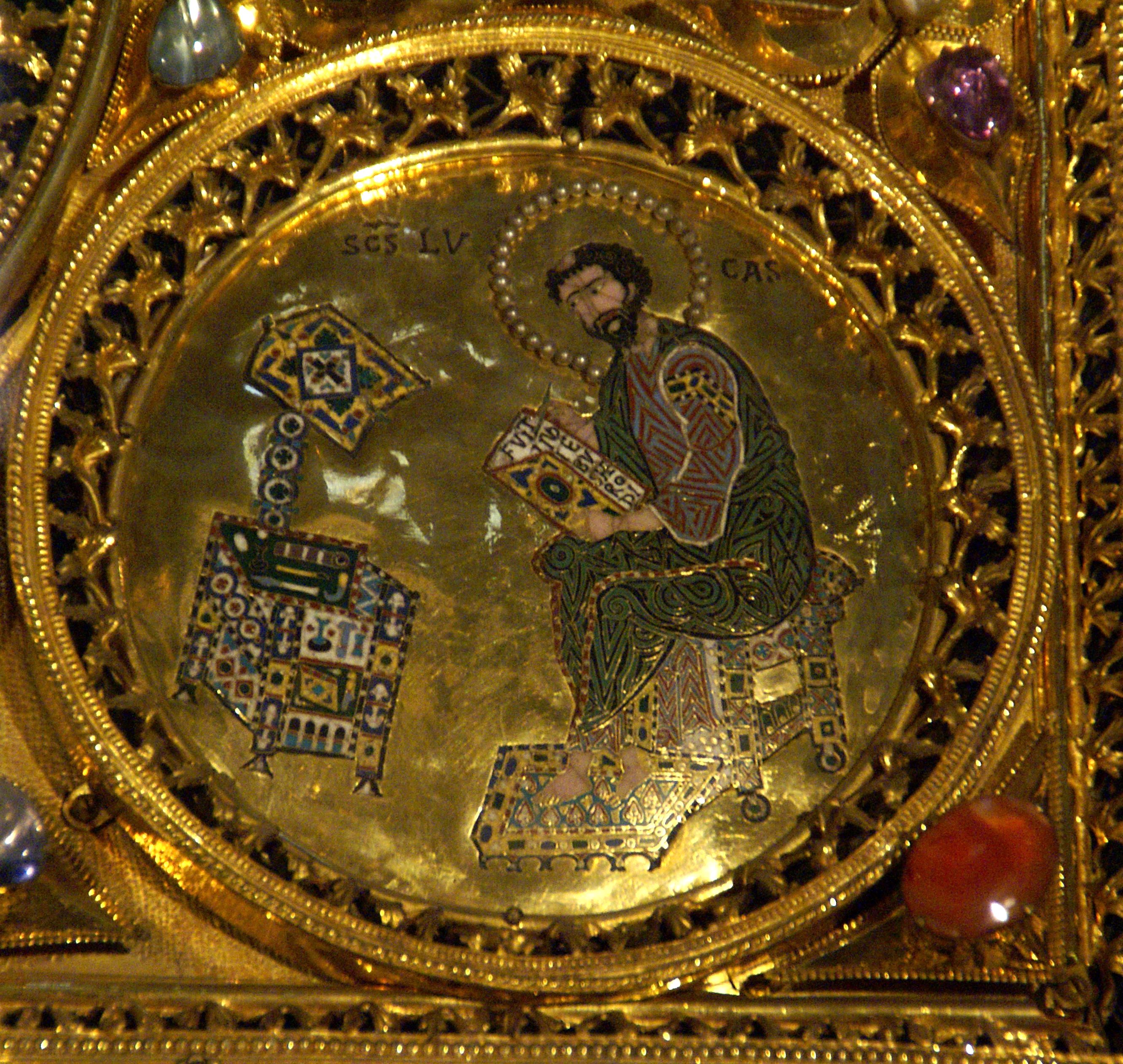
cc) as depicted (at lower right) in one of the early twelfth-century roundels of the evangelists on the central panel, commissioned in Constantinople in 1105 and bearing inscriptions in Latin, of the Pala d'Oro ("Golden Altar-frontal") in Venice's basilica cattedrale patriarcale di San Marco:
Detail view (Luke's roundel):
dd) as depicted in an earlier twelfth-century Gospels from Agen or from the abbey of Moissac (Paris, BnF, ms. Latin 254, fol. 46v):
http://gallica.bnf.fr/ark:/12148/btv1b8426051s/f96.item.zoom
ee) as depicted in an earlier twelfth-century Gospels lectionary from the abbey of Saint-Évroult d'Ouche (betw. 1113 and 1133; Rouen, Bibliothèque municipale, ms. 31, fol. 88r):
http://www.enluminures.culture.fr/Wave/savimage/enlumine/irht6/IRHT_100216-p.jpg
ff) as depicted in an earlier twelfth-century Gospels from the abbey of Saint-Bénigne in Dijon (c. 1126-1150; Dijon, Bibliothèque municipale, ms. 2, fol. 429v):
http://www.enluminures.culture.fr/Wave/savimage/enlumine/irht6/IRHT_093452-p.jpg
Detail view:
http://www.enluminures.culture.fr/Wave/savimage/enlumine/irht6/IRHT_093453-p.jpg
gg) as depicted (upper register at right) in the mid-twelfth-century apse mosaics (completed in 1148) of the basilica cattedrale della Trasfigurazione in Cefalù:
hh) as depicted (with his calf / ox) in a later twelfth-century Bible from the abbey of Saint-Sulpice in Bourges (betw. 1176 and 1200; Bourges, Bibliothèque municipale, ms. 3, fol. 323v):
http://www.enluminures.culture.fr/Wave/savimage/enlumine/irht8/IRHT_146690-p.jpg
ii) as depicted in a pendentive of the later twelfth-century Crossing Cupola / Ascension Cupola (betw. 1176 and 1200) in Venice's basilica cattedrale patriarcale di San Marco:
http://tinyurl.com/onxulat
jj) as portrayed (at right, below his calf / ox; at left, St. Mark) in a late twelfth-century jamb statue on the Galluspforte (the north portal; c. 1180-1190) of the Basler Münster:
https://www.flickr.com/photos/martin-m-miles/7110881499/
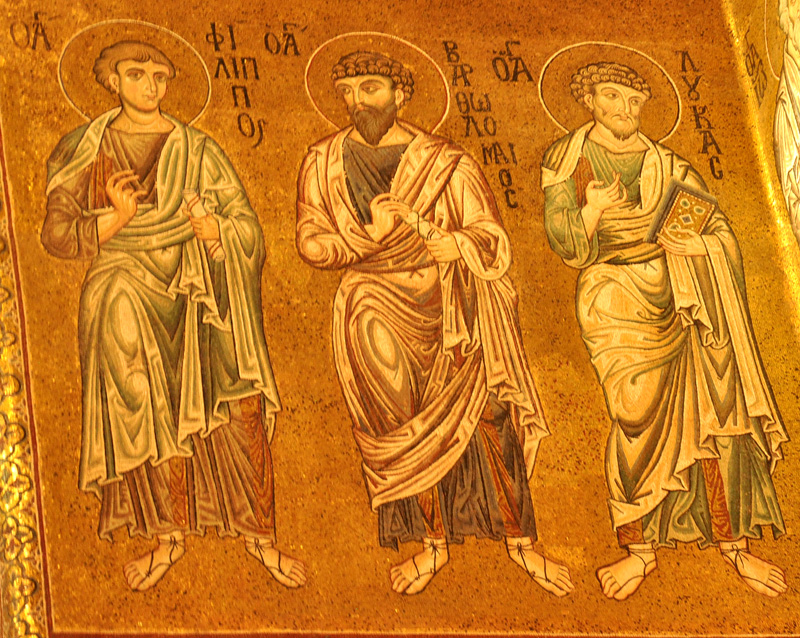
kk) as depicted (at right, after Sts. Philip and Bartholomew) in the late twelfth-century mosaics (ca. 1182) in the sanctuary of the basilica cattedrale di Santa Maria Nuova in Monreale:
http://www.christianiconography.info/sicily/philipBartholomewLuke.smal.jpg
ll) as depicted (with his calf / ox) in two places in the late twelfth-century Souvigny Bible (Moulins, Médiathèque Communautaire de l'agglomération de Moulins, ms. 2, fols. 329v and 342):
1) At the beginning of his gospel:
http://www.enluminures.culture.fr/Wave/savimage/enlumine/irht4/IRHT_080149-p.jpg
2) At the beginning of St. Jerome's commentary on Luke:
http://www.enluminures.culture.fr/Wave/savimage/enlumine/irht4/IRHT_080152-p.jpg
mm) as depicted (with two oxen) in the twelfth- or thirteenth-century Red Gospels of Ganjasar (Chicago, University of Chicago Library, Goodspeed Manuscript Collection, ms. 949, fol. 139v):
http://goodspeed.lib.uchicago.edu/view/index.php?doc=0949&obj=282
nn) as depicted in a thirteenth-century bible possibly of Italian origin (Le Puy-en-Velay, Bibliothèque du Puy en Velay, ms. 1, fol. 315v):
http://www.enluminures.culture.fr/Wave/savimage/enlumine/irht4/IRHT_080585-p.jpg
oo) as portrayed in an earlier thirteenth-century vault boss (c. 1215-1225?) in an apsidial chapel in the église Saint-Serge in Angers:
http://tinyurl.com/p4o7fdh
pp) as depicted (at far left) in the earlier thirteenth-century apse mosaic (1220) of the basilica di San Paolo fuori le Mura in Rome:
qq) as depicted in a later thirteenth-century fresco (between 1260 and 1263) in a pendentive in the church of the Holy Apostles in the Patriarchate of Peć at Peć in, depending on one's view of the matter, either the Republic of Kosovo or Serbia's province of Kosovo and Metohija:
http://tinyurl.com/d269b75
rr) as depicted on a pendentive of the third cupola of Joseph in the later thirteenth-century mosaics (c. 1260-1270) of the north narthex in Venice's basilica cattedrale patriarcale di San Marco:
http://tinyurl.com/otgswrd
Detail view:
http://tinyurl.com/pnjbhph
ss) as depicted by Toros Roslin in the later thirteenth-century Walters T'oros Roslin Gospels (a.k.a. Sebastia Gospels of 1262) from Armenian Cilicia (1262; Baltimore, Walters Art Museum, ms. W.539, fol. 200v):
http://tinyurl.com/qjcen74
tt) as depicted (lower register at left; with his calf / ox) by Cimabue in a later thirteenth-century fresco (between 1277 and 1283) in the crossing vault of the upper church of the basilica di San Francesco in Assisi:
http://tinyurl.com/qd4xaz2
Detail view (Luke):
http://tinyurl.com/pqvquzd
uu) as depicted in the late thirteenth-century Burney Gospels (1285; London, BL, MS Burney 20, fol. 142v):
http://www.bl.uk/manuscripts/Viewer.aspx?ref=burney_ms_20_f142v
vv) as depicted (with his calf / ox) in the late thirteenth-century Livre d'images de Madame Marie (c. 1285-1290; Paris, BnF, ms. Nouvelle acquisition française 16251, fol. 74r):
http://tinyurl.com/n9c8h9r
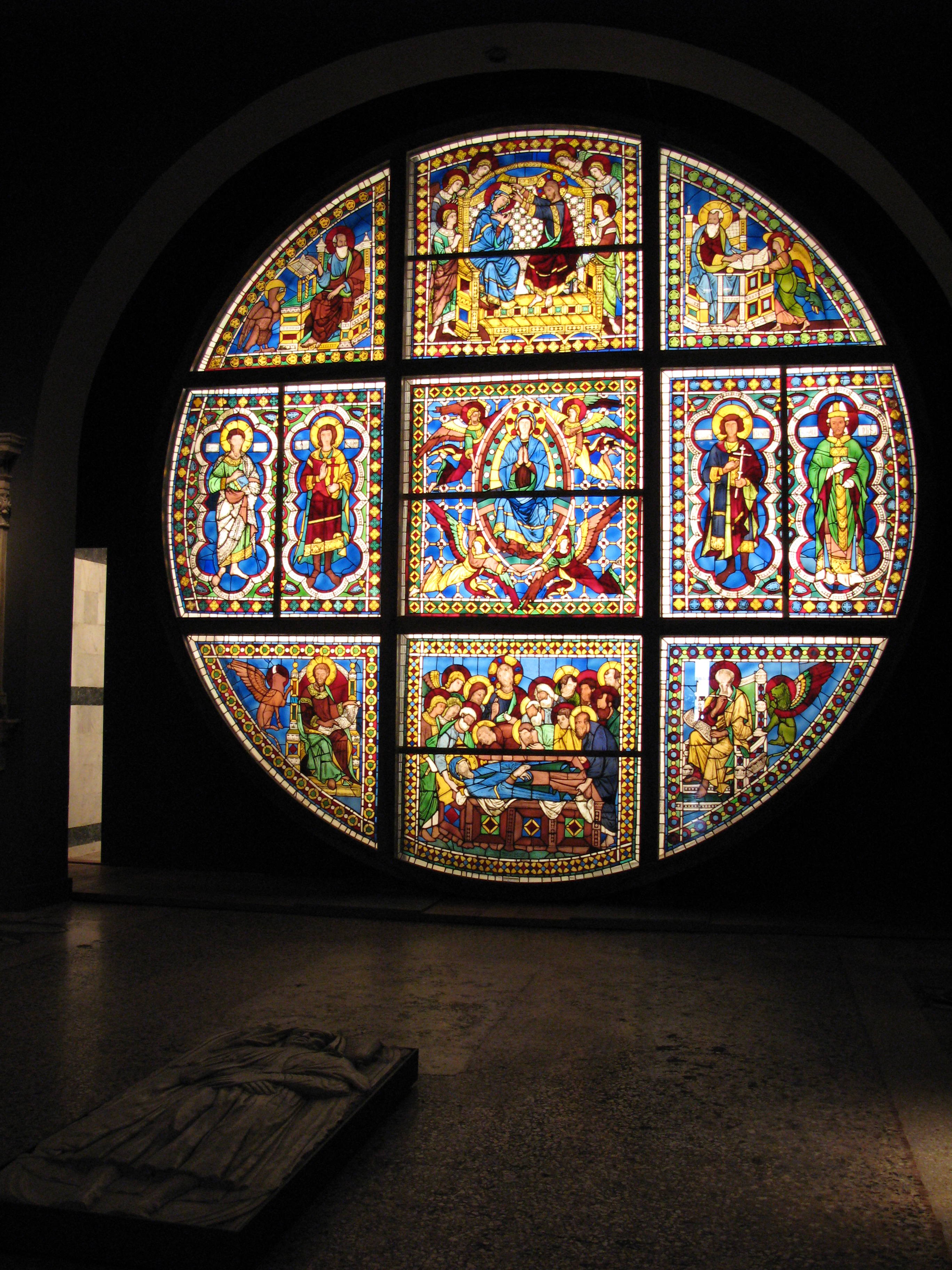
ww) as depicted (at lower left; with his calf / ox) by Duccio di Buoninsegna in his relatively recently restored late thirteenth-century great window (1287-1288) for
Siena cathedral (now in the Museo dell'Opera della Metropolitana):
xx) as portrayed in high relief (with his calf / ox) by Arnolfo da Cambio on his late thirteenth-century ciborium (1293) in the basilica di Santa Cecilia in Trastevere in Rome:
yy) as depicted (with his calf / ox) in a fourteenth-century bible (Bible des Célestins / Bible of Charles V; Paris, BnF, ms. Arsenal 590, fol. 447r):
http://gallica.bnf.fr/ark:/12148/btv1b84581342/f901.item.zoom
zz) as depicted in an earlier fourteenth-century fresco (between c. 1312 and 1321/1322) in a pendentive in the monastery church of the Theotokos at Gračanica in, depending on one's view of the matter, Serbia's province of Kosovo and Metohija or the Republic of Kosovo:
http://tinyurl.com/33shq5u
aaa) as depicted in the earlier fourteenth-century frescoes (between c. 1317 and 1324) in a pendentive in the church of St. Demetrius in the Patriarchate of Peć at Peć in, depending upon one's view of the matter, either Serbia's province of Kosovo and Metohija or the Republic of Kosovo:
http://tinyurl.com/nnfom4q
bbb) as depicted in an earlier fourteenth-century copy of the
Legenda aurea in its French-language version by Jean de Vignay (ca. 1326-1350; Paris, BnF, ms. Français 185, fol. 68v):
http://tinyurl.com/oud2tng
ccc) as depicted (at left, flanking the risen Jesus on the road to Emmaus; at right, St. Cleophas / Clopas) in an earlier fourteenth-century panel (later 1320s or 1330s) in a window (W 14 [also s VI]; "Vie surnaturelle du Christ" or "After the Passion") in Strasbourg's cathédrale Notre-Dame:
http://www.cathedrale-strasbourg.fr/popgallery.aspx?pic_id=2595&cat_id=118
ddd) as depicted (with his calf / ox) in an earlier fourteenth-century French-language legendary of Parisian origin with illuminations attributed to the Fauvel Master (c. 1327; Paris, BnF, ms. Français 183, fol. 73r):
http://tinyurl.com/p6nm8g5
eee) as depicted (with his calf / ox) by Simone Martini in an earlier fourteenth-century panel painting (1330s) in the J. Paul Getty Museum, Los Angeles:
http://tinyurl.com/nmmlw2f
http://www.wga.hu/art/s/simone/7last/5luke.jpg
fff) as depicted (with his calf / ox) in an earlier fourteenth-century copy, from the workshop of Richard and Jeanne de Montbaston, of the
Legenda aurea in its French-language version by Jean de Vignay (1348; Paris, BnF, ms. Français 241, fol. 280r):
http://tinyurl.com/o7ebse7
ggg) as depicted (top centre) in a mid-fourteenth-century copy (c. 1355) of Ulrich of Lilienfeld's
Concordantiae caritatis (Lilienfeld, Stiftsbibliothek, Cod. 151, fol. 220v):
http://tarvos.imareal.oeaw.ac.at/server/images/7005011.JPG
hhh) as depicted in a later fourteenth-century Gospels from the monastery of Gamałiēl in Xizan (Paris, BnF, ms. Arménien 333, fol. 124v):
http://tinyurl.com/objf9o3
iii) as depicted (with his calf / ox) in a later fourteenth-century panel painting (between 1357 and 1367) by Theodoric of Prague and workshop in the Holy Cross Chapel, Karlštejn Castle (near Prague):
http://tarvos.imareal.oeaw.ac.at/server/images/7014179.JPG
jjj) as depicted (at right; at left, St. John the Baptist) by Giovanni da Milano in a later fourteenth-century panel painting (c. 1360; from his dismembered Ognissanti Polyptych) in the Galleria degli Uffizi, Florence:
kkk) as depicted in the later fourteenth-century frescoes (1360s and 1370s; restored, 1968-1970) in the church of St. Demetrius in Marko's Monastery at Markova Sušica:
http://tinyurl.com/o6mf7wv
lll) as depicted by the Master of the Misericordia in a later fourteenth-century panel painting (ca. 1365-1370) in the Pinacoteca di Brera, Milan:
NB: As those who have looked closely at what Luke appears to be writing will have guessed, this image is reversed. An expandable grayscale image is here:
http://tinyurl.com/ooows8t
mmm) as depicted by Jacopo di Cione and workshop in a later fourteenth-century panel painting (ca. 1365-1370) in the National Gallery, London:
http://tinyurl.com/q9sj5e4
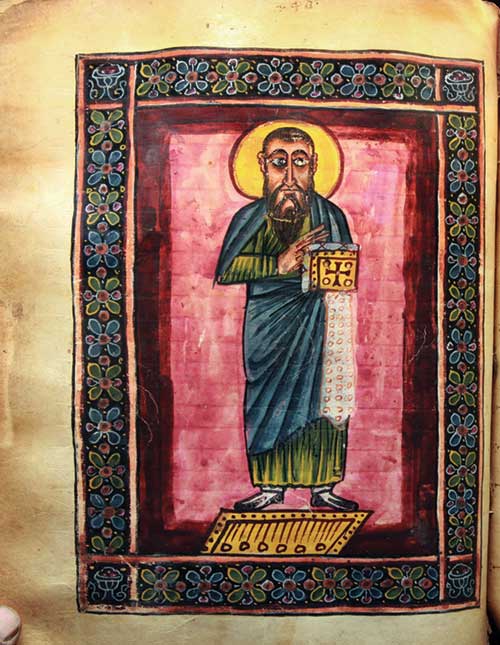
nnn) as depicted on a later fourteenth-century single leaf from Lake Tana in Ethiopia (between 1375 and 1400; Baltimore, Walters Art Museum, Ms. W/840):
http://tinyurl.com/ode87jk
ooo) As depicted on a pendentive in the late fourteenth-century frescoes of the cathedral of the Transfiguration of the Savior in Tsalenjikha, Georgia:
http://www.truechristianity.info/img/churches/georgia/tsalenjikha_cathedral_4.jpg
ppp) as depicted by Giovanni di Benedetto and workshop in a late fourteenth-century Franciscan missal of Milanese origin (ca. 1385-1390; Paris, BnF, ms. Latin 757, fol. 206v):
http://gallica.bnf.fr/ark:/12148/btv1b8470209d/f416.image.r=
qqq) as depicted (with his calf / ox) by Spinello Aretino in two late fourteenth-century vault frescoes in Florence and vicinity:
1) in the chiesa di San Miniato al Monte in Florence (1387-1388):
http://tinyurl.com/phygyhs
2) in the oratorio di Sante Caterina delle Ruote in Bagnoli a Ripoli (ca. 1388; restored, 1996-1998):
http://tinyurl.com/oe5jcn8
rrr) as depicted (with his calf / ox) in an early fifteenth-century copy of Guiard des Moulins'
Bible historiale (Paris, BnF, ms. Arsenal 5058, fol. 476v):
http://tinyurl.com/nt89ndw
http://gallica.bnf.fr/ark:/12148/btv1b8458142m/f362.item.zoom
sss) as portrayed by Nanni di Bianco in an early fifteenth-century statue (c. 1408-1415) formerly on the facade of Florence's cattedrale di Santa Maria del Fiore and now in the Museo dell'Opera del duomo there:
http://tinyurl.com/owdz729
As seen from below:
http://tinyurl.com/nkqr4qb
ttt) as depicted (with a companion that looks more like the lion of St. Mark than either a calf or an ox) in the early fifteenth-century Hours of René of Anjou (ca. 1410; London, BL, MS Egerton 1070, fol. 104v; image expandable):
http://www.bl.uk/manuscripts/Viewer.aspx?ref=egerton_ms_1070_f104v
uuu) as depicted in an early fifteenth-century copy of the
Elsässische Legenda aurea (1419; Heidelberg, Universitätsbibliothek, Cod. Pal. germ. 144, fol. 163r):
http://digi.ub.uni-heidelberg.de/diglit/cpg144/0341
vvv) as depicted in a full-page illumination in the earlier fifteenth-century Radoslav Gospel from Serbia (1428-1429; Saint Petersburg, National Library of Russia, ms. РНБ. F.I.591, fol. 3r):
http://tinyurl.com/q872my7
www) as portrayed in high relief (with his calf / ox) by Donatello in an earlier fifteenth-century terracotta roundel (between 1428 and 1445) in the old sacristy of Florence's basilica di San Lorenzo:
http://www.wga.hu/art/d/donatell/2_mature/sacristy/1sacri11.jpg
xxx) as depicted (with his calf / ox) by Piero della Francesca in a mid-fifteenth-century vault fresco (ca. 1450-1460) in the cappella dei Santi Michele e Pietro in Rome's basilica di Santa Maria Maggiore:
http://tinyurl.com/qxwmdpj
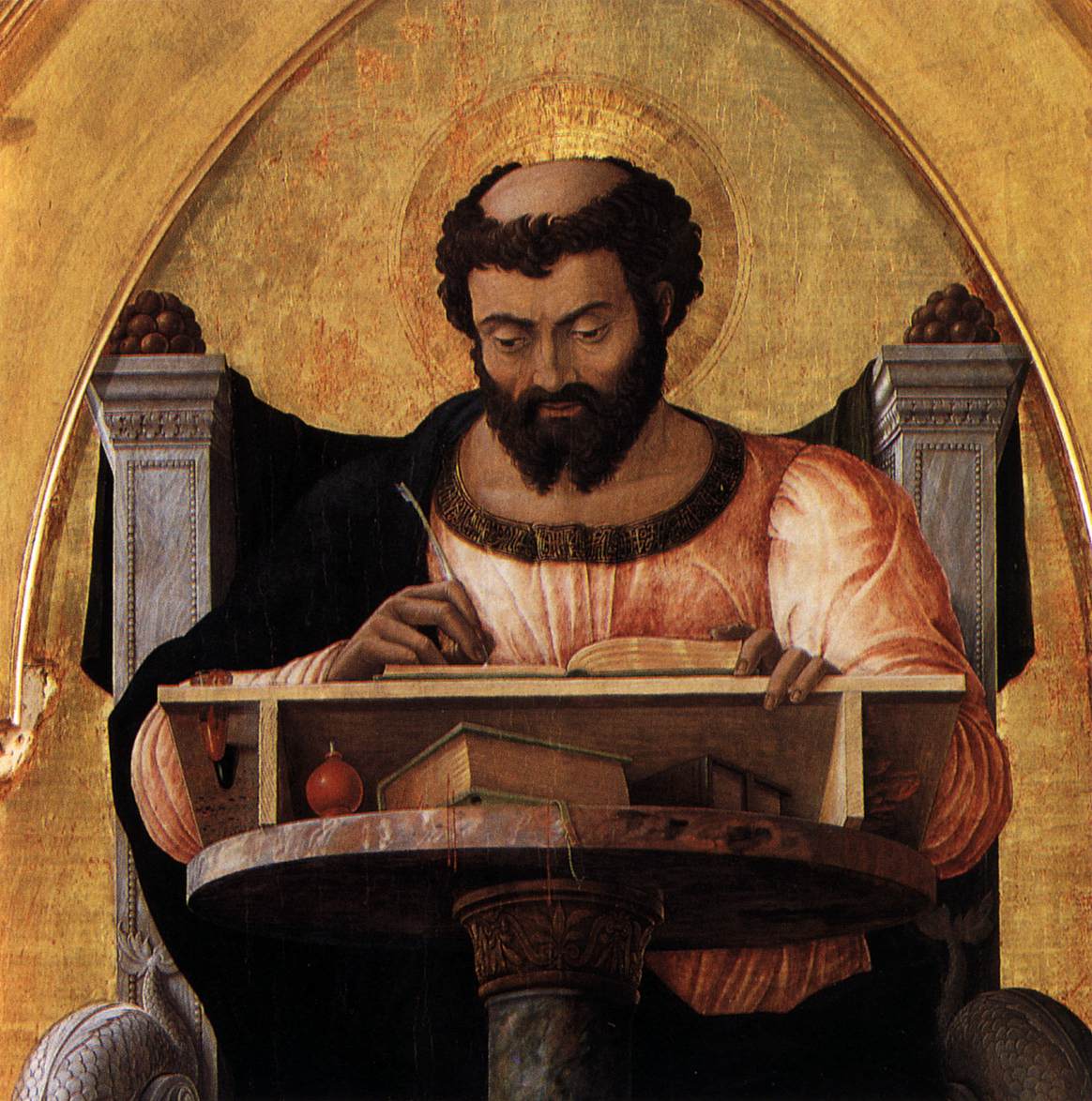
yyy) as depicted by Andrea Mantegna in his mid-fifteenth-century St. Luke altarpiece (commissioned in 1453) in the Pinacoteca di Brera in Milan:
Detail view:
zzz) as depicted by Filippo Lippi in a mid-fifteenth-century vault fresco (c. 1454) in the sanctuary of Prato's cattedrale di Santo Stefano:
http://www.wga.hu/art/l/lippi/filippo/1450pr/01stluke.jpg
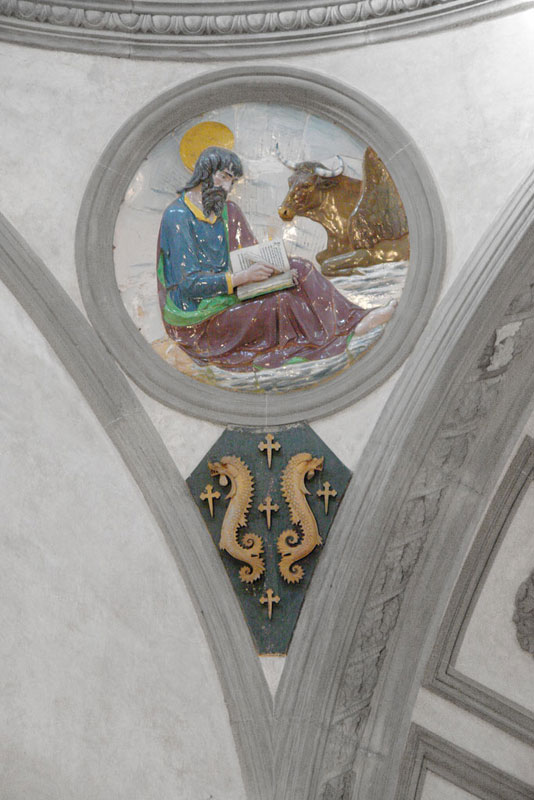
aaaa) as portrayed in high relief in a mid-fifteenth-century glazed terracotta roundel, variously ascribed to Luca della Robbia and workshop or to the aged Donatello, on a pendentive in the Cappella dei Pazzi (completed in 1460) in the Santa Croce complex in Florence:
http://www.florentinermuseen.com/foto/cappella%20pazzi/image/2.jpg
bbbb) as depicted (with his calf/ ox) in a later fifteenth-century panel painting (c. 1460-1470) on a Sunday-side wing of an altar in the Katholische Wallfahrtskirche Sankt Wolfgang in St. Wolfgang, a locality of Velburg (Lkr. Neumarkt in der Oberpfalz) in Bayern:
cccc) as depicted (at left, with his calf / ox; at right, St. Mark) on a section of the later fifteenth-century rood screen (c. 1480) in the church of All Saints, Morston (Norfolk):
https://www.flickr.com/photos/paulodykes/7482944470
Detail view (at left, the calf / ox):
https://www.flickr.com/photos/paulodykes/7482805504
dddd) as depicted (with his calf / ox and with a painting of the BVM) in a later fifteenth-century copy of the
Legenda aurea in its French-language translation by Jean de Vignay (ca. 1480-1490; Paris, BnF, ms. Français 245, fol. 141r):
http://tinyurl.com/nooaell
eeee) as depicted (with his calf / ox) in a late fifteenth-century panel painting (c. 1480-1500) on an outer wing of the Siebenhirter Altar (a.k.a. Apostle Altar) in the Pfrarrkirche of Lieseregg, a locality of Seeboden am Millstätter See (Land Kärnten):
ffff) as depicted (with his calf / ox) by Domenico Ghirlandaio in a late fifteenth-century vault fresco (c. 1485-1490) in the cappella Tornabuoni in Florence's chiesa di Santa Maria Novella:
gggg) as portrayed by Tilman Riemenschneider in a late fifteenth-century glazed limewood statue from the St. Mary Magdalene altarpiece in Münnerstadt (1490-1492), now in the Bode-Museum in Berlin:
https://www.flickr.com/photos/grahamfellows/8141405053
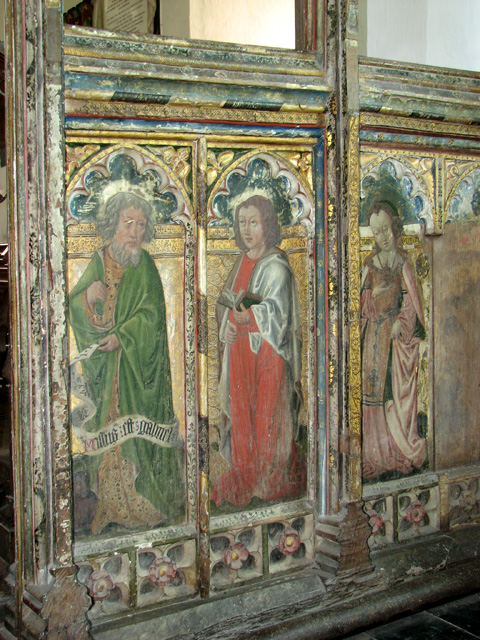
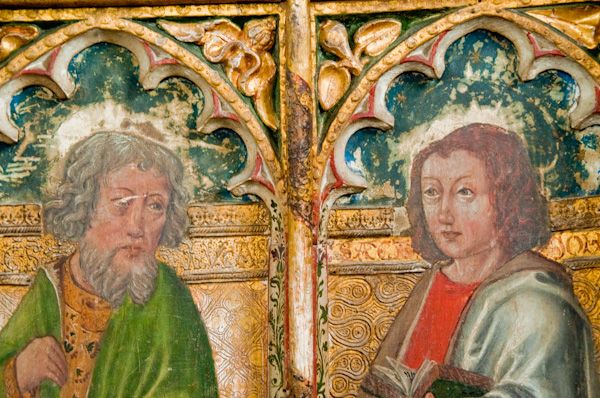
hhhh) as depicted (at left, followed by St. John and by St. Mary Magdalene) on the probably early sixteenth-century rood screen in the church of St. Andrew, Bramfield (Suffolk):
Detail view:
iiii) as portrayed (with his calf / ox) in an earlier sixteenth-century polychromed wooden statue (c. 1500-1520) in the Kirche St. Thomas in Hirschzell, a _Stadtteil_ of Kaufbeuren:
Subsequently John Dillon added two more images:
An even earlier image of St. Luke:
α) as depicted in the recently re-dated late fourth- to later sixth-century Garima 2 Gospels in Ge'ez (c. 390-570) from the Abba Garima monastery in northern Ethiopia, seemingly the oldest Christian book bearing paintings on its pages:
And for those already sated with images of St. Luke, herewith a view of his earlier fourteenth-century depiction (1330s) on a pendentive in the church of the Hodegetria in the Patriarchate of Peć at Peć in, depending upon one's view of the matter, either Serbia's province of Kosovo and Metohija or the Republic of Kosovo:
http://tinyurl.com/ohg8jmv