Once I was a clever boy learning the arts of Oxford... is a quotation from the verses written by Bishop Richard Fleming (c.1385-1431) for his tomb in Lincoln Cathedral. Fleming, the founder of Lincoln College in Oxford, is the subject of my research for a D. Phil., and, like me, a son of the West Riding. I have remarked in the past that I have a deeply meaningful on-going relationship with a dead fifteenth century bishop... it was Fleming who, in effect, enabled me to come to Oxford and to learn its arts, and for that I am immensely grateful.


Showing posts with label Vestments. Show all posts

Wednesday, 14 October 2015

Vestments and the Gunpowder Plot


From Supremacy and Survival - adapted:

From Friday, October 16, 2015, through Monday, April 11, 2016, Auckland Castle will present an exhibition titled "Plots and Spangles":

The Guy Fawkes story comes to life through the resplendent embroidered vestments created by Helena Wintour, daughter of a Gunpowder Plot conspirator.

On the eve of the Gunpowder Plot's planned date 410 years ago, there will be a presentation at the castle:

Jan Graffius, Curator at Stonyhurst, will present an examination of Helena Wintour's embroidered vestments and their Catholic iconography. The talk will look at the religious and cultural resources available to recusant laity in the decades after the failed Plot of 1605, and Helena's close association with Jesuit spirituality. The complex iconography of her beautiful embroideries draws on many sources, from botanical prints to Counter-Reformation confraternities and English metaphysical poetry.

Helena's remarkable life story and that of the creation and survival of a unique set of 17th century embroideries is a compelling, romantic and tragic tale, which culminates in the triumphal re-uniting of her divided life's work at Auckland Castle, in the exhibition 'Plots and Spangles: The Embroidered Vestments of Helena Wintour’ that opens in October 2015.


Sophie Holroyd presented a paper at 2002 conference on Helena Wintour's vestments titled "Rich Embroidered Churchstuff" that was subsequently published in Catholic Culture in Early Modern England from the University of Notre Dame Press. Holroyd had written her PhD thesis at the University of Warwick on Embroidered rhetoric: the social, religious and political functions of elite women's needlework, c.1560-1630, also in 2002.
According to its website, Auckland Castle:
is one of the UK’s most important historical buildings. Since the days of the Norman Conquest in the 11th Century, Auckland Castle has been a seat of power. For almost 900 years, it has been the palace of the Prince Bishops of Durham and although the site where Auckland Castle now stands has seen numerous changes, few will have been as far reaching and visionary as those which are set to take place in the 21st Century. 
The castle was home of the Prince-Bishops of Durham before the English Reformation and remained a seat of Church hierarchy even after the Reformation, falling into private hands when the Church of England was disestablished during the English Civil War and Commonwealth period. Then it was restored to the Church of England when King Charles II returned to the throne.

In May this year a similar exhibit was held in the library at Douai. St. John's College, Oxford posted this notice:

This year sees the exhibition at Douai Abbey of another collection of English vestments from the early modern period. The Wintour Vestments date from around 1650 and were embroidered by Lady Helen Wintour, daughter of Robert Wintour, one of the Gunpowder Plot conspirators. The set of vestments was split in about 1670 and will be exhibited together for the first time at Douai (near Newbury) from 23 May until September. The opening hours for the exhibition will be 11 a.m. - 12.30 p.m. from Monday to Friday and 2 p.m. to 4 p.m. at weekends.

Tuesday, 14 July 2015

St Henry


Yesterday, July 13th, was the feast day of St Henry, who was Holy Emperor as Henry II from 1014-24, having been born in 973 and was Duke of Bavaria. There is an online account of his life and reign at Henry II, Holy Roman Emperor. He was the founder of the see of Bamberg, and there is an introduction to the history and architecture of the cathedral at the online article Bamberg Cathedral, and in German and in more detail and with more illustrations at Bamberger Dom

The Emperor and his wife St Kunigunde are buried in the cathedral

John Dillon posted on the Medieval Religion discussion group an impressive set of medieval images of the Saint-Emperor, pointing to the popularity of devotion to him over succeeding centuries in the Empire. They also provide an insight into the riches of medieval German ecclesiastical art.

I am not certain that all the unopened images will open satisfactorily - the computer I am using is being a bit awkward with some of them, although they do open on my mobile phone.

a) Henry as depicted in a full-length portrait in an early eleventh-century copy of the Gospels (ca. 1007-1012) donated to the cathedral of Bamberg by Eberhard I, the new see's first bishop (Bamberg, Staatsbibliothek, Msc.Bibl.95, fol. 7v):

http://bsbsbb.bsb.lrz-muenchen.de/~db/0000/sbb00000056/images/sbb00000056_00016.jpg


b and c) Henry, supported by Sts. Ulrich and Emmeram, Henry being crowned King of the Germans as depicted in a full-page miniature in the early eleventh-century Sacramentary of Henry II (betw. 1002 and 1014; Munich, BSB, Clm 4456, fol. 11r):

https://upload.wikimedia.org/wikipedia/commons/a/aa/Kronung_Heinrich_II.jpg


d) Henry (upper register, just left of center; just right of centre, Empress Kunigunde) being crowned King of the Germans as depicted in a full-page miniature in the early eleventh-century Gospel Pericopes of Henry II (betw. 1007 and 1014; Munich, BSB, Clm 4452, fol. 2r):

e) Henry (at right) and Empress St. Kunigunde as portrayed, in recent replacement copies (mounted, 2002), in statues on Bamberg cathedral's Adamspforte (Adam's Portal; variously dated to ca. 1225 or to ca. 1237; the original statues are now in the archdiocesan museum):
The original statues are now in the diocesan museum. A view of thestatue of Henry may be seen here:


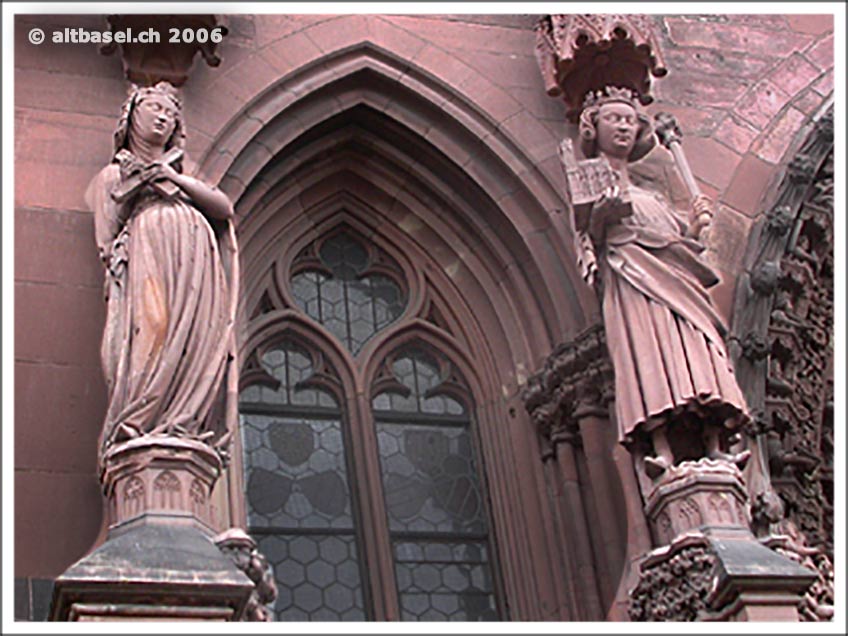
f) Henry (at right; at left, Empress St. Kunigunde) as portrayed in statues from ca. 1290 on Basel's ex-cathedral, the Basler Münster, whose rebuilding Henry initiated and which later medieval tradition in Basel held had been consecrated in the couple's presence in 1019:
Detail view of Henry:

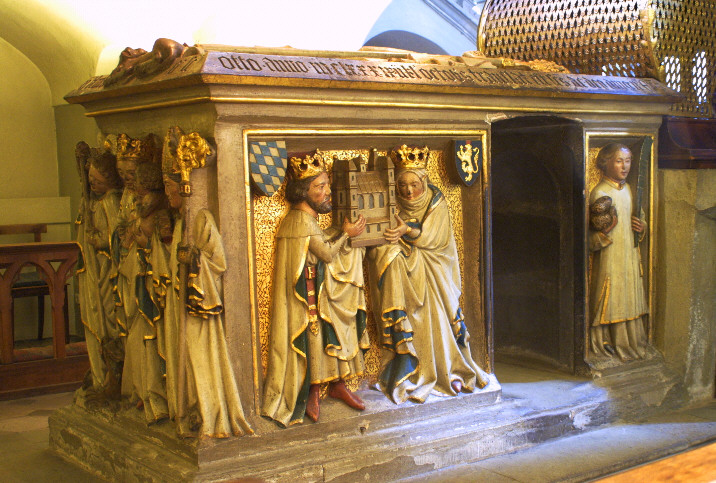
g) Henry and Kunigunde as portrayed in high relief as founders on the fourteenth-century tomb (1340) of bishop St. Otto of Bamberg (d. 1139) in the crypt of Bamberg's St. Michelskirche:

https://upload.wikimedia.org/wikipedia/commons/5/5e/Ottograb_NO%2C_klD.jpg


Detail view:

https://upload.wikimedia.org/wikipedia/commons/2/24/Heinrich_und_Kunigunde_Michelsberg_Bamberg.jpg


h) Henry as depicted in a panel of a mid-fourteenth-century window (ca. 1340-1350) formerly in the Stadtpfarrkirche zum Hl. Leonhard in Bad Sankt Leonhard im Lavanttal in Austria's Land Kärnten and now in the Cloisters Collection of the Metropolitan Museum of Art in New York:

http://www.burgenseite.com/glas/st_leonhart_heinrichII_glas.jpg


i) Henry (at left) and Kunigunde (at right) as depicted in the upper register of an originally early fifteenth-century window (ca. 1414) from the Andreaskapelle in the cloister of Bamberg's cathedral, now in the diocesan museum: http://tinyurl.com/nbdgnjo

j) Henry and Kunigunde as portrayed in early fifteenth-century statues formerly on the west pediment of the Basler Münster and now on display in the Museum Kleines Klingental in Basel:
Seen here overseeing preparations for a reception:

k) Kunigunde and Henry between St. Lawrence and Jesus as depicted as founders in the earlier fifteenth-century Ehenheim Epitaph (after 1438) in the St. Lorenzkirche in Nürnberg (since 1015 part of the diocese of Bamberg):

l) Henry and Kunigunde as founders as depicted in a hand-coloured woodcut in an unidentified copy of the Bamberg breviary of 1484 (the arms at right are those of prince bishop Philipp von Henneberg):

m) Henry (at upper left) as portrayed in relief on the late fifteenth-century bronze armorial plaque (ca. 1489) of Merseburg's bishop Thilo of Trotha on the castle of Merseburg:

n) Henry and Kunigunde as founders as depicted in a hand-coloured woodcut in the Staatsbibliothek Bamberg's copy of the Bamberg missal of 1507 (the arms at right are those of prince bishop Georg III. Schenk von Limburg):

o) Henry and Kunigunde as founders as depicted in a hand-coloured woodcut in the Beloit College copy of Hartmann Schedel's Nuremberg Chronicle (1493) at fol. CLXXXVIr:

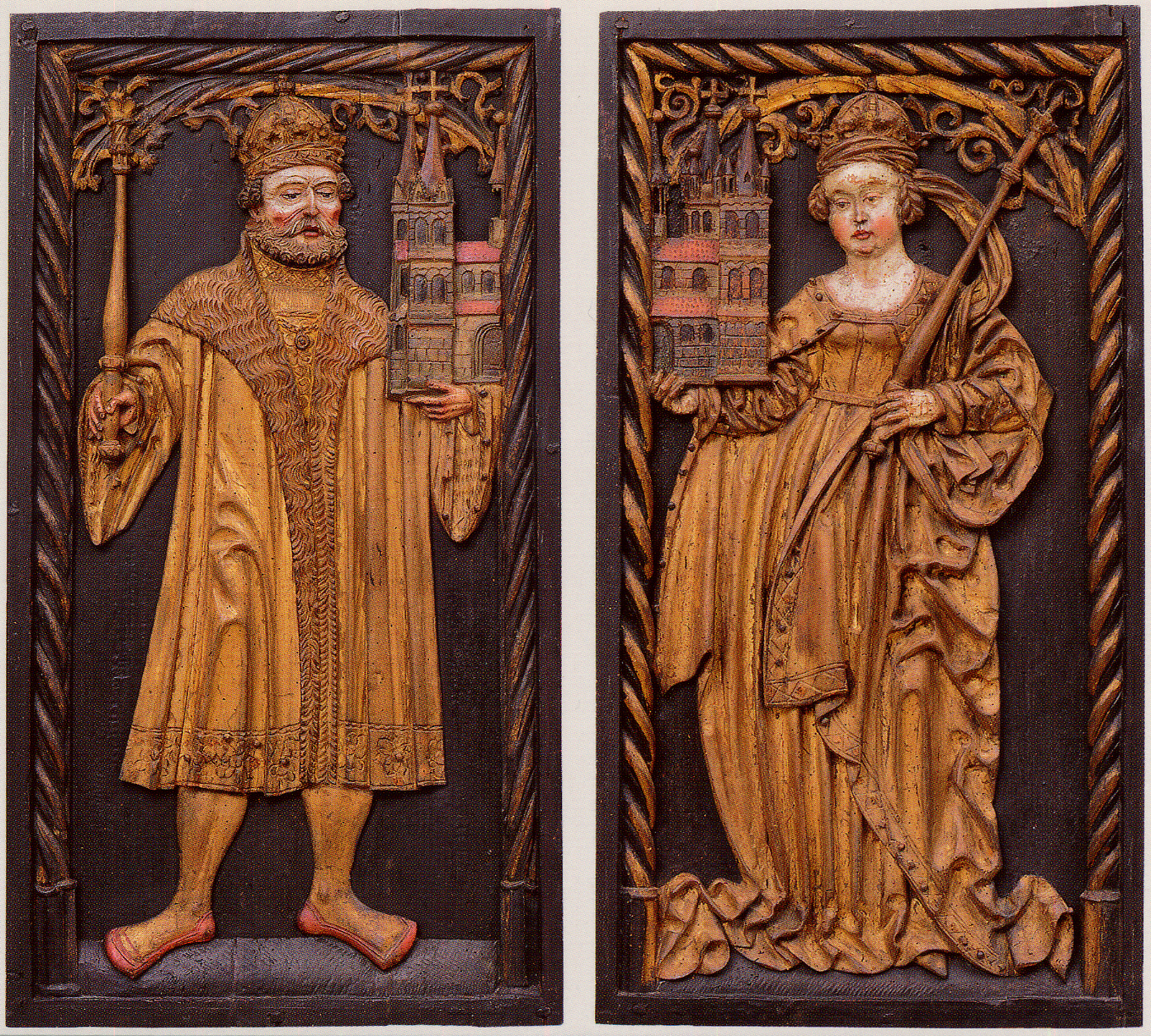
p) Henry and Kunigunde as founders (each holding a different half of the cathedral) as portrayed in relief on a pair of late fifteenth- or early sixteenth-century wooden panels now in the diocesan museum in Bamberg:

q) Henry and Kunigunde as portrayed flanking the BVM in modern replacements of their earlier sixteenth-century statues (ca. 1511) above the clock on the facade of Basel's city hall:
The originals inside the city hall (the BVM was refashioned in 1609 as Justitia):

r) Henry and Kunigunde as portrayed in relief by Tilman Riemenschneider and workshop on the imperial couple's present tomb in the cathedral of Bamberg (contracted for in 1499, completed in 1513):
On the side of the tomb chest the relief shows Henry (at left) and Kunigunde (at far right) and depicts an incident from Kunigunde's Vita in which she is said to have defended herself successfully, by walking barefoot over red-hot ploughshares, against an accusation of adultery.

s) Henry (at right) and St. Castulus flanking the BVM and Christ Child as portrayed in statues on the earlier sixteenth-century altarpiece (1514) of the Münster St. Kastulus in Moosburg an der Isar:

t) Henry and Kunigunde as portrayed in relief on earlier sixteenth-century stall ends (1519) in the cathedral of Merseburg:
Henry:
Kunigunde:

u) Henry and Kunigunde as depicted (bottom register at right) on the cross of a chasuble from 1519 in the cathedral museum in Salzburg:

http://tarvos.imareal.oeaw.ac.at/server/images/7003054.JPG


v) Henry (at right) as depicted in an earlier sixteenth-century window (1520) in the Saal des Regierungsrates in Basel's city hall:

w) Henry (at centre) as portrayed in an earlier sixteenth-century statue (ca. 1520-1525) on Bamberg cathedral's so-called Riemenschneider Altar (the statue of St. Sebastian has been attributed to Tilman Riemenschneider), with a perhaps slightly earlier founders' portrait of Henry and Kunigunde on the predella of this confection put together in 1926 from several previously unrelated pieces:

File:Riemenschneider altar.jpg


Monday, 27 January 2014

Costly fabrics


Those of you who read my post last week about the sale of here in Oxford of some medieval vestments reworked to form two altar frontals in Medieval textiles for auction in Oxford may be interested to learn that the first one, made from anumber of vestments of thirteenth to fifteenth century date, sold for £10,500, and the second, made from what was once a handsome blue cope embroidered in silver and belonging, by all reasonable hypotheses, to Cardinal Morton(d.1500) sold for £40,000.


Wednesday, 22 January 2014

Medieval textiles for auction in Oxford


The other day Fr Tim Finigan had a post about Campaign to buy Sawston Hall and make it a Catholic heritage centre, which seems to be a very worthwhile project. Yesterday I found out, coincidentally, that two embroideries once at Sawston are on sale today at an aution at Mallams, the long established Oxford auction house.  They now form altar frontals but are made from old vestments, and I hope they will be secured for a suitable public or church  collection. Here is the description taken from Mallam's online sale catalogue - with additional comments by myself in []:


An Altar frontal made up of embroidered orphries with saints in arcades and a large cross-orphrey with a Crucifixion; the embroideries range from the late thirteenth century to the sixteenth century. They are mounted on red silk, and bordered with two different widths of later, possibly eighteenth century, silver lace, 92 cm x 166 cm (through glass) in a gilt display case with removable front, 114 x 186cm. 

Provenance: Sawston Hall, Cambridgeshire and thence by descent. 

In the centre: At the top: The Virgin and Christ Enthroned. Both Christ and the Virgin, dressed in gold mantles, wearing crowns, fifteenth century. Christ is blessing the Virgin with his right hand (this is not a representation of the `Coronation of the Virgin` as Mary is already crowned). Two gold crowns are visible on Christ`s head, and it is possible that he originally wore a triple-crown tiara, but the top of this scene has been cut down. One unusual feature of the iconography is that Christ wears the crown of thorns beneath his gold crowns. 

Middle: on a deep burgundy velvet ground, the Crucifixion: Christ on the Cross with angels catching the blood flowing from his wounds in chalices, fifteenth century. At the foot of the cross, on either side, there are two embroidered figures of the Virgin Mary and St John the Evangelist. They are finely embroidered, and come probably from a cope or altar frontal with a design of figures set within barbed quatrefoils frames, as traces of a frame can still be seen. Part of a scrolling leaf design can be glimpsed above each of the figures. These two figures are finely embroidered in silk, with tiny, form-following stitches, set on a ground of underside-couched, very worn metal thread. These are the earliest fragments of embroidery on this altar frontal, possibly dating from the late thirteenth century. 

Bottom: the lower portion of an embroidered orphrey panel, representing a flowery, grassy meadow. 

On either side of the Crucifixion: Outside edges: two portions of a single cope orphrey, early sixteenth century. Left (top to bottom): A prophet; a bearded saint, possibly St James Major; a prophet. Right (top to bottom): A prophet; St John the Evangelist; a prophet. Next: two portions of a second cope orphrey, third quarter of the fifteenth century. Left (top to bottom): St Paul holding a sword; prophet holding a scroll (Elijah?; St Longinus holding a spear. Right (top to bottom): St Peter; a prophet; St Bartholomew holding a book and a knife. Nearest to the Crucifixion: narrow strips, consisting of separate pieces of embroidery used as infill, to bring the altar frontal up to the desired width. There are half-figures of cherubim holding scrolls, two whole figures, and portions of architectural frames. 

On the velvet cross-orphrey: Crucifixion: The figure of Christ, embroidered in coloured silks, with gold thread details in his Crown of Thorns, is applied to a cross which has couched laid gold thread, forming a pattern more often seen on the background of embroideries. Above the Crucifixion: the Holy Spirit in the form of a Dove, in laid and couched silver filé thread, outlined in silver filé twist. There are also radiances of light, formed of couched gold thread, with gilt spangles. Above and below the cross-bars of the Crucifixion: Left: a white-haired bearded saint, holding a book in one hand and possibly some keys (hard to see) in the other, possibly St Peter, third quarter of the fifteenth century. Below him: the Virgin and Child enthroned. Right: an unidentified saint, holding a branch (or small tree?) and below, a prophet. At the bottom edge of the altar frontal: spaces have been in-filled with portions of embroidered grassy meadows, taken from orphrey panels. 


An Altar frontal made from fragments of a deep blue velvet cope, with embroidered motifs in coloured silks and couched gold and silver thread, 156 x 101 cm (through glass) in a pine display case with removable front, 122 x 178cm.

Provenance: Sawston Hall, Cambridgeshire and thence by descent.

The embroideries represent: a large, central Lily Crucifixion, with God the Father above, surrounded by motifs of waterflowers, fleurs de lis, roses en soleil, part of two cherubim, and rebuses consisting of a falcon on a barrel, with a large letter M framing smaller letters D and R. This could possibly refer to a `Dr Morton`, from Mors, Latin for falcon, on a tun or barrel. [I would suggest it is the eagle of St John the Evangelist standing on top of the letters Mor and a tun as a rebus for John Morton - Clever Boy] May this rebus refer to the future Cardinal John Morton (d. 1500), in his early career, as Dr John Morton (i.e. as a doctor of Law, before he became a bishop?). He was educated at Balliol College, Oxford, where he graduated in law; among many other ecclesiastical preferments, he became Archbishop of Canterbury in 1486 and Cardinal priest of S. Anastasia in Rome in 1493. Because of the presence of the rose en soleil badge of Edward IV, the cope may have been commissioned during the period in which Morton was in the service of Edward IV (he was, for example, sent as ambassador to the French court by Edward IV 1477; it was under Edward IV that he became Bishop of Ely in 1479). [ Sawston is, of course, in the diocese of Ely - Clever Boy]

The Lily Crucifixion. This altar frontal offers an important example of a Lily Crucifixion, whose iconography arose from a conflation of the iconography of the Annunciation, in the form of the pot of lilies, with that of the Crucifixion. The Feast of the Annunciation (25th March) and Easter, sometimes fell on the same day, and during the Middle Ages, a belief arose that Christ`s actual Crucifixion took place on the same date as the Annunciation. In Christian iconography, the Annunciation is often represented with attendant portents of Christ`s Crucifixion, pointing, by implication to our redemption through his Resurrection. In this embroidered Lily Crucifixion on the frontal, the significance of the Annunciation, heralding the incarnation of Christ, is emphasised by the inclusion, above the Crucifixion, of God the Father blessing, represented as a half-figure emerging from a cloud.

[There are early fifteenth century paintings of the Lily Crucifixion in the church at Godshill in the Isle of Wight, in the church of St Helen in Abingdon and in St Michael at the Northgate in Oxford - Clever Boy]

The descriptions of the two preceding lots are taken from notes prepared by Lisa Monnas of the Victoria and Albert Museum to whom we express our gratitude. We also offer our thanks to Dr Jon Whiteley of the Ashmolean Museum for his assistance in this matter.

Text and images: Mallams

Tuesday, 3 December 2013

Relics of St Francis Xavier


When I arrived at the Oratory for Mass this evening I saw displayed in a frame in on the altar in the Relic Chapel the front portion of the white lining of a chasuble said to have been constantly used by St Francis Xavier (1506-1552), whose feast day it is today. Although I knew the oratory has built up an impressive collection of relics this was one which I had not seen before and of whose existence I was unaware.


File:Franciscus de Xabier.jpg

St Francis Xavier
A seventeenth century portrait in Kobe

Image:Wikipedia

At our Brothers meeting this evening Fr Jerome illustrated his talk on St Francis with readings from the saint's letters back to Rome, letters which were eagerly read and heard by St Philip Neri and others, inspiring St Philip to want to go to the Indies. In his case the answer he was given was thnat Rome was to be his Indies.

There is an online account of the remarkable life of St Francis here, which also has pictures of his body, which was taken back to Goa and which has survived remarkably well, although I seem to remember concern last time it was publicly exposed for veneration about the risks of deterioration to it.

Looking on the Internet I found this picture of a vestment which is described as having been used by St Francis and which is still preserved in at the Basilica of Bom Jesus at Velha Goa. I should add that it looks later in date to my mind, and I wonder if it is secondary relic through having been used to clothe St Francis' body. If it really is one he used it indicates the quality of things he used - there was on this evidence clearly no scrimping in the mission field in the mid-sixteenth century:


File:Garments of St. Francis Xavier.jpg

Image:Wikipedia

Wednesday, 6 March 2013

The Skenfrith Cope


Regular readers know that I have a more than passing interest in historic vestments and I was recently alerted by the newly updated Belmont Abbey website to the existence at the nearby medieval church of St Bridget at Skenfrith in Monmouthshire of a late medieval cope. This rare survival has recently been restored and the Abbot and some of the community at Belmont had been to the service of thanksgiving in the church.

Quite how it survived the reformation era and the ensuing centuries of neglect is unclear but by the 1840s it was serving as the cover for the Communion Table in the church, when it was recognised for what it is.


The Skenfrith Cope

Image:friendsofstbridgetskenfrith.co.uk

The Skenfrith Cope is a fine example of English embroidery of the second half of the fifteenth century. The different parts of the pattern were first worked in coloured silks and silver gilt threads on canvas, and afterwards applied to the velvet.

In the centre of the cope is the Virgin Mary, borne aloft by three angels. On either side is a Seraph, and another is represented below. The rest of the cope is covered with floral devices; the fleur-de-lis, the pomegranate and the double headed eagle. On the hood is a seated figure of the Virgin holding the infant Saviour. The Orphreys (ornamental borders), are embroidered with standing figures of the Saints, under canopies. Next to the hood, on the right hand side, is the figure of St. Andrew - the other figures are too worn to be identified with certainty.

As the Abbot pointed out in his sermon, which is on the Abbey website, red is not the colour usually associated with Our Lady. Today one would expect white or blue, but in the middle ages the emphasis was on the splendour rather than the colour, so this was doubtless the most splendid fabric the parish could get with which to honour the Virgin. 

The cope is noteworthy as an example of what a small rural parish in the marches of Wales could expect to have in its possession - this is not a major urban parish church but in a village. This is, so to speak, Voices of Morebath territory.

The parish website has a piece about the cope which can be seen here. 


Wednesday, 26 September 2012

Imperial purple


I recently found on the internet these pictures of a spectacular dalmatic, which as the picture indicates, comes from south Germany and is dated to the first half of the fourteenth century. The fabric is Chinese purple damask of circa 1300.
Unfortunately the website does not indicate in which treasury or museum the dalmatic may be seen. However from the context it appears to be in the Kunsthistorische Museum, Vienna, and to be part of the Imperial vesture. The Imperial eagle and the crowned figures in the embroideries would all point to that. One can presume that it was made for an Emperor such as Henry VII, Louis IV or Charles IV. It is certainly a wonderful vestment.
http://www.virtue.to/articles/images/1300s_real_dalmatic_lg.jpg

http://www.virtue.to/articles/images/1300s_real_dalmatic_close.jpg
Detail of the sleeve and embroidery
Images: virtue.to

Wednesday, 12 September 2012

Pontifical gloves in use at Buckfast


A friend with a keen eye for esoteric matters liturgical has very kindly sent me a link to a set of photographs from the celebration of Easter in 2011 at Buckfast Abbey. The Abbot is wearing Pontifical gloves in the celebration of the Ordinary Form of Mass. They can be seen in the third photograph in the top row where he is blessing the Gospel reader and most clearly in the bottom right photo of the Abbot preaching. The link is here.  
For an introduction to the history and use of  Pontifical gloves or chirotecae for the uninitiated there is an online article here.
My friend enquires if I have you ever seen this before, other than, as he adds, perhaps on the late Cardinal Siri. As the link above states their use is still permitted under current rules for the novus ordo. I cannot say that I have - but then perhaps I was not looking sufficiently closely.

I am, not, of course, objecting to such a use of Pontificalia, but would welcome it - as intended in traditional practice it emphasises the special nature of the prelate's office on a Solemn occasion.

Tuesday, 22 May 2012

The vestments of St Thomas Becket


That indefatigable photographer of the fine arts of the middle ages Genevra Kornbluth has posted, amongst other of her photographs on the Medieval Religion discussion group this link http://www.kornbluthphoto.com/VestmentsBecket.html to her set of photographs of the vestments preserved at Sens cathedral and believed to have been used by St Thomas Becket whilst he lived there in 1164-5 and 1166-70.

Please respect Genevra's rules in respect of her copyright if you wish to use the photographs in any way - the details are posted  on the side bar.

Otherwise enjoy the sight of relics of a martyr prelate and see what twelfth century bishops wore to celebrate the liturgy.


Friday, 24 February 2012

St John's College vestments


In response to the hope from a reader that I could obtain pictures of the St John's vestments I referred to in St John's College Oxford - Laudian and other vestments. I shall, unfortunately, be unable to go along to see them on March 3rd.

I have managed to find only these two photographs on the internet of some of the items - not the most interesting of the pieces, but they give an idea of what will be available for visitors to see.

Image Detail


photo

Images: hereisabee on Flickr


Tuesday, 13 December 2011

The Vestments of Dr Adrian Fortescue


A friend has pointed out to me a set of posts on the St Lawrence Press blog about the surviving vestments of Dr Adrian Fortescue the original author of, inter alia, that classic work for practical liturgists The Ceremonies of the Roman Rite Described. There is an online biography of him here, and Fr Aidan Nichols has a book on him coming out in the new year.

In my days at Pusey one of the regular female attenders, who now, like me, has crossed the Tiber remarked of some of the Sacristan-servers "They ought to have bracelets marked not with WWJD [What Would Jesus Do] but WWFD - What Would Fortescue Do."

The posts are about vestments which were both designed and worn by Fortescue, and are in the gothic style, and can be viewed at The Vestments of Adrian Fortescue, DD. Part I, The Vestments of Adrian Fortescue, DD - Part II, The Vestments of Adrian Fortescue, DD - Part III, The Vestments of Adrian Fortescue, DD - Part IV, The Vestments of Adrian Fortescue, DD - Part V, The Vestments of Adrian Fortescue, DD - Part VI, The Vestments of Adrian Fortescue, DD - Part VII

Friday, 4 March 2011

Westminster chasuble at Wardour


The New Liturgical Movement has recently had two posts about a spectacular rose cope at Wardour Chapel in Wiltshire and a very handsome medieval chasuble that has survived in the collection there.

Following the link about Wardour I found a site produced in connection with last year's display of treasures there, which, unfortunately, I was unable to visit. The history of the chapel includes a list of some of the items that were on display and some photographs, one of which I reproduce here.


IMG_1578.JPG

This vestment, known as the Westminster chasuble, has heraldic motifs on the red velvet fabric that help date it to the era of Queen Catherine of Aragon. Its alternating roses and pomegranates combined with the portcullis badge of the Beauforts and the fleur de lys point to her and her circle. It must therefore belong to the time after her marriage to Prince Arthur in 1501 or from her time as Queen after 1509 until the ''King's Great Matter" wrought such havoc in so many lives and churches, and the life of the nation.

I had seen the chasuble on television on John Betjeman's ABC of Churches many years ago, and was pleased to find this photograph, which is not unfortunately of the highest quality, to share.

I had half expected to see it at the Gothic exhibition at the V&A in 2003-4, but I think it was not on display, although other vestments that have survived from King Henry VII's rebuilding of the Westminster Lady Chapel were there.


Tuesday, 17 August 2010

Vestment and brass rubbings exhibition in Oxford

Over the forthcoming Bank Holiday weekend the Oxford Ortory will be holding another exhibition, this time featuring vestments from the collection, ranging in date from the seventeenth to the twentieth centuries, and also brass rubbings of vestments from an earlier age.

The exhibition will be open on Saturday August 28th 10.30- 5.30, on Sunday August 29th 12.30- 5.30, and on Monday August 30th 10.30-5.30. Admission is free, and there will be a catalogue on sale at a modest price.

Both parts of the exhibition promise to be well worth visiting if you are in or near Oxford that weekend.

Tuesday, 6 April 2010

Bad Vestments

Now those of you who know me, or even those of you who pass a cursory look down the sites listed on the side bar, will have little doubt as to my views on the all-important ecclesiastical question of tat. Let's face it so often that is what we afficionados sit around discussing in the Bird and Baby or wherever. In these discussions - profound and serious as they are (and I'm not joking) one rarely comments on bad-tat, being beneath our notice, but this afternoon whilst working on this blog I found a link to Bad Vestments.

Now being the man I am (yes, sadistic) I thought I would share these images with you, as a sort of Easter offering, to bring a little additional mirth into this already joyous season - and for future reference have added it as a link on the sidebar. There are some specimens therein that are not merely bad, but super-bad, or even meta-bad.

As far as I can see most, but not all, of these vestments are being worn by prelates and clergy of ECUSA - yes, the dear old ECUSA of our brethren on the other side of the Atlantic. However some are being worn here in England. Let us not also forget the dreadful things inflicted on His Holiness in Austria at Mariazell - but then I think those were the final liturgical nail in the career coffin of the previous Papal Master of Ceremonies.

As they would doubtless say in ECUSA "Enjoy!"