Once I was a clever boy learning the arts of Oxford... is a quotation from the verses written by Bishop Richard Fleming (c.1385-1431) for his tomb in Lincoln Cathedral. Fleming, the founder of Lincoln College in Oxford, is the subject of my research for a D. Phil., and, like me, a son of the West Riding. I have remarked in the past that I have a deeply meaningful on-going relationship with a dead fifteenth century bishop... it was Fleming who, in effect, enabled me to come to Oxford and to learn its arts, and for that I am immensely grateful.


Showing posts with label King Louis IX. Show all posts

Friday, 13 December 2024

The Crown of Thorns returns to Notre-Dame


The BBC News website reports that the reliquary of the Crown of Thorns has been ceremonially returned to the cathedral of Notre-Dame following the rededication ceremonies last weekend. The short article can be seen at Notre-Dame: Crown of Thorns returns to cathedral after reopening

There is film of the exposition and veneration of the relic earlier this year in Paris at Sainte Couronne : l'ostension avant son retour à Notre-Dame

Wikipedia has an illustrated history of the Crown and the way in which individual thorns were detached and distributed in the past. It can be read at Crown of thorns


The Reliquary of the Crown of Thorns
Image: Wikipedia 


Friday, 28 August 2015

St Louis in medieval art


To mark the feast day of St Louis on August 25th John Dillon posted the following images of the Saint-King, who ruled France from 1226 until 1270, on the Medieval Religion discussion group. I have opened and copied some of the more spectacular images, but all are worth investigating:

a) as depicted (upper register at right; upper register at left, his mother Queen Blanche of Castile) in the dedication illumination of an earlier thirteenth-century picture bible (circa 1230; New York, The Pierpont Morgan Library and Museum, MS M.240, fol. 8r):


b) as depicted (carrying the Crown of Thorns with Robert of Artois to Sens) in a panel of the mid-thirteenth-century Relics of the Passion Window (window A; ca. 1245-1248) in the Sainte-Chapelle in Paris:


c) as depicted (carrying the Crown of Thorns) in a mid-thirteenth-century glass window panel from Tours (circa 1245-1248) in the Cloisters Collection of the Metropolitan Museum of Art, New York:

King Louis IX Carrying the Crown of Thorns


d) as depicted at the outset of the dedicatory letter to him in a mid- to later thirteenth-century copy of Vincent of Beauvais' Speculum historiale formerly owned by the abbey of Royaumont (Dijon, Bibliothèque municipale, ms. 568, fol. 9r):
http://www.enluminures.culture.fr/Wave/savimage/enlumine/irht6/IRHT_094713-p.jpg

e) as depicted in a later thirteenth-century legendary (ca. 1273-1300; Rouen, Bibliothèque publique, ms. 1410, fol. 3r):
http://www.enluminures.culture.fr/Wave/savimage/enlumine/irht6/IRHT_101412-p.jpg

f) as depicted in a later thirteenth-century copy of the Grandes chroniques de France (1274?; Paris, Bibliothèque Sainte-Geneviève, ms. 782, fol. 327r):
http://www.enluminures.culture.fr/Wave/savimage/enlumine/irht15/IRHT_026819-p.jpg

g) as depicted (carrying the Crown of Thorns) in the later thirteenth-century martyrology and obituary of the abbaye Notre-Dame des Prés in Douai (ca. 1275-1300; Valenciennes, Bibliothèque de Valenciennes, ms. 838, fol. 101r):
http://www.enluminures.culture.fr/Wave/savimage/enlumine/irht5/IRHT_092290-p.jpg

h) as portrayed in a late thirteenth- or early fourteenth-century polychromed statue (circa 1300) formerly in the Sainte-Chapelle in Paris and now in the Musée national du Moyen Âge (Musée de Cluny) in the same city:
http://www.sculpturesmedievales-cluny.fr/notices/notice.php?id=667 This has an account of the statue.


The statue's modern copy in the Sainte-Chapelle in Paris:
https://c2.staticflickr.com/4/3337/3664528845_9db0da0bd0_b.jpg

i) as depicted in an early fourteenth-century sacramentary for the Use of Senlis (ca. 1310; Paris, Bibliothèque Sainte-Geneviève, ms. 103, fol. 278r):
http://www.enluminures.culture.fr/Wave/savimage/enlumine/irht15/IRHT_023729-p.jpg

j) as depicted (at left; at right, St. Louis of Toulouse) by Simone Martini in his early fourteenth-century frescoes (ca. 1310-1320) in the cappella di San Martino in the lower church of the basilica di San Francesco in Assisi:


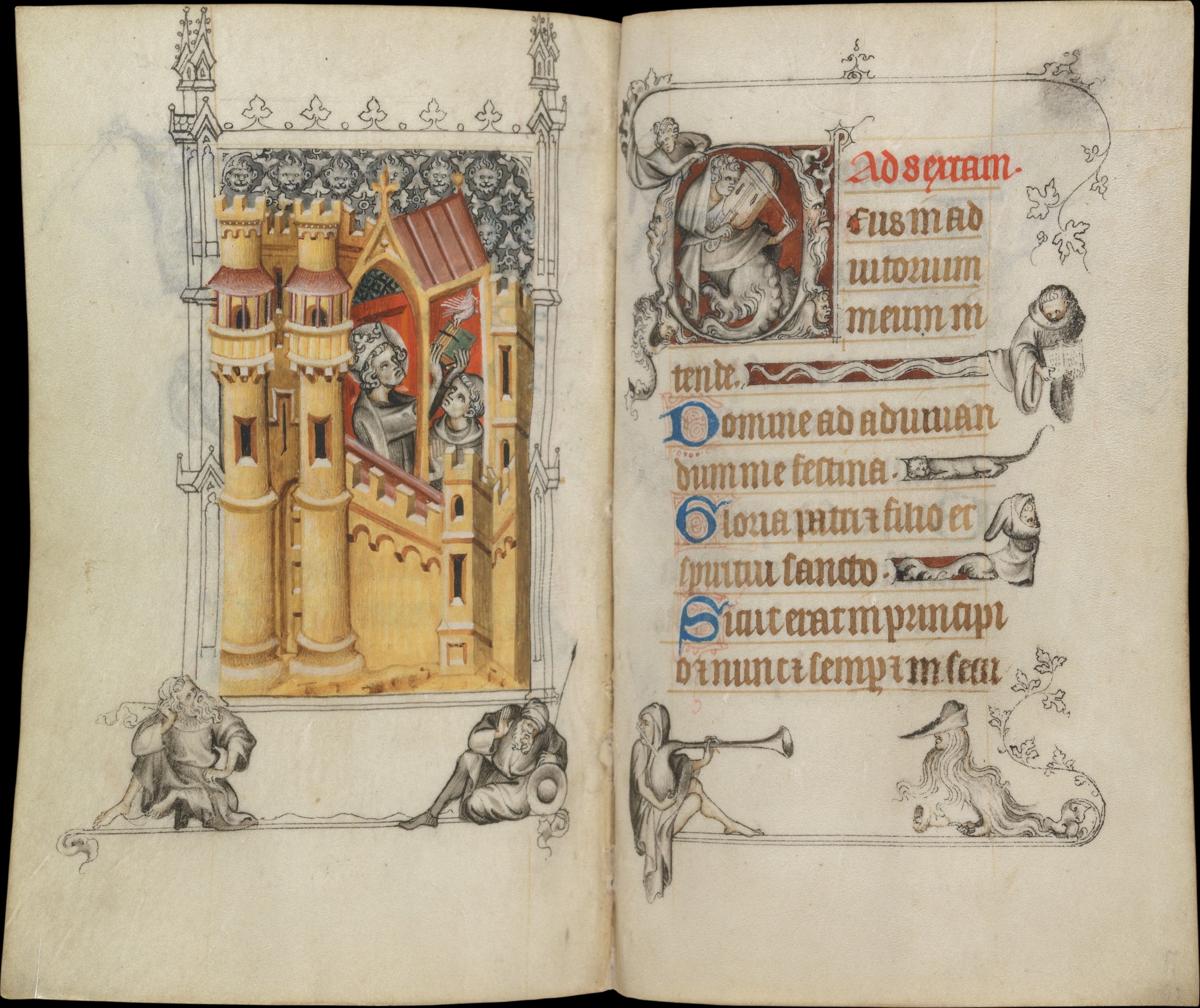
k) as depicted (two of eight scenes illustrating his Dominican Office) by Jean Pucelle in the earlier fourteenth-century Hours of Jeanne d'Évreux (ca. 1324–1328) in the Cloisters Collection of the Metropolitan Museum of Art, New York:
1) receiving from a dove his lost prayer book (fol. 154v): http://images.metmuseum.org/CRDImages/cl/original/DP233778.jpg
2) collecting the bones of martyrs (fol. 159v):
http://tinyurl.com/np6bex2

l) as depicted (three of numerous scenes from his life) by Mahiet in the earlier fourteenth-century sole copy of William of Saint-Pathus' thematically organized Vie et miracles de Saint Louis (circa 1330-1340; Paris, BnF, ms. Français 5716; foliation acc. to the digitization in Gallica):
1) going by ship on crusade (fol. 39v):
http://gallica.bnf.fr/ark:/12148/btv1b8447303m/f48.item
2) instructing his offspring (fol. 43v):
http://gallica.bnf.fr/ark:/12148/btv1b8447303m/f52.item
3) praying before the Crown of Thorns in the Sainte-Chapelle (fol. 67r):
http://gallica.bnf.fr/ark:/12148/btv1b8447303m/f75.item

m) as depicted (with Innocent IV at Cluny) in a later fourteenth-century copy (ca. 1375-1380) of the Grandes chroniques de France (Paris, BnF, ms. Français 2813, fol. 277r):
http://tinyurl.com/ovsjktq

n) as depicted (at his coronation) in the second volume of a late fourteenth- or early fifteenth-century copy of Don Gonzalo de la Hinojosa's chronicle of Burgos in its French-language translation by Jean Golein (ca. 1400; Besançon, Bibliothèques municipales, ms. 1150, fol. 287r):


o) as depicted (right-hand column) in the early fifteenth-century Hours of René of Anjou (ca. 1405-1410; London, BL, Egerton MS 1070, fol. 99v; image zoomable):
http://www.bl.uk/catalogues/illuminatedmanuscripts/ILLUMIN.ASP?Size=mid&IllID=48379

p) as depicted in an early fifteenth-century breviary for the Use of Paris (ca. 1414; Châteauroux, Bibliothèque municipale, ms. 2, fol. 298v):
http://www.enluminures.culture.fr/Wave/savimage/enlumine/irht2/IRHT_054144-p.jpg

q) as depicted in grisaille by Jean le Tavernier and assistant in the Suffrages of the mid-fifteenth-century Hours of Philip of Burgundy (ca. 1450-1460; Den Haag, KB, ms. 76 F 2, fol. 268r):
http://manuscripts.kb.nl/zoom/BYVANCKB%3Amimi_76f2%3A268r_min

r) as depicted (at left center; at right center, Bl. Charlemagne) as depicted in a later fifteenth-century copy of the Grandes chroniques de France (ca. 1460; Châteauroux, Bibliothèque municipale, ms. 5, fol. 282v):


s) as depicted (carrying the Crown of Thorns) in a late fifteenth-century breviary for the Use of Langres (after 1481; Chaumont, Bibliothèque municipale, ms. 33, fol. 340r):
http://www.enluminures.culture.fr/Wave/savimage/enlumine/irht6/IRHT_096983-p.jpg

t) as depicted in a late fifteenth-century copy (1493) of the Legenda aurea in its French-language version by Jean de Vignay (Angers, Université Catholique de l'Ouest, Bibliothèque universitaire, incunable non coté, fol. 290v):
http://www.enluminures.culture.fr/Wave/savimage/enlumine/irht16/IRHT_043130-p.jpg

u) as depicted on a wing of a late fifteenth- or very early sixteenth-century triptych (ca. 1495-1501?; Bl. Charlemagne on the other wing) in the Cappella del Santissimo Salvatore in Naples:
http://www.ilportaledelsud.org/images/casati/ss08.jpg

v) as depicted in a late fifteenth- or early sixteenth-century book of hours for the Use of Rome (ca. 1500; Den Haag, KB, ms. 74 G 22, fol. 201r):
http://manuscripts.kb.nl/zoom/BYVANCKB%3Amimi_74g22%3A201r


Monday, 25 August 2014

St Louis and his Bible


Today is the feast of St Louis, who as King Louis IX ruled France from 1226 until his death in 1270, and whose piety led to his canonisation in the reign of his grandson King Philip IV. Thereafter he became the ideal King of France, a role model for his successors and descendants to seek to emulate. 

My previous posts about him can be seen at St Louis, from 2010, and which has alink to a translation of the Sieur de Joinville's delightful biography of his royal master, and also at Commemorating St Louis from 2012. There is an illustrated online biography of the royal saint here. The illustrations include one of surviving relics of him, such as his shirt which can be seen in Notre Dame in Paris.

 As King he was undoubtedly a worthy exponent of the arts of kingship as understood in the thirteenth century, whilst his mother, Queen Blanche of Castile, a grandaughter of King Henry II and Queen Eleanor of Aquitaine, had proved herslf one of the great female regents of France during his minority.


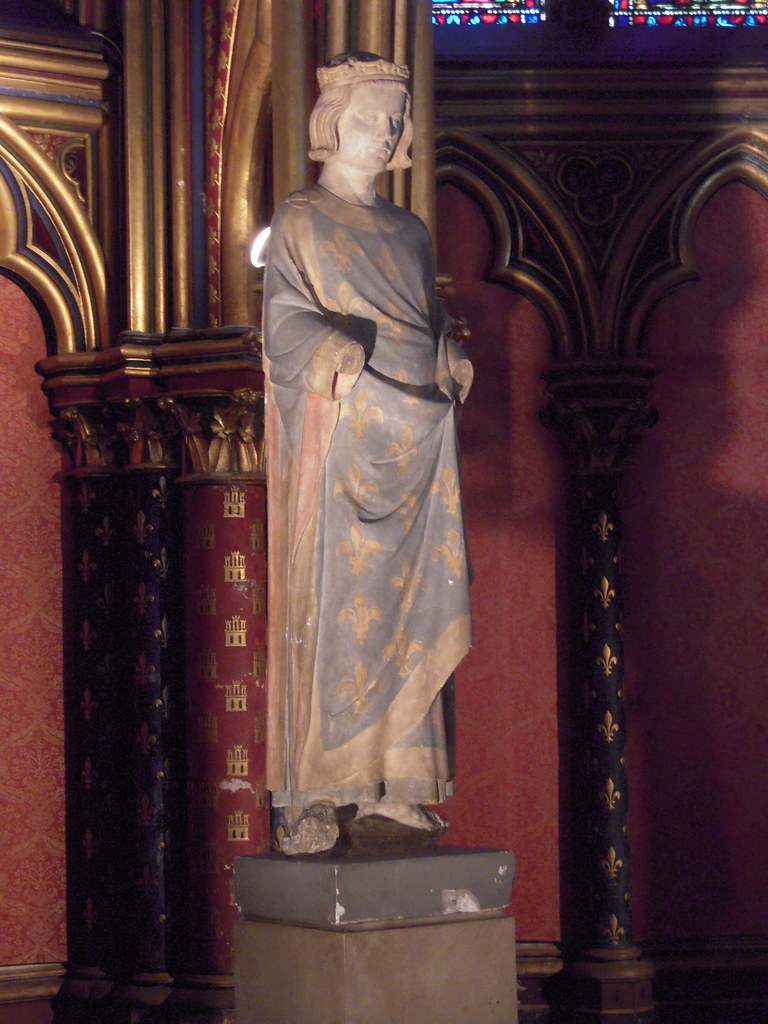
A statue of St Louis in the lower chapel of the Sainte-Chapelle in Paris, a building he commissioned

Image:Wikipedia
  
The illuminated and illustrated Bible of St Louis, preserved at Toledo cathedral, with a few folios, detached in the later middle ages, and including the concluding miniature of the King and his mother Queen Blanche, are now in the Morgan Library and Museum (formerly the Pierpoint Morgan Library) in New York, is one of the great artistic products of its age, and a very substantial link to the King's upbringing and formation. There are more detailed online accounts of it here and, from the publishers of a facsimile commissioned by the Chapter of Toledo in 1999, here.  


Queen Blanche and King Louis IX, with two scribes below
From the Morgan fragment

Image: Wikipedia


I have adapted part of the account written by the publishers of the facsimile as follows:

The first documented record concerning the Bible of St Louis appears in the will and testament of King Alfonso X the Wise of Castile. This will, written in 1282, describes a Bible "of three illuminated volumes given to us by King Louis of France." This short but precise description is sufficient to lead us to believe that he was referring to the same copy that resides today in the treasury of Toledo Cathedral. In addition, this particular copy, divided into three books or volumes each replete with ornate illustrations of the biblical tales and originally owned by King Louis IX of France is surprisingly similar to the Rich Bible of Toledo. Furthermore, the will explains that King Louis IX gave the codex to King Alfonso X as a gift. This valuable piece of evidence clarifies the mystery surrounding the presence of this bibliographic gem in Castile.

In his will, King Alfonso X expressed great appreciation for this Bible classifying it as one of the "noblest possessions belonging to the King." In his testament of 1284, he also alludes to the Bible as one of "the things we had in Toledo that were taken" during a robbery of the royal possessions in the revolt gainst him by his son Sancho. The king describes his regret at having lost one of "the rich and noble things that belonged to the kings". This entry, in addition to the similar phrase written in his will, attests to the fact that this invaluable piece of art was destined for the exclusive use of royalty. 

The Bible of St Louis is one of a small group of Bibles copied in the 13th century for members of the French royalty belonging to the Capetian dynasty ruling at that time. It is a peculiar type of biblical book without precedents in the tradition of European scriptoria, and is lavishly illuminated in keeping with the rank of its owners. These bibles were usually known by the more modern name of Bibles moralisées and were few in number, as mentioned earlier, due to the high cost of producing them. The most obvious feature of these books is their incredible lavishness and splendour. Their external appearance is so exceptional that one immediately realises that their owners could only be the most high-ranking persons in medieval society. This was indeed the case: these Bibles were made for the use of kings alone. 
 
The huge number and quality of their illuminated storia catch the reader's attention from the start. The singularity of these Bibles is demonstrated mainly in two aspects: their codicology and texts. From the viewpoint of the work as a book, we must admit that everything in it is extraordinary. The persons who commissioned it envisaged a project on a vast scale, far larger than any usually produced by book craftsmen. We could even say that everything was sacrificed in the name of magnificence. Some of the requirements in terms of grandeur and splendour imposed by the project forced those working on it to breach many of the rules laid down in the ateliers of copyists and illuminators.

Whilst not of the same size as the ancient Atlantic Bibles, it has nevertheless a very large format and an exceptional number of folios, all of the finest quality. The enormous amount of decoration made it impossible for the parchment folios to bear so much paint and gold on both sides since the pigments would have soaked through to the other side, causing the sheets to crumple. The only solution was to leave one side of each folio blank. The most surprising aspect is that the sides used for the text and images were not the flesh sides, which are whiter, but the hair sides. The reason for this was that the roughness of the hair side enabled the pigments to adhere much better. 

The entire Bible is presented as a totum continuum, opening with a large, illuminated page (God, the Creator of the Universe) and ending with a full-page miniature (Queen Blanche and her son Louis at the top and the codex craftsmen at the bottom), an indication that the book was designed as a single unit. The completed quires were gradually accumulated and in the end it was necessary to split the work into three volumes: a final operation which was not envisaged or allowed for originally. The division was done in a rather arbitrary fashion as revealed by the places where the work was divided into volumes. Looking at the work from the viewpoint of its texts, it can be seen that this book does not coincide completely with our notion of what a Bible is.

Bible of San Luis, 2
 
A page from the Bible

Image: omifacsimiles.com

First of all a careful analysis of the text shows that it is not a complete Bible but a selection of biblical texts, with many others missing. Exactly half of the text does not belong to the Bible but consists of commentaries written by anonymous theologians. No biblical text stands alone: each one is accompanied by an authorised commentary. These short theological texts were so important to those in charge of the work that they were given the same treatment as the biblical texts themselves: both types of texts were glossed iconographically by an illuminated storia along the side. Hence the texts in this work belong to both the Bible and theology in equal parts. The foregoing also demonstrates that, in this respect too, the Bible of St Louis is a very particular Bible, an utterly singular work.

King Alfonso X wrote in his testament that the work was made for use of kings, but the crucial question remains, why did the King of France and his mother need it? Was it just a whimsical possession? There is no documentation in the royal records of France about the purpose for which the Bible was made. However, we cannot reject the theory that the Bible had some utilitarian purpose for the people who used it in the Middle Ages. Books were made to be used as a vehicle of learning and information. According to this theory, books circulated amongst the people who had a use for it. The fact that the Bible was made during the time that the French prince was in his school years suggests that it was made to serve as a pedagogical instrument to complement the education of the future monarch of France. One might even venture to say that it was given to King Alfonso X the Wise in order to educate his children and grandchildren.

From the last illuminated folio, we can determine the timeframe in which the codex was copied and illuminated. King Louis IX of France was born in 1214 and came to the throne in 1226. In 1234 he married Margaret, the daughter of Ramon Berenguer IV, Count of Provence. Given that Saint Louis appears in the portrait as the reigning king but is still unwed, we can deduce that the Bible was completed between 1226 and 1234.


The Creator of the Universe
From the beginning of the Bible of St Louis

Image:Wikipedia 

To that I would add that the fact that the young King imbibed his faith well is well attested by his life and deeds, and his subsequent canonisation. His sense of calling and Christian duty can be seen in the text of St Louis' spiritual testament to his son, the future King Philip III, which is appointed for the Office of Readings for today:

"My dear son, in the first place I teach you that you must love the Lord, your God, with all your heart and all your strength; unless you do so you cannot be saved. You must guard yourself from everything that you know is displeasing to God, that is to say, from all mortal sin. You must be ready to undergo every kind of martyrdom rather than commit one mortal sin. 

If God sends you tribulation, you ought to endure it, giving thanks, realising that it is for your good, and that, perhaps, you have deserved it. If however the Lord confers some benefit on you, you must humbly thank him, and be on your guard not to become the worse for it, either through vainglory or in any other way. You must not offend God with the very gifts he has given you. 

Assist at the Divine Office of the Church with joyful devotion; while you are present in church do not let your gaze wander, do not chat about trifles, but pray to the Lord attentively, either with your lips, or meditating in your heart. 

Be compassionate towards the poor, the destitute and the afflicted; and, as far as lies in your power, help and console them. Give thanks to God for all the gifts he has bestowed upon you, so that you will become worthy of still greater gifts. 

Towards your subjects, act with such justice that you may steer a middle course, swerving neither to the right nor to the left, but lean more to the side of the poor man than of the rich until such time as you are certain about the truth. Do your utmost to ensure peace and justice for all your subjects but especially for clergy and religious. 

Devotedly obey our mother, the Roman Church, and revere the Supreme Pontiff as your spiritual father. Endeavour to banish all sin, especially blasphemy and heresy, from your kingdom. 

Finally, my dear son, I impart to you every blessing that a loving father can bestow on his son; may the Father, Son and Holy Spirit, and all the saints, guard you from all evil. May the Lord grant you the grace to do his will so that he may be served and honoured by you, and that, together, after this life we may come to see him, love him and praise him for ever. Amen."

Translation from Universalis 


bible moralisée de St Louis - St Louis

Bible moralisée de St Louis - Blanche de Castille, sa mère

Details of the portraits of King Louis IX and Queen Blanche

Images:armarium.fr 

Saturday, 25 August 2012

Commemorating St Louis


Today is the feast of St Louis, who reigned as King of France from 1226 until his death at Tunis whilst on crusade in 1270.

His canonization by Pope Boniface VIII at the request of his grandson King Philip IV was one of the happier incidents in their relationship, and St Louis became the beau ideal of French Kingship down to the regrettable events after 1789 - not least the use of the phrase "Son of St Louis, go up to Heaven " by the abbe Edgeworth to King Louis XVI on the scaffold in January 1793. He has remained  a model of Christian Kingship, thanks both to his exemplary life and to such texts at the life by his friend and companion on his first Crusade, Joinville. Louis has remained a favoured name for princes over the succeeding centuries.

Here is an early example of devotion to him in fourteenth century stained glass from the apse of the abbey church of St Pere-en-Valleee (St Pierre) at Chartres:


photo
photo

Detail of St Louis and St Gildouin
Gilduin was a Breton saint who refused a bishopric offered him by Pope Gregory VII, and whose shrine was in the abbey.

Image: Gordon Plumb on Flickr photostream

.That inexhaustible photographer of things medieval Genevra Kornbluth has links on her photo-site to a 1307 enamel funerary plaque with Guy de Meyos kneeling before St. Louis, and a 1927 figure of St. Louis holding an 1833 reliquary that contains the relics from the Sainte Chapelle which can be viewed at http://www.kornbluthphoto.com/Saints3.html row 3.
My post from two years ago about him can be read at St Louis.
This is one of the days in the year when I wear my fleur de lys badge in my lapel. I bought it when I visited the remains of the abbey at Jumieges in 2004 - the French equivalent of English Heritage sells these badges of  fleur de lys, Napoleonic bees and heads of Marianne at their sites - one can express one's constitutional preferences for the government of France in a very pluralistic way!

Thursday, 29 September 2011

Treasures of Heaven


Yesterday I went with a party from the Oxford Oratory to visit the exhibition Treasures of Heaven at the British Museum. The exhibition looks at relics, reliquaries and pilgrimage from the end of the Western Empire until the reformation and beyond. In addition to the Museum's own holdings there are items from the Vatican collections, from elsewhere in Britain, together with France, Germany and Belgium, as well as museum collections in the USA.

The exhibition is housed in the former Reading Room of the Museum, and is a wondrous display of treasures and a record of devotion. Here are reviews from the Guardian (by Eamonn Duffy) and the Daily Telegraph ( complete with predictable mad anti-Papal rant in the appended comments). Both reviews have illustrations of some of the items on display, so do follow the links.

It is an exhibition to take one's time over, and the objcts repay careful study. Accompanying the exhibition is handsome catalogue, available at a special price of a third off to visitors, and a fine array of souvenirs and related books.


Reliquary of St Baudime
Mid-twelfth century

Image: British Museum exhibition website

The relics and relquaries on show are but a fraction of what still survives on the continent, and infinitely less than once existed. In that sense one might be depressed at the greed and stupidity which destroyed so much that was expressive of faith, love and beauty, but one marvels all the more at the skill of medieval craftsmen - just how did they manage to see to produce such miniscule and exquisite detail? - and the joyful vitality of the pieces they created - there are two absolutely delightful figures of a pair of saintly Belgian bishops peering up from the base of their reliquary chasse, rather as if responding to a polite request to put in an appearance or perform some act of intercession.


Reliquary thought to be of one of the companions of St Ursula.
Netherlandish 1520-30

Image: British Museum exhibition website

As always it is invidious to pick out individual objects, but in addition to the episcipal figures I mentioned above, I was particularly interested to see St Cuthbert's portable altar - a sliver of wood used by the great monk-Bishop of Lindisfarne who died in 687 - as well as a fine late medieval Irish bell reliquary, relics of the Crown of Thorns distributed by St Louis, including the reliquary for one thorn made for the Duke of Berry in the late fourteenth century, other exquisite reliquaries of a a few years earlier associated with the court at Prague of the Emperor Charles IV (well it was the feast of St Wenceslaus), and relics and jewellery associated with Mary Queen of Scots and her grandson King Charles I.

In addition to the fine weather the day was all the more pleasant for being a visit with friends, and I appreciated the fact that I was able to spend much of my time with Dr Robert Beddard, formerly my college advisor at Oriel, and with whom I could swap historical observations on the objects we were looking at.

If you have not already been to the exhibition do try to find the time before it closes on October 9th.


Wednesday, 25 August 2010

St Louis


Today is the feast of St Louis, who as Louis IX was King of France from 1226 to 1270. He became recognised as the beau ideal of contemporary kingship and came to be held up as a role model to all his successors as Kings of France, who were on occasion described as "Son of St Louis"


Representation of Saint Louis considered to be true to life.

Early 14th century statue from the church of Mainneville (Eure departement).

Image: Wikipedia


The promotion of devotion to St Louis was aided by the memoirs of the King written by Jean, Sieur de Joinville. This, one of the most famous medieval biographies, was written in his old age by Joinville at the request of Queen Jeanne, wife of King Philip IV, as a guide to good kingship for her eldest son, the future King Louis X. It is available in a modern paperback translation published by Penguin as Two Chronicles of the Crusades: Villehardouin and Joinville. Here is an older translation online. It is a delightful account, and well worth reading for its informative nature and human sympathy. In the Life both the King and his biographer emerge as rounded individuals, not just, as not infrequently in medieval texts, conforming to recognisable stereotypical forms.