Once I was a clever boy learning the arts of Oxford... is a quotation from the verses written by Bishop Richard Fleming (c.1385-1431) for his tomb in Lincoln Cathedral. Fleming, the founder of Lincoln College in Oxford, is the subject of my research for a D. Phil., and, like me, a son of the West Riding. I have remarked in the past that I have a deeply meaningful on-going relationship with a dead fifteenth century bishop... it was Fleming who, in effect, enabled me to come to Oxford and to learn its arts, and for that I am immensely grateful.


Showing posts with label British Museum. Show all posts

Tuesday, 31 January 2017

Fourteenth century alabaster Virgin and Child


I saw on Medievalists.net on Tumblr the following report of the acquisition by the British Museum of an Engliah alabaster statue of circa 1350 of the Virgin and Child and am reproducing it below, with some additional images.

 https://www.artfund.org/assets/news/2016/xx/acquisitions/virgin-and-child/mcm38480.jpg

Image:Art Fund

The British Museum has acquired an outstanding fourteenth-century English alabaster figure of the Virgin and Child which is the best-preserved of its kind on display in a UK national collection.

The sculpture probably originates from the Midlands and provides a precious insight into carved alabaster from the period that was otherwise largely destroyed, hidden or sold abroad during the English Reformation. The fourteenth-century artists who worked alabaster of this quality attracted the attention of King Edward III, who ordered a carved alabaster altarpiece from Peter the Maceon of Nottingham in the late 1360s. The altarpiece he commissioned for the chapel of St George at Windsor, along with the totality of comparable pieces in situ, were destroyed, buried or sold abroad during the English Reformation. This statue of the Virgin and Child is a rare survivor that escaped this wave of destruction triggered by Protestantism, having perhaps been exported to the continent at the time of its manufacture, or sold off when imagery of this sort was no longer allowed.


Image result for British Museum alabaster Virgin and Child

Image:Medievalists.net

The unknown British sculptor demonstrates great skill in suggesting both the divinity of the Virgin and her role as loving mother. The viewer is encouraged to identify with the tender relationship between the mother and her son. This interactive object has been touched and kissed by the faithful with the face of the Virgin and the foot of Christ worn through adoration. The standing Virgin is crowned as Queen of Heaven. The Christ Child is seated on her right arm and holds an orb in his right hand and, with his other hand, touches the Virgin’s chest.

The sculpture is in remarkable condition and is extraordinary in having suffered no major breakages. Even rarer is the survival of large portions of the original decoration, including gilding and imitation jewels which decorate the chest of the Virgin. There are traces of original red and green painting and substantial gilding across the sculpture. The figure has a sophisticated sway emphasising the relationship of mother and child. The reverse of the sculpture is uncarved, suggesting that the figure was originally positioned against something within a tabernacle or architectural niche.

The alabaster figure was purchase by the British Museum from the dealer Sam Fogg with support from the Art Fund, National Heritage Memorial Fund and private donations.

The sculpture is now on display in the Sir Paul and Lady Jill Ruddock Gallery of Medieval Europe (G40).
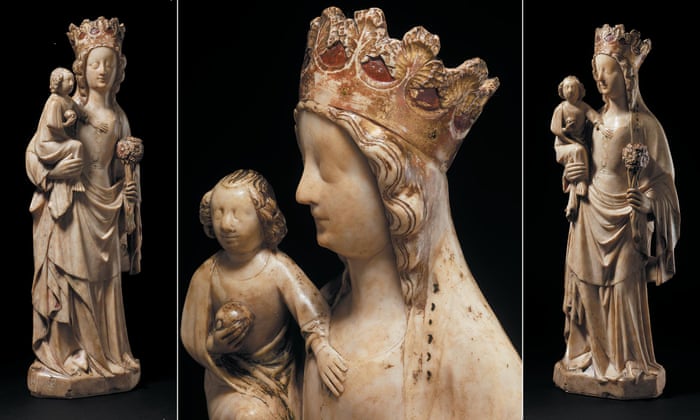
 Image result for British Museum alabaster Virgin and Child

Image: The Guardian

The British Museum website itself reports on the statue at British Museum acquires outstanding alabaster Virgin and Child, together with a set of views of another statue already in the collection featured at British Museum - Image gallery: statue


There are other website articles about the statue from the Guardian at Medieval statue that survived persecution is back on show at British Museum acquires rare alabaster of the Virgin and Child
from the Art Fund and in an article from the Catholic Herald at 'A haunting glimpse of what we lost'

 Image result for British Museum alabaster Virgin and Child

Image: Catholic Herald


Tuesday, 5 May 2015

A day out in London

Today I had a day trip to London. It was a bright but blustery day and the countryside between Oxford and London lush with fresh foliage and blossom

I was struck by the fact that two days before a General Election there was such a lack of election posters - I noticed but one window sticker, two small billboards and one large one all way from Oxford to London and back again. Apathy reigns, the electorate are I sense bored and uninterested.

My purpose in going was to meet at the
British Museum a new acquaintance from California to discuss possible tours for US visitors here next year. I joined his tour group for a conducted introduction to the great collection of Assyrian sculpture, including the Royal Lion Hunt, and the Elgin Marbles, neither of which I had seen before I must admit. Then it was upstairs to visit the Mesopotamia displays from Ur. The guide brought out the Biblical links it being a church group.

I walked from the coach stop to and from the Museum, taking in the blue plaques and the architecture of the eighteenth century development of the Bedford estate, and the architectural mix that is Fitzrovia.

On the way back I went to the evening Mass at St James Spanish Place, one of my favourite Catholic churches.

A good day out, with a change of scene and new things to see.

Thursday, 29 September 2011

Treasures of Heaven


Yesterday I went with a party from the Oxford Oratory to visit the exhibition Treasures of Heaven at the British Museum. The exhibition looks at relics, reliquaries and pilgrimage from the end of the Western Empire until the reformation and beyond. In addition to the Museum's own holdings there are items from the Vatican collections, from elsewhere in Britain, together with France, Germany and Belgium, as well as museum collections in the USA.

The exhibition is housed in the former Reading Room of the Museum, and is a wondrous display of treasures and a record of devotion. Here are reviews from the Guardian (by Eamonn Duffy) and the Daily Telegraph ( complete with predictable mad anti-Papal rant in the appended comments). Both reviews have illustrations of some of the items on display, so do follow the links.

It is an exhibition to take one's time over, and the objcts repay careful study. Accompanying the exhibition is handsome catalogue, available at a special price of a third off to visitors, and a fine array of souvenirs and related books.


Reliquary of St Baudime
Mid-twelfth century

Image: British Museum exhibition website

The relics and relquaries on show are but a fraction of what still survives on the continent, and infinitely less than once existed. In that sense one might be depressed at the greed and stupidity which destroyed so much that was expressive of faith, love and beauty, but one marvels all the more at the skill of medieval craftsmen - just how did they manage to see to produce such miniscule and exquisite detail? - and the joyful vitality of the pieces they created - there are two absolutely delightful figures of a pair of saintly Belgian bishops peering up from the base of their reliquary chasse, rather as if responding to a polite request to put in an appearance or perform some act of intercession.


Reliquary thought to be of one of the companions of St Ursula.
Netherlandish 1520-30

Image: British Museum exhibition website

As always it is invidious to pick out individual objects, but in addition to the episcipal figures I mentioned above, I was particularly interested to see St Cuthbert's portable altar - a sliver of wood used by the great monk-Bishop of Lindisfarne who died in 687 - as well as a fine late medieval Irish bell reliquary, relics of the Crown of Thorns distributed by St Louis, including the reliquary for one thorn made for the Duke of Berry in the late fourteenth century, other exquisite reliquaries of a a few years earlier associated with the court at Prague of the Emperor Charles IV (well it was the feast of St Wenceslaus), and relics and jewellery associated with Mary Queen of Scots and her grandson King Charles I.

In addition to the fine weather the day was all the more pleasant for being a visit with friends, and I appreciated the fact that I was able to spend much of my time with Dr Robert Beddard, formerly my college advisor at Oriel, and with whom I could swap historical observations on the objects we were looking at.

If you have not already been to the exhibition do try to find the time before it closes on October 9th.