Once I was a clever boy learning the arts of Oxford... is a quotation from the verses written by Bishop Richard Fleming (c.1385-1431) for his tomb in Lincoln Cathedral. Fleming, the founder of Lincoln College in Oxford, is the subject of my research for a D. Phil., and, like me, a son of the West Riding. I have remarked in the past that I have a deeply meaningful on-going relationship with a dead fifteenth century bishop... it was Fleming who, in effect, enabled me to come to Oxford and to learn its arts, and for that I am immensely grateful.


Showing posts with label Crown of St Wenceslas. Show all posts

Sunday, 13 July 2014

St Henry


Were today not a Sunday it would be the feast day of St Henry, the Holy Roman Emperor Henry II, who died in 1024. This then is the 990th anniversary of the death of the last Ottonian Emperor, who was canonised in 1146.

There is an online account of his life and reign, including his camapignes in Italy and Poland as well as his extensive patromage of the Church at Henry II, Holy Roman Emperor.

The see of Bamberg, which he founded and in whose cathedral he is buried and a city with which he is always associated through that fact and the survival of relics of him there is also covered here.

The artistic survivals from his reign are an indicator of the lavish, cultivated and beautiful Imperial and ecclesiastical court culture of the age.

                         Henry II, Holy Roman Emperor,  ca. 1010, from the Imperial Sacramentary,  Bayerische Staatsbibliothek, München

  Holy Roman Emperor Henry IIcirca 1010, from the Imperial Sacramentary,  Bayerische Staatsbibliothek, Munich

Image:portraittimeline.com

German dalmatic Henry ll

German coronation dalmatic of Emperor Henry II preserved at Bamberg

Image:pinterest.com


From the website Historical Needlework Resources there is something about another surviving textile from the Emperor's ceremonial wardrobe:

This is the Sternenmantel of Heinrich II (or Star Mantle of Henry II) The Sternenmantel was presented to Henry by Duke Ismahel of Bari. It was donated to Bamberg Cathedral by either Henry II or his wife, St Kunigunde, and it was subsequently was used as a cope). The mantle is currently housed in the Bamberg Cathedral Treasury.


Sternenmantel of Heinrich II


The Sternenmantel of Emperor Henry II

It was created using the stitches and techniques of surface couching, applied pearls and applique

The mantle is approx. 3m wide and 1.5m high. The embroidery depicts scenes from the Life of Christ as well as celestial bodies. There are fourteen medallions containing figures. The design elements are worked in fine couched gold thread on violet silk twill. There is some coloured silk work (white, red, blue and green). Some of the figures have elements worked in stem stitch. The mantle is believed to be of Southern German manufacture.[I am not sure how that coheres with assertion that it was the gift of the Duke of Bari - JRPW]

In 1503 the embroidered elements were cut away and remounted on the current Italian silk damask. Therefore, the original placement of the motifs on the mantle is unknown. There are futher links at

Detail of cuff from Blue Dalmatic

Detail of applique motif from the Sternenmantel of Emperor Henry II

Images :medieval.webcom.net.au


Later in date, but linked to the canonised Emperor, is the later medieval so-called Crown of St Henry II. This is a reliquary crown, which belonged to the reliquary of the Emperor in Bamberg cathedral. This was presumably like that of Charlemagne at Aarchen or the one in Prague of St Weneslas  which was topped off with the surviving Crown of St Wenceslas. After the process of German Mediatisation  Bamberg passed into the Kingdom of Bavaria and  the new ru[ers took the crown to the treasury of the Munich Residenz, where it still can be seen. 

This lily crown consists of six plates which are joined together by hinges fixed with pins. Each of the plates carries a large fleur-de-lis. The pins are surmounted by praying angels standing on acanthus leaves. Four of the segments and all of the fleur-de-lis are adorned with precious stones while two carry antique cameos. The decoration of the frame with foliage work seems to be of later date than the frame itself. Due to fitting slots on the front and back segments it is possible to add an imperial arch and cross to the frame. One theory is that the crown was made for the reliquary in the fourteenth century but it may also be a crown of the Emperor Frederick II (d.1250) which came into the possession of Bamberg cathedral through the Emperors Henry VII and Louis IV the Bavarian.


Wednesday, 25 December 2013

O Come Let Us Adore Him


A Holy, Blessed and Joyful Christmas to you all


http://upload.wikimedia.org/wikipedia/commons/thumb/c/c1/Meister_Theoderich_von_Prag_%28Umkreis%29_001.jpg/399px-Meister_Theoderich_von_Prag_%28Umkreis%29_001.jpg

Image:Wikimedia


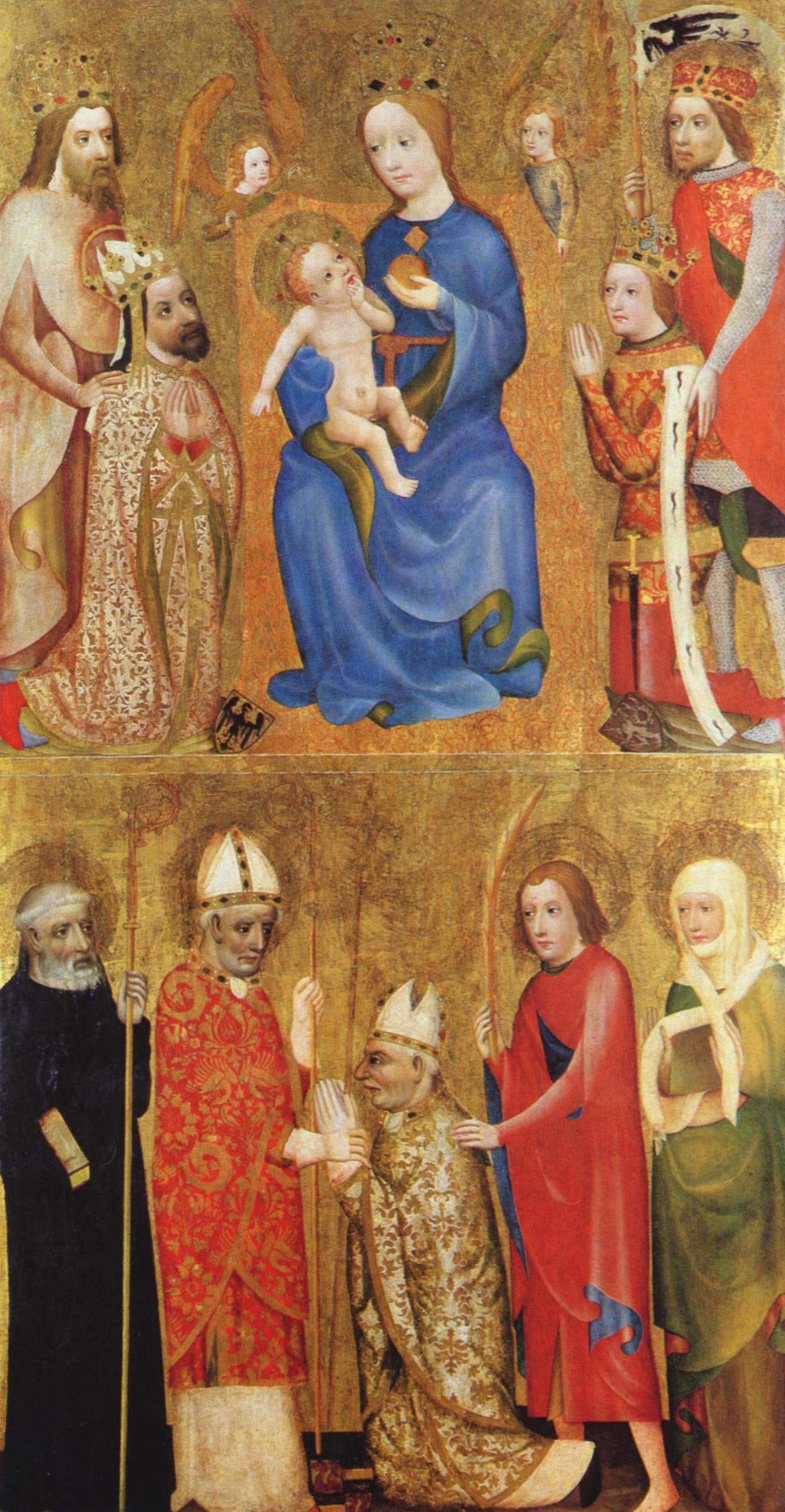
My choice of a Christmas image this year is the votive panel of John Ocko of Vlasim, Archbishop of Prague and dated to circa 1370. Not only does it contain an image of the Virgin and Child but seems to capture so many of the themes I have touched upon in my posts over this last year, so it seemed an appropraite image to use. The Virgin and Christ Child are flanked by the kneeling figures of the Holy Roman Emperor Charles IV, sponsored by his Burgundian patron St Sigismund, and his son, King Wenceslas IV of Bohemia and also King of the Romans, sponsored by St Wenceslas. In the lower register the kneeling figure of Archbishop John is surrounded by his patrons. 


Friday, 28 September 2012

St Wenceslas and the Crown of Bohemia


Today is the feast of St Wenceslas, patron of Bohemia and of the Bohemian monarchy. I posted about him last December in Good King Wenceslas  and  a year ago about the crown made in the fourteenth century which bears his name in The Crown of St Wenceslas. From 2010 there is  The Crown of St Wenceslas  which deals with the same topic ( and also the related post on Treasure from the age of Charles IV ). All these posts are illustrated and give accounts both of the life of the martyred ruler and also of the Bohemian regalia. The crown was made in 1347 and the last Bohemian coronation in 1836. There is an illustrtaed list of Dukes and Kings of Bohemia here.

The regalia is kept in its own strong room in St Vitus cathedral in Prague adjacent to the chapel of St Wenceslas in the south transept, and is relatively rarely on public display - unlike, for example, the Austrian or Hungarian regalia. Hence perhaps the making of the following films in recent years
Here from YouTube is a short film showing the Crown of St Wenceslas and the other regalia:


There are also three parts of a programme about a scientific examination and recording of the Bohemian regalia, which includes more close ups of the crown, orb and sceptre which can be viewed here:


Now all that is needed is to organise the coronation of the legitimate King of Bohemia, King Charles IV, or perhaps one should say King Karel IV.

Monday, 26 December 2011

Good King Wenceslas


Although his feast day is on September 28th thanks to the Christmas carol Good King Wenceslas
not only St Stephen but also St Wenceslas comes to mind today.

The story of J.M.Neale's 1853 carol and its musical accompaniment can be read here.


http://images.arcadja.com/munyaradzi_henry-st__wenceslas~300~10000_20050119_W05700_154.jpg

St Wenceslas and his page on St Stephen's day

A painting by Henry Munyaradzi (b.1931)

Image: arcadja.com

There is a modern online illustrated life of the tenth century Duke of Bohemia who was to become the patron of the monarchy and country here, and there is a modern adaptation of a 10th century Slavonic text biography here.

http://www.hrad.cz/img/u/prazsky-hrad/img-korunovacni-klenoty-koruna.jpg

The Crown of St Wenceslas
It was made for the Holy Roman Emperor Charles IV, who was also King of Bohemia

Image: hrad.cz

I have published two previous posts about the fourteenth century crown of St Wenceslas which can be read at The Crown of St Wenceslas.

http://img.radio.cz/pictures/cirkev/svatovaclavska_prilba.jpg

The helmet preserved as that of St Wenceslas

Image: radio.cz

His relics are enshrined in the St Wenceslas chapel in St Vitus cathedral in Prague, and there is more about it here.


Wednesday, 28 September 2011

The Crown of St Wenceslas


Last year I posted about the Bohemian regalia in The Crown of St Wenceslas and with a following article about Treasure from the age of Charles IV.

I have subsequently found some other websites about the regalia. There is an illustrated official Czech website here. There is another account of the crown here, which has two splendid illustrations which I have copied below.

The Crown of Saint Wenceslas


The Crown of Saint Wenceslas

I also found another article whichI have copied and edited - the original version can be seen here.

The Czech Royal Coronation Jewels

The royal crown was dedicated to St. Wenceslas, the principal saint of the kingdom. At the request of the Emperor Charles IV this was confirmed by a bull of Pope Clement VI, which authorised excommunication for any unauthorized person handling the crown. The crown was supposed to be permanently placed on the head of St. Wenceslas and removed only for a coronation or an exceptionally solemn event in Prague or its nearest environs - and for one day only. The crown was in the care of the Metropolitan Chapter attached to St.Vitus's Cathedral.

However these prescribed strict measures were in force up to the end of the fourteenth century at the latest. The coronation jewels were then deposited in Karlštejn Castle. After the outbreak of the Hussite wars in 1419 Sigismund of Luxembourg took them to Hungary, from where they were returned to Karlštejn in 1436. For a short time before the mid-fifteenth century they were also kept at Velhartice Castle and from 1453 to 1619 they were again guarded by two Karlštejn burgraves. From 1619 to 1620 they were kept in a room of the Land Rolls. During the stormy period of the Thirty Years' War the jewels were alternately kept in a cellar in front of the chapel and in secret places outside Prague, for example, in the cellar of the parish church at Ceske Budejovice.

From the 17th century they were permanently kept in Vienna, returning to Prague only on the occasion of a coronation. In 1791, under the Emperor Leopold II the jewels were finally taken to Prague Castle, displayed for a whole afternoon for the first time and then placed in safe-keeping along with the crown archives.

After a short period during which they were deposited in Vienna in the course of the Prussian-Austrian war they were solemnly returned to Prague in a festively decorated train in 1867, this being their last journey. After being exhibited they were placed in the newly adapted Crown Chamber, where they have remained to the present apart from a short period in 1938 (when they were secretly taken to a safe in a bank in Zilina) and in 1945 (when they were walled-up in the floor of the Old Royal Palace).

The Crown Chamber is one of the least accessible places at Prague Castle. The only entrance to it is a metal-plated door in the south-western corner of St.Wenceslas's Chapel. In order to open in the seven keepers of the keys have to get together. These person are: the president of the Republic, the prime minister of the government, the archbishop of Prague, the Chamber of Deputies, the president of the Senate, the Metropolitan Chapter of St. Vitus and the mayor of Prague.
In the course of the twentieth century the coronation jewels were exhibited eight-times - in 1929, 1945, 1955, 1958, 1968, 1975, 1978 and 1993.

The crown, known as the St. Wenceslas
crown, was most likely made in 1347 of gold plate. It has the form of a coronet consisting of four parts, each of which terminates with a large fleur -de-lys. The individual parts are joined at the top by two curved pieces on which the decorations of an older jewel (coronet or belt) are fastened. At the place where the curved pieces intersect there is a gold cross with a sapphire cameo. In all there are 19 sapphires, 44 spinels, 1 ruby, 30 emeralds and 22 pearls on the crown. The total weight of the crown without the parts made of material is 2,475.3 grammes. It is always exhibited on a special cushion of red velvet with the embroidered Czech emblems of 1867.

The sceptre of the first half of the sixteenth century is 670 millimetres in length, its weight being 1.013 grammes. It is gold and decorated with 4 sapphires, 5 spinels, 66 pearls and hammered and enamel ornaments.

The orb of the first half of the sixteenth century is also made of gold. It is 220 millimetres in height. On the lower hemisphere there is a hammered relief with scenes from Genesis, while on the upper one there are scenes from the life of King David. In all 8 sapphires, 6 spinels and 31 pearls were used for its decoration.

The coronation mantle, with an ermine stole, belt and maniple of red fabric with a pattern woven with gold are kept in the depository of historic textiles in another place. They originated in the first third of the seventeenth century as a part or the collection of Czech coronation, royal and electorate textiles, whose other parts are now in Vienna.

As a rule the St. Wenceslas sword and coronation cross are exhibited with the coronation jewels. Both form parts of the St. Vitus treasure.

Coronation Jewels

The Bohemian regalia
Foto: Jiri opriva

Tuesday, 28 September 2010

The Crown of St Wenceslas


As today is the Feast of St Wenceslas it seems a suitable day on which to post about the Crown that bears his name, although, like that of St Stephen in Hungary is later in date than the actual life of the saint.


Crown

The Wikipedia article about it is here. I am reproducing, with a few adaptations, two passages from that article:

"[The] Crown of Saint Wenceslas is the part of Czech crown jewels (also called the Czech treasure) made in 1347. The eleventh king of Bohemia from the House of Luxembourg, and Holy Roman Emperor Charles IV [Charles I of Bohemia] had it made for his coronation and forthwith he dedicated it to the first patron saint of the country St. Wenceslas and bequeathed it as a state crown for the coronation of future Bohemian kings, his successors to the Bohemian throne. On the orders of Charles IV the new Royal Crown was to be permanently deposited in St. Vitus Cathedral in Prague Castle. It was used last time for the coronation of King Ferdinand V [Emperor Ferdinand I of Austria] in 1836."

"[A]n old Czech legend says that any usurper who places the crown on his head is doomed to die within a year, as the Crown is in personal property of St. Wenceslas and may only be worn by a rightful Bohemian King during his coronation."

Another Wikipedia article on the same set of links states that "[i]t was originally held in Karlstejn Castle, designed in the 14th century by Matthias of Arras. Since 1867 it has been stored in St. Vitus Cathedral of Prague Castle."

Another, independent, account says that Charles ordered a very rich crown to adorn the reliquary containng the skull of his predecessor and Bohemia's patron saint, St. Wenceslas. The crown was to be removed from the reliquary only for the coronation of the kings of Bohemia.

In the cross on the top is set a relic from the Crown of Thorns. The crown is inlaid with ninety one gems (emeralds, sapphires, rubies and amethysts) and twenty pearls and decorated with four large Fleur de Lys.

The Crown is but one example of the flowering of the arts in Bohemia under the Emperor Charles IV - a glittering period in the history of the kingdom which included the building of St Vitus Cathedral in Prague, including the shrine chapel of St Wenceslas, the castle at Karlstejn, and the foundation of the University of Prague - the Charles University. For a biography of the Emperor look here.

Here Charles as Holy Roman Emperor, and wearing the Imperial crown. In the painting, a votive picture of the Archbishop of Prague, John Ocko of Vlasim, by Theodore of Prague and circa 1370, and now in the National Gallery in Prague, he is depicted with his eldest surviving son and heir, Wenceslas IV, King of the Romans until he was deposed by the Electors in 1400, and of Bohemia until his death in 1419, accompanied by Charlemage and St Wenceslas (wearing the appropriate Ducal cap), kneeling before the Virgin and Child.

File:Meister Theoderich von Prag (Umkreis) 001.jpg


Here is a detail of the Emperor:


At least one later Bohemian monarch was not overly impressed by the crown's appearance - on the eve of her coronation Maria Theresa described it in a letter as looking like a "fool's cap" - in other words a jester's cap.

The last Bohemian coronation was, as mentioned above, in 1836, but in September 1871 the Emperor Francis Joseph informed the Bohemian Diet of his willingness to take the Bohemian Coronation oath. The proposal, presumably as part of a plan to establish a relationship similar to that Austria had estanblished with Hungary by the coronation there in 1867 was abandoned due to protests from the German speaking population of Bohemia, who disliked the idea of rule by the Czechs. It is possible that had the Habsburg Empire survived in 1918 that Bl.Charles I and IV would have overseen some such similar process of devolution within his hereditary lands and that the Bohemian coronation would have been revived.


The term the "Bohemian Crown" applies to the lands dependent upon it rather than to the actual crown, as explained here.


Coat of arms of the Bohemian Crown until 1635. Quarterly of five. 1.The checuered eagle of Moravia. 2 The eagle of Silesia.3 The wall of Upper Lusatia. 4 The eagle of Upper Silesia. 5 The ox of Lower Lusatia. An inescutcheon with the lion of Bohemia. Atop the arms is the Crown of St Wenceslas.

There is an illustrated list of the Dukes and Kings of Bohemia here.


Arms of the Kingdom of
Bohemia