Once I was a clever boy learning the arts of Oxford... is a quotation from the verses written by Bishop Richard Fleming (c.1385-1431) for his tomb in Lincoln Cathedral. Fleming, the founder of Lincoln College in Oxford, is the subject of my research for a D. Phil., and, like me, a son of the West Riding. I have remarked in the past that I have a deeply meaningful on-going relationship with a dead fifteenth century bishop... it was Fleming who, in effect, enabled me to come to Oxford and to learn its arts, and for that I am immensely grateful.


Showing posts with label Bohemia. Show all posts

Saturday, 28 September 2024

St Wenceslaus


Today is the Feast of St Wenceslaus, the patron of Bohemia and of the Bohemian monarchy.

The traditional Mattins lessons for today include three biographical ones about this tenth century saint. Despite the authority of the Breviary I would venture to say I cannot vouch for the entire historical accuracy of the account, even though it is substantially true, but here it is:

Wenceslaus, Duke of Bohemia, was the son of a Christian father, Duke Wratislaus I., and an heathen mother named Drahomira. He had for his grandmother a most holy woman, named Ludmilla, who trained him up in godliness. He was a man eminent in all graces, and one who carefully held his virginity unsullied throughout the whole course of his life. His mother seized the supreme power by the foul murder of Ludmilla, and lived foully with her younger son Boleslaus, and the nobles roused thereby to indignation, and wearied with her tyranny and wicked government, cast off the yoke of both of them, and hailed Wenceslaus in the city of Prague as their King.

He ruled his kingdom by his virtues rather than by force. To the orphaned, the widowed, and the destitute he was very charitable, so that some whiles in the winter he carried firewood to the needy on his own shoulders. He helped oftentimes to bury the poor, he set captives free, and went many times to the prisons at the dead of night to comfort with money and advice them that were detained therein. To a Prince of so tender an heart it was a great grief to be behoven to condemn any to death, however guilty. For Priests he had a most earnest respect, and with his own hands sowed the corn and pressed the grapes for the bread and wine which they were to use for the Sacrifice. He would walk round the Church by night with bare feet upon the snow and ice, leaving behind him bloody footprints that warmed the ground.

As his Body-guard he had angels. For when Radislaus, Prince of Gurinna, invaded Bohemia, and Wenceslaus, to save the effusion of his people's blood, went out to meet him in single combat, (two) angels were seen serving him with arms, and heard to say to the adversary Strike not. Therefore, his enemy was stricken with terror, fell down in reverence before him, and begged his forgiveness. When he went to Germany, the Emperor saw two angels carrying a golden Cross before him as he drew nigh him, and arose from his throne, embraced him in his arms, created him a King, and gifted him with the arm of the holy (Martyr) Vitus. Nevertheless, his godless brother, at the exhortation of their mother, bade him to a feast, (given on account of the birth of his son,) and when Wenceslaus, with a foreboding of the death prepared for him, went afterwards into the Church, and was praying there, (Boleslaus followed him thither,) together with some accomplices of his crime, and (when they had wounded him,) despatched him with his own hand, running him through the body with a lance. He suffered a little after midnight, upon the 28th day of September, in the year of our Lord 938. The stains of his blood may still be seen upon the walls. By the judgment of God, his unnatural mother was swallowed up by the earth, and his murderers, in diverse ways, perished miserably.

Text courtesy of Divinum Officium

One might add that his Angelic bodyguard slipped up when he was murdered, by his far from likeable family, for whom the writer of the account could give appropriately suitable fates.

The modern source of all knowledge Wikipedia has the following illustrated account of his life, death and cult at Wenceslaus I, Duke of Bohemia

There is another modern account from St Ignatius Mobile which includes a fine photograph of  the figure of the saint from the Statue of Saint Wenceslas, Wenceslas Square in Prague and which can be seen at Saint of the Month: St. Wenceslaus


May St Wenceslaus pray for us all


Saturday, 30 July 2016

A tenth century Massacre in Bohemia


The Times today has an article based on an article in the Cambridge based journal Antiquity issue from June about more evidence of conflict in the Bohemia of St Wenceslaus. The article, by Ivo Štefan, Petra Stránská and Hana Vondrová, can be accessed at


Tuesday, 28 September 2010

The Crown of St Wenceslas


As today is the Feast of St Wenceslas it seems a suitable day on which to post about the Crown that bears his name, although, like that of St Stephen in Hungary is later in date than the actual life of the saint.


Crown

The Wikipedia article about it is here. I am reproducing, with a few adaptations, two passages from that article:

"[The] Crown of Saint Wenceslas is the part of Czech crown jewels (also called the Czech treasure) made in 1347. The eleventh king of Bohemia from the House of Luxembourg, and Holy Roman Emperor Charles IV [Charles I of Bohemia] had it made for his coronation and forthwith he dedicated it to the first patron saint of the country St. Wenceslas and bequeathed it as a state crown for the coronation of future Bohemian kings, his successors to the Bohemian throne. On the orders of Charles IV the new Royal Crown was to be permanently deposited in St. Vitus Cathedral in Prague Castle. It was used last time for the coronation of King Ferdinand V [Emperor Ferdinand I of Austria] in 1836."

"[A]n old Czech legend says that any usurper who places the crown on his head is doomed to die within a year, as the Crown is in personal property of St. Wenceslas and may only be worn by a rightful Bohemian King during his coronation."

Another Wikipedia article on the same set of links states that "[i]t was originally held in Karlstejn Castle, designed in the 14th century by Matthias of Arras. Since 1867 it has been stored in St. Vitus Cathedral of Prague Castle."

Another, independent, account says that Charles ordered a very rich crown to adorn the reliquary containng the skull of his predecessor and Bohemia's patron saint, St. Wenceslas. The crown was to be removed from the reliquary only for the coronation of the kings of Bohemia.

In the cross on the top is set a relic from the Crown of Thorns. The crown is inlaid with ninety one gems (emeralds, sapphires, rubies and amethysts) and twenty pearls and decorated with four large Fleur de Lys.

The Crown is but one example of the flowering of the arts in Bohemia under the Emperor Charles IV - a glittering period in the history of the kingdom which included the building of St Vitus Cathedral in Prague, including the shrine chapel of St Wenceslas, the castle at Karlstejn, and the foundation of the University of Prague - the Charles University. For a biography of the Emperor look here.

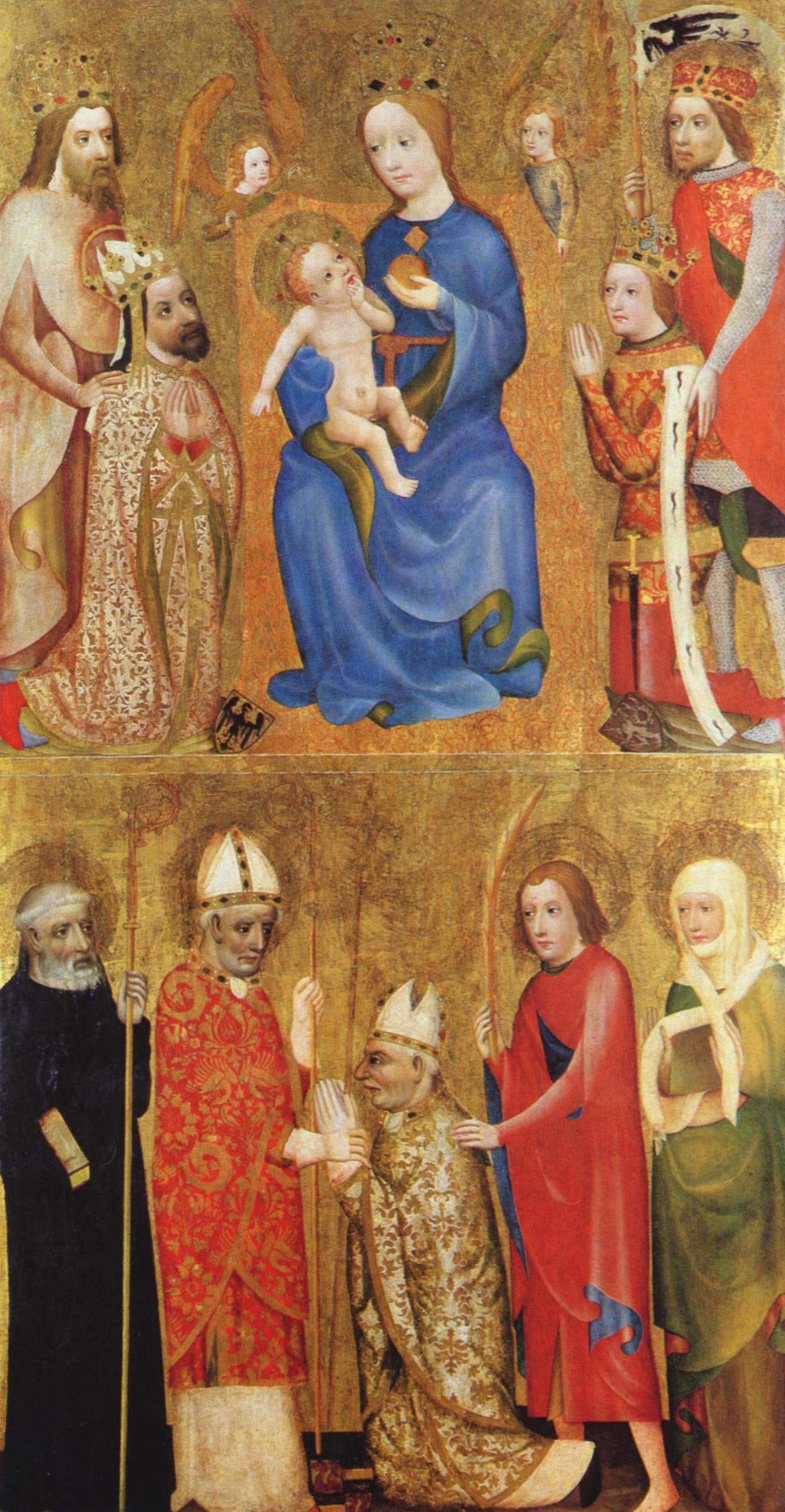
Here Charles as Holy Roman Emperor, and wearing the Imperial crown. In the painting, a votive picture of the Archbishop of Prague, John Ocko of Vlasim, by Theodore of Prague and circa 1370, and now in the National Gallery in Prague, he is depicted with his eldest surviving son and heir, Wenceslas IV, King of the Romans until he was deposed by the Electors in 1400, and of Bohemia until his death in 1419, accompanied by Charlemage and St Wenceslas (wearing the appropriate Ducal cap), kneeling before the Virgin and Child.

File:Meister Theoderich von Prag (Umkreis) 001.jpg


Here is a detail of the Emperor:


At least one later Bohemian monarch was not overly impressed by the crown's appearance - on the eve of her coronation Maria Theresa described it in a letter as looking like a "fool's cap" - in other words a jester's cap.

The last Bohemian coronation was, as mentioned above, in 1836, but in September 1871 the Emperor Francis Joseph informed the Bohemian Diet of his willingness to take the Bohemian Coronation oath. The proposal, presumably as part of a plan to establish a relationship similar to that Austria had estanblished with Hungary by the coronation there in 1867 was abandoned due to protests from the German speaking population of Bohemia, who disliked the idea of rule by the Czechs. It is possible that had the Habsburg Empire survived in 1918 that Bl.Charles I and IV would have overseen some such similar process of devolution within his hereditary lands and that the Bohemian coronation would have been revived.


The term the "Bohemian Crown" applies to the lands dependent upon it rather than to the actual crown, as explained here.


Coat of arms of the Bohemian Crown until 1635. Quarterly of five. 1.The checuered eagle of Moravia. 2 The eagle of Silesia.3 The wall of Upper Lusatia. 4 The eagle of Upper Silesia. 5 The ox of Lower Lusatia. An inescutcheon with the lion of Bohemia. Atop the arms is the Crown of St Wenceslas.

There is an illustrated list of the Dukes and Kings of Bohemia here.


Arms of the Kingdom of
Bohemia