Once I was a clever boy learning the arts of Oxford... is a quotation from the verses written by Bishop Richard Fleming (c.1385-1431) for his tomb in Lincoln Cathedral. Fleming, the founder of Lincoln College in Oxford, is the subject of my research for a D. Phil., and, like me, a son of the West Riding. I have remarked in the past that I have a deeply meaningful on-going relationship with a dead fifteenth century bishop... it was Fleming who, in effect, enabled me to come to Oxford and to learn its arts, and for that I am immensely grateful.


Showing posts with label Prague. Show all posts

Tuesday, 18 April 2017

Medieval Easter customs


The latest online issue of the Medieval Histories website has a series of Easter-themed posts which I think may be of interest to my readers, and so I have copied and pasted the links below:

Naumburg Cathedral Choir Screen c. 1250. Source: Wikipedia/Anders Hoernigk


Crucifixus Dolorosus or Forked Crucifix from c. 1300

In an unusually dramatic way, a Crucifixus Dolorosus or forked crucifix depicts the suffering and dying Christ hung on a living tree.   Read more.
Poland, National Museum of Warsaw. Source: Wikipedia


Arnulf of Leuven – Salve Mundi Salutare

Immersion into the corporeal horrors of the crucifixion led to a new late medieval devotion, the contemplation of the wounds. Arnulf of Leuven led the way   Read more.
Wienhausen Christ in Tomb


The Wienhausen Sepulchre and the Risen Christ

Wienhausen, a convent near Lüneburg has preserved a remarkable heritage of religious art in the form of murals, sculpture, textiles and texts. Touching the Risen Christ was the high point   Read more.
The Jewish cemetery in Prague. Source: Private Prague Guide

Passion in Prague

One of the more evocative places in Prague is the Jewish churchyard and the the oldest synagogue in Europe. In 1389 it was the scene of a terrible pogrom.  Read more.

Friday, 6 March 2015

St Agnes of Bohemia


Today is the feast or commemoration of St Agnes of Bohemia (d. 1282). John Dillon posted the following about her on the Medieval Religion discussion group;

Agnes (also Agnes of Prague; in Czech, Anežka Česká or Anežka Přemyslovna) was the youngest daughter of King Ottokar I of Bohemia. Through her mother she was a cousin of St. Elizabeth of Hungary. A very devout person, educated in Cistercian and Premonstratensian monasteries, she devoted herself to prayers and good works while waiting through a series of betrothals that never got as far as an actual marriage. In 1231, with the assistance of Pope Gregory IX, Agnes extricated herself from the last of these unwelcome arrangements of state. She soon founded a hospital at Prague, next to which she established a convent of Poor Clares, entering it in 1233 or 1234 along with five other religious sent by St. Clare of Assisi, with whom she remained in correspondence. In time Agnes herself became its abbess, though she preferred to be called soror maior.

To manage and staff her hospital, in 1233 Agnes founded a community of Franciscan-affiliated lay brothers, Fratres hospitalares. The community was approved canonically in 1235, was raised to the status of an exempt Order in 1237, and in 1252 was authorized to use the differentiating symbol that made them the Crosiers of the Red Star (Ordo militaris Crucigerorum cum rubea stella; Kreuzherren mit dem Roten Stern). In that year the hospital was moved to a new location.

Agnes was beatified in 1874 and canonized in 1989. Her _dies natalis_ would seem to have been 2. March but her day of commemoration in the RM is March 6th . Herewith an English-language account of Prague's Convent of St. Agnes of Bohemia (Klášter sv. Anežky České), built from the 1230s to the 1280s:
Better views:

Some medieval images of Agnes of Bohemia:

a) Agnes presenting to the Grand Master of the Crosiers a model of their church, as depicted in a full-page illumination the mid-fourteenth-century Breviary of Grand Master Leo (1356; Prague, National Library, sign. XVIII f. 6):
There's a somewhat clearer image in Gábor Klaniczay, Holy Rulers and Blessed Princesses: Dynastic Cults in Medieval Central Europe, tr. Éva Pálmai (Cambridge University Press, 2002), p. 239; in Google Books at:
http://tinyurl.com/na8r9sd [click on the hotlink].

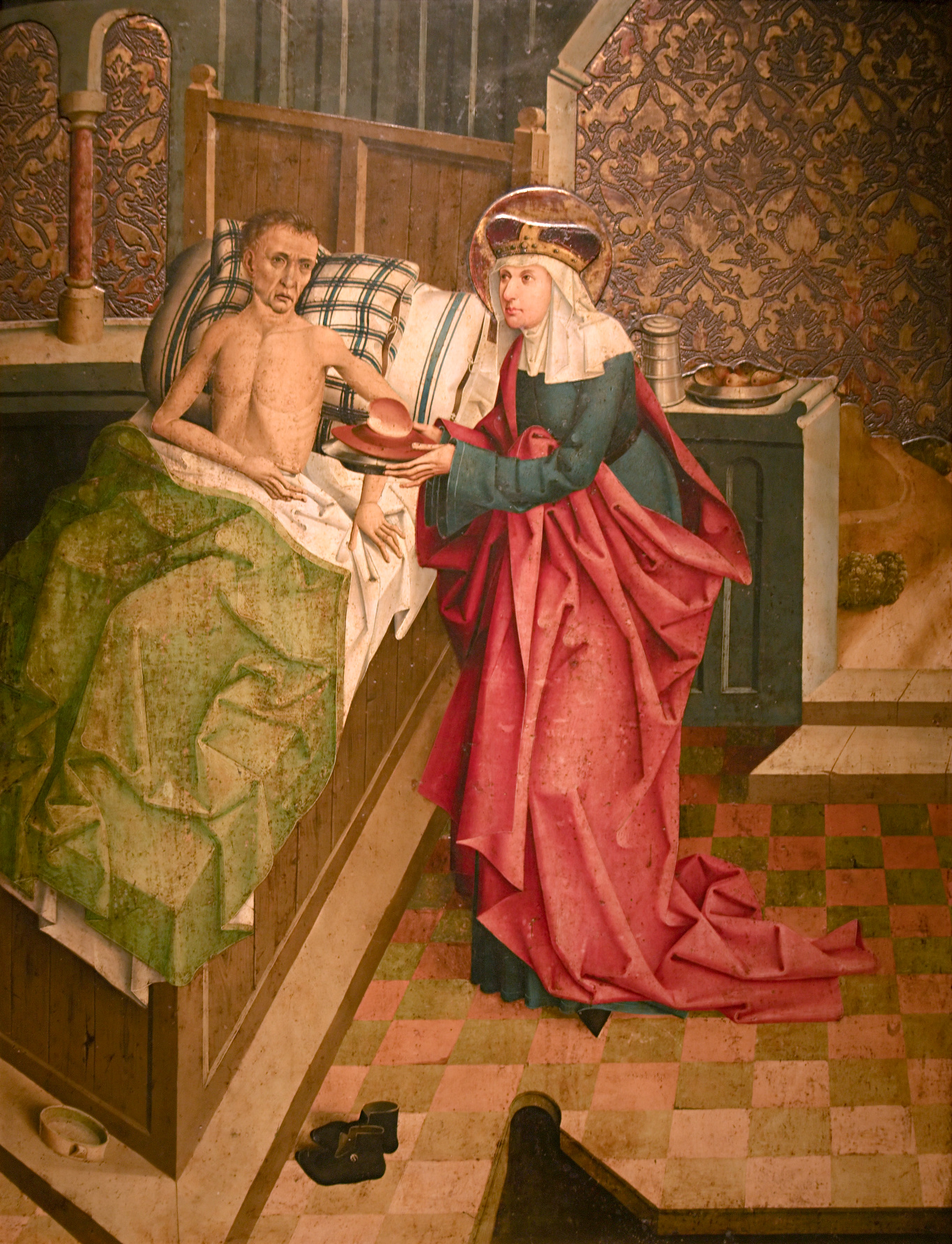
b) Agnes presenting to the Grand Master of the Crosiers a model of their church and Agnes ministering to a man sick in bed, as depicted on panels of the late fifteenth-century Kreuzherren-Altar (a.k.a. Altarpiece of Nicolas Puchner; 1482) in the National Gallery's site at her convent:
and

Somewhat less certain images of Agnes of Bohemia are:

c) this hooded figure on a carved column capital from the altar area of the convent of St. Agnes of Bohemia's later thirteenth-century church of the Holy Savior (kostel Sv. Salvátora), also in the National Gallery site at the convent:

and

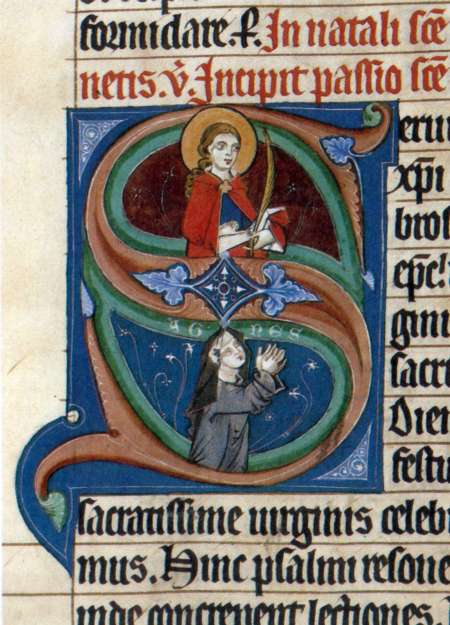
d) the nun depicted in the lower register of the initial "S" at the outset of the Passio of St. Agnes of Rome in the later thirteenth-century Lectionary of Arnold of Meißen (the _pars hiemalis_ of the so-called Osek Lectionary of ca. 1270, dubiously thought to be of Franciscan origin), also in the National Library in Prague:
Detail view (nun):
Traditionally interpreted as a portrait of Agnes of Bohemia, this image could be that of Agnes of Kamenz, a nun of the Cistercian convent of Marienstern (possibly the lectionary's original home) and, on one interpretation, a daughter of its noble founder. Or that of some other Agnes.

Friday, 29 November 2013

Holy Roman Emperor Charles IV


Today is the 635th anniversary of the death in 1378 of the Holy Roman Emperor Charles IV, of whom there is an illustrated online biography here. There is another online account here, also with illustrations, but in occasionally quaint English  and a third one, with links to accounts of other aspects of Bohemian history and places of interest, can be accessed here.

http://www.oocities.org/theodoricus/charlesiv.jpg

Emperor Charles IV kneeling before the Virgin and Child
The Emperor, who is sponsored by St Sigismund, wears the Imperial Crown with the white mitre which was worn with it until the sixteenth century, and inspired the form of the crown of Emperor Rudolf II - the later Austrian crown

From the votive painting of Archbishop Jan Ocko (from the atelier of Master Theodoric), before 1371

Image:oocities.org 


As those accounts all show it is with his kingdom of Bohemia that the Emperor Charles and his artistic patronage is always particularly associated. He encouraged the building of St. Vitus Cathedral in Prague, which had been begun in 1344, two years before his accession, with its shrine chapel of the national patron St Wenceslas, to whom Charles, whose own original name was indeed Wenceslas, a name he also gave to at least two of his sons, was devoted. He commisioned the Crown of St Wenceslas  in 1347,  founded the Charles University, the first within the Holy Roman Empire, built the Charles Bridge with its great ceremonial gateway, redolent of Imperial glory, and created the palace fortress of Karlštejn, south west of Prague.Under his influence and encouragement mid-fourteenth century Bohemia had a rich and vibrant court culture, with a wonderful legacy in art and architecture. The religious revival encouraged by the Emperor was to bear fruit in these aspects as well as eventually leading to the rise of Hussitism - a legacy that would no doubt have horrified him.

Within the wider Empire he is best remembered for the Golden Bull of 1356 which regulated the election of subsequent Kings of the Romans and Holy Roman Emperors down to 1806.

One of his daughters by his fourth marriage was Anne of Bohemia, who married King Richard II in 1382, and there were clear and important links between the two courts and countries - one can see obvious parallels between the courts of the Emperor Charles and of King Richard, as well, of course, as the Wyclif-Hus nexus.

Nicolas Wurmser of Strasbourg.Emperor Charles IV and his wife Anne of Swidnica adore the cross.1350s.KarlstejnCastle,Ch. of Relics of Suffering of the Lord.W.wall 

Emperor Charles IV and his third wife Anne of Swidnica (Schweidnitz) - who died in 1362 - adore the Cross 
Karlstejn Castle, on the west wall of the Chapel of Relics of the Suffering of the Lord 
Nicholas Wurmser of Strasbourg, late 1350s.

Image: 'German 1' by arthistory390 on Flickriver 


Thinking and writing about the Emperor and his life and times has inspired me to go and hunt down a copy of Fr Bede Jarrett's biography of him.

Friday, 28 September 2012

St Wenceslas and the Crown of Bohemia


Today is the feast of St Wenceslas, patron of Bohemia and of the Bohemian monarchy. I posted about him last December in Good King Wenceslas  and  a year ago about the crown made in the fourteenth century which bears his name in The Crown of St Wenceslas. From 2010 there is  The Crown of St Wenceslas  which deals with the same topic ( and also the related post on Treasure from the age of Charles IV ). All these posts are illustrated and give accounts both of the life of the martyred ruler and also of the Bohemian regalia. The crown was made in 1347 and the last Bohemian coronation in 1836. There is an illustrtaed list of Dukes and Kings of Bohemia here.

The regalia is kept in its own strong room in St Vitus cathedral in Prague adjacent to the chapel of St Wenceslas in the south transept, and is relatively rarely on public display - unlike, for example, the Austrian or Hungarian regalia. Hence perhaps the making of the following films in recent years
Here from YouTube is a short film showing the Crown of St Wenceslas and the other regalia:


There are also three parts of a programme about a scientific examination and recording of the Bohemian regalia, which includes more close ups of the crown, orb and sceptre which can be viewed here:


Now all that is needed is to organise the coronation of the legitimate King of Bohemia, King Charles IV, or perhaps one should say King Karel IV.

Tuesday, 6 March 2012

St Agnes of Bohemia


Today is the feast, inter alia, of St Agnes of Bohemia (1211-1282).

She stands in that high and later medieval central European tradition of royal piety that includes St Elizabeth of Hungary, St Margaret of Hungary and St Casimir of Poland - determined offspring of dynasties who brought aristocratic single-mindedness to the service of the Church and the poor.

Also known as Agnes of Prague (in Czech, Anežka Česká or Anežka Přemyslovna) she was the youngest daughter of King Ottokar I of Bohemia. Very devout, educated in Cistercian and Premonstratensian monasteries, she led a life of prayer and good works while waiting through a series of betrothals that never resulted in an actual marriage. With the assistance of Pope Gregory IX, she extricated herself in 1231 from the last of these unwelcome arrangements of state. She soon founded a hospital at Prague, next to which she established a convent of Poor Clares, entering it in 1233 or 1234 along with five other religious sent by St. Clare of Assisi, with whom she remained in correspondence. Agnes became its abbess, though not immediately and she preferred to be called soror maior.

To manage and staff her hospital (which in 1252 moved to a new location), in 1233 Agnes founded a community of Franciscan-affiliated lay brothers, Fratres hospitalares. The community was approved canonically in 1235, was raised to the status of an exempt Order in 1237, and in 1252 was authorized to use the differentiating symbol that made them the Crosiers of the Red Star (Ordo militaris Crucigerorum cum rubea stella; Kreuzherren mit dem Roten Stern).

Agnes was beatified in 1874 and canonized in 1989. Her dies natalis and day of commemoration falls on 6 March. There is a photograph of her as portrayed on a (?) fourteenth-century column capital in Prague in an article about the exhibition which opened last year to mark the 800th anniversary of her birth and which can be read here :
http://tinyurl.com/7p9v8e4


The surviving buildings of Prague's Convent of St. Agnes of Bohemia (Klášter sv. Anežky České), built from the 1230s to the 1280s can be seen here:

http://www.catering-vysehrad2000.cz/data/usr_045_nabidka/anezskyklaster.jpg

Image: John Dillon

There are other pictures of the buildings here, here and here.

The site is now part of the National Gallery. Among its holdings is the Crosiers' Altar (Kreuzherren-Altar) of 1482 with its panel painting on wood of St Agnes ministering to a patient:

File:Sveta Anezka.jpg

St Agnes tends an invalid.
She still wears the headress appropriate to her rank over her veil.

Image: Wikipedia

What appeals about this picture are the details of daily life at the time, typical of fifteenth century Netherlandish and Germanic depictions of late medieval households. The bedding, for example, would not look amiss in a modern shop display.

With acknowledgements to John Dillon's post on the Medieval Religion discussion group