Once I was a clever boy learning the arts of Oxford... is a quotation from the verses written by Bishop Richard Fleming (c.1385-1431) for his tomb in Lincoln Cathedral. Fleming, the founder of Lincoln College in Oxford, is the subject of my research for a D. Phil., and, like me, a son of the West Riding. I have remarked in the past that I have a deeply meaningful on-going relationship with a dead fifteenth century bishop... it was Fleming who, in effect, enabled me to come to Oxford and to learn its arts, and for that I am immensely grateful.


Monday, 17 March 2014

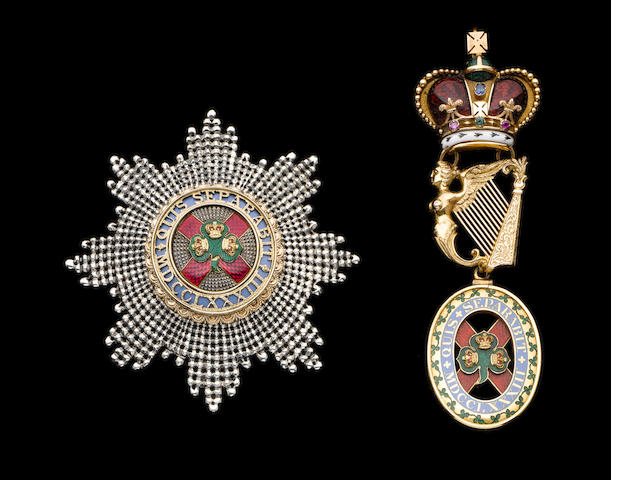
Insignia of the Order of St Patrick


I have posted on several occasions about the Order of St Patrick in The Order of St Patrick in 2011, Banners of the Knights of St Patrick in 2012 and The Order of St Patrick in 2013. There is an online account of the Order, its history and insignia at Order of St. Patrick. A new online piece about the Order has appeared only today in The Order of St. Patrick.

I very much regret that it was allowed after 1922 to fall into abeyance, with only Royal Knights being appointed until 1936, and none since, the last one, the late Duke of Gloucester, dying in 1974. I think it should have been revived, and should be revived - why should this not be done with the forthcoming state visit of the President of the Irish Republic and make him an Extra Knight of the Order?

I am not alone in this opion as can be seen from a letter to The Times a decade ago at Time to revive Order of St Patrick , and more recently these Northern Irish blogpost Quis Separabit: Restore the Order of Saint Patrick  and Order of St Patrick as well as some discussion in the southern political scene at Should the Order of St. Patrick be revived? ( the comments suggest a lack of confidence in the ability of southern Irish politicians rather than doubt about the Order...) and there is the Facebook site Order of St Patrick - Revival.

A quick trawl on the internet produced a considerable number of pictures of the insignia of the Order. There is a wonderful collection of images of the insignia, as well as some of the Officers and Knights, here. Some of the others I found I have copied and pasted in this post.

This example of a diamond star  from the Royal Collection appears to have been made in 1838 for Queen Victoria by Rundell and Bridge :


Star of the Order of St Patrick

 Star of the Order of St Patrick

Image:The Royal Collection © 2012,
Her Majesty Queen Elizabeth II
RCIN 441162


King George V's Diamond Star
Made around 1890, the  centre has a shamrock of emeralds, with the Saint's cross in rubies on a diamond background. 'George, Prince of Wales, April 1910' is engraved on the reverse.

Image:doyle.com.au

 Another jewelled badge of the Order

Image:doyle.com.au

The website these last three illustrations comes has an interesting section on the Order and on the theft of the Irish Crown Jewels - the insignia of the Lord Lieutenant as Grand Master of the Order - in 1907, which can be seen here.


Two stars of the Order were sold in the Harewood: The Attic sale at Christies South Kensington on  December 9th 2012:

Star of the Order of St. Patrick,
Silver, gold and enamel, 81mm. diam. 
Reverse engraved Storr & Mortimer, Jewellers to the Queen, mid 19th century, some enamel damage

Price realized £8,750 (Estimate £2,000 - £2,500)

The provenance was almost certainly Ulick John de Burgh, 1st Marquess of Clanricarde (1802 -1874), and by descent to his son,Herbert George de Burgh-Canning, 2nd Marquess of Clanricarde (1832- 1916), and bequeathed to his great-nephew, Henry Lascelles, 6th Earl of Harewood (1882-1947), and by descent at Harewood House, Yorkshire.

Image:Christies.com


Star of the Order of St. Patrick
Silver, gold and enamel, 68mm. diam, reverse engraved Storr & Mortimer. Early to mid 19th century, some enamel damage to shamrock  
Price realized £5,000 ( Estimate £1,500 - £2,000) 

Image:Christies.com

The Most Illustrious Order of St.Patrick, 

A star and badge of the Order
Made by West and Sons Dublin and hallmarked 1852
Offered but withdrawn at Bonhams 2012 

Image:Bonhams.com 

Badge 

The riband and  badge

Mantle and Collar

The mantle and collar  

Images:medal.org.uk 


St Patrick's at Patrington


Today is the feast of St Patrick, and although there are modern foundations of churches dedicated in his honour I can think of only one medieval example in Britain. That is, however, exceptional in more than just its dedication.

The church of St Patrick at Patrington in Holderness, in the south-east of the East Riding of Yorkshire is popularly known as the Queen of Holderness, and it is, without doubt, one of the finest parish churches both of its era and indeed in the country.

Patriogton was given to the Archbishopric of York circa 933 by King Athelstan, and the grant confirmed by King Cnut in 1033. There is documentary evidence for an earlier monastery near the mouth of the Humber around 700, and the grant by King Athelstan may possibly have been a restoration of such a site to ecclesiastical hands. Given the dedication to the Apostle of Ireland did Patrington originate as an Irish mission to Northumbria in the seventh century, rather like the mission of St Furzey to East Anglia?

The present church reflects both Archiepiscopal patronage as lord of the manor and the wealth of the area in period of its building in the earlier fourteenth century, although the tower and spire was not finally completed until the early fifteenth century, and the chancel east window is also of that period. The stone with which it is built must ahve been brought in from aconsiderable distance, again pointing to the wealth and resources at the command of this parish in the fourteenth century.


Patrington Church from the south

Image: britainexpress.com

Patrington, Yorkshire

A detail of the spire

Image: britainexpress.com

A spectacular example of the skill of stone masons from both the Yorkshire and Lincolnshire sides of the Humber in the period of its building, and linked to work at York Minster, Beverley Minster and Howden Minster.  The church has aisled transepts, the southern one with an apsidal Lady Chapel, and it has an Easter Sepulchre in the tradition of Hawton(Notts) and Heckington(Lincs) in the chancel.

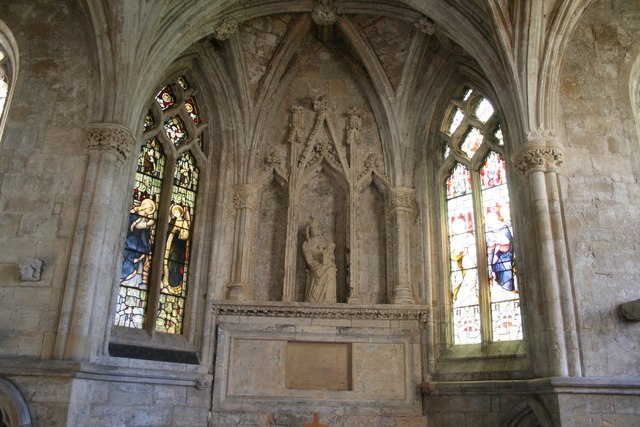
File:Lady Chapel - geograph.org.uk - 617208.jpg

The Lady Chapel
The statue of Our Lady was moved to the chapel in 1985 from the exterior of the church

Image:Wikimedia/geograph

photo

A view across the south transept

Image: Nic Stoker on Flickr

There is a detailed description of the church from English Heritage which can be viewed at  Church of St Patrick (1083450), and a very fine set of photographs of the building, its sculpture and the Easter Sepulchre as well as the good nineteenth or twentieth century glass  by the Rev Gordon Plumb from the online Flickriver site can be seen at Patrington, St Patrick, East Yorkshire.


Patrington, St Patrick's Church photo, Column capitals

Capitals in the church interior

Image: britainexpress.com

The tower and spire were the inspiration for that at the chapel at Clumber Park built for the Duke of Newcastle by Bodley and Garner in 1886-9, and the church is a text-book example of the decorated style. Although denuded of the colour with which it must have been ornamented it does convey the quality of noble simplicity in its unity and cohesion.

Because Patrington is rather off the beaten track it may be a church best known to enthusiasts from pictures rather than by actually visiting it. If you do get the chance to go it is very well worth seeing.

Sunday, 16 March 2014

The new Bishop of Cuncacestre


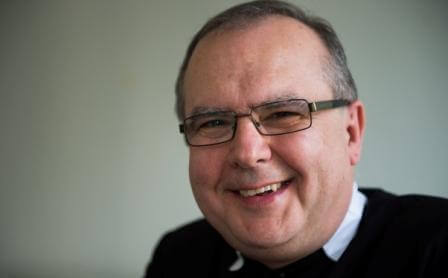
Last night at the Ordinariate mass here in Oxford I saw on the pewsheet that Fr Robert Byrne, the founding Provost of the Oxford Oratory is to be elevated to the episcopate.

He will become Bishop of Cuncacestre - the Anglo-Saxon name for Chester-le-Street, which was the seat of the Northumbrian bishopric until 995 when it moved to Durham - and he will serve as an auxilliary bishop in the Archdiocese of Birmingham. In this new task he will have responsibility for Birmingham and for Worcestershire. The previous Cuncacestrensis was Bishop Alan Hopes who served as an auxilliary in Westminster before he became Bishop of East Anglia.

Fr Robert will be the first Oratorian to be appointed as a bishop in 140 years - in 1874 Fr Edward Bagshawe of the London Oratory became Bishop of Nottingham.

Fr Robert will receive his episcopal ordination in St Chad's Cathedral in Birmingham on May 13th, and I am sure many of us from Oxford will travel to the Mass.

Fr Robert brings awealth of expereince to his new responsibilities. Originally an Oratorian in Birmingham he was the founding Father here in Oxford in 1990-93, and Provost until just over three years ago. Since then he has been the Ecumenical Officer for the Bishop's Conference of England and Wales. I think several of us have been expecting such an elevation for him, and can see that his robust Mancunian style and Oratorian spirituality combined with so much pratical experience will be a wonderful asset for the diocese at large.


bp-elect-byrne


Fr Robert Byrne

His Grace the Archbishop of Birmingham, the Most Reverend Bernard Longley, said:

“I am immensely grateful to Pope Francis for appointing Fr Robert Byrne Auxiliary Bishop of Birmingham. From his time at the Birmingham Oratory and as Provost of the Oxford Oratory, Fr Robert has come to know our Archdiocese well. Having worked alongside him in recent years as the Bishops’ Conference’s Ecumenical Officer, I know that he will bring considerable pastoral, theological and administrative skills to his new responsibilities as a bishop. Above all I am grateful that he brings the spirituality of St Philip Neri, the founder of the Oratory, to enrich his ministry among us. I know that everybody in the Archdiocese, and especially in his pastoral area of Birmingham and Worcestershire, will join me in asking for the prayers of Fr Robert’s fellow Oratorian, Blessed John Henry Newman, as he now prepares for his episcopal ordination in May. I also wish to record my abiding gratitude to Bishop Philip Pargeter for continuing to serve the Archdiocese with great dedication in recent years and for the support and friendship he has so generously given me.”

An interview with Fr Robert may be seen here

The Bishop's Conference website article about Fr Robert and his appointment can be seen here.

Please pray for Fr Robert as he prepares for his episcopal ordination.

Image, quotation and interview: Oxford Oratory website

Friday, 14 March 2014

More historic discoveries in the news


As I said in my previous post the Daily Mail often has interesting articles about historic and archaological finds, and here are two links from the article about Rendlesham that are interesting in their own right.(Both discoveries may affect house prices in the vicinity)


The second story is about the discovery of what is apparently a piece of Tudor court furniture, which would be a remarkable survival, whatever may or may not have occured within it:  Is this the bed which launched the Tudors: Dumped in a hotel car park this four poster could be where Henry VIII was conceived and is worth £20million

More on Rendlesham


I see from the Internet that there is another article on the discovery of the royal centre of the East Anglian kings at Rendlesham in Suffolk about which I posted the other day. It is from the Daily Mail - a paper which is always good in its coverage of such things: one might joke that maybe such finds send up house prices in places such as Rendlesham...


End of term


This morning I went along to the final symposium organised by Azusa Pacific University in Los Angeles for their visiting students in Oxford, three of whom I have been teaching this term through the OPUS programme.

The symposium was held in the Old Library at the church of St Mary the Virgin. This was built in 1320 and, together with the Old Convocation House which forms the lower storey of the building, is the oldest University (as opposed to college) building not only in Oxford but probably in Europe. It is thus the predecessor of Duke Humfrey's library and the Bodleian, and, once a trifling little dispute with my own college of Oriel which ensured the library was closed for a generation or so ... was resolved in the late fourteenth century through the benevolence of Archbishop Arundel, the first functioning University library in Oxford.

At the symposium the students speak about their experience of living and studying in Oxford, and its impact on their own faith and beliefs. As on the previous time I attended such a meeting, this term's group had obviously enjoyed and gained from their term here.

Azusa has a specifically Christian ethic and the students obviously adhered to that and this was reflected in what they said. I have taught students from Azusa for several years and they are always intelligent, conscientious and likeable people with much to offer. I wish them , and my other students from this term well in the future, and hope to hear how they progress.

The website of the University can be seen at their website Azusa Pacific University.


The Old Library in use for a conference

Image:jri.com


Votive objects from Exeter cathedral


A post on the Medieval religion discussion group by John Shinners led me to these photographs of fifteenth century votive offerings found in Exeter cathedral following bomb damage in 1942.  I had read of them beforehand, but not seen photographs.

The ex votos had been offered at the tomb of Bishop Edmund Lacy, who was diocesan from 1420-55, and who had a posthumous popular following of those who sought his intercession. The cult seems to have been suppressed by the Dean of Exeter in 1538. The Oxford DNB life of Bishop Lacy by Nicholas Orme can be read online here, and it gives more details as to the background of these offerings - the Bishop suffered from a condition affecting his shin bones, and the ex votos appear to emphasise a concern with limbs.

Exeter was a cathedral without the shrine of a saint, and at an earlier time the cause of Edmund Lacy might have progressed to fulfill that function but it was not to be.

These are remarkable survivals of medieval piety, and were, presumably, to be found in all pilgrimage churches of medieval England and indeed Europe.

Wax figures 1
Wax figures 2
Wax figures 3

Parts of votive wax figures, animal and human, found above the tomb of Bishop Edmund Lacy in Exeter Cathedral in 1942.

Image:dsnell.zynet.co.uk


The tomb of Bishop Lacy
Originally the tomb chest bore a brass of the bishop

Image: churchmonumentssociety.com

Thursday, 13 March 2014

The King of the Hellenes


Last week, on March 6th, there occurred the fiftieth anniversary of the accession to the Greek throne of King Constantine II upon the death of his father King Paul I. There is an online biography of the King here, and the website for the King and his family can be viewed at Royal Greek Family


king constantine II

The King of the Hellenes at the time of his accession

Image:coinsworld.eu


Unlike other of his relatives amongst European monarchs he will not be able to celebrate this jubilee as the effective reigning monarch of his kingdom, although last year he returned to live in Greece as can be read here.

The political instability and factionalism the Greek monarchy was intended to counterbalance with the election of King George I in 1863 managed to overwhelm the King and his cause in the years bothe before the 1967 coup, in the years following and in the scramble for power in 1974. This has proved both a real personal tragedy for the King and his family, and contributed to the problems of the country. It is not that the King or the institution of the monarchy could of themselves have prevented the economic problems of contemporary Greece, but that they could have provided stability to a country where their absence enabled politicians to pursue wild schemes with fewer restraints than otherwise. Greek politicians who were anxious to destroy the monarchy have shown a remarkable ability in passing on political leadership to their own children as an almost hereditary caste. There is, to my mind, a real sense of waste in the fact that for so many years the King has not been able to exercise his proper constitutional and public role in the life of his country.

The King is, I think, entitled to believe that his case has not been heard by many of his people, and to feel not only hurt at rejection when he sought to fulfill his constitutional obligations, but that the hopeful mood which accompanied both his accession and his marriage in 1964 did not yield a richer harvest for him and his country.


Constantine II returns to Greece


King Constantine II of the Hellenes and Queen Anne Marie. 

Image: neoskosmoa.com/AP/Heribert Proepper.