Once I was a clever boy learning the arts of Oxford... is a quotation from the verses written by Bishop Richard Fleming (c.1385-1431) for his tomb in Lincoln Cathedral. Fleming, the founder of Lincoln College in Oxford, is the subject of my research for a D. Phil., and, like me, a son of the West Riding. I have remarked in the past that I have a deeply meaningful on-going relationship with a dead fifteenth century bishop... it was Fleming who, in effect, enabled me to come to Oxford and to learn its arts, and for that I am immensely grateful.


Showing posts with label Greek Monarchy. Show all posts

Tuesday, 3 February 2015

An Interview with King Constantine


In The Times last Saturday there was a two page interview by Alice Thomson with King Constantine of the Hellenes about his life and his reaction to the recent general election in Greece. I posted something on these matters the other week in Greek General Election.

The King now lives in the country as a private citizen and the article had insightful and reflective thoughts from the King, indicating a stoical assessment of the country's situation and his own position - he was not hopeful of restoration to his throne. His Majesty speaks with openness and a certain wry humour, but also with a real concern for the country and its people in their continuing economic crisis.

I would link to the article if I could, but The Times is only available online to subscribers. So iof you subscribe or can find a hard copy of the newspaper I recommend the article to you.

To my mind it is, to say the very least, a great pity that the King has not been able to exercise his proper place as constitutional monarch in Greece since 1967. His dignity and concern was evidenced by this interview and would have served his subjects well.

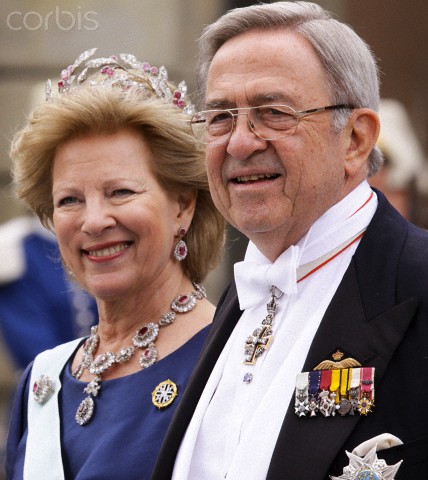
Queen Anne-Marie and King Constantine II at the wedding of Crown Princess Victoria of Sweden, June 2010 

Image:juliapgelardi.wordpress.com/photo: Albert Nieboer/dpa/Corbis


Saturday, 24 January 2015

Greek General Election

Tomorrow the Greek electorate will go to the polls in a their latest General Election. The choice appears to be between the centre-right New Democracy party, who agreed to the EU financial package that committed the country to retrenchment and austerity and the left wing Syriza party, which is pledged to renegotiate it. They appear to be in the lead in polling surveys. If that is not possible then Greece may well leave the Euro. I do not claim to be able to say how the Greeks should vote on these matters. Clearly austerity, which seems to be improving the situation, has made life very hard for many Greeks.

My interest lies in the constitution. This election was called because the old Parliament could not agree on the election of a new President, ultimately forcing a dissolution at the end of December. So a fresh election and more potential uncertainty for a troubled country.

As far as I am concerned this is all unnecessary as Greece has - or should have - a head of state in the King of the Hellenes, King Constantine II, who , following years of exile, now lived again in Athens as a private individual.

Restoring the monarchy would not, of course, solve in itself Greece's economic woes, but it should provide stability, and prevent unnecessary elections and the risk of further uncertainty.

Tuesday, 9 December 2014

Some topical anniversary posts from around the Blogosphere


Here are some posts from other blogs which may interest readers - I would commend each of them in their own right to others.

First there are some fine pictures from the New Liturgical Movement of the Solemn Pontifical Mass at the London Oratory last night. The celebrant was Cardinal Vincent Nichols, Archbishop of Westminster. They can be seen at Pontifical Mass for the Solemnity of the Immaculate Conception at the London Oratory


New Catholic at Rorate Caeli has a piece by Bishop Ullathorne, first Catholic Bishop of Birmingham, in the post On the 160th Anniversary of the Dogmatic Definition of the Immaculate Conception by Pope Pius IX

Peter Kwasniewski at Rorate Caeli has a post with links to the relevant texts of both the Papal encyclical Quanta Cura and the Syllabus itself in The 150th Anniversary of Pius IX’s Syllabus of Errors. Reading the texts makes one realise how little has changed in terms of the issues, however much we may think the circumstances have changed.

Finally The Mad Monarchist has a post about the Greek political and constitutional catastrophe of forty years ago with the referendum on the monarchy there. It can be read at Anniversary of a Greek Tragedy


Thursday, 13 March 2014

The King of the Hellenes


Last week, on March 6th, there occurred the fiftieth anniversary of the accession to the Greek throne of King Constantine II upon the death of his father King Paul I. There is an online biography of the King here, and the website for the King and his family can be viewed at Royal Greek Family


king constantine II

The King of the Hellenes at the time of his accession

Image:coinsworld.eu


Unlike other of his relatives amongst European monarchs he will not be able to celebrate this jubilee as the effective reigning monarch of his kingdom, although last year he returned to live in Greece as can be read here.

The political instability and factionalism the Greek monarchy was intended to counterbalance with the election of King George I in 1863 managed to overwhelm the King and his cause in the years bothe before the 1967 coup, in the years following and in the scramble for power in 1974. This has proved both a real personal tragedy for the King and his family, and contributed to the problems of the country. It is not that the King or the institution of the monarchy could of themselves have prevented the economic problems of contemporary Greece, but that they could have provided stability to a country where their absence enabled politicians to pursue wild schemes with fewer restraints than otherwise. Greek politicians who were anxious to destroy the monarchy have shown a remarkable ability in passing on political leadership to their own children as an almost hereditary caste. There is, to my mind, a real sense of waste in the fact that for so many years the King has not been able to exercise his proper constitutional and public role in the life of his country.

The King is, I think, entitled to believe that his case has not been heard by many of his people, and to feel not only hurt at rejection when he sought to fulfill his constitutional obligations, but that the hopeful mood which accompanied both his accession and his marriage in 1964 did not yield a richer harvest for him and his country.


Constantine II returns to Greece


King Constantine II of the Hellenes and Queen Anne Marie. 

Image: neoskosmoa.com/AP/Heribert Proepper.


Thursday, 29 April 2010

Greek crisis


The current financial and political crisis engulfing Greece has, no doubt, various causes, but one to which I would draw attention is the fact of the exile of King Constantine II and the Monarchy. Twentieth-century Greece had a troubled history, but the events of 1967, compounded in 1974, removed from its public life an institution that could have provided, as it was designed to under the constitution, a focus of stability.

That is not to say that it would be the King's responsibility to solve the economic woes of his country, any more than we would expect the Queen to solve herself the problems her government ministers have landed us all with. That is not the function in modern society of a constitutional Monarch - indeed one might wonder if it ever has been. The function of the Monarch as the ultimate custodian and regulator of authority is to give that stability which enables politicians and administrators to do their specific tasks in the service of the common good.

Coat of Arms of the Royal Family of Greece

The irony is that the tendency of modern Greek politics is on the part of both the political left and right towards the hereditary leadership of political parties, yet, as I understand it, many of the Greek political elite have been opposed to the Monarchy as a result of the events of 1920-22. The politicians often come from the families of those Greeks who lived in Asia Minor, and who felt let down by the Monarchy when their ancestral territory did not become part of the Kingdom of the Hellenes, and they were forced across the Aegean as exiles.

Greek politicians do not seem to have made a very good job of running the economy or anything else there, other that is, than their own careers. In a time of turmoil it is the stability the Monarchy could provide that is lacking. That function is currently being exemplified by the King of the Belgians in the latest governmental crisis there.

Greece is the most obvious basket case amongst the Euro-zone economies. That the next two in line appear to be Portugal and the Irish Republic will not surprise. Here again the absence of the inherent stability offered by Monarchy has produced a political establishment that is self referring, and self indulgent. Spain may also have economic woes, but they have the immeasurable blessing on the restored Monarchy as a focus of unity and stability.

Saying "It's the economy, stupid" may have become a political mantra - maybe "It's the Monarchy, stupid" that may well be part of the answer that needs to be given.