Once I was a clever boy learning the arts of Oxford... is a quotation from the verses written by Bishop Richard Fleming (c.1385-1431) for his tomb in Lincoln Cathedral. Fleming, the founder of Lincoln College in Oxford, is the subject of my research for a D. Phil., and, like me, a son of the West Riding. I have remarked in the past that I have a deeply meaningful on-going relationship with a dead fifteenth century bishop... it was Fleming who, in effect, enabled me to come to Oxford and to learn its arts, and for that I am immensely grateful.


Monday, 10 February 2014

The withering of Anglo-Catholicism


A friend told me the other day of a conversation with a leading member of the congregation of an Anglo-Catholic parish that currently is looking for a new incumbent. When my friend said they assumed the parish was looking for someone in that tradition they got the answer "Oh we wouldn't object to a woman, especially if she was young and had children as that could be good for the village school." 

So much for sustaining the Anglo_Catholic witness of the parish. Was it for this that Fr Tooth and others went to prison?


Thursday, 6 February 2014

Accession Day


Today is the 62nd anniversary of the accession to the throne of Her Majesty the Queen in 1952. It is an opportunity once again to give thanks for the Queen's reign and to express loyal greetings and good wishes to her.

As the Queen approaches matching the length of Queen Victoria's reign of 63 and a half years it is intersting to reflect on the comparative changes within these two reigns. I sense that someone in June 1899 would have been aware of far greater changes over the previous six decades than we are in looking back to 1952. In writing that it is not to say that we have not witnessed, whether we like them or not, great changes in this second Elizabethan era.


Wednesday, 5 February 2014

Persian Prince at the Oxford Union


I became interested in Iran - and the Iranian monarchy - in the early 1960s when one of my cousins met and married an Iranian studying in this country.  As a consequence there was additional interest on my part in the coverage of the Coronation of the Shah in 1967, the celebrations of the 2500th anniversary of the monarchy established by Cyrus the Great in 1971 at Persepolis, and the dreadful and shocking events of the revolution in 1978-9 and the death of the Shah in 1980.

Last night the Oxford Union had as a guest speaker Prince Reza Pahlavi, Crown Prince under his father and the man who in the eyes of loyalists should have succeeded his father as Shahanshah in 1980. In particular I recall seeing him on television and in photographs of him as a solemn seven year old at the 1967 Coronation. There is a guide to the Pahlavi dynasty here.


dek

The Crown Prince of Iran

Image:content.time.com 
There is an online biography of him which can be read here. His own website can be read here. He is now spokesman of The Iranian National Council for Free Elections and an advocate of human rights for Iran, calling for a secular state and for free elections.

The Prince has considerable presence, and having spent many years in the US is fluent and relaxed in English. He had a large audience who almost filled the Union Debating Chamber.

He began with an address on "Democratic Iran: a precondition for peace in the Middle East." After strssing to his hearers their good fortune in sharing in an unrestricted educational system, and the fundamental importance of for society he outlined his view that the five continuing crises in the Middle East - the war in Syria, the continuing Israeli-Palestinian dispute, the situations in Afghanistan and iraq, the Shia-Sunni conflict and the risks posed by Iran's nuclear programme - all bore the footprint of the Islamic Republic of Iran and its involvement. The current regime sought regional hegemony, and fermented turmoil across the region.

It wasa regime anxious to export its ideology, and indeed one which need to expand to survive, and identified the "National Interest" as its own. He was sceptical as to the possibilities of it changing of its own accord. It is, in his view, a system which cannot reform itself, and there was no real change even if it was perceived differently.

Dialogue was needed with the regime and with secular democrats within Iran.

He then took a series of questions from the audience - the acoustic was not ideal, but they raised 
substantive points and received full and thoughtful answers.

In a theocracy such as Iran the possibility of an uprising like the Arab Spring was more difficult, and what was neded was national reconciliation and amnesty, civil disobedience not an uprising. If there were not free elections the people had to choose between the lesser of two evils.

He envisaged a future secular democracy that transended all divisions, and that free elections were the best way of achieving that. By a secular government he did not mean an anti-religious one but one that seperated the state from the religious sphere, but recognised all faiths.

Asked about his own legitimacy as a spokesman, and that he has been critical of some of the actions of his father and grandfather as Shah, he said he was not concerned with the forms of government, but with what in a post referendum Iran would unite.

Democracy would now mean more than the provisions of the 1906 Constitution, and although different forms of democracy existed across the world basic principles such as an independent justice system were central to it. This was not something that could not be developed in the Middle East. He made the telling point that Iran which should be the Japan of the region had become its North Korea.

Cyrus the Great had recognised human rights in a form centuries ago, yet in Iran rights what had been accepted and developed had been lost.

One questioner raised the point that did not the West have to change its attitudes, maintained over many decades, to assist the process of change; the Prince thought trust and transparency were key principles here.

Under the Shah the country had acted as one but with recognised national diversity, but since 1979 there had been a world of "Us" and "Not Us" and there were growing risks of ethnic and religious divisions. Under the present regime the fundamentalist perception of religion was a perversion of the country's faith.

He hoped there would be a"Gorbachev moment" rather than an outcome like thos ein Libya and Syria for Iran, and when asked  by the final questioner if the evidence of countries like Turkey and Egypt did not suggest the free elections in the Islamic world usually resulted in the victory of Islamicist parties the Prince said he hoped the result would be otherwise.

The clear majority of the audience gave the Prince a warm and friendly welcome, and the talk and questions provided a very interesting insight into the possibilities for his country. I am in no position to assess the likelihood of a peaceful transition taking place in Iran or to know how widespread the call for change is, let alone what might result for the future shape of the country.

However I will say what regular readers might expect me to say, and that is  that  whilst there may well have been vainglorious  episodes and unrealistic expectations under the late Shah, and distortions of the economic life of the countryconsequent on the oil price ris e of 1973, and that both Pahlavi Shahs may have sought to change too much too quickly for their people to accept easily, but that an Iran ruled by Shah Reza II would be infinitely preferable to the present system, and offer hope for the future.

File:Imperial Coat of Arms of Iran.svg


Imperial Coat of Arms of Iran under the Pahlavi Dynasty, used from 1925 to 1979. 
The shield is composed of the Lion and the Sun symbol in first quarter, the Faravahar in the second quarter, the two-pointed sword of Ali (Zulfiqar) in third quarter and the Simurgh in the fourth quarter. Overall in the center is a circle depicting Mount Damavand with a rising sun, the symbol of the Pahlavi dynasty. 
The shield is crowned by the Pahlavi crown and surrounded by the chain of the Order of Pahlavi. Two lions rampant regardant, holding scimitars supports the coat of arms on either side. 
Under the whole device is the motto: "Mara dad farmud va Khod Davar Ast" ("Justice He bids me do, as He will judge me" or, alternatively, "He gave me power to command, and He is the judge"). 
Some of the colours were changed in 1971.
Image:Wikipedia

St Agatha


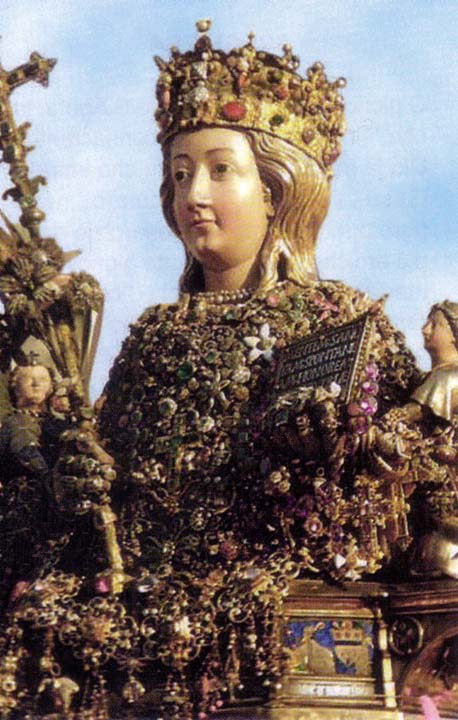
Today is the feast of St Agatha, Virgin and Martyr. Her main centre of devotion is Catania in Sicily, where the Festival of Saint Agatha is the most important one, she being the patron of the city and each year her feast is celebrated from February 3rd-5th.

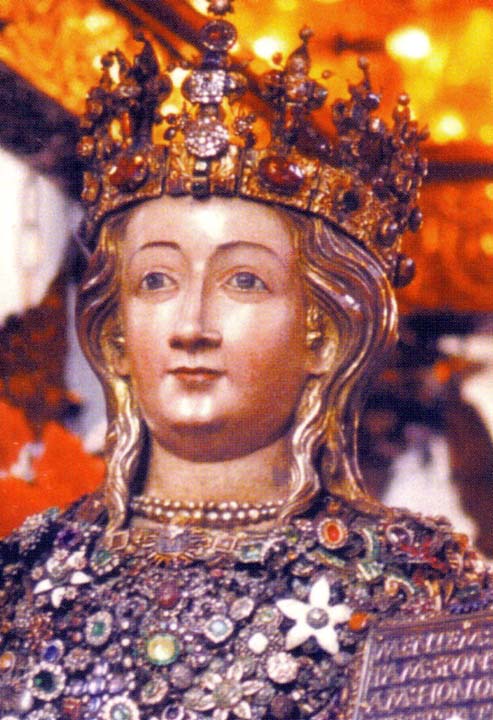
In the cathedral in Catania is this famous and striking reliquary bust:


The Festival of Saint Agatha is the most important religious festival of Catania, Sicily.

Image: nobility.org 
 
 
The bust contains the relics of St. Agatha and many of the jewels that adorn the reliquary are pectoral crosses which belonged to the bishops of Catania, Dusmet, Francica Nava and Ventimiglia. There is also a ring that belonged to Queen Margherita, who gave it in 1881 during a visit to Catania, and a necklace set with emeralds, which was a gift from the Viceroy Ferdinand de Acuna. The crown is said to have been given by given by King Richard the Lionheart when he was on Crusade.

 Sant'Agata

Saint Agatha's reliquary at Catania

Image:goldsmith.it

Saint Agatha's reliquary is attributed to "Giovanni di Bartolo", a goldsmith from Siena who lived in the second half of the fourteenth century.The bust is made of enamelled silver .Two kneeling angels flank it. The saint has a very rich mantle open on the front and adorned with vine shoots and with garlands of flowers partially enamelled. The chromatic effect is increased by the redness, once enamelled, on which a naturalistic colouring has been laid. A hinged window allows a periodic inspection of the relics. The reliquary bust is at present mounted on a sixteenth century base which lies on an octagonal pedestal enlarged on two sides by two small corbels.

On the base is a long inscription in Gothic lettering on a light blue enamel: Virginis istud opus Agathae sub nomine coeptum / Martilias fuerat quo tempore praesul in Urbe / Cataniae cui pastor succesit Helias: / ambos lemovicum clare produxerat arbor / artificis manus hoc fabricabit Marte Foanne / Bartolus et genitor celebrit cui patria Sene / Mille ter et centum post partum Virginis almae / et decies septem sestoq. Fluntibus annis.

Above this a series of eight translucent plates recording the gift of the reliquary: the arms of the Aragonese, who ruled Sicily at the time, of Catania, of the Pope, of the two bishops who paid for it and the images of Saint Catherine of "Alessandria" and of Saint "Lucia ". There are also two rectangular plates that represent the bishops "Marziale and Elia" kneeling as if they were praying to the saint. The first ordered the statue and the second had it finished in 1376.


Image:goldsmith.it

 The details of the figures in enamel show a luxurious effect that "Giovanni di Bartolo" reaches by joining together the painted enamel and the gems, a technique that is foreign to the Sienese jeweller, where "Bartolo" came from, but it was present in the richest French production of the late fourteenth century, which the Tuscan goldsmith seems to follow.

 There is more about the cult of St Agatha from the Catholic Emcyclopaedia, and about the reliquary itself at St. Agatha from the US based Nobility and Traditional Elites blog.


Image: nobility.org 

Tuesday, 4 February 2014

Gilbertine Priories


Today is the feast of St Gilbert of Sempringham about whom I have posted before in St Gilbert of Sempringham and in St Gilbert of Sempringham in glass.

St Gilbert's Order of Sempringham consisted of both joint houses for nuns and canons as their spiritual ministers, and houses for canons alone. They were situated in the diocese of Lincoln - mainly in Lincolnshire itself - and in the East Riding of Yorkshire. Although there have been excavations on the site of the mother house at Sempringham the only substantial remains of Gilbertine houses are in the East Riding at Malton and Watton

Malton Priory was a house of canons alone, and founded by Eustace FitzJohn, lord of Malton. There is an account of it here. There is more about its history, the gradual destruction of much of the church, and alo pictures of the surviving misericords in The misericords and history of St Mary's Priory Church, Old Malton.

The nave of the church survives, minus its clerestory, aisles and one of its towers.

St Mary's Priory Church, Old Malton

St Mary's Priory Church, Old Malton

   Image: Geograph.org.uk© Copyright Pauline Eccles and licensed for reuse under this Creative Commons Licence.


Old Malton Priory photo, Norman arches
Arches from the original priory church arcade. now on the exterior of the south wall.

Image:britainexpress.com


York Press: St Mary’s Priory Church in Old Malton

A reconstruction drawing by Canon J.S.Purvis of the priory

 Image;yorkpress.co.uk

Also in the East Riding are the remains of Watton Priory, now known as Watton Abbey. Founded in 1150, again by Eustace Fitzjohn, it was a Gilbertine community of both nuns and canons. This may have been the largest Gilbertine house. There is an account of it from the VCH  History of the County of York vol iii (edited by William Page) at "Gilbertine houses: Priory of Watton". The priory was the scene of the story recorded by St Ailred of Rievaulx of the Nun of Watton and her lover.


Watton Abbey

Watton Priory

Watton Abbey is one of two remaining buildings on the site of the former Norman Priory of St Mary. 
This building was the prior's house and is all that remains, apart from the barn, and the mounds of the demolished buildings near the church. Materials from these buildings were allegedly taken to Beverley for the repair of the minster.

In the fourteenth century the house consisted of the northern block only, but it was enlarged in the next century by the southern block. The western block (the red brick section to the right) was added around the end of the fifteenth century.

   Image:Geograph.org.uk © Copyright Paul Harrop and licensed for reuse under this Creative Commons Licence.


Watton Priory from the south

New Hall of mid to late fifteenth century to left and the Prior's Dining Room block to right. 
The two buildings form the Prior's Lodgings.

Image:eylhs.org.uk


There is an expandable plan, which can be enlarged by clivcking on it, of the site as recovered by excavation at Watton here, from Cardinal Gasquet's 1904 book English Monastic Life. The surviving house is at the lower right :

Watton

Image:historyfish.net


Byzantine era church excavated in Israel


Last week the Medieval Religion discussion group had a post from Genevra Kornbluth about the discovery in the Lachish district of southern Israel of the remains of a sixth century church. The site was excavated as a result of the remains of the church being discovered during construction work.
The church had been an aisled basilica with marble pillars. Judging by the quality of the remains of the mosaic floor this was once a very fine building, and indicates something of the nature of the setting for worship in the Palestine of the era of Justinian. 

http://artdaily.com/imagenes/2014/01/24/israel-2.jpg

The mosaic floor of the church
A larger resolution photograph can be seen here.
Image:artdaily.com

There is a newspaper report about the site which can be read here, and which has a link to the more detailed press release by the archaeologist in charge of the excavation. This states that the site is to be preserved by reburying it, and that the mosaic will be removed for conservation and display.


Monday, 3 February 2014

Celebrating Candlemas


With Candlemas falling at the weekend I, and indeed all the faithful,  had more opportunity than usual to join in celebrations of this lovely feast.

The collects and other prayers as well as the antiphons and other propers are particularly rich and apposite in symbolism - a re-statement of the themes of Christmas and Epiphany at the end of the season of forty days, and full of things to reflect upon.

On Saturday evening I went to the vigil Mass of the Oxford Ordinariate group at Holy Rood. We began with the blessing of candle sin the vestibule - narthex if you will -  of the church and then entered the darkened building in procession as the Newman Consort sang. The Mass was in the Ordinariate Use, which the community here are using at all these Masses until Easter preparatory to an assessment of which forms of the Rite to use on a regular basis.

Talking afterwards some of use reflected whether the ceremonies of Candlemas originate in a dawn
liturgy following a vigil - this would make sense of the bearing of lights, although this was done as a mark of honour at all times in the ancient world. Something I ought to look up in the expert literature.

On Sunday I was at the Oxford Oratory for the 11 am Solemn Mass. This is a special day for the Oratory in that in addition to being Candlemas it is also the anniversary of the foundation in 1848 by Bl. John Henry Newman of the English Oratory. As the Provost, Fr Daniel, and I were agreeing after the Mass it looks as if  Newman chose this feast as it was also the feast day of Oriel, his former college, and he had chosen the Oratorian model as being close in structure to the life of an SCR in an Oxford college.

Following the blessing of the candles we went in procession round the inside of the  church, which was a bit difficult as there was briefly a traffic-jam of the altar party and the faithful at the back of church for a period - the church is not big enough for us all - which is a good sign really.

In the evening we had Solemn Vespers sung by the choir, and more processing - although this time by the officiants and servers only - to have the incensing of the Lady Altar. This was followed by Benediction of the Blessed Sacrament

Afterwards I was talking to two friends who had been to the FSSP Mass at St William of York in Reading in the morning. There they had enjoyed a celebration of Candlemas according to the 1962 Missal with all the ceremonies, including a procession round the outside of the church. As Fr Armand de Malleray had pointed to in his sermon - when the candles had guttered or blown out it was like our difficulties in attempting to live the Christian life, but that the important thing was to continue to do so through the adverse times. A good image of the pilgrim Church. 

All in all this was a very good celebration of Candlemas, rounded off by dinner with a fellow Orielensis and saying the College grace together. 


Sunday, 2 February 2014

Candlemas Day


Today is Candlemas, the feast of the Presentation of Christ in the Temple and the Purification of the Blessed Virgin Mary.


An illumination depicting the Presentation of Christ in the Temple,
in a manuscript used by the Carmelite Friars in London c.1375
  

From the Reconstructed Carmelite Missal now in the British Library

Image:carmelite.org

There is a fine selection of other depictions of the Presentation in the Temple dating from the about the year 1000 until the end of the fifteenth century here.

As I have written before Candlemas has long been one of my favourite feasts of the Church year, and it was delight to find when I came to Oriel that it is the College feast. It is an occasion rich in symbolism and imagery, a link between the two greatest seasons of the Church's year at Christmas and Easter.

Looking back I see that since I started blogging I have posted quite a few pieces about Candlemas, and these posts can be viewed, in chronological order, at Candlemas, St Sophronius on Candlemas, Candlemas liturgy, Candlemas images, Candlemas, St Anselm on Candlemas, A personal reflection on Candlemas, Newman on Candlemas, The development of the Candlemas liturgy and Candlemas. Despite the similarity in their titles they do cover arange of ideas and images.

A happy and joyful Candlemas to you all.