Once I was a clever boy learning the arts of Oxford... is a quotation from the verses written by Bishop Richard Fleming (c.1385-1431) for his tomb in Lincoln Cathedral. Fleming, the founder of Lincoln College in Oxford, is the subject of my research for a D. Phil., and, like me, a son of the West Riding. I have remarked in the past that I have a deeply meaningful on-going relationship with a dead fifteenth century bishop... it was Fleming who, in effect, enabled me to come to Oxford and to learn its arts, and for that I am immensely grateful.


Friday, 16 January 2015

St Joseph Vaz


Today is the feast of St Joseph Vaz, who was canonised on Wednesday by the Pope in Colombo during his visit to Sri Lanka. St Joseph was an Oratorian from Goa, where he was born in 1651, and who is known as the Apostle of Sri Lanka (Ceylon). He died in 1711. There is an account of his life at Joseph Vaz 


Joze-Vaz.jpg

St Joseph Vaz

Image: Wikipedia

There is a report frpm the BBC about the canonisation ceremony which can be seen at Pope in Sri Lanka: Huge crowds for Colombo Mass

The Pope's address can be read on the Zenit newsagency website at Pope Draws 3 Lessons From Saint He Canonized Today in Colombo

This evening at the Oxford Oratory following Mass for the feast we had Solemn Pontifical Benediction conducted by Bishop Robert. Here are two photographs of this taken by a friend:

 https://fbcdn-sphotos-c-a.akamaihd.net/hphotos-ak-xap1/v/t1.0-9/10931510_10152692086416297_4906042513674432288_n.jpg?oh=a2e1af102393e2c67f5024c5f5b3409a&oe=55308922&__gda__=1429058935_7546384c0301a90d041d2f227cb216e4

https://scontent-a-lhr.xx.fbcdn.net/hphotos-xaf1/v/t1.0-9/10931242_10152692089206297_2200591109425537694_n.jpg?oh=cf3be654de0453384ae170a9c1bfafb7&oe=5564BDBD

Images: Irim Sarwar

On Sunday the 11am Mass at the Oratory will be in honour of St Joseph and will conclude with the singing of the Te Deum to give thanks for his canonisation. 

May St Joseph Vaz continue to pray for the people of Sri Lanka and Goa and for the Oratories worldwide

Thursday, 15 January 2015

More medieval images of St Hilary


Following on from my recent post here are some more medieval images of St Hilary of Poitiers, courtesy of John Dillon from the Medieval Religion discussion group. Click on the links to view the pictures:

a) Hilary of Poitiers as depicted in an eleventh-century copy of his Vita by St. Venantius Fortunatus (Montpellier, Faculté de Médecine, ms. 48, fol. 31v):

b) Hilary of Poitiers' soul received by angels as portrayed on a later eleventh- or early twelfth-century capital in the église Saint-Hilaire-le-Grand in Poitiers:

c) Hilary of Poitiers (at right) blessing St. Troecia / Troesia (Ste. Triaise) as portrayed on an earlier twelfth-century relief now in the Musée Sainte-Croix in Poitiers:

d) Hilary of Poitiers' soul received by an angel as portrayed on the surviving fragment of his mid-to-later twelfth-century cenotaph in the église Saint-Hilaire-le-Grand in Poitiers:
Detailed views, at different resolutions, of a cast of this sculpture belonging to the Musées de Poitiers are available here:

e) Hilary of Poitiers (at left) at the Council of Seleucia and devils inspiring and tormenting the non-Nicene (heretical) bishops as portrayed on the later twelfth-century lintel of the west portal of the église (ancienne collégiale) Saint-Hilaire in Sémur-en-Brionnais (Saône-et-Loire):
Detailed views:

f) Hilary of Poitiers treading on the dragon of heresy as depicted by Savalo of Saint-Amand in a later twelfth-century (third quarter) copy of his De Trinitate, De synodis, and Liber in Constantium imperatorem (Paris, BnF, ms. Latin. 166, fol. 3v):

g) Hilary of Poitiers as depicted (four scenes) in the late twelfth-century Navarre Picture Bible from Pamplona (Amiens, Bibliothèques d'Amiens Métropole, ms. 108, fol. 214v):
Detail (Hilary instructing heretics):

h) Hilary of Poitiers blessing St. Martin of Tours as depicted in a panel of the earlier thirteenth-century St. Martin window (ca. 1215-1225) in the ambulatory of the basilique cathédrale Notre-Dame in Chartres:

i) Hilary of Poitiers' soul received by an angel as depicted in a later thirteenth-century gradual (ca. 1250-1260) for the Use of the abbey of Notre-Dame at Fontevrault
(Limoges, Bibliothèque municipale, ms. 2, fol. 54r):

j) Hilary of Poitiers (at centre) at a council as depicted in a late thirteenth-century copy of French origin of the Legenda aurea (San Marino, CA, Huntington Library, ms. HM 3027, fol. 20v; image greatly expandable):

k) Hilary of Poitiers (at right) consecrating St. Martin of Tours bishop as depicted in a panel of the late thirteenth- or early fourteenth-century St. Martin window in the cathédrale Saint-Gatien in Tours:

l) Hilary of Poitiers' consecration as depicted in an earlier fourteenth-century (second quarter) French-language collection of saint's lives (Paris, BnF, ms. Français 185, fol. 211r):

m) Hilary of Poitiers and other bishops fighting heretics as depicted in an earlier fourteenth-century copy (1348) of the Legenda aurea in its French-language version by Jean de Vignay (Paris, BnF, ms. Français 241, fol. 38v):

n) Hilary of Poitiers as depicted by Jean Bandini in a late fourteenth-century book of prayers (payments recorded, 1385 and 1386) made for the Avignonese Pope Clement VII (Avignon, Bibliothèque-Médiathèque Municipale Ceccano, ms. 6733, fol. 30r):

o) Hilary of Poitiers driving out the serpents as depicted in an early fifteenth-century copy of the Legenda aurea in its French-language version by Jean de Vignay (Paris, BnF, ms. Français 242, fol. 32v):

p) Hilary of Poitiers at a council as depicted by Jean Fouquet in his now dismembered mid-fifteenth-century Hours of Étienne Chevalier (1450s; this folio in the Musée Condé, Chantilly [Oise], ms. 71, fol. 36r):

q) Hilary of Poitiers (at centre in the image at left) at the Council of Seleucia as depicted in a later fifteenth-century copy (1463) of Vincent of Beauvais' Speculum historiale in its French-language version by Jean de Vignay (Paris, BnF, ms. Français 51, fol. 138v):

r) Hilary of Poitiers as depicted in a late fifteenth-century Book of Hours (ca. 1490) for the Use of Tours (Paris, Bibliothèque Mazarine, ms. 507, fol. 174r):

s) Hilary of Poitiers (at left, lower half of the page) as depicted in a hand-colored woodcut in the Beloit College copy of Hartmann Schedel's Nuremberg Chronicle (1493) at fol. CXXXIr:

Another list member, Genevra Kornbluth, added the following image of St Hilary with St Martin, a fourteenth century embroidery (second photo):


Wednesday, 14 January 2015

Le Roi est mort. Vive Le Roi. France in 1515


Five centuries ago France, in January 1515, witnessed the death of one king, and the accession of another.

The process began with the death on January 1st of King Louis XII. He had been ill since before Christmas, allegedly worn out by his recent marriage to Mary, sister of King Henry VIII.

King Louis XII

King Louis XII

Image: frenchmoments.eu

The King who was 52, the same age as King Henry VII had been, and formerly Duke of Orleans, had ruled France since 1498 when he succeeded his cousin King Charles VIII. From his predecessor he took over his wife Queen Anne so as to secure her inheritance of Brittany, and also the French campaign in Italy. From being a Prince of the Blood willing to challenge the monarch as he had done in the 1480s he now became King and pursued a pragmatic course, actively engaged in plans to conquer the Duchy of Milan and to partition Naples and Sicily with Spain, anxious to preserve the unity of his French realm  regarding Brittany, able to conciliate the nobility and yet retain secure finances. There is an online account of his life and reign here.

 King Louis XII

Image: Wikimedia

To retain Brittany and, hopefully, secure the succession, he married the widow of his predecessor, Queen Anne, of whom there is an illustrated online life here.

To do so required an annulment of his existing marriage to Jeanne of France, daughter of King Louis XI, who appears to have cynically married his disabled daughter to Louis as a means of ensuring that the Orleans line would die without heirs.  The Pope was willing to grant the appropriate dispensation and Queen Anne, uniquely, had her second turn at being Queen of France. Jeanne retired to a convent and was eventaually beatified in the twentieth century. The episode cannot have escaped the notice of King Henry VIII and his advisors a generation later.

As events turned out the new King and Queen hadsons who died at birth, and were left with two daughters,  the elder of whom, Claude, was married to the next male heir, Francis Duke of Angouleme, so as to maintain the Breton inheritance.

King Louis XII was buried alongside his late wife Queen Anne in the royal abbey of St Denis.


The tomb of King Louis XII and Queen Anne at St Denis

Image:wga.hu 

The baldachin was in arcades, and in the base of the sarcophagus was depicted the victories of Louis XII (Battle of Agnadello, the triumphal entry into Milan), and statues of the Twelve Apostles and the four cardinal virtues are the work of the Juste brothers, Italian sculptors who received the order in 1515. The transi(whose realism was so shocking that included an opening abdomen stitched after the extraction of the entrails before embalming) and orans Prie-dieu crowning the platform are attributed to Guillaume Regnault. The tomb was desecrated during the Revolution on 18 October 1793 and the bodies being thrown into a mass grave. Alexandre Lenoir saved much of the monument, which was preserved in the Museum of French Monuments in 1795, before being returned to the Royal Basilica under the second Bourbon Restoration.

Adapted from Wikipedia

The most important and original work of the Juste brothers is the tomb of Louis XII at St Denis, commissioned by his successor Francis I, probably in 1515, and finished in 1531. It bears the name of Jean (Giovanni) only, but is often said to be a work of both brothers working in collaboration. The arrangement with the kneeling figures above links the design with the tomb of Charles VIII, and the placing of the gisants in an arcaded enclosure below follows the usual disposition of the fifteenth century. In all other respects, however, the tomb marks an innovation in French practice. First of all, the enclosure of the gisants is now almost a small chapel open at the sides and the ends. This feature is combined with the allegorical figures of the Virtues at the corners and the apostles in front of the arcade.

In the sculpture several different hands can be distinguished. Two groups - the apostles and the Virtues - seem to be Florentine in derivation and apparently connected with the style of Andrea Sansovino. The apostles and the Virtues can almost certainly be attributed to members of the Juste family. The bas-reliefs round the base seem also Florentine in style and indicate an artist trained in the studio of Bertoldo. On the other hand, as suggested by Vitry and Pradel, the kneeling figures of the King and Queen on the top of the tomb are likely to be by a French artist of the circle of Colombe. The most remarkable group consists of the two gisants. It seems likely that these figures are by a French artist with some knowledge of Italian sculpture. The statues are among the most remarkable works of the period. The sensitiveness of their modelling and the liveliness of their conception are shown up by the contrast with the heavy proportions and coarse modelling of the statues round the base of the tomb. 

Web Gallery of Art

Image: Jean I Juste - Effigies of Louis XII (1462-1515) and Anne of Brittany (1477-1514) from their tomb

 Gisante sffigies of King Louis XII (1462-1515) and Queen Anne of Brittany (1477-1514) from their tomb at St Denis

Image:art-prints-on-demand.com

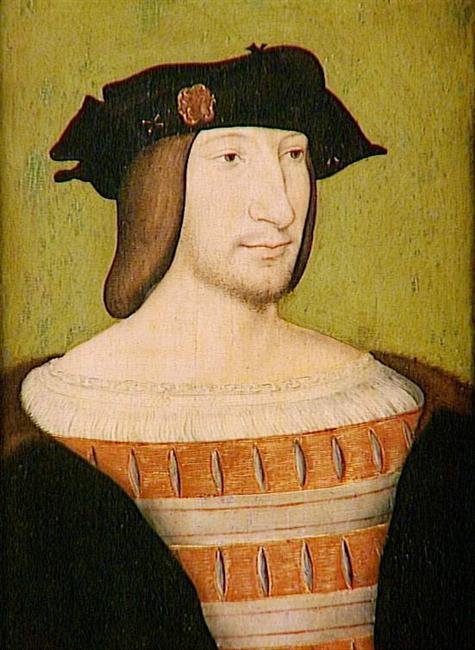
To English popular perception King Louis XII is presented as the elderly husband of Mary Tudor, who then married for love Charles Brandonm, and who, once reconciled to her brother King Henry VIII, became Duke and Duchess of Suffolk. By contrast King Francis I is one of the most easily recognised Kings of France, and recalled as a (usually)friendly rival and contemporary of King Henry VIII - the French king died only two months after him in 1547.  

There is an online biography of King Francis I here

The new king was 20 and there soon developed that rivalry over appearance and matters of style and presentation with King Henry VIII, who was three years older.

 File:François 1515.jpg

King Francis I

A portrait of 1515-20

Musée Condé Chantilly

Image: Wikipedia

King Francis I was crowned at Rheims on January 25th 1515. There is a useful online account of the history of the ceremony and its form at Coronation of the French monarch and there are some details of the regalia used in the liturgy at Crown of Charlemagne.

In the ritual of the Sacre the new King was anointed with oil from the Sainte Ampoulle - about which there is an online article here - and was vested and crowned as King of France.


The Sainte Ampoulle before it was smashed in 1793

Some fragments of the reliquary and of the oil survived and are still at Rheims

Image:Wikimedia

The Crown of Charlemagne - the Coronation Crown of France

Image: Wikipedia


Tuesday, 13 January 2015

St Hilary and St Martin


Today is the feast of St Hilary of Poitiers, the fourth century Gaulish champion of orthodoxy in respect of the Divinity of Christ.

He also was the bishop who ordained St Martin of Tours as an acolyte. In this panel from the St Martin window in the church of St Martin in York St Martin is depicted as acolyte at a Mass celebrated by St Hilary. The window dates from circa 1442, and was the gift of the vicar Robert Semer. Originally the west window of the church it was removed in 1940 and so survived the bombing of the church in 1942. In the peculiar, and to my mind, highly dubious scheme of restoration of part of the church - once a fine moid-fifteenth century building - it is now situated in the new north wall.

photo

Image: Gordon Plumb on Flickr

Marcel Proust on Cathedrals and Liturgy


With France and, in particular, attitudes to religion in that country being in so much the news, Rorate Caeli has what might be described as something of a scoop or exclusive in publishing an article written in 1904 by Marcel Proust about what seemed the likely fate of French cathedrals and churches under the impending Law of Separation, which was enacted in 1905. The article has not been available in English hitherto, but has been translated specifically for Rorate Caeli by Dr John Pepino.

Proust's fears may not have been entirely realised - though not a few great churches in France do feel like cold and dead museums these days - but he makes many telling points in his prescient and insightful article, which can be read at THE DEATH OF CATHEDRALS - and the Rites for which they were built - by Marcel Proust (first full English translation)


Monday, 12 January 2015

The Rite of Baptism


Following on from yesterday's Feast of the Baptism of Our Lord I am reproducing the text of a post on the Medieval religion discusion group about the change in practice from total immersion to pouring or sprinkling - technically described as affusion - the baptismal candidate. It came from the Rev. Gordon Plumb in answer to a query about this from another list member.

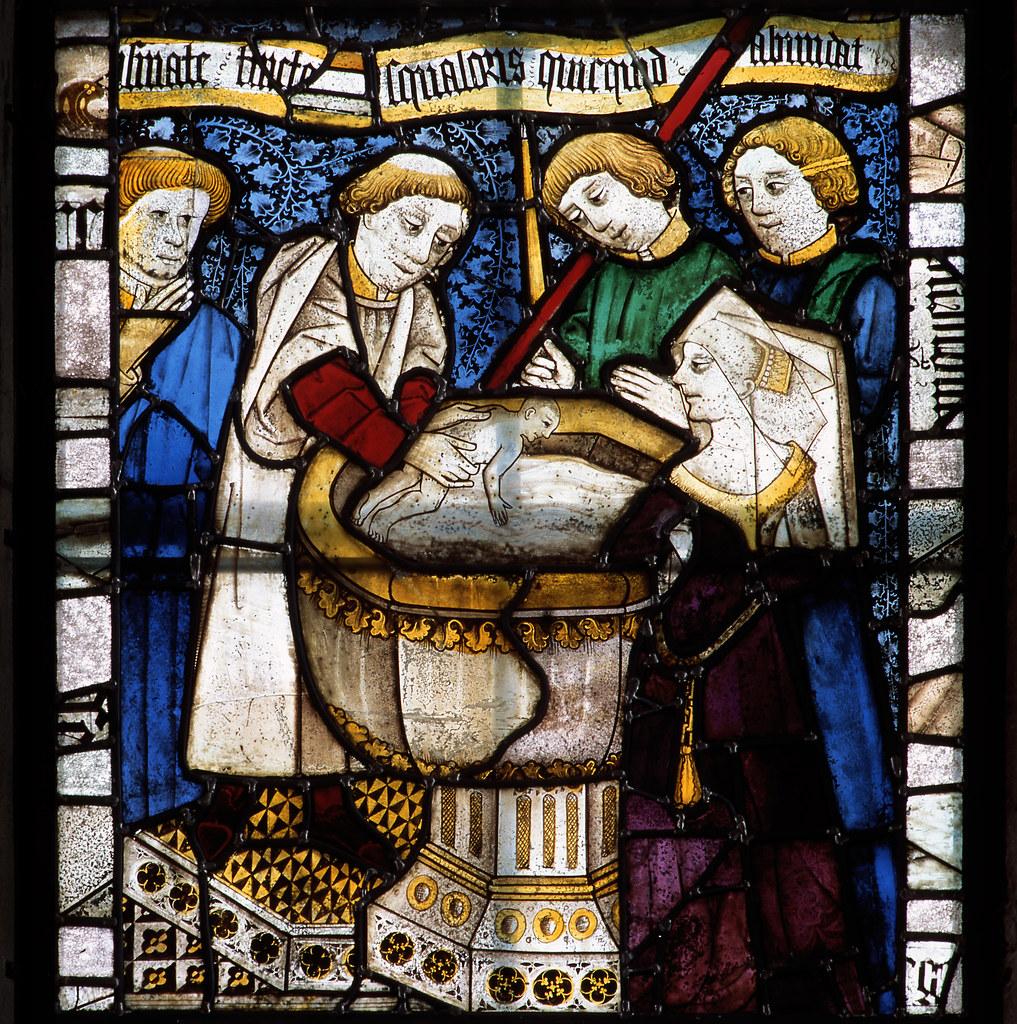
Towards the end of the Middle Ages images show that baptism of infants was by total immersion as here:

  photo

Scene of Baptism from a Seven Sacraments window painted by Richard Twygge and Thomas Wodshawe in 1482 for the collegiate church at Tattershall in Lincolnshire. 

Coming down to the font from the top right is the stream of Christ's blood, flowing originally from a central figure of Christ himself - symbolizing that all the sacraments derive their virtue from the sacrifice of Christ on the cross. Note how the priest is shown as having rolled up his surplice sleeves to avoid them getting wet during the immersion of the child!
The father is probably the figure behind the priest, and the other three figures are the sponsors or godparents. (Since the mother was unclean for 40 days after childbirth and baptism usually took place within days of birth, she was not usually present).
 
Image and comments: Gordon Plumb om Flickr

Maxwell E. John in his The Rites of Christian Initiation: their  Evolution and Interpretation, Collegeville, Minnesota, 1999 writes at page 217,

"While liturgical documents still indicated a preference for immersion or submersion, and baptismal fonts generally remained large enough to accommodate easily the immersion or submersion of infants, there does develop, in France primarily, a marked preference for pouring or sprinkling the water on the candidate during the baptismal formula. Although, as we have seen, this practice of "affusion" is also a very ancient practice in the history of baptism (see the 'Didache'), by the end of the Middle Ages it had tended to replace immersion and submersion as the common and regular practice".

It appears that affusion must have become the norm in the West sometime between the 900s and 1400s since it was never adopted as normative in the East - which still practices triple immersion of the infant, as I have witnessed in Oxford - but it is normal in most forms of Protestantism, although adult total immersion is, of course, practised by some reformed groups.


I would add that the church at Tattershall is very well worth visiting. Less well known than the spectacular brick great tower of the castle, both are the creation of Ralph Lord Cromwell, Lord Treasurer under King Henry VI.


Sunday, 11 January 2015

Another El Greco of the Baptism of Christ


Whilst revising my previous post I found a picture of another painting of the Baptism of Christ by El Greco, and thought I would share that with readers. It is extremely close in composition and details to the one in Toledo which I reproduced previously.


The Baptism of Christ
El Greco, 1597-1600
Image:museodelprado.es

Originally in the Colegio de la Encarnación in Madrid, otherwise known as that of Doña María de Aragón, de agustinos, from 1600-1813, and then in the Iglesia de San Felipe el Real y Casa de la Inquisición in the city from 1813-1835, before being moved to the Real Academia de Bellas Artes de San Fernando from 1835-1838 and the Museo de la Trinidad, 1838-1872 before going to the Prado.

Clearly El Greco and his patrons had no difficulties with him producing such similar paintings, and both are wonderful examples of his unique style. As regular readers will be aware I am a great admirer of his work, combining spectacular visual effects with his figures and colours with a remarkable spiritual insight. These are timeless - seemingly modern, yet more than four centuries old - and which lead to prayer and reflection.


The Baptism of the Lord


http://sunsite.icm.edu.pl/wm/paint/auth/greco/baptism-1608.jpg

 The Baptism of Christ
El Greco, 1608-14
Hospital of San Juan Bautista de Afuera, Toldedo
The painting was completed after the artist's death by his son Jorge Manuel

Image: sunsite:icm.edu.pl

Today is the Feast of the Baptism of the Lord, and the end of most of the formal liturgical Christmastide celebrations, barring their final conclusion at Candlemas on February 2nd.

As it is observed in the Novus Ordo the Feast, on the Sunday after Epiphany (or after the Sunday of Epiphany) dates from 1970. In the Vetus Ordo it is assigned to January 13th, the old Octave day of Epiphany, by both the 1955 and 1962 Missals, and indeed as a separate feast from the traditional threefold celebration of the manifestation of Christ at Epiphany ("Three wonders mark this day...") is a creation of Pope Pius XII in 1955. For that reason he re-used the Epiphany propers for the new festal observance he developed from it, and such an addition seems to me to fall within the range of things which can and should be legitimately added to the liturgy. This is the proper development of liturgy analogous to the proper development of doctrine.

In the Eastern Orthodox tradition the Great Theophany is celebrated as one commemoration. As Kurt Sherry pointed out on the Medieval religion discussion group the other day, the western feast of Epiphany commemorates the adoration of the Magi, which the eastern church commemorates on Christmas itself.  In the Eastern Orthodox tradition, January 6 is the feast of Theophany, which is the Baptism of Christ. The Baptism is called Theophany because it is the manifestation of the Holy Trinity (the Incarnate Son, the voice of the Father, and the Holy Spirit in the likeness of a dove). Thus, an Orthodox church named Holy Trinity should (there are some parishes that violate the "rules" and use Rublev's Trinity or one of the "heretical" depictions of "an old man, Christ, and a bird") have the Baptism of Christ in the position to the left of the Theotokos when facing the iconostasis. Another member of the list, who is Orthodox, added the point that although Pentecost is not taken to be so explicitly Trinitarian in the West, it is celebrated as THE revelation of the Trinity among the Orthodox. Theophany -- also called Epiphany in Orthodox circles -- and Transfiguration are both celebrated as Trinitarian revelations that are consummated by Pentecost.

The Eastern Fathers had much more to say, it would appear on the basis of the magisterial and exuberant texts in the Office of Readings for this week, about the Baptism than their Western counterparts. So establishing a Feast of the Baptism to point out its enormous significance and drawing direct attention to it as a distinct event rather than subsuming it in the visit of the Magi on January 6th seems right and fitting. In so doing the abolition of the Octave, by Pope Pius, was in part undone by Pope Paul.

There is a history of the feast day here.

The painting by El Greco conveys much of the exultation of Orthodox writers about the Baptism and its significance which the artist conveyed to the Catholic Counter-Reformation world in his unique vision of things heavenly and earthly bound inextricably together.


A revised and extended version of my post from this Feast last year