Once I was a clever boy learning the arts of Oxford... is a quotation from the verses written by Bishop Richard Fleming (c.1385-1431) for his tomb in Lincoln Cathedral. Fleming, the founder of Lincoln College in Oxford, is the subject of my research for a D. Phil., and, like me, a son of the West Riding. I have remarked in the past that I have a deeply meaningful on-going relationship with a dead fifteenth century bishop... it was Fleming who, in effect, enabled me to come to Oxford and to learn its arts, and for that I am immensely grateful.


Showing posts with label Bourbon dynasty. Show all posts

Saturday, 14 May 2016

Kingdom of the Two Sicilies - amending the Castro succession


The Kingdom of the Two Sicilies

Image:Wikimedia 


 I was sent the following link by a friend about the announcement by HRH the Duke of Castro that he has amended the law of succession to his claim to the throne of the Kingdom of the Two Sicilies to a system of absolute primogeniture, thus putting his two daughters in immediate succession to himself. The post can be seen at  http://royalmusingsblogspotcom.blogspot.co.uk/2016/05/duke-of-castro-adopts-gender-equal.html

As the writer points out this may well call into question the apparent moves to reconciliation two to three years ago with the other claimant branch of the Bourbon house of Two Sicilies represented by HRH the Duke of Calabria. The link to that story can be accessed at  http://royalmusingsblogspotcom.blogspot.co.uk/2014/01/royal-musing-exclusive-reconciliation.html

Looking for illustrations to add to this post I was surprised by the number of T-shirts, mugs, key-rings and suchlike that one can buy on-line with the arms of Il Regno that one can purchase online. Do Cafepress know something we don't? It it a hopeful sign for the future of the cause of the Two Sicilies?

I remeber being told by friends who had been on a motoring holiday that on a mountain road in, I think, the Abruzzi, they passed a very modern road sign proclaiming that drivers had now entered the Kingdom of the Two Sicilies.

Talking to other freinds who are from the south of Italy and indeed from the Two Sicilies, they still resent the denigration of what was in many ways a progressive realm by Italian standards in the mid-nineteenth century and the wholseale asset stripping of economic resources that followed upon unification wiith Piedmont-Sardinia. That led to the poverty of the south. Only now are people outside Italy becoming aware of how the south was an occupied zone, with Piedmontese troops in plenty for many years after 1861.

File:Coat of Arms of Princess of the Two Sicilies.svg

 Arms of a Princess of the Two Sicilies

 Image: Wikimedia 

Tough cookie, Garibaldi, as one might say.

All of which reminds me to try to get on and read Harold Acton's The Bourbons of Naples and The Later Bourbons of Naples.


Saturday, 10 May 2014

Madame Élisabeth


Madame-elisabeth-2.jpg

 Madame Élisabeth

Image:Wikipedia

Today is not only the anniversary of the death in 1774 of King Louis XV, but also of the guillotining of his grandaughter Madame Élisabeth in 1794.
There is an illustrated online account of her life here, and one from the palace of Versailles website entitled Madame Elisabeth. There is another account of her, with good illustrations, here.

The interesting blog Tea at Trianon has a post from a few years ago The Death of Madame Elisabeth of France and the Digital library Project has the memoirs of her neice Madame Royale and of Cléry, King Louis XVI's valet which can be seen at The Ruin of a Princess.

Madame Élisabeth was clearly a determined and devout woman, noted for acts of charity. Probably the most opposed of her family to the revolution's challenge to the existing system, and who, devoted to her brother the King and his wife, stayed with them at the Tuilleries and in the Temple. By not feeling she may have sought to stiffen the King's resolve in the face of the revolutionary demands. By doing so she sacrificed her life. Whilst in the Temple she looked after Madame Royale after the Queen was removed to the Conciergerie, and knew nothing of her fate until her own death.

The cuase of her beatification was introduced in 1924.


King Louis XV


Today is the 240th anniversary of the death at Versailles of King Louis XV in 1774.


King Louis XV
A portrait of 1748 by Maurice Quentin de la Tour

Image: Wikipedia

As the online biographies here and here, both with a good illustrations of portraits, suggest there is considerable discussion as to the impact of the King's long reign on the life of France and the extent to which it set the scene or created the climate for the events leading to the revolution of 1789. Inevitably some of this is merely hindsight, some of it an accurate assessment of the relative decline of French power and institutions in the eighteenth century. A consequence of the rise of modern history in the nineteenth century and the political pre-conceptions of many of its practioners in both France and Britain has been a tendencey to point the finger of blame at the personalities and events of the reign of King Louis XV, and not least the King himself. This may well be unfair in human terms, and unfair in terms of balanced historical assessment.

That the Ancien Regime needed an obverhaul was, I think, recognised by most people at the time. The problem lay more in the practicalities of doing that. Such was the structure of society that the interlocking elements, many very long established indeed, inhibited movement. in that the King and his ministers were caught, with relatively little room to manoeuvre. When, late in the reign, the Parlements were suppressed as areformist move it merely alienated the Parlementaire class, who came back with the restoration of the institutions after 1774, but now less amenable to the Crown. Reform was not completely ignored, but needed sustaining. In that respect the system failed to maintain momentum.

Whilst other European rulers did tackle problems of administrative reform, often root and branch, I suspect the French failure to do so came, in part, from complacency about what had been achieved under the King's great-grandfather, King Louis XIV. I can well imagine a complacency about French ascendency that took along time to be challenged. The Philosophes might argue for a range of things - and were indeed protected in a way by Mme de Pompadour, and hence the King, but were they merely the chattering classes of their day?

The pursuit for much of the reign - and indeed its active promotion as na image - reflected not only financial necessity but also political reality. The wars of King Louis XIV had been waged in aEurope France could expect to dominate. The French may have expectesd, despite the crise sof the last years of the old King's reign, that this would continue. However King Louis XV and his government faced new military powers who reconfigured the European scene - Britain, Prussia and Russia were major new factors to be dealt with, as wasa resurgant Austria under the Empress Maria Theresa.

That more needed to be done in the way of governmental initiatives can certainly be seen, and I suspect was, but how was an unanswered,and possibly unanswerable question short of sweeping everything away. that happened after 1789 of course, but that is not to say that was a good thing - it was n't. To blame the King hmself seems somewhat unfair. His popularity certainly fluctuated and declined in many ways as the reign progressed, but eighteenth century Kings did not expect to rule by the whims of public opinion polls. 

The King's limitations and shortcomings - not least his pursuit of female comapnsionship - may well have been a consequence of being orphaned so young, and his early accession to the throne - he was more isolated than his great-grandfather or grandson were to be as  monarch.

Maybe he needs a revisionist interpretation that looks at his life and reign in term sof his own times whilst avoiding the nostalgic temptation to eulogise or sentimentalise a lost era. Such a study might well give a more positive assessment than that which is often given of Louis the Well-beloved.


Saturday, 3 May 2014

The entry of King Louis XVIII into Paris 1814


Today is the bicentenary of the entry into his capital city of King Louis XVIII in 1814. I posted about his arrival in France in Return of the Bourbons in 1814 - post I have revised slightly by adding another image.

The Senate having offered to Crown to King Louis XVIII on April 6th, on April 12 his brother the Count of Artois, who had been in France since earlier in the year, entered Paris in state as Lieutenant General of the Realm and what the Count described as the happiest day he had known for thirty years. On April 24th King Louis travelled from Dover to Calais accompanied by other members of the Royal family.

On the 2nd of May 1814 King Louis stopped in Saint-Ouen where, under pressure from Tsar Alexander I and urged on by Talleyrand, he signed the Saint-Ouen Declaration, re-establishing the monarchy whilst recognising significant constitutional changes established under the Revolution and the Empire.There is more about the Declaration here. This can be seen as similar to the Declaration of Breda by King Charles II in 1660, and the terms in respect of land confiscated and sold during the Revolutionary regime similar to the acceptance of the sale of monastic estate sin the 1554 English return to the Roman obedience.


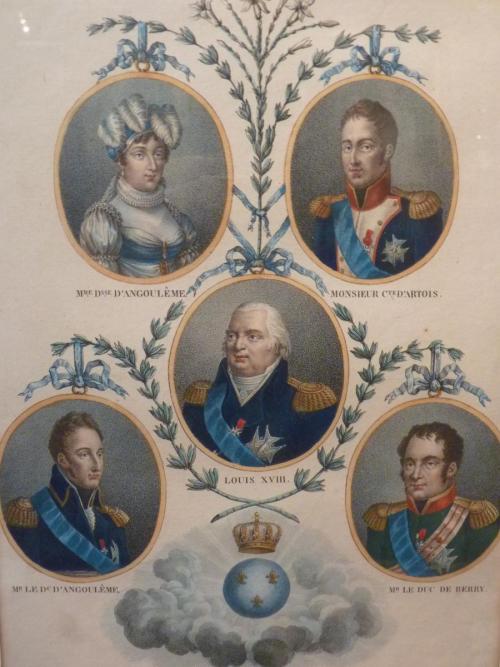
The French Royal family in 1814
King Louis XVIII in the centre, with top left Madame Royale, daughter of King Louis XVI and Queen Marie Antoinette, top right the Count of Artois, the King's brother and successor as King Charles X, and at the base his two sons, the Duke of Angoulême, husband of Madame Royale, and later King Louis XIX, and the Duke of Berry, father of King Henri V

Image: Tea at Trianon


Nicolas Joseph Vergnaux:Louis-Antoine de France 1775-1844 Duc dAngouleme, at the Barriere de Vaugirard, 1814

The Duke of Angoulême at the Barriere Vaugirard
 by Nicholas Joseph Vergnaux
Musee Carnevallet

Image:1st-art-gallery


Presentation of the Keys of Paris to King Louis XVIII at the Barriere Saint-Denis on 3rd May 1814, c.1815-20 - Henri  (after) Courvoisier-Voisin

Presentation of the keys of the city at the Barriere Saint Denis to the King
by Henri Courvoisier-Voisin

Biblioteque des Arts Decoratifs, Paris

Image:mystudios.com

Nicolas Joseph Vergnaux:Entrance of Louis XVIII 1755-1824 through the Porte Saint-Denis, 1814

Entry of the King at the Porte Saint-Denis
 by Nicholas Joseph Vergnaux
Musee Carnevallet

Image:1st-art-gallery
                                                
  
The ceremonial entry of King Louis XVIII into Paris  A detail of  Melling’s painting of the scene. Brunot's equestrian statue of King Henri IV on the Pont Neuf as seen  here replaced the seventeenth-century original that was destroyed during the Revolution.

Image:sites.google.com

Entry into Paris of Louis XVIII 1814 by French School


A contemporary French print of the entry of the King and Royal Family

Image: Bridgeman art Callery/ easyart.com

Entrée de Louis XVIII à Paris : [3 mai 1814]. 26 : [estampe] / Courvoisier del. ; Dubois sculp. - 1

The procession through the streets
Drawn by Courvoisier, engraved by Dubois 

Image: gallica.bnf.fr 

Nicolas Joseph Vergnaux:Charles-Ferdinand de France 1778-1820 Duc de Berry returning to the Tuileries through the Place Vendome, 1814

The Duke of Berry returns to the Tuilleries through the Place Vendome
 by Nicholas Joseph Vergnaux
Musee Carnevallet

Image:1st-art-gallery


When the Royal party finally arrived at the Tuilleries the emotion of the occasion was to prove too much for Madame Royale on her return to the city which had seen the murder of her parents, aunt and brother by the revolutionaries and she fainted. One can hardly be surprised considering what she had witnessed or been subjected to in the city in the years after 1789 before her release from the Temple in 1795. 

Nonetheless the Restoration had taken place. The next year witnessed the Hundred Days, but the Bourbons were to return again. Asked if the Crown was secure King Louis opined, in his mordant fashion, that if he outlived his brother it was, but if his brother outlived him he could not be sure. The pity is that there was the 1830 revolution, and no satisfactory Restoration after that  - well not so far...


File:Coat of Arms of the Bourbon Restoration (1815-30).svg

Image:Wikipedia

Vive Le Roi!


Thursday, 24 April 2014

Return of the Bourbons in 1814


File:Louis XVIII relevant la France.jpg

Allegory of the Return of the Bourbons on 24 April 1814:Louis XVIII Lifting France from Its Ruins 

A painting by Louis-Philippe Crépin at Versailles

Image:Wikipedia

Today is the two hundredth anniversary of the return of the Bourbon dynasty to France in the restoration of 1814. King Louis XVIII returned to his kingdom at Calais, entering Paris on May 3rd.

In this allegorical painting the King, robed and crowned - he was in fact never to be have a coronation at Rheims due to his physical incapacity - is shown raising a somewhat distree personification of France. He is surrounded by his relatives, with, on the left, the seated figure of Madame Royale, Marie-Thérèse, daughter of King Louis XVI and Queen Marie Antoinette, who had been married to her cousin Louis, Duc d'Angoulème, who stands beside her, and who was the elder son of the King's younger brother Count of Artois, the future King Charles X, who was acting as Lieutenant -General of the Realm in anticipation of King Louis' return.

The 'Royal Sovereign' conveying Louis XVIII to France, 24 April 1814 Fine Art Print by Nicholas Pocock

The Royal Sovereign conveying King Louis XVIII to France 24 April 1814

 Nicholas Pocock
Image; Magnolia Box

At Burton Constable Hall in Yorkshire there is a small painting of the return of the French royal family which is not an allegory but appears to be a more direct, if dramatic, representation of the return. In it the seated King Louis XVIII and Madame Royale are presented with three lilies, symbolic of the kingdom whilst still on board their ship, the Royal Sovereign. A fascinating little picture to find amongst the other treasures of that very interesting country house.


The Arrival of King Louis XVIII of France in Calais in 1814 

The Arrival of King Louis XVIII at Calais in 1814

Edward Bird (1772-1819)

Image: BBC Your Pictures


The misfortune of France, in my opinion, since 1814 is that the Restoration celebrated in these images was not to last - consolidated under King Louis XVIII, jeopardised by King Charles X and his advisors, but not such that it might not have endured it was to be followed by a whole series of constitional experiments from 1830 onwards that have done little for the country, and at times its survival has indeed been in question. It is the enduring strengths of France, and they are far older than anything set off in 1789, which have enabled it to survive, and it is those which attract me on my visits.

Vive le Roi!


Wednesday, 23 October 2013

DNA and King Henri's head


Like that of King Charles the head of King Henri IV of France keeps cropping up. My previous posts about it can be seen at King Henri's head and Uneasy lies the head.

The identification of the head as that of the first Bourbon King of France and its potential reburial at St Denis, whence it was disinterred, along with the other royal remains in 1793, is of genuine if slightly macabre interest. Such a return to St Denis would be one way of the French atoning for the sacrilege of the revolution, and King Henri remains one of their most popular monarchs 

However having been the victim of assassination, disinterment and separation from its body and turnedinto a museum object the royal head is now at the mercy of experts in DNA, as is reported in this article from the Spanish newspaper El Tempo, which a friend has kindly forwarded to me, and which can be seen here. I must warn readers that it has, rather like the royal head, suffered in the process of transmission, having been put through the Yahoo automatic translation system and coming out in particularly bad Spanglish - which is probably worse to read than battling through the original with little or no knowledge of Spanish.

Nonetheless the article is interesting. It points out how the Bourbon-Orleanist claimant to the throne of France, the Count of paris  -the de jure  King Henri VII has remained somewhat aloof from the controveries around the head, other than wishing for its honourable reburial at St Denis.  DNA tests from members of the Bourbon family, including the Queen of Romania, have established genetic identity between the head and known descendents of King Henri IV.

The article gets very confusing for the unwary when it moves on to the other claimannt to the French throne, the Duke of Anjou-Segovia, who claims as the de jure King Louis XX. When the article writes of "Queen Elizabeth II" and her husband it does not mean those whom you might think, but is a literal Anglicisation of the name of Queen Isabella II, born in 1830 and who died in 1904, having reigned as Queen of Spain from 1833 until 1868/70.

The point here is that the Anjou claim to the throne of France come sthrough that Queen's marriage to her cousin and consort King Francis, whose father was her father's younger brother. Both their parents were siblings, which affects the DNA count, but it is widely believed that none of the children borne by Queen Isabella were actually fathered by her husband (who is thought not to have been able or willing to do that sort of thing if you understand my coyness in such delicate matters), although he recognised them as his progeny.

If the Duke of Anjou-Segovia is not descended from from King Francis d'Asis and the uninterrupted male line of the Bourbons  then he would have no claim to the French throne as King Louis XX - and never mind the treaty of Utrecht's provisions about not conjoining the thrones of France and Spain. 
Hence the article's query as to whether of not the Duke would undergo DNA matching himself.

However, to complicate matters further DNA testing is not quite that simple, as is conveniently explained in the biographical article about King Francis here.