Once I was a clever boy learning the arts of Oxford... is a quotation from the verses written by Bishop Richard Fleming (c.1385-1431) for his tomb in Lincoln Cathedral. Fleming, the founder of Lincoln College in Oxford, is the subject of my research for a D. Phil., and, like me, a son of the West Riding. I have remarked in the past that I have a deeply meaningful on-going relationship with a dead fifteenth century bishop... it was Fleming who, in effect, enabled me to come to Oxford and to learn its arts, and for that I am immensely grateful.


Showing posts with label Madame Royale. Show all posts

Saturday, 10 May 2014

Madame Élisabeth


Madame-elisabeth-2.jpg

 Madame Élisabeth

Image:Wikipedia

Today is not only the anniversary of the death in 1774 of King Louis XV, but also of the guillotining of his grandaughter Madame Élisabeth in 1794.
There is an illustrated online account of her life here, and one from the palace of Versailles website entitled Madame Elisabeth. There is another account of her, with good illustrations, here.

The interesting blog Tea at Trianon has a post from a few years ago The Death of Madame Elisabeth of France and the Digital library Project has the memoirs of her neice Madame Royale and of Cléry, King Louis XVI's valet which can be seen at The Ruin of a Princess.

Madame Élisabeth was clearly a determined and devout woman, noted for acts of charity. Probably the most opposed of her family to the revolution's challenge to the existing system, and who, devoted to her brother the King and his wife, stayed with them at the Tuilleries and in the Temple. By not feeling she may have sought to stiffen the King's resolve in the face of the revolutionary demands. By doing so she sacrificed her life. Whilst in the Temple she looked after Madame Royale after the Queen was removed to the Conciergerie, and knew nothing of her fate until her own death.

The cuase of her beatification was introduced in 1924.


Saturday, 3 May 2014

The entry of King Louis XVIII into Paris 1814


Today is the bicentenary of the entry into his capital city of King Louis XVIII in 1814. I posted about his arrival in France in Return of the Bourbons in 1814 - post I have revised slightly by adding another image.

The Senate having offered to Crown to King Louis XVIII on April 6th, on April 12 his brother the Count of Artois, who had been in France since earlier in the year, entered Paris in state as Lieutenant General of the Realm and what the Count described as the happiest day he had known for thirty years. On April 24th King Louis travelled from Dover to Calais accompanied by other members of the Royal family.

On the 2nd of May 1814 King Louis stopped in Saint-Ouen where, under pressure from Tsar Alexander I and urged on by Talleyrand, he signed the Saint-Ouen Declaration, re-establishing the monarchy whilst recognising significant constitutional changes established under the Revolution and the Empire.There is more about the Declaration here. This can be seen as similar to the Declaration of Breda by King Charles II in 1660, and the terms in respect of land confiscated and sold during the Revolutionary regime similar to the acceptance of the sale of monastic estate sin the 1554 English return to the Roman obedience.


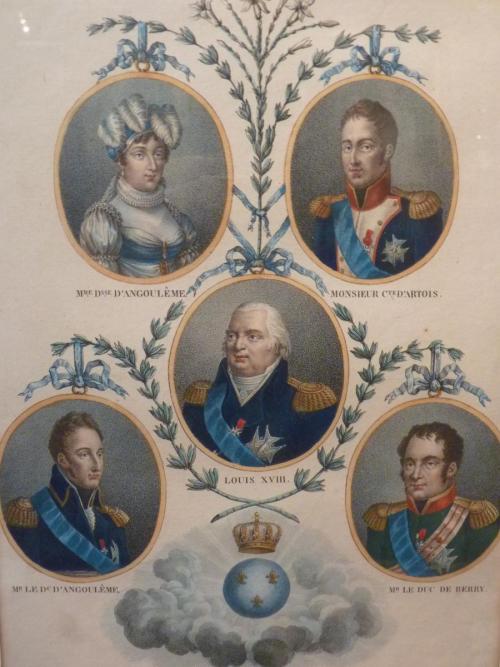
The French Royal family in 1814
King Louis XVIII in the centre, with top left Madame Royale, daughter of King Louis XVI and Queen Marie Antoinette, top right the Count of Artois, the King's brother and successor as King Charles X, and at the base his two sons, the Duke of Angoulême, husband of Madame Royale, and later King Louis XIX, and the Duke of Berry, father of King Henri V

Image: Tea at Trianon


Nicolas Joseph Vergnaux:Louis-Antoine de France 1775-1844 Duc dAngouleme, at the Barriere de Vaugirard, 1814

The Duke of Angoulême at the Barriere Vaugirard
 by Nicholas Joseph Vergnaux
Musee Carnevallet

Image:1st-art-gallery


Presentation of the Keys of Paris to King Louis XVIII at the Barriere Saint-Denis on 3rd May 1814, c.1815-20 - Henri  (after) Courvoisier-Voisin

Presentation of the keys of the city at the Barriere Saint Denis to the King
by Henri Courvoisier-Voisin

Biblioteque des Arts Decoratifs, Paris

Image:mystudios.com

Nicolas Joseph Vergnaux:Entrance of Louis XVIII 1755-1824 through the Porte Saint-Denis, 1814

Entry of the King at the Porte Saint-Denis
 by Nicholas Joseph Vergnaux
Musee Carnevallet

Image:1st-art-gallery
                                                
  
The ceremonial entry of King Louis XVIII into Paris  A detail of  Melling’s painting of the scene. Brunot's equestrian statue of King Henri IV on the Pont Neuf as seen  here replaced the seventeenth-century original that was destroyed during the Revolution.

Image:sites.google.com

Entry into Paris of Louis XVIII 1814 by French School


A contemporary French print of the entry of the King and Royal Family

Image: Bridgeman art Callery/ easyart.com

Entrée de Louis XVIII à Paris : [3 mai 1814]. 26 : [estampe] / Courvoisier del. ; Dubois sculp. - 1

The procession through the streets
Drawn by Courvoisier, engraved by Dubois 

Image: gallica.bnf.fr 

Nicolas Joseph Vergnaux:Charles-Ferdinand de France 1778-1820 Duc de Berry returning to the Tuileries through the Place Vendome, 1814

The Duke of Berry returns to the Tuilleries through the Place Vendome
 by Nicholas Joseph Vergnaux
Musee Carnevallet

Image:1st-art-gallery


When the Royal party finally arrived at the Tuilleries the emotion of the occasion was to prove too much for Madame Royale on her return to the city which had seen the murder of her parents, aunt and brother by the revolutionaries and she fainted. One can hardly be surprised considering what she had witnessed or been subjected to in the city in the years after 1789 before her release from the Temple in 1795. 

Nonetheless the Restoration had taken place. The next year witnessed the Hundred Days, but the Bourbons were to return again. Asked if the Crown was secure King Louis opined, in his mordant fashion, that if he outlived his brother it was, but if his brother outlived him he could not be sure. The pity is that there was the 1830 revolution, and no satisfactory Restoration after that  - well not so far...


File:Coat of Arms of the Bourbon Restoration (1815-30).svg

Image:Wikipedia

Vive Le Roi!


Thursday, 24 April 2014

Return of the Bourbons in 1814


File:Louis XVIII relevant la France.jpg

Allegory of the Return of the Bourbons on 24 April 1814:Louis XVIII Lifting France from Its Ruins 

A painting by Louis-Philippe Crépin at Versailles

Image:Wikipedia

Today is the two hundredth anniversary of the return of the Bourbon dynasty to France in the restoration of 1814. King Louis XVIII returned to his kingdom at Calais, entering Paris on May 3rd.

In this allegorical painting the King, robed and crowned - he was in fact never to be have a coronation at Rheims due to his physical incapacity - is shown raising a somewhat distree personification of France. He is surrounded by his relatives, with, on the left, the seated figure of Madame Royale, Marie-Thérèse, daughter of King Louis XVI and Queen Marie Antoinette, who had been married to her cousin Louis, Duc d'Angoulème, who stands beside her, and who was the elder son of the King's younger brother Count of Artois, the future King Charles X, who was acting as Lieutenant -General of the Realm in anticipation of King Louis' return.

The 'Royal Sovereign' conveying Louis XVIII to France, 24 April 1814 Fine Art Print by Nicholas Pocock

The Royal Sovereign conveying King Louis XVIII to France 24 April 1814

 Nicholas Pocock
Image; Magnolia Box

At Burton Constable Hall in Yorkshire there is a small painting of the return of the French royal family which is not an allegory but appears to be a more direct, if dramatic, representation of the return. In it the seated King Louis XVIII and Madame Royale are presented with three lilies, symbolic of the kingdom whilst still on board their ship, the Royal Sovereign. A fascinating little picture to find amongst the other treasures of that very interesting country house.


The Arrival of King Louis XVIII of France in Calais in 1814 

The Arrival of King Louis XVIII at Calais in 1814

Edward Bird (1772-1819)

Image: BBC Your Pictures


The misfortune of France, in my opinion, since 1814 is that the Restoration celebrated in these images was not to last - consolidated under King Louis XVIII, jeopardised by King Charles X and his advisors, but not such that it might not have endured it was to be followed by a whole series of constitional experiments from 1830 onwards that have done little for the country, and at times its survival has indeed been in question. It is the enduring strengths of France, and they are far older than anything set off in 1789, which have enabled it to survive, and it is those which attract me on my visits.

Vive le Roi!