Once I was a clever boy learning the arts of Oxford... is a quotation from the verses written by Bishop Richard Fleming (c.1385-1431) for his tomb in Lincoln Cathedral. Fleming, the founder of Lincoln College in Oxford, is the subject of my research for a D. Phil., and, like me, a son of the West Riding. I have remarked in the past that I have a deeply meaningful on-going relationship with a dead fifteenth century bishop... it was Fleming who, in effect, enabled me to come to Oxford and to learn its arts, and for that I am immensely grateful.


Showing posts with label King Henri VII. Show all posts

Wednesday, 10 August 2016

The French Succession


Two friends drew my attention to report in The Daily Telegraph about dissension between the Orleanist claimant to the French throne, the de jure King Henri VII, and his second son, Jean, about whether the latter should be, as his father intends, in effect, Regent for his disabled elder brother or whether as he thinks, should suceed to the headship of the House of France upon the present Head's decease. The article can be read at  http://www.telegraph.co.uk/news/2016/08/09/pretender-to-frances-non-existent-throne-embroiled-in-succession/

The situation looks rather similar to the Bavarian situation in 1913 when the new Regent, Prince Ludwig, suceeded his father Prince Luitpold as Regent for King Otto, and then assumed the throne as King Ludwig III, although King Otto lived until 1916. Only then did King Ludwig assume sole and undisputed sovereignty over the realm.


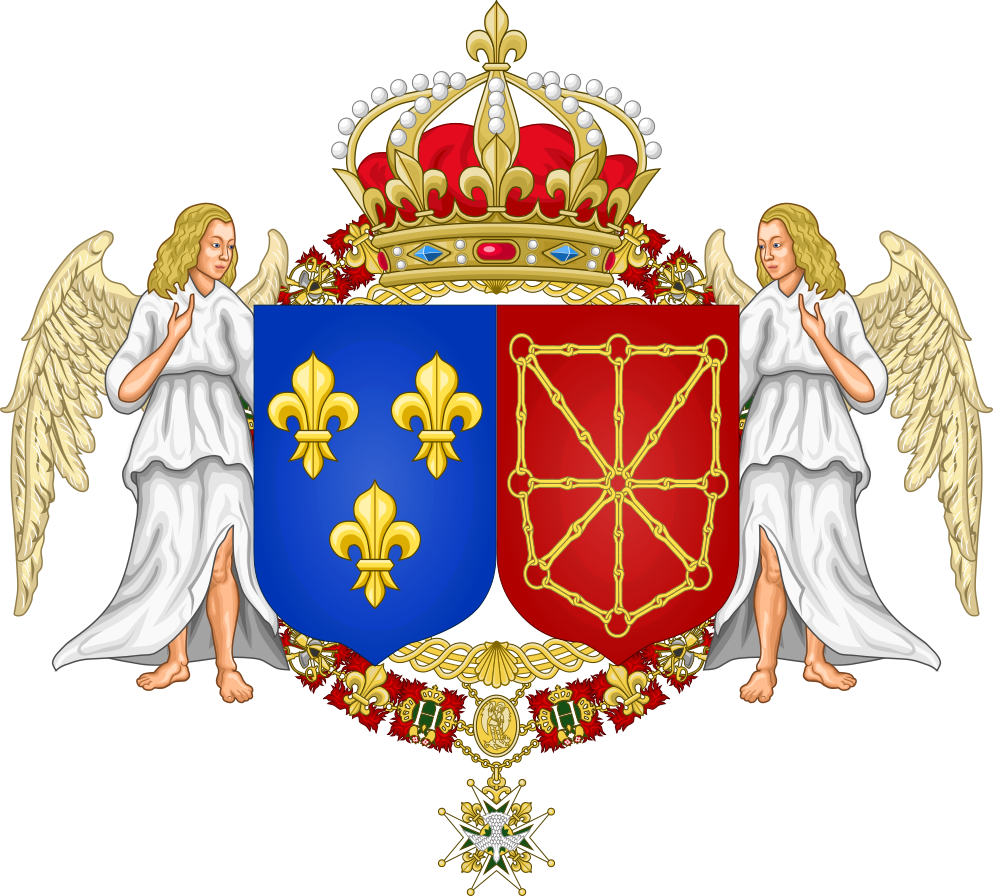
Image result for French royal arms 

Arms of the King of France and Navarre 

Image:Wikipedia


Thursday, 19 June 2014

Meanwhile in another Bourbon kingdom


In addition to today's events in Spain in another Bourbon monarchy it is also accession day. Today is the fifteenth anniversary of the accession to the position of claimant of the de jure King Henri VII of France following the death on this day in 1999 of his father the de jure King Henri VI. Better known to the world as the Count of Paris, there is an online account of the present head of the Bourbon Orleanist house here, and one of his father here.


Prince Henri Philippe Pierre Marie d'Orleans, the Count of Paris and his second wife Princess Mickaela arrive at Senlis Cathedral to attend the wedding of his son Jean de France with Philomena de Tornos on May 2, 2009 in Senlis, France. 

Image:wc.rootsweb.ancestry.com/Photo by Pascal Le Segretain/Getty Images 

The French Royal House has struggled, with varying degrees of intensity, over the legitimist issue ever since Louis Philippe took the throne, rather than acting as Regent in 1830. Given the reconciliation - however much crossing of fingers there may have - been between King Henri V and Philippe of Orleans before the former's death in 1883, the succession should be clear. The issue has not been helped by some of the tensions within the Orleanist family nor by the claims in the nineteenth century of the Carlist Spanish line or, more recently, of the Spanish Angevin Bourbon to be King Louis XX. These various claims - some of which appear tenuous or highly partisan - have not helped the French monarchist cause, and, as I have pointed out on other occasions, that is one which shows surprising resilience.

File:Coat of Arms of the Bourbon Restoration (1815-30).svg

Image:Wikipedia 

Vive Le Roi!


Thursday, 13 February 2014

News from France


Last night I had dinner with a friend who Twitters on line. One of his themes therein is French Royalism and he was flattered to find that he has recently gained a new member in his group of 3000 plus followers the Orleanist claimant to the throne, the Comte de Paris, or, as one thinks of him, King Henri VII.

This fortuitously links in with an interesting new post on Rorate Caeli which can be read at "The Reactionary Generation": traditional Catholic values sweep French politics.

The other week another friend introduced me to the blog Riposte-catholique: La réinformation catholique au quotidien. This is a collaborative effort from various contributors and highlights attacks on the Church in France and threats to Catholicism, both external, and internal through abuses of power and administration.

It  does look as though traditionalsm in various forms has quickened with the advent of a left-of- centre government and the questioning of some of the hitherto accepted principles of French political life - including the development of French Euroscepticism and the significant scale of the protests over same- sex marriage legislation there - which were, interestingly, hardly reported at all this side of the Channel. Funny that.

My own visits over the years to France always give me the sense of there being two Frances - that of the modern state and that of an older Catholic realm, by no means dead, but still alive, still breathing, and maybe, somehow,waiting. Waiting for what for may indeed be the question, but more than 200 years after the events of 1789, that older France - dare I call it an Ancien Regime? -  is more potent, more significant than many might think.

Wednesday, 23 October 2013

DNA and King Henri's head


Like that of King Charles the head of King Henri IV of France keeps cropping up. My previous posts about it can be seen at King Henri's head and Uneasy lies the head.

The identification of the head as that of the first Bourbon King of France and its potential reburial at St Denis, whence it was disinterred, along with the other royal remains in 1793, is of genuine if slightly macabre interest. Such a return to St Denis would be one way of the French atoning for the sacrilege of the revolution, and King Henri remains one of their most popular monarchs 

However having been the victim of assassination, disinterment and separation from its body and turnedinto a museum object the royal head is now at the mercy of experts in DNA, as is reported in this article from the Spanish newspaper El Tempo, which a friend has kindly forwarded to me, and which can be seen here. I must warn readers that it has, rather like the royal head, suffered in the process of transmission, having been put through the Yahoo automatic translation system and coming out in particularly bad Spanglish - which is probably worse to read than battling through the original with little or no knowledge of Spanish.

Nonetheless the article is interesting. It points out how the Bourbon-Orleanist claimant to the throne of France, the Count of paris  -the de jure  King Henri VII has remained somewhat aloof from the controveries around the head, other than wishing for its honourable reburial at St Denis.  DNA tests from members of the Bourbon family, including the Queen of Romania, have established genetic identity between the head and known descendents of King Henri IV.

The article gets very confusing for the unwary when it moves on to the other claimannt to the French throne, the Duke of Anjou-Segovia, who claims as the de jure King Louis XX. When the article writes of "Queen Elizabeth II" and her husband it does not mean those whom you might think, but is a literal Anglicisation of the name of Queen Isabella II, born in 1830 and who died in 1904, having reigned as Queen of Spain from 1833 until 1868/70.

The point here is that the Anjou claim to the throne of France come sthrough that Queen's marriage to her cousin and consort King Francis, whose father was her father's younger brother. Both their parents were siblings, which affects the DNA count, but it is widely believed that none of the children borne by Queen Isabella were actually fathered by her husband (who is thought not to have been able or willing to do that sort of thing if you understand my coyness in such delicate matters), although he recognised them as his progeny.

If the Duke of Anjou-Segovia is not descended from from King Francis d'Asis and the uninterrupted male line of the Bourbons  then he would have no claim to the French throne as King Louis XX - and never mind the treaty of Utrecht's provisions about not conjoining the thrones of France and Spain. 
Hence the article's query as to whether of not the Duke would undergo DNA matching himself.

However, to complicate matters further DNA testing is not quite that simple, as is conveniently explained in the biographical article about King Francis here.


Monday, 18 February 2013

Uneasy lies the head


Following on from my recent posts about the positive identification of the skeleton of King Richard III and about the drawing of the skull of King Richard II a German friend has pointed out to me an online article about what is thought or claimed to be the head of King Henri IV of France. The article can be viewed here

I have posted about this particular royal body part before in December 2010 in King Henri's head.


http://s3.amazonaws.com/readers/2010/12/15/henryiv_1.jpg

King Henri IV

Image: Bookstove.com

The King's body was, like that of the other Kings of France sacrilegiously disinterred from St Denis in 1793, and when it was reburied in 1817 in the abbey the head was found to be missing. This head would appear to be that of the King. From what I have read the identification looks very probable, and it is unfortunate that the matter has now been caught up in controversy over the veracity of a book about the discovery, and indeed in differing responses from the rival claimants to the French throne, who would be King Henri VII or King Louis XX. 

If it is adjudged to be in truth the head of the first Bourbon King of France then it would indeed be right and proper for it to be reburied at St Denis. Until then, like the bones of St Edward the Martyr did for so many years in this country, it remains in a bank vault.